Introduction
A rich assortment of mosses (Bryophyta) in the coastal and interior forests of the Pacific Northwest is frequented by a diversity of arthropods, including eriosomatine aphids (Hemiptera: Aphididae: Eriosomatinae). At times, these are common in Berlese funnel extractions. Melaphis rhois (Fitch) is a true moss feeding aphid (Baker Reference Baker1919; Heie Reference Heie1980; Moran Reference Moran1989; Hebert et al. Reference Hebert, Finston and Foottit1991), while others are suspected or known to be root feeders (Smith Reference Smith1969, Reference Smith1974; Stroyan Reference Stroyan1975; Danielsson Reference Danielsson1990b) feeding in whole or in part on the roots of selected conifers (Pinaceae) or willow (Salix Linnaeus (Salicaceae)) with roots intertwined at times in moss at the moss–soil interface zone. Smith and Knowlton (Reference Smith and Knowlton1975) reported finding unidentifiable pemphigines (now named as Eriosomatinae; Nieto Nafría et al. Reference Nieto Nafría, Mier Durante and Remaudière1998) in moss using Berlese funnels.
The Eriosomatinae are characterised by host alternation from a primary host (trees and shrubs) on which they form galls or pseudogalls, to various secondary hosts, usually the subterranean parts. The morphological forms (morphs) on the secondary hosts differ significantly from the forms on the primary hosts. As a result, it has been difficult to link the different parts of the life cycles without rearing and host transfer experiments. All of the aphids treated here were originally described from their gall-producing or leaf-curling forms on the primary host. In this study, the identity of the morphs on moss, or moss and fine roots (fir and spruce [Abies Miller and Picea Dietrich (Pinaceae)] and willow), or roots was confirmed by matching deoxyribonucleic acid (DNA) sequences with specimens obtained from the primary hosts. The secondary host forms of each species are characterised morphologically and an identification key is provided.
Materials and methods
Species descriptions, character measurements, and DNA sequences were based on specimens from authors’ field collections obtained through Berlese extraction of moss and roots of conifer and willow from a wide range of sites in coastal and interior forests of the Pacific Northwest, including Alaska, or from galls and pseudogalls on primary hosts from various locations in North America. Extracted aphids were preserved in ethanol, with part used for DNA analysis (namely, DNA barcodes; Foottit et al. Reference Foottit, Maw, von Dohlen and Hebert2008) to confirm species identification, and part used for permanent slide mount preservation. Voucher specimens for morphological characterisation were cleared and slide mounted in Canada balsam following methods by Foottit and Maw (Reference Foottit and Maw2000) and deposited in Washington State University (WSU) Aphid Collection, Prosser, Washington, United States of America unless otherwise indicated. Descriptive nomenclature is after Foottit and Richards (Reference Foottit and Richards1993) and Pike et al. (Reference Pike, Boydston and Allison2003). Full synonymies for aphids studied are available from Remaudière and Remaudière (Reference Remaudière and Remaudière1997). Plant names are after the United States Department of Natural Resources Conservation Service plant profiles (USDA 2009); full moss names with authors are shown in Table 1.
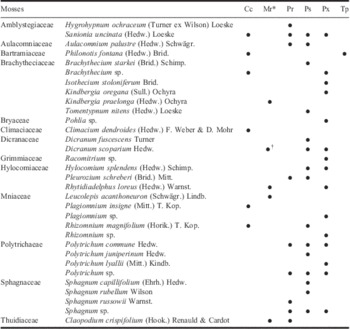
Aphid eriosomatine associations with moss in the Pacific Northwest including Alaska (based on Berlese funnel extractions) for Clydesmithia canadensis (Cc), Melaphis rhois (Mr), Pachypappa rosettei (Pr), Pachypappa sacculi (Ps), Prociphilus xylostei (Px), and Thecabius populimonilis (Tp).

*Associations reported in Europe (Holman Reference Holman2009): M. rhois – Eurhynchium striatum (Schreb. ex Hedw.) Schimp. (Brachytheciaceae), Hylocomium armoricum Wijk & Marg., Hypnum sp. (Hypnaceae), P. commune, and Sphagnum sp.; in Arizona (Moran Reference Moran1989) – Haplocladium microphyllum (Hedw.) Broth. (Thuidiaceae).
†Large numbers of M. rhois extracted; possible preferred moss or moss habitat (moss on coastal sands intermixed with dune grasses, adjacent to or under lodgepole pine or spruce).
The following abbreviations are used in collection records: ap, aptera vivipara; Boro., Borough; CG, campground; Co., county; coll., collector; Cr, creek; E, east; ex, eriosomatines extracted or taken from; FR, forest road; Hwy, highway; im, immature; jct, junction; Lk, lake; mi, mile or miles; Mtns, mountains; Pk, park; N, north; NP, national park; nr, near; S, south; SP, state park; W, west. Identifying letters in authors’ collection codes (e.g., A1A108): A# = year (i.e., A1 = 2001, A2 = 2002, etc.); centre letter indicates collector, A, A. Pantoja, A. Hagerty, and S. Emmert; G, G. Graf; K, K. Pike; 108, sample number. Anatomical and other descriptive abbreviations are as follows: ABD, abdomen or abdominal; ANT, antenna; ASI, II, etc., antennal segment I, II, etc.; B, basal length of ultimate antennal segment (part up to and including primary rhinarium); Htbs, metatibia apical seta; Htars, metatarsus I apical seta; L/W, length/width; PT, processus terminalis of ultimate antennal segment (i.e., part beyond primary rhinarium); 2° RHIN, antennal secondary rhinaria; URS, ultimate rostral segment (penultimate and ultimate segments).
Illustrations were drawn from images taken with a DEC13M digital eyepiece camera through a Zeiss Axiolab compound microscope (model 450907) (Carl Zeiss, Göttingen and Jena, Germany); morphological measurements (all recorded in millimetres, with segment length measured unless otherwise indicated) and character ratios are derived using image-measuring software (Pike et al. Reference Pike, Foottit, Miller, Idechiil and Allison2005).
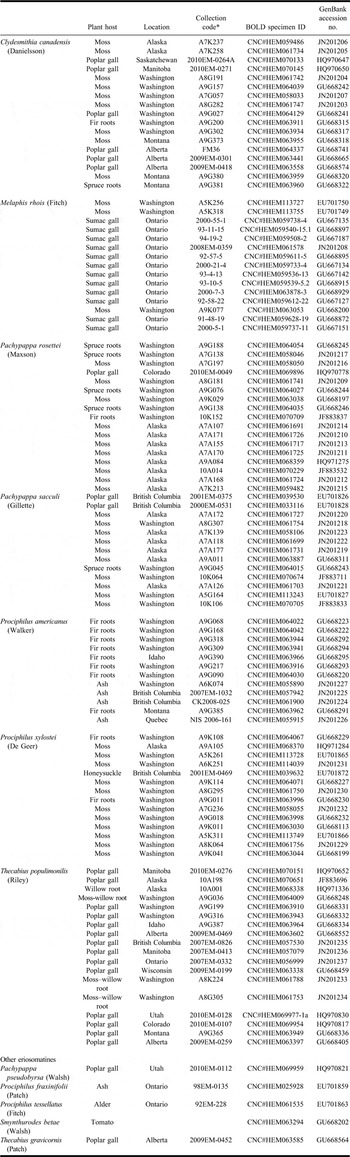
Sequence data for mitochondrial cytochrome c oxidase subunit I (COI), 5′ end (“DNA barcoding” region) of exemplar specimens (Table 2) selected from authors’ collections were compared to provide an indication of molecular coherence and distinctness of species. A few sequences of related aphids were included for comparison purposes. Details on primers and specimen processing follow Foottit et al. (Reference Foottit, Maw, von Dohlen and Hebert2008). Information on sequences, collections, and taxonomy for each specimen was entered in the Barcode of Life Data System (Ratnasingham and Hebert Reference Ratnasingham and Hebert2007). All sequences obtained in this study were deposited in GenBank (Table 2). Where available, voucher specimens from the same collection sequenced are deposited in WSU or the Canadian National Collection (CNC) of Insects, Arachnids and Nematodes (Agriculture and Agri-Food Canada, Ottawa, Ontario).
Material used for deoxyribonucleic acid (mitochondrial cytochrome c oxidase subunit 1) sequence comparisons.

Note: Full collection data for all samples available on the BOLD System (http://www.boldsystems.org; ‘published projects’ link, in projects RDBA and RFKPE); sequence data available on BOLD as well as on GenBank.
*Collection codes for the moss–root inhabiting eriosomatines correspond to collection numbers in specimens examined sections listed in the text. Other collections from ash, honeysuckle, poplar, and sumac are standards (confirmed species) for comparative species sequence match evaluation.
BOLD, Barcode of Life Data.
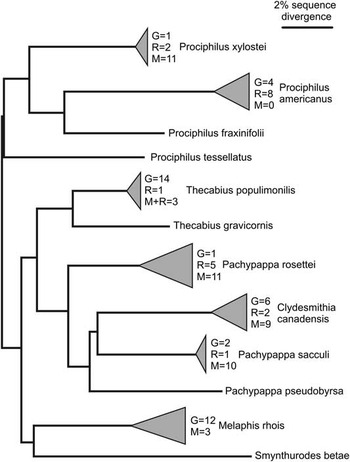
Pairwise nucleotide sequence divergences were calculated using the Kimura two-parameter model of base substitution (Kimura Reference Kimura1980) and neighbour-joining analysis (Saitou and Nei Reference Saitou and Nei1987) was used to examine relationships among taxa and population samples. Although distance calculations are based on a particular evolutionary model, the neighbour-joining tree presented is intended as a graphical representation of phenetic sequence divergences among samples and should not be interpreted as a phylogenetic hypothesis.
Results
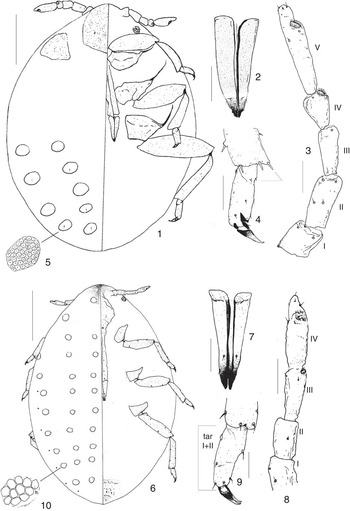
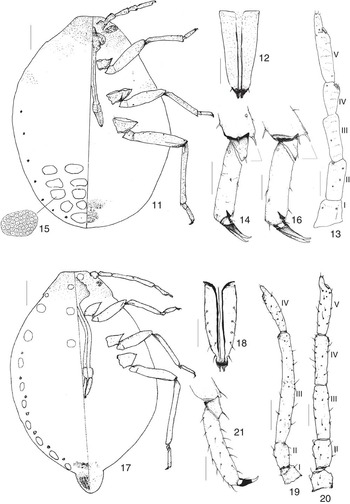
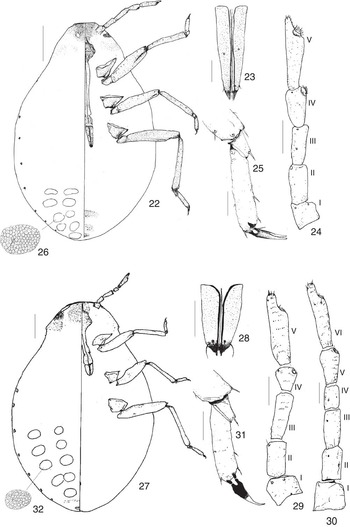
Specimens obtained during the course of this study were identified as belonging to the following species: Clydesmithia canadensis Danielsson, M. rhois (Fitch), Pachypappa rosettei (Maxson), Pachypappa sacculi (Gillette), Prociphilus americanus (Walker), Prociphilus xylostei (De Geer), and Thecabius populimonilis (Riley) (Figs. 1–32). Associations of aphid species with moss species are summarised in Table 1.
Eriosomatinae (aptera vivipara) of moss and/or roots of fir or spruce. 1–5, Clydesmithia canadensis: 1, adult; 2, ultimate rostral segment; 3, antennal segments I–V; 4, metatarsus and apex of tibia (lines point to size differences in setae on tarsus I and apex of tibia); 5, wax gland plate. 6–10, Melaphis rhois: 6, adult; 7, ultimate rostral segment; 8, antennal segments I–IV; 9, metatarsus and apex of tibia (tarsus I and II fused); 10, wax gland plate. Scale bars: 0.20 mm for Figures 1, 6; 0.05 mm for Figures 3, 4; 0.03 mm for Figures 2, 7, 8, 9.

Eriosomatinae (aptera vivipara) of moss and/or roots of fir or spruce. 11–15, Pachypappa sacculi: 11, adult; 12, ultimate rostral segment; 13, antennal segments I–V; 14, metatarsus and apex of tibia (lines point to size differences in setae on tarsus I and apex of tibia); 15, wax gland plate. 16, Pachypappa rosettei, metatarsus. 17–21, Prociphilus americanus: 17, adult; 18, ultimate rostral segment; 19–20, antennal segments showing variation in number; 21 metatarsus. Scale bars: 0.20 mm for Figures 11, 17; 0.10 mm for Figures 19, 20; 0.05 mm for Figures 12, 13, 18, 21; 0.03 mm for Figures 14, 16.

Eriosomatinae (aptera vivipara) of moss and/or roots of fir, spruce or willow. 22–26, Prociphilus xylostei: 22, adult; 23, ultimate rostral segment; 24, antennal segments I–V; 25, metatarsus and apex of tibia; 26, wax gland plate. 27–32, Thecabius populimonilis: 27, adult; 28, ultimate rostral segment; 29–30, antennal segments showing variation in number; 31, metatarsus and apex of tibia; 32, wax gland plate. Scale bars: 0.20 mm for Figures 22, 27; 0.05 mm for Figures 24, 28, 29, 30, 31; 0.03 mm for Figures 23, 25.

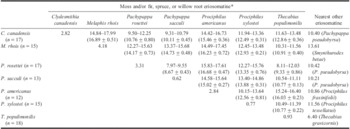
COI sequences for each species formed distinct clusters well separated from other species, with the moss/root forms falling within the clusters defined by the corresponding primary host forms (Fig. 33). Values for sequence divergences within and between clusters are given in Table 3. Maximum within-species sequence divergence was 4.18% while the minimum sequence divergence among clusters was 6.40%.
Simplified neighbour-joining tree of cytochrome c oxidase subunit I sequence divergences among samples. Terminal clusters corresponding to species are represented by an enveloping triangle, with internal structure omitted. G = number of samples from galls or pseudogalls on primary host; R = number of samples from roots of secondary host; M = number of samples extracted from moss; M + R = number of samples from a mixture of moss and roots.

Summary of pairwise distances (percent difference in mitochondrial cytochrome c oxidase subunit 1 sequences) between moss–root eriosomatine species (above the diagonal), maximum observed within-species divergence (on the diagonal), and minimum observed distances between sampled eriosomatines and nearest other eriosomatine species (right-hand column).

Note: Between-species values are given as the range, followed by the mean ± standard deviation in parentheses for all pairwise comparisons of the main studied eriosomatines.
*Includes representative primary host morphs in sequence divergence distance determinations.
The secondary host forms of C. canadensis and T. populimonilis are described here for the first time.
Clydesmithia canadensis (Danielsson, 1990)
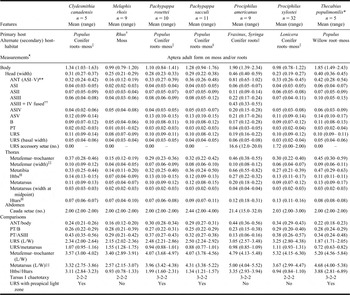
Host/habitat and morphological measurements (mm) and comparisons of adult aptera viviparae of Clydesmithia, Melaphis, Pachypappa, Prociphilus, and Thecabius associated with mosses and/or roots of conifer or willow in the interior and coastal forests of the Pacific Northwest.

*Measurments and comparisons based on morphs with five-segmented antennae.
†Known on Rhus in eastern North America and Arizona, but strictly anholocyclic on moss in Europe and the Pacific Northwest.
‡Abies grandis (Douglas ex D. Don) Lindl. – grand fir and Picea engelmannii Parry ex Engelm. – Engelmann spruce.
§Picea engelmannii Parry ex Engelm. – Engelmann spruce.
∥A. grandis (Douglas ex D. Don) Lindl. – grand fir.
¶Segment lengths measured, unless otherwise indicated.
**M. rhois ASI–IV.
††P. americanus ASIII–IV often fused.
‡‡Measured at widest point.
§§Measurements are length in mm × 10.
∥∥Melaphis measurements based on single tarsomere present; other genera based on tarsomere II.
ANT, antenna; AS, antennal segment; B, base ultimate antennal segment; PT, processus terminalis; URS, ultimate rostral segment; Htbs, metatibial apical seta; Htars, metatarsus I seta; L/W, length/width.
Specimens examined
ex moss (new habitat association) (moss sometimes with fine conifer roots intertwined)
Aptera viviparae and immatures: UNITED STATES OF AMERICA (new distribution records).Alaska: Matanuska Susitna Boro., nr Wasilla-Palmer, Old Glen Hwy, 6-viii-2007, ex Climacium dendroides (Hedw.) F. Weber & D. Mohr (Climaciaceae) (1ap – A7K237); Municipality of Anchorage, nr Portage Glacier, 8-viii-2007, ex Rhizomnium magnifolium (Horik.) T. Kop. (Mniaceae) and Sanionia uncinata (Hedw.) Loeske (Amblystegiaceae) (4im, barcode verified – A7K258); Montana: Mineral Co., I-90 Saltese exit, 12-viii-2009, ex moss (no mounts, barcode verified – A9G380); Washington: Kittitas Co., Manastash Cr Rd, 9-viii-2005, ex moss (1ap – A5G139) and 19-vii-2007, ex Philonotis fontana (Hedw.) Brid. (Bartramiaceae) (2im, barcode verified – A7G057) and 11-ix-2008, ex moss mix P. fontana and Brachythecium sp. (Brachytheciaceae) (2im, barcode verified – A8G283); Klickitat Co., Trout Lake-Glenwood Rd, 11-viii-2008, ex mixed moss Plagiomnium insigne (Mitt.) T. Kop. (Mniaceae) and Brachythecium sp. (2im, barcode verified – A8G191); Skamania Co., nr Trout Lake, FR30 past berry field E of FR24 jct, 25-vi-2009, ex moss (no mounts, barcode verified – A9G157); Yakima Co., South Fork Athanum, FR A1000, 28-vii-2009, ex moss (2ap – A9G302).
ex roots of fir, Abies and spruce, Picea (new host records)
Aptera viviparae and immatures: UNITED STATES OF AMERICA.Montana: Mineral Co., I-90 Saltese exit, 12-viii-2009, ex Picea engelmannii Parry ex Engelm (1ap, 1im – A9G381); Washington: Kittitas Co., Teanaway River Rd, 14-vii-2009, ex roots of Abies grandis (Douglas ex D. Don) Lindl. (1im, barcode verified – A9G200).
Diagnosis
Clydesmithia canadensis apterae from moss and/or conifer roots are distinguished from other moss or root feeding eriosomatines by a combination of features, namely anal plate not protruding (P. americanus with conspicuously protruding anal plate); URS with preapical light zone (M. rhois and Prociphilus spp. without a preapical light zone); tarsus I chaetotaxy 2-2-2 (Pachypappa spp., P. americanus, and T. populimonilis 3-2-2); ANT with five antennal segments (M. rhois with four antennal segments; P. americanus with four to five antennal segments; T. populimonilis with five to six antennal segments).
Description
Aptera vivipara (Figs. 1–5): Body oval, pale. Anterior upper portion of the head, antennae, coxae, femora, tibia, tarsi, rostrum, cauda, genital, and anal plates light brown to brown. Setae sparse, very short, and inconspicuous on body and antennae. Dorsum smooth, with indistinctly visible dorsal wax glands (see Figs. 1 and 5, for relative size, form, number, and distribution). Body length 1.03–1.63 mm; head width across eye 0.27–0.37 mm; ANT with five antennal segments, short 0.21–0.26× body, and without 2° RHIN; ASV longer than other individual segments; PT short, 0.22–0.29× B; rostrum extending to metacoxae; URS length 2.00–2.64× width, with a subapical pale zone (Fig. 2), and without accessory setae; tibial setae at apices stout, length >2× tarsus I setae (Fig. 4); tarsus I chaetotaxy 2-2-2; caudal setae 2. For a full range of morphological measurements and comparisons, see Table 4.
Natural history and distribution
The aphid is recognised from Alaska, Idaho, Montana, Washington, and Canada (Alberta, British Columbia, Manitoba, and Saskatchewan) on black cottonwood (Populus balsamifera trichocarpa (Torr. & A. Gray) Brayshaw (Salicaceae), primary host with sexual phase; Danielsson Reference Danielsson1990a) where it produces linear galls on leaves. Its secondary host habitats include moss and/or roots of fir (A. grandis (Douglas ex D. Don) Lindl.; Pinaceae) or spruce (P. engelmannii Parry ex Engelm.; Pinaceae), and black cottonwood (Aoki et al. Reference Aoki, von Dohlen, Kurosu and Ishikawa1997). Sexuparae (winged migrants) are thought to return to Populus in late summer-early fall, with some anholocyclic populations possibly remaining on roots or in the moss–root substrata through the winter.
Melaphis rhois (Fitch, Reference Fitch1866)
Specimens examined
ex moss (new host species associations)
Aptera viviparae and immatures: UNITED STATES OF AMERICA.Washington (new distribution records): Clallam Co., Olympic NP, Ozette Lk, Swan Bay, 19-ix-2002 (3im – A2K236); Jefferson Co., Olympic NP, Hoh Rain Forest, 11-viii-2002, (1ap, 1im – A2K113); nr Kalaloch, Beach 3, 13-xii-2005, (1im, barcode verified – A5K256); and nr Quinault River, N Shore Rd, 15-xii-2005 (1ap, 6im – A5K318), 5-vi-2008, ex Rhytidiadelphus loreus (Hedw.) Warnst. (Hylocomiaceae) (1im – A8K103) and a mix of Leucolepis acanthoneuron (Schwägr.) Lindb. (Mniaceae), Claopodium crispifolium (Hook.) Renauld & Cardot (Thuidiaceae) and Kindbergia praelonga (Hedw.) Ochyra (Brachytheciaceae) (1ap – A8K106); Pacific Co., nr Loomis SP, ex Dicranum scoparium Hedw. (Dicranaceae), 9-iv-2009, coll. K. and L. Pike (2ap – A9K080); nr Pacific Pines SP, 9-iv-2009, ex D. scoparium, coll. K. and L. Pike (21ap – A9K077, part deposited in CNC, UAF, USU, and WSU); Skagit Co., 3.6 mi from Hwy 20 on Baker Lk Rd, 24-ii-2005 (1ap, 20im – A5K009-10).
Diagnosis
Apterae are most easily distinguished from other moss-frequenting eriosomatines by differences in the number of tarsomeres (M. rhois one tarsomere versus two tarsomeres [C. canadensis tarsomeres often semi-fused]), antennal segments (M. rhois four antennal segments versus five to six antennal segments [P. americanus sometimes with four antennal segments, but then tarsi always with two tarsomeres]), and differences in the number, style, and arrangement of dorsal wax gland plates.
Description
Aptera vivipara (Figs. 6–10): Body oval, pale. Anterior upper portion of head, antennae, coxae, femora, tibia, tarsi, and rostrum light brown. Cauda, genital, and anal plates pale to slightly brown. Setae sparse, short, and inconspicuous on body and antennae. Dorsum smooth, with indistinctly visible multifaceted wax gland plates (see Figs. 6 and 10, for relative size, form, number, and arrangement). Body length 0.79–1.20 mm; head width across eye 0.21–0.29 mm; ANT with four antennal segments (rarely with five antennal segments), short 0.12–0.20× body, and without 2° RHIN; ASIV longer than other individual segments; PT short, about 0.28× B (range 0.21–0.39× B); rostrum extending to near metacoxae; URS length 2.02–2.36× width; legs short, tarsi with one tarsomere; caudal setae 2. For a full range of morphological measurements and comparisons, see Table 4.
Natural history and distribution
This aphid species is known from the central and eastern United States (Smith and Parron Reference Smith and Parron1978), eastern Canada (Smith and Parron Reference Smith and Parron1978; Hebert et al. Reference Hebert, Finston and Foottit1991), and Arizona (Moran Reference Moran1989), alternating between sumac, Rhus Linnaeus spp. (Anacardiaceae) (primary host with sexual phase) and moss, and from northwestern United States (Washington) as anholocyclic monoecious populations on moss. Outside of North America, M. rhois is known from Europe, but without heteroecy, feeding only on moss (Heie Reference Heie1980). Its discovery in Washington State is new, collected from mosses in rainforests near Mt. Baker, the Olympic National Park, and from sandy coastal sites on Washington's Long Beach Peninsula.
Pachypappa rosettei (Maxson, Reference Maxson1934)
Specimens examined
ex moss (new habitat association) (moss sometimes with fine conifer roots intertwined)
Aptera viviparae and immatures: UNITED STATES OF AMERICA. Alaska(new distribution records) (mosses sampled mainly from spruce forest habitat (Picea glauca (Moench) Voss and Picea mariana (Mill.) Britton, Sterns & Poggenb.): Denali Boro., nr Cantwell, 4-viii-2007, ex Pleurozium schreiberi (Brid.) Mitt. (Hylocomiaceae) (2ap – A7K213); Fairbanks North Star Boro., Fairbanks, Spinach Cr Rd, 10-viii-2007 (4ap – A7K101, 104, 105, 107, 108), and ex mixed Polytrichum (Polytrichaeae) and Sphagnum (Sphagnaceae) (5ap, 1im – A7K150, 151, 152, 153, 154, 155); Juneau Boro., Juneau, Dredge Lake Rd, Pond Area A, 22-viii-2007 (no mounts, barcode verified – A7A211); Yukon-Kuyokuk Boro., Greyling Lake, 16-viii-2007, ex mixed Polytrichum commune Hedw. and Sphagnum russowii Warnst. (12ap – A7A170, part in CNC, UAF, and USU) and ex Pleurozium schreberi (no mounts, barcode verified – A7A171). Washington (mosses sampled mainly in spruce forest habitat (Picea spp.): Clallam Co., Olympic NP, Sol Duc River, ∼2 mi SE of Sol Duc Hot Springs, 3-viii-2005 (3ap – A5K123); Kittitas Co., Manastash Rd and Lost Lk Trailhead, 11-ix-2008, ex S. uncinata (2im – A8G295); Pacific Co., nr Ilwaco, 8-iv-2009, ex C. crispifolium (2im, barcode verified – A9K029); Yakima Co., Bethel Ridge, FR1500, 1 mi N of Cash Prairie Jct, 6-viii-2008, ex Aulacomnium palustre (Hedw.) Schwägr. (Aulacomniaceae) (no mounts, barcode verified – A8G181); FR 82 bridge across Bird Cr, 16-viii-2007, ex Hygrohypnum ochraceum (Turner ex Wilson) Loeske (Amblystegiaceae) (no mounts, barcode verified – A7G197); 5 mi N of Clear Lk, 27-vi-2007 (2ap – A7K108).
ex conifer roots, Picea engelmannii and Abies.
Aptera vivipara: UNITED STATES OF AMERICA.Washington: Skamania Co., nr Trout Lake, FR6621, between Goose Lk and South Prairie, 25-vi-2009, ex P. engelmannii (3ap – A9G138) and Pseudotsuga menziesii (Mirb.) Franco (Pinaceae) (probably errant on host, no mounts, barcode verified – A9G139); Yakima Co., Bethel Ridge, FR1500, 0.5 mi from Cash Prairie Jct, 8-vii-2009, ex P. engelmannii (3ap – A9G188); nr Clear Lk, N Fork Tieton Rd, 22-vi-2009, ex P. engelmannii (3ap – A9G076); Morse Cr, 10-ix-2010, ex Abies sp. (no mounts, barcode verified, 2im – 10K152).
Diagnosis
Pachypappa rosettei is nearly identical morphologically to P. sacculi but can be distinguished by a difference in length comparison of specific setae, that is, metatibia apical seta/metatarsus I seta (P. rosettei = 1.99 [range 1.60–2.31]; P. sacculi = 1.34 [range 1.21–1.57]). See key below to separate P. rosettei from other eriosomatines in moss or on conifer or willow roots.
Description
Aptera vivipara: Body oval, pale. Anterior upper portion of the head, antennae, coxae, femora, tibia, tarsi, and rostrum brown. Cauda, genital, and anal plates light brown. Setae sparse, very short, and inconspicuous on body and antennae. Dorsum smooth, with indistinctly visible dorsal wax glands (see Fig. 11, for relative size, form, number, and distribution). Body length 0.84–1.41 mm; head width across eye 0.23–0.33 mm; ANT with five antennal segments, short 0.28–0.34× body, and without 2° RHIN; ASV longer than other individual segments; PT short, 0.22–0.31× B; rostrum extending to metacoxae; URS length 2.21–2.86× width, with a subapical pale zone and without accessory setae; tibial setae at apices stout, length 1.60–2.31× tarsus I setae (Fig. 16); tarsus I chaetotaxy 3-2-2; caudal setae 2–4. For a full range of morphological measurements and comparisons, see Table 4.
Natural history and distribution
The aphid is recognised from Canada and the western United States on aspen (Populus tremuloides Michx. (Salicaceae) primary host with sexual phase) (Danielsson Reference Danielsson1990b; Blackman and Eastop Reference Blackman and Eastop1994), host alternating to roots of Picea spp., with the roots commonly entwined in moss on the forest floor. The habitat is typically moist or semi-moist and shaded. Based on Berlese extractions, P. rosettei uses roots of P. engelmannii, P. mariana (Mill.) Britton, Sterns & Poggenb., Picea sitchensis (Bong.) Carrière in the Alaska–Washington region, and probably other Picea spp. when present, Abies, and possibly P. menziesii (Danielsson Reference Danielsson1990b). Sexuparae (winged migrants) return to aspen in mid-August to October, but also anholocyclic populations remain on roots of Picea (or Picea and moss) through the winter as manifested by P. rosettei presence on roots in the spring (aphid found in moss in April, see A9K029).
Pachypappa sacculi (Gillette, Reference Gillette1914)
Specimens examined
ex moss (new habitat association) (moss sometimes with fine conifer roots intertwined)
Aptera viviparae and immatures: UNITED STATES OF AMERICA.Alaska (mosses sampled mainly from spruce forest habitat [P. glauca and P. mariana]): Fairbanks North Star Boro., Calypso Farm, 30-vii-2007, ex Sphagnum capillifolium (Ehrh.) Hedw. (Sphagnaceae) (1im – A7K139), Chena Hot Springs Rd, 1-viii-2007, ex P. schreberi (1im, barcode verified – A7K168, A7K174), Hylocomium splendens (Hedw.) Schimp. (Hylocomiaceae) (4ap – A7A170, part in UAF), 1-vi-2009, coll. R. Pampell (no mounts, barcode verified – A9A002), 30-vi-2009, coll. R. Ranft (no mounts, barcode verified – A9A011), 27-vii-2009, coll. R. Pampell (no mounts, barcode verified – A9A032) and ex P. commune, coll. D. Fleming (no mounts, barcode verified – A9A038); Fairbanks, 31-viii-2007, ex Polytrichum juniperinum Hedw. (1ap – A7K162) and A. palustre (3ap – A7K165); Spinach Cr Rd, 10-viii-2007 (2ap – A7A103, A7A152-2), and ex Polytrichum sp. and Sphagnum sp. (1ap – A7A153), Rosie Cr Farm; 18-vi-2007, ex mixed Dicranum fuscuscens Turner (Dicranaceae), P. schreberi, Ptilidium pulcherrimum (Weber) Vain. (liverwort) (Ptilidiaceae), and S. uncinata (1ap – A7A134); Juneau Boro, Dredge Lk Rd, 22-viii-2007 (1ap, 1im – A7A126-127); North Slope Boro., N of pass, 15-viii-2007, ex Tomentypnum nitens (Hedw.) Loeske (Brachytheciaceae) (no mounts, barcode verified – A7A118); Yukon-Kuyokuk Boro., Dalton Hwy, 16-viii-2007, ex H. splendens (no mounts, barcode verified – A7A176) and P. commune (1ap – A7A177); Elliott Hwy, nr mi marker 71, 22-vi-2009, coll. R. Ranft (2ap – A9A030); Greyling Lake nr Dalton Hwy, 16-viii-2007, ex D. fuscuscens (no mounts, barcode verified – A7A174), and Sphagnum rubellum Wilson and P. schreberi (2ap – A7A172); Rd to Nolan, 14-viii-2007, ex T. nitens (2im, barcode verified – A7A111); Washington (mosses sampled mainly from spruce forest habitat [P. engelmannii or P. sitchensis (Bong.) Carrière]): Jefferson Co., Olympic NP, Queets River Rd, ∼8 mi NE of Hwy 101, 14-xii-2005 (1ap, 1im – A5K268), 22-vi-2006 (1ap – A6K158), and ∼5 mi NE of Lk Quinault on North Shore Rd, 21-iii-2006, ex Polytrichum (1ap – A6K026); Kittitas Co., FR112 1 mi from Manastash Rd, 10-ix-2002 (8ap, 1im – A2G313, part in CNC, UAF, USU), Lost Lk Trailhead, 10-ix-2002 (1ap, 1im – A2G310), ex Polytrichum (3ap, 2im – A2G311), and ex moss sampled from under A. grandis (2ap – A9K114), Tamarack Springs Rd, 11-ix-2008 (no mounts, barcode verified – A8G307); Lewis Co., 1 mi W of White Pass, 13-ix-2010, ex moss (no mounts, barcode verified – 10K106); Pacific Co., nr Loomis SP ex D. scoparium, coll. K. and L. Pike (2ap – A9K080); Skamania Co., nr Big Mosquito Lk, FR 24, 2.5 mi S of FR 8851, ex Polytrichum, 30-viii-2005 (3ap – A5G164) and 12-ix-2005 (2ap – A5G215), South Prairie, 1-ix-2010, ex moss (no mounts, barcode verified – 10K064); Yakima Co., Morse Cr Rd, 4-ix-2007, ex Brachythecium starkei (Brid.) Schimp. (1ap – A7G251); N Fork Tieton River, FR 1207, 22-vii-2008, ex R. magnifolium (1ap – A8G083).
ex Picea roots only (no moss)
Aptera viviparae: UNITED STATES OF AMERICA.Washington: Kittitas Co., Manastash Rd and Lost Lk Trailhead, 3-vi-2009, ex P. engelmannii (3ap – A9K109) and 16-vi-2009, coll. G. & D. Graf (no mounts, barcode verified – A9G045).
Diagnosis
Secondary host forms of P. sacculi are nearly identical morphologically to P. rosettei; to distinguish the species, see diagnosis statements for P. rosettei. Also see key below to separate it from other eriosomatines in moss or on conifer or willow roots.
Description
Aptera vivipara (Figs. 11–15): Body oval, pale. Anterior upper portion of the head, antennae, coxae, femora, tibia, tarsi, and rostrum light brown. Cauda, genital, and anal plates pale to light brown. Setae sparse, very short, and inconspicuous on body and antennae. Dorsum smooth, with indistinctly visible dorsal wax glands (see Figs. 11 and 15, for relative size, form, number, and arrangement). Body length 0.94–1.76 mm; head width across eye 0.22–0.38 mm; ANT with five antennal segments, short 0.27–0.31× body, and without 2° RHIN; PT short, 0.22–0.29× B; rostrum extending almost to metacoxae; URS length 2.24–2.92× width, with a subapical pale zone (Fig. 12), and without accessory setae; tibial setae at apices stout, length 1.21–1.57× tarsus I setae (Fig. 14); tarsus I chaetotaxy 3-2-2; caudal setae 2. For a full range of morphological measurements and comparisons, see Table 4.
Natural history and distribution
The aphid is recognised from across Canada and areas of the western United States and Alaska on aspen (P. tremuloides, primary host with sexual phase) (Danielsson Reference Danielsson1990b; Blackman and Eastop Reference Blackman and Eastop1994), host alternating to roots of Picea spp. (occasionally found on A. grandis), with the roots often intermingled in mosses on the forest floor. Based on Berlese extractions, P. sacculi uses roots of P. engelmannii, P. mariana, and P. sitchensis in the Alaska–Washington region, and other Picea spp. (Danielsson Reference Danielsson1990b). Sexuparae return to aspen in mid-August to October, but also anholocyclic populations continue on roots of Picea (or Picea and moss) through the winter (aphid found in moss in March, see A6K026).
Prociphilus americanus (Walker, Reference Walker1852)
Specimens examined
ex roots of fir, Abies grandis
Aptera viviparae or immatures (all collections by G. and D. Graf): UNITED STATES OF AMERICA.Idaho: Kootenai Co., Beauty Creek, 12-viii-2009 (11ap – A9G390); Montana: Mineral Co., I-90 Lookout Pass, 12-viii-2009; Washington: Kittitas Co., Teanaway, FR9738, 14-vii-2009 (3ap – A9G217); Klickitat Co., Trout Lake-Glenwood Rd, 24-vi-2009 (12ap – A9G082, A9G090) and 25-vi-2009 (2ap – A9G169); Skamania Co., nr Trout Lake, FR66 & 6610 Jct South Prairie, 25-vi-2009 (1ap – A9G082), FR88 nr Trout Lake, 25-vi-2009 (1ap, 1im – A9G168); Yakima Co., North Fork of Tieton Rd, 22-vi-2009, (3ap, 1im – A9G067, A9G068); S. Fork Athanum, FR A1000 mi marker 7 and FR A2400 north side of Red Saddle, 28-vii-2009 (5ap – A9G309, A9G318).
Diagnosis
Prociphilus americanus is found on roots of fir, not on roots of spruce or willow, and not in moss. It is morphologically distinct from other moss–root eriosomatines found in the study area by a conspicuously protruding anal plate (versus no protruding anal plate), long rostrum, often extending well beyond metacoxae (versus not or only marginally extending beyond metacoxae), URS with preapical constriction (versus without preapical constriction), URS with >10 accessory setae (versus four or fewer), and cauda with ≥15 setae (versus four or fewer).
Description
Aptera vivipara (Figs. 17–21): Body oval, pale. Anterior upper portion of the head, antennae, coxae, femora, tibia, tarsi, and rostrum light brown to brown. Cauda and anal plate brown. Setae easily visible on body and appendages. Dorsum smooth. Abdomen with marginal wax glands; head and thorax with rounded wax glands (see Fig. 17, for relative size, form, number, and arrangement). Body length 1.39–2.34 mm; head width across eye 0.40–0.59 mm; ANT with four to five antennal segments, short 0.36–0.56× body, and without 2° RHIN; PT short, 0.15–0.38× B; rostrum long, distinctly extending beyond metacoxae; URS length 2.57–3.48× width, without a pale subapical zone (Fig. 18) and with 12–20 accessory setae; tibia setae at apices and tarsus I setae equal in size; tarsus I chaetotaxy 3-2-2; caudal setae 15–32. For a full range of morphological measurements and comparisons, see Table 4.
Natural history and distribution
This aphid species is widely distributed in North America (Smith Reference Smith1969; Smith and Parron Reference Smith and Parron1978), including Alaska, on roots of Abies (Blackman and Eastop Reference Blackman and Eastop1994, Reference Blackman and Eastop2006) host alternating to ash, Fraxinus Linnaeus (Oleaceae) (primary host with sexual phase; also reported on Forsythia Vahl (Oleaceae) and Syringa Linnaeus (Oleaceae)) (Blackman and Eastop Reference Blackman and Eastop2006). Some anholocyclic populations continue on roots of Abies year around (Zak Reference Zak1965; Smith Reference Smith1969; DeFrancesco and Murray Reference DeFrancesco and Murray2009).
Prociphilus (Stagona) xylostei (De Geer, Reference De Geer1773)
Specimens examined
ex moss (new habitat association) (moss sometimes with fine roots of conifer intertwined)
Aptera viviparae and immatures: UNITED STATES OF AMERICA.Alaska (new distribution record): Juneau Boro., nr Juneau, Montana Cr Trail, Area C, 28-viii-07, coll. E. Kunibe (no mounts, barcode verified – A7A129); Kodiak Island, 9-viii-09, coll. S. Lillard, (no mounts, barcode verified – A9A105); Washington: Grays Harbor Co. Olympic NP, Lk Quinault, North Shore Rd, 15-xii-2005 (4ap, 2im – A5K311-12), and ex H. splendens (5ap – A5K313, A5K320); Clallam Co., Olympic NP, Ozette, Sand Point Trail, 4-vi-2008, ex Polytrichum lyallii (Mitt.) Kindb. (1ap – A8K064); Jefferson Co., Olympic NP, nr Kalaloch, Beach 5, 12-viii-2004 (4ap, 1im – A4K084) and Big Cedar tree, 13-xii-2005 (2ap – A5K261); Lk Quinault, nr park entrance on South Shore Rd, 21-iii-2006 (1ap – A6K007); nr Ruby Beach, 15-ix-2006 (2ap – A6K251); Kittitas Co., Lost Lk Trailhead, 27-viii-2002 (1ap, 1im – A2G288), 10-ix-2002 (4ap – A2G310) and ex Polytrichum sp. (3ap – A2G311), 11-ix-2008, ex S. uncinata (2ap – A8G295), and 3-vi-2009, coll. G. & D. Graf, (1ap – A9K114); Manastash Rd & FR 112, 27-viii-2005, ex Plagiomnium sp. (1im – A2G296); FR 112, 1 mi from Manastash Rd, 10-ix-2002, (1ap – A2G313); Pacific Co., nr Black Lk, 8-iv-2009, coll. K. and L. Pike, ex D. scoparium, (4ap – A9K008, A9K019), ex Isothecium stoloniferum Brid. (Brachytheciaceae) (2ap – A9K009), ex Kindbergia oregana (6ap – A9K011, A9K017), and ex R. loreus (1ap – A9K012); nr Loomis SP, 9-iv-2009, ex K. oregana (Sull.) Ochyra, coll. K. and L. Pike (1ap – A9K083); Skamania Co., FR 24, 2.5 mi S of FR 8851, nr Big Mosquito Lk, 12-ix-2005, ex P. commune (1ap – A5G215); FR 6030, 1 mi S of Forlorn Lk, 22-viii-2002 (3im – A2G280); Yakima Co., Bumping Lk Rd, 3 mi from Hwy 12, 10-x-2005, ex Rhizomnium sp. (2ap – A5K204) and Brachythecium sp., K. oregana and Racomitrium sp. (Grimmiaceae) (1ap, 1im – A5K211); Morse Cr, 1.5 mi from Hwy 410, 10-x-2005 (5ap – A5K218),ex Rhizomnium sp. (8ap, 2im – A5K220, part in CNC, UAF, USU), ex Sphagnum sp. (2ap, 1im – A5K216), and 10-vi-2009, coll. G. and D. Graf (2ap – A9G006); nr Morse Cr, Bear Gap Trailhead, 4-ix-2007, ex Pohlia sp. (Bryaceae) (2ap – A7G236).
ex roots of fir, Abies grandis
Aptera viviparae and immatures: UNITED STATES OF AMERICA.Washington: Kittitas Co., Manastash Rd and Lost Lk Trailhead, 3-vi-2009 (3ap – A9K108, part in CNC); Yakima Co., Morse Cr, 10-vi-2006, coll. D. & G. Graf (2ap, 2im – A9G011).
Diagnosis
Prociphilus xylostei has general features similar to Pachypappa spp. described above, but differs in URS pigmentation (P. xylostei without a preapical light zone versus Pachypappa spp. with a preapical light zone); URS accessory setae usually two versus none; dorsal wax glands on head present versus absent; and setae at apex of tibia and tarsus I equal in size versus unequal. See key below to distinguish it from other eriosomatines in moss or on conifer or willow roots.
Description
Aptera vivipara (Figs. 22–26): Body oval, pale. Anterior upper portion of the head, antennae, coxae, femora, tibia, tarsi, and rostrum light brown. Cauda, genital, and anal plates pale to light brown. Setae sparse, very short on body and antennae. Dorsum smooth, with indistinctly visible dorsal wax glands including a round pair on the head (see Figs. 22 and 26, for relative size, form, number, and arrangement). Body length 0.78–1.22 mm; head width across eye 0.19–0.27 mm; ANT with five antennal segments, short 0.29–0.43× body, and without 2° RHIN; PT short, 0.20–0.40× B; rostrum extending almost to metacoxae; URS length 2.80–4.38× width, without a pale subapical zone, and usually with two accessory setae; setae at apex of tibia and tarsus I equal in size; tarsus I chaetotaxy 2-2-2; caudal setae usually 2. For a full range of morphological measurements and comparisons, see Table 4.
Natural history and distribution
The aphid is widely distributed in Eurasia and in North America (New Brunswick, Maine, Alaska, Colorado, Utah, Oregon [Smith Reference Smith1969], and Washington) on black twinberry (Lonicera involucrata (Richardson) Banks ex Spreng., Caprifoliaceae, primary host with sexual phase) (Smith Reference Smith1969), host alternating to moss and/or roots of conifer (confirmed on A. grandis in Washington; reported on Picea in Europe [Blackman and Eastop Reference Blackman and Eastop1994]). Sexuparae (winged migrants) return to Lonicera Linnaeus in October–November (Blackman and Eastop Reference Blackman and Eastop1994); in the Pacific Northwest and possibly throughout its geographical range, some anholocyclic populations continue on roots of conifer (or conifer and moss) through the winter (aphid found in moss in March, see A6K007).
Thecabius populimonilis (Riley, Reference Riley1879)
Specimens examined
ex moss (new habitat association) (with Salix roots intertwined)
Aptera viviparae and immatures: UNITED STATES OF AMERICA. Washington: Kittitas Co., FR 3111 1 mi NE of Buck Meadows 11-ix-2008, ex P. fontana (9ap – A8G305, A8K224) and 16-vi-2009 (5ap, 2im – A9G036).
ex roots of willow, likely Salix rotundifolia Trautv. ssp. dodgeana (Rydb.) Argus
Aptera viviparae and immatures: UNITED STATES OF AMERICA. Alaska (new distribution record): Kenai Peninsula Boro., nr Nunatak, Harding Ice Field, 13-vii-2007, coll. M. Bowser (3ap, 1im – 10A001).
Diagnosis
Thecabius populimonilis is the only eriosomatine found in the moss–willow root habitat in the Pacific Northwest; it is not found on conifer roots. It differs in tarsus I chaetotaxy from C. canadensis and M. rhois (T. populimonilis 3-2-2 versus 2-2-2) and from other moss–root eriosomatines by its short URS (T. populimonilis URS length/width usually <2.0 [range 1.71–2.05] versus > 2.2 [range 2.21–4.38]).
Description
Aptera vivipara (Figs. 27–32): Body oval, pale. Anterior upper portion of the head, antennae, coxae, femora, tibia, tarsi, rostrum, cauda, genital, and anal plates light brown. Setae sparse, very short, and inconspicuous on body and antennae. Dorsum smooth, with indistinctly visible dorsal wax glands (see Figs. 27 and 32, for relative size, form, number, and distribution). Body length 1.49–2.43 mm; head width across eye 0.36–0.45 mm; ANT with five to six antennal segments, short 0.18–0.23× body, and without 2° RHIN; ultimate antennal segment longer than other individual antennal segments; PT short, 0.02–0.04; URS length 1.71–2.05× width, with a subapical pale zone, and without accessory setae; tibia setae at apices and tarsus I setae equivalent in length (Fig. 31); tarsus I chaetotaxy 3-2-2; caudal setae 2. For a full range of morphological measurements and comparisons, see Table 4.
Natural history and distribution
This aphid species is widely distributed in North America (Smith Reference Smith1969; Blackman and Eastop Reference Blackman and Eastop1994) on poplar (galls produced on Populus spp., primary host with sexual phase), with at least some members host alternating to roots of willow, Salix (observed in California (Lange Reference Lange1943) and Washington), and others apparently recolonising poplar (Blackman and Eastop Reference Blackman and Eastop1994).

Discussion
All of the eriosomatines discussed above were originally described from their gall-producing or leaf-curling forms on their primary hosts. These same species on their secondary hosts or alternate habitats are not equivalent morphologically to those on the primary host, and some had not been previously recognised or described. DNA sequence comparisons were used to match morphs of the primary host with those on the alternate host habitats. Of the numerous eriosomatine aphid–moss associations discovered through Berlese extraction (Table 1), most are reported here for the first time.
Of the seven eriosomatines in the moss–root substrata in forests of the Pacific Northwest, only one, M. rhois, is clearly recognised to use moss as a food source. Thecabius populimonilis is found in moss but only when roots of willow are present, implying that willow is its true secondary host. Prociphilus americanus is found strictly on roots of fir in soil below the forest floor mosses. Clydesmithia canadensis, P. rosettei, P. sacculi, and P. (Stagona) xylostei occur in mosses with conifer roots, but also in mosses free of roots. The latter situation suggests that these aphids exploit mosses in some fashion, but their specific relationships or interactions with the mosses are little studied. It may be that they feed on moss directly, but it is also possibly that they are simply dispersing through the moss, or because of a diverse suite of mycorrhizal fungi that interact with moss (Davey and Currah Reference Davey and Currah2006; Ptaszyńska et al. Reference Ptaszyńska, Mułenko and Żarnowiec2006), they frequent mosses to feed on fungi. It has been reported previously that Pemphigus piceae (Hartig) (now a junior synonym of P. rosettei or P. sacculi, see Danielsson Reference Danielsson1990b; Carter and Danielsson Reference Carter and Danielsson1991; Remaudière and Remaudière Reference Remaudière and Remaudière1997) and a similar aphid feed on mycorrhizal fungi associated with conifers (Zak Reference Zak1965).
Most of the eriosomatines found in the moss–root forest habitats of the Pacific Northwest are relatively obscure and of little or no known economic importance. None have direct useful purposes for humans, but they are part of the ecological structure or food web used by a variety of organisms. Those that frequent moss, whether feeding on moss or not, have no observable effect on moss health. Those that feed on the roots of fir, spruce, or willow in old growth or managed forests likewise have little or no apparent effect on plant health. The only reported damage or stress to trees caused by conifer root feeding aphids (P. americanus) has been in Christmas tree fir plantings (O'Donnel Reference O'Donnel2008; DeFrancesco and Murray Reference DeFrancesco and Murray2009). Also, as an above ground winged migrant, P. americanus can be a nuisance for participants in outdoor activities when it occurs in large numbers as it migrates from roots of fir to ash trees in the fall (Mack Reference Mack2010). On ash, the aphid overwinters in the egg stage, then feeding by new generation aphids in the spring cause developing leaves to curl and twist. Homeowners sometimes treat for the aphid to minimise its impact on ash.
Acknowledgements
The authors express thanks to D. Graf, (Washington State University technical staff), D. Fleming, B. Kunibe, S. Lillard, R. Pampell, and R. Ranft (United States Department of Agriculture-Agricultural Research Services, Alaska); M. Bowser (Kenai National Wildlife Refuge, Soldotna, Alaska), and L. Pike (Prosser, Washington) for assistance in field collecting and Berlese extraction; and D. Graf for specimen clearing and mounting. For the loan of specimens or making collections available for study they thank R. L. Blinn, North Carolina State University, Raleigh, North Carolina; J. Pitts, Utah State University, Logan, Utah; G. Miller, United States Department of Agriculture, Systematic Entomology Laboratory, Beltsville, Maryland; and the Canadian National Collection of Insects, Arachnids and Nematodes (Agriculture and Agri-Food Canada, Ottawa, Ontario). The authors also thank the United States National Forest Service for permission to sample, and J. Frelich and G. Hunter for facilitating collections in the Olympic National Park. DNA sequencing was supported through funding to the Canadian Barcode of Life Network from Genome Canada (through the Ontario Genomics Institute), Natural Sciences and Engineering Research Council of Canada and other sponsors listed at www.BOLNET.ca.