“Resolved. That sea letters be granted in the usual form, for the ship Columbia, burthen about 220 tons, and the sloop Lady Washington, burthen about 90 tons, bound on a voyage to the north-west coast of America.” And thus in September 1787, not four years after it had achieved independence, the United States dispatched its first circumnavigation (Figure 1). It was a bold gesture for a new nation with barely any naval power. For that reason, when Robert Gray took the Columbia and the Lady Washington around the world from 1787 to 1790, his venture was privately funded by Boston merchants who were gambling that the fur-abundant Pacific Northwest would pay their way to China. But the expedition had official US sanction. The sea letters were in effect US passports, formal declarations that, 250 years after the first circumnavigation of the world, the United States was joining an ongoing tradition of planetary travel, and the nation has, ever after and ever since, been a follower rather than a leader in planetary consciousness.Footnote 1
Picture of the Columbia and Lady Washington (Massachusetts Historical Society).

With the departure of Ferdinand Magellan from Spain, in 1519, on the first and unintended circumnavigation, human beings have established what is now a nearly five-hundred-year history of going around the world. It is the longest tradition of human action done on a planetary scale. I define it as a geodrama, from the Greek for Earth (Ge or Gaia) and for action (drama). Within the European countries that sponsored the first circumnavigations, there was an established tradition of considering the world as a theater, theatrum mundi. It was an ancient Greek idea, sustained through Roman antiquity and the Renaissance, and exemplified in Shakespeare's claim that “all the world's a stage.” The theatrum mundi was a metaphor, but around-the-world travelers made it a reality by presenting themselves as actors on a stage of planetary dimensions. And, over time, circumnavigations would be presented as dramatic entertainments, first in print, then onstage, and later in film.
Geodrama is different from geography, meaning depictions of the Earth made by writing (graphos). While geography engages the human eye, hand, and mind, geodrama requires all of a human being, the entire body and its range of physical experiences, in relation to Gaia, the Earth. That whole-body experience of the whole Earth is well documented in accounts of around-the-world travel, which describe what it felt like, from agonizing to exhilarating. Most people never go around the world but, by now, almost everyone has some idea of the big statement that a circumnavigation makes. Indeed, circumnavigators have generated nearly half a millenium's worth of evidence of humanity's direct, tangible connection to something usually perceived in the abstract, the whole Earth. Since the early 1500s, narratives of going around the world have constituted a distinct genre, with variations adapted to changing media, and have been immensely readable, watchable, popular. Together, the accounts constitute the longest and most sustained way in which people have considered themselves as actors upon a planetary stage.
Of course, humans have had a relationship with the planet for as long as they have existed. And yet consciousness of that relationship is thought to be rather recent. Most people in the past are not supposed to have been aware of themselves on a planetary scale, except perhaps metaphorically. They are otherwise supposed to have thought small, to have been cosily tucked into patches of smaller landscapes, unable even to give consistent labels to continents and oceans. It was allegedly only by the nineteenth century that mastery of the oceans and penetration into continents gave people in the nations of the global West the world's first version of a planetary consciousness, one that was augmented by developments in science and geography that posited large landscapes over which biological and geological changes took place. And it was only supposedly with the famous Apollo 8 photographs of the Earth rising above the Moon, which US astronauts took in 1968, that humans first truly grasped their place on the Earth as a whole.Footnote 2
Today, we are hyper-aware of our connection to the planet, given our ongoing environmental crisis, most of which can be attributed to human actions in generating matter that overheats the atmosphere, or clogs land, air, and water. We use our planetary consciousness both to praise and to criticize ourselves, to emphasize our greater scientific wisdom about the Earth, for example, but also to stress an unprecented transformation of it. Plus, there is our sense of globalization. Surely we must have a greater awareness of the planet, given the globalized culture in which we live, the global connections we know we now have with people all over the world?
But it may just be the case that no one has looked hard enough to find a longer history of planetary awareness, a history that extends back before 1800. After all, Shakespeare's Puck had announced, no later than the 1590s, that he would “put a girdle round about the Earth / in forty minutes” – a planetary vision, indeed. But the history of that longer vision has been obscured precisely because globalization has hogged most of the attention. Global is social – it implies the social relations that extend over the globe. In contrast, planetary is physical, implying the physical planet itself. Far more historical studies have focussed on the former than on the latter; the lion's share of attention has been paid to the status of the United States as a dominant force in global affairs, especially during the twentieth century, and particularly after World War II. This approach assesses America's place in the sociopolitics of globalization: how it has benefited from, influenced, and absorbed trends in global society; indeed, how its rise has been temporally identical to the politics of globalization.Footnote 3
I look at things slightly differently, in terms of how the United States has expressed its ambitions not within global relations, but in terms of tracing actual circles around the planet. It is easy to correlate the rise of the United States with the emergence of global culture, because the two things happened in parallel, if not in interconnection. But an idea of the human ability to take on the physical planet has an older history, preceding the creation of the United States. The nation came into this tradition remarkably late, for a global power, and this explains a lot about its ongoing failure to become a political power that takes the physical Earth seriously as an expression of its world-wide obligations and privileges.
My focus on physical nature is not what most humanists and social scientists typically do. We tend to focus on human-to-human interactions. Only recently have human relations with the non-human parts of nature been put into dialogue with those human interactions; only very recently have scholars begun to reread historical documents ecocritically, in order to discover past ways of interpreting our place within nature. I read circumnavigators’ accounts ecocritically in order to establish and examine one long tradition of human engagement with the planet. The half-millenium tradition of describing what it was to go around the world may show something worth knowing about why any of us, including Americans, think of the Earth the way that we do.Footnote 4
To show how the United States came into the story of around-the-world travel so belatedly, I must give a kind of before-picture, a presentation on how going around the world became a part of human history, and a very particular part, with no clear predecessors or even parallels.
Circumnavigations are distinctive because any voyager who goes all the way around the world has to think of himself or herself on a planetary scale. This is unique. No other form of travel, and, really, hardly any other human experience, is truly planet-encompassing. In fact, an around-the-world voyage is distinctively planetary in three ways, as measured by time, space, and death.
First of all, around-the-world travel is time travel. Circumnavigators were the first people to discover, by mind-blowing experience, that solar time on Earth is not universal, but relative. When Ferdinand Magellan's battered survivors made it back to Seville in 1522, they did penance for having violated a great many sabbaths and holy days, however unwittingly, because they had somehow lost a day by encompassing the globe westward, in what would be called the circumnavigator's paradox, which we know under the more prosaic label of the International Date Line. The ship in which Magellan's survivors had returned, the Victoria, was therefore not just the first ship to go around the world, but also the first time machine. It was said that the ship was retired from service and preserved as a wonder – the same would be true of Francis Drake's circumnavigating ship the Golden Hind. That was appropriate, given how Magellan's survivors had discovered, and Drake and his men confirmed, the only form of time travel that has ever been proven to work. Perhaps most importantly, they had generated evidence that something natural divided the globe along lines of longitude, just as surely as the equator did along lines of latitude, a truly planetary discovery.Footnote 5
Because of what is now called the International Date Line, the day gained or lost during an around-the-world voyage has remained a fundamental and unique characteristic of such a journey. Any traveler changes his or her place on the globe, but only circumnavigators change the date on their calendar. That experience reorients them in relation to the sun, timekeeper of the hours and days on Earth. It was all the more dismaying to the predominantly Christian circumnavigators of the early modern period, starting with Magellan's survivors, that they had no way of telling when the Sabbath ought to be celebrated at various points around and across the Pacific Ocean, and this conundrum would remain an essential ritual of an around-the-world journey.Footnote 6
The mystique of the circumnavigator's paradox has had remarkable staying power. It provided the plot twist to Jules Verne's Around the World in Eighty Days: the circumnavigating Phileas Fogg wins a bet that he can go around the world within that eighty-day period because he goes eastward, and unwittingly gains a crucial day. For over a century, cruise ships, first, and then aircraft, later, have given certificates to passengers who make a full circuit of the planet, as small rewards for whatever seasickness or jet lag they have endured on a planetary scale. When aircraft finally made it possible to go around the world via the two poles, by the second half of the twentieth century, it was noted that there was no gain or loss of a day in making such a circuit. To honor that fundamental difference, polar circuits of the globe are hyper-correctly called trans-global voyages, rather than circumnavigations.Footnote 7
The space over which a circumnavigator must travel is also distinctive because it represents the whole world, which is painfully larger than any of the individual humans who might contemplate getting around it, and dauntingly large, as well, when compared to any vehicle capable of taking on the whole world. Shakespeare's Puck may have been able to zip around the planet with ease, and Milton's Satan would be, too, but mere mortals have always had to go more slowly, and they would always need a protected space around their small selves, whether physical, sociopolitical, or both.
It is conventional in many cultures to consider the human body as a microcosm, a smaller, metaphorical version of the world or cosmos. So too have ships been considered microcosms, little wooden worlds that ride the waves. To put a body around the world on a ship (or in another vehicle) puts these three worlds into a dynamic relationship with each other. The mismatch in size makes the encounter both comic and cosmic, heroic and unlikely, in equal measure.
And yet the human ability to encompass the world became something that could be marked on representations of the world. The first uncensored world map to reflect Magellan's discoveries was made sometime before 1533, perhaps in Nuremberg. The map consisted of twelve woodcut printed paper gores that could be mounted on a globe. The maker drew the famous 1493 papal Line of Demarcation all around the world, to denote a division of interests between Spain and Portugal. This was an imaginary line meant to adjudicate human global relations. But the globe-maker also invented a new device, the circumnavigator's track, which represents a real line over the physical planet. It traces the expedition's route, embellished in two places with a little ship. That line around the world was the first graphic representation of a global human activity: it said, look – actual people did this.Footnote 8
The circumnavigator's track would be repeated on a great many other world maps, beginning with triumphant Spanish representations of Magellan's circuit around the world. Then the second and third successful circumnavigators, Drake and Thomas Cavendish, had their tracks marked on maps of the world, beginning in the late 1500s. This would be the standard for all circumnavigators of the eighteenth century, and into the nineteenth century, perhaps especially for James Cook's three voyages, two of which went around the world. Even more strikingly, circumnavigators’ tracks were added to pocket globes, small representations of the world that could be held in one hand, on which space was at a premium, but where it was important to represent how human action seemed to be shrinking the world in yet another way, by making repeated circuits around it.Footnote 9
One other feature was common on the pocket globes that were made after 1779: British examples frequently included a notation of Captain James Cook's death in Hawaii. Again, this was a serious sacrifice of space on a very limited surface, but the repeated inclusion of Cook's demise upon these small, handheld globes brings me to the third characteristic feature of circumnavigations.Footnote 10
Because of the size of the planet, and the inadequacy of early sailing ships to cover long distances while protecting the humans within them, sailors quickly learned that a circumnavigation meant death. That was certainly the case with Magellan's unintended and agonizing circumnavigation, which set out in 1519 with five ships and an estimated 280 men, and which concluded in 1522 under the command of Sebastian Elcano, with 35 survivors and only one surviving ship, the somewhat ironically named Victoria.
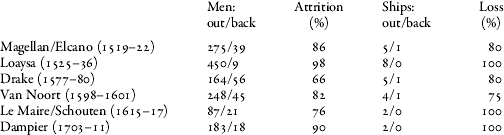
You might think that things would get better, but they didn't, at least not for a long while. For the first 250 years of around-the-world travel, more people died than survived circumnavigations. The planet simply shrugged them off. Many forms of travel and exploration in the age of sail were badly dangerous, but around-the-world travel was the most consistently bad. Consider in this regard Table 1, showing a fairly representative set of attrition rates for circumnavigations in the first two centuries of around-the-world travel.
Loss of men and ships on circumnavigations, 1519–1711. Numbers for the men on these voyages are less certain than those represented in Table 2. The attrition rates include a number of hazards: losses due mostly to deaths (Loaysa), to men being parted from the ships (Le Maire/Schouten), or to both factors (Dampier)
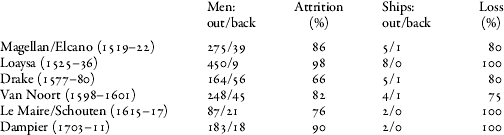
Sources: Antonio Pigafetta, Magellan's Voyage: A Narrative Account of the First Circumnavigation, trans. and ed. R. A. Skelton (New Haven: Yale University Press, 1969), 148, 149 n. 10, 172 n. 15, 181 n. 23; Clements R. Markham, ed., Early Spanish Voyages to the Strait of Magellan (London: Hakluyt Society, 1911), 25–27 (Magellan survivors), 30 (Loaysa); Harry Kelsey, Sir Francis Drake: The Queen's Pirate (New Haven: Yale University Press, 1998), 84; Glyndwr Williams, The Great South Sea: English Voyages and Encounters, 1570–1750 (New Haven: Yale University Press, 1997), 31 (Drake), 136, 141 (Dampier); J. C. Mollema, De Reis om de Wereld van Olivier van Noort, 1598–1601 (Amsterdam: Van Kampen, 1937), 31; Raymond John Howgego, ed., Encyclopedia of Exploration to 1800 (Sydney: Hordern House, 2003), 617 (Le Maire/Schouten), 760 (Van Noort).
Attrition rates on single- or even double-ocean journeys were on average lower. Vasco da Gama, for example, lost just over half his men (many to scurvy) on his voyage to India and back (1497–99); the average death rate for the Middle Passage of the Atlantic slave trade has been estimated at 12.5 percent. Circumnavigations’ total casualties numbered in the hundreds, rather than the slave trade's appalling millions, because such journeys were rare. In the earliest centuries, they tended to be sneak attacks on someone else's empire, done at great cost to those who attempted them.
Because being a circumnavigator was a minority experience, and an infrequent achievement, the commanders who returned from an around-the-world expedition made a point of claiming the globe for themselves. The globe was added to the coats of arms of, or given in those bestowed on, Elcano, Drake, and Cook. Drake himself inaugurated a tradition of being portrayed with a globe, a remarkable claim to the whole world in an era when orbs and globes were the distinctive possession of monarchs and of Jesus Christ, savior of the world. Other circumnavigators after Drake would continue to have themselves portrayed while holding or placing a hand or arm over a globe, as if their miraculous survival of a planetary circuit had given them that right. So too would surviving commanders of circumnavigations be represented as members of a distinct pantheon, extraordinary even in an age of expanding global travel, and not least because of the deadly nature of their characteristic journey.Footnote 11
Only by the end of the eighteenth century did circumnavigations begin to have lower mortality rates. This followed ample publicity from a disastrous attrition record set by George Anson. As part of a wartime mission, Anson had set out in 1740 with six ships and 1,939 men, but 743 of the officers and crew had turned back and 1,051 had died, overwhelmingly from scurvy. In total, 93 percent of the men and five of Anson's six ships were lost.Footnote 12 After that point, the Royal Navy made notable efforts to provision ships better and to enact hygienic regimens, which were most famously associated with Captain James Cook (Table 2).
Survival rates on post-Anson circumnavigations. NB: all original ships in these expeditions returned

Sources: Howgego, Encyclopedia of Exploration to 1800, 140 (Bougainville), 165 (Byron), 194 (Carteret); George Robertson, The Discovery of Tahiti: A Journal of the Second Voyage of H.M. S. Dolphin, ed. Hugh Carrington (London: Hakluyt Society, 1948), xxiii, 245; J. C. Beaglehole, ed., The Journals of Captain James Cook on His Voyages of Discovery, 4 vols. (London: Hakluyt Society, 1955–74), 1, cxxvi–cxxvii, 588–600; 2, 874–87.
From this point onward, European nations rebranded circumnavigations. No longer the most heartless of maritime expeditions (short of actual military efforts), they refocussed on the preservation of human life and on the pursuit of scientific goals as a kind of peaceful, international endeavor. Cook had been enjoined to do his utmost to preserve his men. And his scientific missions, to observe the Transit of Venus in 1769 and to chart as much of the Pacific Ocean as possible, were notable new elements of around-the-world expeditions. True, they were only subcomponents of what were still overtly imperial ventures, but they were remarkable efforts to dissociate modern circumnavigations from their nakedly piratical predecessors.Footnote 13
These humanitarian goals became part of the formal orders given to commanders of circumnavigations. When Jean-François de Galaup de la Pérouse set out in 1785, with two ships and 114 men, Louix XVI specified that the health of the sailors was a high priority, something that no one would have bothered to do a generation earlier. The surgeon of the expedition's flagship was promised a state pension if mortality did not exceed 3 percent. La Pérouse himself was told never to use force against foreigners unless self-defense required it. When a landing party was attacked and killed in Samoa, la Pérouse ordered no reprisal – the damage was done, and more bloodshed would besmirch the honor of the expedition. These goals would be the new standard, and commanders of circumnavigations who were perceived as failing to uphold them were regarded with suspicion, as with William Bligh's failed circumnavigation on the Bounty, when he was suspected as caring less for the physical condition of his men than for the botanical and imperial goals of the expedition.Footnote 14
As the United States came into being, its citizens would have known that a modern circumnavigation was supposed to be a peaceful and international venture. In the American colonies, George Anson's especially deadly around-the-world voyage, in the 1740s, had been famous as the counterexample – George Washington owned a copy of the expedition's narrative, as well as a globe marked with Anson's track. In 1779, the independent nation formally recognized the new model of around-the-world expeditions. When Cook had begun his second circumnavigation, during the American Revolution, Benjamin Franklin, acting as US ambassador to France, produced documents to instruct US and allied ships to let the expedition pass, as its scientific business was supposed to benefit all of humanity, quite the opposite of what had been true of earlier around-the-world voyages.Footnote 15
Think of it this way: circumnavigation, as a geodrama, has proceeded as if in three acts of a play. In the first act, which lasted from Magellan's departure on the first circumnavigation to James Cook's death in Hawaii (1519–1779), mariners who went around the world did so in fear. It was reasonable for them to be fearful, given the dangers of an around-the-world voyage in the age of sail. It was in this initial 250-year phase, the longest in the history of circumnavigation, that death prevailed. The general conclusion was that humans might take on the planet, but the planet would fight them every inch of the way. Washington and Franklin would have been among many colonists who would have known of this agonizing history.
From the 1780s until the 1920s, however, travelers who made their around the world did so with a striking confidence that they could survive the experience, the second act within our geodrama. That confident attitude was because Western societies had generated technology and political networks that seemed to have conquered the globe. Steam power and imperialism, in particular, were repesented as globe-spanning; petroleum power and a network of reciprocal recognition of national passports would later continue the sense of confidence.
At first, the newfound hopefulness about going around the world was a proprietary confidence – it belonged to the Western imperial powers specifically, and was particularly associated with the British. But this imperially inflected sense of planetary possibility was something to which others might aspire.
It is notable in this regard that two nations which had been on the sidelines of the imperialism that had dominated the Atlantic worlds since the 1500s made their first circumnavigations during and just after the Napoleonic Wars; this was the case for the United States and for Russia, each of which mounted repeated around-the-world expeditions to make clear its debut on the world stage. Under Tsar Alexander I (who reigned from 1801 to 1825), the Russians initiated twenty-five circumnavigations, and they would complete a total of thirty-four between 1803 and 1849.Footnote 16
The Americans were not quite so busy, as around-the-world travelers, but had in fact preceded the Russians in making their first circumnavigation, the fur-trading venture of the late 1780s with which this essay began. Although that expedition's profits were scant, Thomas Gray's return with both his ships and the overwhelming majority of his men was news. “The Columbia and Washington are the first American vessels who have circumnavigated the Globe,” announced the Philadelphia Mercury and Universal Advertiser in 1790, as did several other American newspapers. The official story was that Gray had lost only one man. But records from the expedition noted two deaths from scurvy and another from suicide, possibly caused by the melancholy associated with scurvy. The papers also noted that the Americans had exhibited an “urbanity and civility” which “secured the friendship of the aboriginals of the country they visited.” That too was propaganda – there had been episodes of violence. It all fell short of the post-Cook ideal of an around-the-world expedition, though certainly the expedition better resembled that model than the older, deadlier version.Footnote 17
The shaky adherence to the new peaceful standards for a circumnavigation continued to characterize US efforts. By the 1830s, the republic began to use around-the-world expeditions for overtly political, if not military, reasons. When an American commercial vessel, the Friendship, was attacked off Sumatra in 1831, and her captain and several officers killed, President Andrew Jackson ordered a reprisal. The following year, the USS Potomac (carrying fifty guns) did an eastabout circumnavigation, pausing to bombard the forts and town of Kuala Batee. The town surrendered. The region's governing rajahs were warned never to attack US vessels again. The narrative of this circumnavigation, unlike Thomas Gray's commercial expedition, was reported in print. In Francis Warriner's 1835 published narrative of the cruise, he emphasizes the patriotism of the venture, as in shipboard celebrations of George Washington's birthday. The shelling of Kuala Batee is the climax of the story, proof of US global might.Footnote 18
Perceived military necessity would remain a major reason for US ships to circle the globe. To avenge an 1838 Malay attack on the merchant ship Eclipse, for example, a Second Sumatran Expedition (from December 1838 to January 1839) deployed two US warships that were already doing circumnavigations. Another military convoy did a circuit from 1840 to 1844. These circumnavigations were measures of how Americans saw themselves as global actors – commanding a spotlight on the world stage, at last, guns blazing.Footnote 19
A scientific circumnavigation admitted the brash new republic to a more refined role on the planet, more like what European nations had been doing since Cook, and not unlike the roughly contemporary cartographic circumnavigation of Robert Fitzroy, on which Charles Darwin served as naturalist, from 1831 to 1836. The United States made its first scientific circumnavigation with the US Exploring Expedition (1838–42), Charles Wilkes commanding. Wilkes was ordered to do extensive reconnaissance of the Pacific Ocean and to verify and chart any major landmass to the far south, following reports of icy terrain there, which had set off a rush for the South Pole. The mission, nicknamed the Ex. Ex., was described as being “not for conquest, but discovery … to extend the empire of commerce and science, to diminish the hazards of the ocean.” Wilkes was ordered to protect his men from accidents and disease and cautioned never to order a military attack, except in self-defense. But even the earliest stages of the expedition were troubled.Footnote 20
Very quickly, the expedition violated the two post-Cook taboos against risking lives, either of sailors at sea or of civilians on land. On the first count, Wilkes was not entirely to blame. The US Navy, probably unaware that large fleets could weaken rather than strengthen a circumnavigation, had given Wilkes too many ships. Only two of the six actually made it around the world; of the other four, one returned back around the Horn, another was sold off in Asia, one was lost (though all hands were saved), and the last was lost with all hands. These were uncomfortably reminiscent of pre-Cook casualty rates. As to hurting people ashore, Wilkes violated that taboo all on his own. On a visit to Fiji, two crewmen were killed. In reprisal, not self-defense, the Americans killed almost eighty Fijians and demolished two villages.Footnote 21
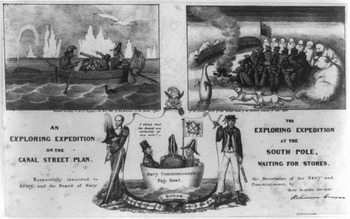
It was a muddled achievement. The enterprise was criticized and lampooned by a variety of critics as expensive, ill-conjectured, and fruitless (Figure 2). On his return, Wilkes was court martialled on several counts, mostly due to his treatment of his men, though he was acquitted on all but one charge. He produced a five-volume narrative that went through fourteen editions before 1865. Twenty-four other volumes of scientific material were prepared, though not all were published. American-produced world maps featured Wilkes's circumnavigator's track. The United States would sponsor other scientific circumnavigations – the Ex. Ex. was an excellent dress rehearsal for them.Footnote 22
Satirical cartoon for the US exploring expedition (Library of Congress).

But the venture compared badly to the contemporary circumnavigation of Jules Sébastien César Dumont d'Urville, who was also engaged in the race for the South Pole. The Frenchman had set out with two ships in 1837 and braved pack ice and rampant scurvy to cross the Antarctic Circle, where he made landfall and claimed the territory for France. His losses of men were much lower than those of Wilkes; France's claim to Antarctica meant no imperialist violation of anyone else's inhabited land. D'Urville's and other European circumnavigations would continue to augment the more confident and blandly scientific tradition of around-the-world travel.Footnote 23
In contrast, the United States would continue to use circumnavigations for military purposes, as with President Theodore Roosevelt's Great White Fleet, an armada of sixteen warships that swept around the world from 1907 to 1909. To be sure, other nations sent naval vessels on circumnavigations, but they tended not to advertise those ventures, favoring instead the scientific kind, as with the oceanographic mission of HMS Challenger, about thirty years before the Great White Fleet.Footnote 24
Americans made more peaceful and creative contributions to planetary confidence when such efforts could be commercialized. As telegraph lines spread, perhaps most dramatically with the laying of the Atlantic Cable, which connected the United Kingdom with the United States in 1858, commentators repeatedly cited Shakespeare, to claim Puck as patron saint of the electrical impulses that now zinged over the globe. American entrepreneurship was a centerpiece of those claims. A telegraph circuit of the Earth did not yet exist, but there was anticipation that it would be done, that humans could finally move information around the world even faster than Puck had made his forty-minute flight. When the telegraph circuit did encompass the Earth completely in 1903, it was accomplished by an American-led initiative to lay a Pacific cable. President Roosevelt had a telegram sent around the world, from his summer house on Long Island, and back to him. So too with the completion of the Panama Canal was there a sense that the Americans had worked to make a built environment for human convenience in spanning the globe, and in this way it appeared as if the United States had kept up with the other planetary powers, unlike the case with their military circumnavigations.Footnote 25
In essence, to go around the world was to demand membership in the club of nations that dominated the globe. The accumulated circumnavigations demonstrated mastery of the physical world; the voyages made the planet into an ever-more accessible object, on which the drama of human achievement would be made, ideally by all nations, even upstarts like the United States. Furthermore, Americans thought they would add to the circumnavigator's old pantheon new planetary characters, including women. When journalist “Nellie Bly” (Sarah Cochrane) returned from a seventy-two-day sprint around the world in January 1890, her employer, the New York World, published a cartoon showing her being greeted by a collective of slow, dead, male explorers: Elcano, Drake, and so on. This was to make the planet more accessible to more people. That's a positive way of putting it. Another way would be to point out that, in vying for world power, humans were not only vying with each other, but sharing the goal of making the planet a common object of domination.Footnote 26
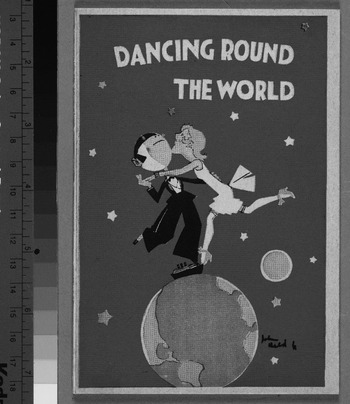
Not only was it possible to go around the world and live to tell about it, but it became a popular pasttime, and a commercially profitable consumer activity. That sense of encircling confidence would inform descriptions of the steamships and railroads that made it happen. At this, the Americans excelled, and exulted in it. Consider Mark Twain. When he went around the world in the 1890s, he dutifully noted the day lost in the circuit. He playfully concludes that he and the other passengers will all die a day earlier than had been foreordained. “We shall be a day behindhand all through eternity,” he predicts. “We shall always be saying to the other angels, ‘Fine day today,’ and they will be always retorting, ‘But it isn't to-day, it's to-morrow.’” It is a characteristically Twain-like swipe at faith, in this case the orthodox Christian perplexity over the circumnavigator's paradox. Other representations of doing a circumnavigation were likewise playful, enticing, joyous (Figure 3). There were costs, not all of them hidden, but they seemed outweighed by the glories of making an easy swing around the planet.Footnote 27
“Dancing around the World” (Huntington Library).

There was even one moment at which the United States led, rather than followed. This was with the first aerial circumnavigation. The Americans were not entirely innovating, here. Several other nations were trying to make the first circumnavigation by airplane. But the United States was able to carry it off in 1924 because at that point in time, after World War I, they had greater material resources to throw at the venture. The US Army Air Corps organized an entire team: four planes each with two men aboard, in notable contrast to the plane or two that other nations or private individuals could afford. With this material excess, and using the now familiar US military model to make a circumnavigation, three of the planes completed the aerial circuit – none of the other attempts was successful.Footnote 28
It continued to be in aviation that the United States carried forward its contributions to around-the-world travel. Many early aviators flew around the world, but it was Americans who set the important speed records. John Henry Mears and Charles Collyer went around the world faster than the Moon did, in 1928, and Wiley Post and Harold Gatty set an eight-day record in 1931. And it was again characteristically American to make the aerial circuit pay. Pan American airlines was one of three in the world that, before World War II, could make a near-circumnavigation of the world, and Pan Am was one of two airlines that, after the war, began to offer scheduled around-the-world service.Footnote 29
Their nation having been born during the confident era of around-the-world travel, citizens of the United States thought of themselves in relation to the planet in extremely confident ways, and particularly in terms of their military and consumer power. Perhaps because of that historical timing, Americans have been notable followers, rather than leaders, in the final act of geodrama. This act has been characterized by doubt, doubt that humans could continue to go around the world in comfort and ease, and doubt that it would be wise to continue to dominate the planet; in other words a significant questioning of the confidence of the long nineteenth century.
That questioning of the ostensible human mastery of the globe, and appreciation of the Earth's existence in and for itself, characterized the pioneering Soviet orbits of the world, beginning with Yuri Gagarin's, on 12 April 1961. Gagarin gave descriptions of the Earth that began with detached observation, then slipped into rhapsody: “I'm observing clouds … The landing site.” And then Gagarin catches his first glimpse of the larger Earth: “It's pretty, what beauty!” When Gherman Titov spent a day in space on 6 August 1961, doing seventeen loops around the planet, he too found himself drawn back to Earth, especially the multiple sunrises and sunsets he witnesssed in succession and described as poetically as possible. In his postflight memoirs, Titov concluded, “It is very handsome, our earth!” He emphasized his authority on that matter, as someone whose vision of the planet gave him a unique perspective: “I saw it, our earth, I saw it all. It is lovely, but it is really small, when you look at it from space … I suddenly realized with all my being how careful we must be with it.” Finally, there is the testimony of the man to make the first space walk, Alexey Leonov, who ventured out into space on 18 March 1965. One might have expected a cosmic appreciation of the void of space, or of the stars beyond, but Leonov's first words upon embarking on his unprecedented cosmic experience were “I can see the Caucasus.” Even from the soaring perspective of orbit, Gaia was the center of attention.Footnote 30
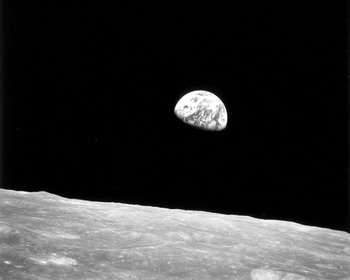
These statements were essential foundations for the better-known moment of planetary consciousness, the Apollo 8 photographs of the Earth, taken in 1968 and broadcast on Christmas day of that year. Those cosmic snaps have been held up as the beginning of an environmental awareness of the whole Earth. But the Americans who made and responded to these images were not leading the world toward that conclusion. Rather, they were amplifying what the Soviets had already said, followers yet again (Figure 4). And despite the considerable attention to the impact of the whole-Earth photographs taken from space, it is wishful thinking to claim that they have made a lasting impression on Americans, who lag behind many parts of the developed world in public discussion of environmental issues.Footnote 31
Earthrise (NASA).

For that reason, I will close by pointing out two implications of the near-five-hundred-year history of around-the-world travel, and of the United States’ place within it. First, I want to reemphasize, against the chronocentric claim that planetary consciousness is modern, that it is not; since the early sixteenth century, there has been a tradition of measuring the human body and human technology against the entire planet – the consciousness of human actions, on a planetary scale, is not wholly unprecedented.
And yet, the succeeding phases of around-the-world travel help to identify why there has been public incredulity that humans can, through individual actions, collectively damage the Earth, and those phases also help explain why people in the United States may be most prone to this incredulousness. Consider the first 250 years of geodrama, in which circumnavigators thought that, if they took on the planet, the planet would win, nearly all of the time. From that experience, we have derived a long legacy of assumptions that we are too small, individually or collectively, to make a dent in the planet. And then consider the next hundred-odd years, in which the scenario was so entirely, dramatically different: after a long battle against the planet, an easy victory, with all those joyful, ever more socially inclusive, swoops around the Earth.
Neither stage could have prepared anyone for the way we must think about the planet now. It is especially apparent that the confidence of the long nineteenth century has been the shortest and least representative of planetary experiences, yet it is clearly the most difficult to relinquish. And this is a marked problem for the United States, which came into being at a moment in history when an around-the-world expedition was both an important achievement for an independent nation, and yet easier to do than ever before, which has perhaps imparted to my nation a sense that the planet is there to be used, and even used up.