The confrontation of Western powers in the mid-nineteenth century was the most decisive event determining the modern history of East Asia. Unlike the American continents, where they populated the land with their own people and conquered the indigenes, Western powers used a commercial approach in East Asia. They threatened China, Japan, and Korea with guns and fleets to open ports.Footnote 1 Since then, East Asian countries have been exposed to an unprecedented amount of new knowledge, capital, foreigners, and commodities.
The consequences of the port-opening differed across countries. Japan achieved successful economic growth by absorbing the inflow from the West and finally became a member of imperial powers at the turn of the century. Korea and China did not follow this path. If we focus on Korea, the nation opened its ports in 1876 but became a colony of Japan in 1910. Explaining this economic and political divergence is a fundamental subject of Korean history and East Asian history.
Many historians of Korea blame the port-opening and subsequent events as the main cause of colonization. Imports of high-quality manufacturing products and exports of crops at low prices ruined Korean industries and agriculture. Foreigners unjustly obtained rights to exploit gold mines and to construct railroads, electricity networks, and telegraph systems and earned enormous profits. To accommodate their exploitation, imperial forces hindered Koreans from building a strong and independent modern state. All these factors weakened the Korean economy and state capacity and ultimately brought about the colonization.Footnote 2
However, this view has serious weaknesses. First, it assumes an unrealistic alternative that Korea could have achieved modernization autonomously without the port-opening. Second, no reasonable answer is provided as to why the results of the port-opening differed between Korea and Japan. Last, the scholars claiming this view have not provided compelling evidence to verify their claim regarding the economic decline during the port-opening period. They have only implied, without much scrutiny, that trade with foreign countries, foreign direct investment, inflow of advanced knowledge, and so forth were overall harmful rather than beneficial to the Korean economy.
Did the Korean economy really decline during this period? The major difficulty in answering this question is the lack of data. Suitable sources are not available to estimate either GDP per capita or real income in this period. We resolved this obstacle by measuring biological living standards. We estimated the height of the Hangryu Deceased, individuals who died on the street or charity hospitals but whose bodies were not claimed by acquaintances. Although the causes of death for Hangryu Deceased were diverse, most of them died of poverty-related reasons. After taking care of the corpses, the colonial government published information on almost every Hangryu Deceased at The Official Gazettes from the early 1910s. They contain various individual information, but most important is height for our study. As they were at the lowest stratum of the society, studying their heights can provide important clues on how the port-opening affected Korean living standards in general.Footnote 3
For our analysis, we digitized every record in The Official Gazette of Government-General of Korea and estimated average heights of male Hangryu Deceased aged 25 to 69 by regressing heights on decadal dummies and various control variables and found that the height of male Hangryu Deceased increased by 1.1 cm from the 1880s to 1910s. We checked whether factors like inaccuracy of age information or selection on unobservables generate this pattern and found that our results are robust to these problems. Considering the low socio-economic status of these people, this result indicates that Korean living standards improved during the port-opening era.
This result also sheds new light on the Korean economy after the annexation to Japan. GDP estimates by Mizoguchi and Umemura (Reference Mizoguchi and Umemura1988) and Kim (Reference Kim2006) and studies of biological living standards such as Kim and Park (2011) have shown that the Korean economy grew steadily during the colonial period (1910–1945). However, the interpretation of this information has been limited due to the lack of information prior to 1910. Our finding shows that the height growth of the colonial period was a continuous trend from the port-opening period rather than a reversal from decline. This implies that free trade by market integration, rather than either economic policies or new institutions implemented by the colonial government, could have been a primary source of the improvement in living standards during the colonial era.
Our case study of Korea contributes to recent studies on the economic history of East Asia from the mid-nineteenth century to the early twentieth century. Allen et al. (Reference Allen, Bassino, Ma, Moll-Murata and van Zanden2011), Xu et al. (Reference Xu2017), Broadberry, Guan, and Li (Reference Broadberry, Guan and Li2018), and Bassino et al. (2019) have estimated the long-term pattern of income of East Asian countries and showed that the mid- to late-nineteenth century was a watershed of long-term growth. Studies on biological living standards, such as those by Morgan (Reference Morgan2004) and Baten et al. (Reference Baten, Ma, Morgan and Wang2010) for China and Olds (Reference Olds2003) for Taiwan, have proposed similar implications. The Korean case can enrich this stream of literature and broaden the perspective on the long-term growth of East Asia.
Jia (Reference Jia2014) focused on the impact of the port-opening on the economic growth of China in the long run. Although influenced by her seminal work, our study differs in two respects. First, whereas Jia focused on the comparison between treaty ports and other regions, we have examined the nationwide impact of the port-opening. Second, in the investigation of the immediate impact of the port-opening, Jia used the size of the population rather than measures of living standards. Our work has estimated biological living standards directly.
The article proceeds as follows. We briefly describe the history of Korea during the port-opening era and review the prevailing understanding of this period and its weaknesses. Then, we introduce the Hangryu Deceased data and explain how we analyze them for investigating the living standards of the port-opening period. Using these data, we show that the biological living standards of Korea improved during the port-opening period. After exploring the robustness of the results and their implications, we conclude.
HISTORY AND LITERATURE REVIEW
Since its establishment in 1392, the Chosun Dynasty prohibited private foreign trade. The dynasty allowed only government trade for diplomacy and very limited private trade, under government control, with China, Japan, and a few small neighboring countries.Footnote 4 Although the level and the intensity differed, Japan and China also discouraged foreign trade from the early seventeenth century and from the early eighteenth century, respectively (Yamaguchi Reference Yamaguchi1993; Twichett and Fairbank 1978; Findlay and O’Rourke 2007).
Western powers challenged the closed-door policy of East Asian countries with military forces in the mid-nineteenth century. In the case of Korea, fleets from France and the United States invaded and requested treaties on commerce in 1866 and 1871, respectively. Instead of negotiating, the Korean government fought back and drove them out. Lee Ha-ung, the father of King Kojong and de facto ruler of Korea, claimed that he would not allow any diplomatic relations or economic transactions with “Western barbarians.” Most of Yangban, the ruling class, who were preoccupied with Confucian perspectives, supported his policy.
However, this resistance ended in 1876, and it led to a critical turning point in Korean history. Japan, which was forced to open its ports by the United States in 1854, had strengthened economic and military power and applied the same tactic to Korea. The Korean government could not fight back further and signed a treaty on commerce with Japan in February 1876. Subsequently, Korea signed treaties with China (1882), the United States (1882), the United Kingdom (1883), and Germany (1883). By the late 1880s, Korea had opened its market to almost every major country.
An immediate consequence of these commercial treaties was, of course, an increase in foreign trade (Figure 1). From 1877 to 1910, the total volume of trade soared from 179 thousand won to 69 million won, and this trend continued after the annexation to Japan.Footnote 5 Korea mainly exported rice and imported cotton goods from Britain and Japan.Footnote 6
EXPORT AND IMPORT OF KOREA, 1877–1944 (THOUSAND WON)
Source: Kim et al. (Reference Kim2018), V149–V150.

The rapid expansion of foreign trade was only a part of the explosive increase in Korea’s interactions with other countries. Many people from Japan and Western countries visited Korea. These visitors were involved in trade activities and invested in land, railroads, telegraph systems, and mines (Lee Reference Lee1989; Reference ChungChung 1999). Modern Western knowledge, including science, engineering, social sciences, and philosophy, was propagated through books and missionary schools (Kim Reference Kim2005; Park Reference Park2007; Kim Reference Kim2016). Western medicine and vaccines were prescribed in newly built Western hospitals (Shin Reference Shin1997; Hwang Reference Hwang2013; Park Reference Park2010). The Korean government also attempted to adopt Western institutions, laws, military technology, educational system, and government structures.Footnote 7
Some scholarship has emphasized the negative sides of this historic transformation and the following events. The importation of high-quality cotton goods destroyed the livelihood of traditional Korean producers (Kajimura Reference Kajimura and Kajimura1983; Kwon Reference Kwon1989). Rice exports to Japan raised the rice price and resulted in the impoverishment of the Korean people (Han Reference Han1970; Kim Reference Kim1994; Ha Reference Ha2009; Kang Reference Kang2018; Korean Modern History Society 2007). Korean merchants and entrepreneurs lost their markets to Japanese and other foreign markets (Han Reference Han1970; Kim Reference Kim1994; Kang Reference Kang2018; Korean Modern History Society 2007; Reference ChunChun 2012; Na Reference Na1998). Foreign investors obtained rights on gold mines and railroad construction from the government and earned an enormous profit.Footnote 8 The suffering Korean people resisted in various ways but were ultimately unsuccessful (Korean History Research Association 1993; Kim Reference Kim2009b; Park Reference Park2009; Hong Reference Hong2009; Oh Reference Oh2009; Yoo Reference Yoo2009; Choi Reference Choi2009). According to them, the coerced port-opening essentially rendered the imperial forces with unlimited opportunities to exploit the Korean people and their wealth. The exploitation devastated the Korean economy, worsened Korean living standards, and ultimately resulted in annexation to Japan. Under the Japanese occupation, the living standards of Korean people continued to worsen (Huh Reference Huh2005).
However, there are significant problems with this view. Most importantly, these scholars have not provided concrete evidence of the economic downturn they assumed. Recent quantitative studies, by contrast, have implied a positive aggregate impact of the port-opening. For instance, Cha and Lee (Reference Cha and Lee2004) found that the real price of arable land and land productivity increased in this period. Park and Cha (2003) revealed that the population started to increase directly after the port-opening. Kye and Park (2019) showed that social mobility improved significantly during this period. Based on these results, some scholars have proposed revisionist conjecture that the Korean economy either stagnated or declined in the early and mid-nineteenth century but started to recover and grow from around the 1880s (Kim and Park 2012; Park Reference Park2009; Kim Reference Kim2016).
Thus, further evidence is necessary. Unfortunately, monetary measures such as GDP per capita or real income were difficult to obtain because of data limitations.Footnote 9 Therefore, we used height as a substitute for the traditional measures of living conditions, and estimate the overall impact of the openness, putting negative growth implied from the prevailing view as the null hypothesis.Footnote 10
Our estimation also enabled us to conduct a comprehensive overview of the colonial era (1910–1945). Quantitative studies have demonstrated that the Korean economy grew steadily during the colonial period. The population increased from approximately 15 million to 25 million, and the mortality rate declined.Footnote 11 GDP per capita increased by 2.1 percent per annum, and biological living standards improved (Mizoguchi and Umemura Reference Mizoguchi and Umemura1988; Kim Reference Kim2006; Kim and Park 2011). However, the possibility that this growth might have been affected by the port-opening and its aftermath has not been examined systematically. More specifically, was colonial growth either a reversal from the decline of the previous period or a continuation from the port-opening era? The former implies that policies of the colonial government played a critical role for Korean economic growth in the early twentieth century, but the latter suggests a somewhat ignored possibility that openness, rather than policies of the colonial government, might matter more in respect of the economic growth during the colonial era.
DATA
We analyzed height information of the Hangryu Deceased during the colonial period. The term “Hangryu Deceased” applies to two groups of people (Figure 2).Footnote 12 The first group is homeless or vagrant people who died at either charity hospitals or institutions. If homeless or vagrant people were seriously sick and hospitalized, they were called Hangryu Patients, and if they died there, they were called Hangryu Deceased. Because most of these people had neither family members nor acquaintances to claim the body, the hospital or facilities either buried or cremated their corpses. The second group is related to accidental death. If a dead body was found on the street, the police investigated to determine his or her identity and cause of death. If the police identified the corpse and the contact information of his or her family, the police notified them and gave them the corpse. Otherwise, the corpse was classified as Hangryu Deceased. Similar to the aforementioned cases, municipalities either buried or cremated them within a few days.
DEFINITION OF HANGRYU DECEASED
Source: Authors’ illustration.

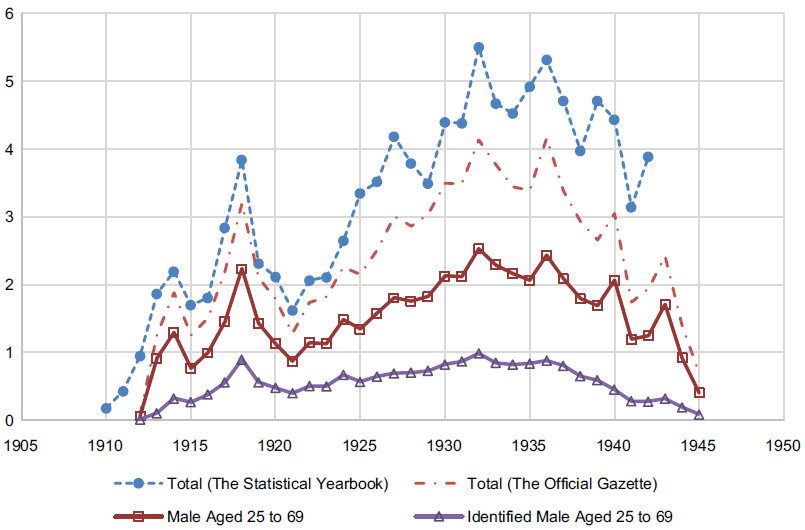
The concept of Hangryu Deceased originated from Japan. The Japanese government enacted a law on the Hangryu Deceased in 1899 and implemented an administrative process related to the Hangryu Deceased.Footnote 13 The system was applied to colonial Korea after the annexation in 1910. The colonial government reported statistics on Hangryu Deceased and the total expenditure on them in The Statistical Yearbook of Government-General of Korea. According to The Statistical Yearbooks, the total number of Hangryu Deceased from 1910 to 1942 was 105,476 (Figure 3). The number of Hangryu Deceased changed each year but was approximately 0.015–0.020 percent of the total population in the 1930s.
NUMBER OF HANGRYU DECEASED, 1910–1945 (THOUSAND)
Notes: Number of Total (The Statistical Yearbook), Total (The Official Gazette), Male Aged 25 to 69, and Identified Male Aged 25 to 69 are 105,476, 89,301, 52,073, and 18,532, respectively.
Sources: The Statistical Yearbook of Government-General of Korea and The Official Gazette of Government-General of Korea.

The municipalities advertised the Hangryu Deceased in either The Official Gazettes or the newspapers according to the law.Footnote 14 The advertisements provided a detailed description of the deceased, for example, their appearance, clothing, and belongings. The advertisements also reported where and when the deceased was found, how he or she died, and how the corpse was treated.Footnote 15 Due to the nature of the Hangryu Deceased, the advertisements commonly gave the name or address as “unknown,” but sometimes they included the name or permanent address of the deceased and, although rarely, his or her occupation.Footnote 16 Detailed information related to identity was available for a certain portion of Hangryu Deceased, especially if they had been institutionalized before death, lived with other individuals who were vagrant, or resided in a small village, where residents were inevitably acquainted with them.
We digitized the major information of all the advertisements in The Official Gazette of the Government-General of Korea. The advertisements on the Hangryu Deceased first appeared in The Official Gazette in November 1912, continued throughout the colonial period, but featured rarely in The Official Gazette of the Republic of Korea that was published from right after the liberation. Therefore, we focused on the advertisements published during the colonial era, and the complete database comprised 89,301 observations. The total number and yearly distribution show in Figure 3 suggest that most of the Hangryu Deceased were advertised in The Official Gazette. Using this information, we measured the long-term trends of biological living standards during the port-opening period.
ESTIMATION STRATEGY
The advertisement of the Hangryu Deceased, i, contains information on the date of death (D i), age at death (A i), height at death (H i), and other factors (Z i), for example, place of death and causes of death. Using the date of death and age at death, we calculated the date of birth (B i = D i – A i). Then we estimated average heights for each birth cohort and identified height trends.
There are two caveats. The first is the age effect. Human beings’ height increases from birth to approximately the age of 25 years, and they then start to shrink from approximately 40 years old.Footnote 17 However, selection bias can make the height of Hangryu Deceased show a different pattern. A Hangryu Deceased who died at an older age is more likely to have been in better health for longer than were those who died younger. As a result, older Hangryu Deceased can be taller than younger Hangryu Deceased. The height at death from the data is a net result of these two opposing forces. Online Appendix 1 shows a positive correlation between height and age, and this suggests that the selection effect is larger than the shrinkage effect in our data. This also shows that control of age is indispensable in comparing the heights of birth cohorts and inferring the time trends of living standards.
The second caveat is the socio-economic conditions of the death year. Suppose that famine occurred in the year of death, D i. This phenomenon could cause the death of people who might not have died in normal years; thus, the average height of the Hangryu Deceased dying in this year could be greater than in other years. A simple solution to ameliorate this problem is to control the impact of economic conditions in death years by using year dummies. Unfortunately, due to the perfect co-linearity among birth year, death year, and age, this method cannot be used. Instead, we resolved this problem by using variables reflecting the economic condition of the death years, such as per capita GDP or the death rates of the overall population.
We reflected the aforementioned concerns and estimated the long-term pattern of biological living standards by adopting the following specification for regressions.
 $${H_{ijD}} = \beta {B_i} + \alpha {A_i} + \upsilon {V_{jD}} + {\xi _j} + {\varepsilon _{ijD}}$$
In Equation (1), H ijD is the height at the death of a Hangryu Deceased i who died in region j in year D. The β parameters of the birth year dummies (B i) are the key to be estimated. They capture the average height according to birth years and ultimately reveal changes in living standards over time. The age variable (A i) controls the aforementioned impact of ages to make βs comparable. The socio-economic condition variables (V jD) control the potential impact of the social or economic condition of death year D in region j. In addition, we included province fixed effects for unobserved time-invariant regional characteristics (ξ j). The error term is ε ijD.Footnote 18
Two factors should be further considered in interpreting the estimation results. First is the potential distortion due to inaccuracy of age information. As many Hangryu Deceased were found after death, their identities were unknown, and their age reported at The Official Gazette was likely a guess based on appearance. This means that inaccurate age information might cause systematic bias and generate a wrong result. The second is potential selection on unobservables (Bodernhorn, Guinnane, and Mroz 2017).Footnote 19 We inferred living standards from heights based on a positive correlation between the two variables. However, this relation might not hold in our case due to the nature of the Hangryu Deceased. If the economic conditions continue to worsen, people who were relatively poor but making decent livings might lose their jobs, become poor, become vagrant, and die as Hangryu Deceased. The addition of these people should increase the average height of the Hangryu Deceased. This suggests that the increase in height of the Hangryu Deceased could originate from secular worsening of the economic condition, not vice versa. As a robustness check, we investigated whether these two problems might distort our estimation results.Footnote 20
BASIC STATISTICS
From all the advertisements for the Hangryu Deceased, we analyzed information on Korean male Hangryu Deceased aged 25–69 years. We focused on males only as the share of females are much smaller.Footnote 21 We also dropped males aged younger than 25 years and older than 69 years, as their age information could be unreliable.Footnote 22 These data enable us to measure the heights of people born from the 1850s to the 1910s and to infer the changes in living standards during both the port-opening period (1876–1910) and the colonial period (1910–1945).Footnote 23
After removing the foreign Hangryu Deceased and those with incomplete records, the total number of records that satisfied the aforementioned criteria was 52,073 (Kim and Park 2021).Footnote 24 In Figure 3, their distribution across time is similar to all Hangryu Deceased in the database. Figure A2-2 in Online Appendix 2 provides the number of the male Hangryu Deceased for 13 provinces and their correlation with the male population, and it shows that there is no systematic regional bias in geographical distribution.
Table 1 shows the basic statistics of the variables examined in the following regressions. Height was originally measured by Chock (30.3 cm) and Chon (3.03 cm), and we converted this measurement into centimeters. Because a Chon (3.03 cm) is a somewhat large unit, rounding could cause either inaccuracy or bias. However, Fogel et al. (Reference Fogel1983) addressed similar concerns when analyzing heights measured in inches (2.54 cm) and found no serious distortion.
BASIC STATISTICS: MALE HANGRYU DECEASED, AGED 25 TO 69 YEARS

Notes:
a“Identified” refers to the Hangryu Deceased whose names were recorded in the advertisement: 1 for identified and 0 otherwise.
b“Non-poverty death” refers to the Hangryu Deceased who died of suicide, murder, railroad accidents, drowning, food-poison, and pandemic: 1 for non-poverty death, 0 otherwise.
cThere were 13 provinces in Colonial Korea; these are listed and illustrated in Online Appendix 2.
dGDP per capita is available from 1911 to 1940. However, as the year of death in our analysis started from 1913, we used data from 1913 to 1940 (364 = 13 Provinces * 28 years).
eReliable statistics on male death rate by province are available from 1920 to 1938 (247 = 13 Provinces * 19 years).
Sources: Individual level data are from The Official Gazette of Government-General of Korea. In Province level regional data, GDP per capita are from Kim et al. (Reference Kim2018), N360-N385, and male death rates are from the Statistical Yearbooks of Government-General of Korea.
The year of death spanned from 1913 to 1945 based on the advertisements.Footnote 25 Selecting persons aged from 25 to 69, the computed year of birth for the Hangryu Deceased is between 1850–1919. Figure 4 shows the distribution of observations according to birth year by age group. Each age group has an inverse-U shape, and this mirrors the distribution of the Hangryu Deceased by death year in Figure 3. Every age group for more than three decades contains at least 200 observations in most years, except for the youngest cohort, age 25–29. This richness enables reliable estimation.
THE MALE HANGRYU DECEASED ACCORDING TO BIRTH YEAR AND AGE AT DEATH
Note: The total number of observations by decades and age group are presented in Online Appendix 1.
Source: The Official Gazette of Government-General of Korea.

From the advertisements, some individual characteristics were used for checking the robustness of the estimation. The first is information related to the identification. Many Hangryu Deceased were individuals living in poverty and were either homeless or vagrant. However, in many cases, village residents would know their basic information, such as name or age, if they were around for a certain period of time.Footnote 26 Additionally, because many Hangryu Deceased were Hangryu patients and died at charity hospitals, the institutes gleaned the major information, including name and age, directly from the patients. Therefore, names were reported in 36 percent of the advertisements regarding male Hangryu Deceased aged 25–69. We used this information in examining potential problems related to the inaccuracy of age information. As age information of the identified people is more reliable, we will estimate heights for the identified people only for a robustness check.
The second characteristic is information on the cause of death. Due to the nature of the Hangryu Deceased, most of them died of hunger and cold. However, 12 percent of male Hangryu Deceased died from what we call non-poverty reasons, such as suicide, murder, railroad accidents, drowning, food-poison, and pandemic. As people died of non-poverty reasons are relatively independent of changes in economic conditions, his or her height should be reasonably free from the selection on unobservables problem. Based on this reasoning, we will measure the height for the individual who died of non-poverty reasons for checking the robustness of the estimations against the selection on unobservables problem.
Lastly, socio-economic conditions in the year of death can affect the height at death. To control these, we used two sources of province-level regional data; Online Appendix 2 provides a map of 13 provinces and lists their names. The first source is death rates. As The Statistical Yearbook of Government-General of Korea provides reliable information on the total population and number of deaths by province from 1920 to 1938, we can calculate the male death rates for the period. The second is GDP per capita. Kim (Reference Kim2006) estimated GDP per capita at the province level from 1911 to 1940. Using this information, we controlled the potential impact of economic conditions in the death year.
HEIGHT GROWTH DURING THE PORT-OPENING PERIOD
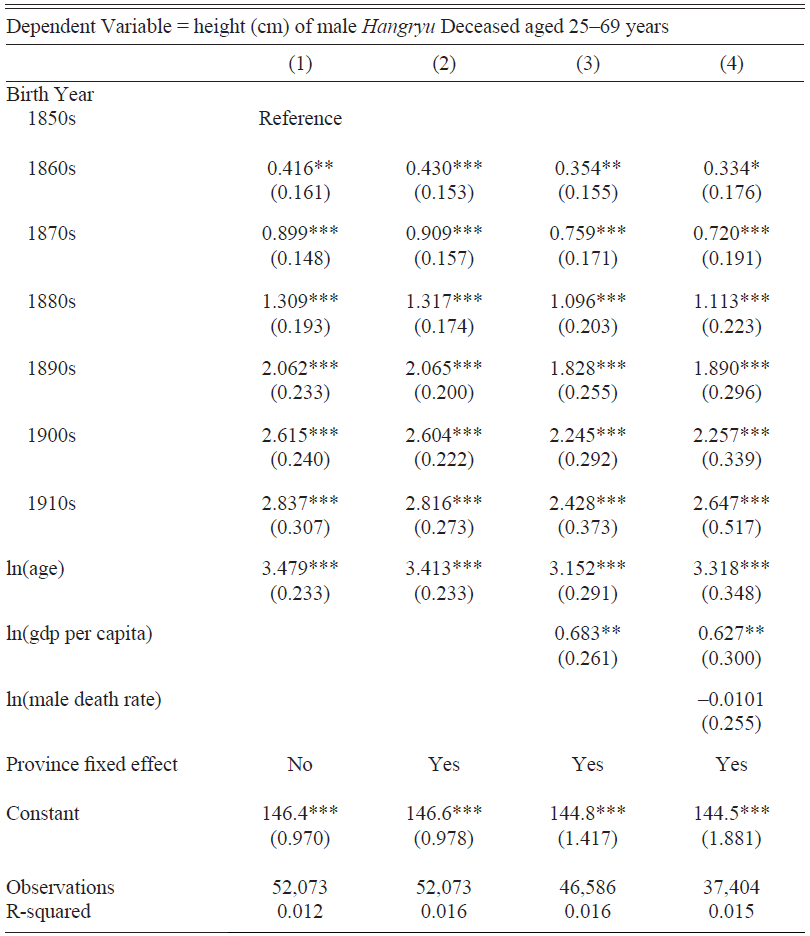
Table 2 provides estimation results of the heights of male Hangryu Deceased obtained by using Equation (1). By comparing the heights of birth cohorts of the 1850s and the 1880s, we inferred changes in biological living standards during the port-opening period. The people born in the 1850s became 30 years old and fully grown around the 1880s, implying that their height was determined either before or by the early stage of the port-opening period. People born in the 1880s had stopped growing by the 1910s, and their growth was influenced by the port-opening from birth. The difference of height between these two groups measured by the coefficient of the 1880s-birth-year dummy was interpreted as the general impact of the port-opening on Korean living standards.
HEIGHTS OF MALE HANGRYU DECEASED AGED 25–69 ACCORDING TO BIRTH YEAR

Note: Numbers in parenthesis are standard errors clustered at province by birth year level.
***p<0.01, **p<0.05, *p<0.1
Sources: See Table 1 and Kim and Park (2021).
Column (1) comprises birth year dummies and the age variable. The coefficient estimate of the 1880s’ birth cohorts shows that male Hangryu Deceased born in the 1880s were 1.3 cm taller than those born in the 1850s, and this difference is statistically significant. Estimates of the coefficient for the 1860s’ and 1870s’ birth year dummies show that this growth was gradual. Column (2) further includes province dummies for managing the province fixed effect; this did not result in a big difference. Column (3) controls for the economic condition of death year using GDP per capita by province.Footnote 27 This lowered the coefficient of the 1880s-birth-year-dummy only slightly, to 1.1 cm, but it is statistically significant. Column (4) adds male death rates of death year by province for further controlling the economic conditions; this does not make a big difference.Footnote 28 We claim from these results that the height of male Hangryu Deceased grew by 1.1 cm during the port-opening period.
It is not easy to evaluate the magnitude of growth. Scholars have made various efforts to identify how much height growth coincides with income growth, but no consensus emerges so far (Steckel Reference Steckel2008; Baten and Blum 2012). However, comparison with the colonial period can be useful. The difference of coefficients between the 1880s-birth-year dummy and the 1910s-birth-year dummy in Table 2 shows the height growth during the colonial period (1910–1945). It is 1.6 cm in Column (4). GDP per capita grew 2.1 percent annually during the colonial period (Kim et al. Reference Kim2018). If similar relation between growth of GDP per capita and height holds, the annual growth of GDP per capita during the port-opening period was 1.6 percent. Considering that growth rate of GDP per capita in Western European countries from 1880 to 1910 was 1.6 percent per annum, this growth cannot be said trivial (Bolt et al. Reference Bolt, Inklaar, de Jong and van Zanden2018).
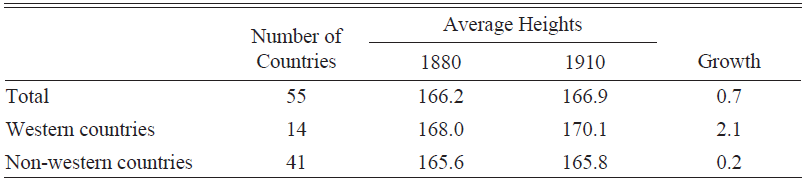
We can also evaluate by comparing height growth with other countries for the same period. According to height information collected at Clio Infra, the heights of people in 55 countries grew 0.7 cm on average from 1880 to 1910, which is less than the 1.1 cm increase for Korea in the same years (Table 3). As another comparison, the height increase in Korea is smaller than the 2.1 cm of the Western countries who were the most advanced countries for the same period, but it is much higher than the height growth of the non-Western countries, whose growth rate is 0.2 cm. These comparisons imply that Korean heights grew reasonably in this period.
HEIGHT GROWTH IN 55 COUNTRIES, 1880–1910 (CM)

Note: “Western Countries” are Austria, Canada, Denmark, France, Germany, Greece, Italy, Netherlands, Norway, Spain, Sweden, Switzerland, United Kingdom, and United States.
Source: Clio Infra (n.d.).
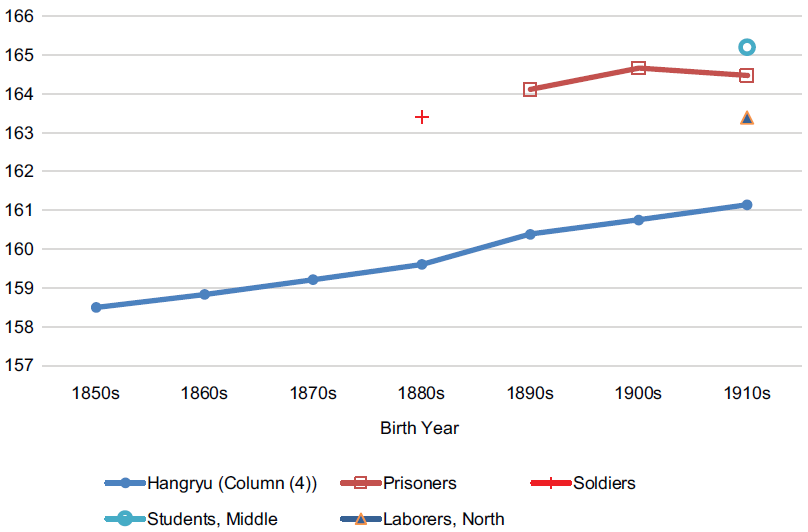
Figure 5 visualizes Column (4) of Table 2 by applying 30 as the age. The height of people born in the 1850s was 158.5 cm, and that of those born in the 1880s was 159.6 cm.Footnote 29 As general height information during the port-opening period is very rare, it is hard to compare and evaluate this result. One available source of information is the average height of soldiers born in the 1880s; this height was 163.4 cm. Height information is more available for the colonial era. Figure 5 shows estimates not only for those born from the 1850s to the 1880s, whom we have discussed so far but also for those born from the 1880s to the 1910s, who will be discussed further in the following section. Compared with their contemporary prison inmates, students, and laborers of similar ages, the Hangryu Deceased in the latter period is approximately 3–4 cm shorter in height.Footnote 30 Considering either the general social status of the Hangryu Deceased or the potential decomposition of the body after death, this difference does not go against the reliability of the estimation results.
HEIGHT OF MALE HANGRYU DECEASED COMPARED WITH OTHER STATISTICS (CM)
Note: Hangryu (Column (4)) is from Column (4) of Table 2.
Sources: Hangryu (Column (4)) is from Table 2. Prisoners are from Choi and Schwekendiek (2009, p. 260, table 1). The other statistics are requoted from Kimura (Reference Kimura1993, p. 645, table 6).

We also examined regional patterns by dividing the Korean Peninsula into three regions—North, Middle, and South—following the convention. Online Appendix 2 shows the map of provinces and describes the regions to which the provinces belong. It also presents descriptive statistics and regression results by region, and the heights of all three regions generally show a pattern similar to that in Table 2. This finding implies that the height growth was general rather than being driven by some regions.
The discussion so far shows that the biological living standards of Koreans improved during the port-opening era. This goes against the view that the overall impact of the port-opening was negative and that the Korean living standards declined during this period. At the same time, the estimation results provide a clue for a novel understanding of the port-opening era. Nationalistic scholars have claimed that the port-opening allowed foreign countries to exploit the Korean people and that this weakened the Korean economy and government and ended in colonization. Our result suggests that this might not be true.
ROBUSTNESS OF THE RESULTS
Several questions can be raised about the estimation results, and two of these are the most crucial. The first is the potential distortions due to inaccuracy of age information. As discussed in the data description, the identities of the 64 percent of Hangryu Deceased were unknown. Their age was likely a guess based on appearance. Given the results in Table 2, we can pose the following question. Would inaccurate age information cause systematic bias and generate a wrong result, that is, an increase of height in estimation compared with actual stagnation or decline?
We checked this problem by using the identified people only, that is, those whose names or birthplaces were recorded in the advertisements. As aforementioned, 36 percent of the advertisements contained information on identity. We have described the reason why such information was provided and can assert that their age information is reasonably reliable.
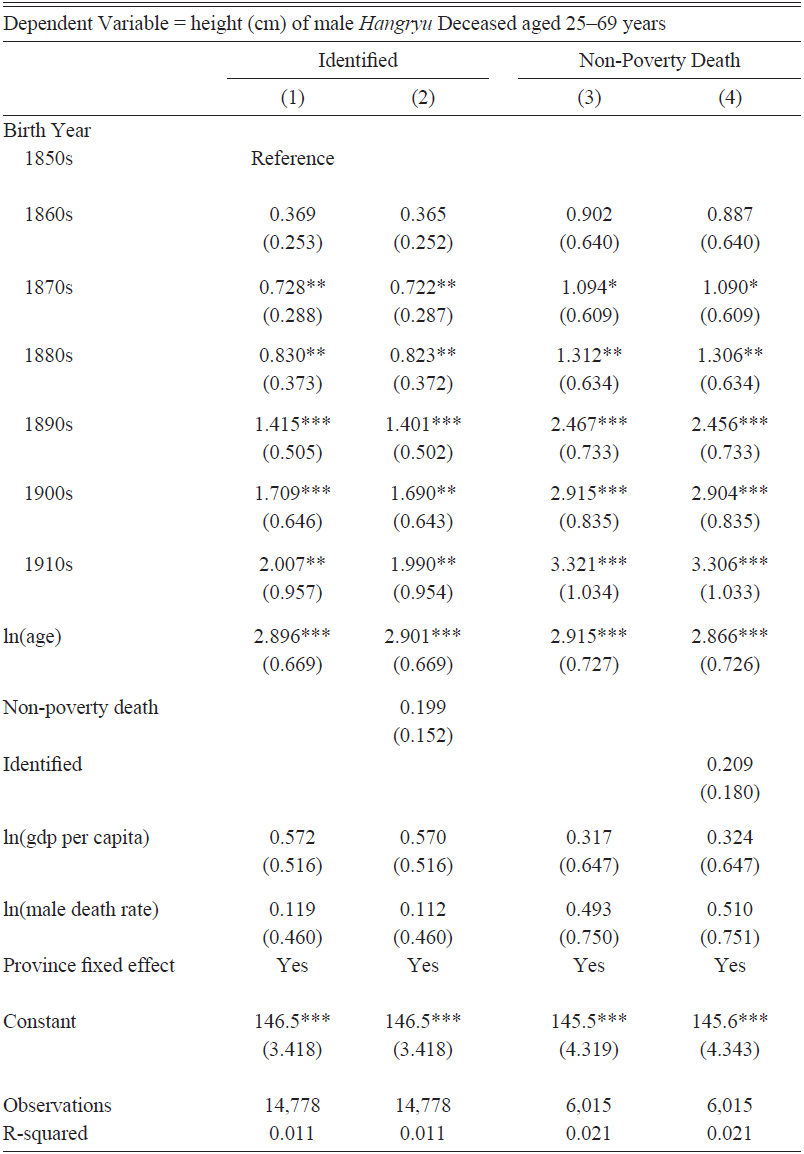
We reported the basic statistics of variables according to identification in Online Appendix 3, ran regressions on identified male Hangryu Deceased separately in Columns (1) and (2), Table 4. The height of the identified Hangryu Deceased increased by 0.83 cm during the port-opening era. This finding is smaller than Columns (1)–(4) of Table 2 but still supports the claim that the Korean living standards improved during the port-opening era.
ROBUSTNESS Check

Note: Numbers in parenthesis are standard errors clustered at province by birth year level.
***p<0.01, **p<0.05, *p<0.1
Source: See Table 1.
The second is potential selection on unobservables. We inferred living standards from heights based on a positive correlation between the two variables. However, this relation might not hold in our case due to the nature of the Hangryu Deceased. If the economic conditions in a particular year became worse suddenly, people who were relatively poor but making decent livings might lose their jobs, become poor, become vagrant, and die as Hangryu Deceased. The addition of these people should increase the average height of the Hangryu Deceased. This suggests that the increase in the height of the Hangryu Deceased reported in Table 2 could originate from secular worsening of the economic condition, not vice versa.
We are skeptical of this possibility for several reasons. First, if selection on unobservables matters here, the long-term growth of height should be a consequence of economic decline. However, such incongruence does not hold. GDP per capita continued to grow during the data generating period (Figure 6).
REAL GDP PER CAPITA AND MALE DEATH RATES, COLONIAL KOREA
Sources: Kim et al (Reference Kim2018), N360-N385 and the Statistical Yearbooks of Government-General of Korea.

Of course, worsening inequality can generate this pattern. If income inequality grew even under the rise of GDP per capita, the number of impoverished people could rise, and this could have caused the increase in the height of the Hangryu Deceased. If that were true, either death rates or the number of Hangryu Deceased should have increased continuously from 1910 to 1945. However, the evidence goes against this assumption. The male death rate did not grow during this period (Figure 6). The number of Hangryu Deceased had a basically inverse-U shape with 1930 as the peak (Figure 3). These patterns refute the inference based on increasing inequality.
Last, we checked the robustness of our results by using the information on Hangryu Deceased, who died of non-poverty reasons. As we mentioned, 12 percent of male Hangryu Deceased died of suicide, murder, railroad accidents, drowning, food-poison, and pandemic. Their death could be reasonably independent of the economic downturn causing the potential selection on unobservables. Estimates (3) and (4) in Table 4 measure the heights of the Hangryu Deceased died of non-poverty reasons only, and their height grew by 1.3 cm. This effect is precisely estimated, despite the smaller sample. These support the robustness of our estimation.
COLONIAL ECONOMIC GROWTH MIRRORED FROM THE PORT-OPENING PERIOD
The Hangryu Deceased data contain information on adults born from the 1850s to 1910s. This information enabled us to investigate changes in living standards from the 1880s to the 1940s. The first half of this period (1880s–1910s) coincides with the port-opening period, and the second half (1910s–1940s) coincides with the colonial period. Thus, we have a consistent index of living standards covering the port-opening period and the colonial period.
According to Column (4) in Table 2 and Figure 5, people born in the 1910s were 2.6 cm taller than were those born in the 1850s, and the coefficients between these two endpoints increased gradually over time. This finding implies that the living standards of Korean people improved steadily during the whole period under consideration. Of this total, 1.1 cm, or 43 percent, was from the port-opening era, and the remaining 1.5 cm, or 57 percent, was from the colonial period.
This result provides insight that allows a new understanding of the origin and nature of economic growth during the colonial period. Since Mizoguchi and Umemura (Reference Mizoguchi and Umemura1988) and Kim (Reference Kim2006) published estimation of GDP per capita during the colonial period respectively, scholars have debated widely the reliability of these estimations and their implications. Basically, some scholars have criticized the estimation and claimed that the Korean living standards worsened, whereas others accepted the estimation and attempted to explain it in connection with colonial policies such as new institutions or industrial policies.Footnote 31
Our result sheds new light on this controversy. First, our result is consistent with the GDP per capita estimation showing that the Korean living standards improved during the colonial period.Footnote 32 Second, the height growth of the colonial period was a continuous trend from the port-opening period rather than a reversal from decline. This implies that free trade by market integration, rather than either economic policies or new institutions implemented by the colonial government, could have been a primary source of the improvement in living standards during the colonial era. Cha and Lee (Reference Cha and Lee2004), Park and Cha (2003), Kim and Park (2012), and Kim (Reference Kim2016) heralded this view, but there has not been much examination of the empirical evidence. Whether supporting or refuting this view, our study has at least demonstrated clearly that any attempt to explain the economic growth during the colonial era should consider legacies of the port-opening era and the impact of free trade systematically.
CONCLUSION
The first wave of globalization in the nineteenth century transformed the world economic order significantly. The Chosun Dynasty finally opened its ports in 1876 and joined this movement. From that point, the Korean economy was exposed to a massive inflow of foreign people, commodities, and knowledge. Many scholars have tended to view this period pessimistically and have claimed that the Korean economy was harmed and exploited by foreigners. They hold that damage from the port-opening weakened the Korean economy and caused colonization in the end.
We have raised questions concerning this understanding. To measure the impact of the port-opening, we explored the biological living standards of Koreans during the port-opening period by using the height information of Hangryu Deceased. Our estimates show that from the 1880s to 1910s, the height of male Hangryu Deceased increased by 1.1 cm. Considering the social and economic status of these people and the height growth of contemporary other countries, this result indicates that Korean living standards improved during the port-opening era. We also confirm that this result is robust to potential bias originating from inaccuracy of crucial variables such as age or selection on unobservables that could result from the nature of Hangryu Deceased.
The estimation results on the port-opening era also provide new insights into the colonial period. The height of Hangryu Deceased increased by 1.5 cm during the colonial period, which is consistent with estimates of GDP per capita. Notably, this growth was a continuation of the port-opening era rather than a reversal of a declining trend of the previous period. This implies that economic growth during the colonial era might be more related to gain from free trade than to either colonial policies or transplanted institutions. Further studies on these topics would enhance the understanding of Korean history and East Asian history as a whole.