Introduction
The development of materials and coatings to enable prolonged operations of moving components in small-scale systems is becoming increasingly important, especially as the application of micro/nano-electromechanical systems (MEMS/NEMS) and micro/nano-robotic joint systems continues to increase.[Reference Kim, Laschi and Trimmer1,Reference Puthoff, Holbrook, Wilkinson, Jin, Pesika and Autumn2] Through millions of years of evolution, insects have evolved leg joints that operate efficiently and are durable—tolerating repeated rubbing and compression cycles during their lifetime.[Reference Wegst, Bai, Saiz, Tomsia and Ritchie3,Reference Bhushan4] Studying materials based on natural systems can provide important clues for developing effective materials with similar material properties for appropriate use, as well as practical applications.[Reference Oh, Behmer, Marquess, Yegin, Scholar and Akbulut5,Reference Ji and Gao6] A better understanding of insect joints can lead to new insights in the future design of bio-inspired coatings for nanoscale and microscale engineered systems.[Reference Meng, Zhang and Wang7,Reference Rakitov and Gorb8]
The outer surfaces of insects, e.g., exocuticle[Reference Bustamante, Panzarino, Rupert and Loudon9,Reference Zhang, Huang, Zhang, Zhang and Ren10] and wing surfaces,[Reference Chen, Skote, Zhao and Huang11] have been extensively studied. In contrast, the mechanical properties of the inner surfaces of the exocuticle have not been investigated at the same depth. Over the lifetime of an insect, leg joints can withstand repeated bending, running, swimming, and jumping motions, and surpass the strength and durability of mechanical devices made by humans.[Reference Oh, Yegin and Akbulut12,Reference Kheireddin, Williams and Akbulut13] For example, the exertion forces of insect joints are ten to several hundred times greater than their body weight, as shown in locusts (eight times), fleas (135 times), and froghoppers (414 times). This vastly exceeds that of humans (three times).[Reference Burrows14] Hence, it is essential to study the mechanical properties of insect leg joints that enable these extraordinary characteristics and functions.
In the current study, we have quantified variation in the mechanical properties of insect joints for three different insects. The first was an adult beetle, which has terrestrial cursorial legs (specialized for walking and running). The second was a mantis, chosen because of its terrestrial raptorial forelegs (specialized for catching and securing prey). The third was a dragonfly nymph, which lives submerged in freshwater habitats and uses its aquatic cursorial legs for underwater walking and swimming. Our results provide novel insights concerning the structure–function–property relationship of insect joints, and have the potential to inform bio-inspired, durable, wear-resistant coatings for MEMS/NEMS and micro/nano-robotic gears, components, and junctions operating in terrestrial and aquatic environments.
Material and methods
Sample preparation of insect joints
Three insects were chosen for this study: an adult beetle (Coleoptera: Tenebrionidae), an adult mantis (Mantodea: Mantidae), and dragonfly nymph (Odonata: Aeshnoidea). For structural and experimental studies, live insects were first anesthetized with carbon dioxide (CO2). Next, we incised the outer exoskeleton of insect joints using a surgical scalpel, and gently separated the tibia and femur from each other by applying a gradual tensile force. To avoid desiccation of specimen and resultant changes in mechanical properties, all experiments were performed immediately after dissecting the legs from the insect bodies.
Structural characterization of insect joints
Close-up photographs of insect joints were captured using a high-definition camcorder (HDR-XR160; Sony Corp., Tokyo, Japan), while high-magnification images of insect joints were obtained using scanning electron microscopy (SEM, JSM-7500F; JEOL USA, Inc., Peabody, MA, USA). To reduce undesirable charging effects and beam damage, a thin layer (25 nm) of platinum–palladium alloy was deposited on the sample surfaces prior to SEM imaging. The SEM was performed in a vacuum with an emission current of 15 µA and an accelerating voltage of 1 kV.
Nanoindentation measurements of insect joints
We used the nanoindentation technique (Hysitron TI 950; Bruker, Billerica, MA, USA) to measure the mechanical properties of the insect joint surfaces. While a Berkovich nanoindenter tip was brought into contact with the sample surface, the applied load (μN) and penetration depth (h) of displacement were simultaneously recorded. The load profile consisted of three 10 s intervals: (1) zero to maximum load, (2) maximum load held constant, and (3) maximum load to zero. Different maximum loads (i.e., 100–5000 µN) were applied to penetrate the insect joint surfaces over a range of depths (i.e., 200–1200 nm). The load-displacement nanoindentation curves were used to determine the effective elastic modulus (E eff) of the specimen. Particularly, the analysis is based on the simple assumptions that the unloading is completely reversible. The measurements were carried out at room temperature (23 °C) and relative humidity of 65%.
Statistical analysis
Statistical analysis was done using the Analysis ToolPak in Microsoft Excel (Microsoft Corp., Redmond, WA, USA). A one-way analysis of variance was used to compare the nanoindentation data for each insect, and where significant differences were detected, a Tukey's honestly significant difference post hoc test (P < 0.05) was employed.
Results and discussion
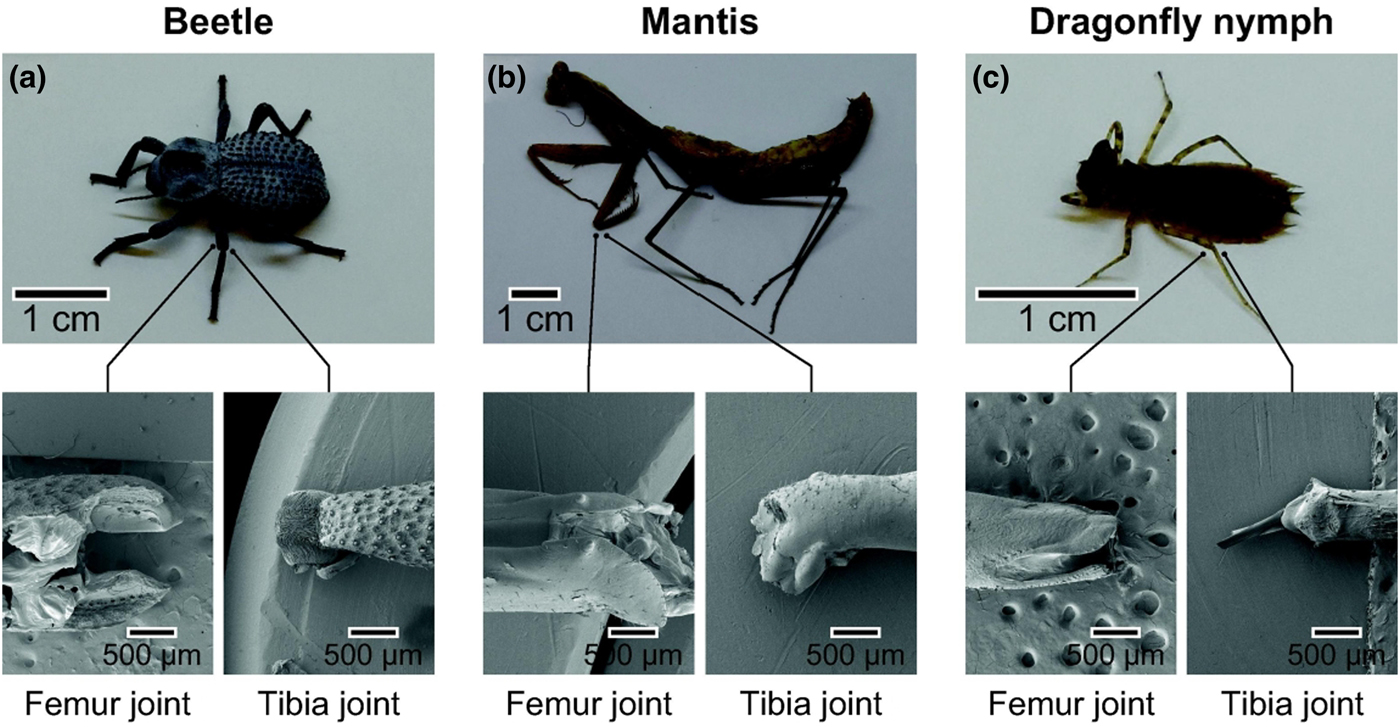
Figure 1 shows photographs, for each insect, indicating which joints were examined. Figure 1 also shows SEM micrographs that reveal tibia and femur morphology. For the beetle, the femur showed hexagonal platy morphology, while the tibia showed long, flexible, and deformable conical micropillars. The surface of mantis femur contained randomly distributed nanobumps, but the tibia side was smooth. Uniquely, for the dragonfly nymph, the femur and tibia surfaces were both smooth.
Photographs showing the tibia and femur joints investigated in this study: (a) an adult beetle, (b) an adult mantis, and (c) a dragonfly nymph. The SEM micrographs below each insect show high magnification morphology of the tibia and femur joints, respectively.

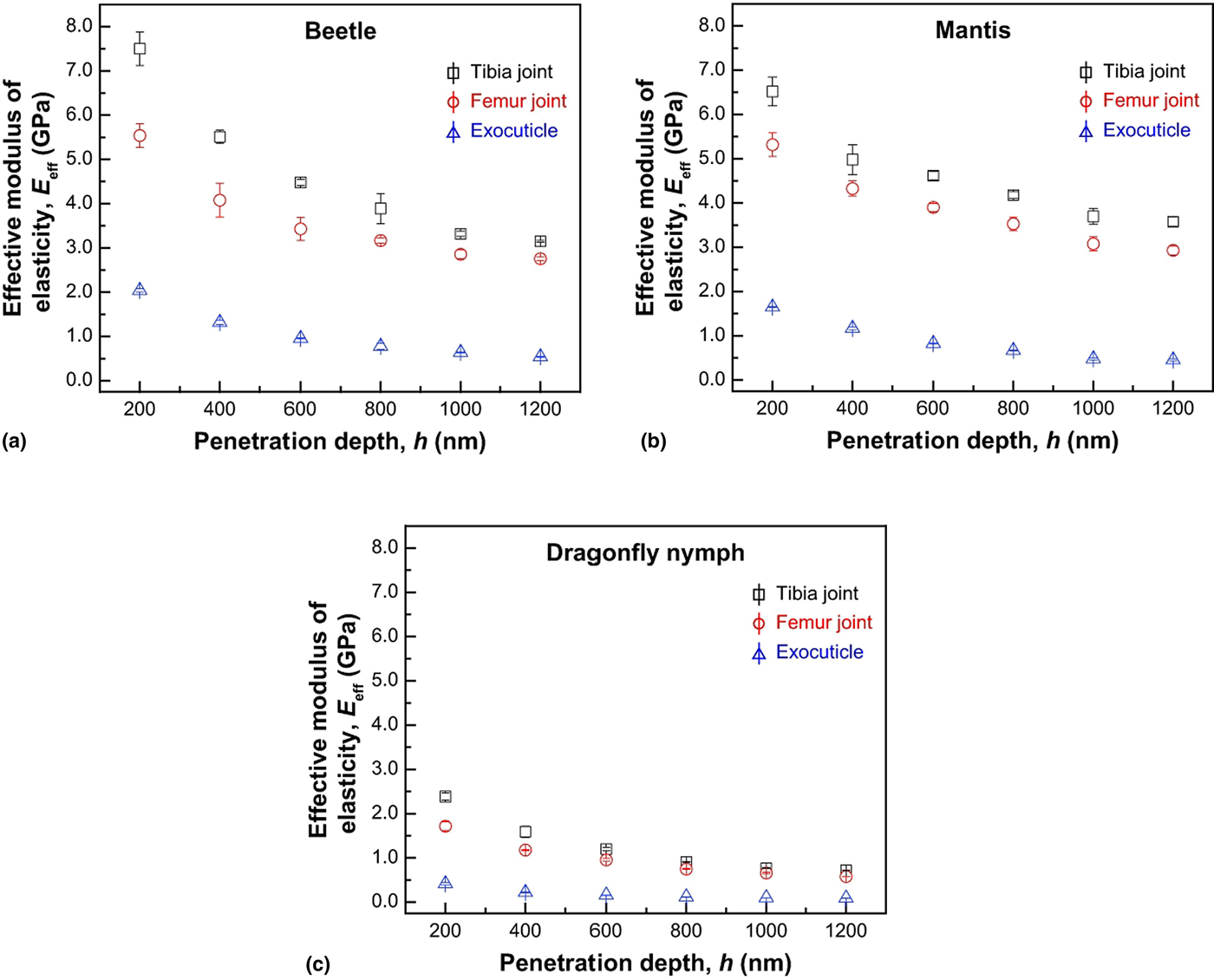
We found significant variation in the mechanical properties of insect joints with respect to joint functions (Fig. 2). The effective elastic modulus (E eff) of femur joint, tibia joint, and exocuticle surface for beetle ranged from 2.76 ± 0.04 to 5.54 ± 0.27, 3.15 ± 0.02 to 7.50 ± 0.38, and 0.54 ± 0.01 to 2.04 ± 0.04 GPa, respectively. The effective elastic modulus of femur joint, tibia joint, and exocuticle surface for mantis ranged from 2.93 ± 0.10 to 5.32 ± 0.27, 3.58 ± 0.11 to 6.52 ± 0.32, and 0.46 ± 0.02 to 1.65 ± 0.01 GPa, respectively. On the other hand, the effective elastic modulus of femur joint, tibia joint, and exocuticle surface for dragonfly nymph was in the range of 0.58 ± 0.00–1.72 ± 0.10, 0.72 ± 0.01–2.39 ± 0.08, and 0.09 ± 0.00–0.42 ± 0.03 GPa, respectively. For instance, as shown in Table I, in the beetle, the effective elastic modulus of the tibia and femur joint showed similar ranges. However, the exocuticle values on the beetle were generally lower. For the mantis, the range of values for the effective elastic modulus of tibia joint, femur joint, and exocuticle surface was similar to the beetle. In contrast, the values and ranges reported for the dragonfly nymph differed compared to the beetle and mantis. In general, the effective elastic modulus of the tibia joint, femur joint, and exocuticle surface was much lower compared to the respective values reported for the beetle and mantis. The statistical analysis revealed that the articulating joints of aquatic dragonfly nymphs are much softer than those of terrestrial beetles and mantises. Prolonged hydration of chitinous structure is one possibility that may be responsible for the observed difference in mechanical properties between aquatic and terrestrial insects.[Reference Meyers, Chen, Lin and Seki15] For our two terrestrial insects, the elastic modulus value of joints decreased to half its value at a ~1 µm depth from the surface (in an exponential fashion). On the other hand, the joints of the dragonfly nymph displayed a nearly threefold reduction in elastic modulus within ~1 µm depth away from the surface. The existence of a hard-coating layer above a softer compliant layer has tribological advantages in dissipating high shear and local stressed on the surface to the internal structure. For all insect species at a given penetration depth, the tibia joints had the largest effective elastic moduli, followed by the femur joints, while the exocuticle had the smallest values. On average, for all three insects, the modulus of the tibia joints was three to four times larger than that of the exocuticle regions away from leg joints, and about 50% larger than that of the femur joints. The obtained values are comparable with the reported values from the articulation between the head and neck of the beetle (i.e., 1.50 ± 0.80 GPa),[Reference Barbakadze16] hind wings of the Asian lady beetle (i.e., 2.96 ± 0.35 GPa),[Reference Sun, Wu, Ling, Bhushan and Tong17] and endocuticle layers of the rostrum in the weevil (i.e., 9.71 ± 1.02 GPa).[Reference Singh, Jansen, Franz and Chawla18]
The effective elastic modulus (E eff, GPa) versus penetration depth (h, nm) of (a) an adult beetle, (b) an adult mantis, and (c) a dragonfly nymph.
Summary of the results depicted in Fig. 2. The range of the elastic modulus variables measured for each insect and each joint/surface.

Different letters (i.e., a and b) indicate a statistically significant difference between species (P < 0.05).
Conclusions
In this work, the mechanical properties of the tibial and femoral articular surfaces of beetle, mantis, and dragonfly nymph joints, adapted for terrestrial cursorial, terrestrial raptorial, and aquatic locomotion activities, were investigated using nanoindentation. The articular surfaces of the different regions (i.e., femur joint, tibia joint, and exocuticle surface) were evaluated by measuring the effective elastic modulus. A key finding from this comparative study is that the elastic modulus of the insect legs we examined varied depending on their environment. Most notably, our aquatic insect had much more compliant and flexible joints compared to our terrestrial insects. For both terrestrial and aquatic insects, tibia articulation (convex in shape) of insect joints was slightly stiffer than femur joints (concave in shape), which were significantly stiffer compared to exoskeleton (relatively flat). Finding the unique natural surfaces is an attempt to draw out some of the potentials for the biomimetic-based design and encourage for further advanced research in the lubrication systems.
Acknowledgments
This material is based upon the work supported by the National Science Foundation under Grant No. 1434421 to J.K. Oh and M. Akbulut.