The global prevalence of methicillin-resistant Staphylococcus aureus (MRSA) nasal colonization in children admitted to the pediatric intensive care unit (PICU) is ∼3%. Reference Zervou, Zacharioudakis, Ziakas and Mylonakis1 Importantly, MRSA colonization in children is associated with ICU outbreaks and increased surgical infections. Reference Milstone, Carroll and Ross2–Reference Kalra, Camacho and Whitener4 Specifically, MRSA-colonized children have increased risk of developing postoperative infections after gastrostomy tube placement, a common procedure in children with neuromuscular disorders (NMDs). Reference Mainie, Loughrey, Watson and Tham5 Although the mechanism remains unknown, children with NMDs are at increased risk of postoperative wound infections. Reference Sullivan, Abousamra and Puvanesarajah6,Reference Schaps, Leraas, Rice and Tracy7 Given increased surgical infections in this population, it is important to understand whether children with NMDs, such as cerebral palsy, have higher prevalence of MRSA colonization to inform prevention strategies. Reference Huang, Singh and McKinnell8 The purpose of our nested case–control study was to determine whether children with cerebral palsy have higher prevalence of MRSA nasal colonization at PICU admission that children without cerebral palsy.
Methods
Using a web-based query tool, we extracted a retrospective cohort of patients <18 years old with PICU admissions from January 1, 2008, to June 15, 2021, from a single tertiary-care referral center in the southeastern United States. Reference Horvath, Rusincovitch, Brinson, Shang, Evans and Ferranti9 Institutional policies required assessment of MRSA nasal colonization within 48 hours of admission using polymerase chain reaction. The cohort was stratified into 2 groups based on whether the patient had an International Statistical Classification of Diseases, Tenth Revision (ICD-10) diagnosis of cerebral palsy associated with paralysis (ie, G80.0, G80.1, G80.2.) in the medical record. 10
The first PICU admission after the first year of life was included; subsequent admissions were excluded. PICU admissions during the first year of life were excluded given the high PICU utilization by this cohort during that period and because cerebral palsy diagnoses may not be assigned reliably in the first year of life. Children with cerebral palsy were randomly matched 1:3 by age at PICU admission and admission year with children who did not have cerebral palsy. If a child with cerebral palsy was unable to be matched to a child of the same age, they were matched to a child one year older or younger.
The primary outcome was MRSA nasal colonization at PICU admission. Primary outcome data were confirmed through manual chart review (D.S. and R.D.). Demographic information and colonization were compared using χ Reference Milstone, Carroll and Ross2 tests. Adjusted and unadjusted odds ratios were estimated using univariable and multivariable logistic regression. Covariates included sex, age, preferred language, race or ethnicity, state of residence, and admission year, all selected a priori. These variables were selected to guide future analyses on risk factors modulating MRSA nasal colonization prevalence in children with cerebral palsy. The study was approved by the Duke University Health System Institutional Review Board (no. Pro00107907). We followed the Strengthening the Reporting of Observational Studies in Epidemiology (STROBE) guidelines for reporting observational studies.
Results
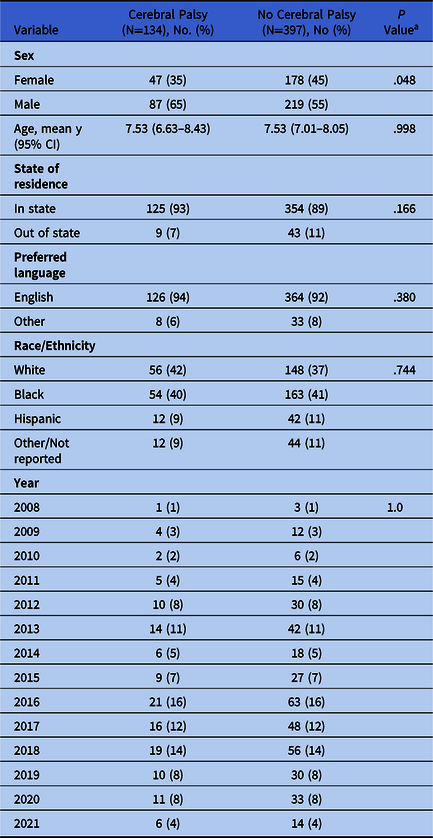
In total, 531 children were included in this study: 134 (25.2%) with cerebral palsy and 397 (74.8%) without cerebral palsy. Of the demographic variables collected, only sex differed between the 2 groups: 47 children (35%) with cerebral palsy were female and 178 children (45%) without cerebral palsy were female (P = .048). The groups did not differ by age, state of residence, preferred language, race or ethnicity, or year of admission (Table 1). The prevalence of MRSA nasal colonization at PICU admission was higher for children with cerebral palsy than for children without cerebral palsy: 20 (14.9%) versus 26 (6.6%; P = .0029).
Demographic Information Stratified by Cerebral Palsy Diagnosis Status at Time of Pediatric Intensive Care Unit Admission

Note. CI, confidence interval.
a P value generated by χ Reference Milstone, Carroll and Ross2 test.
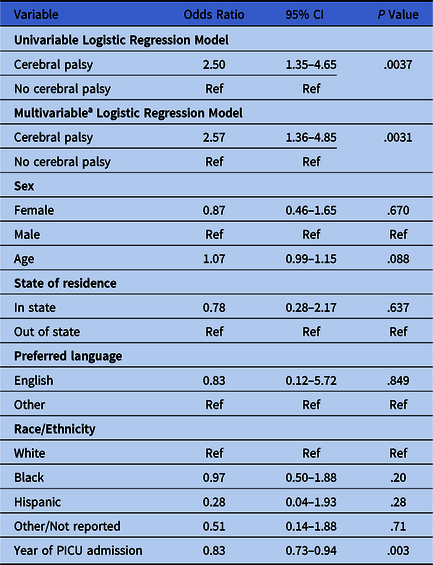
Unadjusted odds of MRSA nasal colonization at PICU admission after the first year of life were 2.5-fold higher among children with cerebral palsy than for those without cerebral palsy (odds ratio [OR], 2.50; 95% confidence interval [CI], 1.35–4.65; P = .0037). After adjusting for sex, age, preferred language, race or ethnicity, state of residence, and admission year, odds of MRSA nasal colonization at PICU admission after the first year of life were ∼2.6-fold higher among children with cerebral palsy than those without cerebral palsy (OR, 2.57; 95% CI, 1.36–4.85; P = .0031). Odds of MRSA colonization decreased by 17% for each calendar year (Table 2). Otherwise, sex, age, state of residence, preferred language, and race or ethnicity were not significant covariates (Table 2).
Univariable and Multivariable Logistic Regression of Methicillin-Resistant Staphylococcus aureus (MRSA) Nasal Colonization Status at Time of Pediatric Intensive Care Unit (PICU) Admission

Note. CI, confidence interval.
a Multivariable model is adjusted for sex, state of residence, preferred language, race or ethnicity, age at PICU admission, and year of PICU admission.
Discussion
After matching for age and year of admission, children with cerebral palsy had 2.6-times higher adjusted odds of MRSA nasal colonization at PICU admission. Given the association between colonization and surgical infections in children with NMDs, increased MRSA colonization may be contributing to higher rates of postsurgical infection. Reference Kalra, Camacho and Whitener4,Reference Sullivan, Abousamra and Puvanesarajah6,Reference Schaps, Leraas, Rice and Tracy7 Our findings clarify MRSA epidemiology in this high-risk cohort and may inform prevention strategies, decolonization, and outbreak management as has been successful in other high-risk populations. Reference Huang, Singh and McKinnell8 Why MRSA prevalence in our matched cohort is nearly double reported rates remains unclear and likely reflects local epidemiology. Also, the referenced population captures a global variety of children requiring critical care who may not typically have frequent exposures to healthcare settings or require devices, which are reasons proposed for higher prevalences in patients with cerebral palsy. Reference Zervou, Zacharioudakis, Ziakas and Mylonakis1
Our study had several limitations. We did not evaluate potential factors leading to increased colonization such as previous admissions, medical device use, or prior MRSA infection because these were inconsistently reported. Additionally, our study focused on single-center data; however, the results remain generalizable given reliable MRSA screening over a 14-year period. Furthermore, we excluded data from the first year of life, a time when there may have been exposures that contribute to the outcome. Rather, our study generates key questions about whether environmental exposures or cerebral palsy pathophysiology contributes to the increased MRSA nasal colonization prevalence we observed in patients with cerebral palsy. Future studies can confirm our findings and determine contributory factors to inform risk-factor modification. Other vulnerable groups should be assessed to determine disparities in colonization with MRSA or other multidrug-resistant organisms.
Children with cerebral palsy have higher odds of MRSA nasal colonization at PICU admission than children without cerebral palsy. Our findings should serve as a call to action to determine factors leading to increased MRSA nasal colonization in children with cerebral palsy, whether colonization translates to increased morbidity, mortality, or healthcare expenditures, and whether current preoperative antimicrobial prophylaxis practices are effective in this group. Programs such as tailored surgical infection bundles, targeted MRSA screening during pre-operative evaluations, and increased surveillance, may reduce this disparity.
Acknowledgments
We thank our colleagues in the Duke Department of Pediatrics and the Duke Center for Antimicrobial Stewardship and Infection Prevention for their support.
Financial support
No specific funding was provided for this study.
Conflicts of interest
The authors have no conflicts of interest relevant to this article. D.J.A. has received grants from the Agency for Healthcare Research and Quality (AHRQ), the Centers for Disease Control and Prevention (CDC), and the National Institutes of Health (NIH)/National Institute of Allergy and Infectious Diseases (NIAID). D.J.A. has received royalties for authorship from UpToDate Online. I.C.K has received grant funding from NIH and CDC Epicenter. I.C.K has received consulting fees from Wayfair and IPEC Experts.