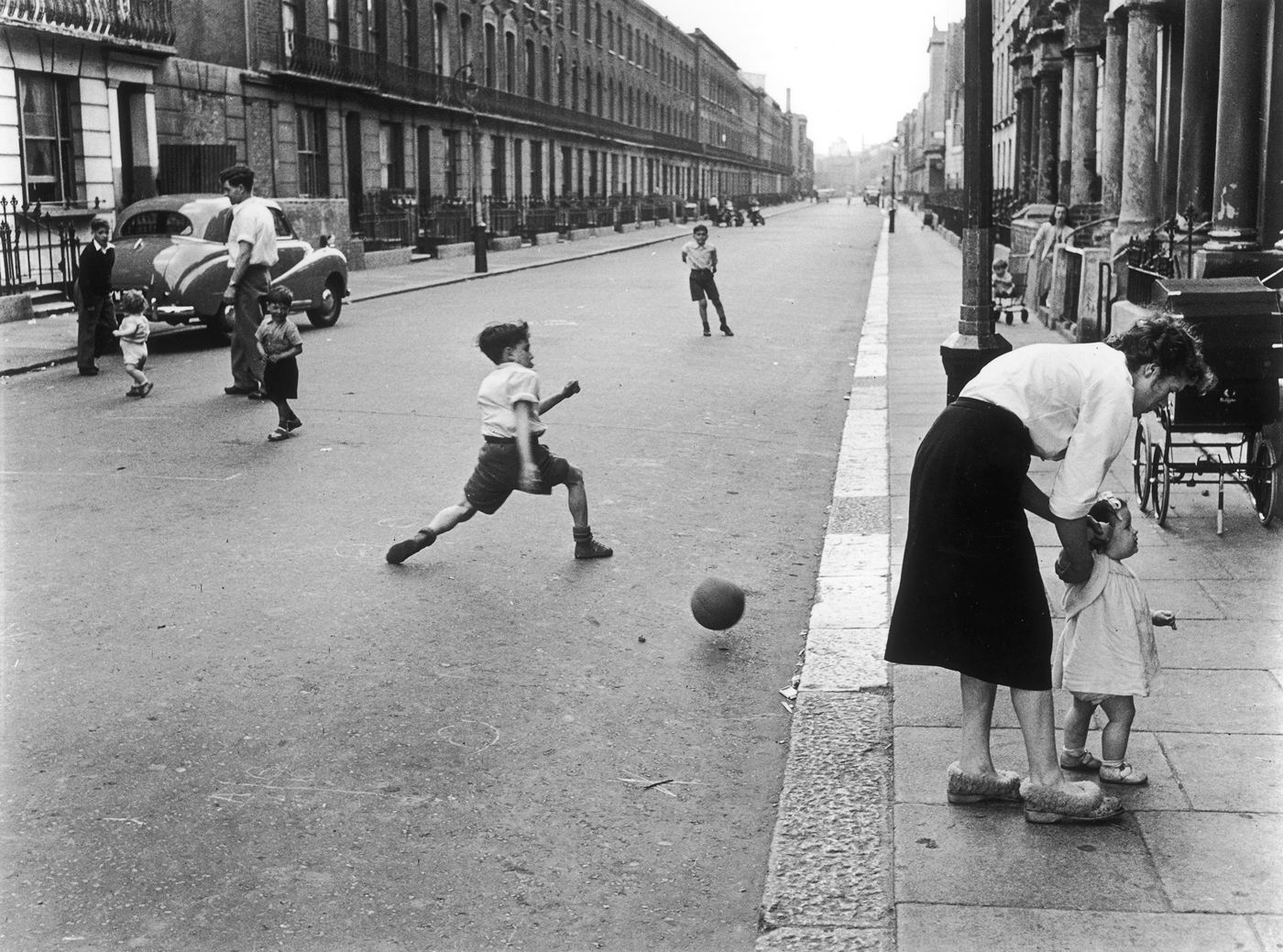
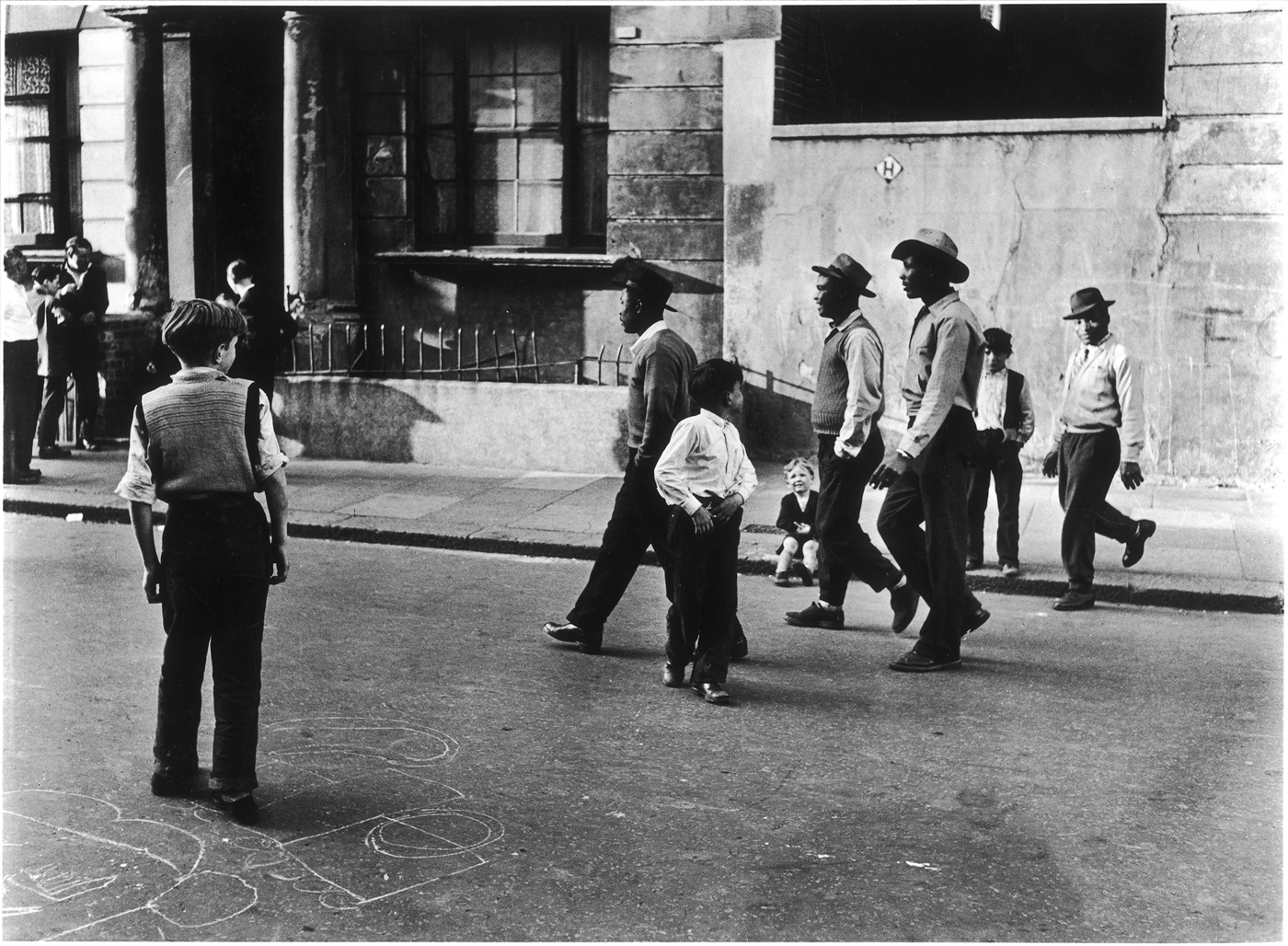
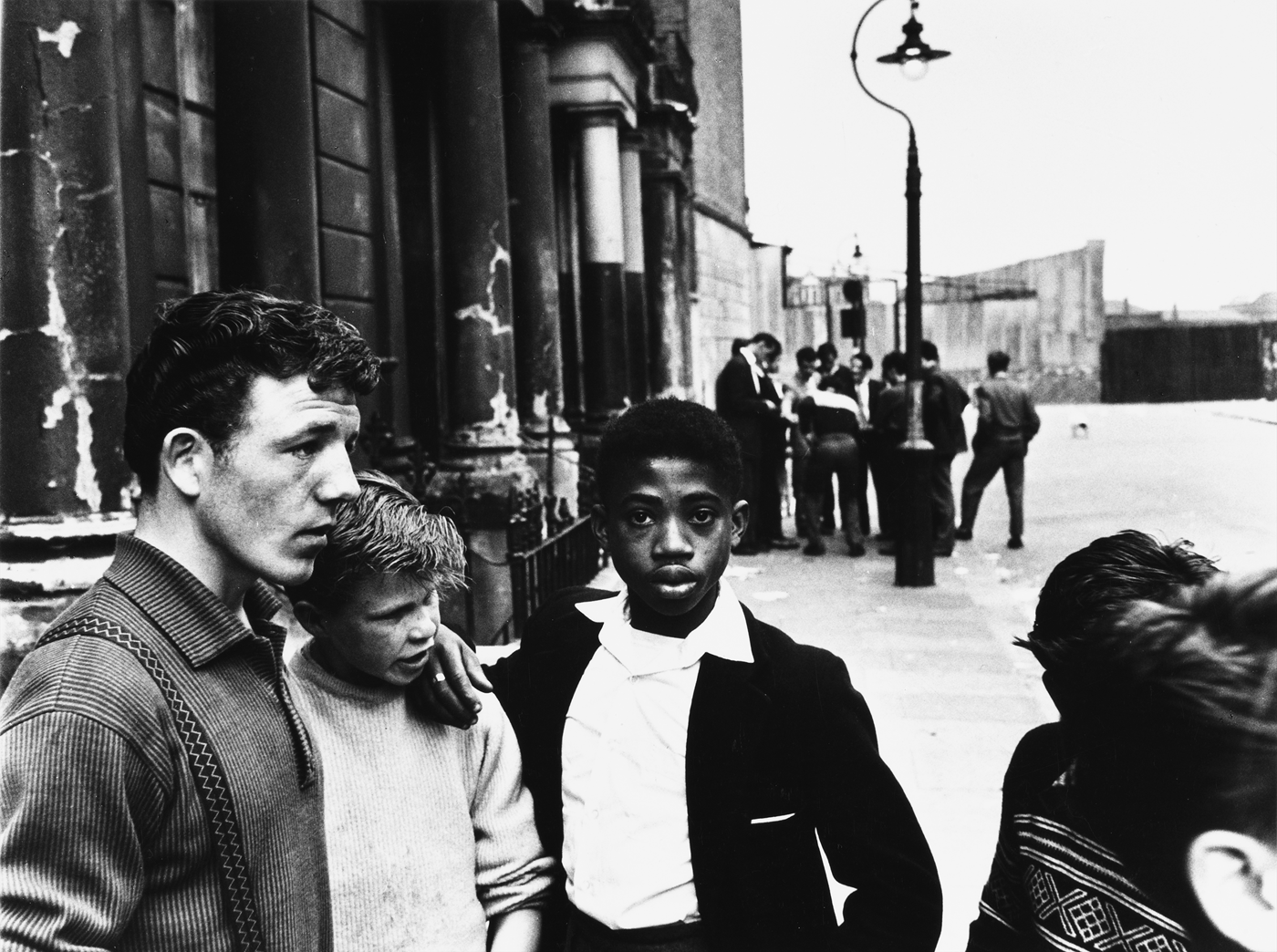
In 1956, Roger Mayne (1929–) took these photographs of Southam Street, Kensal New Town, London (fig. 1, “Football in the Street,” and fig. 2, “West Indian Men/London”). They formed part of a large series of photographic studies of the street he did between 1956 and 1961.Footnote 1 Mayne's pictures quickly became visual ciphers of the modern and the urban in postwar Britain. The Southam Street photographs obtained wide exposure in the pages of the Sunday Graphic, the Sunday Times, the Observer, The Times Educational Supplement, Vogue, and Queen. Mayne's work circulated in other ways in the fifties and sixties: he took the cover photograph for Colin MacInnes's totemic fictional exploration of fifties' youth culture, Absolute Beginners (1959); he illustrated articles on class and youth in the Universities and Left Review; and he provided the covers to several Penguin studies of poverty, class, and youth. Recent major exhibitions of British photography and London street photography have accorded the Southam Street pictures a central place in the representation of both city and nation in the twentieth century.Footnote 2
Roger Mayne, “Football in the Street.” Used with the permission of the Mary Evans Picture Library.

Roger Mayne, “West Indian Men in London.” Used with the permission of the Mary Evans Picture Library.
When Mayne's photographs of Southam Street were first seen in the 1950s and 1960s, the quality that attracted comment was their sense of immediacy, their ability to capture the dynamism of working-class life and chronicle new actors on the urban stage such as teenagers and African and West Indian immigrants. Responding to a show of the Southam Street photographs at the Institute of Contemporary Art in London, the Observer noted the way they “powerfully reflected” the “vitality of the working-class streets of London.”Footnote 3 According to Colin MacInnes, Mayne's Southam Street was the map of “a world of modern fact.”Footnote 4
But more recent responses to Mayne's work, particularly in the 1980s, have elided such immediacy and are instead colored by nostalgia, leaving his Southam Street as a place fixed in a lost past. The Southam Street photographs are often taken as odes to the richness of working-class life, particularly working-class childhood, before the impact of affluence and housing reform. An exhibition of the pictures at the Victoria and Albert Museum in 1986, for example, prompted fond recollections from the street's former inhabitants; one woman “proclaimed that if they rebuilt Southam Street as it was, she would be back there tomorrow.”Footnote 5 A BBC Timewatch program accompanying the exhibition featured interviews with former residents of Southam Street, whose nostalgic comments stressed its communal culture (“doors wide open”), as well as the sense of immediacy and lack of materialism that characterized life on Southam Street (“we didn't live for tomorrow, we lived for today”; “you never had nothing, but you had everything”).Footnote 6 These sentiments evoked an older understanding of working-class community, with its perceived roots in collectivism, modest material expectations, and “living in and for the present,” the political high noon of which was the 1940s.Footnote 7 Dissonant notes were sounded in the Timewatch documentary (“from a kid I detested it”; “I hated Southam Street”), but the dominant tenor was of loss.Footnote 8 The shadows cast by the tower blocks and housing estates supplanting places like Southam Street further darkened this tone.
Writers and critics have reinforced this sense of loss and nostalgia, particularly since the 1980s. A reviewer of Mayne's 1986 show remarked that the photographs were documents “frozen within a time frame and we are all travelers that travel away.”Footnote 9 Associating the disappearance of a particular kind of working-class street with the loss of a strong sense of working-class community is a familiar motif of postwar British history. In the social imagination of the late twentieth century, the “terraced street has become a powerful symbol of decency, compassion and survival,” in the words of David Gervais.Footnote 10 Such landscapes were altered, apparently irrevocably, by rehousing. Journalist Ray Gosling lamented, “[W]e were a slum rich in life, and now we've become a very boring, decent council estate.”Footnote 11 Not least, the landscape of the working-class street was eclipsed by the increasing importance of the council estate as an environment of working-class life and by contemporary difficulties in comprehending that environment.Footnote 12 Since the 1980s, the images of Southam Street have been taken as a means of returning to a more comprehensible place, along with a more comprehensible and comforting sense of class.Footnote 13 Doreen Massey has reflected that the idea of “place” comes loaded with meaning, often that “of a seamless coherence of character . . . singular, fixed and static.”Footnote 14 The stability and order of a “place” must be contrasted here, as Michel de Certeau has suggested, with the fluidity and instability of a “space.”Footnote 15 The nostalgic reaction to Mayne's Southam Street photographs suggests the welcome apprehension of a place and a class fixed in time, singular in their meaning. In this way, Andrew Blaikie has argued that an “an affective community of belonging” rooted in the past is created through photography.Footnote 16
The present article revisits Roger Mayne's Southam Street as a way of thinking about the postwar representation of a working-class London street. It uses this focused perspective as a line of sight on a broader landscape: the relationship among class, identity, and social change in the English city after the Second World War. Mayne's photographs of Southam Street afford an examination of the representation of economic and social change in the postwar city and, not least, the intersections among class, race, generation, and gender that shaped that city. They document and represent not only the persistence of older signifiers of class but also the emergence of new youth subcultures (such as Teddy boys and girls) and the growing importance of black Britons.
Revisiting Southam Street is also a way of thinking about the persistence and representation of working-class poverty in an age of affluence.Footnote 17 In the 1950s and 1960s, Southam Street probably seemed an oasis of poverty in a wider landscape of working-class affluence. But it was not a solitary oasis. There were other working-class areas documented in a variety of ways in the 1950s and 1970s that similarly stood as visceral demonstrations of the limits of affluence: Madeline Kerr's “Ship Street” in Liverpool; the Hulme and Salford photographed by Shirley Baker before their redevelopment; the Bethnal Green of Michael Young and Peter Willmott's investigations; Margaret Vassell's “Wellington Road”; or St. Ann's Road in Nottingham, the focus of Ken Coates and Richard Silburn's study of Poverty: The Forgotten Englishmen (1971).Footnote 18
The first aim of this article is to restore the sense of immediacy to Mayne's portrait of a working-class street. This article strips away the nostalgic veneer Mayne's photographs have acquired in recent years. Instead, it reflects upon what the immediacy of his pictures might mean in terms of the representation of postwar working-class identity.
Mayne's photographs are often taken as the representation of a working-class community at a decisive moment, the moment before that community was lost, literally, to the bulldozers, and, metaphorically, to the effects of postwar rehousing, immigration, and affluence. There is a parallel here with how we perceive the history of working-class identity in postwar British society. The waning salience of class as a social identity is a recurrent theme in some recent accounts of postwar society, with the suggestion that “the traditional markers of class and community had been profoundly dislocated” in this new world, increasingly experienced only through a passive nostalgia.Footnote 19 The difficulty with such accounts is, as Ben Jones has rightly argued, a reductive view of working-class nostalgia.Footnote 20 But more broadly, these accounts may also overstate the disruption of working-class life and identity after 1945 by affluence, welfare, rehousing, or the introduction of new kinds of social actors, such as immigrants and youth. Such a perspective leaves us less able to explain class identity in the late twentieth century.
This article will argue that Mayne's photographs are representations of working-class identity and community, not at the point of disappearance, but rather at a moment when working-class identity and community were being reworked and rearticulated. This reworking and rearticulation occurred within the context of class, not outside of it. Mayne's photographs literally and metaphorically framed these changes within the traditional context of a working-class street. To adopt terms from photographic criticism, Mayne's photographs offered what Geoff Dyer has called an “ongoing moment” in the life of the postwar working classes, rather than a “decisive moment” following the famous dictum of Henri Cartier-Bresson.Footnote 21 Mayne's Southam Street pictures present a narrative that mixes elements of change and loss with those of continuity. The underlying characteristics of this unfolding narrative are its dynamism and lack of closure.Footnote 22 Such a narrative opened out not in an ordered and stable “place,” easily transformed into passive nostalgia, but rather in a “space,” the fluidities, angularities, and instabilities of which need to be recognized even if they cannot be easily resolved. Mayne's photographs told this ongoing story in several ways: in relationship to the progressive management of postwar society; with regard to the intersections between class and more novel categories of social identity, such as race and generation; and, not least, with reference to the uncertain reach of affluence itself and the persistence of poverty.
The present article uses photography as a way of exploring postwar British history. Methodologically, this includes thinking about photographic practice and composition in historical analysis.Footnote 23 I do not present Mayne's photographs as unproblematic and unmediated “documents” of a particular social reality. There is, of course, a crucial tension in any “documentary” work between the subjective position of the artist or writer and the object of documentation.Footnote 24 An insistent theme in the history of twentieth-century British documentary photography is the relationship between middle-class photographers and working-class subjects. Mayne brought a particular vision to photographing Southam Street. His was a middle-class, white, and male eye. He was a visitor to Southam Street rather than one of its inhabitants.Footnote 25 The Southam Street photographs were also a construction of Mayne's own identity. I have been careful throughout the article to refer to the group of photographs Mayne produced as his Southam Street to indicate that this is a singular and partial construction. But even with such qualifications, Mayne's photographs represent a powerful construction, shaping the way class and the city after 1945 are understood. It is a construction that has important political consequences, in, for example, the valency we give class as a social category in the late twentieth century. This article highlights particular aspects of that construction (by thinking about visual composition, for instance) in order to challenge existing historical understandings of the 1950s and 1960s. Through the exploration of a discrete set of photographs by a particular photographer, we can find a new way of thinking about postwar Britain.
I
This article is based upon the engagement between a photographer and a place. Some attention must of course be given to both, as well as to the context of urban photography in twentieth-century Britain. First of all, the street itself. In the 1950s, Southam Street was in the Golborne Ward of the borough of Kensington, tucked between the rail line west out of Paddington and the Grand Union Canal, northeast of Portobello market, on the border between Kensal New Town and North Kensington. The street was an example of what Colin MacInnes called London's “crazy little islands of slum habitation shut off from the world by concrete precipices, and linked by metal bridges.”Footnote 26
In 1964, the social researcher Pearl Jepthcott characterized conditions in the Southam Street area as “those of any nineteenth-century urban slum.”Footnote 27 These conditions had been established early in the nineteenth century by the building of the canal, the Great Western Railway, Kensal Cemetery, and the Western Gas Company gasworks. Even before residential development began in the 1840s, the Survey of London remarked, “the ingredients for the making of a slum were . . . already present.”Footnote 28 The proximity of the Piggeries and Potteries in Notting Dale with their high levels of cholera and smallpox did not help. In the 1860s and 1870s, four-story terrace houses were built in Southam Street, “tightly-packed . . . with no front gardens.”Footnote 29 When Charles Booth visited the street toward the end of the nineteenth century, he found a “great deal of dark blue in this street,” meaning “very poor, casual, chronic want”; the men of the street were “labourers” and “navvies” and the women worked in the laundries of Kensal Town.Footnote 30 In 1893, North Kensington and Kensal New Town were tarred by the Daily News as “A West-End Avernus.”Footnote 31 Nearly two decades later, the London County Council built a small garden nearby in the recognition that the children of the area had nowhere to play “except in the streets.”Footnote 32
Slum conditions in Southam Street persisted in the twentieth century. Overcrowding was the main problem. In 1924, F. M. Gladstone noted that the “bad housing accommodation” in Southam Street “surpass[ed] even the special area of Notting Dale.”Footnote 33 At that point, 2,500 people were living in 140 houses; the population density by 1938 was 390 to the acre.Footnote 34 In 1961, Southam Street remained the “most densely crowded district in London,” with 1.5 persons per room for 40 percent of the local population.Footnote 35 The 1930s witnessed early attempts at clearance and redevelopment. Basement rooms were closed, and about nearly 2,000 residents in the area moved to new houses. This did not solve the housing problem. In 1963, Southam Street was selected for large-scale redevelopment as part of the London County Council Comprehensive Development Plan.
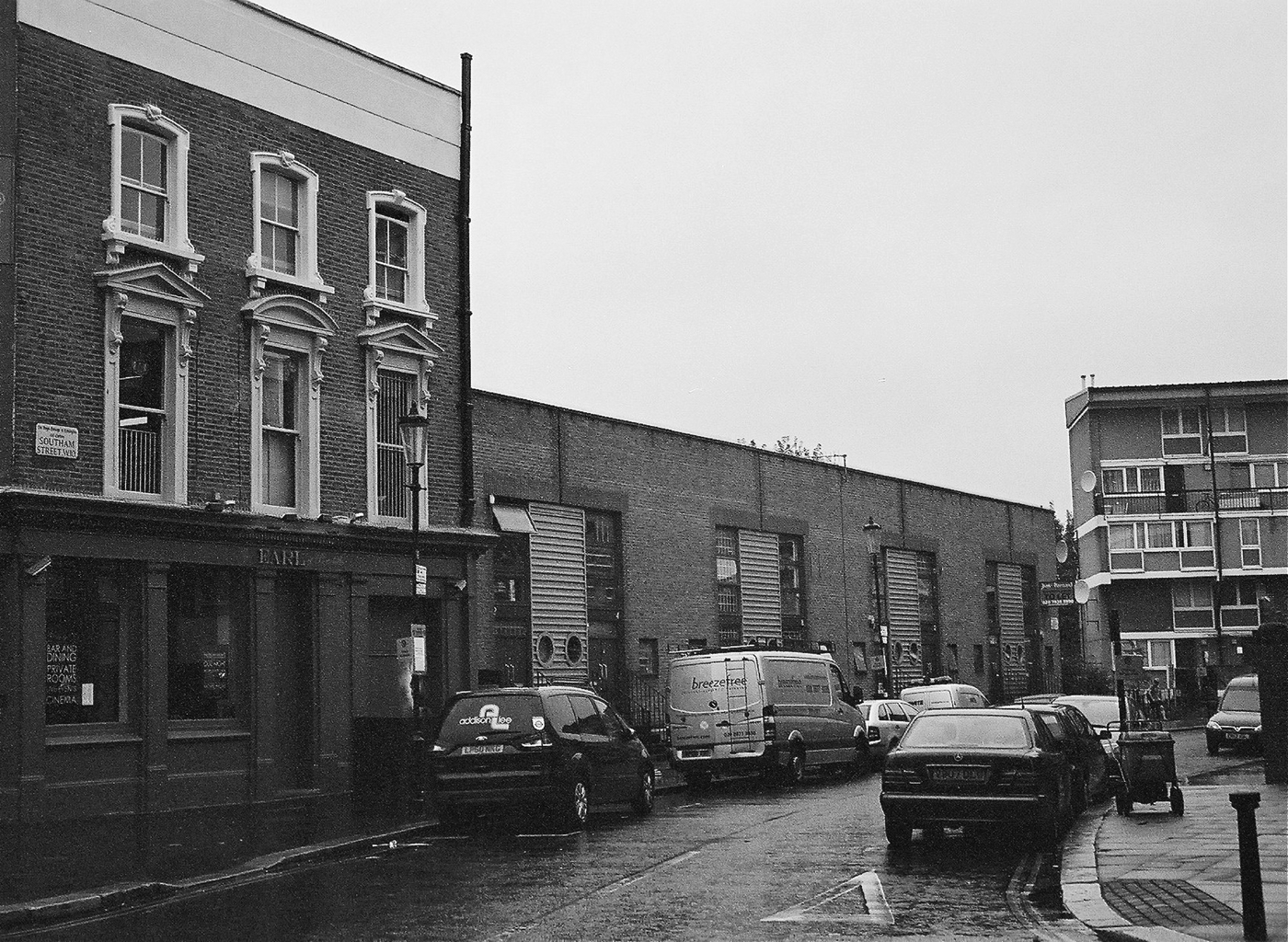
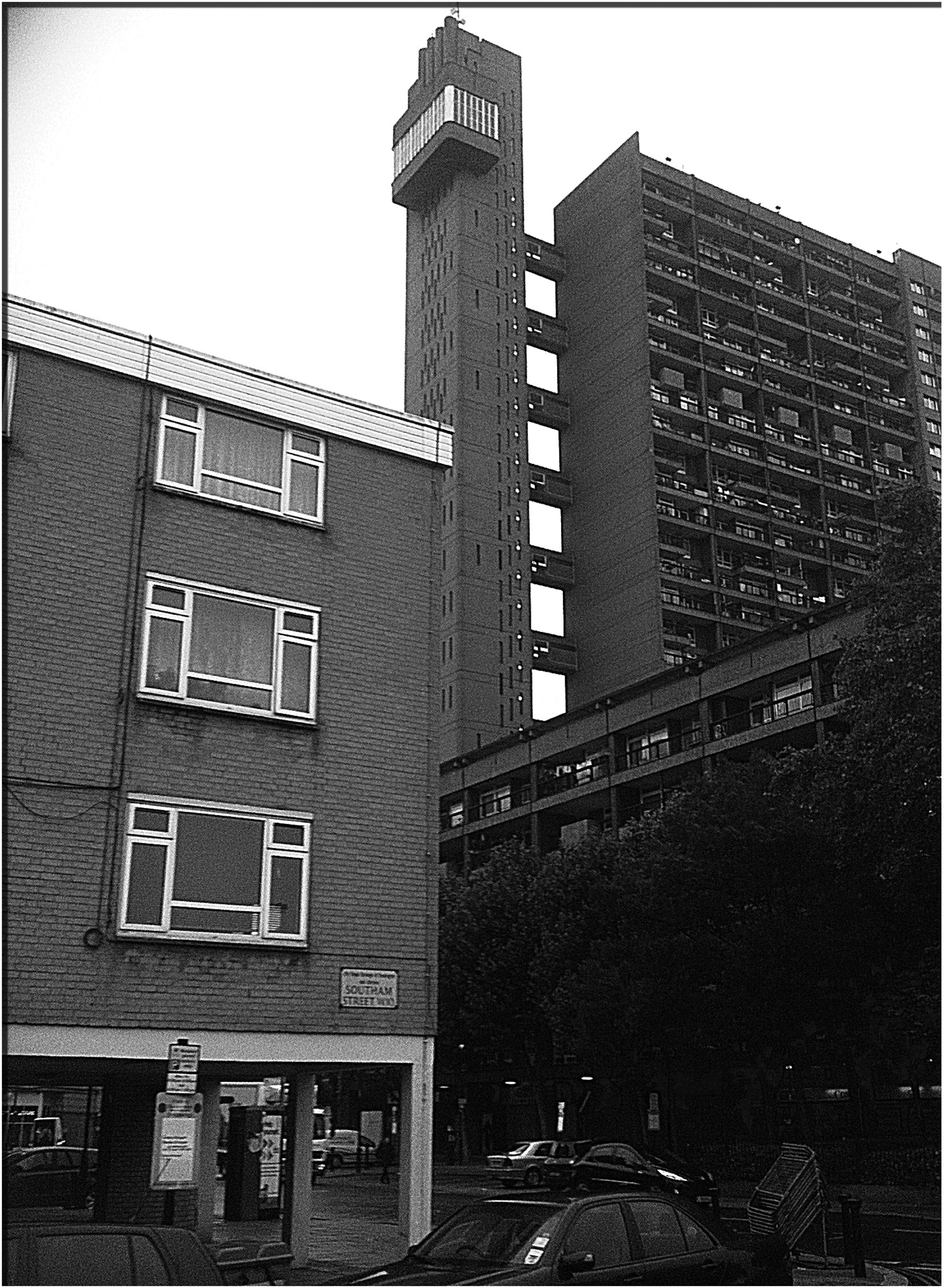
Today, Southam Street is largely unrecognizable from its previous iteration. Where once it extended from Adair Road, past Golborne Road and Kensal Place, to turn north into Kensal Road, Southam Street presently goes only from Adair Road to Golborne Road, a distance of perhaps two hundred yards (see fig. 3, “Southam Street, Looking West, 2011”). Elkstone Road, the street that replaced the eastern part of Southam Street, is not primarily residential. Local housing is now found in enclosed estates northeast off Elkstone Road, west and north between Adair and Bosworth Roads, and in the famous Brutalist block, Trellick Tower, designed by Ernö Goldfinger (see fig. 4, “Southam Street, Looking North, 2011”). The four-story terraces have disappeared, unlike in other formerly deprived areas of North Kensington and Notting Hill, such as St. Stephen's Gardens, where they became lodestones for gentrification.
“Southam Street, Looking West, 2011.” Author's photograph.
“Southam Street, Looking North, 2011.” Author's photograph.
For most of the twentieth century, the population of North Kensington was poor and often transient. The area still offered local employment, such as in the gasworks or laundries, or for women in the 1950s, at a Smiths crisps factory. Unlike the Notting Hill of today, North Kensington and Kensal New Town were homogeneous in class terms in the nineteenth and early twentieth centuries; the main divisions and tensions were along sectarian lines. Irish migrants dominated the population. From the 1930s, the area began to reflect a growing cosmopolitanism, particularly with the arrival of West Indian and African migrants after 1948.Footnote 36 Writing in the 1960s, sociologist Ruth Glass included Southam Street as one of several “zones of transition” with a significant Afro-Caribbean population.Footnote 37 Around the same time, Jepthcott wrote of the “[s]aris and sandals, the Sikh's white turban and black beard, the carefully careless headscarf of the Nigerian, and the goffered guimp of the Italian nun [that] lend a (slightly seedy) exoticism to the area.”Footnote 38 The new migrants were forced into “sub-standard housing at luxury prices”; in this way, the mark of Rachmanism fell heavily on areas like Southam Street.Footnote 39 The new residents also faced considerable racism, as Mike Phillips has written: “Life there at the start of the sixties was a perpetually difficult and precarious round. Finding a place to live, keeping an exhausting job . . . avoiding assaults on the street by white racists or policemen, and putting up with a dozen daily pinpricks of harassment or insult.”Footnote 40 In 1958, white assaults on black residents of Notting Hill erupted into rioting. This was followed by concerted efforts by racist politicians such as Oswald Mosley, once leader of the British Union of Fascists, to enflame white fears. On 17 May 1959, Southam Street itself was horrifically stained by racial violence: Kelso Cochrane, a thirty-two-year-old carpenter originally from Antigua, was murdered by a group of white youths at the corner of Southam Street and Golborne Road.Footnote 41 The murderers were never brought to justice, but Cochrane's funeral was a catalyst for the emergence of a more assertive West Indian community, a “critical moment of political mobilization” that “began the West Indian decade of Notting Hill.”Footnote 42
II
How did the camera capture areas like Southam Street in the twentieth century? The invention of photography coincided with urbanization, and street photography was an early genre of the young form.Footnote 43 John Thomson's Street Life in London appeared in 1877, the first major photographic documentation of the metropolis. Representing the working classes went hand in hand with representing the city. This was, to some extent, a social or political imperative, a desire to document and expose conditions of the urban poor to a middle-class audience in order to prompt social reform. There were recurring visual motifs in this work—families enclosed in cramped and dirty courts and closes, children playing in the street, and women doing washing outdoors. Street children were a particularly important cipher of the problem of urban poverty.Footnote 44
Between the wars, the growth of street and documentary photography was aided by smaller cameras and faster film.Footnote 45 The rise of pictorial magazines such as Picture Post created a demand for photographs of ordinary urban life, as seen in the work of the working-class photographer Bert Hardy.Footnote 46 But a social agenda still drove much of the representation of the urban working classes. In London, Cyril Arapoff and Margaret Monck photographed slum conditions, while Edith Tudor Hart wedded street photography to an explicitly socialist commitment.Footnote 47 Humphrey Spender's work for Mass Observation in Bolton offered a photographic botany of the ordinary life of working-class people.Footnote 48
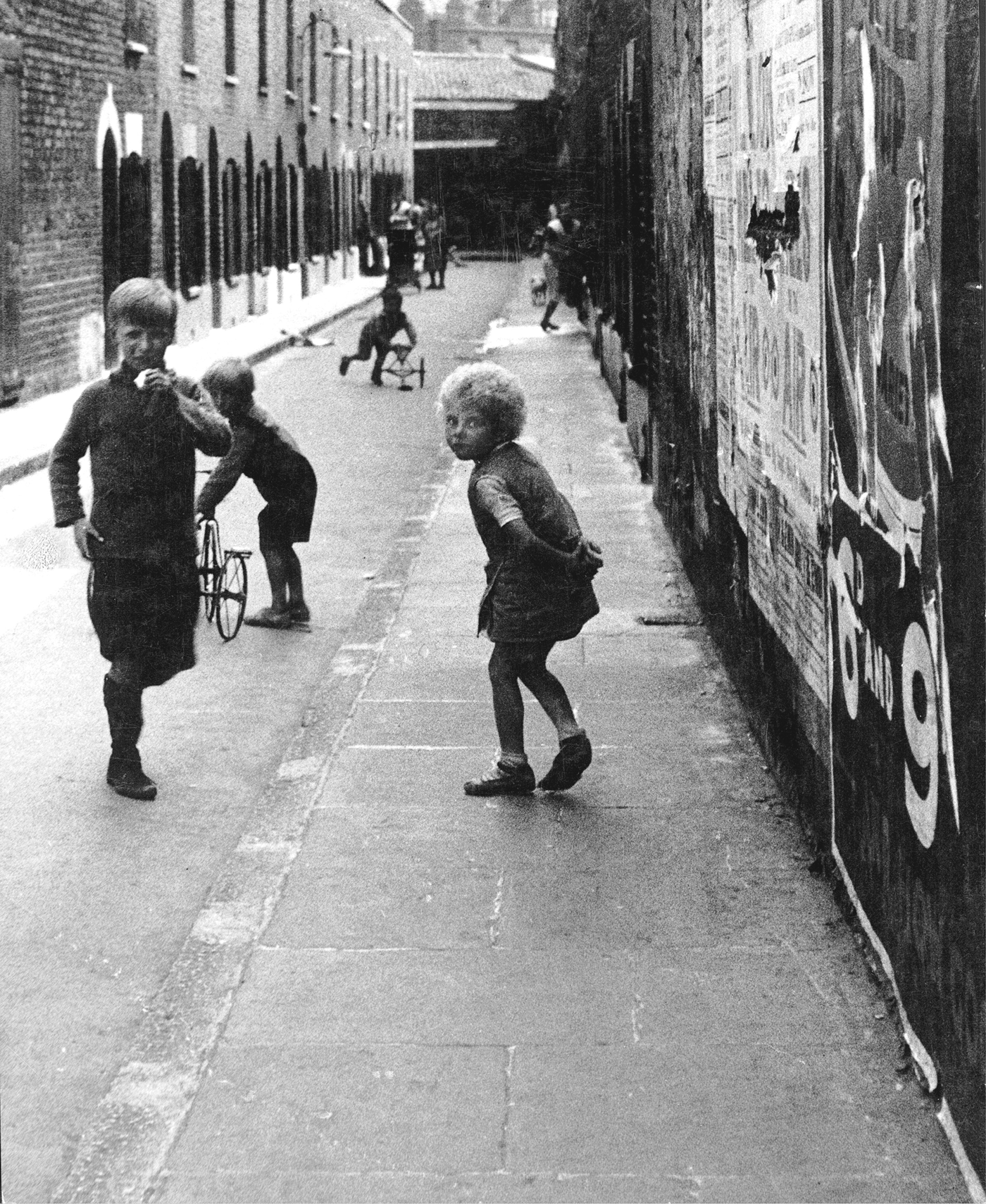
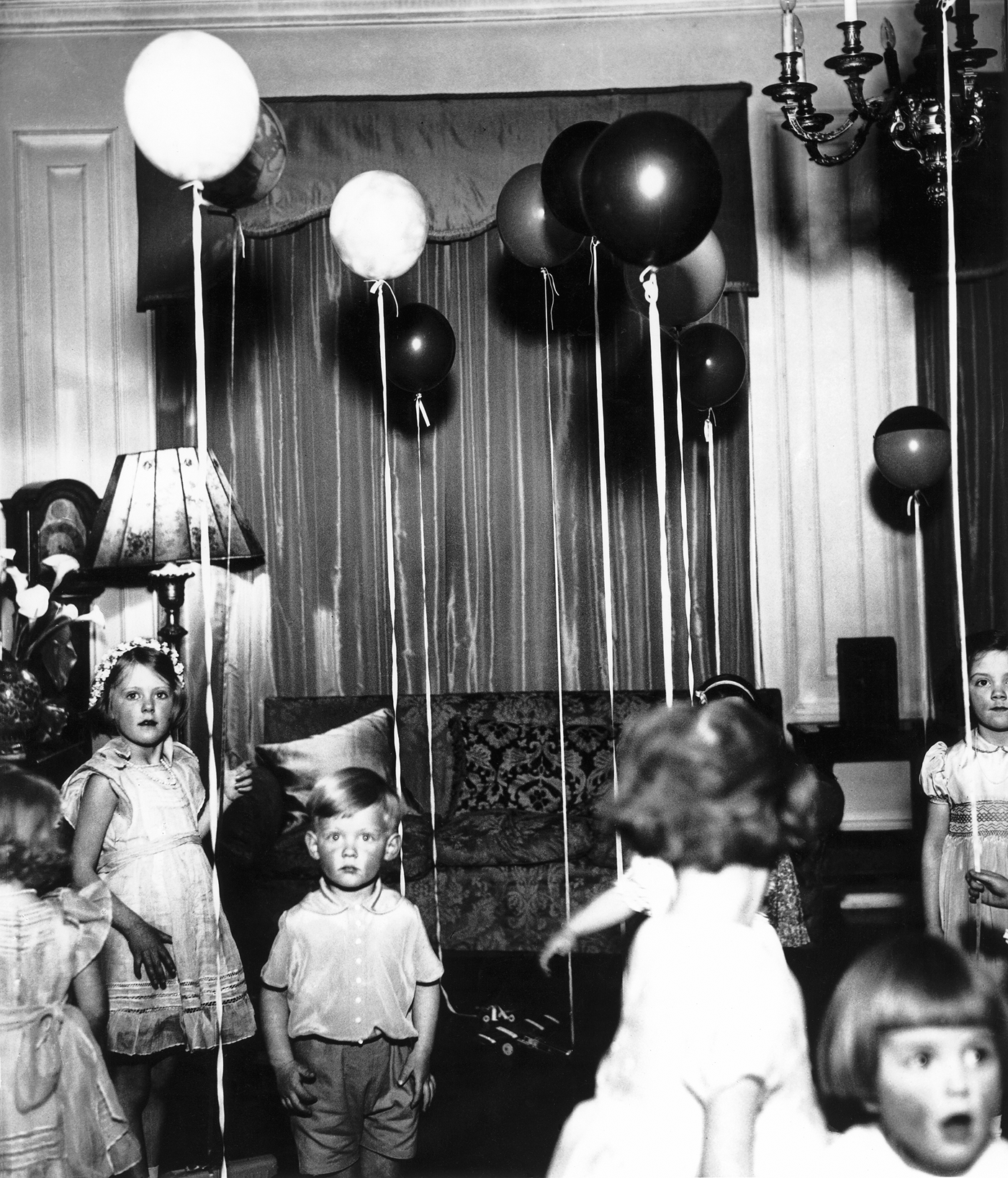
Documentary and street photography in the interwar period took the working classes as their subject, but such images also helped constitute a particular view of middle-class identity. Bill Brandt's The English at Home (1936) provides a useful example. In this photobook, the German-born Brandt used contrasting photographs on facing pages to represent the social dichotomy that he believed defined England. The facing pages featuring “East End Playground” (fig. 5) and “Kensington Children's Party” (fig. 6) were particularly striking examples of this technique.Footnote 49 On the surface, the disparity portrayed in the photographs is obvious: play for the upper-class children of Kensington is within a comfortable interior; for the working-class children of the East End, it is outside on the rough streets. The material limitations of working-class life are suggested by the heavy framing of the walls and terraced houses, lines that lead the viewer toward an apparent dead end. But Brandt offered another way of thinking about class difference with these photographs. Emotional deprivation as much as economic deprivation might also be taken as a theme of The English at Home. In this register, Brandt reverses the position of the classes, with “richness” accorded to the working classes rather than the upper classes. Throughout The English at Home, photographs of the upper classes emphasize their formality and stiffness, hinting at a lack of connection between people, even a lack of life. By contrast, his pictures of the working classes underline warmth, closeness, and physical connection, despite deprived material circumstances; they are often also studies of movement, again to suggest life. The portrait of the “Kensington Children's Party” is uncannily static, with the balloons hanging in a parallel, stiff formation; two children return the photographer's gaze blankly, as if practicing the formality they will adopt or inherit in later life. Set against this is the dynamism and life evident in “East End Playground” despite the limitations of its environment; all four of the children in the frame are in movement, traveling in different directions in relationship to the viewer.
Bill Brandt, “East End Playground,” 1936. Used with the permission of the Bill Brandt Archive.
Bill Brandt, “Kensington Children's Party,” 1936. Used with the permission of the Bill Brandt Archive.
By the time Mayne began photographing Southam Street in the 1950s, therefore, there was a tradition of street and documentary photography that had set up particular ways of representing working-class streets and working-class people while, at the same time, reflecting the middle-class eye. In the 1950s, photographers such as Shirley Baker in Manchester, Oscar Marzaroli in Glasgow, Nigel Henderson in London, and, of course, Mayne himself explored this tradition in changing economic and social circumstances. Cinema was also important in this regard. In the 1930s, the documentary movement consciously attempted to rescue working-class people from being either part of the background of British films or merely reduced to caricature. The legacy of this in the 1940s and 1950s can be seen in the work of Humphrey Jennings and later the Free Cinema. The arrival of the so-called new wave brought working-class stories and working-class landscapes onto the screen, often with a particular visual vocabulary: “shots of canals, street scenes, the pub, the fairground, the bus journey, the visit to the nearby countryside . . . townscapes made picturesque, squalor aestheticized.”Footnote 50
III
Roger Mayne was twenty-seven when he began photographing Southam Street. His background lay a world away from its terraces. Mayne was the son of a schoolmaster. His childhood, according to Mayne's wife, the playwright Ann Jellicoe, was “severe, stern . . . [t]here was love and security but the value of play, imagination or social relationships was never recognized.”Footnote 51 Mayne was educated at Rugby and Balliol College, Oxford, where he studied chemistry.Footnote 52 After the death of his father, Mayne turned his back on a middle-class professional career and moved to London in 1954 to pursue what had been a hobby: photography.Footnote 53 Mayne initially gravitated, as many photographers did, toward the East End as a subject. But he discovered another working-class world much closer to his own flat in Holland Park: Southam Street. By this time, Mayne had already enjoyed success as a photographer; one of his first professional sets was published in Picture Post.Footnote 54 He was influenced by the street photographs of Walker Evans and Henri Cartier-Bresson, as well as the work of the lesser-known British photographer Hugo van Wadenoyen. He also admired the work of Bert Hardy in Picture Post. In terms of a tradition of street photography in Britain, he knew Cyril Arapoff and was aware of the work of Wolf Suschitsky. But he has also remarked recently that he did not “feel there was any real tradition of British photography in a cultural sense,” suggesting that he did not set his own work in any particular lineage.Footnote 55 He was closer, in this regard, to his contemporaries, Nigel Henderson and John Deakin, and to non-British observers of London in the 1950s, such as the Swiss Robert Frank and the Chilean Sergio Larrain.Footnote 56
In the 1950s, Southam Street became Mayne's geographic muse.Footnote 57 He has commented that he was “drawn to crumbling streets.”Footnote 58 To him, they had an inherent beauty and life:
Empty, the streets have their own kind of beauty, a kind of decaying splendour, and always great atmosphere. . . . My reason for photographing the poor streets is that I love them, and the life on them. . . . [I]t may be warm and friendly on a sunny spring weekend when the street is swarming with children playing.Footnote 59
Mayne wrote this for Universities and Left Review, a journal that used some of his photographs to illustrate articles on the rise of “classlessness” and the politics of youth. Though Mayne embraced the “new morality” of the fifties, meaning a modern approach to social and cultural mores, he eschewed any particular political commitment; he was “NOT a social realist or engagé.”Footnote 60 Unlike street photographers of an earlier era, he was skeptical about political engagement and interpretation:
To those who find slums unduly depressing, my photographs will appear as social comment. A photograph of boys leaping for a football in a street might be suitable for a Labour poster. But the attitude of aspiration might equally well express Conservative ideals. . . . I question also how much our young Left has discovered in actual experience and knowledge of the working classes.Footnote 61
Mayne has suggested that he was aware of Southam Street's poverty but also that he was not “photographing consciously to show social conditions.”Footnote 62 He was attracted to it on artistic and personal grounds.
Mayne brought a particular aesthetic sensibility to photographing Southam Street. In the 1940s and 1950s, there was a sea change in European and North American photography. The pictorialist style was increasingly eclipsed by a modernist one that emphasized informality and immediacy, aided by the use of smaller, 35 mm cameras. Mayne used a Zeiss Super Ikonta, the portability of which helped him in his pursuit of what has been called his “constant subject of spontaneity.”Footnote 63 This extended to the composition of his photographs and their rejection of pictorialist framing. Another element of the spontaneity of Mayne's work was the way many of his photographs avoided conscious or formal posing of his subjects. These were photographs taken of fleeting moments. Ben Highmore has suggested that the work of Mayne's friend Nigel Henderson was characterized by a “hopscotch modernism,” drawing eclectically from modernist trends in social observation and surrealism; there are echoes of this diverse lineage in Mayne's work.Footnote 64
Being a photographer on Southam Street was, initially, to be a foreign presence. Mayne joked that “the teenage boys, unaccustomed to seeing a photographer prowling their streets, assumed I was with the police.”Footnote 65 Mayne was, of course, divided from his subjects on a number of different planes: most broadly, in terms of class, but also, depending upon the particular photograph, in terms of gender, generation, and race. He was a white, middle-class man in his late twenties. This is not to say that Mayne did not get to know his subjects over the course of his nearly thirty visits and 1,400 photographs. Photographs of Mayne with some of Southam Street's residents (see fig. 7) suggest a familiarity and comfort between Mayne and the local people. Many of the photographs Mayne was able to take suggest that local people accepted his presence (by, for example, not staring or glaring at his camera).
Unknown photographer, “Roger Mayne in Southam Street.” Used with the permission of the Mary Evans Picture Library.
Mayne once remarked that his aims in photographing Southam Street were to document its environment and people, to find art in that life, the “beauty” of the “crumbling streets,” but also to fulfill a more subjective desire, “to make contact with people.”Footnote 66 This was consonant with other middle-class writers and artists in the 1950s, such as Nigel Henderson, B. S. Johnson, Colin MacInnes, Doris Lessing, and Nell Dunn, who sought life, authenticity, and, not least, connection in London's working-class neighborhoods.Footnote 67 This article focuses more on Mayne's representation of Southam Street, but as with writers like Dunn, Mayne's voyage into a working-class area was also about self-discovery, even if, unlike Dunn, he did not immerse himself in living and working in the street. His wife, Ann Jellicoe, suggested that Mayne was partly drawn to the vibrant street life of Southam Street as a response to the emotional constraints of his own childhood.Footnote 68 The Southam Street photographs thus represent, in part, a self-reflective comment upon the restraint and coldness of middle-class life.
Of course, despite this desire to make connections across a social divide, the position of middle-class observer remains one of considerable class power. Middle-class writers, photographers, and artists are, as Richard Jenkins suggests, “strategically placed others” in working-class areas; the act of categorization is their power.Footnote 69 And through his photographs, Mayne did present both a vision and a version of Southam Street. The dominant tone in that version of a working-class street is a celebration of its life, seen in the attention he paid to physical movement, to connections between people, and to the sense of community he evoked. Undoubtedly, this might be seen as a romanticization or sentimentalization of working-class and, indeed, slum life, which passed over the very real problems of poverty and division in favor of qualities such as community and joy.Footnote 70 But it was not an entirely reductive romanticization. As I shall argue, Mayne's photographs actually got at, for example, the tension between continuing deprivation and rising living standards, as well as the divisions and the connections within working-class life. In this sense, as constructions of the working class, the photographs need to be seen in a more nuanced context.
Mayne's representation of Southam Street was also self-reflective. For Mayne, it is possible that Southam Street became a space in which he found a connection and warmth that his own childhood and class background had lacked. Like Brandt's photographs in The English at Home, the life portrayed in Mayne's Southam Street photographs could be taken as a comment on the emotional absences in middle-class life. The politics of a middle-class observer require some broader reflection in this regard. In the postwar period, it has been argued that the welfare state, the managed economy, and British “modernity” were accompanied by new regimes of social management, surveillance, and authority presided over by middle-class experts and professionals interested in exerting a new kind of class power.Footnote 71 Mayne certainly represented the working class through a middle-class eye, but that representation suggested less the assertion of middle-class authority than its abdication. Indeed, his photographs offered an implicit critique of middle-class emotional life in their celebration of working-class community and connection.
IV
Within the pages of Universities and Left Review, in articles that Mayne's Southam Street photographs sometimes illustrated, New Left intellectuals like Stuart Hall and Raphael Samuel debated whether affluence and welfare had brought about a classless society.Footnote 72 But Mayne's photographs were much less uncertain about this question: they evoked a world still marked and bounded very strongly by class.
The most important point in this regard was that the street was the world in Mayne's Southam Street. His photographs portray a life and community lived outside, on the street and on doorsteps, in clumps of women, children, and young men. These pictures suggest how the external environment both provided the foundation of its community and bound the lives of Southam Street's inhabitants. Mayne's representation of the primacy of the street and the physical environment of Southam Street marked it out as a distinctive and sometimes enclosed working-class world.
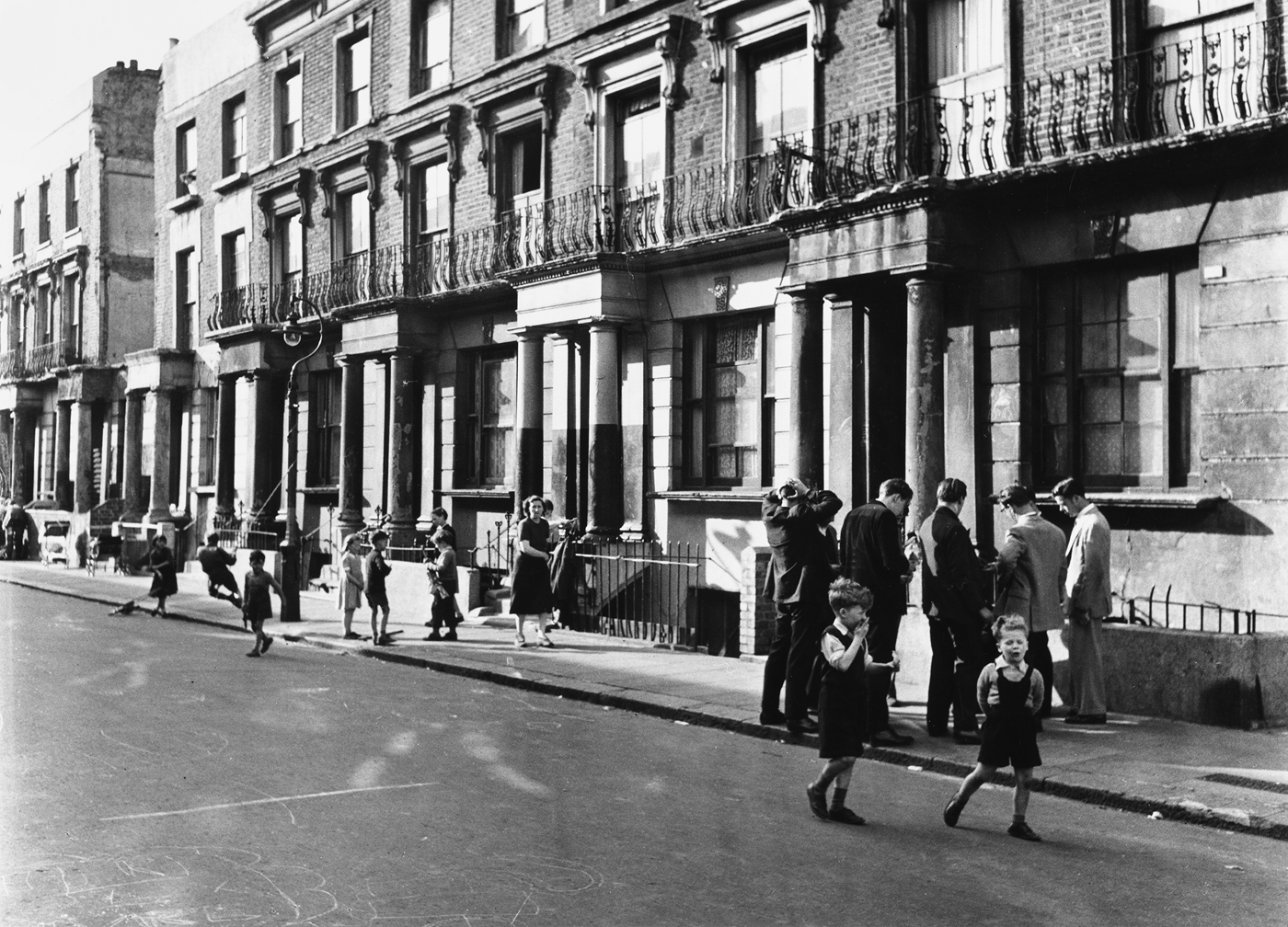
The compositional elements of many of Mayne's photographs of Southam Street underline the importance of the street and, indeed, the entwining of people with environment. In figure 1, “Street Football,” for example, most of the figures in the photograph are placed deep within the frame, rather than in the foreground. This embeds the people of Southam Street firmly within their particular physical environment. The street is a dominating presence in the photographs in other ways. In “Street Football,” as in many of the photographs of Southam Street, the rows of terraced houses and the curbs of the street organize the composition of the photograph. The lines of terraced houses and the curbs lend perspective to the photograph, taking the eye from the foreground to the optical “vanishing point” in the distance. The lines of figures within this compositional organization afford the photograph a kind of contrapuntal rhythm, taking the eye diagonally back and forth across the street, a dynamic that emphasizes the heavy lines of the houses and the street. “Southam Street, 1959” (fig. 8) is a more static picture, but the terraced houses and the lines of the street dominate the frame as they do in “Street Football.” In this example, they serve as a backdrop to the children, women, and men outside. Once again, the physical environment of the street is an important presence; the figures in the photograph are placed against the looming backdrop of the steps and walls of the houses.
Roger Mayne, “Southam Street, 1959.” Used with the permission of the Mary Evans Picture Library.
On that street, children play and adults talk and watch the world. The street is the stage for their life. But the street is also a boundary. The heavy terraces and walls of Southam Street lend a sense of constraint: working-class life might have been built on the streets and doorsteps, but it was lived literally confined by the built environment. The eye is disciplined to see people framed in or against a series of enclosures or walls. There are few sweeping panoramas or distant horizons. Figures in this landscape are consistently framed by lines of terraced houses, by brick walls and by doorways. There are many fewer portraits of people removed from the landscape.
The composition of “Street Football” and “Southam Street, 1959” thus emphasizes the double meaning of the working-class street—its possibilities and its constraints. Mayne's photographs evoke a distinctive world, marked off from other worlds. In Mayne's Southam Street, the street was the world in another respect: there were no interiors. The photographic representation of Southam Street and its inhabitants ended at the door. Mayne has remarked that he did not “particularly want to take the interiors. The Street was one kind of Life.”Footnote 73 In this regard, he wanted to distinguish his photographs of Southam Street from a “Picture Story, which of course would involve interiors, schools work even,” of the kind Bill Brandt had done, for example, of housing in Birmingham for the Bournville Village Trust.Footnote 74
The assertion of a distinct working-class world in Mayne's Southam Street can be perceived in two further ways: one in relation to other classes and other strata of the working classes in the 1950s, the other in regard to the idea of a progressive, managed social democracy. With respect to the first, Mayne's Southam Street photographs and their emphasis upon an exterior world can be linked to the tradition of urban and slum photography in the late nineteenth century, which often associated working-class life with life out-of-doors and on the streets. This portrait resonates with the identification of working-class people with the outside world, with the public life of the street.Footnote 75 Representations of such sociability are the visual equivalent of a tradition of specifically working-class autobiography that Carolyn Steedman has characterized as featuring the “disorganized life of sprawling families,” a sense of the excess of working-class life.Footnote 76 This might be contrasted with the way middle-class people were associated visually with domesticity and institutional life, interiors representing private and public respectability, and restraint.Footnote 77 It should also be set against the image of a new working-class domesticity beginning in the 1930s and developing in the 1950s.Footnote 78 Affluence was increasingly associated with privacy. In his study of The Worker in an Affluent Society (1961), for example, Ferdynand Zweig noted that working-class sociability broke down as people moved up the social ladder: “the higher the level of prosperity, the higher the fences.”Footnote 79 By contrast, Mayne's photographs represent a public rather than a private world, a link to an older sense of working-class community. In this way, following Judith Butler's analysis, class is performed in Mayne's photographs.Footnote 80
The explicitly public life of Southam Street can also be distinguished from the progressive, managed public sphere of reconstruction and affluence after 1945. David Matless and Richard Hornsey have suggested that ideas of managed public space went along with new visions of managed domesticity and private space—in other words, the interior and the exterior were meshed together.Footnote 81 The new age of affluence was associated with a greater emphasis on domesticity and privacy, an ideology and a lived experience that was assumed, by the likes of Michael Young and Peter Willmott, to have enveloped the working classes as much as the middle class, sometimes at the cost of traditional ideas of working-class community.Footnote 82 The origins and scope of this ideology and experience have been rightly questioned.Footnote 83 In Mayne's Southam Street, the external environment and the social world remained stronger motifs than the domestic and the private. In his photographs, an excess of external life works against the grain of postwar ideas of managed space, a rejection of the “prescribed landscape of proper social relations.”Footnote 84 The sociologist Ruth Glass's description of areas like Southam Street from the early 1960s gets at this juxtaposition between the vibrancy of street life and the transgression or degeneration of an “ideal” community:
The streets are often wide, and they are also lively. Especially in the summer months, the people congregate outdoors; they come out of their overcrowded lodgings as much as possible. There is a great deal of movement, and of visual diversity. . . . Here at the fringes of the present zone of transition are Notting Dale and Kensal New Town—areas which were in transition in the late nineteenth century, and which have become the rotten parts of the Royal Borough . . . Notting Dale and Kensal New Town . . . have stagnated in blight.Footnote 85
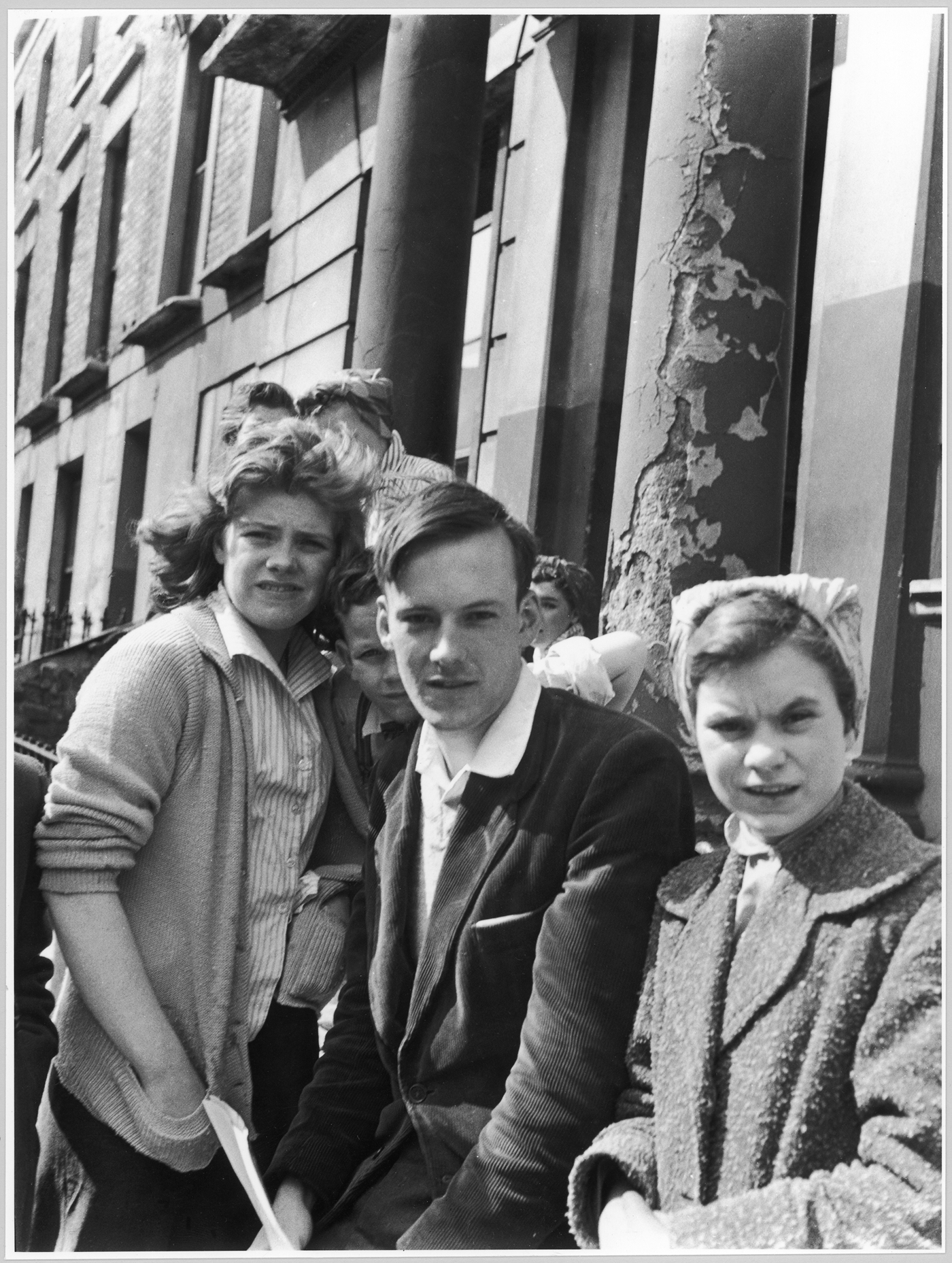
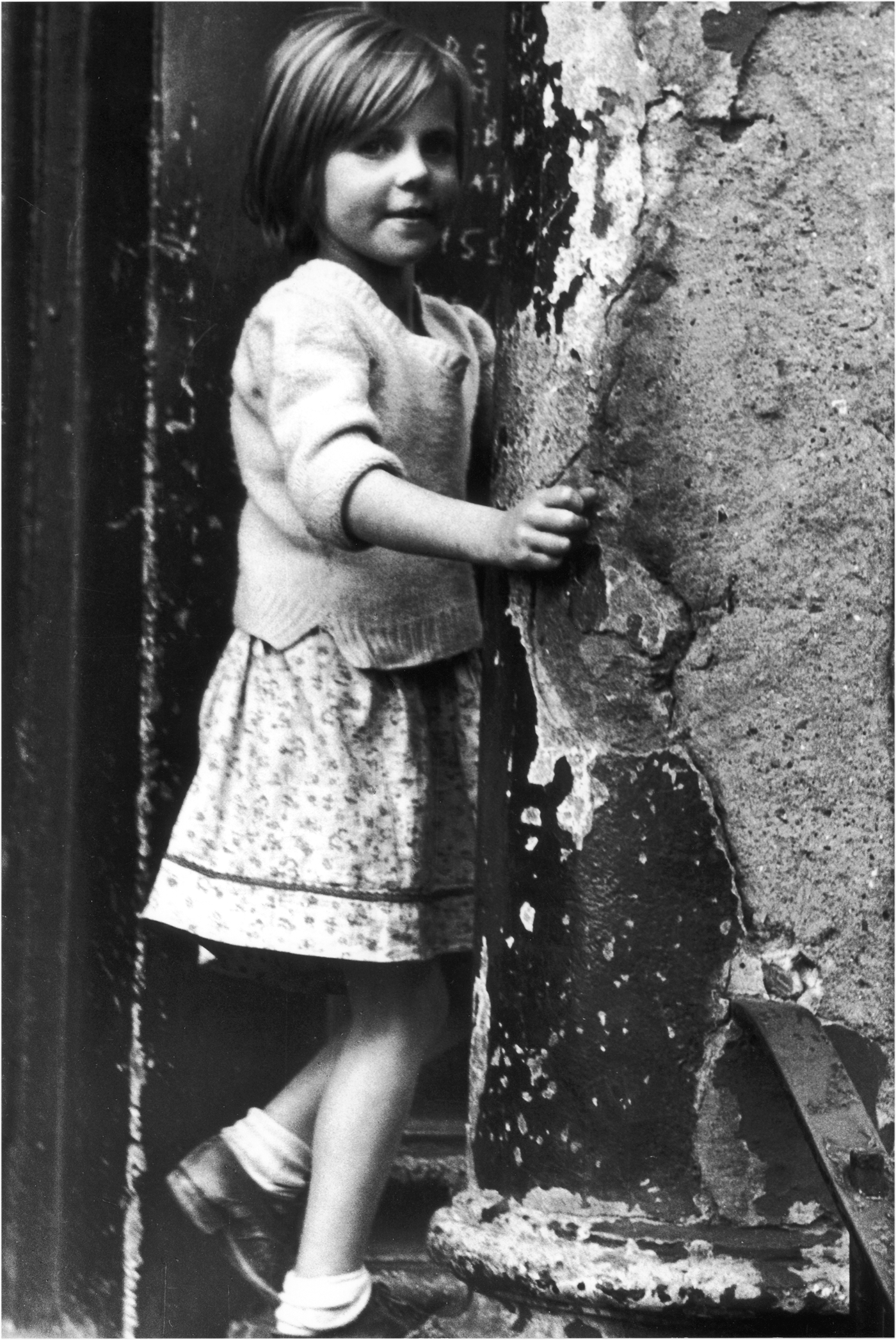
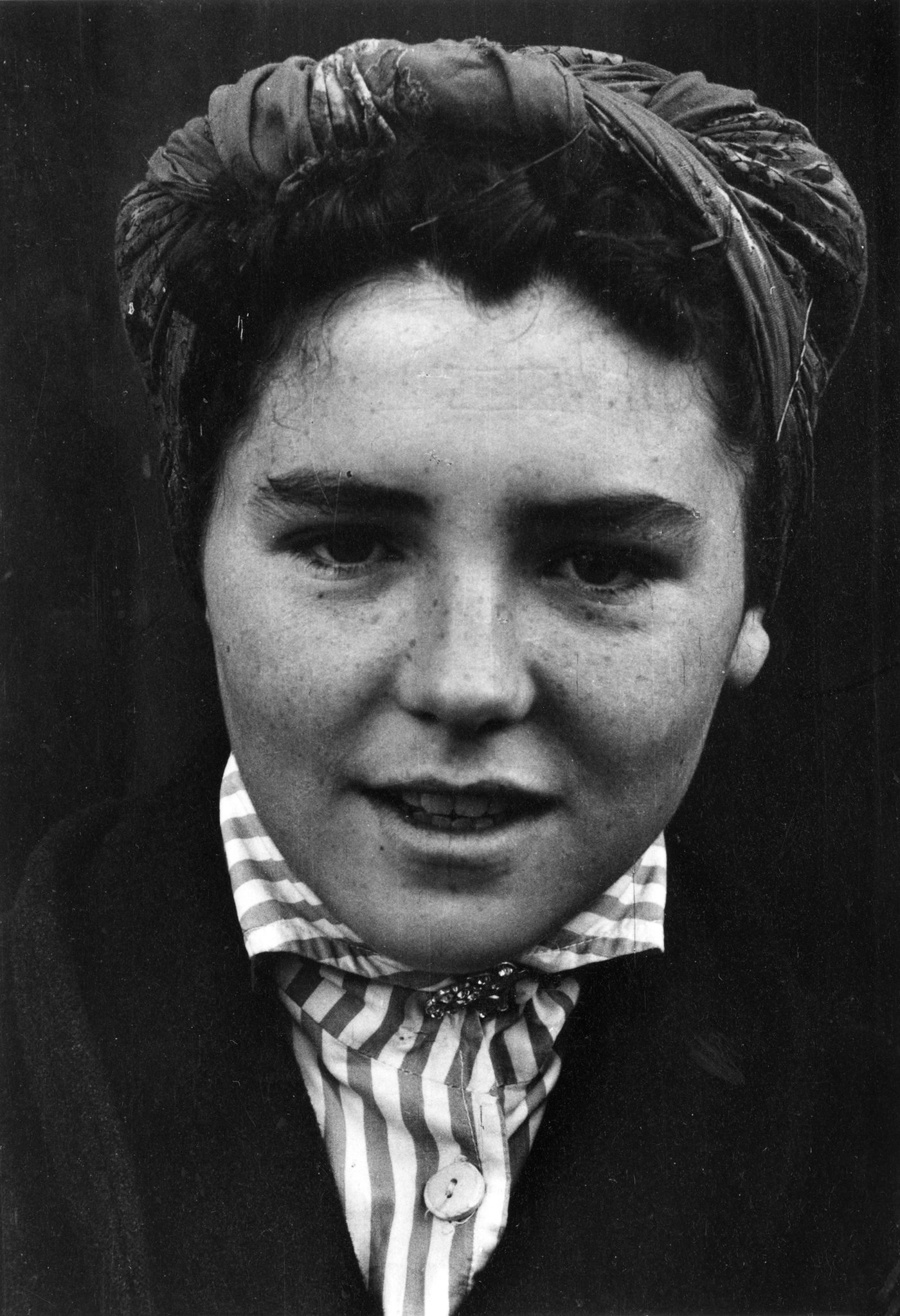
The deprived material condition of Southam Street was indeed a consistent theme in Mayne's photographs; after all, it was the “crumbling streets” that initially drew him to the area. The photographs from Southam Street and elsewhere also suggested a physical or material landscape similar to earlier periods of deprivation and unemployment, most obviously in the rows of worn terraced houses. In the portrait of “Working Class Girl” (fig. 9) from 1956, for example, Mayne offers a photograph of a child embedded in the physical environment—the depth of field used in the photograph places the child within or on the same plane as the door and pillar of a terraced house. The photograph also makes much of the texture of flaking masonry and peeling paint. The “roughness” of this environment is a counterpoint to the image of the child. Again, this accords with a description of the area offered by Ruth Glass: “The tall houses, structurally similar to those of the south [Kensington], are badly in need of repair: the woodwork is unpainted; window frames are rotten; plaster has fallen away from the outside walls, showing patches of bare brick.”Footnote 86
Roger Mayne, “Working Class Girl.” Used with the permission of the Mary Evans Picture Library.
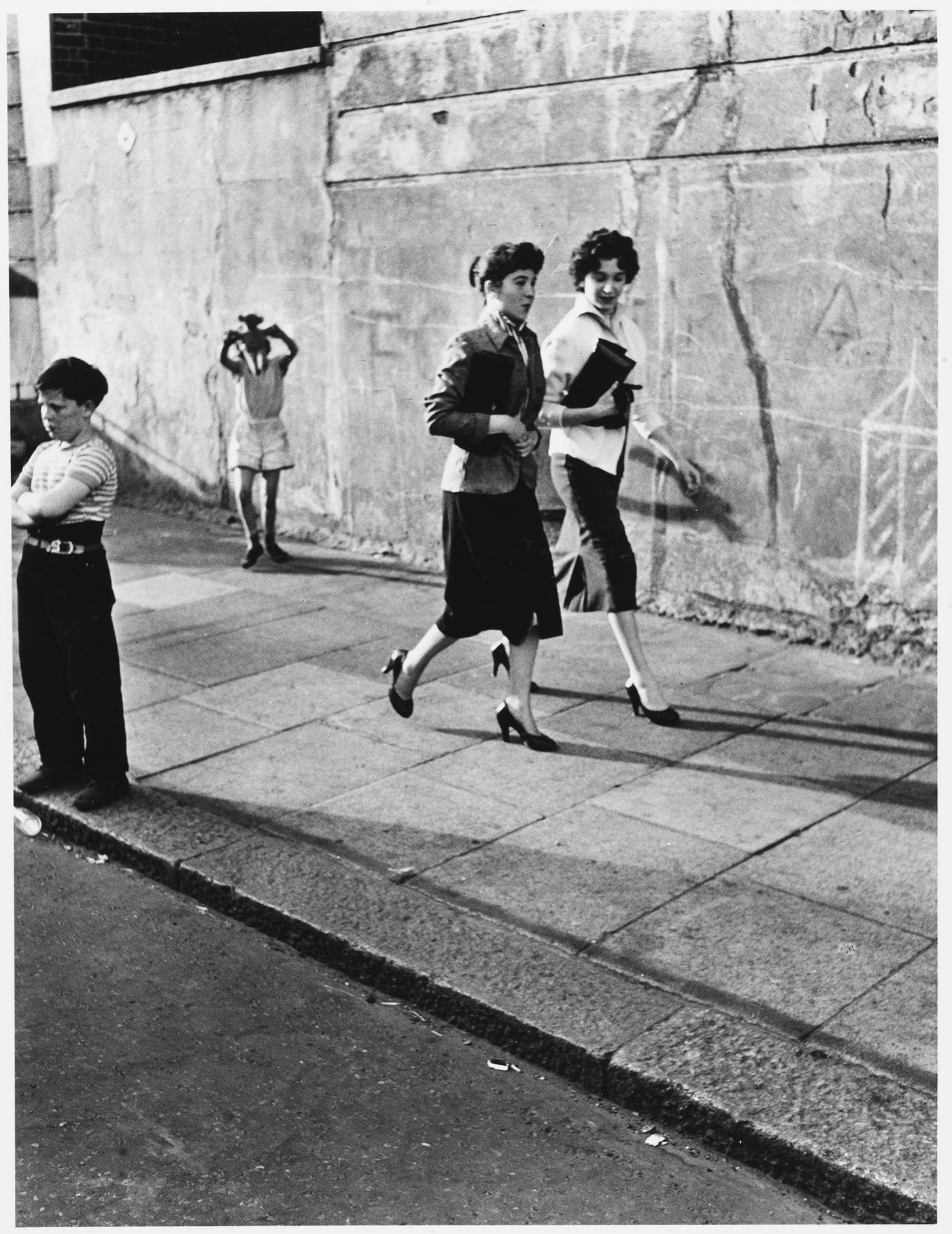
But this sense of material deprivation or shabbiness introduces one of the complexities in Mayne's portrait of Southam Street's working class and his representation of a “slum” in an age of affluence. Though deprived, this is not a community entirely severed from affluence. Even in the photograph of “Working Class Girl,” for example, the child's clothes are relatively clean and new, contrasting with the dilapidation of the background. She is wearing shoes, her face is clean, her hair is tidily cut, and she is smiling. This represents a departure from the tradition of slum photography in which children were clearly materially deprived, signaled by torn clothes and dirty faces. In Southam Street, the children's faces may be dirty, but their clothes seem intact. In figure 10, “Girls in Southam Street,” we get another view of this contrast between the environment and its people. Two stylish young women walk down Southam Street in pencil skirts and high heels, with a shabby wall in the background. The relationship between the world of Southam Street and affluence is complex in these pictures, a set of overlaps and dissonances within the new society, with borders that were at once porous and solid. The hairstyles and fashion of the women and the clothes of some of the children suggest that they are not cut off from the material effects of the affluent society. Rather, these photographs suggest a participation in consumerism that is often at odds with the physical environment.
Roger Mayne, “Girls in Southam Street.” Used with the permission of the Mary Evans Picture Library.
Mayne's Southam Street pictures afford one visual representation of the complex continuities and departures in the experience of working-class life since the 1930s, made more intense by postwar affluence. In Relative Deprivation and Social Justice (1966), W. G. Runciman represented the affluent society as a dynamic thing in which the reference points of the perceived material inequality between classes were continually shifting, rooted not only in work but also in the material differences exposed, rather than salved, by increased consumption.Footnote 87 This set up a tension between the experience of life and the aspirations of the new society. There is an interesting remark made in Peter Willmott's book on Adolescent Boys of East London (1966), researched around the same time as the Southam Street photographs were made. Willmott commented that, in a Bethnal Green that had “clearly shared in the ‘affluence,’” “the boys all know . . . that judged by the standards of the wider society their community and its residents are not ‘successful.’ They know that, despite the ‘affluence,’ local people are relatively poor financially and relatively low in status.”Footnote 88 “[M]oney,” Mary Morse observed at around the same time, “was the all powerful god” among northern working-class youth, but, unsurprisingly, it was not a socially cohesive force; the young men and women of her study were all too aware of continuing inequalities in income and purchasing power.Footnote 89 In a later study of St. Ann's Road in Nottingham, a slum area comparable to Southam Street, Ken Coates and Richard Silburn reflected that “private affluence lives at one remove from itself, a mocking half-echo of the standards established over the hill.”Footnote 90
Mayne's Southam Street photographs do not carry the same political criticism found in Coates and Silburn's portrait of St. Ann's Road, but they still afford a sense of affluence at “one remove” and emphasize the continuing importance of social difference. In Southam Street, material well-being is both apparent and yet unevenly present in people's lives; new clothes clash with decrepit buildings. In some ways, this is an apt visual description of class difference and the persistence of a sense of inequality in the fifties and sixties.Footnote 91 Carolyn Steedman's reflection on her mother also gets at the feeling of inequality and desire in working-class life made more, not less, intense by affluence: “[T]here existed a newly expanding and richly endowed material world” in which her mother “was denied a place.”Footnote 92 What these photographs set up, as a representation of a particular working-class street, is not, therefore, a portrait of an unrelievedly poor working class—these are not the slum dwellers of the late nineteenth century—nor is it a picture of a new, affluent, privatized, and domesticated working class. Instead, the photographs offer a study in the dynamic dissonances and overlaps between the perception of the new society and the memory of an older world: old and new meet in Southam Street. This was also true in terms of the representation of children.
V
Mayne's photographs of children playing on Southam Street were a particular focus of nostalgia thirty years after they were taken.Footnote 93 While in the 1950s they appeared as documents of the way working-class childhood continued to be lived, thirty years later Ray Gosling wrote that they were like postcards from a “golden age for kids,” remnants of a “theatre of life framed in these backstreets” that was “being destroyed.”Footnote 94 The idea of childhood bears a critical weight in understandings of the postwar working classes. Jeremy Seabrook's Working Class Childhood (1982) traces the movement, for example, from a material poverty that nonetheless provided community and “consolation” in the 1930s and 1940s to a spiritual privation ushered in by the affluence of the 1950s and 1960s—the “poverty of the market-place.”Footnote 95 For Seabrook, this was associated with “an overwhelming sense of loss” in many “traditional” working-class neighborhoods.Footnote 96 This specific sense of nostalgia was not only about the corrosive social effects of tower blocks, new estates, or materialism, but also spoke to anxieties about the security of children in public spaces.Footnote 97
Nostalgia about children playing on the streets does require some immediate qualification. First of all, as recent photographic work by Shirley Baker and Sirkka-Lisa Konttinen shows, children still play on the streets in working-class areas, undercutting the assumption that this is a thing of the past.Footnote 98 Second, as Nick Danziger makes clear in his photo essay The British (2001), children on the street can be represented as objects of threat rather than nostalgia: of Newcastle, Danziger comments, “[T[he children are out prowling for new victims to rob, new buildings to cover with graffiti and burn. . . . [T]he children's games are with the police and the firemen.”Footnote 99
The meaning of the child in the immediate post-1945 period was shaped by the legacy of the nineteenth century and the rise of psychology in the first decades of the twentieth century. In the nineteenth century, the idea of childhood was inflected with concerns about poverty and class.Footnote 100 There was a long-standing association among the representations of children, the street, and working-class identity.Footnote 101 Pictures of children playing in the street, free from obvious parental or institutional supervision, distinguished working-class children from middle-class ones. This persisted well into the twentieth century. It was lamented that working-class children were “flung into the street for their social life.”Footnote 102 In his 1957 study of Croydon, Terence Morris linked the distinctive freedom and lack of restraint of the working-class child to the way “he is cast at an early age . . . into street play-group society.”Footnote 103 This resonates with more recent sociological analyses of the links among place, generation, and class.Footnote 104 The expansion of compulsory state education and the elimination of child labor by the 1920s effected some changes in the idea of childhood. But the minds and bodies of children continued to be a focus of concern. By the 1940s, child guidance, child psychiatry, and educational reform all spoke a progressive language about child development.Footnote 105 Theories emanating from progressive educationalists and psychologists were brought to bear on the idea of childhood in the hope that the sympathetic management of childhood, and the treatment of child psychology as a distinct area, might build an emotionally stable national community.Footnote 106 The high point of such an outlook came after the war, first with the reshaping of the education system following the 1944 Education Act and then with the 1948 Children Act.
But children remained in the street after the Second World War. The popular historian Arthur Bryant wrote in 1954 of the “children of the Welfare State playing in the drab, crowded streets,” catching an overlap between old and new worlds.Footnote 107 In Absolute Beginners (1959), Colin MacInnes asserted that “our London Napoli” was found in streets like Southam Street and that children were crucial to this world: “[T]he kids live in the streets—I mean they have charge of them.”Footnote 108 In Kensington, there was an empirical basis to the overwhelming presence of children in areas like Southam Street: 65 percent of all children under fourteen in the borough lived in the four wards of North Kensington.Footnote 109
The rise of documentary photography in the 1930s saw the continued use of images of working-class children on the streets as signifiers of social inequality and poverty. Brandt highlighted what he saw as the contrast between the indoor play of upper-middle-class children and the outdoor play of working-class children. Other photographers used children in different ways, but still as a means of conveying class division. Wolf Suschitzky's portrait of Charing Cross Road in the 1930s reminds us, as Raphael Samuel remarked, that the street was more “plebeian than patrician,” a point underlined visually by a photograph of children playing in a back alley.Footnote 110 Photographs of children on the street continued to be co-opted into the representation of class and poverty in the 1950s and 1960s. Anthony Armstrong Jones's photo book London (1958) made a clear distinction between the working-class children who played in the street and the middle-class children who played in parks and schools.Footnote 111 The “rediscovery of poverty” also encouraged the continuing use of photographs of working-class children to signify social problems.Footnote 112
Mayne's Southam Street photographs worked within an established iconography that signified class difference in the city through the representation of children on the street. His children played within a world of sooty, crumbling walls and grubby streets, a landscape that might have seemed unchanged since the Victorian period.Footnote 113 Mayne's photographs also set out a particular relationship among the material environment, children's bodies, and children's play. A central element to Mayne's view of the beauty and life of Southam Street was that the street was “swarming with children.”Footnote 114 This is also where we might see most clearly the self-reflexiveness of the Southam Street photographs, the way that a middle-class person in his late twenties celebrated working-class childhood as a comment on his own childhood.
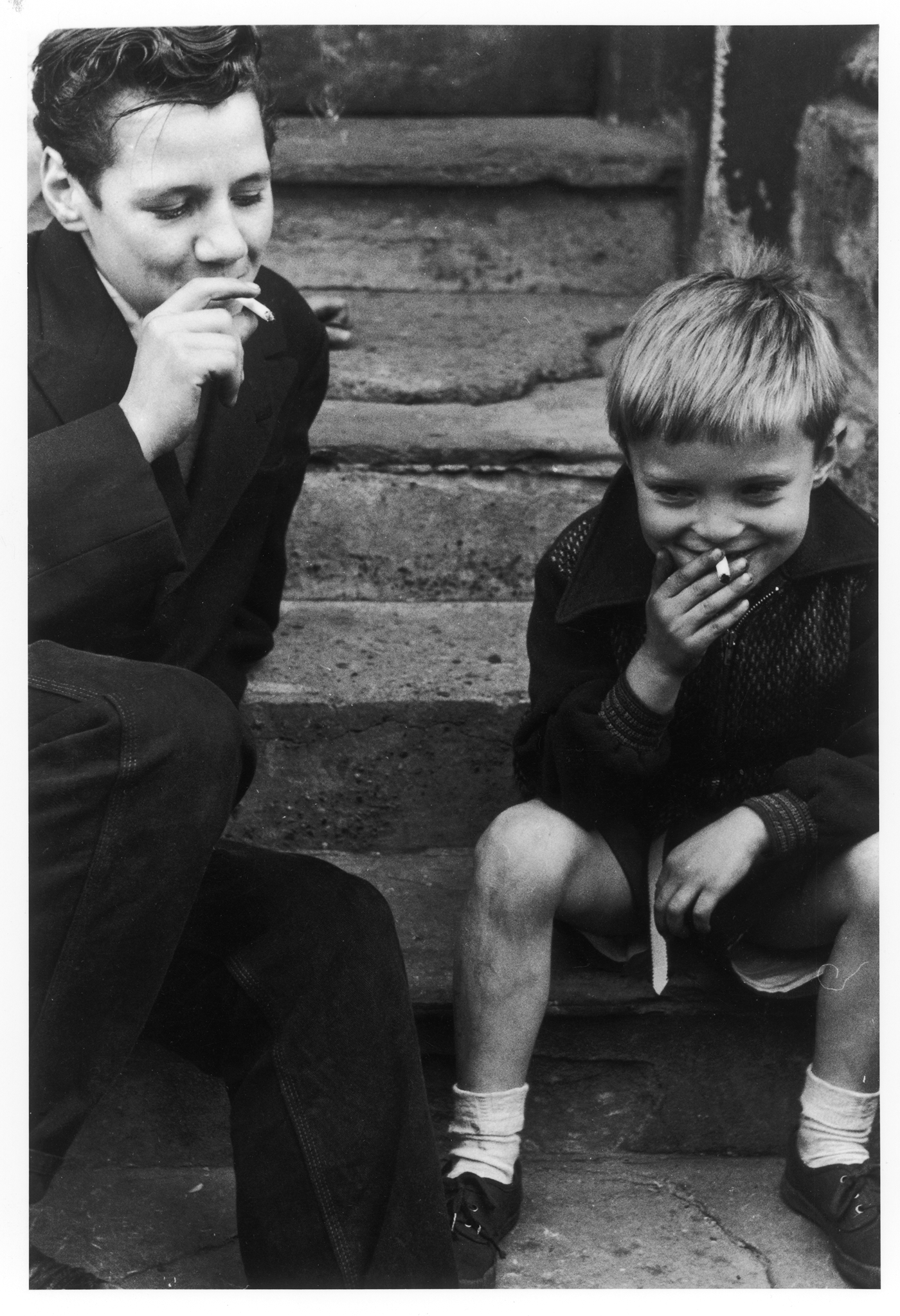
Several of Mayne's Southam Street photographs illustrate the relationship between the image of the child and class difference. In figure 11, for example, two boys sit on the steps of a house, both apparently smoking cigarettes. One is a teenager, but the other looks to be about six or seven years old. There is, of course, a sense of transgression in the image of the smaller boy smoking a cigarette, a transgression that evokes, for example, Victorian images of boy street workers smoking pipes. Mayne's boy was perceived by Colin MacInnes as a classic working-class type, the “street arab.”Footnote 115 This image also recalls the way working-class children had been configured as being between the worlds of childhood and adulthood, outside both categories.Footnote 116
Roger Mayne, “Boys Smoking.” Used with the permission of the Mary Evans Picture Library.
The representation of children's play conveys class difference in a particular way. In many of Mayne's photographs of Southam Street, and London more generally, children's play is located in two contexts, one long term and one more immediate. The long-term context is the visual understanding of a working-class world largely situated out-of-doors, as we have also seen in the photography of Bill Brandt. The playthings that children often have in Mayne's photographs are the debris of the street, whether bricks, rope, or an old bicycle wheel without a tire. The more immediate context is the Second World War. War altered the landscape of urban working-class children's play. After 1945, children's playgrounds included bomb sites and bomb-damaged houses as well as the traditional street.Footnote 117
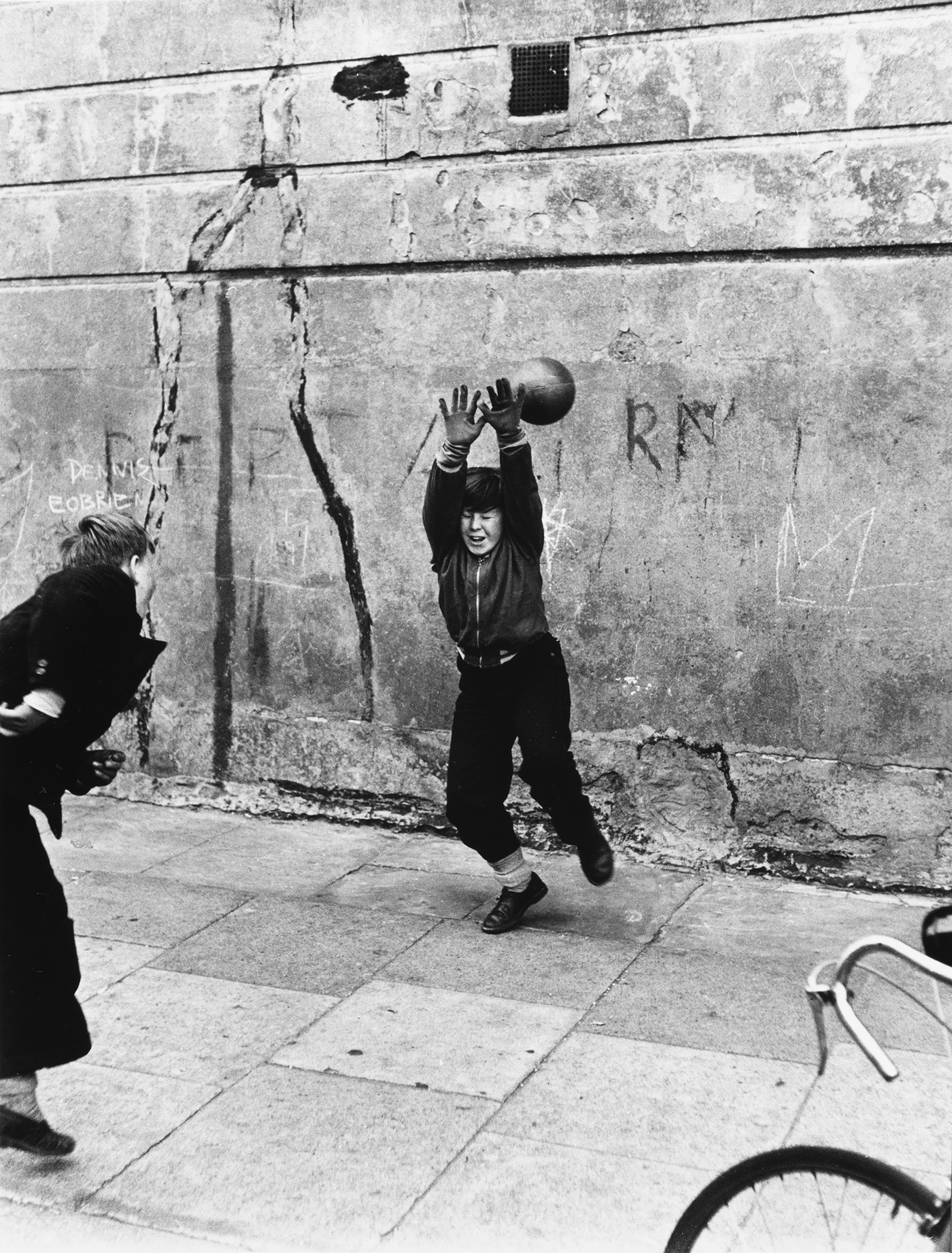
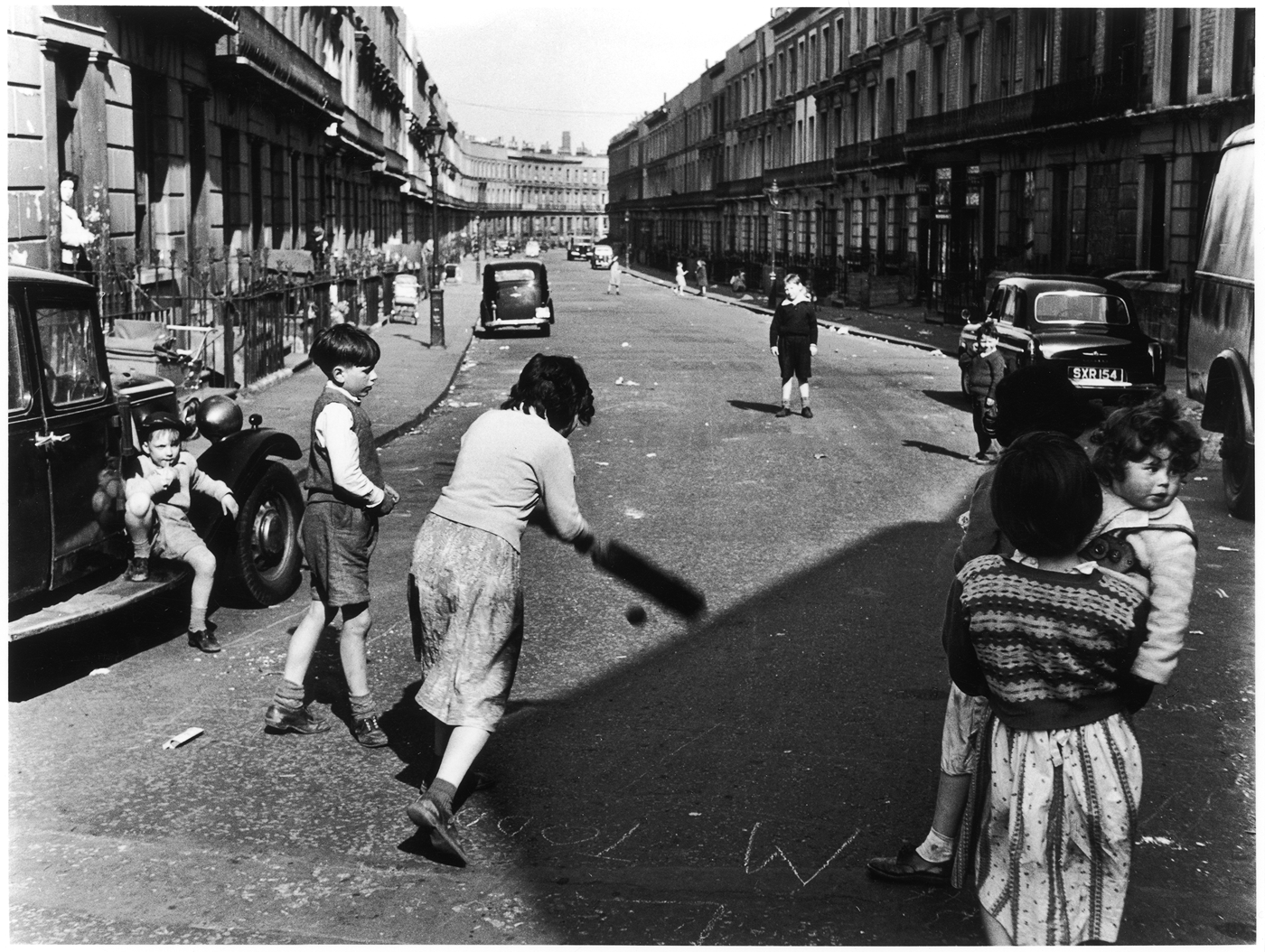
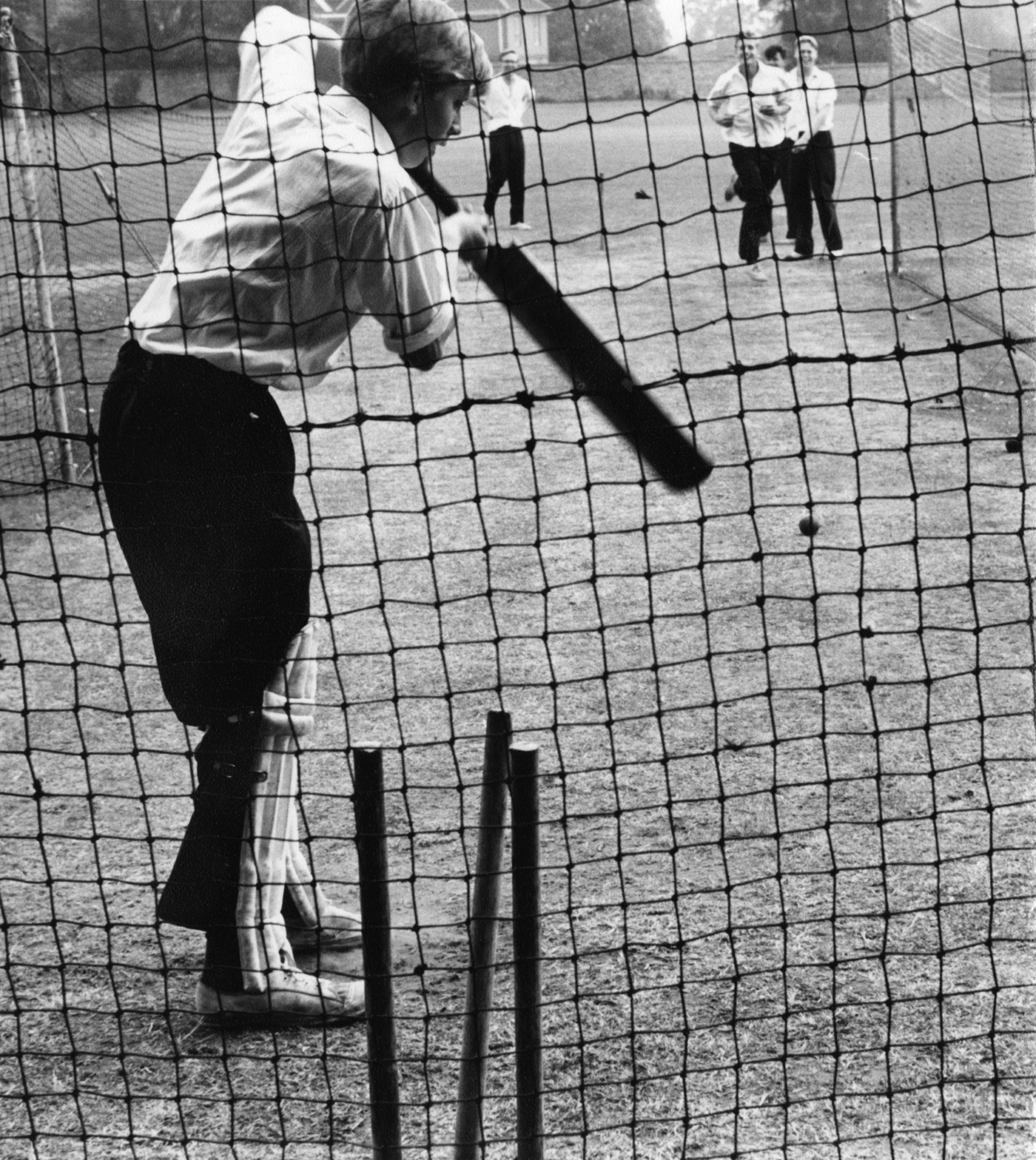
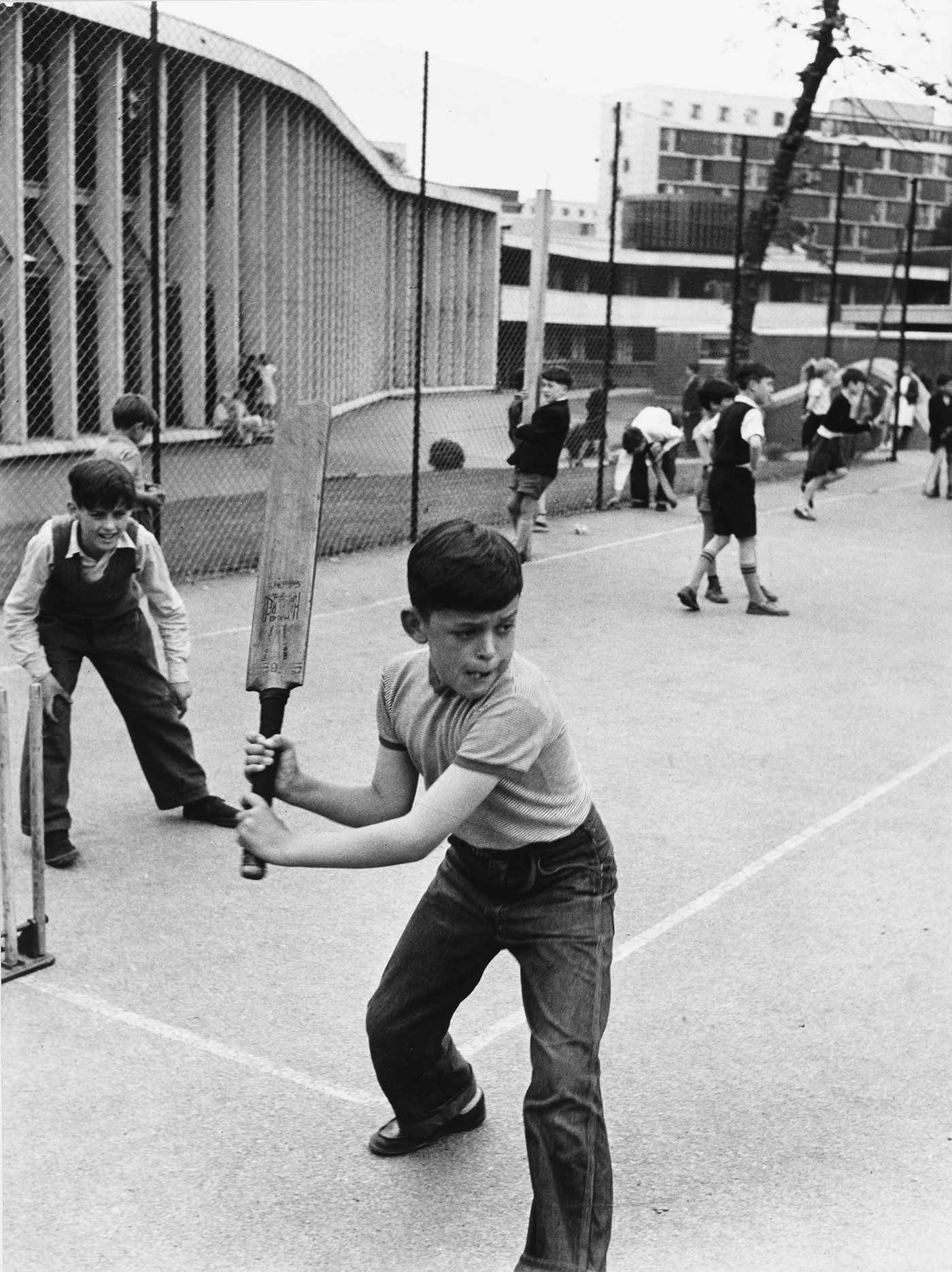
Photographs of children playing games are striking in this regard. In figure 12, a boy stands in front of a wall keeping goal (unsuccessfully); in figure 13, a young girl bats a cricket ball down the street, watched by children lounging on the running board of a parked car and looking after smaller children. This might be contrasted with photographs taken by Anthony Armstrong Jones of children playing cricket in a park (with real wickets) or, indeed, Mayne's own photographs of boys at Charterhouse school playing with real nets, cricket bats, equipment, and wickets (fig. 14). The Southam Street photographs suggest a quite separate world of working-class childhood to these images of middle-class childhood; working-class childhood is dependent upon improvisation and spontaneity within a materially reduced environment rather than organized parks or proper equipment.
Roger Mayne, “Boy Keeping Goal.” Used with the permission of the Mary Evans Picture Library.
Roger Mayne, “Cricket in a London Street.” Used with the permission of the Mary Evans Picture Library.
Roger Mayne, “Cricket, Charterhouse School.” Used with the permission of the Mary Evans Picture Library.
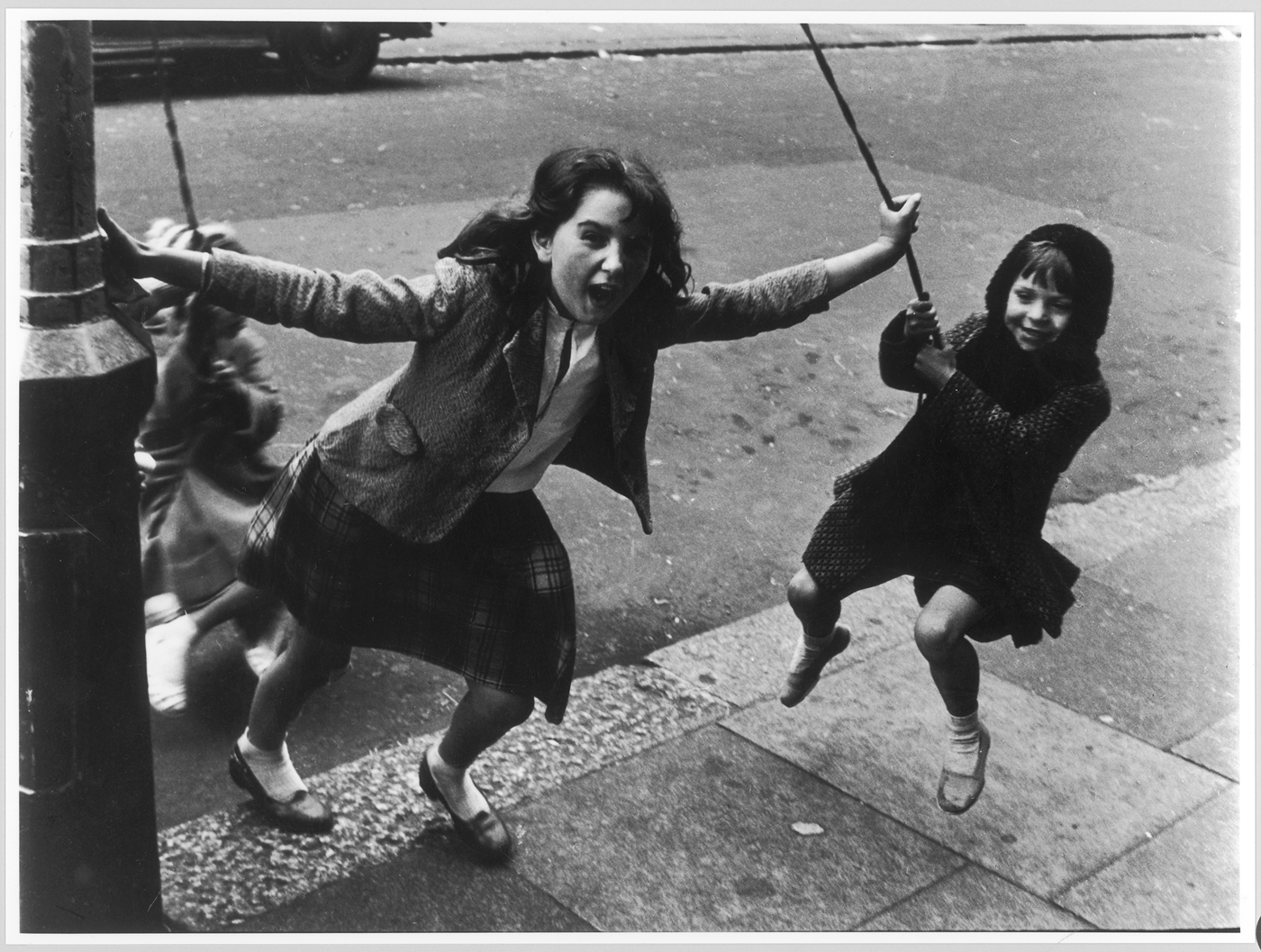
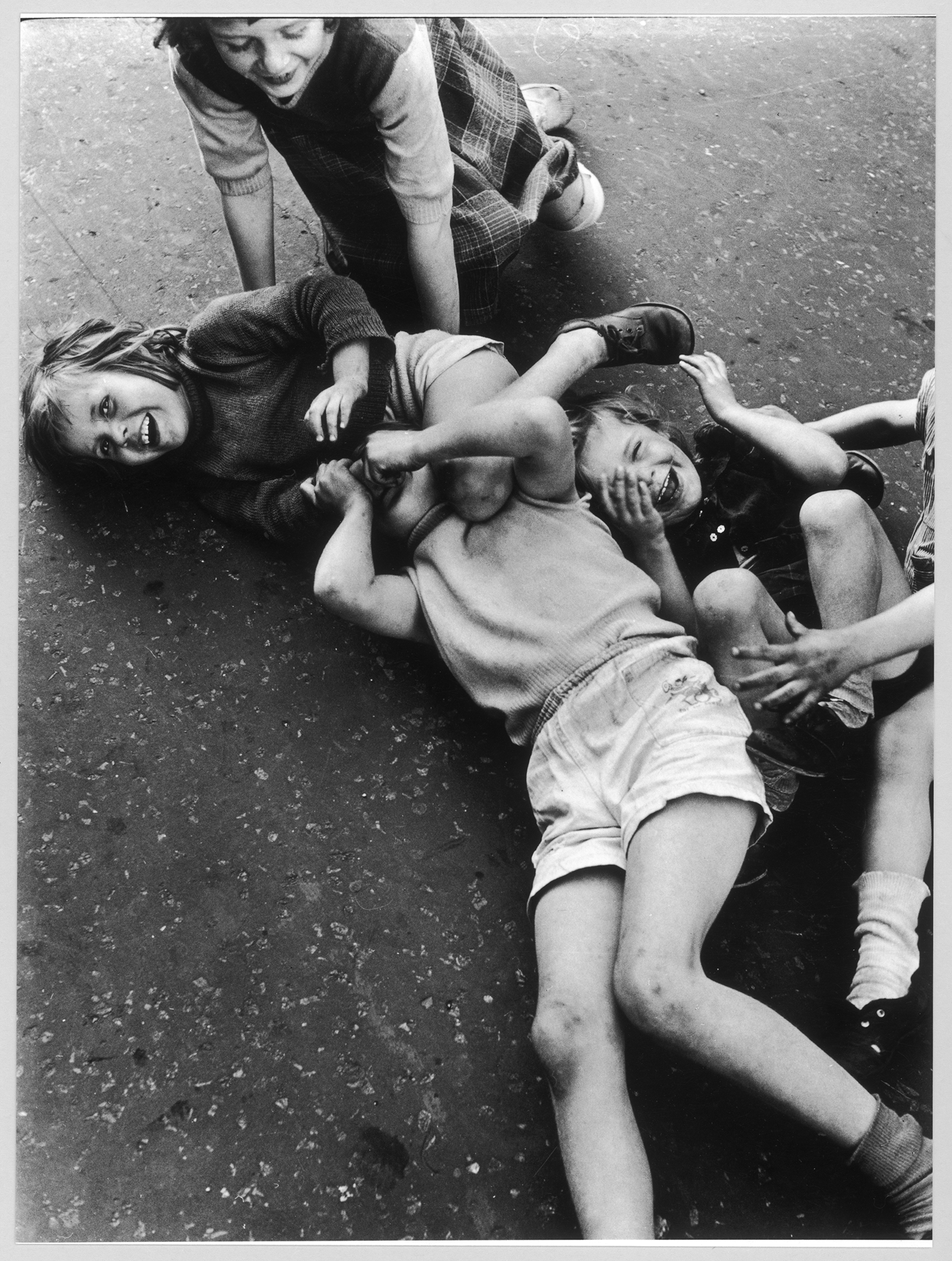
The nature of class difference is also signified by the visual quality of children's play and movement in the photographs, a point alluded to earlier with Brandt's photograph of “East End Playground.”Footnote 118 What is common to almost all of Mayne's pictures of children on the streets is that the children are usually photographed in motion: running, walking, playing, swinging, or simply falling about, as these two photographs show (figs. 15 and 16).
Roger Mayne, “Unruly Girls.” Used with the permission of the Mary Evans Picture Library.
Roger Mayne, “Kids Larking About.” Used with the permission of the Mary Evans Picture Library.
Thinking about the motion of children in Mayne's Southam Street photographs is key to understanding the photographs' broader social and political meaning. In the first place, these photographs break with the tradition of slum photography. Unlike many slum photographs, which tend to feature children posing and looking at the camera (even in the 1930s, when faster film and smaller cameras were available), the Southam Street photographs are portraits of children in motion, often unselfconscious of the camera lens.Footnote 119 Mayne's photographs represent children in dynamic, unrestrained play; they are studies in the joy of play. Of course, such joy can be appreciated just in itself, viscerally or emotionally, rather than intellectually, or as an indication of Mayne's self-reflexiveness in photographing Southam Street. But there remains a social and historical meaning to it. This becomes particularly clear if we think of these photographs in the context of educational and psychological reform of the 1940s and 1950s. Mayne's images are studies of a world beyond such management and surveillance.Footnote 120 The complex patterns made by the bodies in motion are, in some ways, fractal shapes that are barely contained within the frame of the photograph and sometimes threaten to spill out, as if escaping the solid structure of categorization. By contrast, Mayne offered a more structured view of play, within a controlled environment, in photographs he did of Hallfield Junior School, a largely working-class school newly built in nearby Paddington (fig. 17). In these photographs, children's movement is choreographed rationally. Children's play is placed within a structured and defined space. Bodies are managed in the way that urban planners hoped to manage public space. This is not true of the photographs of Southam Street. There is a visual dynamic and anarchy to Mayne's Southam Street photographs that signifies something else: to be working class and to be a working-class child is to remain beyond newer categories mapped out by social reform and regulation. The ineffability of children and their play is a kind of resistance to a managed and reformed new world.
Roger Mayne, “Playground Cricket at Hallfield Junior School.” Used with the permission of the Mary Evans Picture Library.
VI
The emphasis upon an exterior social life and the place of children's play in the Southam Street photographs suggests the persistence of a distinct working-class world, albeit one that exhibits signs of both modernity and the past. It might still be argued that both elements could be accommodated within a nostalgic view of the working classes in the 1950s, a view of a “lost” class and community. There are, however, three aspects to Mayne's photographs that disrupt such a nostalgic view. At the beginning of this article, it was argued that Mayne's images represent Southam Street, not as an ordered and stable place, but as a dynamic and contested space. An important aspect of that dynamism comes through the representation of women, youth, and Afro-Caribbean migrants in Mayne's work. And, once again, it should be noted that Mayne photographed these groups as an outsider.
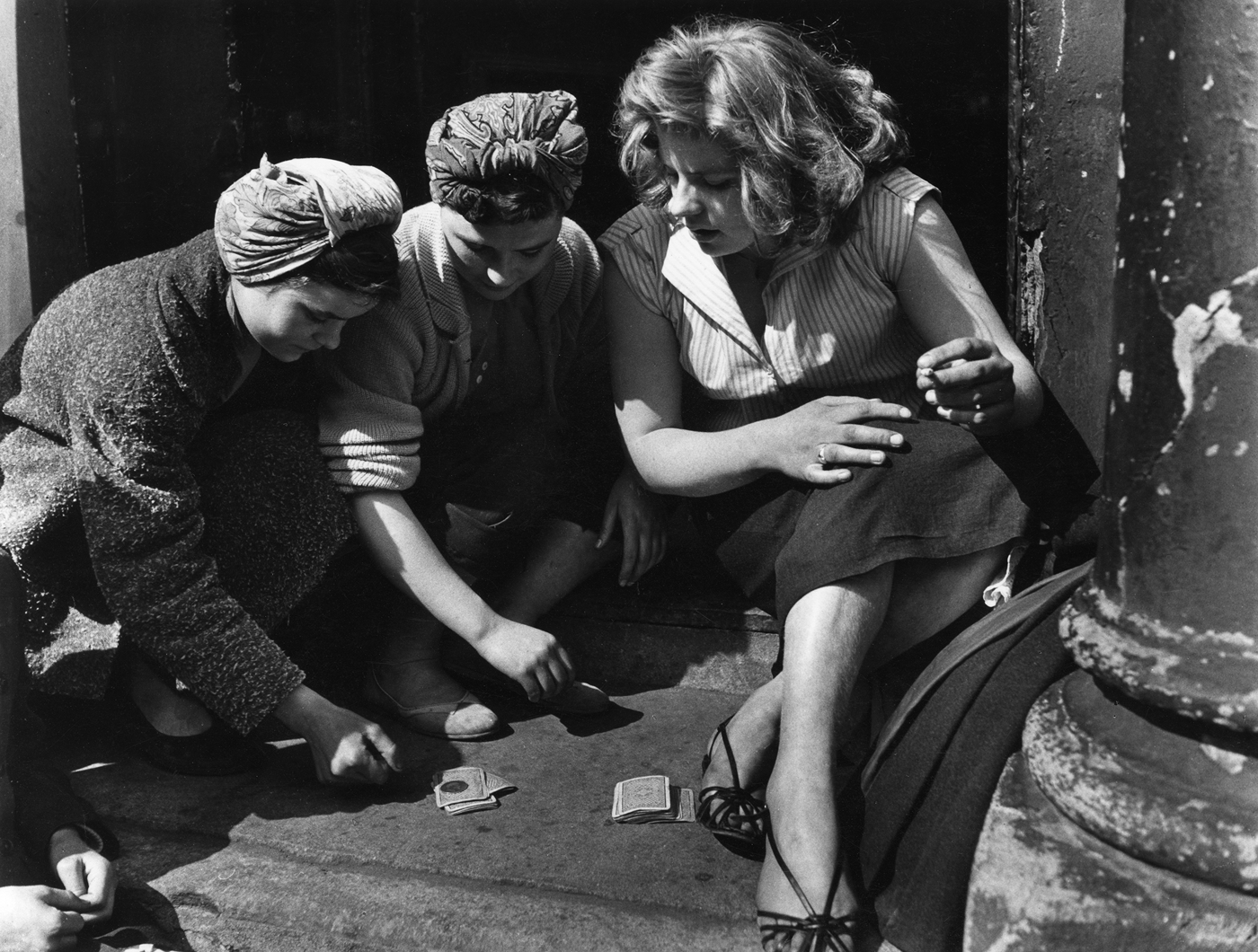
Mayne's Southam Street is a street of women as much as children. Women's movement and activity are central to his photographs. They show women as active, even dominant, protagonists of street life, walking, shopping, minding children, chatting, mixing with men, standing on the steps observing the street, and playing games (fig. 18). Women are indeed more visible than men.Footnote 121 An obvious point is that this may be because Mayne's photographs were taken during the day when men were at work. But there is more to it than that. Women are seen in a number of roles, as mothers, to be sure, but also as workers (fig. 19), consumers, symbols of youth culture, and, simply, as individuals socializing with one another.
Roger Mayne, “Young Women Playing Cards.” Used with the permission of the Mary Evans Picture Library.
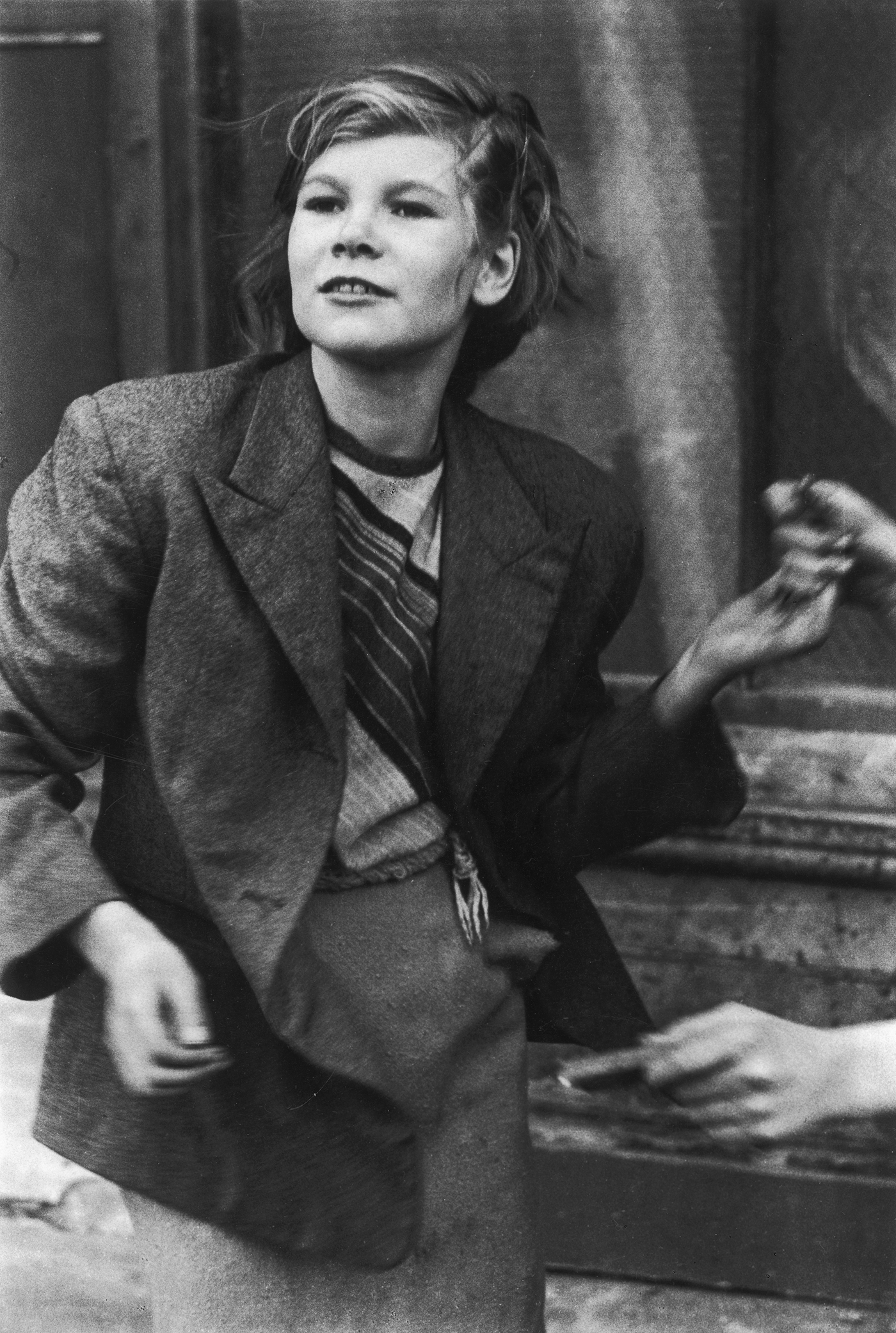
Roger Mayne, “Young Woman on Southam Street.” Used with the permission of the Mary Evans Picture Library.
The portrayal of women in this way represents a blurring of gender distinctions around everyday life in the public sphere. Following Highmore's analysis, Mayne's photographs show women participating in a “feminine” sphere of everyday life, with “countless repetitive gestures and small practices” (shopping, childminding, playing, and chatting), as well as a “masculine” world of “chance encounters of the street,” meeting, socializing, and dancing.Footnote 122 On Southam Street, there were flaneuses as well as flaneurs, of different ages, within the context of a working-class street.
This is significant when placed in the wider context of the representation of working-class women in the twentieth century. In older representations of working-class women, the working-class mother was often used as a cipher for poverty. In photography, for example, the photographs of working-class women taken by Edith Tudor Hart and used in Margery Spring Rice's Working Class Wives (1939) or the images of miners' wives produced by Bill Brandt in his studies of northern England comprised a visual shorthand for working-class poverty. Such ciphers continued to have purchase in the postwar period. One of the most famous examples came in the late 1960s with the television play Cathy Come Home (1966), in which it is the image of the title character, a working-class mother, that provokes an empathetic response to the problem of working-class homelessness; indeed, in the Pan paperback edition of the television play, fictional and documentary representations of women and children in poverty were placed together.Footnote 123
But the Southam Street photographs break with this singular association between poverty and working-class motherhood. Mayne's images afford a different and more complex representation of working-class femininity. In the first place, the women portrayed in the Southam Street photographs are not the heirs of Tudor Hart and Brandt's downtrodden working-class mothers. Rather, they might be taken as the descendants of that generation of working-class girls who, in the 1920s and 1930s, participated in the workplace and leisure culture as often-overlooked protagonists of modernity.Footnote 124 Second, Mayne's Southam Street is a frame for glimpsing women across a number of life stages, as mothers, to be sure, but also as children, as girls, as young adults, as well as in old age. Third, the photographs suggest the dynamic nature of working-class identity in the postwar period. Changes in working-class identity in the fifties were rooted in and read through gender and sexuality by many social observers.Footnote 125 Through the growth of part-time work for women and an increased emphasis on birth control and sexual companionability and fulfillment, it was more difficult to reduce working-class women simply to the role of dependent wife and mother. Working-class identity could no longer be easily organized around an understanding of breadwinner male and dependent wife or mother. This is not to say that such an understanding did not still exist, but that it existed at the same time as other, more disruptive, ways of understanding femininity that were more connected to pleasure and production than duty and reproduction. In this context, Mayne's photographs of Southam Street are images of the dynamic and sometimes disruptive changes within working-class life; a nostalgic view of the photographs dependent on order and stability requires suppressing such visions.
Mayne's documentation of urban youth is similarly disruptive of a nostalgic view of working-class life. Youth was a recurring focus of much of Mayne's photography in the fifties and sixties. He was clearly fascinated by youth culture, shown in shots of winkle picker shoes, Teddy boy couples, jive dancers, jazz festival goers, and Campaign for Nuclear Disarmament supporters. The greater visibility of teenagers and the accompanying emergence of distinctive youth subcultures, such as Teddy boys, mods, and rockers, is a much-noted historical change in the 1950s. “Youth” attracted sociological attention as a notable, but unknown, social category in the postwar period. It was often assumed to be disruptive of older ways of belonging. In his lament for the “withering of the old working-class sub-culture” with its “sense of unity and compassionate understanding” in 1960s Blackburn, Seabrook singled out “youth” for criticism as a factor corroding working-class community: the “chief aims” of the young were “enjoyment and self-gratification” rather than “any kind of social or political commitment.”Footnote 126 As Catherine Ellis has suggested, the category of “youth” was also perceived as breaking with a larger climate of social and political consensus.Footnote 127 Youth were, in the view of Mary Morse, “the unattached.” For some, this seemed particularly true with respect to class. Colin MacInnes argued that youth culture allowed one to “step outside your class.”Footnote 128 But to other social observers, it was less clear that there was a break between class and youth. The Bethnal Green teenagers studied by Peter Willmott were firmly rooted in their class background, as were the subjects of David Downes's 1966 study of East End delinquents.Footnote 129
Mayne's Southam Street photographs inscribed youth as a category both within and without the boundaries of the working-class street. Young people—people who were neither children nor adults—are a consistent feature of Mayne's Southam Street. They were distinguished as a discrete group by, first of all, their dress and style, and, second, their own approach to the act of being photographed: in Mayne's photographs, youth are conscious of the camera and often act out an apparent lack of deference by posing. Youth is performed physically within a working-class environment. In these ways, youth are both of the working-class street and pull themselves out of—or distinguish themselves from—that environment.
If we think of, for example, one of Mayne's most famous photographs, the “Dancing Girl on the Street” (fig. 20), we might see in it both a resonance with a previous working-class world and a break with that past.Footnote 130 The photograph is, first of all, reminiscent of Brandt's famous “East End Girl Dancing the Lambeth Walk, 1936,” with its image of a young girl dancing in the street, spontaneously, free from social restraints, an embodiment of working-class freedom and energy. The relationship among body, environment, and class is similar in both photographs across a span of two decades. But there are also differences between the two photographs. Dick Hebdige's reflections on subculture and style are useful in this regard. Hebidge moots both subculture and style as a “form of Refusal” to larger cultures or social conformities: “[T]he deviation may seem slight indeed—the cultivation of a quaff, the acquisition of a scooter or a record, or a certain type of suit. But it ends in the construction of a style, in a gesture of defiance or contempt, in a smile or a sneer.”Footnote 131
Roger Mayne, “Girl Dancing on the Street, Southam Street.” Used with the permission of the Mary Evans Picture Library.
“Dancing Girl” is closer to a smile than a sneer, a study of joyful movement, but it is a representation of the distinction of youth within working-class culture in the fifties, a joyful rebellion. Though we see hands coming out of the side of the frame in Mayne's “Dancing Girl,” holding her while she jives, “Dancing Girl” is also the portrait of an individual taken out of the context of a community. She is isolated from the photograph's background by the camera's focus. The freedom and energy of the photograph is situated strongly in that sense of the individual. Clothing is also important. Mayne's “Dancing Girl” wears a man's suit jacket in an appropriation of Teddy boy style, a statement of flamboyance, distinct from the clothes of the children of Southam Street and the dress of the adults.
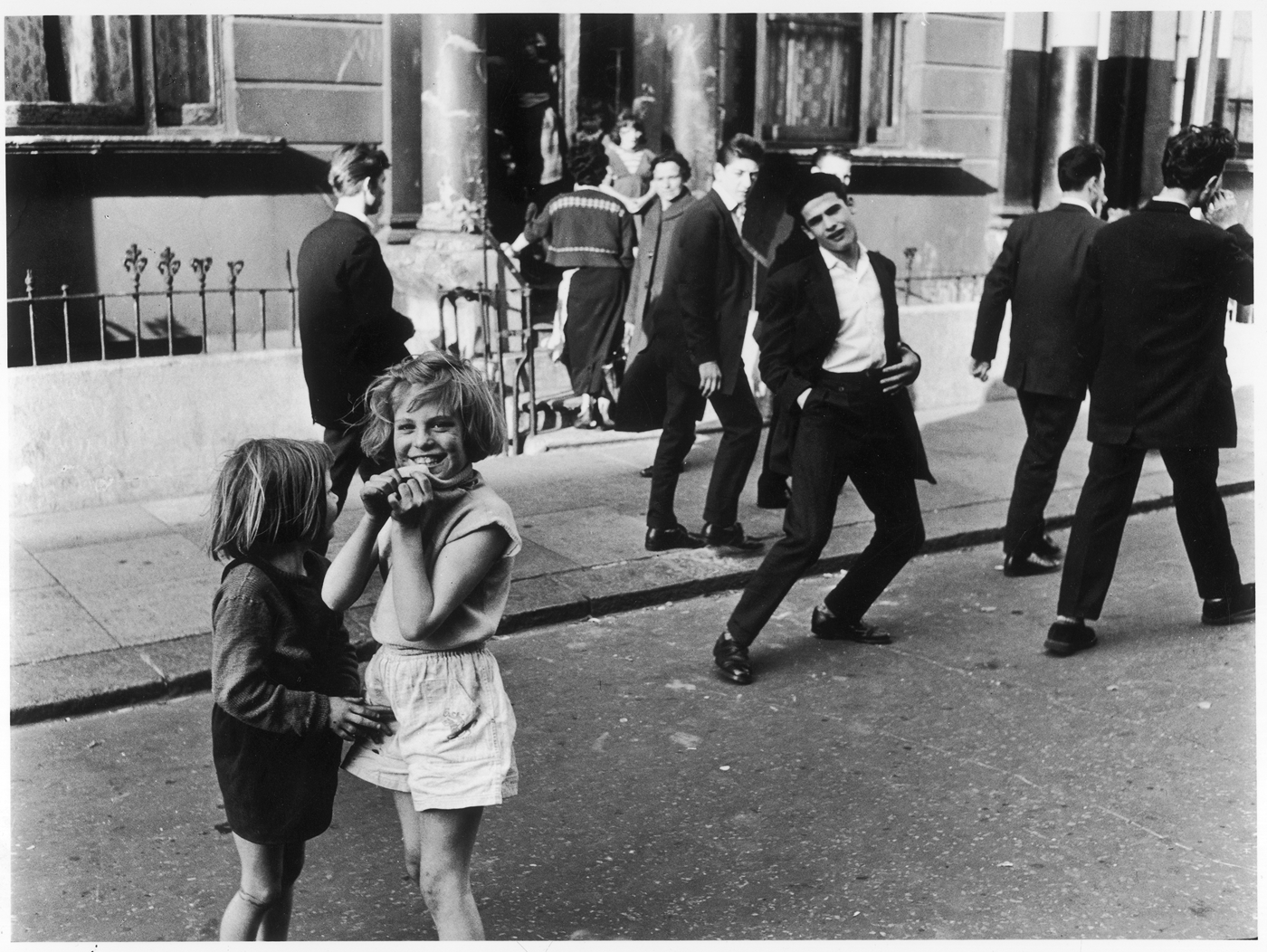
A second example can be found in “Playing in the Street” (fig. 21). The title suggests a reference to children, but the main focus of the photograph is the group of Teddy boys moving through the foreground, with one turning around and posing cheekily for the camera. Tony Jefferson has argued in his study of the Teds' subculture that such belonging was both a “cultural extension of the self (dress, personal appearance)” and “the social extension of the self (the group).”Footnote 132 “Playing in the Street” visually represents the second. In Mayne's photograph, the handful of Teds are distinguished from the children in the left foreground as well as from the adults on the steps in the background. They form a recognizable, comprehensible group, in part because of the similarity of their dress—the Teds' uniform of long suit jackets and crepe-soled shoes—and in part because of the way they appear in the photograph, as a collective line of figures moving through the landscape. The composition of the photograph thus makes clear the distinctiveness of the group. The children in the foreground also point this way, one child directly looking at the Teds; this particular act of looking underlines the spectacle of youth.
Roger Mayne, “Playing in the Street.” Used with the permission of the Mary Evans Picture Library.
But what is also notable about this picture is, of course, the young Ted returning the gaze of the photographer and striking a pose, bending his knees forward, leaning back, with one hand in his pocket, the other on his midriff. Just as the photographs of children playing on the street should be taken in part as simple and powerful statements of the joy of physicality, this image should be taken as a simple but powerful statement of the embodiment of youthful, stylish nonchalance, the ineffable “cool.” Generation is performed or enacted. This is a pose that actually arrests the movement of the photograph in the way the young man pulls away from his fellow Teds walking out of the frame and brings the focal attention to himself. But there is also a particular historical meaning to this pose. Thinking again of Hebdige's reflection on style, “a gesture of defiance or contempt, in a smile or a sneer,” the young man's pose can be understood as both a smile and a sneer. The young man's pose is exactly a gesture of defiance, in this case a playful disruption of the photograph (that then becomes the focal point of the photograph), an insouciant lack of deference to the photographer. Mayne's images of youth suggest a social identity that was both of the working classes and a challenge to the constraints of that identity, opening up worlds beyond Southam Street, whether connected to fashion, pop music, or other youth cultures. Indeed, in Mayne's photographs, this is literally so, with Teds and teenagers in his pictures moving through North Kensington to other areas such as Soho.
Figure 2, “West Indian Men in London,” is a kind of reverse image of figure 21, “Playing in the Street.” In both photographs, a line of figures walks down Southam Street; in both, the figures in question form a distinctive collectivity. This is in part because of the way they are dressed (in the case of the West Indian men with their fedoras); in part because they are walking together; and in part because children in the photograph mark out the figures as a spectacle to be viewed. The difference between the two photographs rests on the racial difference between West Indian men and white youth. Mayne's portrait of a working-class London street in the 1950s was notable for its attention to the increasing presence of Afro-Caribbean migrants in working-class areas.
There has been considerable work on the social and cultural impact of postwar immigration on British national identity.Footnote 133 Some analyses have called attention to the “re-racialization” of England, the sharper inscription of racial difference.Footnote 134 One way this was conveyed was in the construction of an idea of black colonial migrants as “strangers,” in appearance, dress, and manners, transgressing “normative” ideas of Britishness.Footnote 135 The oft-cited sociological example of this is Sheila Patterson's 1963 study of Brixton, with its register of a “sense of strangeness, almost of shock” at the new communities, not least at the way black Britons were “shopping, strolling, or gossiping on the sunny street-corner with an animation that most Londoners lost long ago.”Footnote 136
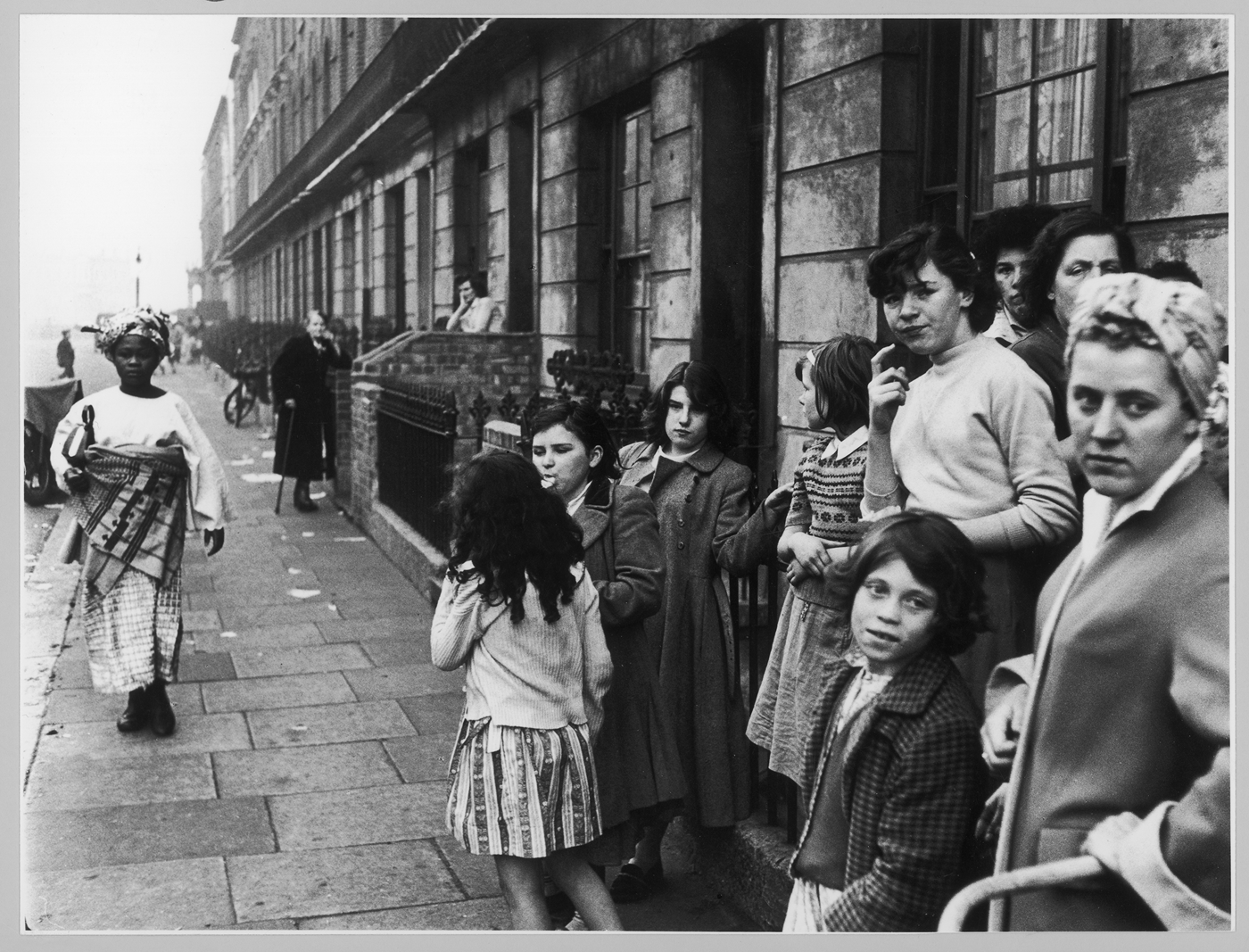
At first glance, Mayne's photographs of Southam Street would seem to be a visual counterpart to this framework. Figure 22, “African Woman,” underlines visually what is suggested in Patterson. The sense of separation in the photograph between the white working-class residents of Southam Street and the African migrant could not be more stark: the former are grouped on the steps of the terraced houses, some watching the African woman walking down the street; the African woman is herself physically isolated in the photograph, cut off from the community on the street, without a connection to them. She is also isolated by the act of looking: she is looked at, as an object. Finally, there is her exotic dress, which distinguishes her from the comparatively drab clothing of the working-class women and girls. Though the clothing is less exotic, that same sense of division between a “native” white community of Southam Street and black migrants can also be seen in figure 2, “West Indian Men.” These two examples suggest that Mayne's Southam Street photographs contributed, like race relations discourse, to a construction of the “strangeness” of black British migrants; the working-class street becomes, in this context, a place whose identity and community is disrupted by the racial other.
Roger Mayne, “African Woman.” Used with the permission of the Mary Evans Picture Library.
But this would also be a reductive, incomplete view of Mayne's Southam Street photographs. What exists alongside images such as “African Woman” and “West Indian Men” are many images of black men, women, and children gathering with white people, playing and talking. It is, of course, important to note the exclusiveness of the working-class street suggested in some of these photographs; it is, nonetheless, equally important to note the potential inclusiveness of such a street. After all, if we turn back to Patterson's description of black Brixton in 1963, people “shopping, strolling, or gossiping on the sunny street-corner,” this would serve equally well for Mayne's white and black Southam Street in 1956.
A more telling description of what is occurring at the ground level of working-class London at this time might be a permeable tension rather than an immutable divide. John McLeod has written, for example, of the in-between position of London's black migrants in the postwar period: “within, but not a part of London's economic and social fabric.”Footnote 137 The critical point here is the tension or the space between being “within” and “not a part of.” It is in the negotiation of that space that we might see the construction of a new kind of working-class London in which blacks are an important part. In this sense, Southam Street is once again a “space,” open to dynamic change and contestation within the context of a working-class area, rather than a stable “place.”Footnote 138
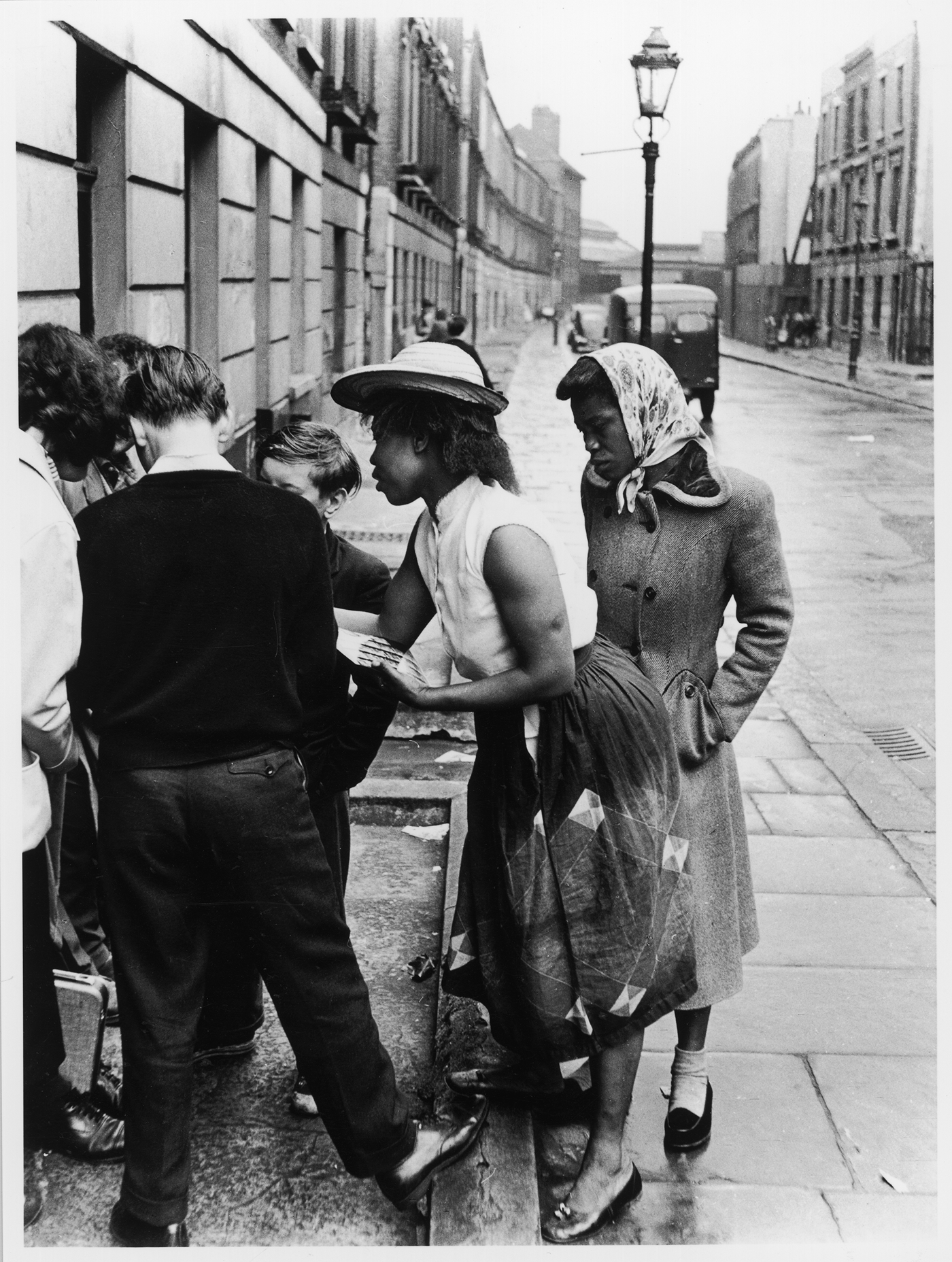
Figure 23, “West Indian Women in London,” gets at this complexity. The photograph shares much with Mayne's other photographs of a working-class street: the walls of the terraced houses that frame the photograph; the clump of women, youth, and children that form a community on that street; and the contrast between the shabby street and the not-so-shabby clothing of the people in the photograph. The obvious difference between this and other photographs of Southam Street is that it features two young black women. Unlike “West Indian Men in London” and “African Woman,” these women are not isolated from the larger group. Indeed, one is physically close, even within the larger group looking at something hidden to the viewer. The two women are not distinguished from the larger group by their dress; they look like any other working-class women on the street, different only because of their skin color.
Roger Mayne, “West Indian Women in London.” Used with the permission of the Mary Evans Picture Library.
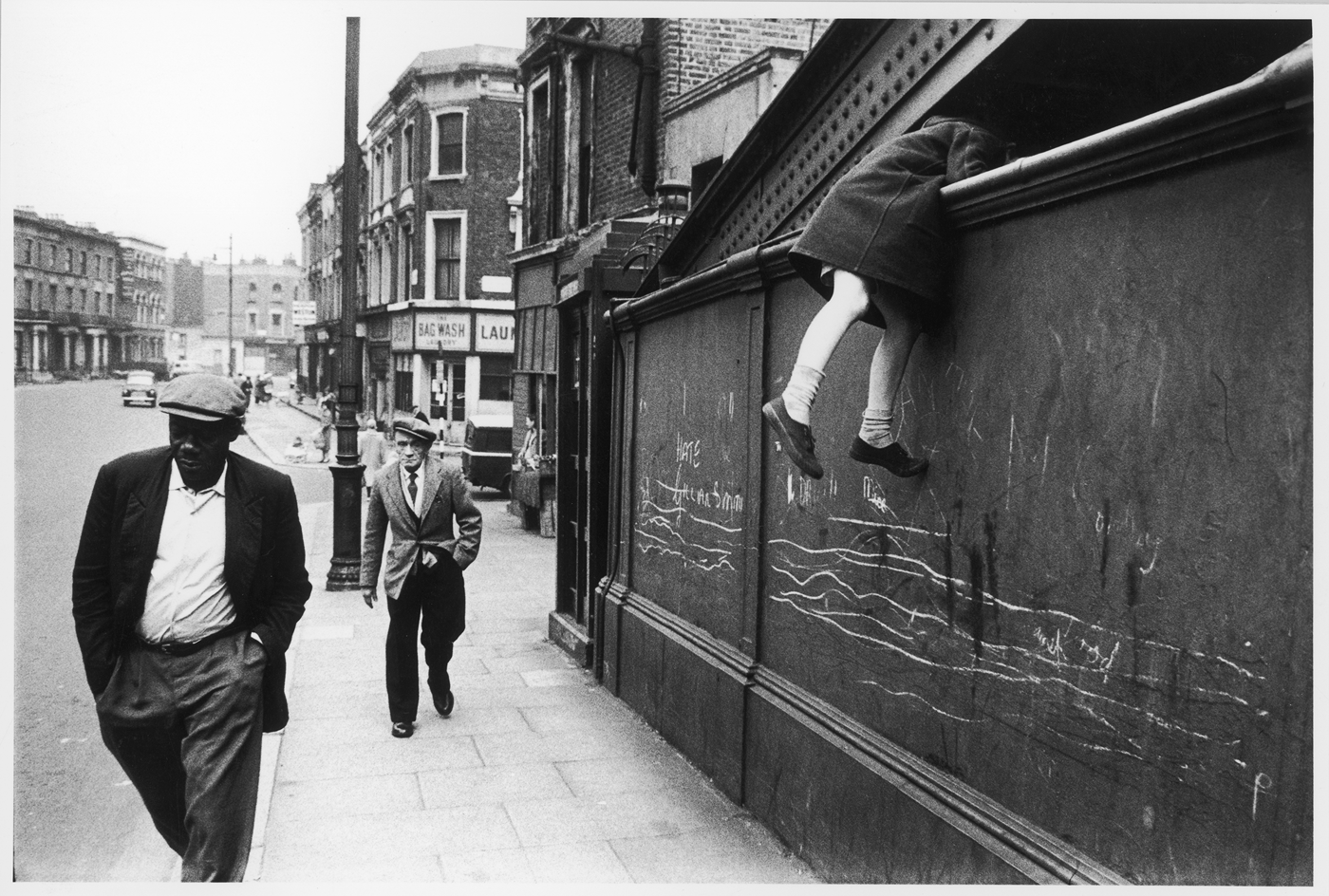
In this picture, race becomes part of the landscape of the working-class street, but not necessarily in a disruptive way. It is an aspect of dynamic changes to the street, but it does not necessarily sound its death knell. Indeed, in some of Mayne's photographs of Southam Street, the categories of childhood or youth or motherhood or, indeed, working-class masculinity transcend race. In one photograph, for example, two older men walk toward the photographer along the bridge linking Golborne Road and Southam Street (fig. 24), while a child climbs the bridge. Both men are dressed in the uniform of the working man: cloth cap, jacket, and worn trousers. One is black and one is white, distinguished by skin color but brought together by dress.
Roger Mayne, “West Indian Man in London.” Used with the permission of the Mary Evans Picture Library.
In other photographs, boys and girls of both races play together. It is important not to resort only to a quantitative survey, but it is notable that of the 53 photographs published in the catalog to the 1986 Southam Street exhibition, the majority of those photographs featuring African and West Indian migrants showed them within the fabric of the larger working-class community, rather than (as in “African Woman”) isolated from it. Similarly, in the online photo repository of Mayne's pictures, numbering nearly 1,600 images, a rough proportion of two to one show black and white people together rather than isolated from one another.Footnote 139 This is not to downplay or ignore the racism and racial violence in areas like North Kensington. But Mayne's pictures map not only racial estrangement and tension but also a more complex change, the building of a new kind of working-class community in London that included black and white. As with their representation of youth and gender, this is one of these ways that Mayne's photographs resist nostalgia. Against the suggestion that the “traditional markers of class and community had been profoundly dislocated” in places like Southam Street, Mayne's image is a more complicated one in which class and community were being reworked, in a way that class remained a powerful referent even if inflected by gender, youth, and race.Footnote 140 As with figure 23, “West Indian Women in London,” a more characteristic and more complex image of this new world can be found in figure 25, “Men and Boys.” If, as Paul Gilroy has written, “we have to produce histories of the city . . . which allow the presence of diverse colonial peoples and their stubbornly non-colonial descendants a far greater significance than they have been allowed in the past,” Mayne's photographs of Southam Street allow us to conceive of a history that brings those two presences together, that makes sense of the young black boy with his arm casually on the shoulder of a young white boy, together on a working-class street.Footnote 141
Roger Mayne, “Men and Boys.” Used with the permission of the Mary Evans Picture Library.
■ ■ ■
In 1963, the redevelopment of Southam Street began. In the sixties, Mayne's photographic interests widened to include portraits of writers and artists, photographs of Europe and Asia, and his own family. In 1969, he returned to what had been Southam Street; the photograph he made shows what seems to be a massive bomb site.
Most of Southam Street thus literally disappeared, leaving Mayne's photographs as the visual residue of a lost world. Nostalgia then gathered around the idea of Southam Street in the 1980s, prompted in immediate terms by the exhibition of Mayne's photographs, but perhaps more broadly by the mounting discontent with a trajectory of housing for working-class people in London that seemed to end too often in either gentrification or tower blocks. Nostalgia is not, however, the only meaning of these photographs.
Mayne's Southam Street photographs comprised a portrait of a world undergoing considerable change, not least with the greater visibility of women, youth, and black migrants. But this was not the picture of a world about to end. Instead, Mayne's photographs told the unfolding story of a working-class street, a street that might change physically but still held considerable relevance for understanding social life in Britain in the 1960s and 1970s. The story that Mayne's Southam Street told traced the fault lines among affluence, poverty, and material aspiration in postwar society, as well as charting the tensions between management and freedom. It was also a story about the “ongoing moment” of working-class life in Britain, the shift from one kind of working-class community to another.Footnote 142 Revisiting Roger Mayne's Southam Street thus reveals the dynamism of a working-class street, the people who lived on it, and the communities they formed.