Introduction
In 2015, Great Britain became the first country in the world to allow the creation of so-called “three-parent babies.”Footnote 1 The controversial reproductive procedures that allow for such a possibility replace a mother’s disease-linked mitochondrial DNA with that of another healthy woman. The result is a child with three genetic contributors: one male and two females. Rather curiously, however, the mitochondrial donor is required to acknowledge, by consent, that she will not be the child’s genetic parent.Footnote 2 Similarly, when the UK-based Nuffield Council on Bioethics conducted an inquiry into the ethical issues raised by mitochondrial donation, it concluded that, “[this type of] donation does not indicate, either biologically or legally, any notion of the child having either a ‘third parent,’ or ‘second mother.’”Footnote 3 But why such emphasis? Why worry about third parents and second mothers? These issues arise in the case of mitochondrial donation because there is nothing about the way biologists characterize reproduction—as a process by which organisms generate new individuals of the same kind—that would exclude the donor from being a third genetic parent. What is the basis, then, for considering an egg donor a genetic parent but not a mitochondrial donor? I will argue that a closer look at the biological facts will not give us an answer to this question because the process by which one becomes a genetic parent, i.e., the process of reproduction, is not a concept that can be settled by looking. It is, rather, a concept in need of philosophical attention.
The details of my argument will rest on recent developments in biological technology, but the persuasiveness of my argument will turn on the history of another biological concept, death. Given some important similarities between the two concepts, the way in which ‘death’ evolved in the recent past can provide guidance on how we should think about ‘reproduction.’ The paper will unfold in three stages: first, I will provide an account of how technological advancements muddled the seemingly biological concept of death in a way that prevented us from resolving it by empirical means; second, I will show that something similar is currently happening to the concept of reproduction; finally, I will argue that, as with death, there are important practical issues hinging on a more rigorous understanding of reproduction. Although much of what I say in this paper suggests that we need a new concept of reproduction, I do not offer one here. My aim is simply to show why ‘reproduction,’ a seemingly biological concept, is in need of philosophical analysis.Footnote 4
Death
Prior to the invention of the mechanical ventilator, death in the United States was determined by looking, not thinking. To tell if someone had died, all one had to do was check basic vital signs, e.g., pulse and breathing. Since the heart, the lungs, and the brain all work together, the cessation of any one would soon stop the other two and result in death. The widespread dissemination of ventilators in the 1960s (along with artificial nutrition and hydration) changed all that. Suddenly, an individual’s lungs and heart could continue to function even though the brain, and all the cognitive functions regulated by the brain, had ceased.
This possibility raised a new question: Should a person with a nonfunctioning brain, but with mechanically sustained cardiopulmonary functions, be considered dead or alive? In 1968, the Harvard Ad Hoc Committee responded to this question by contending that such a person ought to be considered dead.Footnote 5 However, the philosophical justification as to why wasn’t published until more than a decade after the committee’s decision. In 1981, the President’s Commission for the Study of Ethical Problems in Medicine and Biomedical and Behavioral Research wrote:
[D]eath is that moment at which the body’s physiological system ceases to constitute an integrated whole. Even if life continues in individual cells or organs, life of the organism as a whole requires complex integration, and without the latter, a person cannot properly be regarded as alive.Footnote 6
Since the brain’s functioning is necessary for the integration of the other functions of the human organism, and death is the irreversible loss of the functioning of the organism as a whole, the brain’s destruction constitutes death. In their report, the President’s Commission acknowledges that it was the invention of the ventilator that forced the medical community to think about death separately from its symptoms.Footnote 7 Keeping the two apart helped clarify that death is, and always has been, the irreversible cessation of an organism’s integrated functions, and the irreversible cessation of cardiopulmonary functions was merely an indicator of death.
The definition of death put forth by the President’s Commission is used in ethical and legal practice, but some philosophers have rejected the idea that death requires the cessation of the brain’s functioning as a whole. Jeff McMahan, for example, has argued that for the whole-brain conception of death to be right, it must be the case that we are merely organisms, an assumption that shouldn’t be taken for granted. He writes:
Whether we are organisms is not a scientific question. There is no experiment that can be done to determine whether or not we are organisms, just as there is no experiment that could tell us whether a statue and the lump of bronze of which it is composed are one and the same thing or distinct substances. These are both metaphysical questions that must be settled by philosophical argument.Footnote 8
McMahan argues that only if we assume we are merely organisms can we accept the whole-brain definition of death. But if we assume we are persons, in addition to biological organisms, we may cease to exist before the brain ceases functioning as a whole. In other words, we can die before the organism we are is dead.
On the higher-brain conception of death, which McMahan supports, we die when we irreversibly lose the capacity for consciousness, when there is no longer anything it is like to be the persons we are. That moment comes with the permanent loss of consciousness. Accordingly, it is not necessary for the whole brain to stop functioning in order for death to occur. The lower brain may continue to function, but if the higher brain no longer works, the person is rightly considered dead.
Not surprisingly, James Bernat and colleagues (who were among the first to provide the philosophical justification for whole-brain death) have rejected the higher-brain conception and with it, the idea that death is synonymous with the death of a person. “The concept ‘person’ is not biological but rather a concept defined in terms of certain kinds of abilities and qualities of awareness…Death is a biological concept.”Footnote 9 According to Bernat et al., if we want to define what it means for a person to die, such a conception of death is not sufficiently general. Death does not pertain only to persons but to all living things, and since the focus on higher-brain death is narrowly construed to apply only to creatures capable of consciousness, it is a definition that is not well suited to account for the general biological phenomena associated with death.
Philosophers continue to debate whether death is the irreversible cessation of integrated functions of an organism or the irreversible loss of consciousness. That’s because no scientific experiment can determine the extension of the concept. Again, in the words of the President’s Commission, “The basic concept of death is fundamentally a philosophical matter.”Footnote 10 But, of course, there are important practical consequences that hinge on an account of ‘death.’ For example, many of our legal statutes—such as criminal, tort, family, property and estate inheritance, insurance, and tax laws—make use of the concept, and all require a clear conception of death. Moreover, how we define death can determine when it is permissible to remove someone’s organs for donation. And, as a last example, depending on how death is defined, hospitals can refuse to take care of patients who can still grow, develop and give birth, claiming that they are nonetheless dead.Footnote 11
Reproduction
We see, then, that technological innovations sometimes require us to rethink old concepts. When the ventilator became available, we had to reconceive a concept that, in the past, seemed obvious. But it is not as though this reconceptualization could be settled with additional empirical evidence. Even with full agreement on the empirical facts, ‘death’ is ambiguous. Consequently, trying to understand the concept of death has become an important philosophical topic. Something similar is currently happening to the concept of reproduction. As new ways of reproducing emerge, advancing technologies are forcing us to rethink an old concept.
What are these new technologies that are posing problems for the concept of reproduction? Let us return to the example with which I began. Recall that there are controversial procedures currently being developed in Great Britain that would replace a mother’s disease-linked mitochondrial DNA (mtDNA) with that of another healthy woman. The replacement can be done using one of two methods: maternal spindle transfer (MST) and pro-nuclear transfer (PNT). The former method removes nuclear genetic material from an oocyte, the latter from a zygote. The nuclear genetic material is then transferred to an enucleated recipient cell (a cell without a nucleus), which contains all the remaining cellular structures, including healthy mitochondria. Both techniques—if working as intended—allow a woman with disease-linked mtDNA to have a child who will share her nuclear genetic material but not her defective mitochondrial genes. Instead, the child’s mtDNA will come from a female donor, and if the child is female, that donated mtDNA will be passed down to the next generation (assuming she has children).Footnote 12
The Nuffield Council acknowledges that a child created using either MST or PNT would have three genetic contributors—one male and two females—but they don’t see this as a child with three biological parents. Why not? According to the report, there are a couple of reasons to believe that contributing mtDNA is not sufficient to result in a child with three biological parents. The first reason is that mtDNA is not the right kind of DNA, and the second is that mtDNA comprises only a small fraction of overall DNA. Let’s examine each reason in turn.
Why think mtDNA is not the right kind of DNA? According to the Nuffield Council, the kind of DNA that might turn a donor into a biological parent is DNA that influences a child’s phenotypic characteristics. For example, if a donor’s mtDNA were to influence the child’s physical appearance or personality, she might rightly be considered the child’s “genetic parent.” But since mtDNA is primarily involved in the production of cellular energy, its replacement is often compared to the replacement of a battery: replacing a battery helps an appliance function, but it doesn’t affect the functioning of an appliance.Footnote 13 Similarly, healthy mtDNA helps a child develop but it doesn’t change the physical characteristics the child develops, which is why mitochondrial donors shouldn’t be viewed as a child’s genetic parents. In the following passage, the Nuffield Council seems to endorse this perspective:
It is beyond the remit of this project to fully investigate the widely variable perceptions of parenthood as brought about by genetic connections (or the lack of them). However, it does seem apparent to the Working Group that mitochondrial donation could be difficult to fit into some of the aspects often thought of as denoting characteristics of (nuclear) genetic ‘parenthood’…For example, paternal and maternal nuclear genetic contributions create a child with a unique nuclear genome, reflecting various recognizable aspects of these two genetic contributors. By contrast, it is discordant with current cultural conventions generated around (nuclear) genetic parenthood, that (as far as we are aware) mitochondrial genes convey to the resulting child no physical resemblances or other traits of personal characteristics of the donor, beyond that of health or ill-health.Footnote 14
The idea is that since mtDNA recipients lack any physical resemblance to their donors—except with respect to health or ill-health—and since there is an expectation of physical resemblance between genetic parents and their children, mtDNA recipients should not be considered the donors’ genetic children.
This argument is problematic for a number of reasons. First, while it is true enough that offspring tend to resemble their parents, it’s not by resemblance that we determine whether two people are genetically related. I may share my biological mother’s eye color or sense of humor, but our shared similarities are not the reason I am her daughter. Of course, we’re likely to share such features because we stand in a certain biological relation to one another, but what that biological relation amounts to, i.e., what counts as reproduction, is exactly what is being contemplated. To gesture at shared similarity without an account of the relation that justifies that gesture is to beg the question. My worry is that emphasizing resemblance when deciding whether mtDNA is the right kind of DNA to qualify the donor as a third genetic parent ignores the standard by which genetic parents qualify as genetic parents.
Second, the Nuffield Council’s report doesn’t offer a supporting argument for the idea that some genes, namely nuclear ones, convey traits of physical resemblance and some, namely mitochondrial ones, don’t. That’s not to say there isn’t another gesture at a reason for thinking nuclear genes play a role in physical resemblance not played by mitochondrial DNA, but again, the gesture is empty. Here is why. It is widely recognized that there are no “genes for” traits, for example, there are no “genes for” eye color.Footnote 15 Accordingly, to say that someone has a “gene for” blue eyes is the equivalent of saying that nuclear genes played some causal role in the development of that trait. However, given that mitochondrial genes also play some causal role in the development of traits—after all, they are the batteries necessary for developing physical characteristics—we cannot dismiss mitochondrial genes as causally insignificant in determining the traits of the offspring, at least not without an argument. Demoting the causal role of mtDNA while promoting that of nuclear DNA, when determining biological parentage, requires an account of causation that can explain why some types of causal relations are more significant than others.
Now that I’ve highlighted some problems with the first reason offered by the Nuffield Council for believing that mitochondrial donation doesn’t lead to genetic parenthood, let’s turn to the second. Recall that this reason relied on the fact that mtDNA comprises only a small fraction of overall DNA. But why would the fraction of contributed DNA matter? Or, more precisely, given that the fraction of DNA transferred between generations can vary significantly and not undermine parent/offspring relations, using the fraction of transferred DNA to determine those relations doesn’t seem like the right move. Compare, for example, the amount of DNA passed from parent to offspring in two standard forms of reproduction: sexual and asexual. In asexual reproduction, the offspring inherits 100 percent of the DNA of its parent, but in sexual reproduction, that amount drops by half. The offspring of sexually reproducing parents inherits only half of a parent’s DNA, yet the process is still considered ‘reproductive’ in kind. Now, if the amount of DNA passed from parent to offspring can vary this dramatically and still count as reproduction, what prevents even smaller amounts of DNA transmission from being considered? What if we develop a method of replacing stretches of DNA constituting 30 percent of overall DNA, or 20 percent, or 40 percent? How much is enough for the reproductive process to involve three parents, rather than two? If there is no principled way of drawing a boundary between instances of DNA transmission that are large enough to fall within the boundaries of reproduction and ones that aren’t, then we need some other justification for denying that mitochondrial DNA transfers fall under the scope of the concept.
A Spectrum of Cases
The fact that members of the Nuffield Council felt compelled to question whether mitochondrial donors are genetic parents shows that mtDNA transfers are challenging the boundaries of reproduction. The challenge is to be expected. After all, parts merged during mitochondrial donation are at the same subcellular level as parts merged during traditional sexual and asexual reproduction. Maybe this fact warranted the Council’s engagement with such a question, maybe not. Either way, the reasons offered for dismissing mtDNA transmission as insignificant compared to the transmission of nuclear DNA in determining genetic parenthood aren’t conclusive. And the problem is only going to get harder. It isn’t just subcellular transfers that raise problems for the concept of reproduction. Increasingly, transfers of biological material at the cellular level can also mimic reproduction, making this technological development a further problem for correctly identifying an individual’s genetic parents.
When cellular instead of subcellular material is merged, the result is a chimera, i.e., a biological individual composed of cells derived from at least two different zygotes, which can be of either the same or different species. Let’s look at a few recent experiments to see how chimeras can raise problems for understanding the concept of reproduction.
In March 2013, a team of researchers working at the University of Rochester in New York isolated specific types of brain cells—called glial progenitors—from second trimester fetuses (obtained after abortion), and engrafted them into the brains of newborn mice.Footnote 16 By the time these human-mouse chimeras reached adulthood, a large portion of their glia were replaced by human glia. Afterwards, the team tested the chimeras to see if the engraftment had any impact on their abilities. To everyone’s surprise, they discovered that the chimeras performed better on various learning and memory tests than their entirely murine controls. For example, when trained to fear an innocuous tone by pairing it with foot shock, “the human glial chimeric mice exhibited a significant enhancement in learning of the tone foot shock association: they showed greater fear to the tone as measured by scoring freezing behavior (the cessation of all movement except for respiration).”Footnote 17
Intrigued by these results, the team conducted another experiment the following year. This time, they transplanted more human glial progenitor cells into newborn mice to test whether the human cells could completely replace their murine counterparts. A year after the transplant, the cells of human origin completely replaced the host population, leading to “the effective humanization of the adult mouse with respect to its glial phenotypes.”Footnote 18
Both experiments are fascinating, but the question no one seemed to ask was whether the engraftment (and subsequent incorporation) of human glia in the mouse brain should count as an example of reproduction? But maybe such a suggestion is just too odd. Why would anyone think that transferring brain cells to neonatal mice would be a process that might fall under the purview of the concept ‘reproduction’? Perhaps because these mice inherited body parts from both human beings and mice and, in at least the first experiment, those parts influenced their phenotypic traits. It is in virtue of the transfer that the human-mouse chimeras were able to learn quicker. But is that enough to make both the contributors of the mouse and the human parts biological parents? If not, why not?
Given that the glial cells were merged so late in the developmental process of the mice—on the day they were born—my guess is that most people would say that the genealogical history of the mouse was not altered as a result of the transfer. A proper mouse was already in existence when the experiment was performed, making the engraftment look more like an organ transplant than an instance of reproduction. But I should emphasize that it only looks this way. It’s not clear what an argument to decide the issue would amount to. Intuitively, then, this is a case of transplantation rather than reproduction. However, the difference between transplantation and reproduction is not always this intuitive.
Indeed, if cells are merged early enough in a creature’s development, the merged cells may have the effect of altering our intuitions about genealogical relations. As a demonstration of this point, consider an experiment that involved pushing three young rhesus monkey embryos together to form one aggregate embryo. The outcome was the birth of a rhesus monkey whose initial composition was the product of three different populations of cells, which contained the genetic material of six individuals. Although the merging of biological material was at the cellular level, as opposed to the subcellular level typical of both sexual and asexual reproduction, it would be hard to argue that the offspring did not bear a genealogical relation to all six individuals. Indeed, the headlines also announced the outcome as the birth of monkeys with six parents.Footnote 19
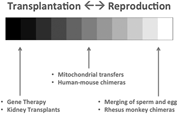
What do these examples mean for the concept of reproduction? It seems that at both the subcellular and cellular levels of material transfer, there is a spectrum of cases that may qualify as instances of reproduction (see Figure 1). On one end of the spectrum are cases that are less like reproduction and more like transplantation, and on the other end are cases that are more like reproduction and less like transplantation. Between the ends of the spectrum are cases that do not fall neatly into either category and there are a variety of such examples. Hence, things like gene therapy (a subcellular transfer) and kidney transplants (a cellular transfer) resemble transplantation; the merging of sperm and egg (a subcellular transfer) and the creation of rhesus monkey chimeras (a cellular transfer) resemble reproduction; mitochondrial transfers (a subcellular transfer) and the creation of human-mouse chimeras (a cellular transfer) fall somewhere in the middle.
The Transplantation-Reproduction Spectrum.

As new cases make their appearance on the spectrum, we’ll need something more robust than mere intuitions to guide us. Biological facts can help us navigate the space, but they cannot determine why some processes should, and others should not, qualify as ‘reproduction.’ What is needed is a philosophical argument, especially since matters of practical importance depend on it.
Implications
To illustrate the practical importance of providing a defensible account of reproduction, I’m going to return to cases of mitochondrial donation. Although mtDNA transfers are just one example on the transplantation-reproduction spectrum, they have received the most public attention, and are thus well suited for thinking through the practical implications of understanding mitochondrial donation as ‘reproduction’ rather than ‘transplantation.’
To get started, it’s worth pointing out that if a mitochondrial donor were recognized as one of a recipient child’s genetic parents, she wouldn’t thereby become the child’s social/legal parent. Instead, her role would likely be analogous to that of an egg or sperm donor: an individual who is enabling another individual (or a couple) to become a social/legal parent. As such, she would be the child’s genetic parent, but the intended parents would be the bearers of parental rights and responsibilities. As Josephine Johnston explains, third-party reproduction routinely separates the genetic/biological/gestational parents from the intended social/legal parents:
[W]e have generally come to recognize the intended parents as the legal and social parents of any child born from donated gametes or embryos, and the donors are understood simply as donors, or as “genetic parents” or “biological parents” or—in the case of gestational surrogate—as the “gestating mother.” These terms are still somewhat problematic and contested—in part because we usually give so much responsibility to anybody identified as a parent—but it is fair to say that the legal system, the fertility industry, and much of society now recognize the social parents as the legitimate parents and release the donors and surrogates from any parental rights and responsibilities.Footnote 20
Applied to our current discussion, the suggestion is that even if mitochondrial donation were equivalent to gamete donation, the mtDNA donor would likely be released from any parental rights and responsibilities. In that sense, changing the status of the mitochondrial donor to a genetic parent wouldn’t make much difference—either way, the intended parents, not the mtDNA donor, would bear all parental rights and responsibilities.
However, changing the status of the mitochondrial donor would result in changes to the consent procedure. According to the Human Fertilisation and Embryology Authority (HFEA) in the UK, in order to fully inform a donor’s decision (sperm, egg or mitochondria donor), the individual has to be given “enough information to enable them to understand the nature, purpose and implications of their treatment or donation.”Footnote 21 Currently, the nature of mitochondrial donation is not recognized as influencing reproduction. Although we haven’t seen any good reasons for believing that, there are consequences. For example, instructions for medical practitioners put forth by HFEA, which explain what is required to get informed consent from a mitochondria donor, ask them to make sure that the patient understands that “the intended mother, not your patient, will be the genetic parent of any child that is born.”Footnote 22 However, if mitochondrial donation were acknowledged to influence ‘reproduction,’ the nature of the donation would involve understanding that the donor is one of the child’s genetic parents. Informed consent could require a different set of criteria.
Aside from differences in obtaining informed consent, there are other practical issues that arise for our understanding of reproduction. For example, in 2005, egg and sperm donors (donating for purposes of reproduction through licensed clinics) became the only tissue and organ donors in the UK who are unable to donate anonymously.Footnote 23 This means that at the age of 18, a donor-conceived child can apply for identifying information about the donor and contact the donor, as well as any donor-conceived siblings. Conversely, gamete donors can find out whether their donation resulted in children. HFEA provides the following reason for ending gamete-donor anonymity:
Anonymity has been removed because it has been recognized by law that many donor-conceived people have a desire and interest in finding out about where they came from. Similarly, the interest donors have in finding out about children born from their donation has also been recognized.Footnote 24
Given HFEA’s explanation for the end of anonymity, it seems that the same reasons could apply to mtDNA donors if they are considered genetic parents. Indeed, if it turns out that mtDNA donors are genetic parents, losing their anonymity would help donor-conceived people find out where they came from.
One last point, although this one is not specific to mitochondrial donation. In the context of third-party reproduction, and assisted reproduction more broadly, it is often taken for granted that one has a right to reproduce.Footnote 25 But given the uncertainty of what counts as reproduction, and the possibility of someone inadvertently becoming a genetic parent, we might want to focus some attention on the question of whether we have a right not to reproduce.Footnote 26 As we sign lengthy consent forms for medical procedures, we may want to know, and have a right to know, if any of our extracted parts will be used in a way that will turn us into genetic parents. After all, if there is a right not to reproduce, we should know when that right is in danger of being violated. On a related note, we may have to decide whether aborted fetuses should be allowed to become genetic parents.Footnote 27 As we saw in the glial cell experiments, cells are sometimes extracted from aborted fetuses and engrafted to nonhuman animals in an effort to study human cells in the context of a chimera. If such experiments were to count as instances of reproduction, the aborted fetuses would be the chimeras’ genetic parents. These concerns provide additional reasons for getting clear on exactly what we mean by ‘reproduction.’
Conclusion
Sometimes technological innovations inspire us to reexamine old concepts. Just like the invention of the ventilator helped us reimagine our concept of death, so too, our increasing ability to transfer biological parts within and across species is challenging our concept of reproduction. Appeals to sexual or asexual reproduction are of little use since new ways of merging parts no longer resemble the way biologists have traditionally characterized reproduction. As a result, dismissing something like mitochondrial donation as not an instance of reproduction is a challenge. Even some transfers at the cellular level are hard to place on the transplantation-reproduction spectrum. All of these difficulties suggest that the concept of reproduction is in need of philosophical analysis. In the 1960s, we faced a similar realization with respect to death and today almost every bioethics textbook has a discussion on the topic. But the same is not true of ‘reproduction,’ and my aim in this paper has been to argue that this needs to change.