The most common reason for antibiotic prescribing is acute respiratory tract infection (ARTI). Reference Shapiro, Hicks, Pavia and Hersh1 In the ambulatory setting, the proportion of antibiotic-prescribed ARTIs could be as high as 41%–63%. Reference Thorpe, Smith and Trygstad2 This figure was higher in the emergency department (ED) setting compared to the primary care setting, Reference Thorpe, Smith and Trygstad2–Reference Donnelly, Baddley and Wang4 and this trend has continued over the years among adults. Reference Grijalva, Nuorti and Griffin5
Uncomplicated ARTIs (uARTIs) are commonly caused by respiratory viruses, Reference Shapiro, Hicks, Pavia and Hersh1 and those of bacterial origin have been estimated to be 5%–15%. Reference Yoon, Park and Kim6 The ED setting has a higher rate of inappropriate antibiotic prescribing than other ambulatory settings such as medical offices and retail health clinics, Reference Palms, Hicks and Bartoces7 and inappropriate antibiotic prescribing is higher in adults than in children (36.9% in adults vs 22.9% in children). Reference Denny, Gartside, Alcorn, Cross, Maloney and Keijzers8 These factors pose important public health implications that include accelerating antimicrobial resistance worldwide, adverse clinical outcomes due to adverse drug events, and higher healthcare cost. Reference Llor and Bjerrum9–Reference Kenealy and Arroll13 Antibiotics allergies also account for 47% of all drug allergies. Reference Thong and Tan14
Systematic reviews on antibiotic use in uARTIs to date have not been specific to the ED setting or the adult population. Reference McKay, Mah, Law, McGrail and Patrick15 In the ambulatory setting, the diagnosis of acute bronchitis and clinical manifestations (eg, fever, purulent sputum, abnormal respiratory examination, tonsillar exudate, and physician’s perception of the patient’s desire for antibiotics) were associated with higher odds of antibiotics prescribing. Reference McKay, Mah, Law, McGrail and Patrick15 In the primary care setting, the factors also include uncertainty of diagnosis, working under time pressure, the physician’s professional training, and the patient’s socioeconomic status. Reference O’Connor, O’Doherty, O’Regan and Dunne16
The ED setting is a unique healthcare setting. Physicians working in EDs face conflicting priorities, and they have to make time-sensitive decisions as they attend to critically ill and injured patients. Clinical care provision in the ED is also episodic. Unlike the primary care clinic, established relationships between providers and patients are lacking in the ED setting. Reference Newton17,Reference Pun, Matthiessen, Murray and Slade18 Therefore, it is important to identify determinants for antibiotic use in uARTIs presenting to the ED to reduce inappropriate antibiotic use in the ED. We investigated the clinical and nonclinical factors influencing physicians’ antibiotic prescribing practices for adult uARTI patients in the ED setting.
Methods
Study design
The protocol used for this systematic review was registered with PROSPERO and can be accessed at http://www.crd.york.ac.uk/PROSPERO (no. CRD42017071350).
Search strategy and selection criteria
Using the PICOS format, Reference Higgins and Green19 we designed the search categories as (1) population: uncomplicated acute respiratory tract infection (uARTI) patients aged 18 years or older; (2) interventions or interests: factors that address or influence antibiotic prescribing or expectation or demand; (3) comparison: appropriate versus inappropriate antibiotic prescribing behaviours (if intervention is available); (4) outcomes: antibiotic prescribing rates and antibiotic use; and (5) setting: emergency department (ED) or emergency room (ER) or accident and emergency (A&E).
We searched the studies through the OvidSP platform (Medline, Embase, PsycINFO) and the Cochrane Library (Cochrane Database of Systematic Reviews, Central Register of Controlled Trials [CENTRAL] and Cochrane Methodology Register) databases using a predetermined search strategy (Appendix 1 online). The strategy included MeSH (medical subject headings) terms for antibiotic, ARTI, and ED, Boolean operators AND and OR, and truncation symbols. We limited the search to English language articles published from January 1, 2005, to June 30, 2017, involving adult participants.
The titles and abstracts of all identified studies were screened twice, each time by 2 different reviewers (L.S.O. and H.L.G.) using a priori selection criteria. Studies were included if they met the following criteria: (1) peer-reviewed study in either experimental or observational design, (2) investigated ARTI including acute or unspecified rhinitis, sinusitis, supraglottitis, epiglottitis, laryngitis, pharyngitis, tonsillitis, tracheitis, bronchitis, common cold, influenza, and/or ARTI of multiple or unspecified sites, (3) involved adult patients (aged 18 years or older), and (4) conducted in the ED setting. Qualitative studies were included if they described antibiotics prescribing behavior among adult patients. We excluded studies on participants who developed secondary complications, abscess, swelling, or soft-tissue infection in the respiratory tract. Studies conducted in mixed settings or populations were excluded from our review unless the analysis was stratified and results specific to the ED setting and adult population were reported.
The reviewers then accessed the full text of the selected abstracts and reapplied the inclusion criteria detailed above. Discrepancies were resolved through discussion and adjudication by a third reviewer (A.C.).
Data extraction
Two investigators (H.L.H. and D.W.L.) independently performed data extraction using a standardized data extraction form on all selected articles. Discrepancies were resolved by discussion and consensus with a third reviewer (A.C.). Reviewers extracted the following information: (1) general study information (ie, authors, publication year, study location); (2) study design and setting; (3) study population details; (4) clinical and nonclinical factors; and (5) the outcomes of interest (ie, antibiotic prescription and appropriateness of antibiotic use).
Data synthesis and analysis
We expected significant heterogeneity among studies and did not plan for a meta-analysis. All factors extracted were included in the review and were categorized into either clinical or nonclinical factors. Nonclinical factors were further classified into provider, patient, and health-services factors. An α of 0.05 was used to interpret the factors as significant or nonsignificant in all studies. Factors associated with antibiotic use and appropriateness of antibiotics were interpreted together. Results from qualitative and quantitative studies were interpreted together if they examined the same factors.
Results
After excluding 52 non–English-language articles, the search returned 2,591 articles: 459 articles were from MEDLINE (Ovid), 2021 articles from EMBASE, 106 articles from Cochrane Library and 5 articles from PsychInfo. After removal of duplicates, we screened the titles and abstracts followed by complete text review. Only 11 articles remained for data extraction by the 2 investigators. We added 1 article from the references of the selected articles that was relevant to this study. Hence, 12 articles were included in this systematic review (Fig. 1). Reference Bergmark and Sedaghat3,Reference Aspinall, Good, Metlay, Mor and Fine20–Reference Roumie, Halasa, Edwards, Zhu, Dittus and Griffin29
PRISMA flow diagram of literature search and study inclusion criteria.

Characteristics of the studies
Table 1 shows a summary of the study characteristics. Among the studies, 9 were observational studies and 3 were interventional studies. Also, 11 studies were conducted in the United States, and 1 study was conducted in South Korea. Overall, 11 articles included ED patients or visits with nonpneumonia uARTI and 1 article included the diagnosis of pneumonia. Reference Gonzales, Camargo and MacKenzie23 In addition, one study restricted the study population to the maximum age of 64 years Reference Xu, Roberts, Sulapas, Martinez, Berk and Baldwin22 and another included only healthcare providers. Reference May, Gudger and Armstrong28 Sample sizes ranged from 2,270 to 2.3 billion visits or 139 to 2.2 million patients. We summarized the results into clinical and nonclinical factors associated with antibiotic prescription and appropriate antibiotic use (Tables 2 and 3).
Characteristics of Studies

Note. ED, emergency department; VA, Veterans’ Administration; ARTI, acute respiratory tract infection; IVRAT, influenza virus rapid antigen test; ILI, influenza-like illness; URTI, upper respiratory tract infection; NHAMCS, National Hospital Ambulatory Medical Care Survey; NEDSS, National Emergency Department Safety Study.
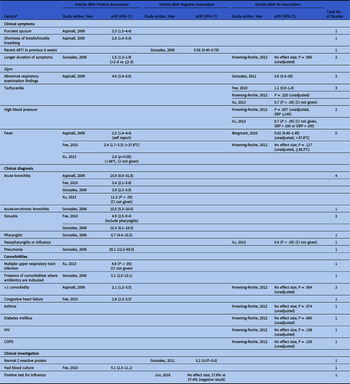
Studies Reporting a Positive, Negative, or No Association Between Respective Clinical Factors and Antibiotic Prescription or Inappropriate Antibiotic Use

Note. aOR, adjusted odds ratio; CI, confidence interval; ARTI, acute respiratory infection; HIV, human immunodeficiency virus; COPD, chronic obstructive pulmonary disease.
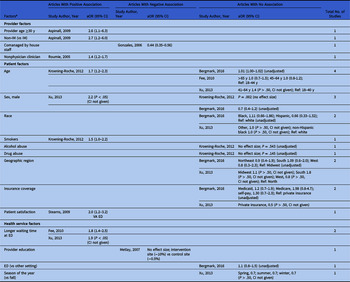
Studies Reporting a Positive, Negative, or Association Between Respective Nonclinical Factors and Antibiotic Prescription or Inappropriate Antibiotic Use

Note. aOR, adjusted odds ratio; CI, confidence interval; ED, emergency department; IM, internal medicine; VA, Veterans’ Administration (VA) hospital.
Clinical factors associated with antibiotic prescribing
We identified 6 studies that explored the association between the presenting complaints of the patients and the likelihood of being prescribed antibiotics (Table 2). Reference Bergmark and Sedaghat3,Reference Aspinall, Good, Metlay, Mor and Fine20–Reference Xu, Roberts, Sulapas, Martinez, Berk and Baldwin22,Reference Gonzales, Aagaard and Camargo24,Reference Kroening-Roche, Soroudi, Castillo and Vilke30 Symptoms reported to be associated with the prescription of antibiotics included fever, purulent sputum, shortness of breath/trouble breathing, and abnormal respiratory examination findings. Reference Aspinall, Good, Metlay, Mor and Fine20–Reference Xu, Roberts, Sulapas, Martinez, Berk and Baldwin22 Several studies showed no association between fever Reference Bergmark and Sedaghat3,Reference Kroening-Roche, Soroudi, Castillo and Vilke30 and abnormal respiratory findings Reference Gonzales, Aagaard and Camargo24 with antibiotics prescribing.
Furthermore, 2 articles described the duration of symptoms, but with contrasting results with different cutoffs. Patients with >2 days of symptoms (vs ≤2 days) were more likely to be prescribed antibiotics. Reference Gonzales, Camargo and MacKenzie23 This finding was not observed for acute bronchitis patients with >7 days of symptoms (vs 1–7 days). Reference Kroening-Roche, Soroudi, Castillo and Vilke30 Patients with uARTI 6 weeks prior to the current visit were less likely to receive antibiotics treatment. Reference Gonzales, Camargo and MacKenzie23
Furthermore, 4 studies underlined the association between antibiotic prescription and clinical diagnoses, including acute bronchitis, Reference Aspinall, Good, Metlay, Mor and Fine20–Reference Xu, Roberts, Sulapas, Martinez, Berk and Baldwin22 acute-on-chronic bronchitis, Reference Gonzales, Camargo and MacKenzie23 sinusitis, Reference Fee, Metlay, Camargo, Maselli and Gonzales21,Reference Gonzales, Camargo and MacKenzie23 pharyngitis, Reference Fee, Metlay, Camargo, Maselli and Gonzales21,Reference Gonzales, Camargo and MacKenzie23 and pneumonia. Reference Gonzales, Camargo and MacKenzie23
In addition, 2 studies reported the association between the number of comorbidities and antibiotic prescription. Only one study reported that antibiotic prescribing was associated with uARTI patients with ≥1 comorbidity, Reference Aspinall, Good, Metlay, Mor and Fine20 but another study showed no association. Reference Kroening-Roche, Soroudi, Castillo and Vilke30 Congestive heart failure was the only comorbidity to be associated with antibiotic prescribing. Reference Fee, Metlay, Camargo, Maselli and Gonzales21
Finally, 3 studies examined the association between antibiotic prescription and laboratory parameters. Patients who had a blood culture taken were more likely to have antibiotics prescribed. Reference Fee, Metlay, Camargo, Maselli and Gonzales21 A normal reading of C-reactive protein and a positive rapid influenza antigen test were negatively associated with antibiotic prescription. Reference Gonzales, Camargo and MacKenzie23,Reference Jun, Kim, Yoon, Lim, Ch and Choi25
Nonclinical factors associated with antibiotic prescribing
Provider factors
One study reported that older physicians and those from non–internal-medicine specialties were more likely to prescribe antibiotics. Reference Aspinall, Good, Metlay, Mor and Fine20 Another study described higher rates of antibiotic prescribing among nonphysician clinicians (eg, nurse practitioners or physician assistants). Reference Roumie, Halasa, Edwards, Zhu, Dittus and Griffin29 By contrast, ED visits comanaged by house staff (student, residents or fellows) or medical trainees had lower antibiotic prescribing. Reference Gonzales, Camargo and MacKenzie23
ED physicians also expressed that they were more likely to prescribe antibiotics if they perceived that the patient expected antibiotics. Reference May, Gudger and Armstrong28
Patient factors
Of 6 studies that examined patient demographics, 2 reported that older age, male gender, and smoking were positively associated with antibiotics prescriptions. Reference Xu, Roberts, Sulapas, Martinez, Berk and Baldwin22,Reference Kroening-Roche, Soroudi, Castillo and Vilke30 However, 4 studies reported no association between antibiotic prescription and age or gender. Reference Bergmark and Sedaghat3,Reference Fee, Metlay, Camargo, Maselli and Gonzales21,Reference Xu, Roberts, Sulapas, Martinez, Berk and Baldwin22,Reference Kroening-Roche, Soroudi, Castillo and Vilke30
One study suggested that antibiotic treatment increased the overall satisfaction of visits to non–Veterans’ Administration (VA) hospital EDs but not VA hospital EDs. Reference Stearns, Gonzales, Camargo, Maselli and Metlay27
Health service factors
The thresholds for antibiotic prescribing were lower when the patient’s ability to receive follow-up care was uncertain. Reference May, Gudger and Armstrong28 Longer waiting time at the ED was also associated with antibiotic prescribing in 2 studies. Reference Fee, Metlay, Camargo, Maselli and Gonzales21,Reference Xu, Roberts, Sulapas, Martinez, Berk and Baldwin22
The Improving Antibiotic Use in Acute Care Treatment (IMPAACT) trial reported beneficial effects of educational programs for clinicians and patients in reducing antibiotic prescribing in the ED. Reference Metlay, Camargo and MacKenzie26 The adjusted year-to-year reductions was −10% (95% CI, −18% to −2%). In a mixed-methods study, in-house education by experts in antimicrobial stewardship was one of the facilitators to improve the appropriateness of antibiotic prescribing. Reference May, Gudger and Armstrong28 Additionally, antibiograms and online antibiotic decision support were reported to be useful for antibiotic decisions. Reference May, Gudger and Armstrong28
Discussion
In this systematic review, we identified key factors associated with reduced antibiotic prescription for adult uARTIs in the ED, which included provider education on antibiotics use, attendance by internal medicine–trained physicians, and comanagement with house staff. Clinical factors associated with reduced antibiotics use were a normal CRP, positive influenza test, and patient having a recent ARTI.
There is strong evidence to support interventions to reduce antibiotics use in the primary care and inpatient settings. Reference Gonzales, Anderer and McCulloch31,Reference Davey, Marwick and Scott32 A proactive approach with educational outreach and workshops was more effective than a passive approach. Reference Ranji, Steinman, Shojania and Gonzales33 This situation is similar to the inpatient setting, where audit and feedback, decision support tools, and educational outreach improved adherence to antibiotics prescription policies by 15%. Reference Davey, Marwick and Scott32 The only study with provider education included in our systematic review highlighted a 10% reduction in antibiotics use at year 2 by adopting a similar approach. Reference Metlay, Camargo and MacKenzie26 This intervention included large- and small-group education sessions on the principles of antibiotics use for the providers; feedback on antibiotic utilization; and education of patients through posters, brochures, and video kiosks. Reference Metlay, Camargo and MacKenzie26 Although effect size was not provided in the study, the results suggested that evidence from other settings could likely be translated to the ED setting. Innovative methods of delivering education and the frequency of outreach could be explored to minimize the disruption to ED physicians’ work shifts.
At the provider level, older physicians and those from non–internal-medicine specialties were more likely to prescribe antibiotics. Both factors were identified by the same study. Reference Aspinall, Good, Metlay, Mor and Fine20 While the reason is not well understood, time constraint could play a role. Reference May, Gudger and Armstrong28 Older physicians have more responsibilities, and surgeons allocate their time between operating theatre, clinics, and wards, Reference Charani, Ahmad, Rawson, Castro-Sanchèz, Tarrant and Holmes34 in addition to fear of litigation and concerns about patient access to follow-up faced by all other physicians. Reference Newton17,Reference Saposnik, Redelmeier, Ruff and Tobler35 Because younger physicians and those in the internal medicine specialty are more likely to use antibiotic regularly and be updated with the antibiotic guidelines, Reference Charani, Ahmad, Rawson, Castro-Sanchèz, Tarrant and Holmes34 they could be engaged in the education of other physicians on appropriate antibiotic use.
In this review, comanagement of patients by junior physicians reduced antibiotic prescribing, similar to findings from a mixed setting (primary care and emergency department). Reference Pynnonen, Lynn and Kern36 In clinical decision making, 2 systems of thinking could be involved: intuitive and analytical. Reference Croskerry, Petrie, Reilly and Tait37,Reference Audétat, Laurin, Dory, Charlin and Nendaz38 The intuitive thinking system is fast but error prone, while the analytical thinking system counters cognitive biases. The presence of other colleagues on a team, could activate the analytical thinking process to rationalize the use of antibiotics. Laboratory investigations also augment the decision-making process. Patients presenting with fever, purulent sputum, and abnormal respiratory examinations are often inaccurately perceived as ARTIs of bacterial etiology. Reference McKay, Mah, Law, McGrail and Patrick15 Positive influenza virus test or a normal C-reactive protein level provide objective evidence that antibiotics are not required, resulting in the reduction of antibiotic prescription. Reference Stearns, Gonzales, Camargo, Maselli and Metlay27,39–Reference Rosenfeld, Piccirillo and Chandrasekhar41 Given the fast working pace in EDs, tools that address cognitive biases may reduce unnecessary antibiotic prescription. Reference Gonzales, Anderer and McCulloch31
Only 1 study in this systematic review reported that the physician’s perception of the patient’s expectations of antibiotics was associated with antibiotic prescription; this study was multicentered and consistent with the findings from a systematic review at the ambulatory setting, with adjusted odds ratios ranging from 1.7 to 23.3. Reference McKay, Mah, Law, McGrail and Patrick15 Potential reasons include perceived antibiotics as a convenient solution to shorten consultation time, Reference Morgan, Chang, Alqatari and Pines42 as a compensation for patients’ waiting time, Reference Newton17,Reference Dempsey, Businger, Whaley, Gagne and Linder43,Reference Gaarslev, Yee, Chan, Fletcher-Lartey and Khan44 or as a tool to increase patient satisfaction, which was often associated with financial incentives. Reference Sharp, Shen, Kanter, Berman and Gould45 However, 1 study suggested that the reason patients desired antibiotics was for pain relief and faster recovery, Reference van Driel, De Sutter and Deveugele46 both of which cannot be addressed by antibiotics. Hence, it might be worth correcting patients’ misconceptions of antibiotics by addressing their real concerns.
These findings have important public health implications. First, education of providers on appropriate antibiotics use could reduce antibiotics prescriptions for adult uARTIs. Effective strategies in the primary care and inpatient settings that have been widely accepted Reference Davey, Marwick and Scott32,Reference Ranji, Steinman, Shojania and Gonzales33 can be explored in the ED setting to assess their effectiveness in this fast-paced, time-sensitive context. Second, clinical factors associated with antibiotics prescribing could potentially be addressed by laboratory investigations or other decision-support tools that differentiate viral and bacterial etiologies. Their cost-effectiveness and practicality in the real-world setting are worth exploring. Third, most of the factors identified were based on 1–2 studies. Similar studies need to be replicated in different settings because the antibiotics prescribing culture likely differ among EDs and health systems. Nurse practitioners who are empowered to prescribe antibiotics, for instance, are nonexistent in the healthcare systems of some countries. Furthermore, the medical education systems and healthcare financing models also vary worldwide.
This review has several limitations. The study designs and study populations in the various studies were heterogenous. By restricting the review to the adult population, the results are only generalizable to adult uARTI visits at EDs. For the same factor examined, different studies adopted different definitions. Furthermore, different comparator groups were used in the outcome analyses. Nonetheless, we explicitly described them in the review and considered them when interpreting the results. Lastly, we considered English-language publications only. However, our literature search only identified 52 non–English-language articles, a small proportion (2.8%) of all articles, rendering any selection bias highly unlikely.
Antibiotics need to be used judiciously in the ED to conserve the limited armamentarium against infections. We identified important clinical and nonclinical factors influencing antibiotic prescribing for uARTI in the ED at the patient, provider, and health-service levels. Further studies on interventions addressing these factors to optimize antibiotics use are warranted.
Supplementary material
To view supplementary material for this article, please visit https://doi.org/10.1017/ice.2020.1245
Acknowledgments
Financial support
No financial support was provided relevant to this article.
Conflicts of interest
All authors report no conflicts of interest relevant to this article.