INTRODUCTION
Fishing represents one of the greatest anthropogenic impacts on global marine resources (Watson et al. Reference Watson, Cheung, Anticamara, Sumaila, Zeller and Pauly2013). Serial depletions of marine fish resources are jeopardizing the future of marine fisheries, probably leading to species extinction, to ecosystem regime shifts (Pauly et al. Reference Pauly, Christensen, Guénette, Pitcher, Sumaila, Walters, Watson and Zeller2002; Mullon et al. Reference Mullon, Fréon and Cury2005) and threatening the overall integrity of marine ecosystems (Pikitch, Reference Pikitch2012).
In line with the global tendency, developing coastal countries have increased their fishing capacity in order to further production of both large, high-value and small, low-value fish, with Latin America being a good example of such a trend (Arana et al. Reference Arana, Alvarez Perez and Pezzuto2009). Fishing is an important and widely distributed economic activity along South American Atlantic coasts (SAAC) (Thorpe et al. Reference Thorpe, Aguilar Ibarra and Reid2000; Salas et al. Reference Salas, Chuenpagdee, Seijo and Charles2011) and it has expanded in the region during recent decades; for example, fishing effort has increased on the Argentine continental shelf (Bertolotti et al. Reference Bertolotti, Verazay, Errazti, Pagani, Buono and Boschi2001; Carozza et al. Reference Carozza, Perrotta, Cotrina, Bremec and Aubone2001), while a deep-sea fishery is being developed in Brazil (Perez et al. Reference Perez, Pezzuto, Schwingel, Lopes and Rodrigues-Ribeiro2003). Consequently, catches have been gradually shifting from long-living and high trophic level species to short-living species located in low trophic levels of the food web. This process, known as ‘fishing down marine food webs’ (Pauly et al. Reference Pauly, Christensen, Dalsgaard, Froese and Torres1998) has been documented in this region (Milessi et al. Reference Milessi, Arancibia, Neira and Defeo2005; Jaureguízar and Milessi, Reference Jaureguízar and Milessi2008; Freire and Pauly, Reference Freire and Pauly2010). Furthermore, total catches have fluctuated around 2 million tonnes after a period of increasing catches ended in the mid-1980s. Major species such as Argentine hake, Merluccius hubbsi and Brazilian sardinella, Sardinella brasiliensis, are still estimated to be overexploited, and 50% of the monitored fish stocks in the region were overexploited, 41% fully exploited and only the remaining 9% is considered non-fully exploited (Freire, Reference Freire2003; FAO, 2012).
Undoubtedly, conservation challenges for the development of sustainable fisheries in the South West Atlantic are vast in terms of their complexity and their impact on economies and marine ecosystems throughout the region. The enormous fishing pressure upon these rich marine resources will drive them to economic, biological and ecological collapse, if fisheries are not controlled, regulated or transformed soon. Stock identification, involving the recognition of population structure of fishery resources is, therefore, a central theme for effective fisheries and endangered species management (Begg et al. Reference Begg, Friedland and Pearce1999; Cadrin et al. Reference Cadrin, Friedland and Waldman2005). Different approaches have been used in identifying and classifying stocks, including mark–recapture, catch data, life-history characteristics, otolith microchemistry, morphology, genetics and parasites (Begg and Waldman, Reference Begg and Waldman1999), and holistic approaches (e.g. involving a broad spectrum of complementary techniques) have been advocated to be used in future stock identification studies.
Despite few studies having actually used parasites in conjunction with other techniques (Marcogliese, Reference Marcogliese, Afonso-Dias, Menezes, MacKenzie and Eiras2008), parasites have been widely used as biological markers to provide information on the diet, movements and population structure of their hosts (Williams et al. Reference Williams, MacKenzie and McCarthy1992; MacKenzie and Abaunza, Reference MacKenzie and Abaunza1998, Reference MacKenzie, Abaunza, Cadrin, Friedland and Waldman2005). This methodology is increasingly recognized as being applicable to the problems of fishery management and is being broadly used worldwide (MacKenzie, Reference MacKenzie2002), constituting also a suitable tool to predict harvest locations helping to combat illegal fisheries (Power et al. Reference Power, Balbuena and Raga2005).
Here we review the existing studies about parasites as biological tags in fishes under exploitation in SAAC, where parasites have been identified as promising tools for stock assessment, at least in southern regions (Timi, Reference Timi2007). The current status of this methodology is evaluated in the context of regional fisheries, their possible constraints are identified, and the corresponding solutions are suggested. General macrogeographical patterns are also analysed, expanding the use of biological tags from a population to a community level, and from local to regional scales. Finally, future trends and outlooks about the potential use of parasites to provide information for fishery science are analysed.
CURRENT STATUS OF THE USE OF PARASITES AS BIOLOGICAL TAGS IN THE SOUTH WESTERN ATLANTIC
The use of biological tags is ultimately based on the geographical distribution of parasites, since the geographical distance between populations of conspecific hosts is undoubtedly a key determinant of the likelihood that exchanges of parasite species occur between these populations (Poulin and Morand, Reference Poulin and Morand1999). Therefore, the underlying assumption of this method is that hosts can become infected only when they are within the endemic area of a parasite, namely that geographical region in which the conditions are suitable for transmission (MacKenzie and Abaunza, Reference MacKenzie, Abaunza, Cadrin, Friedland and Waldman2005). For parasites with direct life cycles the endemic area is mainly determined by environmental conditions, whereas for parasites with indirect life cycles, an additional requirement is that suitable hosts for all the developmental stages must be present (MacKenzie and Abaunza, Reference MacKenzie and Abaunza1998). Furthermore, all host species involved in the life cycle of parasites should be present at population densities that ensure parasite transmission. Therefore, environmental conditions can also influence parasite distribution indirectly through their effects on the distribution of hosts.
For marine parasites, in particular, geographical distributions are mainly determined by temperature-salinity profiles and their association with specific masses of water (Esch and Fernández, Reference Esch and Fernández1993). Consequently, although not always available, the knowledge of oceanographic and biological characteristics in the regions to be compared is necessary for sample scheduling and interpretation of results.
The environment in the South Western Atlantic
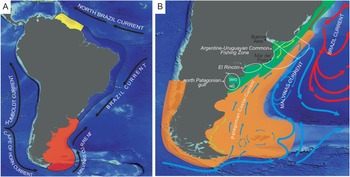
The SAAC extends almost 15 000 km from the coast of Venezuela, contiguous with the Caribbean Sea, to the southern tip of Argentina, bordering the Pacific Ocean, and ranging from tropical to subantarctic environments (Fig. 1A). This region has an extensive continental platform that receives the discharge of enormous amounts of fresh water and sediment from three major rivers: the Orinoco, the Amazon and the de la Plata (Miloslavich et al. Reference Miloslavich, Klein, Díaz, Hernandez, Bigatti, Campos, Artigas, Castillo, Penchaszadeh, Neill, Carranza, Retana, Díaz de Astarloa, Lewis, Yorio, Piriz, Rodriguez, Yoneshigue-Valentin, Gamboa and Martín2011). The water circulation along the SAAC is very complex, and includes at low latitudes the North Brazil and the Brazil currents, flowing north-west towards the Caribbean Sea and south, respectively, along the Brazilian coast (Fig. 1A) (Artigas et al. Reference Artigas, Vendeville, Leopold, Guiral and Ternon2003; Garraffo et al. Reference Garraffo, Johns, Chassignet, Goñi, Malanotte-Rizzoli and Goni2003; Miloslavich et al. Reference Miloslavich, Klein, Díaz, Hernandez, Bigatti, Campos, Artigas, Castillo, Penchaszadeh, Neill, Carranza, Retana, Díaz de Astarloa, Lewis, Yorio, Piriz, Rodriguez, Yoneshigue-Valentin, Gamboa and Martín2011). The Brazil Current (warm and saline water) flows southwards from its origin and along the continental margin, reaching the northern Argentine Sea near 38°S, where it meets the Malvinas Current (cold and low salinity sub-Antarctic water) which flows northwards at the edge of the Argentine shelf (Bakun and Parrish, Reference Bakun and Parrish1991).
Map of the South American continent showing (A) the three subregions defined by Miloslavich et al. (Reference Miloslavich, Klein, Díaz, Hernandez, Bigatti, Campos, Artigas, Castillo, Penchaszadeh, Neill, Carranza, Retana, Díaz de Astarloa, Lewis, Yorio, Piriz, Rodriguez, Yoneshigue-Valentin, Gamboa and Martín2011) as analysed in this paper: Tropical West Atlantic (yellow), The Brazilian Shelves (blue), and Patagonian Shelf (red) and the main ocean currents in the West Atlantic Ocean and (B) the southern tip of South America, its ocean currents and zoogeographical provinces of Patagonian shelf subregion: Argentine Biogeographical province (green) and Magellanic Biogeographical province (orange). SMG: San Matías Gulf; NG: Nuevo Gulf. Map modified from Amante and Eakins (Reference Amante and Eakins2009).

This heterogeneous region harbours an enormous biodiversity, the distribution patterns and endemisms of which have been utilized to describe a series of ecosystems and biogeographical realms and provinces, recently revised and redefined (Spalding et al. Reference Spalding, Fox, Allen, Davidson, Ferdaña, Finlayson, Halpern, Jorge, Lombana, Lourie, Martin, McManus, Molnar, Recchia and Robertson2007; Miloslavich et al. Reference Miloslavich, Klein, Díaz, Hernandez, Bigatti, Campos, Artigas, Castillo, Penchaszadeh, Neill, Carranza, Retana, Díaz de Astarloa, Lewis, Yorio, Piriz, Rodriguez, Yoneshigue-Valentin, Gamboa and Martín2011; Briggs and Bowen, Reference Briggs and Bowen2012). According to Miloslavich et al. (Reference Miloslavich, Klein, Díaz, Hernandez, Bigatti, Campos, Artigas, Castillo, Penchaszadeh, Neill, Carranza, Retana, Díaz de Astarloa, Lewis, Yorio, Piriz, Rodriguez, Yoneshigue-Valentin, Gamboa and Martín2011), based on a large number of regional and local studies, the ecosystems along the SAAC are: the Tropical West Atlantic (including the Venezuelan Atlantic, Guyana, Suriname and the French Guiana), the Brazilian Shelves (north, south and east) and the Patagonian Shelf (Uruguay and Argentina) (Fig. 1A).
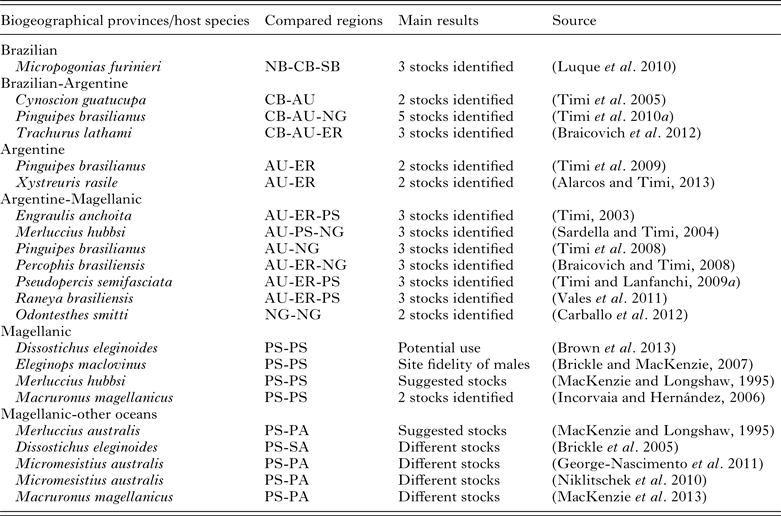
The status of the use of parasites as biological tags in the SAAC is analysed considering the subregions or ecosystems as defined by Miloslavich et al. (Reference Miloslavich, Klein, Díaz, Hernandez, Bigatti, Campos, Artigas, Castillo, Penchaszadeh, Neill, Carranza, Retana, Díaz de Astarloa, Lewis, Yorio, Piriz, Rodriguez, Yoneshigue-Valentin, Gamboa and Martín2011), across which the studies on biological tags are unevenly distributed (Table 1).
Published surveys on stock discrimination using parasites as biological tags in fish species from South American Atlantic waters, within and across biogeographical provinces

AU: Argentine-Uruguayan Common Fishing Zone; CB: central Brazil; ER: El Rincón; NB: North Brazil; NG: North Patagonian gulfs; PA: Pacific; PS: Patagonian shelf; SA: other subantarctic localities; SB: south Brazil.
Parasites as biological tags for fish stock identification in the South Western Atlantic
Tropical West Atlantic
At present, there are no studies dealing with parasites as biological tags in this region, despite its heterogeneity in terms of oceanographic, geological and biological features, which undoubtedly offers great potential for this methodology in this ecosystem.
The Brazilian shelves
Brazil has the longest coastline in South America; considering the heterogeneity of the Brazilian continental shelf, margin, adjacent seamounts and abyssal plain, this very large ecosystem is hydrologically and topographically complex, having contrasting dominant ecosystems of unique features, including mangroves, coral reefs, dunes, sand banks, sandy beaches, rocky shores, lagoons, estuaries and salt marshes. As in the case of the Tropical West Atlantic, this region offers excellent possibilities for using parasites as biological indicators of stock structure for the enormous variety of fish species that it harbours.
Despite extensive areas of the Brazilian coast remaining unexplored because of its vastness (Miloslavich et al. Reference Miloslavich, Klein, Díaz, Hernandez, Bigatti, Campos, Artigas, Castillo, Penchaszadeh, Neill, Carranza, Retana, Díaz de Astarloa, Lewis, Yorio, Piriz, Rodriguez, Yoneshigue-Valentin, Gamboa and Martín2011), this country has a long history of parasitological studies in the marine environment, probably the longest and most constant over time in South America. Although these studies are to a large extent taxonomic, the largest number of papers dealing with parasite ecology in the continent have been also published by Brazilian authors (see e.g. Luque et al. Reference Luque, Mouillot and Poulin2004). However, at present only one study using parasites to discriminate fish stocks within Brazilian boundaries has been published. This is the case of the whitemouth croaker, Micropogonias furnieri from five localities along the Brazilian coast (Luque et al. Reference Luque, Cordeiro and Oliva2010). These authors successfully identified three groups of localities associated with three stocks of M. furnieri in Brazil. The successful study by Luque et al. (Reference Luque, Cordeiro and Oliva2010) should encourage Brazilian researchers to extend their investigations in this field.
Other studies comparing fish species from the Brazilian Biogeographical province (BBP), particularly from the region of Rio de Janeiro, with conspecifics from the northern Argentine Sea in the Argentine Biogeographical province (ABP) showed parasite faunas significantly different between these regions. These studies included the striped weakfish, Cynoscion guatucupa, the Brazilian sandperch, Pinguipes brasilianus and the rough scad, Trachurus lathami (Table 1).
An exponential decay of similarity, which implies a constant proportional reduction in similarity per unit distance (Poulin, Reference Poulin2003), was observed for parasite assemblages of P. brasilianus (Timi et al. Reference Timi, Lanfranchi and Luque2010a ). This pattern was attributed to the existence of geographical gradients in environmental conditions, determined by the water currents characterizing water circulation in the SAAC. As the localities of capture are distributed along a latitudinal/environmental gradient, it is to be expected that geographical distance is correlated with this ‘environmental’ distance, emerging as a predictor of similarity for parasite communities of P. brasilianus. This pattern is probably reinforced by differential responses of parasite species to environmental variation (Vinarski et al. Reference Vinarski, Korallo, Krasnov, Shenbrot and Poulin2007), as well as to the probability that geographical barriers occur over greater distances and to the limited dispersal abilities of organisms, even in homogeneous environments (Brouat and Duplantier, Reference Brouat and Duplantier2007; Soininen et al. Reference Soininen, McDonald and Hillebrand2007). Despite the general absence of geographical barriers in marine systems, the de la Plata river can represent an obstacle for the dispersion of many marine parasites, through a significant discharge of fresh water into the Atlantic (Acha et al. Reference Acha, Mianzán, Guerrero, Carreto, Giberto, Montoya and Carnigan2008).
The environmental and biological processes acting along this latitudinal gradient are expected to produce similar patterns for other species, at least for non-migratory fishes that, however, need to be confirmed by further studies.
The Patagonian Shelf
The majority of studies using parasites as biological tags were carried out in this ecosystem (Table 1). Consequently its physical and biological characteristics will be treated in more detail. Analyses, revisions and conclusions provided by this work are also largely based in the information available in this region.
The Patagonian Shelf (PS) is the largest and one of the most productive ecosystems in the southern hemisphere (Miloslavich et al. Reference Miloslavich, Klein, Díaz, Hernandez, Bigatti, Campos, Artigas, Castillo, Penchaszadeh, Neill, Carranza, Retana, Díaz de Astarloa, Lewis, Yorio, Piriz, Rodriguez, Yoneshigue-Valentin, Gamboa and Martín2011). The water circulation in this region is determined by the southern extension of the Brazil Current in the north and the Malvinas Current in most of its extent; both currents run parallel to the coast and meet on the continental slope near 38°S, creating a strong frontal zone, which marks the division between subtropical and sub-Antarctic waters (Piola and Rivas, Reference Piola, Rivas and Boschi1997) (Fig. 1).
The Malvinas Current dominates adjacent shelf waters, producing a latitudinal gradient of temperature which decreases southwards, whereas at the northern limit of the Argentine Sea, the effect of the warm Brazil Current is marked (Bakun and Parrish, Reference Bakun and Parrish1991). The discharge of the de la Plata river strongly influences the oceanographic conditions at the north of the Argentine Sea by reducing salinity, mainly north of 38°S (Guerrero and Piola, Reference Guerrero, Piola and Boschi1997).
The PS ecosystem is biogeographically divided into two zoogeographical provinces, the Argentine (ABP) and the Magellanic (MBP), which meet around the Valdes Peninsula (Fig. 1B). The ABP extends from 30–32° to 41–44°S, encompassing coastal or relatively shallow shelf areas off southern Rio Grande do Sul State in Brazil, Uruguay, and northern Argentina. The MBP, extending from the de la Plata river (Argentina/Uruguay border) to 56°S in the Atlantic, includes the deep waters in the outer Buenos Aires province and in the outer Uruguayan shelf and slope, as well as the coast and shelf of southern Patagonia (Bogazzi et al. Reference Bogazzi, Baldoni, Rivas, Martos, Reta, Orensanz, Lasta, Dell'Arciprete and Werner2005; Cousseau and Figueroa, Reference Cousseau, Figueroa, Cousseau, Díaz de Astarloa, Ehrlich, Fabré and Figueroa2010), and reaches Chiloé Island off the Pacific coast of Chile (Briggs and Bowen, Reference Briggs and Bowen2012) (Fig. 1B).
In PS, several oceanographic variables show latitudinal gradients, including water temperature, which decreases southwards (Bakun and Parrish, Reference Bakun and Parrish1991; Hoffmann et al. Reference Hoffmann, Núñez, Piccolo and Boschi1997). Temperature, as a correlate of energy input, is a good predictor of latitudinal gradients in species richness and diversity (Rohde, Reference Rohde1992, Reference Rohde1999). The thermal gradient characteristic of this region is, therefore, expected to have a sufficient influence on the structure of parasite populations and communities, in terms of both composition and abundance, to produce differences in the structure of assemblages. In this sense, all studies comparing fish samples between northern and Patagonian waters showed differences significant enough for them to be considered as discrete stocks, these species being M. hubbsi, P. brasiliensis, the Argentine anchovy, Engraulis anchoita, the Argentine sandperch, Pseudopercis semifasciata and the banded cusk-eel, Raneya brasiliensis (Table 1). Therefore, it can be hypothesized that stocks of other fish species could be discriminated between these bioregions with contrasting physical and biological features.
Despite these large oceanographic areas being characterized as biogeographical provinces, each has its own subdivisions or districts, identifiable by singular environmental and biological characteristics varying at smaller spatial scales. Indeed, in the ABP the water mass delimited by the Malvinas Current is known as Continental Shelf Waters. This water mass extends into the northern continental shelf from the southwest and occupies the central portion of the shelf. It is separated from coastal waters by the 50 m isobath, with the exception of the coast between 38°30′S and 37°30′S, where it reaches the coast (Guerrero and Piola, Reference Guerrero, Piola and Boschi1997), producing the penetration of shelf waters into the coastal region around 38°S and generating a marked bathymetric gradient (Lucas et al. Reference Lucas, Guerrero, Mianzán, Acha and Lasta2005). Both coastal zones, separated by continental shelf waters, represent different basins with contrasting oceanographic and biological characteristics. The northern coastal region, known as the Argentine-Uruguayan Common Fishing Zone (AUCFZ) (Fig. 1B) is greatly influenced by the Brazil Current, as well as by the discharge of the de la Plata river (Bakun and Parrish, Reference Bakun and Parrish1991; Guerrero et al. Reference Guerrero, Acha, Framinan and Lasta1997), especially during spring and summer when their influence reaches the coasts of Mar del Plata (Guerrero et al. Reference Guerrero, Acha, Framinan and Lasta1997). In fact, waters across the AUCFZ region undergo a seasonal oscillation in distribution and extension that implies a spring–summer reversal of the characteristic shelf-wide north-northeastward direction of flow within the coastal zone (Jaureguízar et al. Reference Jaureguízar, Menni, Lasta and Guerrero2006).
The southern coastal region, known as El Rincón (ER) (Fig. 1B) is a semi-enclosed area which generates its own oceanographic features. In both AUCFZ and ER, locally modified waters create frontal zones with important biological properties (Acha et al. Reference Acha, Mianzán, Guerrero, Favero and Bava2004), providing breeding grounds and zones of concentration for juveniles of several fish species by promoting retention of fish larvae (Guerrero and Piola, Reference Guerrero, Piola and Boschi1997; Piola and Rivas, Reference Piola, Rivas and Boschi1997; Carozza et al. Reference Carozza, Fernandez Aráoz, Ruarte, Massa, Hozbor and Jaureguizar2004; Acha et al. Reference Acha, Orduna, Rodrigues, Militelli and Braverman2012). The processes associated with the formation of these fronts also influence the distribution of mesozooplankton on coastal waters which, by displaying a differential composition between the AUCFZ and ER, have been classified as different faunistic areas (Marrari et al. Reference Marrari, Viñas, Martos and Hernández2004).
Moreover, these two oceanographically different zones harbour distinct fish populations, mainly of resident species (Jaureguízar et al. Reference Jaureguízar, Menni, Lasta and Guerrero2006), as has been established by some ichthyologic studies (Díaz de Astarloa and Bolasina, Reference Díaz de Astarloa and Bolasina1992; Perrotta and Fernández-Giménez, Reference Perrotta and Fernández-Giménez1996; Militelli and Macchi, Reference Militelli and Macchi2006; Volpedo and Fernández Cirelli, Reference Volpedo and Fernández Cirelli2006; Sabadin et al. Reference Sabadin, González-Castro, Iudica, Díaz de Astarloa and Fernández-Iriarte2010; Militelli, Reference Militelli2011). The same pattern has been demonstrated in all studies using parasites to compare fish stocks between the AUCFZ and ER, including E. anchoita, P. brasilianus, P. semifasciata, T. lathami, the flathead, Percophis brasiliensis and the flounder, Xystreuris rasile (Table 1). On the other hand, comparisons within the AUCFZ, even at both sides of the mouth of de la Plata river, showed no differences between parasites communities of C. guatucupa and P. brasiliensis (Table 1), indicating the uniformity of the stocks of resident fishes inhabiting this zone.
South of the ER, in the region between the ABP and MBP, two north Patagonian gulfs are located. These are Nuevo and San Matías Gulfs, which display their own oceanographic characteristics, especially the latter which is an isolated coastal basin markedly different from the continental shelf. Furthermore, the geomorphology of the gulf mouth restricts the interchange of water with the open sea (Piola and Rivas, Reference Piola, Rivas and Boschi1997). Some ichthyologic studies carried out in San Matías Gulf support the belief that oceanographic conditions are important in determining the stock composition of fish species (Volpedo and Fernández Cirelli, Reference Volpedo and Fernández Cirelli2006). The physical characteristics of the gulf are thought to be responsible for larval retention and, therefore, of stock discreteness for fish species (Di Giácomo et al. Reference Di Giácomo, Calvo, Perier and Morriconi1993; González et al. Reference González, Narvarte and Caille2007; Machado Schiaffino et al. Reference Machado Schiaffino, Juanes and Garcia-Vazquez2011). In the same way, parasitological studies comparing fish species from San Matías Gulf with those from other regions provided evidence of the existence of discrete stocks for M. hubbsi, P. brasiliensis, P. brasilianus and the silverside, Odontesthes smitti in this gulf, as well as of the two latter species in Nuevo Gulf (Table 1). Similar results were obtained by studying parasite communities of the shortfin squid, Illex argentinus, from San Matías Gulf (González and Kroeck, Reference González and Kroeck2000). In fact, the composition, prevalence and mean intensity of the enteric parasitic fauna found in these squids were different from those previously reported for other stocks of the species that occur on the Argentine continental shelf, indicating that they are biotopically isolated (González and Kroeck, Reference González and Kroeck2000).
The MBP includes almost the whole southern PS, south of Valdes Peninsula, reaching the southern coasts of Chile in the Pacific (Fig. 1). The southern region of the PS is very wide (c. 850 km), being one of the more productive regions, as well as one of the largest and shallowest submarine plains on the planet. In this vast region, the seabed is generally flat but with a bottom sloping very gently from west to east (Piola and Falabella, Reference Piola, Falabella, Falabella, Campagna and Croxall2008).
The water mass extending over most of this region is of mixed origin. One major component is the sub-Antarctic pure water that advects into the shelf south of 45°S as the Malvinas Current (Arkhipkin et al. Reference Arkhipkin, Brickle and Laptikhovsky2013). On crossing the Drake Passage, the Malvinas Current separates into two arms. The main branch moves along the edge of the continental slope transferring cold, nutrient-rich waters northwards. The western branch originates the low salinity Patagonian Coastal Current, which moves northwards over the continental shelf from the Strait of Magellan to 40–42°S, where it veers offshore and flows northwards over the outer shelf and slope, transporting cold sub-Antarctic waters of low salinity due to the addition of continental freshwater discharges (Fig. 1B).
The shore fish fauna of the MBP shows no indications of provincial endemism (Sielfeld and Vargas, Reference Sielfeld and Vargas1999). However, the very high endemism rates observed for invertebrates in southern Chile, Tierra del Fuego, southern Argentina and the Malvinas/Falkland Islands indicate that these four areas should be designated as provinces within a South American Region (Briggs and Bowen, Reference Briggs and Bowen2012). This geographical partitioning of invertebrate fauna and, consequently, of intermediate hosts for fish parasites, could potentially represent a differential source of infective stages in each sub-region, which in turn will be reflected in fishes across the BMP.
Despite being more homogeneous in terms of coastal geomorphology and bottom topography than regions at lower latitudes, the heterogeneity of this zone in terms of marine fonts and water currents (Acha et al. Reference Acha, Mianzán, Guerrero, Favero and Bava2004), as well as the endemism of invertebrate fauna together with the longitudinal and bathymetric extension, allows us to predict that this region will offer excellent perspectives for using fish parasites as stock indicators.
Unfortunately, the number of parasitological studies is still low in this region in comparison with northern areas, with the southernmost limit remaining largely unexplored from a parasitological perspective. Broader sampling schedules with wider latitudinal coverage and the inclusion of some of the many endemic species in parasitological studies are necessary to test these predictions.
Some studies on geographical variability of parasites of fishes from this region have demonstrated that parasites are potentially useful as biological tags to study fish movements and population structure, as in the case of M. hubbsi (MacKenzie and Longshaw, Reference MacKenzie and Longshaw1995) and the Patagonian toothfish, Dissostichus eleginoides (Brown et al. Reference Brown, Brickle and Scott2013). These authors agreed, however, in pointing out that more data would be required for a proper assessment of geographical patterns. At a smaller spatial scale, Brickle and MacKenzie (Reference Brickle and MacKenzie2007) evaluated whether parasites might be used as biological tags for stock studies of the rock cod, Eleginops maclovinus around Malvinas/Falkland Islands. The results of this study supported mechanical tagging data in suggesting that smaller male E. maclovinus are resident in the creeks and that at this stage of their lives they tend not to migrate over long distances.
Depth has been also found as a determinant of parasite community structure in this region for D. eleginoides (Brickle et al. Reference Brickle, MacKenzie and Pike2006) and hoki, Macruronus magellanicus (Incorvaia and Hernández, Reference Incorvaia and Hernández2006). Both works, although analysing the effect of depth at different spatial scales, found significant differences between shallower and deeper waters, with transitional samples showing similarities to both extremes of the bathymetric gradient. These depth clines, limited by marine fronts, deserve as much attention as latitudinal gradients in further studies on biological tags.
The southern tip of South America represents the limit between the Atlantic and Pacific Oceans. Most magellanic species that occur in the South Western Atlantic extend to southern Chile, where they live under different oceanographic regimes determined by the Cape Horn Current (Fig. 1). This current moves southward and interacts with the estuarine circulation in the complex fjords, becoming less saline and with higher oxygen values (Acha et al. Reference Acha, Mianzán, Guerrero, Favero and Bava2004). Although water circulation in this zone could be a transport system for organisms from both oceans, the environmental characteristics at both sides of southern South America provide a promising field for the stock assessment of fishery resources distributed in this region.
At present only two studies have been performed comparing fish samples from southern Atlantic and Pacific waters. Niklitschek et al. (Reference Niklitschek, Secor, Toledo, Lafon and George-Nascimento2010), combining parasites with otolith microchemistry, identified two ecologically distinct sub-populations of southern blue whiting Micromesistius australis in both sides of South America. More recently, MacKenzie et al. (Reference MacKenzie, Brickle, Hemmingsen and George-Nascimento2013) compared samples of M. magellanicus between the Southwest Atlantic and the Southeast Pacific, obtaining inconclusive results with regard to stock identification which, however, did not contradict the hypothesis of a single stock with two spawning grounds around South America. On the other hand, these authors identified promising biological tags for hoki stock identification among the long-lived larval helminths, as well as some other parasite species that may prove to be useful for following seasonal migrations of hoki and estimating the proportions of fish of different origin in mixed samples.
These findings are strong indicators that this region also provides optimal conditions for further studies on stock structure of several fish species of high economic value.
Parasites as indicators of fish migrations in the South West Atlantic
Hosts can acquire parasites in their endemic area and carry them to a region where the intermediate host does not occur or environmental conditions are adverse for the parasite. Consequently, parasites can act as tags, indicating the past movements of the individual fish and have been used as biological tags to trace their migrations (MacKenzie, Reference MacKenzie1983; Lester, Reference Lester1990; Williams et al. Reference Williams, MacKenzie and McCarthy1992; Mosquera et al. Reference Mosquera, de Castro and Gómez-Gesteira2003).
The likelihood of a parasite being detected in a region outside its endemic area depends on its lifespan. Whereas long-lived parasites (i.e. larval forms) persist for long periods or permanently in fish, short-lived parasites (i.e. ectoparasites and many adult endoparasites) are affected by changes in environmental conditions, which can reduce their abundance and prevalence. Transient parasites are, therefore, suitable markers for migrations of anadromous and catadromous hosts, as well as for fish whose migrations span shorter periods than the lifespan of the parasites. Long-lived parasites, on the other hand, can be suitable indicators to trace migrations because their burdens and community structure remain stable through their migratory routes.
Only two studies have attempted to trace fish migrations using parasites as biological tags in the SAAC. Carballo et al. (Reference Carballo, Cremonte, Navone and Timi2012) studied the migrations of the silverside O. smitti along the Argentine coast from the north Patagonian gulfs to the region of Mar del Plata, around 38°S. This species is found all year round in north Patagonian gulfs, such as Nuevo and San Matías, but it is present only during the colder months (July to August) at lower latitudes. The presence of the digenean Proctotrema bartolii in O. smitti caught in both regions was a clear indication of the Patagonian origin of silversides caught in Mar del Plata during winter, since the endemic area of this parasite is the MBP, where its intermediate mollusc host, Darina solenoides, is distributed. On the other hand, no differences were found between parasite communities of fish from Mar del Plata and those from San Matías Gulf caught in summer, which was congruent with a migratory cycle that implies that fish caught in northern zones during winter inhabit San Matías Gulf, but not Nuevo Gulf, during summer.
Alarcos and Timi (Reference Alarcos and Timi2013), based also on the lack of differences between the parasite communities of samples of Xystreurys rasile, corroborated the seasonal migration of this species along north Argentine coasts suggested by previous ichthyological studies.
No other studies on fish migration indicated by parasites have been carried out in this region. However, previous knowledge of migration routes of other fish species, such as the small pelagics E. anchoita and T. lathami, allowed the interpretation of their distribution patterns in northern Argentine waters (Timi, Reference Timi2003; Braicovich et al. Reference Braicovich, Luque and Timi2012), indicating the potential of this kind of study for tracing seasonal migrations of these and other fish hosts. From these previous studies, it is also evident that there is a need for sampling over different seasons, as well as increasing the number of study areas along SAAC, in order to determine accurately the existence of migratory processes and how patterns of movement correlate with spatial and temporal changes in the environment.
VALIDATION OF THE METHODOLOGY: STRENGTHS AND WEAKNESSES
Despite the fact that parasites offer considerable potential as biological tags for discrimination of fish stocks and tracing their migrations, only a few studies appear to have contributed to management decisions, such as the redefinition of stock boundaries or the setting of catch limits (Mosquera et al. Reference Mosquera, de Castro and Gómez-Gesteira2003). In fact, in the SAAC, most studies discriminating fish stocks by their parasites have been ignored by subsequent works dealing with stock identification or assessment using other methodologies (but see González et al. Reference González, Narvarte and Caille2007; Sabadin et al. Reference Sabadin, González-Castro, Iudica, Díaz de Astarloa and Fernández-Iriarte2010; Ocampo Reinaldo et al. Reference Ocampo Reinaldo, González, Williams, Storero, Romero, Narvarte and Gagliardini2013). The use of biological tags, however, is now being recognized as a valuable tool and holistic approaches, involving a broad spectrum of complementary techniques, are suggested for future stock studies (Begg and Waldman, Reference Begg and Waldman1999; Baldwin et al. Reference Baldwin, Banks and Jacobson2012).
Combining different sources of evidence
The consistency and reliability of parasitological studies must be demonstrated to encourage researchers from other disciplines to integrate fish- and parasite-based techniques in multidisciplinary studies. One way to prove the validity of parasitological results is the finding of comparable results when more than one technique is applied simultaneously.
In the SAAC, there is a unique study combining two techniques to elucidate the stock structure of M. australis (Niklitschek et al. Reference Niklitschek, Secor, Toledo, Lafon and George-Nascimento2010). These authors combined otolith microchemistry and parasite assemblage approaches to show the existence of at least two ecologically distinct sub-populations of southern blue whiting in South America, suggesting that the joint use of both techniques is a promising way to test hypotheses concerning ecological stocks in marine fishes.
Unfortunately, no other studies have been carried out applying simultaneously different techniques, but indirect evidence supports their usefulness. In fact, parasitological studies comparing samples from different zones yielded similar results for those fish species whose stock structure was previously studied using other methodologies. For example, the different stocks of P. brasiliensis between ER and the AUCFZ evidenced by Braicovich and Timi (Reference Braicovich and Timi2008) were in agreement with the findings of Perrotta and Fernández-Giménez (Reference Perrotta and Fernández-Giménez1996). The presence of a single stock of C. guatucupa in southern Uruguay and northern Buenos Aires province, as demonstrated by parasites (Timi et al. Reference Timi, Luque and Sardella2005), agreed with a previous study by Díaz de Astarloa and Bolasina (Reference Díaz de Astarloa and Bolasina1992) based on meristic and morphometric comparisons of hosts. In a similar way, compatible results between parasitological evidence and those derived from other methodologies have been obtained in stock studies of anchovies, hakes and flounders (Timi, Reference Timi2003; Sardella and Timi, Reference Sardella and Timi2004; Alarcos and Timi, Reference Alarcos and Timi2013).
Recurrent patterns across parasite species
Further evidence validating the value of biological indicators is derived from the identity of the parasites; indeed those recognized as suitable biological markers in all previous studies in the SAAC were coincident in most fish species investigated. In fact Timi (Reference Timi2007), based on the three studies available at that time in the SAAC, observed that three host species, namely E. anchoita, M. hubbsi and C. guatucupa, shared a group of suitable biological tags, including juvenile acanthocephalans of the genus Corynosoma, plerocerci larvae of trypanorhynch cestodes and larval anisakid nematodes. These species exhibit extremely low specificity and, more importantly, independently of variations in parasite burdens among host species due to their differential habits, diet, size, etc., they display similar latitudinal patterns in different hosts. Timi (Reference Timi2007) hypothesized that these few parasite species should be enough for identifying populations of other fish species in further studies. This was confirmed later in all investigations carried out in the area, with the inclusion of other species belonging to the same taxa as suitable biological tags (see below).
The advantages of long-lived parasites: residence time in hosts and temporal predictability
Apart from low specificity, members of this group of parasites share other features, such as complex life-cycles, trophic transmission and their occurrence as larval stages in host tissues and in the body cavity, being therefore long-lived in fishes. This latter characteristic enhances their suitability as biological tags. It has been recommended that, to be used as biological tags, parasites should have a lifespan or remain in an identifiable form in the subject host long enough to cover the timescale of the investigation (Mosquera et al. Reference Mosquera, de Castro and Gómez-Gesteira2003). This is because many parasites acquired by fishes during their life, perhaps during seasonal migrations or other movements, will survive in or on the fish for much less than the fish's lifespan; this is the case of short-lived parasites that are acquired and lost as fish move geographically (Lester and MacKenzie, Reference Lester and MacKenzie2009). Therefore, parasites with lifespans shorter than a year are likely to be of little value for stock discrimination (MacKenzie and Abaunza, Reference MacKenzie and Abaunza1998), and there is a general consensus that the most important criterion for an effective parasite marker is its long residence time in the fish (Lester, Reference Lester1990; Lester and MacKenzie, Reference Lester and MacKenzie2009).
The guild of long-lived larval endoparasites complies with this premise. Indeed, information from studies on biological tags, as well as from other investigations dealing with parasite communities in northern Argentine waters, clearly show that in this region long-lived parasites (mainly nematodes, cestodes, trematode metacercariae and acanthocephalans) are the dominant guild, as documented for most fish species so far examined (Timi and Lanfranchi, Reference Timi and Lanfranchi2009b ; Rossin and Timi, Reference Rossin and Timi2010).
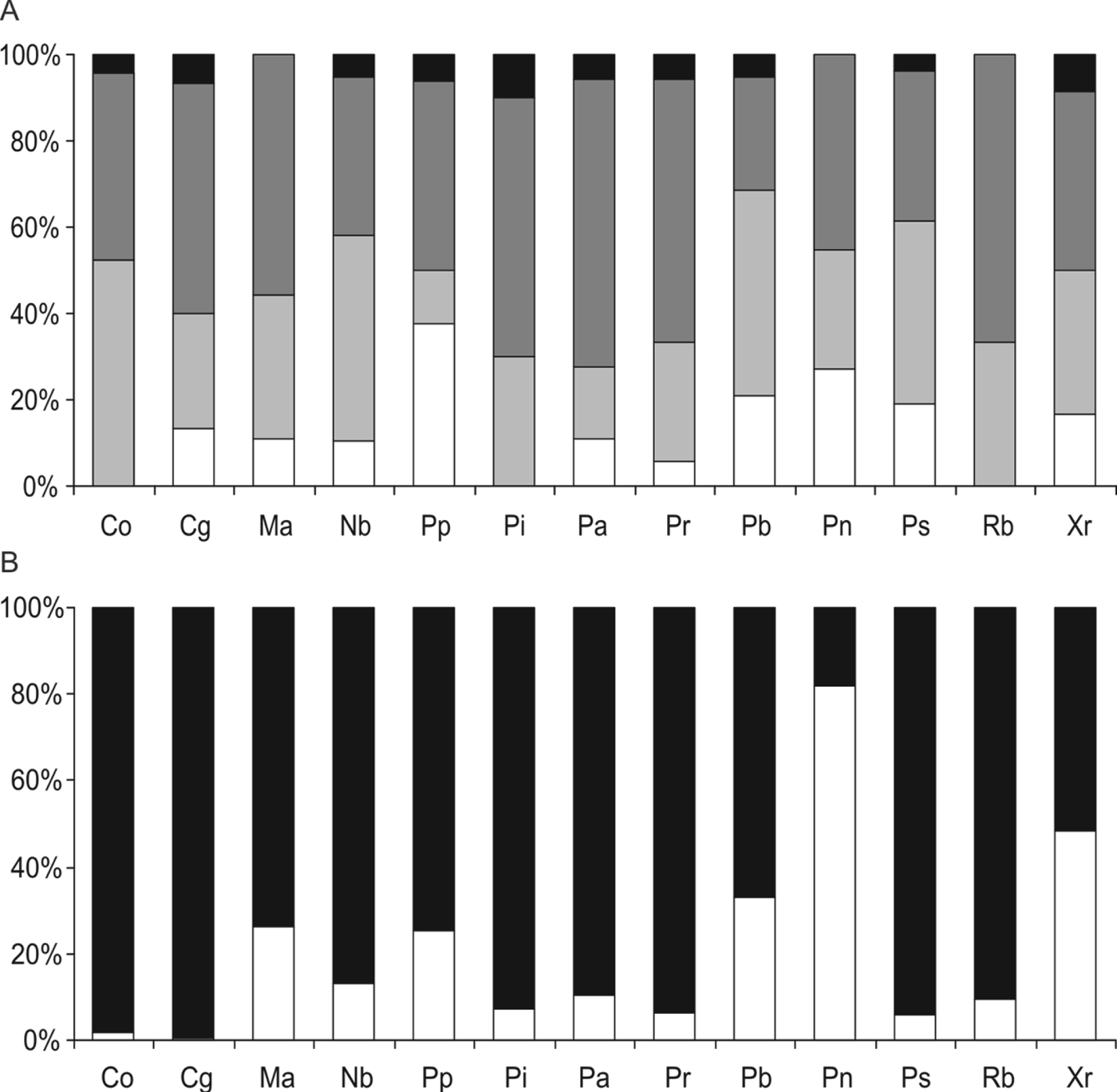
Figure 2 shows the contribution of long-lived larval endoparasites to assemblages in selected samples of different species included in studies aimed at identifying fish stocks (P. brasilianus, P. semifasciata, C. guatucupa, P. brasiliensis, X. rasile and R. brasiliensis, see Table 1), as well as in other publications characterizing parasite assemblages of resident fishes in the north Argentine Sea – the Argentine goatfish, Mullus argentinae, the Atlantic sea robin, Prionotus nudigula, the hawkfish, Nemadactylus bergi, the flounders, Paralichthys patagonicus and Paralichthys isosceles and the conger, Conger orbignianus (Lanfranchi et al. Reference Lanfranchi, Rossin and Timi2009; Timi and Lanfranchi, Reference Timi and Lanfranchi2009b , Reference Timi and Lanfranchi2013; Rossin and Timi, Reference Rossin and Timi2010; Alarcos and Timi, Reference Alarcos and Timi2012) and unpublished data of the red porgy, Pagrus pagrus. Migratory species alternating their habitats seasonally between coastal and deep waters, such as E. anchoita and T. lathami, were excluded. Whereas the contribution of long-lived parasites in terms of species richness is in general equivalent to that of other guilds (Fig. 2A), its contribution in terms of abundance (Fig. 2B), shows the absolute dominance of these larval stages over members of all other guilds, namely ectoparasites and larval gut parasites plus adult endoparasites, combined as the ‘short-lived’ group.
Proportional contribution of different parasite guilds to parasite assemblages across fish species in northern Argentine Sea in terms of (A) species richness; black: short-lived larval endoparasites (those living in the gut, such as larval cestodes); dark grey: long-lived larval endoparasites; light grey: short-lived adult endoparasites; white: short-lived ectoparasites, and (B) abundance; black: long-lived larval endoparasites, white: short-lived parasites combined. Co: Conger orbignianus; Cg: Cynoscion guatucupa; Ma: Mullus argentinae; Nb: Nemadactylus bergi; Pp: Pagrus pagrus; Pi: Paralichthys isosceles; Pa: Paralichthys patagonicus; Pr: Percophis brasiliensis; Pb: Pinguipes brasilianus; Pn: Prionotus nudigula; Ps: Pseudopercis semifasciata; Rb: Raneya brasiliensis; Xr: Xystreuris rasile.

Long-lived parasites determine the structure of the infracommunities they form, which can be considered as subsets of the species available regionally. They are obtained by passive ingestion of infective stages in fish food, and lead to predictable assemblages with a non-random composition and structure modelled mainly by ecological filters rather than by host phylogeny (Timi and Lanfranchi, Reference Timi and Lanfranchi2009b ).
Differences in ecological traits across possible hosts in the ABP account for the variability in parasite burdens. These characteristics include mainly fish size and trophic level (Timi et al. Reference Timi, Rossin, Alarcos, Braicovich, Cantatore and Lanfranchi2011; Alarcos and Timi, Reference Alarcos and Timi2012), with unrelated fish species of similar trophic level, diet and size displaying equivalent and, therefore, predictable assemblages of long-lived larval parasites (Timi et al. Reference Timi, Rossin, Alarcos, Braicovich, Cantatore and Lanfranchi2011).
As an additional advantage for their use of biological tags, the residence time of these parasites in fish confers temporal stability to communities, a desirable characteristic in studies comparing samples caught at different periods of time. In other words, temporal predictability of parasite burdens is necessary in order to make reliable inferences on stock structure (Timi, Reference Timi2007), especially when samples are not taken simultaneously, during a short period of time or at least during the same season. Indeed, temporal persistence in the structure of parasite assemblages has been documented in this region at different time scales (Timi et al. Reference Timi, Luque and Sardella2005, Reference Timi, Lanfranchi, Etchegoin and Cremonte2008; Braicovich and Timi, Reference Braicovich and Timi2010; Rossin and Timi, Reference Rossin and Timi2010).
Although still few in number, available results on temporal stability of parasite assemblages in this region suggest that differences in sampling periods seem to have no marked effects on the parasite community structure, at least at annual or shorter scales. However, further studies should be carried out for longer periods as well as in other zones of the south West Atlantic, where temporal variability of parasite populations and communities in fish has been not assessed.
The disadvantages of long-lived parasites: residence time in hosts and age-related cumulative patterns
Despite the advantages of long-lived parasites for fish stock identification, this feature imposes some restrictions on this methodology. As a consequence of their long periods of residence, these parasites tend to accumulate as fish grow, producing ontogenetic changes in the structure of parasite communities, a pattern frequently reported in the literature (Poulin, Reference Poulin2000, Reference Poulin2004; Poulin and Valtonen, Reference Poulin and Valtonen2001; Valtonen et al. Reference Valtonen, Marcogliese and Julkunen2010).
Larger-bodied hosts are able to accommodate more parasite species and to sustain a greater absolute number of parasites than small ones. They also display larger surface areas for parasite attachment and ingest larger quantities of food with a concomitant higher exposure to infective stages (Guégan et al. Reference Guégan, Lambert, Lévêque, Combes and Euzet1992; Poulin, Reference Poulin2000; Valtonen et al. Reference Valtonen, Marcogliese and Julkunen2010). Furthermore, large fish can also feed on larger prey, broadening the set of potential parasites (Timi et al. Reference Timi, Rossin, Alarcos, Braicovich, Cantatore and Lanfranchi2011). These processes are common to all types of parasites, but parasite accumulation is more pronounced for long-lived ones, because they remain for long periods or for the entire lifespan of their hosts, depending therefore, not only on fish size, but also age and longevity.
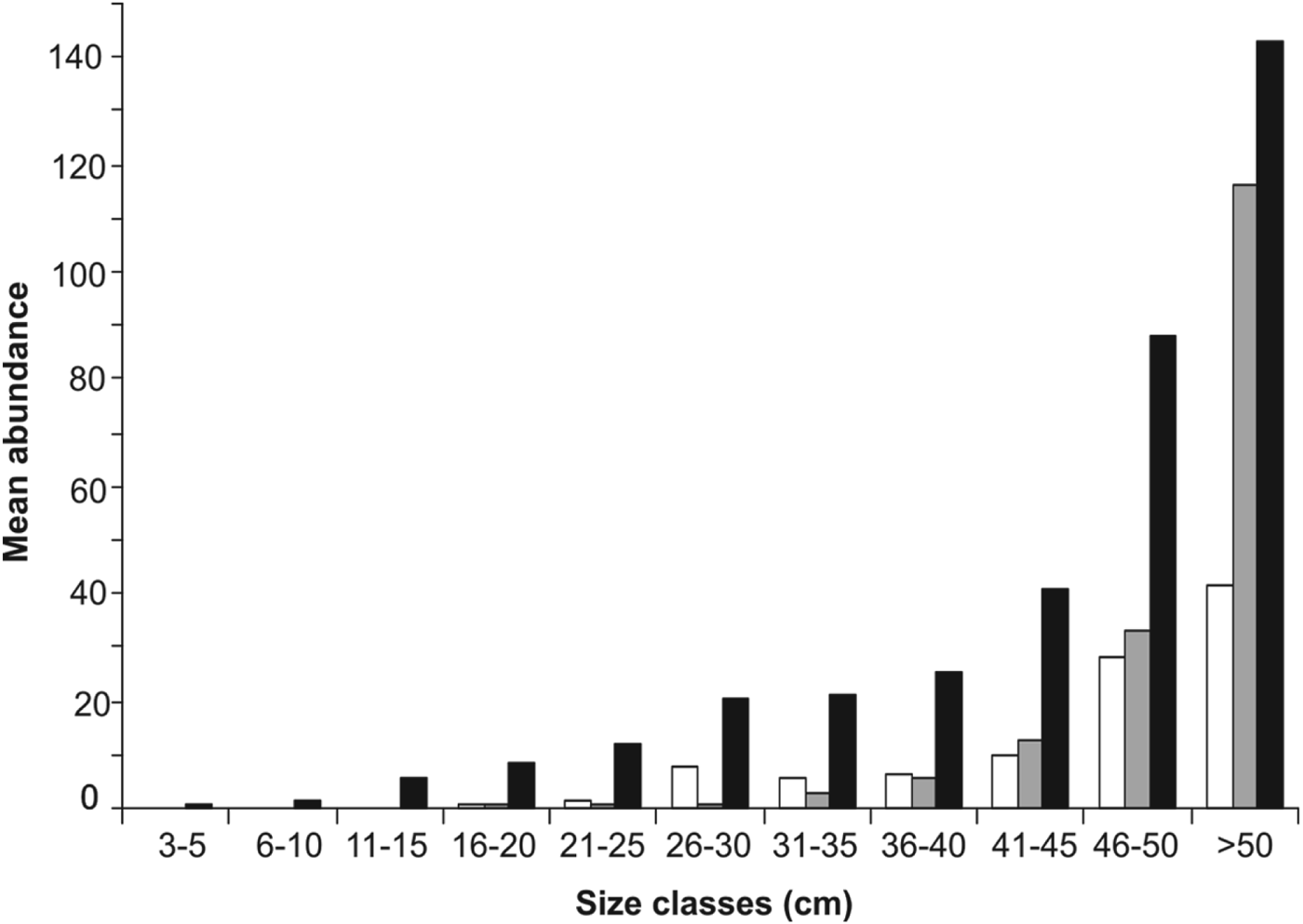
Due to the dominance of long-lived larval parasites, an increase in both parasite abundance and species richness in larger hosts is a common feature of fish-parasite systems in the northern Argentine Sea (Timi and Poulin, Reference Timi and Poulin2003; Timi et al. Reference Timi, Luque and Poulin2010b , Reference Timi, Rossin, Alarcos, Braicovich, Cantatore and Lanfranchi2011; Timi and Lanfranchi, Reference Timi and Lanfranchi2013). A clear example is the cumulative pattern shown by three of the most common parasites found in fishes of this region across age size classes of C. guatucupa ranging from juveniles to adults (Fig. 3). In this graph it is evident that comparing samples of different size classes, even of consecutive ones, will yield significant differences in abundance, especially for larger hosts. Therefore, if fish size is not considered in comparisons between samples from different localities, the occurrence of ontogenetic differences in parasite burdens can be wrongly attributed to a locality effect.
Cumulative patterns of mean abundance of three of the most common parasites found in fishes in northern Argentine waters across age size classes of Cynoscion guatucupa ranging from juvenile to adults. White bars: Hysterothylcium deardorffoverstreetorum; grey bars: Corynosoma australe; black bars: Grillotia carvajalregorum.

Investigators must be extremely careful when using long-lived parasites as markers and fish size should be taken into account as a potential confounding variable in the interpretation of spatial patterns and stock structure. This problem can be solved by comparing fishes of similar size or by introducing their length as a covariable in ANCOVA-type models, in order to mitigate its effect on parasite abundance and achieve consistent conclusions. On the other hand, if larger fish in a given locality harbour lower parasite abundance than smaller congeners from other zones, because of the known positive relationship between these variables, these results can reliably be interpreted as a consequence of a locality effect.
An additional confounding factor for this kind of study including long-lived parasites is host age, which as related to size, may cloud any underlying association between host length and parasite diversity. Fish size is often used as a surrogate of age, but their functional relationship is not linear. Indeed, it is evident, for example from von Bertalanffy growth curves, that large changes in age do not represent proportional changes in size, especially in older/larger fish. This means that fish assigned to a given size class can, in fact, belong to different cohorts, and because of the cumulative effect of long-lived parasites, the sample will be not homogeneous in terms of parasite abundance.
Despite both size and age acting together as drivers of parasite community structure, this well-known feature of fish–parasite systems (Poulin, Reference Poulin2000) has been largely based on evidence from studies including a single fish species and it has been generally assumed that both variables act synergistically. However, Alarcos and Timi (Reference Alarcos and Timi2012), after analysing comparatively two flounder species with different age-size relationships, but harbouring parasite assemblages of equivalent structure, showed that both variables seem to act at dissimilar rates on different characteristics of parasite assemblages. Indeed, fish age seems to affect mainly the parasite abundance, whereas body size influences mainly the species richness, through its relationship with the trophic level. The discernment between these variables is essential for understanding how parasite community structure is mediated by size-dependent trophic interactions, or by the host age, but also for interpreting differences between samples when they are homogeneous in size, but heterogeneous in age. This discernment becomes of paramount importance when multivariate comparisons are applied, because they combine composition and abundance data.
Although the differential effect of age and size has to be proved in other fish–parasite systems to test its generality, efforts should be made to include host age information when using long-lived parasites as biological tags; especially because different host populations can display different age-size relationships that will be reflected in their parasite burdens. Fish age, to our knowledge, has never been used as a quantitative variable in parasitological studies for stock identification, but it undoubtedly deserves more attention and further research to support the reliability of this methodology.
Parasite identification
Another of the characteristics shared by this group of suitable markers is their larval stage, which means that their reproductive system and secondary sexual characters are not fully developed or are not present at all. The reproductive system, especially the morphology of male terminal genitalia, is one of the most reliable characters for taxonomic identification of most helminth species. Specific identification is, therefore, more difficult for larval forms than for adults, because they have few species-specific features, and complexes of cryptic species could occur in the study area. Nevertheless, most members of this guild in the region can be morphologically identified at the species level, many of which are among the most important for stock identification. For instance, polymorphid acanthocephalans, trypanorhynch cestodes and anisakid nematodes of the genus Hysterothylacium are readily identifiable at the specific level based on morphometrics and morphological features, such as patterns of hooks and spines in different regions of the body (Navone et al. Reference Navone, Sardella and Timi1998; Timi et al. Reference Timi, Sardella and Navone2001; Sardella et al. Reference Sardella, Mattiucci, Timi, Bastida, Rodríguez and Nascetti2005; Menoret and Ivanov, Reference Menoret and Ivanov2009). However, some other nematodes, such as those of the genera Anisakis, Pseudoterranova and Contracaecum, comprise species complexes that are morphologically indistinguishable, and that can be often found in sympatry and syntopy infecting the same definitive or intermediate host species. Their specific status, however, can be solved with the application of molecular systematics, a suite of techniques that has advanced substantially over the last few decades and is now broadly applied (Mattiucci and Nascetti, Reference Mattiucci and Nascetti2008). In the study area, studies dealing with the genetic identification of larval parasites of fish are still scarce (Sardella et al. Reference Sardella, Mattiucci, Timi, Bastida, Rodríguez and Nascetti2005; Garbin et al. Reference Garbin, Mattiucci, Paoletti, Díaz, Nascetti and Mavone2013; Timi et al. Reference Timi, Paoletti, Cimmaruta, Lanfranchi, Alarcos, Garbin, George-Nascimento, Rodríguez, Giardino and Mattiucci2014), but the presence of sibling species within species complexes cannot be disregarded. The determination of the existence of sibling species within these species complexes, as well as in other parasite groups, is still pending in the region, but if their existence is confirmed, it will be a step forward towards the validation of the use of parasites as biological tags.
UPGRADING SCALES: FROM POPULATION TO COMMUNITY LEVEL AND FROM LOCAL TO REGIONAL SCALE
As mentioned in previous sections, some general patterns of parasite distribution in the Argentine sea are apparent. Indeed, the similar geographical patterns that have been observed for different host species are, in general, determined by the spatial distribution of a suite of biological tags, represented by several members of the guild of larval long-lived parasites. These parasites not only display the same latitudinal pattern in all hosts, but, because of their ubiquity, they indiscriminately infect paratenic hosts and some of them can be transmitted from one paratenic host (prey) to others (predators), thereby persisting in the food web. These characteristics make them potentially available for any fish host, leading to similar assemblages in sympatric fish species, whose similarity increases for host species with equivalent diets and trophic levels (Timi et al. Reference Timi, Rossin, Alarcos, Braicovich, Cantatore and Lanfranchi2011).
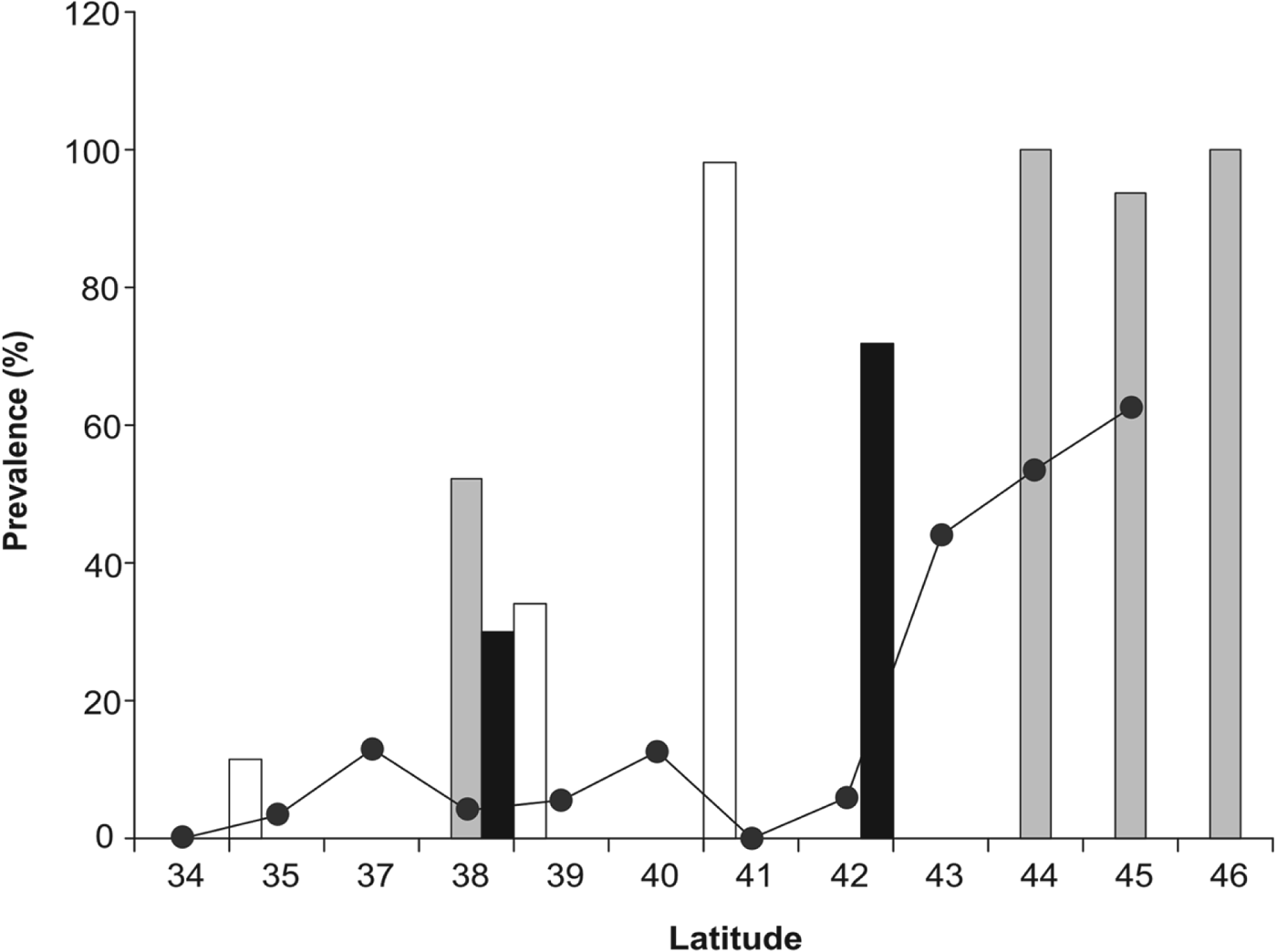
As an example, the nematode Anisakis simplex s.l., broadly distributed across fish species in the region, is always present at higher prevalences in southern areas than at lower latitudes. This pattern is evident in samples of E. anchoita (Fig. 4), which were caught following a latitudinal schema (Timi, Reference Timi2003), instead of at discrete localities, as in other fish studied in the region. However, the distribution of A. simplex in other host species follows the same pattern. Some examples are provided in Fig. 4. Several other parasite species follow similar patterns in anchovies, whereas others decrease in prevalence southwards (Timi, Reference Timi2003). Significant latitudinal gradients have been observed for long-lived parasites in many other fish species.
Prevalence of Anisakis simplex s.l. in four host species along a latitudinal gradient in the Argentine Sea. Line represents prevalence in samples of Engraulis anchoita following a latitudinal sampling schema, and showing a pronounced increase of prevalence in southern latitudes (data from Timi, Reference Timi2003). Bars represent prevalence in fish species caught at discrete localities: white: Percophis brasiliensis (data from Braicovich and Timi, Reference Braicovich and Timi2008); grey: Merluccius hubbsi (unpublished own data); black: Pseudopercis semifasciata (data from Timi and Lanfranchi, Reference Timi and Lanfranchi2009a ).

Therefore, there are unquestionable latitudinal gradients in the distribution of parasite species and, consequently, of their assemblages, which are a consequence of the effect of environmental conditions. According to Rohde and Heap (Reference Rohde and Heap1998), water temperature rather than latitudinal gradients affects the spatial distribution of parasite communities. Temperature, as a measurement of energy input, is a good predictor of latitudinal gradients in species richness and diversity (Rohde, Reference Rohde1992, Reference Rohde1999), so the pronounced influence of latitude on populations and communities of parasites in the region could be due mainly to the thermal gradient, characteristic of the study area (Bakun and Parrish, Reference Bakun and Parrish1991; Hoffmann et al. Reference Hoffmann, Núñez, Piccolo and Boschi1997).
These recurrent latitudinal patterns lead us to postulate that not only fish stocks, but also fish assemblages might be identified according to the occurrence of this group of parasites, making them suitable as regional biological tags (Braicovich and Timi, Reference Braicovich and Timi2008). This rather intuitive hypothesis is tested here by searching for patterns of parasite community structure in space across host assemblages from different biogeographical provinces, based on multivariate statistical ordinations and tests.
Data sources and analyses
Multivariate statistical procedures on community data were implemented in PRIMER v. 6 (Clarke and Warwick, Reference Clarke and Warwick2001; Clarke and Gorley, Reference Clarke and Gorley2006) and PERMANOVA+for PRIMER (Anderson et al. Reference Anderson, Gorley and Clarke2008) packages. A dataset was compiled from published studies on parasite communities in the region (ABP and MBP) and unpublished data for some species were also included. Some articles published by other authors were excluded to ensure taxonomic consistence, given that only data of larval stages were selected and these parasites are often reported as identified at the genus or family levels. Our data, on the other hand, although containing taxa identified to generic level, were congruent with the identification of these parasites.
Mean abundance of unspecific, long-lived larval parasites was recorded and the geographical position of each sample was assigned to either of three regions: ABP, MBP and the ecotone region between both provinces, including the North Patagonian Gulfs (EC). A sample of Odonthesthes smitti from ABP was assigned to EC zone (Golfo San Matías) based on the results of Carballo et al. (Reference Carballo, Cremonte, Navone and Timi2012) on the migratory behaviour of this species between regions. Only unspecific parasites, those reported from two or more unrelated host species (different family), were selected. As a result, data from 14 parasite species and 51 fish samples corresponding to 20 fish species were retained. Parasites included the nematodes A. simplex s.l., Hysterothylacium aduncum, Hysterothylacium deardorffoverstreetorum, Contracaecum pelagicum, Contracaecum sp., Terranova galeocerdonis and Pseudoterranova cattani; the cestodes Grillotia carvajalregorum, Grillotia sp., Callitetrarhynchus gracilis and Hepatoxylon trichuri and the acanthocephalans Corynosoma australe, Corynosoma cetaceum and Bolbosoma turbinella. Fish species included C. orbignianus, C. guatucupa, E. anchoita, N. bergi, M. argentinae, O. smitti, P. brasiliensis, P. brasilianus, P. isosceles, P. nudigula, P. patagonicus, P. semifasciata, R. brasiliensis, Scomber japonicus, T. lathami and X. rasile and unpublished data of M. hubbsi, P. pagrus, the horsefish, Congiopodus peruvianus and the rock cod Patagonotothen ramsayi.
We first used non-metric multidimensional scaling (MDS), an unconstrained ordination technique, to create graphical summaries of relationships among samples based on the mean abundance of parasite species and to highlight geographical patterns of their community structure. The fit of MDS ordinations was quantified by a value of stress (Clarke and Warwick, Reference Clarke and Warwick2001). MDS analyses were based on Bray–Curtis similarity matrices and applied to both untransformed mean abundance values, and square-root- and fourth-root-transformed data in order to increasingly down-weight the importance of very abundant species so that the less dominant species played some roles in determining similarity among samples (Clarke and Gorley, Reference Clarke and Gorley2006). Hierarchical agglomerative clustering was performed using group-average linking and resemblance levels were overlaid on the MDS plot (Clarke and Gorley, Reference Clarke and Gorley2006).
Multidimensional scaling showed that some samples were inconsistently located (see results). Among these samples, those of anchovies were caught during spring (Timi, Reference Timi2003). This species performs seasonal migrations between coastal and shelf waters. In spring they migrate into the coastal reproductive habitat off the Buenos Aires province (<50 m depth) for spawning (Sánchez and Ciechomski, Reference Sánchez and Ciechomski1995). After spawning, in summer and early autumn, schools disperse into outer shelf and slope waters to feed, accumulating a large amount of energy for the next reproductive cycle (Hansen and Madirolas, Reference Hansen and Madirolas1996). Anchovy feeding in coastal waters during the reproductive season is negligible when compared with the intense feeding occurring in deeper waters (Pájaro, Reference Pájaro2002), therefore their parasite fauna, mainly those species acquired through diet, is mostly representative of sub-Antarctic waters (MBP). On the other hand, samples of P. semifasciata were the only ones assigned to EC that were caught outside the north Patagonian gulfs. Although coming from the ecotone region between biogeographical provinces, according to the MDS results their parasites are undoubtedly representatives of the ABP. Consequently, samples of anchovy were reassigned to MBP and those of P. semifasciata to ABP for further analyses. The other problematic samples (M. argentinae, R. brasiliensis and P. brasiliensis) were maintained in their region of origin.
Differences in samples among regions were examined by PERMANOVA analysis (Anderson et al. Reference Anderson, Gorley and Clarke2008). The structure of samples (one-way PERMANOVA design, regions as fixed factors) was compared between regions, testing for main effects after 9999 permutations, restricting analyses to intermediate transformation of data (square-root transformed mean abundances) previous calculation of the Bray-Curtis resemblance matrix. Where differences were detected by PERMANOVA, pair-wise comparisons were used to determine which pairs of regions differed. Following Anderson et al. (Reference Anderson, Gorley and Clarke2008), a permutation of residuals under a reduced model was used as the method of permutation. A sequential sum of squares (type I SS) was applied because number of samples was unbalanced across regions and because host trophic level was introduced as a covariable (ANCOVA model). The host trophic level was included as a covariable because it was recognized as a key determinant of community structure for the guild of parasites selected in the region (Timi et al. Reference Timi, Rossin, Alarcos, Braicovich, Cantatore and Lanfranchi2011). Since PERMANOVA is sensitive to differences in multivariate dispersion between groups (sensu homogeneity of variances, which can inflate type 1 errors even when centroids have identical locations), the same model was tested for differences in dispersion using the routine PERMDISP (Anderson et al. Reference Anderson, Gorley and Clarke2008). Dispersions were measured as distances to the centroids, and each term in the analysis was tested using 9999 permutations (Anderson et al. Reference Anderson, Gorley and Clarke2008).
As PERMANOVA showed significant differences among regions, canonical analysis of principal coordinates (CAP) (Anderson and Willis, Reference Anderson and Willis2003; Anderson et al. Reference Anderson, Gorley and Clarke2008) was applied to the same similarity matrix. Within the routine, principal coordinates (PCO) were calculated from the resemblance matrix, and potential over-parameterization was prevented by choosing the number of PCO axes (m) that maximized leave-one-out allocation success to groups (Anderson and Robinson, Reference Anderson and Robinson2003). To test for significant differences in parasite communities among the regions, a permutation ‘trace’ test (sum of squared canonical eigenvalues) was applied, and P was obtained after 9999 permutations. An indication of the underlying species differences in community structure was obtained by the strength of their correlation with the canonical discriminant axes co-ordinates, with diagnostic compounds visualized using vector overlays based on Spearman correlations (Anderson et al. Reference Anderson, Gorley and Clarke2008).
Synthesis
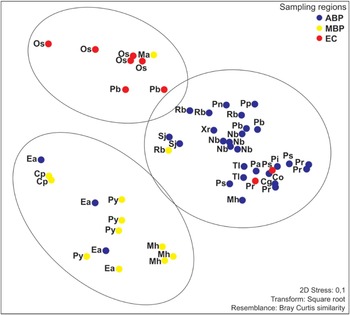
Multidimensional scaling revealed an apparent pattern of separation between sampling regions (Fig. 5). Samples in Fig. 5 correspond to square-root-transformed data, but the same pattern was observed when both untransformed and fourth-root transformed data were analysed (data not shown), revealing that abundances of rarer species do not change the similarity patterns among samples. The stress level (0·1 in all cases) indicated that community structure was substantially different from random. Samples clustered in three large groups, which corresponded to the three selected zones; these were supported by relatively low values of similarity given the ecological differences across host species. Some inconsistencies appeared in relation to the expected ordination of samples, including samples of E. anchoita, M. argentinae, R. brasiliensis, P. brasiliensis and P. semifasciata, which clustered with samples from other regions (Fig. 5).
Non-metric two-dimensional ordination plot using Bray–Curtis similarity based on square-root transformed mean abundance of 14 species of long-lived and unspecific larval parasites across 51 fish samples corresponding to 20 fish species caught in three regions of the Argentine Sea. Results of hierarchical agglomerative clustering performed for parasite species is overlaid on the MDS plot with line circles representing 20% of similarity. ABP: Argentine Biogeographical province; MBP: Magellanic Biogeographical province: EC: Ecotone zone. Co: Conger orbignianus; Cg: Cynoscion guatucupa; Cp: Congiopodus peruvianus; Ea: Engraulis anchoita; Ma: Mullus argentinae; Mh: Merluccius hubbsi; Nb: Nemadactylus bergi; Os: Odontesthes smitti; Pp: Pagrus pagrus; Pi: Paralichthys isosceles; Pa: Paralichthys patagonicus; Pr: Percophis brasiliensis; Pb: Pinguipes brasilianus; Pn: Prionotus nudigula; Ps: Pseudopercis semifasciata; Py: Patagonotothen ramsayi; Rb: Raneya brasiliensis; Sj: Scomber japonicus; Tl: Trachurus lathami; Xr: Xystreuris rasile.

Results of PERMANOVA analyses showed a strong effect of host trophic level on the response variables and, therefore, on the parasite community structure (Table 2). The interaction of trophic level with regions showed that the nature of the relationship between the covariate and the multivariate response differs within different levels of the factor, probably accounting for the differences of trophic level due to the nature of samples (i.e. lower in EC), but also to the effect of dominant parasite species in each region and their dependence on fish diet. Furthermore, taking into account the variations among samples due to host trophic level, significant variability was detected among the parasite assemblages. Pair-wise tests between host samples showed that there were significant differences between all zones (all P (perm)<0·001). None of these differences can be attributed to differences in multivariate dispersions of parasite communities, since PERMDISP results were not significant (F 2, 48 = 0·28, P (perm) >0·05).
One-factor PERMANOVA results of community data of unspecific and long-lived larval parasites of fishes from three regions in the Argentine Sea based on Bray–Curtis dissimilarity measures of square-root transformed mean abundances, with host trophic level as covariable. P-values obtained after 9999 permutations

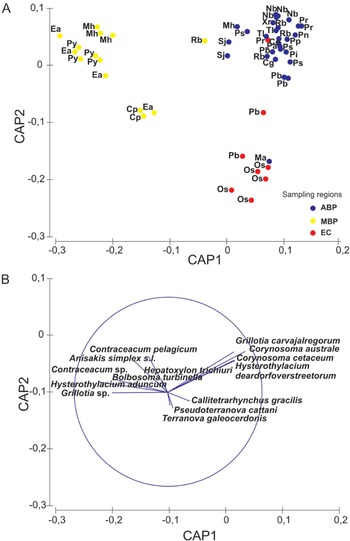
The CAP analysis (Fig. 6) also showed significant differences between samples (tr = 1·49; P<0·0001). The selected orthonormal PCO axes (m = 3) described 69% of the variation in the data cloud, with a high percentage of correct allocations (94·12%). Cross-validation results showed that 96·55% of samples from ABP; 92·86% from MBP and 87·50% from EC were correctly allocated to their own sample. Misclassified samples were those of M. argentinae from ABP assigned to EC and R. brasiliensis and P. brasiliensis from MBP and EC respectively, both assigned to ABP.
Canonical analysis of principal coordinates (CAP) ordination showing Bray–Curtis similarity based on square-root transformed mean abundance of 14 species of long-lived and unspecific larval parasites across 51 fish samples corresponding to 20 fish species caught in three regions of the Argentine Sea (A) and vectors representing Spearman rank correlations of individual parasite species with the CAP axes indicating which species characterize the different regions. Site and species codes as in Fig. 5.

The first two canonical axes resulting from CAP analysis clearly separated samples in three groups, representing the biogeographical regions, with the exception of the three misclassified samples. A strong association between the multivariate data ‘cloud’ and the hypothesis of group differences was indicated by the reasonably large size of their canonical correlations (δ1 = 0·95 and δ2 = 0·77). Indeed, samples from MBP and ABP, clearly distinguishable from each other, were situated at the left and right upper corners of the CAP biplot, while those from EC occupied the lower right corner separated from the others. When vectors corresponding to Spearman correlations of individual species were superimposed with the CAP axes, G. carvajalregorum, C. australe, C. cetaceum and H. deardorffoverstreetorum were strongly related to samples from ABP, judging from the strength of the correlation coefficients (r>0·7); whereas the mean abundances of Grillotia sp., A. simplex s. l., C. pelagicum, Contracaecum sp. and H. aduncum were mainly associated with the separation of samples from MBP along the first axis. Callitetrarhynchus gracilis, T. galeocerdonis and P. cattani were related to fish from EC, although their correlation values were relatively low, reflecting the lower parasite burdens in fishes from this region, and their low value as indicators, as in the case of B. turbinella and H. trichuri (Fig. 6).
Discussion
As expected, results of multivariate analyses showed a strong effect of the characteristics of the local ecosystem and its trophic web, a relationship commonly reported in the literature (Marcogliese, Reference Marcogliese2001, Reference Marcogliese2002; Luque and Poulin, Reference Luque and Poulin2004). Beyond some particular cases, whose misclassification could be associated with the biology of each fish species itself, both biogeographical provinces, and even the ecotone zone, harboured singular parasite faunas clearly defined by their own characteristic species that can be considered as typical of each environment. This becomes more evident since some species caught in different regions (i.e. P. brasilianus in ABP and EC, and M. hubbsi in ABP and MBP) harboured parasite assemblages typical of each zone.
Some influence of the fish trophic level could be expected in the separation of samples from EC and ABP, since most species in ABP display higher trophic levels that could account for higher parasite abundances (Timi et al. Reference Timi, Rossin, Alarcos, Braicovich, Cantatore and Lanfranchi2011). However, the distribution of a single species, P. brasilianus, in both regions supports this geographical discrimination.
The previous results show that, at least in the region covered by the analyses, the concept of biological tags can be expanded from a local to a regional scale and from the level of fish and parasite populations to the level of communities. Parasites, therefore, can be considered as markers of the regions or masses of waters they inhabit and, consequently, as ecosystem indicators.
The present findings, based on comparative analyses across host species and biogeographical provinces, confirm that G. carvajalregorum, C. australe, C. cetaceum and H. deardorffoverstreetorum can be considered as markers of the coastal ecosystem of the ABP. Their value as markers should be tested by comparing fish species that are also distributed in northern waters of the BBP. On the other hand, the best indicators of fishes from MBP are represented by H. aduncum, both species of Contracaecum, A. simplex s.l. and Grillotia sp. The validity of other species with low correlation values (r<0·4) as ecosystem markers needs to be proved in further studies that include other fish species.
Because fisheries have a direct effect on the ecosystem, which is also impacted by other human activities, they need to be managed in an ecosystem context (García et al. Reference García, Zerbi, Aliaume, Do Chi and Lasserre2003). The ecosystem-based approach to fisheries science and management (Caddy, Reference Caddy1999; García et al. Reference García, Zerbi, Aliaume, Do Chi and Lasserre2003; Grafton et al. Reference Grafton, Hilborn, Squires, Williams, Grafton, Hilborn, Squires, Tait and Williams2010) implies the need to make community ecology, as opposed to population biology, the central scientific paradigm for fisheries science (Mangel and Levin, Reference Mangel and Levin2005), and parasites, as a critical part of the biodiversity (Poulin, Reference Poulin1999; Wood et al. Reference Wood, Byers, Cottingham, Altman, Donahue and Blakeslee2007; Lafferty, Reference Lafferty2008), appeal as suitable tools for such a proposal.
The adoption and implementation of the ecosystem approach to fisheries requires the delineation of the geographical extent and boundaries of the ecosystems that occur within a given region, as well as their complexity, structure, functioning and natural variability (García et al. Reference García, Zerbi, Aliaume, Do Chi and Lasserre2003). Most research on fish stock structure in Argentina has focused on single species; however, fisheries management is starting to move from single-species management to ecosystem-based management, and their boundaries need to be identified (Jaureguízar et al. Reference Jaureguízar, Menni, Lasta and Guerrero2006). The existence of recurrent and predictable parasite assemblages in a given region, useful as ecosystem markers, can provide essential information to delineate ecosystem boundaries for host communities whose components differ considerably in their temporal and spatial population dynamics.
Ecosystem-based approaches to fishery management are indisputably necessary, but applying such complex ecosystem models is difficult (Caddy, Reference Caddy1999; Quinn and Collie, Reference Quinn and Collie2005), especially in developing countries where community data of sufficient detail to provide stock assessment and guide fisheries management are incipient or non-existent. On the other hand, multispecies fisheries management, although it implies a restrictive view of the marine ecosystem, relies on the manipulation of the harvestable components of an ecosystem using fish population dynamics and may seem more attainable (Caddy, Reference Caddy1999).
In northern Argentine waters, several fish species are commercially exploited within a multispecies fishery, with maximum catches under government regulation (Rico, Reference Rico2010), despite the differences in their population dynamics. Furthermore, since the end of the last century, the capture of these species has increased progressively (Carozza et al. Reference Carozza, Fernandez Aráoz, Ruarte, Massa, Hozbor and Jaureguizar2004). For this reason, it is critical that stock structure for each of these species is identified to allow a sustainable management of the coastal fishery. The ubiquity and the recurrent geographical patterns of the selected biological tags, as well as their association with specific masses of water and environments, makes them useful tools in this kind of management procedure. Their potential application goes from providing theoretical frames for generating hypothesis about stock structure to tracing fish migrations across ecosystems, and identifying the origins of catches for given species, even when their parasite fauna could be unknown in other regions.
CONCLUDING REMARKS AND OUTLOOKS
The decline in marine catches over recent years together with the increasing proportion of overexploited fish stocks are global trends occurring also in the SAAC. In this region fisheries are threatened, and many of them are under serious risk of collapsing, especially artisanal coastal fisheries, which are the most vulnerable sector in the case of declining or depletion of stocks.
The SAAC comprises a diversity of coastal and shelf environments, possesses a complex and increasingly known oceanography and harbours a vast biodiversity. The combination of these characteristics provides an enormous potential for using parasites as biological tags.
In the SAAC, however, the use of parasites as indicators is still incipient and has been unevenly applied across the region. Indeed, most studies have been carried out in northern Argentine waters and, to a lesser extent, on the PS, but a minor proportion of exploited stocks have been assessed by this or other techniques in the whole region.
In the northern to central areas of SAAC, which represent more than 60% of its extent, there is at present only one study using parasites for fish stock delineation. On the other hand, the few studies comparing fish stocks between Brazilian and Patagonian shelves have succeeded in revealing striking latitudinal patterns of parasite distribution. Because of the potential of the region for this kind of study, researchers from these latitudes should be encouraged to apply this methodology, especially in central Brazil, where the amount of information about fish parasites is relatively high.
In the MBP, some promising evidence has been reported in relation to bathymetric and latitudinal discrimination of stocks, as indicated by parasites. This evidence is enhanced after comparison with fish stocks inhabiting the ABP. Further studies following both latitudinal and longitudinal sampling designs are needed to clarify the stock structure of fish species inhabiting this region, which include many highly valuable species.
The promising forecasts for the use of parasites as biological tags derived from the biological and oceanographic features of the region have been corroborated in northern Argentine waters. The key to such success is the structure of parasite assemblages in this region, which is determined by a suite of dominant helminth species that share an extremely low specificity, larval stages, long persistence in fish and trophic transmission. Due to the combination of these features they parasitize indiscriminately almost all available fish species in the region.
Long-lived parasites are commonly recommended for studies on stock identification. In northern Argentine waters, this dominant guild confers temporal stability to communities, a desirable characteristic in studies comparing samples caught at different periods of time that simplifies future sampling designs. Additional studies should be carried out for longer periods as well as in other zones of the SAAC, where temporal variability has not been assessed.
Long-lived parasites, however, impose some restrictions to the methodology due their cumulative patterns as fish grow. Consequently, ontogenetic differences in parasite burdens can be wrongly attributed to a locality effect. Researchers should be cautious when using long-lived markers, and must take into account fish size as a potential confounding variable in the interpretation of spatial patterns and stock structure.
Ontogenetic parasite accumulation also depends on fish age and longevity. Since large changes in fish age do not represent proportional changes in size, individuals classified in a given size class can belong to different cohorts, causing heterogeneity in parasite abundance. Fish size and age seem to act at dissimilar rates on parasite abundance and species richness. Discerning between these variables is essential when multivariate comparisons are applied combining composition and abundance data, and efforts should be made to include age information when using long-lived markers; mainly because different age–size relationships can occur between host populations, which will be reflected in their parasite burdens.
Due to their larval stage, several suitable parasites cannot be identified to species level and complexes of cryptic species could occur sympatrically in the study area. The specific status of such groups can be solved by means of molecular systematics, techniques broadly applied in other regions of the world, but the application of which is still pending in the SAAC.
Long-lived parasites display similar latitudinal patterns in all hosts across the region. Their individual geographical gradients are reflected on recurrent clines in parasite assemblage structure across fish species, leading to hypotheses about their value as regional tags to identify fish assemblages.
Shifting the focus from fish populations to communities, the concept of biological tags can be expanded from a local to a regional scale. Parasites, therefore, can be used as markers of the regions or masses of waters they inhabit and, consequently, as ecosystem indicators.
The identification of ecosystem markers can provide essential information to delineate ecosystem boundaries for host communities whose components differ considerably in their temporal and spatial population dynamics. This new concept and its application could be a powerful tool to help the implementation of ecosystem-based approaches to fisheries management, the new paradigm for fisheries science, on which regional activities are starting to focus.
Despite the potential offered by parasites as biological tags, few parasitological studies have contributed to management decisions in fisheries. The consistency and reliability of this methodology must be demonstrated and researchers from other disciplines must be encouraged to integrate fish- and parasite-based techniques in multidisciplinary studies. Reliable parasitological results are necessary and can be achieved only after a cautious selection of suitable biological tags (long-lived and temporally stable parasites) and detailed consideration of possible confounding variables (host size and host age) affecting comparisons, which must be avoided during sampling designs or included in the analyses.
Marine ecosystems in the SAAC are currently subjected to a range of exploitation rates, resulting in a variety of undisturbed, declining, collapsed, and rebuilding fish stocks and ecosystems. Unfortunately, effective controls on exploitation are still lacking in most areas of the region, but plans and actions to protect, and opportunities for successfully rebuilding, marine resources are increasing. Finding the best management tools will depend on fisheries scientists sharing the best available data, and joint efforts under a multidisciplinary perspective to achieve effective conservation, and sustainable use of marine resources. Parasites offer excellent possibilities to help in this situation, and it is our responsibility as parasitologists to convince the scientific community that the use of parasites as biological tags is a reliable tool, and that the incorporation of parasitological data in holistic approaches will undoubtedly contribute valuable information to help insure fisheries and marine ecosystems against further depletion and collapse.
ACKNOWLEDGEMENTS
The authors thank Dr K. MacKenzie (School of Biological Sciences, University of Aberdeen, Aberdeen, Scotland, UK) for his valuable suggestions on the manuscript.
FINANCIAL SUPPORT
Financial support was provided by grants from CONICET (PIP #112-201101-00036); ANPCyT (PICT #2012-2094) and Universidad Nacional de Mar del Plata (EXA 621/12).