Introduction
The diagnosis of cancer forces patients to brave both physical and emotional strain. Head and neck cancer treatment specifically may require surgery and/or chemoradiotherapy, and may result in obvious physical deformities, in addition to extreme emotional challenges. Head and neck cancer and its treatment can also affect deglutition, speech and breathing. This can greatly disrupt patients’ lives and decrease quality of life (QoL).Reference Shepherd and Fisher1 This distress is directly linked to the disease and its treatment, but the effect of reconstructive surgery and, specifically, donor site morbidity remains unknown.
A fibula free flap is the favoured method for primary bone reconstruction following head and neck cancer ablative surgery. The fibula free flap technique was first introduced in 1975 by Taylor et al.,Reference Taylor, Miller and Ham2 but it was not until 1989 that Hidalgo described its use in mandibular reconstruction.Reference Hidalgo3 Since then, its popularity has grown to the point that it is now considered the standard method in maxillary and mandibular reconstruction.
The fibula flap can be raised as either a strict osseous flap or as an osteocutaneous flap based on the peroneal (fibular) artery. Advantages include a long pedicle length, dependable anatomy, appropriate vessel size, and the potential for dental rehabilitation with implants.Reference Hidalgo3–Reference Baj, Lovecchio, Bolzoni, Mapelli, Gianni and Sforza5 In addition, a second team can work simultaneously to expedite the surgery, which is important given that the harvest site is in the lower extremity. The fibula free flap is an excellent source for bone, which makes it an ideal flap for most large mandibular defects.
Although the fibula free flap is a good reconstructive option, it is not a benign procedure. Donor site morbidity can include impaired wound healing, pain, numbness, cold intolerance, muscle weakness, lower extremity oedema, unsightly scarring, valgus deformity, ankle instability, gait disturbance, and great toe clawing or weakness.Reference Baj, Lovecchio, Bolzoni, Mapelli, Gianni and Sforza5–Reference Ling and Peng8
There is a paucity of data regarding patients’ subjective assessment of morbidity. There are numerous validated questionnaires to assist in assessing post-operative morbidity. These questionnaires are often categorised as site-specific, disease-specific or generic regarding a particular point of interest. Often there is correlation among the surveys, as dysfunction of a particular site or disease leads to changes in overall QoL.
This study aimed to evaluate the presence of subjective post-operative donor site morbidity utilising three validated instruments: the 36-item Short Form Health Survey (‘SF-36’), with its two categories of Physical Component Summary and Mental Component Summary;Reference McHorney, Ware and Raczek9, Reference Ware, Kosinski, Bjorner, Turner-Bowker, Gandek and Maruish10 the Short Musculoskeletal Function Assessment questionnaire, including its bothersome and function indices;Reference Swiontkowski, Engelberg, Martin and Agel11, Reference Hunsaker, Cioffi, Amadio, Wright and Caughlin12 and the Lower Limb Core Scale.Reference Hunsaker, Cioffi, Amadio, Wright and Caughlin12–Reference Monticelli, Ciclamini, Boffano, Boux, Titolo and Panero14
The benefit of a general health survey, such as the Short Form 36 Health Survey, is that comparisons can easily be made across different populations. Disease-specific or site-specific questionnaires, such as the Short Musculoskeletal Function Assessment and Lower Limb Core Scale respectively, are more sensitive to changes in a particular area of concern. These questionnaires are often shorter than generalised QoL surveys, which can greatly affect their clinical utility.
To our knowledge, no data exist on the evaluation of fibula free flap donor site morbidity using the Lower Limb Core Scale questionnaire. Additionally, this study would aid the comparison and correlation of general, disease-specific and site-specific disability surveys in this patient population.
Materials and methods
Between January 2009 and July 2014, 55 patients underwent head and neck reconstruction with an osteocutaneous fibula free flap. One of two surgeons (author YJP and another surgeon) performed all reconstructions.
Each flap was raised under tourniquet control at the thigh. Donor sites were closed with the use of a split thickness skin graft from the ipsilateral thigh with a vacuum-assisted bolster dressing. All fibula free flaps included a skin paddle that was harvested using a subfascial technique.
All patients followed the institution's standardised clinical care pathway, with most wound vacuum-assisted dressings being removed on post-operative day 5. The patients’ legs were then dressed with simple antibiotic ointment and a non-stick gauze dressing until all open areas had healed. One drain was placed in each leg and removed once the output was less than 30 ml for 24 hours. All patients were placed in a foot-drop boot and were kept as non-weight bearing until their first post-operative visit, between 7 and 14 days post-operatively.
The study protocol was approved by the Institutional Review Board at the University Of Cincinnati College of Medicine (protocol 2013-5488). A retrospective study was designed to identify all head and neck reconstruction patients who specifically underwent fibula free flap reconstruction. Patients were excluded if they were deceased or failed to complete all survey questions. No gender, racial or ethnic, or educational level exclusion criteria were applied, although patients were required to be English-speaking.
All patients were called by the senior author or members of the research staff to assess their willingness to participate in the study. Surveys were then mailed, in a single packet, to all patients. If surveys were not returned, the patients were called, and asked to complete and return the surveys. Unreturned surveys were completed either over the telephone or at the patients’ next follow-up visit.
Demographic variables were summarised using means and standard deviations for continuous variables, and percentages and frequencies for categorical variables. All questionnaires and their respective subcomponents were scored as previously described in the literature, to allow comparison with general population mean values. As the standard deviation of the general population survey scores were known, one-sample z-tests were performed to compare the patients’ means to the US population norms.Reference Ware, Kosinski, Bjorner, Turner-Bowker, Gandek and Maruish10, Reference Hunsaker, Cioffi, Amadio, Wright and Caughlin12 The statistical analyses were performed using SAS software version 9.4 (SAS Institute, Cary, North Carolina, USA) and R software version 3.2.3.15
Results
Fifty-five patients underwent head and neck reconstruction with a fibula free flap. Of these patients, 20 (36 per cent) ultimately completed the study, including 1 patient with bilateral fibulas (the first for initial cancer treatment and the second later on because of osteonecrosis), for a total of 21 fibula flaps. All patients were free of recurrence at the time of the study. The remaining patients were either deceased or unreachable.
The average time (± standard deviation) between surgery and completion of the surveys was 34 ± 25 months (range, 3–79 months). The mean patient age was 58.7 years (range, 25–78 years). Twelve males (60 per cent) and eight females (40 per cent) were included. One patient had a maxillary defect, while all other patients had mandibular defects that required reconstruction. Two patients had sarcomas; the remaining patients had squamous cell carcinoma. Only five patients underwent chemotherapy. Radiation treatment varied in patients, as seven patients underwent fibular free flap reconstruction after radiation to treat subsequent osteonecrosis. None of the patients experienced flap loss.
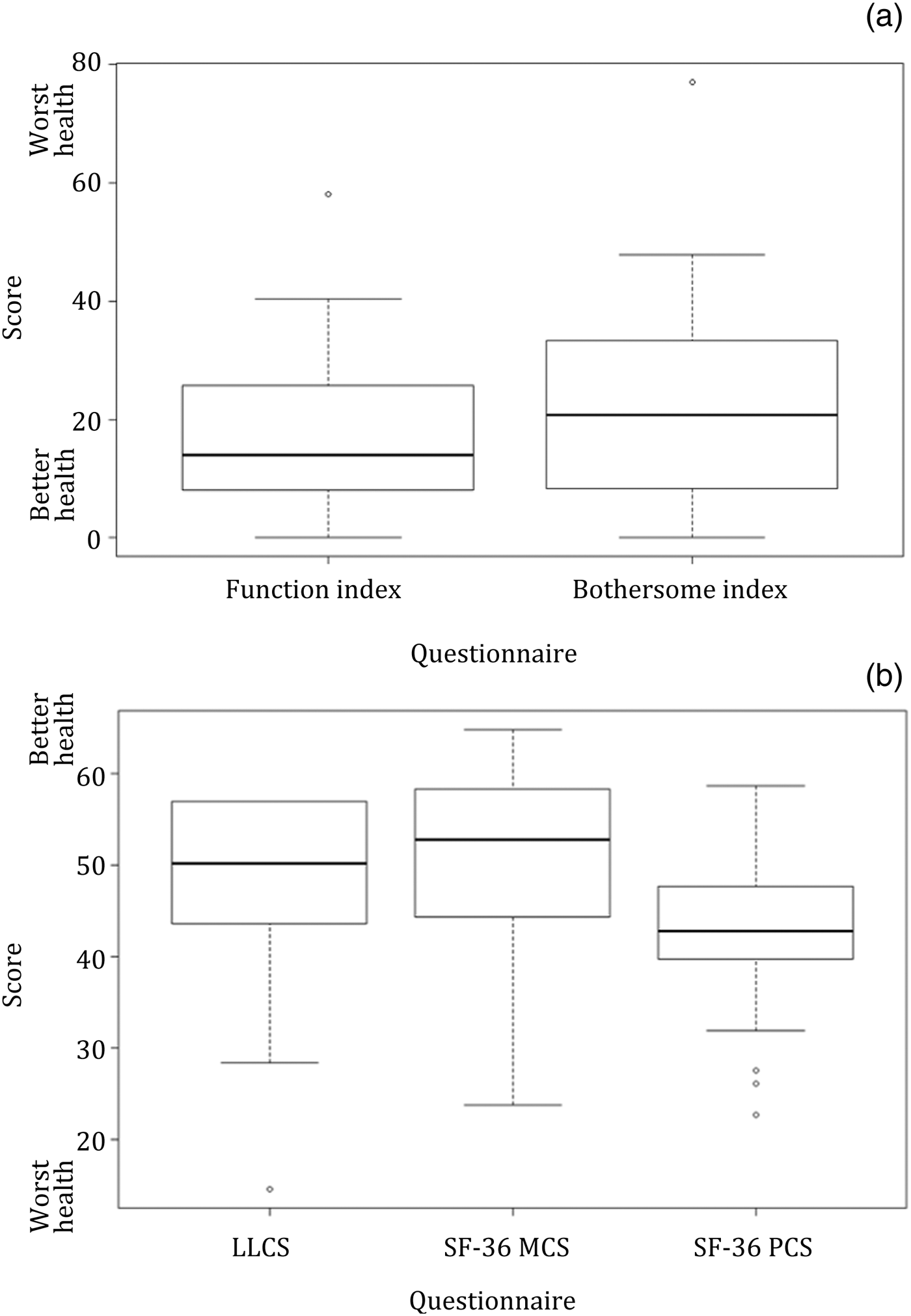
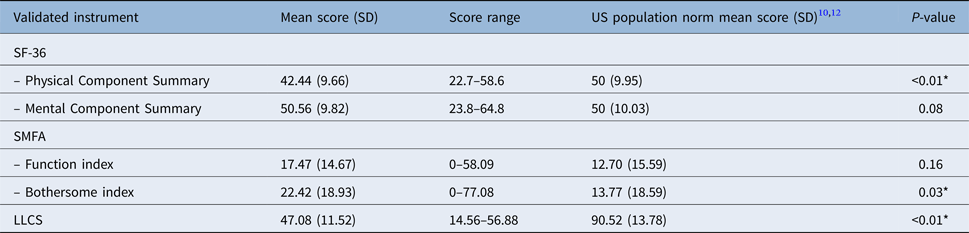
Results from each survey and corresponding key components were compared to US population norms (Table 1). The patients in this study were found to have a statistically significantly higher Short Musculoskeletal Function Assessment bothersome index (22.42 vs 13.77, p = 0.03), demonstrating increased emotional strain (Fig. 1a). They also had significantly lower Short Form 36 Health Survey Physical Component Summary scores (42.44 vs 50, p < 0.01) and Lower Limb Core Scale scores (47.08 vs 90.52, p < 0.01), signifying increased disability (Fig. 1b). The Short Form 36 Health Survey Mental Component Summary scores and Short Musculoskeletal Function Assessment function index failed to demonstrate significant differences compared to US population norms.
Boxplots of (a) Short Musculoskeletal Function Assessment function and bothersome indices; and (b) Lower Limb Core Scale (LLCS) and 36-item Short Form (36-SF) Health Survey Mental and Physical Component Summaries (MCS and PCS) scores (circles represent outliers).

Summary of survey scores and comparison to US population norms

* Indicates statistical significance. SD = standard deviation; SF-36 = 36-item Short Form Health Survey; SMFA = Short Musculoskeletal Function Assessment questionnaire; LLCS = Lower Limb Core Scale
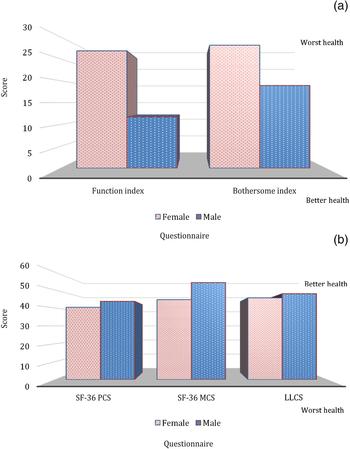
Additional analysis demonstrated that gender affected overall disability scores. The Short Musculoskeletal Function Assessment scores indicated that female patients observed greater disability, based on higher mean scores compared to males, for the bothersome index (28.13 vs 18.91) and the function index (26.84 vs 11.71) (Fig. 2a). Additionally, female patients observed greater disability, based on lower mean scores compared to males, for the Physical (40.38 vs 43.71) and Mental (44.68 vs 54.18) Component Summaries of the Short Form 36 Health Survey. Moreover, the Lower Limb Core Scale indicated that females had slightly more disability, based on a lower mean score compared to males (45.65 vs 47.95) (Fig. 2b).
Gender distribution for (a) Short Musculoskeletal Function Assessment function and bothersome indices; and (b) 36-item Short Form Health Survey (SF-36) Mental and Physical Component Summaries (MCS and PCS) and Lower Limb Core Scale (LLCS).

Discussion
Cancer is known to affect patients’ QoL, and this is especially true for patients suffering from head and neck malignancies.Reference Shepherd and Fisher1, Reference Tschiesner, Rogers, Harreus, Berghaus and Cieza16 In this study, validated instruments were used to evaluate donor site morbidity in patients who had undergone fibula free flap reconstruction. Each instrument assessed a specific component of patients’ overall well-being. The response rate was relatively low, at 38 per cent; the mean response rate for mail surveys published in medical journals is approximately 60 per cent.Reference Asch, Jedrziewski and Christakis17 The study design required the completion of three individual surveys, which likely explains the low compliance.
Patients’ general well-being was assessed using the Short Form 36 Health Survey. This questionnaire evaluates eight distinct elements, including bodily pain, physical function, general health, vitality, mental health, social function, and role limitations secondary to physical and emotional problems, but it can be aggregated into the two over-arching categories of mental health (Mental Component Summary) and physical health (Physical Component Summary).Reference McHorney, Ware and Raczek9 Lower scores demonstrate poorer QoL. Patients’ mental health was not different from the general population. Although a clear explanation for this does not exist, one may consider the effect of time. Patients had completed treatment an average of 34 months prior to survey completion. Physical health assessed via the Short Form 36 Health Survey was significantly worse in this study's patient group compared to the general population. As the Short Form 36 Health Survey is simply a general assessment, a more specific survey of musculoskeletal or lower limb function is required.
Both the Short Musculoskeletal Function Assessment and the Lower Limb Core Scale questionnaires examine functional outcome. The former evaluates general musculoskeletal function while the latter specifically focuses on musculoskeletal function of the lower extremity.
The Short Musculoskeletal Function Assessment comprises a function index and a bothersome index, respectively reflecting the actual physical dysfunction and the extent to which patients are bothered by it.Reference Swiontkowski, Engelberg, Martin and Agel11 Higher scores indicate poorer function. Although not significant, our patients reported a higher level of dysfunction compared to the general population, and they were significantly more bothered by the dysfunction. Of note, the Short Musculoskeletal Function Assessment bothersome index has been found to increase as age increases.Reference de Graaf, El Moumni, Heineman, Wendt and Reininga18 The average patient age in this study was almost 59 years, while the normative data were based on patients with an average age of 49 years.Reference Swiontkowski, Engelberg, Martin and Agel11
The Lower Limb Core Scale assesses core disability of the lower limb, combining seven items addressing pain, stiffness, swelling and function.Reference Johanson, Liang, Daltroy, Rudicel and Richmond13 Lower scores indicate greater disability. A statistically significant difference existed between our patients and the general population, indicating that our sample showed higher dysfunction related to the lower limb. Both the Short Form 36 Health Survey and the Short Musculoskeletal Function Assessment demonstrated that patients perceived a dysfunction that was bothersome; the Lower Limb Core Scale results suggest that this was related to their lower limb fibular donor site.
Many previous studies have examined fibula free flap donor site morbidity. Most of these have focused on objective measurements. Although many short-term complications may occur, including pain, numbness, cellulitis, oedema, wound breakdown or skin graft loss, there are fewer long-term complications. Studies have described ankle stiffness, changes in dorsiflexion and plantar flexion, ankle instability, clawing of the great toe, changes in pelvic tilt and gait, and persistent numbness.Reference Ling, Peng and Samman6, Reference Anthony, Rawnsley, Benhaim, Ritter, Sadowsky and Singer7, Reference Momoh, Yu, Skoracki, Liu, Feng and Hanasono19 However, most patients are able to return to daily and recreational activities,Reference Anthony, Rawnsley, Benhaim, Ritter, Sadowsky and Singer7 and may not demonstrate any differences with the contralateral leg on key activities such as climbing stairs.Reference Baj, Lovecchio, Bolzoni, Mapelli, Gianni and Sforza5
The few studies utilising subjective assessment tools have demonstrated no differences in the Short Form 36 Health Survey subcategory scales for overall health,Reference Daniels, Thomas, Bell and Neligan20 and patients generally felt that their ability to perform tasks was unchanged.Reference Anthony, Rawnsley, Benhaim, Ritter, Sadowsky and Singer7 In contrast, we found that the Physical Component Summary scores were significantly affected. In the head and neck cancer population, most patients face disability at the cancer site.
The gender differences in reconstructive surgery have not been well studied or reported in the literature. In our sample, there was a trend for female patients to show greater disability. However, additional analysis is necessary to determine if gender is indeed a factor that influences overall morbidity.
Morbidity studies assessing the lower limb overall have demonstrated donor site morbidity, but this was at a relatively low to moderate level.Reference Ling and Peng8, Reference Sagalongos, Valerio, Hsieh, Kuo, Wang and Rong21, Reference Vittayakittipong22 Reported long-term donor site morbidity has been variable, with some studies reporting no long-term morbidity and others suggesting that the majority of patients experience long-term problems.Reference Momoh, Yu, Skoracki, Liu, Feng and Hanasono19 Questionnaires focusing on the foot and ankle have demonstrated worse pain, disability and activity levels.Reference Ling, Peng and Samman6, Reference Daniels, Thomas, Bell and Neligan20
The QoL of patients who have undergone fibula free flap reconstruction has been evaluated using many different scales. The American Orthopedic Foot and Ankle Society ankle-hindfoot scoring system evaluates outcomes following an operation.Reference Rogers, Lakshmiah, Narayan, Lowe, Brownson and Brown23, Reference Schardt, Schmid, Bodem, Krisam, Hoffmann and Mertens24 Subjective patient data have been collected using a wide variety of questionnaires, including: the University of Michigan V4 questionnaire, the Hospital Anxiety Depression Scale, the Short Form 36 Health Survey, the University of Washington Quality of Life Scale V4, the European Organisation for Research and Treatment of Cancer Quality of Life Questionnaire Core 30 (‘EORTC QLQ-C30’), and the European Organisation for Research and Treatment of Cancer QoL Module for Head and Neck Cancer (‘H&N35’) questionnaire.Reference Rogers, Lakshmiah, Narayan, Lowe, Brownson and Brown23, Reference Zhu, Xiao, Liu, Wang, Yang and Xie25–Reference Al-Hayder, Elberg and Charabi30
The Lower Limb Core Scale is a simple and rapid tool to evaluate patients. To our knowledge, this is the first time the Lower Limb Core Scale has been used to evaluate morbidity in head and neck cancer patients who underwent fibula free flap reconstruction. We believe that its use, combined with a general QoL questionnaire (the Short Form (36) Health Survey) and a general musculoskeletal functional tool (the Short Musculoskeletal Function Assessment), provides reliable results. Moreover, the findings helped to identify the donor site area as the specific cause of morbidity in the patient population.
• Fibula free flap is the favoured method for primary bone reconstruction following head and neck cancer ablative surgery
• There is a paucity of data on patients’ subjective assessment of morbidity
• To our knowledge, no data exist on fibula free flap donor site morbidity evaluation using the Lower Limb Core Scale questionnaire
• Significant long-term disability was demonstrated after fibular flap reconstruction, as measured by the Lower Limb Core Scale
• There is a trend for female patients to show greater disability
Future studies should add validated questionnaires that examine QoL in head and neck cancer patients, along with assessments of donor site morbidity and therapies to improve donor site function. This may improve QoL in this population.
Conclusion
We demonstrated significant long-term disability after fibular flap reconstruction, as measured by the Lower Limb Core Scale. Disability and emotional strain were significantly higher compared to general population means, and these findings were related to donor site dysfunction.
Acknowledgements
The authors wish to thank Dr Keith A Casper (Associate Professor at the Department of Otolaryngology, University of Cincinnati), for providing the study patients, and Alyssa S Pyun (University of Cincinnati), for collecting the study data.
Competing interests
None declared