Sociologists of law have argued that the law does not function simply as a set of imperatives prescribing appropriate conduct and social relations, but provides interpretive frameworks through which norms and social relations are constructed, interpreted, and assigned meaning (Ewick & Silbey, Reference Ewik and Sibley1998; Sarat & Kearns, Reference Sarat and Kearns1995; Silbey, Reference Silbey2005). Legality, it is argued, is so deeply embedded in the material and social organization of everyday life that its influence is often unnoticed, in spite of its ubiquity (Silbey & Cavicchi, Reference Silbey, Cavicchi, Latour and Weibel2005). The term legal consciousness captures this broader psychological importance of the law and legal system, and can be described as the implicit and explicit assumptions—or schema—people have about the law (Nielsen, Reference Nielsen2000; Silbey, Reference Silbey2005).
Although scholars interested in legal consciousness have investigated the diversity of meanings people attach to the law and the personal narratives individuals construct from their direct (e.g., encounters with law enforcement) and vicarious (e.g., media representations) experiences of law, it can be assumed that there also exists broad similarities across individual experiences of, and meanings attached to, the law. That is, insofar as one’s experience of the law and legal system is bounded by its particular structure and function in any specific time or place, commonalities in the content and nature of legal consciousness will presumably exist amongst individuals subject to the same system of law (Callan, Kay, Olson, Brar, & Whitefield, Reference Callan, Kay, Olson, Brar and Whitefield2010).
Implicit in this observation, then, is the further assumption that broad individual differences in legal consciousness will also exist between groups of people subject to differing legal systems. Indeed, as Berrey, Hoffman, and Nielsen (Reference Berrey, Hoffman and Nielsen2012) noted, “a person’s legal schema is contingent on the specific contexts in which he or she engages law (or avoids it)—which includes the legal environment as well as the structure of the markets, the workplace, and the government’s legal categories and classifications” (p. 7). This view resonates with cultural psychology research showing that varying institutional factors between cultures (e.g., differing economic systems) can influence differences in cognitive styles and modes of thinking (Markus & Hamedani, Reference Markus, Hamedani, Kitayama and Cohen2007; Uskul, Kitayama, & Nisbett, Reference Uskul, Kitayama and Nisbett2008).
Associations between law and competitiveness
The adversarial system of law, which is the prevailing legal system in most English-speaking, common law countries, is premised upon the assumption that the best method for eliciting truth and attaining justice is through a confrontational encounter in which disputing parties, through an advocate, compete for the support of a neutral and passive decision maker (i.e., a judge or jury) (Glenn, Reference Glenn2004). The general view of the adversarial legal process is as a zero-sum, “winner takes all” situation in which disputing parties are expected to zealously pursue their self-interested aims within the rules of the court. That the Anglo-American legal system is characterized by competitiveness is reflected in the combative language often used by both lay people and professionals in reference to legal matters—for example, lawyers “fight cases” and plaintiffs engage in “custody battles” (Kysar, Reference Kysar and Hanson2012; O’Conner, Reference O’Conner1999).
In contrast, the inquisitorial legal system, common to many continental European, civil law countries, is premised on the assumption that truth is best ascertained through careful, continuing investigation led by a disinterested party (Roberson & Das, Reference Roberson and Das2008). The roles of judge and lawyer are in some respects reversed under the inquisitorial system; judges are highly active in the trial process, investigating facts and determining guilt, and lawyers play only a minor role, highlighting evidence that favors their interpretation of the case. Hence, the inquisitorial method of legal practice is inherently less competitive in nature than the adversarial system, as it affords the disputing parties little opportunity to influence the evidence and proceedings to suit their own self-interest.
Callan et al. (Reference Callan, Kay, Olson, Brar and Whitefield2010) argued that through legal socialization—or the process through which people acquire their knowledge of and beliefs about the law and legal system (Cohn & White, Reference Cohn and White1990)—people in countries that adopt an adversarial legal system come to cognitively associate the law with notions of competition and the pursuit of self-interest. One potentially potent agent of legal socialization stems from fictional and non-fictional portrayals of the legal system in popular culture and the media (Asimow, Reference Asimow2007). Although relatively few people have direct experience of the courtroom, most will be highly familiar with the adversarial trial process, and the combative role of lawyers, through exposure to courtroom dramas (e.g., Law & order), high-profile trials in the news (e.g., the O.J. Simpson trial) and “Syndi-Courts” (e.g., Judge Judy). Although not all aspects of the Anglo-American legal system are adversarial (e.g., administrative law), those elements that are tend to be overrepresented in the media (e.g., tort litigation; Bailis & MacCoun, Reference Bailis and MacCoun1996).
Callan et al. (Reference Callan, Kay, Olson, Brar and Whitefield2010) found that during an Implicit Association Test, participants studying at a UK university mentally associated concepts relating to the law (e.g., legal, courts, lawyers) more strongly with competition than cooperation. They also found that these mental associations had consequences for social perceptions and attitudes: participants who were primed with law-related (vs. neutral) stimuli perceived social actors as less trustworthy and more competitive and adopted more self-interested attitudes.
Despite Callan et al.´s (Reference Callan, Kay, Olson, Brar and Whitefield2010) findings, it is still unclear whether people from countries that adopt non-adversarial legal systems will show a similar pattern. Insofar as the development of cognitive associations between the law and notions of competitiveness result from legal socialization of the adversarial elements of the legal process, we hypothesize that constituents of a country that employs a non-adversarial (vs. adversarial) legal system will show weaker cognitive associations between law and competition. To test this hypothesis, we compare English and Spanish students on their mental associations between the concepts of “law” and “competitiveness” versus “cooperativeness” using the Single-Category Implicit Association Test (SC-IAT; Karpinski & Steinman, Reference Karpinski and Steinman2006). The SC-IAT is a modified version of the Implicit Association Test (IAT), which has been widely used to measure implicit processes, and also seems to be a satisfactory instrument to gauge implicit stereotypes or beliefs. In the task, participants are asked to classify different concept exemplars into different categories. The rationale of the IAT is that responses will be easier and therefore quicker if the exemplars assigned to the same response category are strongly associated in memory (Greenwald, McGhee & Schwartz Reference Greenwald, McGhee and Schwartz1998). The IAT has been applied in a range of domains, such as racial and gender attitudes (e.g., Greenwald et al., Reference Greenwald, McGhee and Schwartz1998; Nosek, Cunningham, Banaji, & Greenwald, Reference Nosek, Cunningham, Banaji and Greenwald2000). For our purposes, the main advantage of the using the SC-IAT over the original IAT is that it allows for the assessment of mental associations between single categories—that is, where there are no obvious opposing categories, such as “law” (see Karpinski & Steinman, Reference Karpinski and Steinman2006).
Participants also reported their beliefs about the adversarial versus non-adversarial nature of the legal system in their own country. We also assessed a number of individual differences in people’s tendencies to behave cooperatively versus competitively, view their relationships as communal, and trustworthiness of others to explore the relations between mental associations between law and competition and these relevant variables. The present study aimed to test cultural differences in people’s mental associations between the law and notions of competition versus cooperation.
Method
Participants
A total of 229 students from Spain and the United Kingdom (UK) participated for course credit or 3€/3£. One hundred twenty two participants were from the Universidad Complutense and Universidad Autónoma, Madrid, Spain (M age = 21.32, SD = 3.45, 56% female). One hundred seven participants were from the University of Essex, Colchester, UK (M age = 21.48, SD = 5.24, 64% female). Participation was restricted to participants who were not enrolled in legal studies at university.
Materials and Procedure
Participants were invited to participate in a study about how people associate the legal system with various concepts.
Single Category Implicit Association Test
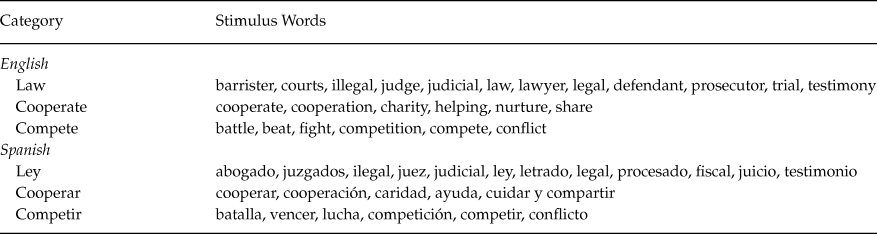
Participants first completed a Single Category Implicit Association Test (SC-IAT). For the SC-IAT, participants categorized words appearing on a computer screen into one of three categories: law, compete, or cooperate (for the Spanish participants: ley, competencia or cooperativo). The stimulus words used during the SC-IAT are shown in Table 1.
Categories and Stimulus Words used for the SC-IAT

For one block of trials, participants were asked to press a key on the left side of the keyboard if the words, which appeared one a time in the middle of the screen, matched the categories law/ley or compete/competencia, or a key on the right if the words matched the category cooperate/cooperativo. In the next block of trials, law/ley was paired with cooperate/cooperativo and words matching those categories required a response from the right-side key, whereas compete/competencia words required a response from the left-side key (whether law was on the left or right first was counterbalanced between participants). Participants were shown the category labels on the bottom left and right sides of the screen. Error feedback was given using red X’s for incorrect responses and green O’s for correct responses, and participants were given a response deadline of 1500ms (cf. Karpinski & Steinman, Reference Karpinski and Steinman2006). Participants received the message ‘‘Please respond more quickly!” in red for 500 milliseconds if they did not respond within the response deadline.
Each block consisted of 24 practice trials that were immediately followed by 72 critical trials. Following Karpinski and Steinman (Reference Karpinski and Steinman2006), for the law-compete block, law words, compete words, and cooperate words were presented in a 7:7:10 ratio. In the law-cooperate block, law words, compete words, and cooperate words were presented in a 7:10:7 ratio. The stimuli were not presented at equal frequency by category to limit response biases.
Individual Differences Measures
After the SC-IAT, participants completed a questionnaire package that included the Communal Orientation Scale (COS; Clark, Ouellette, Powell, & Milberg, Reference Clark, Ouellette, Powell and Milberg1987), a Social Value Orientation scale (SVO; Van Lange, De Bruin, Otten, & Joireman, Reference Van Lange, Otten, De Bruin and Joireman1997) and the Generalized Communication Scale (GCS; Levine & McCornack, Reference Levine and McCornack1991). Footnote 1 These scales were included to gauge participants’ general tendencies to behave cooperatively versus competitively (SVO), view their relationships as communal (COS, e.g., “When making a decision, I take other people’s needs and feelings into account”), and be suspicious and distrustful of others (GCS, e.g., “I often feel as if people are not completely truthful with me”). For the SVO, participants chose between a cooperative response (e.g., you get 480 points, the other person gets 480 points), competitive response (e.g., you get 480 points, the other person gets 80 points), or an individualistic response (e.g., you get 540 points, the other person gets 280 points) across nine items. For the purpose of analyses, we coded competitive and individualistic responses as 1 and cooperative choices as 0, resulting in SVO scores ranging from 0 (prosocial) to 9 (proself).
Next within the questionnaire package, participants answered questions assessing their attitudes toward the legal system (2 items: “In general, my attitude toward the UK[Spain] legal system can be best expressed as:” and “How positive or negative do you feel towards the UK[Spain] legal system”). These items were assessed on scales ranging from 1 (very unfavorable/very negative) to 7 (very favorable/very positive). Participants’ experiences with and knowledge of their legal system were assessed using one item each: “Please report your own sense of how much direct experience you have had with the legal system over your lifetime” (1 = little or no direct experience, 4 = a great deal of direct experience) and “How knowledgeable are you with how the UK[Spain] legal system operates” (1 = not at all knowledgeable, 4 = very knowledgeable).
We then gauged participants’ understanding of the method of legal practice (i.e., adversarial vs. non-adversarial) of their own legal system. Adapted from an online legal dictionary (“The Free Dictionary”), participants were presented with descriptions of two methods of legal practice (labelled Method A and Method B):
Method A
During trials, hearings, or other legal adjudications, the presiding judge is primarily responsible for supervising the gathering of the evidence necessary to resolve the case. He or she actively steers the search for evidence and questions the witnesses, including the respondent or defendant. Lawyers play a more passive role, suggesting routes of inquiry for the presiding judge and follow the judge's questioning with questioning of their own. Lawyer questioning is often brief because the judge tries to ask all relevant questions.
Method B
During trials, hearings, or other legal adjudications, the parties to a dispute, or their lawyers, square off against each other and assume roles that are strictly separate and distinct from that of the decision maker, which is usually a judge or jury. The opposing parties gather evidence and present the evidence, and their arguments, to a judge or jury. The respondent or defendant is not required to testify. The decision maker is expected to be objective and free from bias, and knows nothing of the controversy or dispute until the parties present their cases.
After reading each method, participants were asked to rate the degree to which they believed it characterized the method of legal practice in their own country: “To the best of my knowledge, Method A [B] accurately characterizes the method of legal practice used in the UK [Spanish] legal system” (1 = strongly disagree, 7 = strongly agree). For a third item, participants were asked to circle which of the two methods best characterizes the method used in their own country.
The final section of the questionnaire package assessed participants’ consumption of legal media, general media use, and background information (e.g., age, sex). For the legal media items, participants rated (1 = never, 4 = often) how often they watched law-related TV programs, read law-related books, and watch law-related films (e.g., “In general, how regularly do you watch (or have watched in the past) television programs with themes related to the law and/or legal system (e.g., Law and Order, Garrow’s Law, Criminal Justice, Kavanagh Q. C., The Good Wife)”). Finally, participants reported their general media use with the item, “In general, how regularly do you watch television and/or read newspapers?” (1 = never, 4 = often).
Results
Single Category Implicit Association Test
Data from the SC-IAT were analyzed using the D-score algorithm advocated by Greenwald, Nosek, and Banaji (Reference Greenwald, Nosek and Banaji2003). The D-scores reflect differences in reaction times during the task in standard deviation units between the two critical blocks (law-cooperate and law-compete). Responses less than 350ms were removed, and error responses were replaced with the mean reaction time within block plus a 400ms error penalty. Based on Karpinski and Steinman’s (Reference Karpinski and Steinman2006) procedure, participants with high error rates (>20% of the critical trials) were not included in analyses (17%), which did not differ significantly between samples (12% vs. 21%), χ2(1) = 3.39, n.s. Higher D-scores indicate stronger associations between law and compete than law and cooperate.
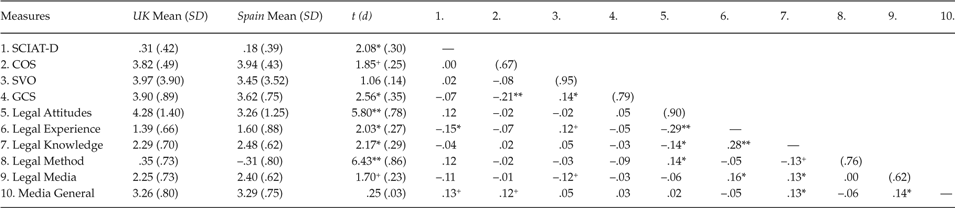
Consistent with Callan et al. (Reference Callan, Kay, Olson, Brar and Whitefield2010), analyses showed that, overall, the average D-score was significantly greater than zero (M = .24, SD = .41) in the predicted direction, t(189) = 8.16, p < .001, d=1.18, indicating that overall our participants tended to associate legal concepts with competition more strongly than with cooperation. More importantly, a 2 (Country of origin: UK vs. Spain) X 2 (Block Order: law-cooperate first vs. law-compete first) ANOVA on D-scores revealed only a significant main effect of country, F(1, 186) = 4.39, p = .038, d = .30 (all other ps > .24). Shown in Table 2, compared to participants from Spain, participants from the UK associated law with compete more strongly than law with cooperate. Footnote 2
Descriptive Statistics and Intercorrelations for Dependent Measures

Note: SCIAT-D = Single-Category Implicit Association Test D score; COS = Communal Orientation Scale; SVO = Social Value Orientation; GCS = Generalized Communication Scale; Higher scores for Legal Method indicate beliefs that the legal system is more adversarial. Where applicable, alpha reliabilities are presented in parentheses along the diagonal.
* p < .05; **p < .01; + p < .10.
Questionnaire Responses
Descriptive statistics by country for each of the self-report measures and the correlations among the measures are presented in Table 2. In terms of differences between the countries, participants from Spain (vs. UK) were significantly less suspicious of others, had more negative attitudes toward their legal system, and reported having more direct experience with the legal system. Among all the measures employed, however, only legal experience correlated significantly with SC-IAT D scores (r = –.15, p = .037), suggesting that, by and large, people’s implicit associations between law and competitiveness are not significantly correlated with their tendencies to behave cooperatively, legal attitudes and legal knowledge, or media use.
We standardized and averaged the three items assessing participants’ understandings of the method of legal practice (i.e., adversarial vs. non-adversarial) to form one composite measure (α = .76). Higher scores on this measure reflect a stronger belief that the method of legal practice in one’s country is adversarial (Method B). Shown in Table 2, as expected and reflecting differences in the actual methods of legal practice between the countries, participants in the UK reported believing that their legal system was more adversarial than participants from Spain. Footnote 3
Exploratory analyses
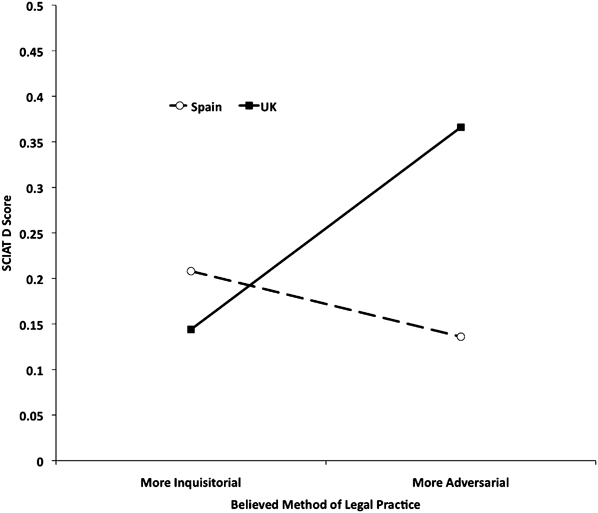
The believed method of legal practice within one’s country did not correlate significantly with participants’ mental associations between law and competitiveness versus law and cooperation (see Table 2). We explored whether this correlation might depend on participants’ country of origin. Following Aiken and West (Reference Aiken and West1991), we regressed SC-IAT D scores onto an effect-coded variable representing country of origin, our composite measure of believed method of legal practice (mean-centered), and their cross-product interaction term. Shown in Figure 1, analyses revealed a statistically significant Country X Believed Method of Legal Practice interaction (B = –.07, SE = .03), t(185) = 2.23, p = .027, sr 2 = .03.
Relation between believed method of legal practice within one’s own country and Single-Category Implicit Association Test (SC-IAT) D score as a function of participants’ country of origin. Higher values on SC-IAT D scores indicate stronger associations between law and competition than law and cooperation.

Follow-up analyses showed that participants from the UK more strongly associated the law with competiveness during the SC-IAT than participants from Spain at 1 SD above the mean of believed method of legal practice (B = –.12, SE = .04), t(185) = 2.65, p = .009, but not at 1 SD below the mean (B = .03, SE = .05, p = .56). Analyzed differently, method of legal practice significantly predicted SC-IAT D scores among participants from the UK (B = .11, SE = .05, p = .026) but not among participants from Spain (B = –.04, SE = .04, p = .41). These results suggest that the effect of inhabiting a country with an adversarial vs. non-adversarial legal system on mental associations between law and competition (vs. cooperation) may not be straightforward and depend on participants’ explicit beliefs about the adversarial nature of their own legal system.
Similar exploratory analyses with participants’ level of legal experience showed that the correlation between legal experience and SC-IAT scores did not differ significantly as a function of country of origin (p = .87). It is important to note, however, that direct experience with the legal system was low overall across the samples (65% of the entire sample reported little or no direct experience with their legal system).
Discussion
Consistent with Callan et al.’s (Reference Callan, Kay, Olson, Brar and Whitefield2010) findings, participants mentally associated the law with competition more strongly than the law with cooperation during the SC-IAT. This association, however, depended on the participants’ country of residence, with participants from Spain associating the law with competition less strongly than participants from the UK. These results suggest that the nature of the legal system in which individuals are exposed—adversarial versus non-adversarial—is related to their implicit associations between legal concepts and notions of competitiveness.
Ancillary analyses revealed that the differences between participants from Spain and the UK in their mental associations between law and competition (vs. cooperation) depended on their beliefs about the adversarial nature of their own legal system. Among participants from the UK, the more they believed their legal system was adversarial, the more they mentally associated law with competition. This relationship did not hold among the Spanish participants, so Spanish participants show a lower mental association between law and competition, independently of their own beliefs about the legal system. Therefore, perceiving the legal system as adversarial predicted mental associations between law and competition for UK but not for Spanish participants. One possible explanation for this difference is that the Spanish participants were less clear about the actual method of legal practice in Spain—indeed, just over half of the Spanish participants believed that the adversarial legal method best characterized their own legal system. Thus, the Spanish participants’ explicit beliefs about the adversarial vs. non-adversarial nature of their own legal system may not have predicted their mental associations between law and competition because they were largely unclear about the method of legal practice in their own country. Although we can only speculate, some Spanish participants might have believed that the method of legal practice in Spain was more “adversarial” because of the increasing popularity of American courtroom/legal dramas, which often depict the more adversarial elements of legal practice, in Spain. Moreover, these results show that culture is not only represented at an explicit level but also at automatic level.
The individual differences measures suggest some interesting differences between the UK and Spanish participants. Spanish participants reported more negative attitudes towards their legal system than the UK participants. These results resonate with a recent report by the Spanish Sociological Research Center (CIS) in their last annual social surveys (2011). In this survey, a large majority of the 5,000 Spanish citizens surveyed thought that Spanish laws favour some people more than others and do not protect people’s rights, and half of the respondents reported that they believed the actual system worked poorly or very poorly. These differences in legal attitudes could stem from the current distrust in public institutions in light of the current economic malaise in Spain, but they also resonate with Thibaut and Walker’s (Reference Thibaut and Walker1975, Reference Thibaut and Walker1978) work on people’s preferences for adversarial vs. non-adversarial (inquisitorial) legal procedures. Thibaut and Walker found that people generally favor adversarial legal procedures, presumably because such procedures afford individuals more control over the legal process.
Although we found that our UK participants on average associated the law with competition more strongly than our Spanish participants, the potential consequences of this difference remain unclear. Callan et al. (Reference Callan, Kay, Olson, Brar and Whitefield2010) found that priming participants with concepts relating to the law and legal system diminished their perceptions of others’ trustworthiness and enhanced self-interested attitudes and behavior. To the extent that people from a country that adopts a more non-adversarial legal system mentally associate law with competition less strongly, thinking about the law and legal system may have weaker effects on social perception.
Future research should also examine the broader influences that different methods of legal practice can have on people’s social preferences (e.g., Bar-Gill & Fershtam, Reference Bar-Gill and Fershtam2004; Kysar, Reference Kysar and Hanson2012). There was a general trend for our Spanish participants to be less suspicious of others and marginally more communal than our UK participants, but these measures did not correlate significantly with either participants’ mental associations between law and competition or their explicit beliefs about the method of legal practice in their own country. Moreover, future research should analyze the interplay between explicit and implicit mental association.
The challenge for future research will be to determine the extent to which different legal systems can not only affect the concepts people mentally associate with the law, but whether these associations can translate into differences in social preferences and interests.