To sum up, we have to live among the living…
Michel de Montaigne, Essays, III: 8 (Montaigne Reference Montaigne2003)
1. Introduction
Intuitively, to ‘perform’ is to ‘show’ or ‘tell’: performances allow for some kind of response in someone other than the performer. Today, we continue to speak of giving ‘concerts’ of electroacoustic music, locating our new technologies and ourselves in contexts inherited from eighteenth-century musical practice. As performers, we assume that people will witness and respond to the sounds that we make. Perhaps we carry an innate understanding that, whatever music is, it is social and perhaps it is this understanding that promotes our reluctance to relinquish historical models of performance at events of electroacoustic music. Composer-researchers working with new technologies often set about the task of re-immersing the body in electronically mediated acts of sound-making in an effort to acknowledge our embodied continuity with the physical world. So difficult is it to operate computer-based technologies in a manner that acknowledges and asserts electronically mediated performances as social that the prosthetics we build to resolve that difficulty take on a hermeneutic role of tremendous responsibility. Not only are they charged with reconnecting body and sound, they must provide for a prolongation of our bodily presences within the wider context of interhuman relations in which we are embroiled. It is this tension between music as an individual act of sound-making and social act of communicating that I address in this article. I argue that in the development of the ‘concert’ model of electroacoustic performances, relationships between performers, instruments, assembled witnesses and the wider, physical context of the performance environment may be redefined. To illustrate, I refer to my 2008 installation-performance, As I Have Now Memoyre, on the relationship between music, the process of human ageing and memory.
2. Transitive/Intransitive Acts
Musical instruments can be thought of as devices that bear some relation to a musician's body at the same time as they are useful in a way that transcends that body's unaided capacity for music-making.Footnote 1 If we consider a singer's unaided, unmediated voice as an ‘instrument’ we may assert i) its being part of the complex of facilities that constitutes the singer's body, and ii) its having been developed for use in the context of particular kinds of musical action. This invokes what I shall call a ‘presentational’ mode of singing and is in accord with the notion that the voice can be ‘trained’ in order to guarantee its fitness for future-presentational purposes, namely the ‘delivery’ of composer-authored works of music. Such a concept of voice has arguably provided the foundation for the vocal pedagogy typically practised in ‘classical’ music conservatories today. But whilst it is possible to speak of ‘using the voice to sing [a musical work]’, it is also possible, simply, to speak of ‘singing’. The word ‘sing’ may be used either transitively or intransitively. Crucially, what guarantees the ‘voice-as-instrument’ paradigm is the notion of a work of music. In traditional vocal pedagogy, the work remains the thing; the composer retains authority. Conversely, if there is no work for delivery (and, therefore, the performance cannot be said to concern an absent author's imagination), then ‘voice-as-instrument’ and methodologies of teaching vocal ‘control’ are challenged.
In contrast to a presentational mode of singing, I wish to outline a non-presentational mode. In this second mode, a singer does not consciously align her actions with those designated by an absent author (that is, she is not primarily a messenger of someone else's imagination). This mode does not deal in musical works. Musical ideas may be discerned by any present listener, but their scope and development is determined (indeed, limited) by the singer herself, according to her nature – the physical condition of her vocal facility and her psychology – rather than any predesignation by a composer-author. There would appear to be similarities here with the concept of ‘improvisation’. But I want to make a distinction between vocal improvisation and non-presentational singing to the extent that improvisation is not necessarily non-presentational if it has to do with responding to musical material and its arrangement.Footnote 2 I would argue that responding, as a way of proceeding musically, has the character of a musical work in a state of becoming. The extent to which improvisation might tend towards being non-presentational would inhere in the primary ‘touch’ of an improvisation session – that is, in whatever might be presented before any response were made (the first gesture-flourish of an instrument, for example). Any response would be improvisatory, even if the ‘statement’ were to some extent non-presentational.
In non-presentational singing there is no teleology. A singer's actions are not ‘preceded’ by a musical work and the end-purpose of these actions is not in any independent listener's response to the design or character of any musical work. Non-presentational singing is an act of vocalising that may or may not be an object of aesthetic interest. As a mode of production it has the character of a private (‘not-intended-to-be-appreciated’) vocalisation that may be understood according to the relation it bears to the psychological state of the singer concerned – by the fallibility of a singer's memory, for instance. A person might sing in an attempt to render a particular tune, but fail to recall the tune in quite the right way. Assuming that person was aware of the discrepancy, they might engage in some kind of vocalisation, thereby ‘filling’ or ‘inhabiting’ the ‘gap’ between the tune intended and the tune actualised. Non-presentational singing might be deployed in performing such a gap. Another instance might be recognised in someone's ‘masking’ or singing ‘over’ a concurrent sound that the subject did not wish to hear. In such a case, there would be no intention of delivering any particular, pre-designed pattern of sound to another person, but rather the use of an act of sound-making to engender and prolong a subject's isolation from social interaction.
Non-presentational singing, as I have described it, problematises the notion of an audience. As the work-for-delivery model breaks down, the need for a listener-recipient is reduced. If there is no teleological progress, then nothing is rendered by a singer for a listener. On first consideration, this seems to work against a conception of music as a social activity. When a subject engages in singing for a purpose that has no presentational intent, the question of how any witness receives the sound and interprets the sound-making action remains. In the context of my work as a practitioner, I am interested in audience response to actions that have no presentational intention, particularly when they occur in the wake of actions that did have some teleological purpose. I am keen to investigate what happens when a performer engages and disengages what Alfred Schutz called the ‘mutual tuning-in relationship’ (Schutz Reference Schutz1951: 161). For instance, in ‘Making Music Together: ‘A Study in Social Relationship’, Schutz writes that the origin of this relationship is ‘in the possibility of living together simultaneously in specific dimensions of time’ (Schutz Reference Schutz1951: 162), with reference to the relations between those gathered at a musical performance, ‘by which “I” and “thou” are experienced as “we” ’ (Schutz Reference Schutz1951: 161). The meaning of musical experience is to be found in what Schutz calls music's ‘polythetic structure’: ‘[t]he meaning of a musical work … consists in inner time, in the very polythetic constitutional process itself’ (Schutz Reference Schutz1951: 172). He describes the following situation:
[t]wo series of events in inner time, one belonging to the stream of consciousness of the composer, the other to the stream of consciousness of the beholder, are lived through in simultaneity, which simultaneity is created by the ongoing flux of the musical process … this sharing of the other's flux of experiences in inner time, this living through a vivid present in common, constitutes … the mutual tuning-in relationship, the experience of the ‘We,’ which is at the foundation of all possible communication. (Schutz Reference Schutz1951: 172)
Schutz is writing about musical works of the order of Beethoven sonatas and symphonies that (by analogy with the modes of singing I have outlined) require unambiguous acts of presentational performance. Nonetheless, I am interested in refocusing the ‘stream of consciousness’ of the composer onto that of the performer and in considering the ‘lived-through simultaneity’ of the shared experience felt by a performer in close proximity with a beholder and vice versa. I propose that access to a singer's psychology may be granted most expediently via acts of non-presentational singing, which are, ostensibly, not to be witnessed. But in the light of Schutz's analysis of musical experience, I want to go further and suggest that within a non-presentational act there is a need on the part of the performer to be witnessed in order to explore the phenomenological experience of sound-making, of being embodied within the physical world of things, to explore the meaning of inter-relations with other human presences and, indeed, to construct his or her sense of self. In the remainder of this article, I therefore offer an account of As I Have Now Memoyre that focuses on the progression from transitive acts of presentational singing to intransitive acts of psychological explication that give voice to memory.
3. Close presences
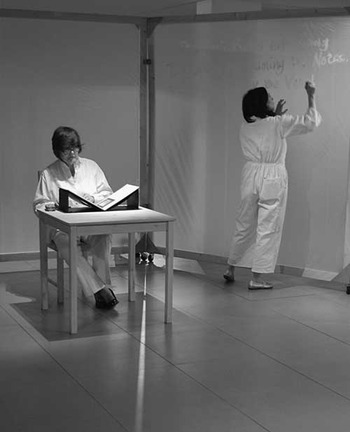
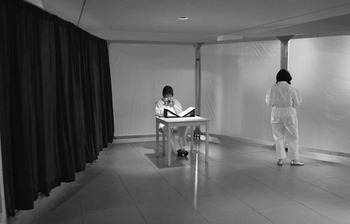
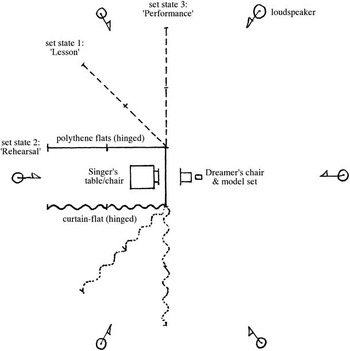
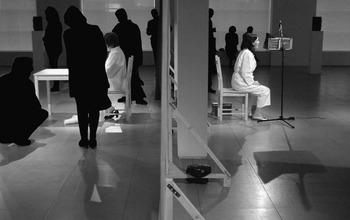
As I Have Now Memoyre (2008)Footnote 3 examines the connection between music and memory through the relationship between two female vocal artists, a singing teacher (the Singer) and her pupil (the Dreamer).Footnote 4 The audience is invited to wander amongst the performers and witness their actions in close proximity as they decode musical notation with mirrors, write on polythene walls and, at one point, build a chamber for a quartet of ‘birds’ that ‘sings’ eighteenth-century music. During the first part of the performance (subtitled, ‘Lesson’), an installation-set is assembled from polythene screens, curtains, a table, chairs and other small items of technology such as a vibrating plate and video monitor. The hinged screens divide the space into a nexus of zones, which the two performers and audience members inhabit (see Figures 1 and 2). These screens are opened and closed during the performance, making a distinct set ‘state’ for each of the three parts of the performance (see Figure 3). Because this construction process takes place around the gathered audience, people are required to move in order to allow the screens to be brought in and the performance zones assembled. Changing between these ‘set states’ assists in managing the proximity between the audience members and the performers as well as reflecting the flux between presentational and non-presentational acts of singing. The entire space is immersed in a six-channel, live audio feed from a computer running Max/MSP.
Linda Hirst and Natasha Lohan in As I Have Now Memoyre at the Louise Blouin Foundation, London, April 2010.

Figure 2

Diagram showing performance layout with set states.

Roughly halfway through the performance, the Singer leaves the space and retires to another part of the building to learn a piece of music. This signals the beginning of the second part of the performance (‘Rehearsal’). Some members of the audience follow the Singer; others remain in the main space and watch her actions via a live video feed. Meanwhile, the pupil sits at her teacher's desk and gives her own vocal performance whilst she converts an audio recording made by the Singer (earlier in the performance) into a Chladni pattern of salt on a vibrating plate (see Figure 4). Once this has been done, the Dreamer makes an image of the salt-pattern on one of the screens with red paint (see Figure 5).
Salt-pattern on a vibrating plate.

Polythene screen with salt-pattern in red paint.

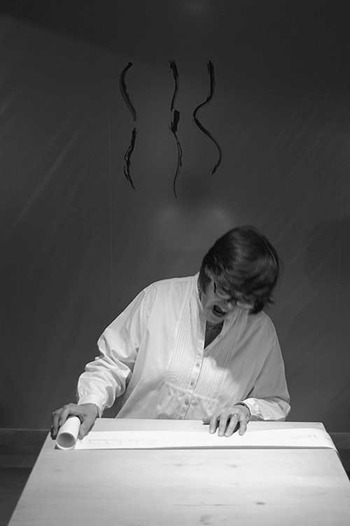
In the third and final part (‘Performance’), the Singer returns to the main space. Teacher and pupil sit either side of the paint-marked polythene screen and sing a ‘duet’, facing opposite directions (see Figure 6). The Dreamer sings into a suspended model of the constructed set-environment, which contains a small microphone that sends her voice to a granulation patch and out to the six-channel sound system. Eventually, the slow-burning duet reaches an impasse: the Dreamer completes her part and leaves the performance space; the Singer moves to the Dreamer's side of the screen and sits on her chair. She begins to sing a phonetic version of the Dreamer's song, in search of her own past. The small set-model remains suspended in front of her, but the electronic processing is no longer active. The Singer leaves the performance space; the audio is looped and the lighting changes to ‘installation state’. Gathered witnesses are left to view the assembled installation until they wish to leave.
Teacher and pupil either side of screens (set state 3) with audience in close proximity. Pupil sings into model set.

Structurally, the performance concerns the ebb and flow between presentational (henceforth, ‘type 1’) and non-presentational (‘type 2’) vocal acts. The strength of the polarity between type 1 and 2 acts is governed by the fluctuating significance of musical notation in score and the mediation of audiovisual technology. The requirements of the Singer's handmade score-text, as a mandate for performance, oscillate between type 1 acts of singing and type 2 acts, which are motivated via particular graphic devices that allow ‘gaps’ for the singer to ‘inhabit’. This is achieved by i) scraping away parts of a score covered in white oil pastel to reveal certain fragments of sepia-ink notation, ii) printing the pages of the score on sheets of transparent acetate, which are layered on top of each other, and iii) printing the notation in reverse (i.e. requiring a mirror for viewing). In each case, the obfuscation of the notation necessitates an appeal to the vocalist's memory. There are two ways in which this may be carried out. First, the vocalist may recall past performances or rehearsals of As I Have Now Memoyre in an attempt to reconstruct what she remembers from those events. This is problematic insofar as what she is appealing to amounts to previous attempts to perform something that has never been presented as a fixed and stable work-to-be-performed. Second, the vocalist may appeal to her memories of performing other, particular musical works at earlier times in her career. This is possible because all of the Singer's musical material in As I Have Now Memoyre is constructed from fragments of particular musical works that the vocalist has sung at some time during the course of her actual career (i.e. her repertoire). Essentially, then, when the vocalist encounters ‘gaps’ in her ‘knowledge’ of the score, she may appeal to memories of earlier performances or rehearsals of As I Have Now Memoyre, which inevitably present themselves as previous vocalisations in search of some fixed original – that original being a previous performance of an entirely different musical work.
In the beginning of the 1970s, Richard Schechner wrote down his theories concerning ‘the practice of environmental theatre’ and suggested that environments ‘can be imagined not only as spaces but as active players in complex systems of transformation’ (Schechner Reference Schechner1973: x). The first of Schechner's ‘Six Axioms for Environmental Theatre’ proposes that a theatrical event comprises three primary and related transactions: first, among performers; second, among members of the audience; and third, between performers and audience (see Schechner Reference Schechner1973: xxiii). In As I Have Now Memoyre, the extent to which the ‘transaction’ between performers and audience drives the performance problematises how any performance ‘of’ it might be interpreted. What goes on between performers and audience is critical, but the Singer is not consistently performing something for witnesses to listen to, as an object of cognition, even though she has a score on her desk for much of the performance. Indeed, challenging any witness's assumption that the performance is goal-directed is a crucial part of the function of the polythene screens. When the screens are placed in-between members of the audience and a performer, sight lines are disrupted and patterns of acoustic reflection (from the surrounding six-channel electronic audio, mixed with the live vocals) are changed. The placing of the screens encourages the audience to stand in close proximity to the performers. At the same time, this divisive action seems to say to the audience, ‘you are not meant to witness this’. (Ostensibly, as I have suggested, type 2 acts are not to be witnessed.) Displacing the audience works against presupposed notions of what Stan Godlovitch outlines as an ‘intuitive view’ of musical performance because it shows that not all audience members are potentially in a position to ‘receive’ all performative actions in any case.Footnote 5 Once this has become clear to all members of the audience (i.e. they have relocated themselves and found their individual fields of view) the necessity of their individual presences becomes a matter of instinct.
To be sure, the initial set-building of As I Have Now Memoyre ‘prepares’ members of the audience for type 2 musical actions, but these witnesses also shape the performance in their capacities as individual, living presences. As Schechner observes in cases of environmental theatre, ‘because there is no fixed seating and little indication of how they should receive the performance, spectators arrange themselves in unexpected patterns; and during the performance these patterns change, “breathing” with the action just as the performers do’ (Schechner Reference Schechner1973: xxxvi). For Schechner, the mobility of the audience becomes ‘a flexible part of the performance environment’ that performers can use to their advantage (Schechner Reference Schechner1973: xxxvii). In As I Have Now Memoyre, the relationship between an act of witnessing on the part of the audience and a performer's type 2 vocalisation is the key to the way in which the performer constructs her sense of self by searching her musical memories. This call to (actual) memory is a defining feature of As I Have Now Memoyre. Accordingly, the main objective is to set up opportunities for type 2 acts, which are aided by a relational, interactive role for the audience vis-à-vis the vocalist (and vice versa), given close proximity between the two parties. Hence, the lack of chairs or dedicated performance areas and the ‘shepherding’ of the assembled audience are managed in such ways as create particular conditions for performance.
In The Presentation of Self in Everyday Life, Erving Goffman distinguishes between the ‘self-as-performer’ and the ‘self-as-character’. The former motivates us to engage in a social process of self-definition. He writes, ‘[i]n our society the character one performs and one's self are somewhat equated, and this self-as-character is usually seen as something housed within the body of its possessor’ (Goffman Reference Goffman1959: 244). This performed self, Goffman argues, ‘does not derive from its predecessor, but from the whole scene of his action, being generated by that attribute of local events which renders them interpretable by witnesses’ (Goffman Reference Goffman1959: 244). The idea that the self is a social product provides a useful thesis for approaching the actions of the Singer in As I Have Now Memoyre, especially as regards her oscillating between type 1 and type 2. When witnesses first encounter her (she simply enters the space and begins, without any applause) they must decide whether or not she is an actor in a play. In two productions so far (Kings Place and Riverside Studios), the performer wore a costume that comprised a large brown dress with a wire sculpture-model of a larynx around her neck. In the other two (UEA and Louise Blouin Foundation), she wore predominantly white, everyday clothes. Moving closer to a performer wearing a model larynx is more likely to induce, on the part of a witness, a sense of walking ‘into’ fiction than standing aside a performer dressed for daily life. But whatever the message sent from her clothes, there is a residual sense in which the performer needs to be witnessed in order to be able to manipulate the way in which her audience ‘attaches’ a self to her presence. As Goffman writes:
A correctly staged and performed character leads the audience to impute a self to a performed character, but this imputation – this self – is a product of a scene that comes off, and is not a cause of it. The self, then, as a performed character, is … a dramatic effect arising diffusely from a scene that is presented. (Goffman Reference Goffman1959: 244)
It is through such social interaction that the Singer, qua real-life musician, is able to construct a self. Initially, she maintains a posture of presentation, of aligning herself with the music notated in the score on her desk. We may see her as a fictional character but we never know what she is singing about because she only sings phonetic sounds. As a performer, the Singer is given opportunities to transcend this paradigm by the previously described ‘gaps’ in the score and the hermeneutic problems of performing what is written down. Having already constructed a self according to the social conditions of the performance (we might say, the ‘theatrical’ self), the performer is able to modify that construct by ceasing to perform any ‘character’ (i.e. to present any part of a musical work) and, instead, to sift through memories of past performances via type 2 acts of singing. Without signal, private acts of remembrance follow the traces of public demonstration.
The relationship between performers and audience members develops systemically until the Singer leaves the performance space at the end of Part 1. For about fifteen minutes, her musical actions are witnessed by some audience members in situ (some people are ushered out of the main space, to follow the Singer) and by others via a live video transmission fed back to a monitor in the main space. Until this point, diverse actions have occurred simultaneously: one performer has been writing on a screen, another has been singing at a desk, both occupying separate areas of the space. During Part 2, the performance is self-consciously multi-levelled. Only a handful of invited members of the audience may witness the ‘offstage’ performance. The use of video as a form of mediation for this ‘satellite’ performance functions as a way of clarifying a type 1 action. Those witnessing it via video cannot influence the performer by their proximity. Meanwhile, those taken to the Singer's satellite location crowd around her as she learns a vocal score, sitting at a piano. But even here, there is a change: the score the performer is learning does not allow opportunities for type 2 acts of singing.
4. Towards singularity
As live performance, As I Have Now Memoyre sets up conditions for the kind of ‘lived-through simultaneity’ between witness and performer that Schutz wrote about and develops them such that they make demands of both parties. For the witness, it becomes clear that perception is a matter of selective attention. For the performer, the process of encountering another presence is key in her quest for allowing the construction of her self. But there is also a sense of the performance as a document. Something takes place; people gather, share time, engage and leave. For Schutz, ‘making music together is an event in outer time, presupposing also a face-to-face relationship … a community of space’ (Schutz Reference Schutz1951: 177). The ‘mutual tuning-in relationship’ is established by ‘the reciprocal sharing of the Other's flux of experiences in inner time, by living through a vivid present together, by experiencing this togetherness as a “We” ’ (Schutz Reference Schutz1951: 177). Schutz recognises that ‘the Other's body and its movements can be and are interpreted as a field of expression of events within his inner life’ (Schutz Reference Schutz1951: 177). In the case of As I Have Now Memoyre, the success of that expression depends upon a relational approach to music-making as live action, wherein the necessity of witnesses – their presences and their actions – is essential. Interhuman exchange is a sine qua non. And, further, the hierarchical importance of any witness, vis-à-vis any performer, is questioned: As I Have Now Memoyre neither begins nor ends with applause.
Part 3 starts shortly before the Singer returns from the ‘satellite’ space to the main performance area and the ‘satellite’ audience rejoins the majority. Singer and Dreamer sit either side of a polythene screen. Audience members (now familiar with the need to make perceptual choices) gravitate towards one or the other. Figure 7 shows an excerpt from the duet that ensues, as it appears in the score-scroll that the Singer reads whilst sitting at her desk (the Dreamer does not follow a score during the duet). The Dreamer sings her part (which comprises long note values, most of which last several seconds in duration) into a suspended model of the surrounding set-environment. Her voice is sent through a granulation patch and out into the six-channel sound system. The Singer improvises a melodic line, based on given, notated material that comprises short, rhythmic cells. In performances of this duet, the following occurs: i) the electronic processing of the Dreamer's long notes (i.e. the resulting granulation) aspires to the condition of the Singer's improvisations; ii) the Singer hears the electronic manipulation of the Dreamer's part and responds to it, further developing the rhythmicity of her improvisation (i.e. that improvisation is revealed as aspiring to an electronically mediated condition); iii) the Dreamer begins to improvise by breaking the long notes notated in score, ‘folding back’ some of the phrases that change from one pitch to another as if she were imitating a series of electronic delay lines. This is not notated in the score. By undertaking such action, she is acknowledging her own, electronically mediated performance at the same time as she is sympathising with the Singer's aspiration towards its state of fragmentation. This shared affinity is what brings the duet to its impasse.
Excerpt from the Singer's score-scroll showing material for her duet with the Dreamer.

In perceiving and responding to the granulation and, accordingly, moving beyond the notation by repeating brief turns of phrases, the Dreamer asserts her ontological reciprocity with the performance environment. The situation echoes what Merleau-Ponty observed when he wrote, ‘Our own body is in the world as the heart is in the organism: it keeps the visible spectacle constantly alive, it breathes into it and sustains it inwardly, and with it forms a system’ (Merleau-Ponty Reference Merleau-Ponty1962: 203). In a sense, the Dreamer ‘embodies’ the electronic processing by asserting continuity between the electronically mediated performance and the performance rendered by her own unaided body (the acoustic sound of her long melodic lines). There is also a sense in which the Dreamer ‘subsumes’ the model set, as prosthesis-instrument, insofar as she makes a choice to move beyond her line having heard i) what that set-instrument has done to her voice (i.e. her past rendering of the notated vocal line), and ii) what she can hear her teacher doing in the present (the teacher herself being increasingly engaged in an imitation of the student's electronically mediated performance). Past sounds of the pupil's making are re-rendered electronically at just the moment the pupil encounters the flux of her teacher's exhortations. The Dreamer responds by imitating both streams of perception; the process continues, effectively narrowing the polyphony of the duet towards singularity and the inevitability of an impasse. The Singer, meanwhile, continues her quest for a transcendent ‘voice’ that is beyond any purposeful conditioning or embellishment, seeking instead the body's unmediated capacity for rendering pure feeling. The suspended model of the set-environment is revealed as a device that permits a prolongation of the subject's embodiment within the wider context of that ‘life-size’ performance environment.
In this article, I have described how in the course of performing As I Have Now Memoyre the voice may emerge from its status as instrument (for the delivery of a pre-notated work-text) to, simply, voice, through non-presentational acts of singing in a context of electroacoustic performance. Furthermore, I have proposed that in this act of emergence the process of managing the proximity between members of the audience and the performers plays a catalytic role, particularly as regards the inter-relations between performers and witnesses and the way in which a performer is able to construct a sense of self. As I Have Now Memoyre, at time of writing, has received four separate productions. In each case, the performers have been immersed in very different circumstances as the work has evolved to match various production spaces and technical facilities. To this extent, the performance-piece itself has been in a process of becoming. Always, in instances of repeatable, performative actions, the past informs the present. But here the theme is the inevitability of ageing – of the performers and, indeed, of the audience members. Re-witnessing As I Have Now Memoyre is not intended to be an act of reconciliation (as it would be, were we to return to a particular work of music to hear it performed by someone we had not previously heard). It is intended as something more akin to a ‘memento mori’. As Schutz writes, ‘[c]ommunicating with one another presupposes … the simultaneous partaking of the partners in various dimensions of outer and inner time – in short in growing older together’ (Schutz Reference Schutz1951: 178).
Photography by Francesca Heathorn. Used with permission.