





Background
Infection prevention and control (IPAC) involves navigating complex situations that require balancing multiple values and principles. Reference Herwaldt1 Unlike other areas of healthcare, which have established ethical frameworks to guide practice, IPAC did not have a standardized framework until recently. Reference Tan, Ofner and Candon2
The Ethical Infection Prevention and Control (EIPAC) framework provides a structured approach to decision-making in complex situations such as when no standard or policy exists, a deviation from policy is being considered, or when a decision will have substantial impacts on involved parties or risk compromising ethical principles. Reference Tan, Ofner and Candon2,3 Its four simple steps include: Identifying the facts, Determining relevant values and principles, Exploring the options then Acting. Five process conditions are provided to support greater trust in the process followed.
The EIPAC framework was endorsed by both the Association for Professionals in Infection Control and Epidemiology (APIC) and IPAC Canada in June 2024 and disseminated as a practical toolkit for professionals in the field. 3 It received broader endorsement in 2025 by the Australasian College of Infection Prevention and Control along with the Infection Prevention Society in the United Kingdom. 3
Since the release of the EIPAC framework, the uptake and perceived utility of this framework has not been assessed. The present study aimed to assess awareness, adoption, and barriers to using the EIPAC framework among IPAC professionals across the United States and Canada.
Methods
A binational cross-sectional descriptive survey was conducted in May–June, 2025, to assess awareness and uptake of the EIPAC framework among members of APIC and IPAC Canada. The survey was jointly distributed by both professional societies through direct member mailing lists and postings on their respective websites. Participation was voluntary and anonymous. Completion of the survey implied consent. Responses were collected electronically over a 6-week period.
The survey instrument was developed collaboratively by APIC and IPAC Canada teams. It included both closed and open-ended questions addressing employment in IPAC and practice setting, awareness and use of the EIPAC framework, perceived helpfulness and specific aspects found valuable, along with challenges experienced during application and recommendations for improvement. Respondents who reported not using the framework were asked about barriers to adoption, while those who had used it were asked to describe its utility and provide examples of real-world scenarios where it was applied.
Multiple responses could be selected for describing benefits or perceived barriers. Free-text responses were included at the end of the survey to capture additional nuanced feedback and suggestions for improvement. Research ethics review was not required, as the project met institutional criteria for exemption under quality improvement and program evaluation activities.
Results
A total of 236 responses were received, with 96.2% (227/236) respondents actively working in IPAC. Respondents worked in a range of healthcare settings, with 58.9% (139/236) employed in acute care, followed by nursing homes 14.0% (32/236), long-term acute care 4.4% (11/236), community care 5.5% (13/236), public health 6.4% (15/236), and government agencies 6.8% (16/236).
Among respondents working in IPAC, 25.1% (57/227) reported being aware of the EIPAC framework, and 12.3% (28/227) indicated they had used the framework in practice. Among those who had used the framework, 60.7% (17/28) rated it as very or extremely helpful, while 39.3% (11/28) described it as somewhat helpful. None of the respondents found it unhelpful.
The most frequently cited benefits of the framework included its structured approach to addressing ethical dilemmas in IPAC (57.1%; 16/28), articulation and weighing of ethical principles (46.4%; 13/28), facilitation of broader team discussions (35.7%; 10/28), provision of confidence in making difficult decisions (32.1%; 9/28), the supporting worksheet for documentation and decision-making (35.7%; 10/28), and informing policy development or revision (10.7%; 3/28). None of the users indicated that the framework provided no value. When asked whether they would recommend the EIPAC framework to colleagues, 89.3% (25/28) answered yes and 10.7% (3/28) indicated maybe, and no respondents selecting no.
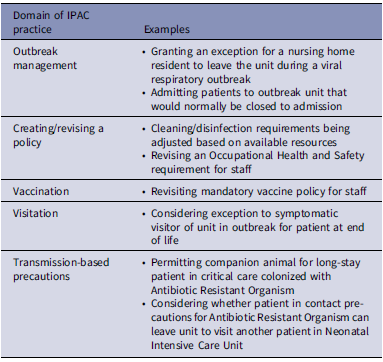
Respondents described applying the EIPAC framework across a diverse range of ethical decision-making contexts (Table 1). Use of the EIPAC framework touched many different domains ranging from patient and family visitation, vaccination strategies, outbreak management, occupational health and safety, environmental cleaning, as well as to inform the development and revision of organizational policies and procedures. Among those who reported not using EIPAC framework in practice (n = 208), the most common barrier was lack of awareness that this framework existed (84.6%), while use of an internal framework (1.4%) or lack of situations that needed it (1.0%) were uncommon barriers.
Examples where Ethical Infection Prevention and Control (EIPAC) framework was used, based on binational survey in 2025

Table 1. Long description
A table titled ‘Domain of IPAC practice’ with two columns: Domain of IPAC practice and Examples. The table has five rows, each representing a different domain and corresponding examples. Row 1: Outbreak management, Respiratory outbreak—granting an exception for a nursing home resident to leave the unit, Admitting patients to outbreak unit that would normally be closed to admission. Row 2: Creating/revising a policy, Cleaning/disinfection requirements being adjusted based on available resources, Occupational Health and Safety requirements for staff. Row 3: Vaccine, Revisiting mandatory vaccine policy for staff. Row 4: Visitation, Considering exception to visit Neonatal Intensive Care Unit in context of colonization with Antibiotic Resistant Organism, Considering exception to symptomatic visitor of unit in outbreak for patient at end of life. Row 5: Transmission-based precautions, Permitting companion animal for long-stay patient in critical care colonized with Antibiotic Resistant Organism.
Among feedback and suggestions for improving the EIPAC framework, the main theme was the need for more awareness, formal training, and education regarding its use in practice.
Discussion
This binational survey provides an early snapshot of the uptake, use and perceived utility of the EIPAC framework among IPAC professionals in Canada and the United States. Although awareness and use of the framework remain low, findings support the intent of the framework in supporting structured decision-making in complex situations.
There is a recognized international need to refine IPAC practice to ensure that non-infection-related risks are considered in decision-making in complex situations. The COVID-19 pandemic exposed this gap in clinical practice. Prolonged restrictions on visitation is one recognized example, which was associated with increased risk of patient complications including delirium and falls. Reference Shennan, Coyle, Lockwood and DiDiodato4–Reference Van der Roest, Prins and van der Velden6
Our survey suggests that the EIPAC framework may be useful in addressing this gap as intended. The greatest barrier to not using the EIPAC framework was ultimately lack of awareness, rather than not encountering situations that warranted its use especially given that over half of respondents who were aware of its existence used it within one year of its release. The high proportion of respondents who rated the framework as very or extremely helpful reinforces its value in supporting IPAC professionals as they navigate complex scenarios. No substantive changes were suggested by end-users of the framework except for the need for better dissemination along with training and education for IPAC professionals.
Despite the EIPAC framework addressing a known gap in practice, the lack of broad adoption into practice within a year of its release is not surprising for several reasons. Uptake into practice may require a longer time horizon and more than passive dissemination through webinars and toolkits to reach all IPAC professionals. 3 Other social, behavioral, and environmental factors beyond awareness or knowledge alone are known to influence implementation of new practices. Reference Atkins, Francis and Islam7 Formal implementation efforts led by IPAC professional societies may be needed to better understand how best to incorporate the EIPAC framework into practice in different practice settings.
Our study has some important limitations. First, the responses from IPAC Canada and APIC members could not be separated, which limits the ability to assess regional or organizational differences in awareness and use. Second, the sample size represents roughly 2% of total membership between the two professional societies. Third, those who have used the EIPAC framework could be more likely to respond to survey leading to overestimation. Nonetheless, this represents an important initial step in understanding how the framework is being received and applied in the field.
Despite modest awareness and uptake at this early stage, the EIPAC framework is viewed as a valuable tool by those who have adopted it. Future work could focus on targeted dissemination, training, and implementation strategies to increase awareness and integration into IPAC practice.
Acknowledgements
No funding was received. The authors thank the Working Group members of APIC and IPAC Canada who developed the toolkit for implementing the EIPAC decision-making framework.
Author contribution
All authors contributed to the preparation of this manuscript.
Competing interests
Dr. Jerome Leis has provided expert testimony for the Ontario Hospital Association. None of the other authors have conflicts of interests to declare.

 Open access

