The world you can access through puppetry is so vast, for me it is like oxygen, like fresh air. You can create beautiful images and breathe emotions. Puppets open your hands; they allow you to create magic. Footnote 1
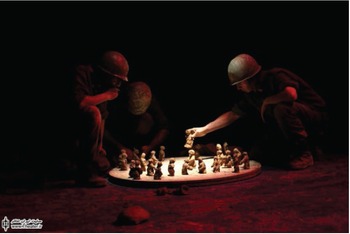
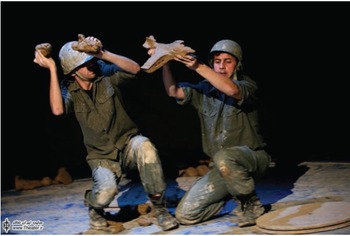
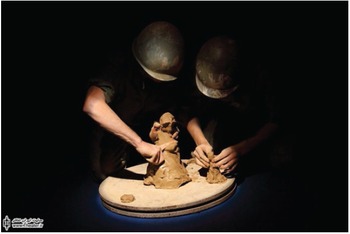
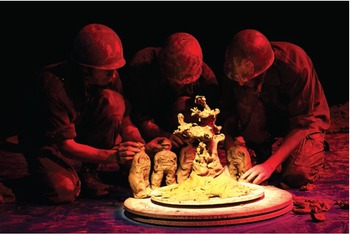
—Zahra Sabri (Reference Sabri2016)The performance begins drowned in an eerie light the color of blood. The stage floor is covered in odd circular patches, with lumps of clay strewn about. Two men, dressed head-to-toe in identical military fatigues, play a game akin to chess on a circular board upstage (fig. 2). The pieces, we come to realize, are made of wet clay; when a piece is captured and tossed aside onto the floor, it loses its shape. After a few rounds, the men spin the board 180 degrees and begin playing for the opposite side — who wins and who loses is irrelevant. The pace of the game rapidly accelerates as a third man in fatigues flies a jet plane molded from clay in circles above the mound of deformed chess pieces with the excitement and innocence of a child playing with his favorite toy. One of the men takes the discarded chess pieces and begins molding them into two indecipherable objects while the plane flies to a new mound, this one covered in miniature clay buildings — a city, we realize. While one puppeteer hovers the plane above the city, another drops two amorphous shapes from the belly of the jet: bombs falling in slow motion toward the city; they are about to bring immense destruction (fig. 3). One of the men averts his gaze from the inevitable catastrophe. But just as the bombs are about to explode, the man holding them pauses. He looks at each of the bombs in his hands…and he sits back, shaking his head.
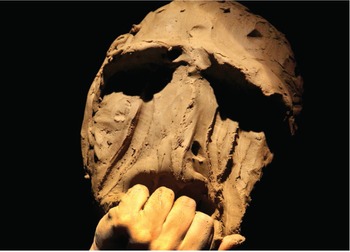
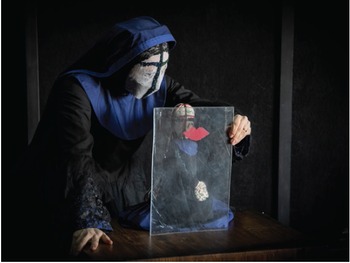
A clay mask decaying at the hands of its puppeteer. Count to One by Zahra Sabri. Tehran, 2012. (Photo by Siamak Zomorodi; courtesy of Zahra Sabri)

A chess game — the opening sequence of Count to One by Zahra Sabri. Tehran, 2012. (Photo by Siamak Zomorodi; courtesy of Zahra Sabri)

This scene opens Ta Yek Beshmar (Count to One; 2012), written and directed by Zahra Sabri.Footnote 2 During its 50 minutes, Count to One defies both Aristotelian narrative structures and the conventions of traditional puppet performance. With the help of several mounds of clay, some classical Persian musical instruments, and six manual pottery wheels built into the stage floor, Sabri explores violence, fate, motherhood, government, sacrifice, and more. Sabri’s play dramatizes stories that explore the beauty and heartache of human existence, inspired by the quatrains of Omar Khayyam.Footnote 3 In Count to One, three soldiers in an unnamed war go against their commander’s orders by refusing to deliver immeasurable destruction and civilian casualties. The soldiers take on the roles of actors, puppeteers, puppet makers, and even the puppets themselves as they wordlessly perform an embodied poetry of solace. Count to One creates its meanings at the intersection of Iranian postmodern puppetry and the country’s legacy of interventionist antiwar theatre. Sabri’s emphasis on corporeal materiality and ephemerality, paired with her signature ambiguity, radically advocates for nonviolence, a world in which people create not destroy. Conceived with the intent of reaching both Iranian and global audiences, Count to One is just as relevant a decade after it was first performed, in a world where the Middle East continues to play a central figure in global wars.
Missiles flying behind a clay airplane. Count to One by Zahra Sabri. Tehran, 2012. (Photo by Siamak Zomorodi; courtesy of Zahra Sabri)

Iranian Theatre and the Puppet Master
While performance traditions have existed in Persian culture for over a thousand years,Footnote 4 the logocentric “modern” form of drama gained prominence in Iran during the late 19th century (Beyzaie Reference Beyzaie1965; Floor Reference Floor2005). The art form experienced a heyday in the mid-20th century with the lofty dramatic work of playwrights like Bahram Beyzaie and Akbar Radi, as well as Lalehzar, the popular theatre form seen in Tehran’s Lalehzar District.Footnote 5 Coinciding with the presidential election of Mohammad Khatami in 1997, Iranian theatres started exploding with new work, a trend that has only increased with the privatizing of Iranian theatre that began in 2012.Footnote 6 Out of this renaissance grew a cohort of theatre-makers who captivated global audiences, including Nassim Soleimanpour, Amir Reza Koohestani, Mohammad Aghebati, Reza Servati, and Zahra Sabri.Footnote 7
Sabri’s work does not fit in neatly with the others of this cohort. For one, she is a woman achieving significant acclaim amidst a sea of men. Although female directors like Pari Saberi and Manijeh Mohammedi have been hugely influential in the Iranian theatre, the field remains dominated by men. In order to reach the privileged position she now enjoys, Sabri has had to advocate for her work in partnership with female officials in Iran’s Dramatic Arts Center (the government entity that approves productions for public consumption). When I visited Iran in 2016, Sabri asked that I interview her in the office of a close friend of hers, a female bureaucrat who stayed for the duration of the interview and offered us tea, sweets, and pleasant anecdotes of her professional history with Sabri. At the time, I found this interaction surprising, given the incisive social critique that is evident in many of Sabri’s most well-known productions — for instance, Lorca’s The House of Bernarda Alba (2010) and Brecht’s Mother Courage and Her Children (2014). What I would come to learn, however, is that Sabri’s artistry uses strategic ambiguity as a way of distancing her work from specific political references to contemporary Iranian life. This performative ambiguity that underlies both the language and mimetic aspects of Sabri’s theatre is masterfully woven throughout Count to One. Perhaps Sabri’s friendship with “theatre censors” is a strategy for overcoming the countless hurdles women face within Iranian and global misogyny. Regardless, her work continues to be uplifted and supported by the theatrical institutions that function beneath the umbrella of the state, which attests to Sabri’s capacity to speak on multiple levels with her work, as she is championed by both the government and its critics.
Born in 1967, Sabri spent the first 12 years of her life in the waning Pahlavi dynasty, during which there were continual protests that would eventually lead to the 1979 Islamic Revolution. The Iran-Iraq War (1980–1988) consumed much of her adolescent years, which perhaps explains the thematic prevalence of war in her work. When she turned 23 in 1990, Sabri began studying theatre at the Kanoon Ta’atr Banovan, Tehran’s Women’s Theatre Center. She focused on acting, but soon developed a love for puppet design as well, ultimately receiving degrees in both. After finishing the two-year program, the center asked Sabri to stay on as associate faculty. She accepted the job as a way of getting more directing experience. In 1997, she received a master’s degree in stage design from the Islamic Azad University, which she explains was “mostly for the credibility factor — and because it was the only thing I hadn’t studied yet” (Sabri Reference Sabri2016).
Puppetry has an extensive history in Iran. Although the origins of Iran’s puppetry are debated by scholars, Persian poets and historians dating back to the 11th century reference puppets and puppeteering in their work (Massoudi Reference Massoudi2009). In his influential Namayesh dar Iran (Theatre in Iran), Beyzaie writes:
The puppet plays that we use today come in two varieties, one sayeh bazi [literally, “shadow play”] and one kheimeh shab bazi [marionettes], which we now separate as distinct entities, but at an earlier time, because of their similarities and a lack of formal theatrical theorization, they appeared to be used interchangeably. (1965:84)
Beyzaie insists that the form now called shadow puppetry was likely prevalent in post-Islamic Iran given the presence of Bedouins and other nomadic inhabitants who slept in tents and gathered around campfires. Other scholars struggle to differentiate a distinctly Iranian shadow puppet tradition from the more popular and widespread Karagöz of neighboring Turkey. Willem Floor argues that a separate form known as lobat bazi (glove puppetry) is widely documented as early as 12th-century Iran (2005:65–70). Of the various puppet forms, Iran’s marionette theatre has lasted the longest and is the most common form of puppetry today.
Puppet theatre is still performed regularly in Iran. Although it is considered primarily for children, there is also an elite group of artists like Sabri, Behrouz Gharibpour, and Maryam Moini whose puppeteering is innovative and aimed at adults. Footnote 8 Sabri identifies her work as “adult puppetry,” explaining, “I’ve only done one or two puppet plays for kids, but for the most part, my puppetry is for adults. Children wouldn’t enjoy it. They might come see it, but I don’t create theatre for them” (2016). Sabri pushes back against the narrative traditions from Iran’s puppetry origins, building on a tradition of 20th-century revisionist narratives like Beyzaie’s play The Marionettes (1963), which deconstructs kheimeh shab bazi’s common plot structure: after defeating the latest monster, the Hero puppet decides that battling mythical beasts is no longer worth the strain; he exits the stage leaving the Puppeteer alone with the audience. The Puppeteer apologizes, “My intention was to entertain you, / But these characters could not forget themselves; / They were slaves to strings stronger than my words” (in Beyzaie et al. Reference Beyzaie, Morad and Na’lbandian1987:27). In a similar vein, Behrouz Gharibpour’s work transforms kheimeh shab bazi into epic puppet spectacles, in which his marionettes lip-synch full-length operas.
As a theatre director who uses puppets because of their expressive potential, Sabri’s work breaks with puppet tradition both in design and the way she integrates puppets into the mise-en-scène. During our interview, she pointed at me and said, “If I wanted to create a puppet of you, you right now have a certain level of capability, but your puppet would have one hundred times that, and could actually do the kinds of things I want it to onstage” (2016). For Sabri, puppets are imbued with their own dramaturgical necessity, unlocking a play’s deeper meaning. Sabri is wildly inventive with her puppets’ design, material, and mechanics. The puppets for Bernarda Alba, for example, resemble children’s rag dolls, and those in Soil and Crown (2019), a fused adaptation of Hamlet and Macbeth, are made entirely from paper, a nod to the plays’ significance as dramatic literature. Sabri explains, “I don’t know what the puppets will look like before I start working on a show. Only through the workshop process does the style of my puppets become clear to me and I realize what they need to be like” (2016).
What’s most innovative in Sabri’s puppetry is the transparency of the performed relationship between objects and actors. Some styles of puppet theatre aim to erase the puppeteer, obscuring their presence to elevate the fantasy of the puppet’s autonomous animacy. Other forms like ventriloquism depend on what Paul Piris identifies as the “co-presence” of puppet and puppeteer and the continuing engagement between the two:
Co-presence inherently supposes that the performer creates a character through the puppet but also appears as another character whose presence next to the puppet has a dramaturgical meaning. For this reason, co-presence is different from the simple visible presence of puppeteers on stage because, in this case, puppeteers do not bear any dramaturgical presence […] In acting, the actors’ aim is to focus the audience’s attention on their body, whereas the puppeteers’ aim is to focus the audience’s attention on the puppets. The co-presence of the puppeteer and the puppet requires that a double focus on both the performer and the puppet is achieved. (2014:31)
Piris’s notion of copresence builds on the work of performance studies scholars who engage liveness, deconstructing distinctions between puppet and puppeteer. “The puppet’s ability to oscillate between states of life and death,” Claudia Orenstein explains, “has long engendered philosophical contemplation. […] To manipulate the puppet is to explore the blurred line between life and death, between the self as a discrete being and one intertwined with inanimate matter” (in Posner et al. Reference Posner, Orenstein, Bell, Dassia, Orenstein and Bell2014:3). Basil Jones of the Handspring Puppet Company says this animacy is due to the continuous engagement of the puppeteer:
Every second onstage is a second in which the puppet could die. The life and credibility of the puppet depend entirely on the vigilance of the puppeteer. The audience will take the puppet seriously only so long as they believe in this life […] The puppeteers give to the audience an interpretive authority that is not often imparted in more conventional forms of theatre. Therefore, it could be argued, the audience takes up an auxiliary authorial role as generators of meaning. (2014:62–66)
In other words, successful puppet performance depends on the dynamic intersection of actor, object, and audience.
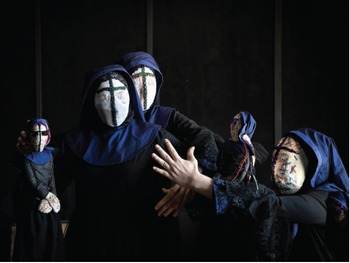
Bernarda Alba’s daughters in a dispute. The House of Bernarda Alba, directed by Zahra Sabri. Tehran, 2010. (Photo by Arghavan Arabsorkhi; courtesy of Zahra Sabri)

Sabri’s puppetry subtly blurs the line between puppet and puppeteer, as well as the distinctions among the puppets themselves. Her dramaturgy draws parallels between the actors and the puppets they animate. In The House of Bernarda Alba, the puppets and puppeteers are dressed identically, in black and grey habits, white gloves, and masks that cover their faces, upon which are embroidered crosses and scars (fig. 4). Elsewhere I have written on the significance of these images for Iranians experiencing Lorca’s text (2013). In Sabri’s Bernarda Alba, one of Lorca’s characters suddenly changes from being embodied by a puppet to being embodied by a human actor. In a climactic scene, Poncia, the family’s maid, confronts Adela, Bernarda’s youngest daughter, about her sexual indiscretions. At first, both Poncia and Adela are puppets, but when Poncia’s accusations reach a fever pitch, the Adela-puppeteer drops the Adela-puppet, crosses the stage as Adela, and snatches the Poncia-puppet from its puppeteer’s hands, hissing, “Mind your own business!” The scene continues, with human actors playing Adela and Poncia, and the actor playing Adela cradling the Poncia-puppet as if it were simply a precious doll. During another moment Angustias, the eldest daughter, is embodied by both an actor and puppet simultaneously, as the character stares into a mirror and puts on makeup (fig. 5).
The human and puppet Angustias sharing a mirror. The House of Bernarda Alba, directed by Zahra Sabri. Tehran, 2010. (Photo by Arghavan Arabsorkhi; courtesy of Zahra Sabri)

Importantly, Sabri’s experiments with puppetry are always rooted in her close reading of a play. She attests that mirroring actors and puppets in The House of Bernarda Alba allowed for Sabri to express the similarities between the way “religious extremism and traditionalism” hurt both Lorca’s characters and “all women.” In our interview, she explained, “I wanted to show the dangers of extremism, how it impacts all things negatively” (2016). For her production of Mother Courage, Sabri at times uses puppets to stand in for Anna Fierling’s three children, illustrating Anna’s occasional disregard for her kids and the transactional philosophy driving her character. Fierling thinks of her children as objects with material value. But even in light of Sabri’s inventive approach to puppetry, Count to One represents a radical departure from her other work in its exploration of the tensions among life, death, and materiality.
“Life Is One”
Unlike Sabri’s other work, Count to One lacks plot, character, conflict, and even language. Three soldiers refusing to engage in battle frames the production, but this consumes very little of the production’s runtime. Instead, the performance consists of distinct vignettes as the three actors/soldiers mold mounds of clay and then animate them. The vignettes themselves often lack a storyline, instead conveying meaning (or perhaps more precisely, affect) symbolically. During an early episode, one actor plays with a clay model train, spinning it in circles on a pottery wheel. As the train chugs along, the actor removes the caboose and tosses it to an actor on the opposite end of the stage, who then places it on his own spinning pottery wheel creating a second train. This pattern continues, with the first actor tossing each successive caboose to the second actor, one train shortening as the other lengthens. Meanwhile, the third actor molds a seated camel and begins spinning it around on his pottery wheel, as the ever-present recorded music begins to mimic the rattling, clacking, and whistling of an old steam engine train. This scene evokes the passage of time and its impact on transportation; it suggests today’s human reliance on machines when we once traveled on the backs of animals. It also portrays a fleeting sense of youth and playfulness, showing the soldiers who opened the performance making bomber planes now engaged with an earlier, simpler, playful time in their lives.
Many of the stories underlying the play’s other moments are easy to decipher, if still elusive in their thematic relevance. At one point, for instance, the actors mold the heads of a cow and bull, and the audience watches as another actor maneuvers a calf to indicate it is suckling at its mother’s udders. In another moment, two actors build a large clay cube, poking holes where the dots would be on a standard die. They take turns rolling the die, tossing the cube into the air and watching as it hits the ground, gradually transmogrifying into a formless lump. Later, a small clay fish nibbles food from a coral reef.
These vignettes intentionally disrupt the performance’s framing narrative of war. This disjunction juxtaposes themes of death and destruction with the simple beauties of quotidian life. Sabri explains that although Count to One is inspired by Omar Khayyam, the 11th-century Persian poet and polymath, the vignettes themselves are not in Khayyam’s poetry:
I didn’t want to work in a way where one poem inspires the train scene, or one poem inspires the cow scene. When you read the poetry of Khayyam, you realize that the pieces are all similar to one another, they relate to each other, and that in total, they’re about life and living in the moment, about not wasting one’s existence. So I decided instead to take it as a whole, the poetry of Khayyam and his message, and create moments that were inspired by them […]. For me, it’s about living and dying and the small portion of time in which we exist on this Earth. (Sabri Reference Sabri2020)
In one scene, we follow the journey of a single woman as she goes through various stages of pregnancy, labor, and motherhood. The puppet-mother starts as a large clay head, resting on the cupped hand of her puppeteer, which is rounded to signify her enlarged belly. The puppeteer-mother spins a pottery wheel (on which rests a clay sun and moon), showing the passage of time as the baby inside her gestates. The puppet-mother lies face-up on the pottery wheel, the music crescendos and the mother’s puppeteer removes his cupped hand to reveal a newborn clay baby. Another actor holds the baby up by its legs and taps it a few times, acting as the attending doctor, before handing the child to its puppet-mother. The mother — now endowed with a full clay body — cradles her baby and nurses it. As the scene continues, the puppet-baby learns to crawl and stand upright. Then, in a coup de théâtre, one puppeteer slowly presses downward on each of the mother’s breasts, slicing off pieces of clay from the mother’s body as if peeling a cucumber. These pieces are then added to the baby’s clay body, as a second puppeteer molds the child into a growing boy. The mother loses more of herself, grows older, thinner, frailer, as the child develops into a tall, capable man. In the scene’s final moment, the elderly mother rests her head on her son’s shoulder as he comforts her in her dying moments (fig. 6).
A mother giving her flesh to her child. Count to One by Zahra Sabri. Tehran, 2012. (Photo by Siamak Zomorodi; courtesy of Zahra Sabri)

Sabri’s directing not only stages the copresence of the puppeteer and the puppet, but also the puppets with each other. The double focus on both the performer and the puppet that Piris points out is multiplied in Sabri’s work. The dramaturgy of her directing transparently layers the performer and the puppet, one puppet with another puppet, as the inanimate becomes animate. The vignette with mother and child highlights the tangible and intangible labors of motherhood. The mother gives flesh to her child, sacrifices her body, her autonomy, and her health so that the child can grow and prosper. The moment also connects the play to a central theme in Khayyam’s work, of the cyclical quality of life and nature.
Death finds us soiled, though we were pure at birth,
With grief we go, although we came with mirth;
Watered with tears, and burned with fires of woe,
And, casting life to winds, we rest in earth! (2012:90, quatrain 354)
This quatrain expresses recurring motifs in Khayyam’s poetry: death, joy, and humanity’s relationship with earth and soil, clay and pottery. In Farsi, the word “گل” is a homograph that can be pronounced as either “gel” or “gol.” The word گل appears often in Khayyam’s writing, at times meaning “flower” or “blossom” (gol), and other times conveying “mud,” “clay,” or “silt” (gel). Loving wordplay, Khayyam invokes this word’s many meanings while simultaneously gesturing toward the Qur’anic idea that man is made from clay (in Arabic, صلصال). The word clay is used 19 times throughout the Qur’an, often as a way of narrating the materiality of humanity:
وَلَقَدْ خَلَقْنَا الْإِنْسَانَ مِنْ صَلْصَالٍ مِنْ حَمَإٍ مَسْنُونٍ
And We did certainly create man out of clay, black mud transformed. (15:26)
For Khayyam, clay also plays a major role in the poet’s favorite pastime — drinking wine. He writes of the clay cups and jugs that hold that magical elixir, relating notions of life, death, and human materiality to these goblets of wine. In two separate quatrains, he waxes:
When Death shall tread me down upon the plain,
And pluck my feathers, and my life-blood drain,
Then mould me to a cup, and fill with wine,
Haply its scent will make me breathe again. (2012:99, quatrain 330)
[…]
O Love! before you pass death’s portal through,
And potters make their jugs of me and you,
Pour from this jug some wine, of headache void,
And fill your cup, and fill my goblet too! (2012:258, quatrain 468)
As the crafter of these cups, jugs, and goblets, the potter holds great power in Khayyam’s world. In fact, as molder of human materiality, the potter takes on a godlike quality. In one of his most famous quatrains, Khayyam relates:
To a pottery I went by chance
Two thousand pots I saw in a glance
Cried out a pot awakened from trance
“whither potter, vendor, and buyer prance?” (1998:6)
Here, Khayyam insinuates the similarity between people and the pots they make.
This thinking is central to the conceit of Count to One, particularly in Sabri’s use of clay and pottery wheels. Her metaphor functions on several levels. In a literal sense, the clay (or mud) is the soil of the battle trenches so saturated with rain and blood that it becomes pliable. Digging deeper, the clay represents the materiality of humanity, which Sabri deftly links to the work of puppet-makers and puppeteers. Returning to the words of Basil Jones, “Every second onstage is a second in which the puppet could die.” Count to One is in fact a relentless cycle of puppet creation and destruction, of living and dying. The carefully crafted clay puppets are brought to life and then, as they are destroyed, they become raw material for new lives, new stories.
Tying this cycle to her framing device of soldiers in battle, Sabri softens and then demolishes the barrier between humans and mud, puppets and puppeteers. Clay becomes both the material for puppet (and human) creation, as well as the mud of war, the site of human decomposition, corporeal decay, and the transformation of organic matter. As John Bell asserts:
The essence of puppet, mask, and object performance […] is not mastery of the material world but a constant negotiation back and forth with it. Puppet performance reveals to us that the results of those negotiations are not at all preordained and that human superiority over the material world is not something to count on, especially since we all eventually end up as lifeless objects. (2014:50)
Khayyam expresses a similar sentiment:
We are the puppets and fate the puppeteer
This is not a metaphor, but a truth sincere
On this stage, fate for some time our moves steer
Into the chest of non-existence, one by one disappear. (1998:6)
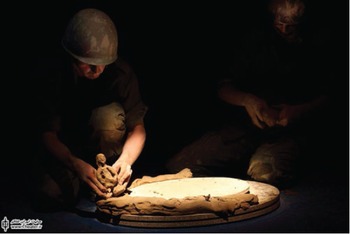
Despite Sabri’s claim that no quatrain directly inspired a particular vignette, this one correlates with one of the last stories in Count to One. On a single pottery wheel with half its circumference formed into a clay path, a small humanoid puppet slowly walks. Reaching the end of the path, the puppet looks into the abyss below and then falls forward, toppling over the edge of the clay path onto the bare pottery wheel. An actor quickly molds that puppet into a continuation of the walkway while another puppet ventures along the same path and also falls forward (fig. 7). By repeating this action again and again, Sabri shows death as part of the process of existence.
A clay puppet walking along a clay path. Count to One by Zahra Sabri. Tehran, 2012. (Photo by Siamak Zomorodi; courtesy of Zahra Sabri)

Sabri’s three actors are dressed in mud-caked military fatigues, helmets, and combat boots. The soldiers’ costumes lack any distinctive flags, badges, medals, or other adornments that might suggest a particular nation or specific war. In one sense, this depoliticizes Count to One. On another level, however, it imbues the play with limitless political readings, allowing these actors to function as metonyms for any soldiers who might be conjured in the audience’s imagination. This intended universality is not only woven into the literal fabric and silence of the soldiers, but also their molding of clay. Sabri sees working the clay as a way to speak to many different audiences. “I don’t think there is anyone in the world who hasn’t played with gel, whether it be in the form of clay or mud or what have you” (2020).
Although Sabri’s representation of death and materiality sees living as an endless recycling, challenging a distinctly morbid view of the afterlife, Count to One does not conclude that living is unimportant. Rather, the performance demonstrates the complexity and beauty of life, its preciousness and ephemerality. Explaining her reasoning for the title of the piece, Sabri says:
When you’re in a competition or something, people count to three, like “one, two, three, go,” and once you get to three, the event starts. But life is so short that you don’t even get the opportunity to count to three. By the time you’ve counted to one, life is already over. Life is now, life is one, it’s so brief. By the time you start life, you’re almost finished with it. (2020)
When her three soldiers decide to disobey their superior’s command, not only are they saving the lives of people who would have otherwise been bombed, but they are choosing to create life and beauty — instead of waging war — for the remainder of their time onstage, that is, the rest of their lives. In the play’s final moments, the actors construct a tree on the center pottery wheel, replete with birds who fly back and forth to feed the chicks in their nest. Three soldier-puppets walk onto the pottery wheel, mirroring the image of the puppeteers who breathe life into them. The soldier-puppets look at the tree and its boughs, the birds nesting in it; they look at the world around them, and finally lay down, resting upon the tree’s trunk, shaded beneath its branches (fig. 8). As the lights go down, the three actors do the same; they lay down and rest on the stage floor.
Clay versions of the army puppeteers finding solace under a tree. Count to One by Zahra Sabri. Tehran, 2012. (Photo by Siamak Zomorodi; courtesy of Zahra Sabri)

Performative Ambiguity and War’s Materiality
In the years since its critically acclaimed premiere in Tehran in 2012, a wide variety of audiences have seen Count to One. Sabri, whose work had already been internationally acclaimed prior to Count to One, made this piece wordless so that it could communicate globally. She was successful: Count to One has played at venues and festivals in Germany, France, Poland, Russia, Portugal, Monaco, Italy, Japan, and Sweden. Arrangements were made for Count to One to be featured in the 2019 Chicago International Puppet Theater Festival, which would have marked Sabri’s US debut. But the organizers were discouraged by the extreme legal difficulties of bringing Iranian artists to the United States, the feasibility of which was only exacerbated by President Donald Trump’s anti-Iranian visa policies. Now a decade after the play was originally performed, its themes are all the more relevant to audiences primed to view Iran through a lens of war. Sabri’s dream of a US tour evidences her desire for Count to One to impact global audiences today.
Even though the antiwar ideas underlying Count to One appear to be fairly straightforward, the work is polysemic, performatively ambiguous. Ambiguity has deep roots within Iranian culture. Seeger A. Bonebakker explains that Iranian narratives have long relied upon what 12th-century poet and philologist Rashid al-Din Vatvat termed ihām, or a specific type of wordplay in which a single word can have multiple meanings (related in part to amphibology). In this tradition, one meaning is obvious (qarib) and the other is hidden, taking the reader’s effort to uncover (gharib) (see Bonebakker Reference Bonebakker1966). The beloved Iranian poet Hafez took ihām to a new level, creating several layers of meaning in his linguistically ambiguous romantic poems. These poems have inspired generations of Iranian artists working in different media. For some, ihām is an act of rebellion and subversion, as artists, navigating censorship and other limitations on free speech, speak to power through the safety of ambiguity. For others, as Shamsur Rahman Faruqi explains, ihām is simply part of “the pleasure of poetry” (1997). In both iterations, however, ihām acts as “a means for ‘meaning-creation’” (Faruqi 2020).
Sabri’s personal brand of performative ambiguity is woven throughout Count to One. Building on Khayyam’s ihām in his invocation of gel/gol and clay, Sabri melds the worlds of pottery, puppetry, and war, conjuring for audiences a profound connection between the material composition of human life/death and the process of artistic creation. However, not only is the play’s framing device steeped in ambiguity, so is its narration. Sabri explains her rationale for not using spoken language: “One of the reasons I didn’t want any dialogue was so that the audience’s focus would be on what is being created and the story of these three soldiers. I think the images we created were very expressive and coherent, and there was no need for any dialogue to be brought into the piece” (2020). What her explanation omits is how the choice to stage the piece without words not only makes it available to international audiences, but provides an additional layer of performative ambiguity. Footnote 9
For Iranian theatregoers, the play’s wartime imagery would likely evoke the Iran-Iraq War. Although this war ended in 1988, its legacy and cultural trauma live on in Iran. The devastating war, which officially began with the Iraqi invasion in September 1980, started only a year after the birth of the post-Shah Iranian nation, before the nation had built a military force, much less a stable form of government. The impact of the eight-year conflict on the psyche of the nascent Iranian state has evolved into a national mythos that glorifies personal sacrifice, ordaining the Iranian government with a spiritual authority confirmed by the blessing of God. The war, which is commonly referred to in Iran as the Defah-eh Moghades (The Sacred Defense), killed over a half million Iranians, including at least 100 thousand civilians. Over the duration of the war, death was commonplace, mourning a daily ritual. Roxanne Varzi paints a stark portrait of the physical and emotional toll the Iran-Iraq War took on the Iranian people, as well as the religious/government ideology that made it possible for Iran to survive:
[…I]n the world of Islam, the state comes first; the state is the family, it is namus. At the beginning of the Iran-Iraq war, during the weekly Friday prayer services, teenagers were encouraged to ask their parents’ permission to go to the front. Mothers were congratulated for giving up their sons, while families were consoled for their losses. (2006:66)
The memory of the Iran-Iraq War is embedded within Tehran’s infrastructure and architecture, where streets are named for fallen soldiers and buildings are adorned with elaborate murals of Iranian martyrs. Varzi explains:
The idea of martyrdom came to represent and conflate the ultimate union of citizen and nation, lover and beloved, and servant of God and God. Martyrdom became state policy. Toward the end of the war, street names were changed to those of young martyrs so often that even the post office was lost. (2006:47)
The Iranian state’s memorialization of the war and its martyrs is a constant reminder of the Defah-eh Moghades, of the toll the war took on the Iranian people. The war “speaks memory” in the enduring trauma of civilians, in the national ethos of martyrdom, and in the teātr-e arzeshi (literally “theatre of values”). Marjan Moosavi writes of this genre, which grew out of the basiji (Revolutionary Guards) artists of the 1980s who “began to envisage a ‘sublime’ (fākher) aesthetics for their theatre making under an agenda of ‘sacred defense’ culture,” fusing Persian performance traditions with war narratives, folklore, and religion (2018:237).Footnote 10 These basiji artists, like the arzeshi style of theatre they initiated, were unwavering champions of the revolutionary government, and the Iranian government in turn gave teātr-e arzeshi its full support. However, this theatre’s complicity in state violence and propaganda prompted the emergence of new dramatic counternarratives, which Moosavi characterizes as “interventionist anti-war theatre.” She explains that this new genre “targets the same sources of power to give visibility to the existential questions, ethical doubts, and value crises that had become endemic in the post-war society of Iran” (2018:237). Both teātr-e arzeshi and the responding interventionist theatre are remains of the Iran-Iraq War, flesh created anew from the decomposed flesh of war.
Count to One is a descendent of this antiwar theatrical tradition in the way it demonstrates materiality-ephemerality, destruction-creation. The performance hinges on the gel that metonymically functions as clay, mud, and flesh — its de/re/construction. The objects/puppets persist even as they disappear as their material is used to make new objects/puppets. These creations are haunted by the ghosts embedded in their clay. They linger in the memories of the spectators.
Theorists of trauma generally concur that trauma cannot be cured; its impact on one’s everyday life might fade over time, but the trauma is forever written into one’s body. Alison Landsberg visualizes this corporeal scripting of trauma as “prosthetic memory” worn on the body like a limb. “Prosthetic memories thus become part of one’s personal archive of experience, informing one’s subjectivity as well as one’s relationship to the present and future tenses” (2004:26). Similarly, Iranian spectators watching Count to One in 2012 entered the performance informed by the lingering, ever-present trauma from the Iran-Iraq War, a war they might have experienced firsthand, encountered in national discourse and art, relived through monuments cemented into the edifices of the city, and/or heard about through stories passed down by those who had lived through the war. By refusing to explicitly connect the soldiers in her play to the Iran-Iraq War, Sabri also gives her Iranian audiences the space to imagine the horrific potential for its recurrence. Advocating broadly for a politics of peace and creation, Count to One challenges the militarist-martyrist factions of Iranian society, simultaneously communicating a simple universal message against the idea of war. Sabri’s performative ambiguity navigates both Iranian authorities keen on keeping anti-state messages out of the theatre and away from an Iranian public who may be invested in challenging the state.
Had Count to One been able to travel to the United States (or should it have the opportunity to do so in the future), one would expect wholly different readings. Ongoing war and militarism are fundamental to the US; its wars take many forms. Even without the explicit use of military weapons, the US is currently engaged in an ongoing war with Iran, using America’s economic prowess and debilitating sanctions to literally starve the Iranian people, fomenting political instability with the hopes of forcing a regime change. The change from Trump to Biden has done little to reduce America’s relentless attack on the Iranian people. Footnote 11 For US audiences, Count to One would not only critique this militarism, but also humanize Iranians in American eyes. As a piece directed and performed by Iranians, filled with Persian music and imagery, and inspired by Khayyam’s poetry, the play could highlight the worth of Iranian lives for an American public primed to view these people as violent and disposable. Count to One could advocate for Iranian life and culture while encouraging audiences to imagine their own future beyond war.
Returning to the notion of ihām and performative ambiguity, one can trace the various ways that Sabri saturates Count to One with potential meaning through a reliance on calculated obfuscation and the interpretive authority of her audiences. Although Sabri is quick to insist that Count to One’s politics are committed to questioning war everywhere and at any time, that her soldiers are stateless and timeless, this approach ultimately imbues the piece with a multitude of specific readings. The task of finding meaning is handed to the spectators. Each spectator goes through cycles of love and loss, finding enchantment and investment in the characters and puppets, only to witness the ease with which they are destroyed and then crafted anew.
In his review of Count to One, the prominent Iranian theatre critic Reza Ashofteh writes about the final image of the soldiers lying beneath the tree:
Of course, this is only one image, and it can have many different interpretations, but it brings to mind the question: after all of their trials and errors, creating and destroying these clay puppets, why do these men stop and — like the puppets themselves — rest under this big tree, conveying this sense of magic and immortality? The feeling is endless and eternal, it seeks out peace and tranquility. It makes you wish that you could leave your seat and find this idealistic tree somewhere in your own life and, for a few moments, sleep beneath its branches! (2012)
And, after all, if humans are clay, then there is no limit to what we might mold ourselves into.