Why do developing country governments bring trade disputes to the World Trade Organization (WTO)? Previous work on this question considers a range of factors, including the role of firms’ lobbying efforts, the quality of their legal claims, the distribution of benefits to a dispute, and the government's past experience as either a litigant or a defendant before the WTO.Footnote 1 The potential role of financial conditions in the suing country in shaping WTO dispute behavior is largely missing from this literature, which is notable because arguments about the primacy of those financial conditions are often made in the broader literature on trade policy-making.Footnote 2 We argue that those financial conditions are, in fact, linked to patterns of dispute initiations. More specifically, WTO disputes function (in part) as compensation to exporters for the maintenance of overvalued real effective exchange rates (REERs).
The REER indicates the exchange-rate-adjusted value of goods produced in one country relative to comparable goods produced in that country's trading partner.Footnote 3 REERs feature centrally in a country's trading environment. Overvalued REERs indicate that domestic goods are too expensive, prompting foreign and domestic consumers to switch consumption to foreign goods; undervalued REERs do the opposite. Overvalued REERs can undermine the competitiveness of trade-exposed firms and, over time, can threaten the balance of payments and growth.Footnote 4 Sustained periods of REER overvaluation are common among developing countries, often because nominal exchange rate rigidities—the result of a fear of floatingFootnote 5 —force REER adjustments to occur not through demand-driven changes in the nominal exchange rate, but through the typically much slower process of downward adjustment in domestic prices.Footnote 6 De facto exchange rate rigidity is by no means the sole cause of sustained REER overvaluation in developing countries—overvalued REERs can come as a consequence of commodity export surges, for example—but it is an important one.Footnote 7 As Henry puts it, “in theory, a fixed nominal exchange rate need not translate into a real overvaluation, but with rare exceptions that is the reality.”Footnote 8
Sustained periods of REER overvaluation come with political and economic costs, and governments often manage those costs using trade policies. The trade policy responses that the literature has identified with REER overvaluation are overwhelmingly trade restrictive. For example, the competitive disadvantage that overvalued REERs create for import-competing firms can be at least partially offset by protective tariffs and other import restrictions. Broz and Werfel have made this case most recently in their study of American antidumping duties.Footnote 9 As Irwin has noted in reference to President Richard Nixon's 1971 10 percent import surcharge, broadly applied tariffs can be used during times of REER overvaluation to help protect the balance of payments.Footnote 10
The literature has identified how the interests of import competitors and macroeconomic considerations shape the trade politics that emerge from periods of REER overvaluation, but it largely omits exporter interests.Footnote 11 Exporters are also hurt by REER overvaluation—they represent an important and frequently organized constituency, and neither tariffs nor antidumping measures are helpful to them and both are often counterproductive. A complete account of the trade politics associated with REER overvaluation should consider whether and in what ways governments enact trade-promotion policies to serve exporter interests.
We look to patterns in trade dispute filings at the WTO for evidence that developing country governments enact (at least some) exporter-friendly trade policies during times of sustained REER overvaluation. Our focus on trade disputes is not to suggest that they are the only or even the most important way that governments could use trade policy to mollify exporters. Trade disputes are an important and easily observable means through which they might do so. Successful trade disputes help exporters by dismantling foreign trade barriers. Whether successful or not, filing disputes allows governments to signal their political support to exporters in a way that is visible, unambiguous, and WTO-compliant. In that sense, WTO suits may give governments the opportunity to offer exporters a trade policy consolation prize that is analogous to the provision of antidumping duties to import-competing firms during times of REER overvaluation, a dynamic identified by several authors.Footnote 12
Analyzing data from a sample of up to 103 developing countries between 1994 and 2004, we find considerable support for our theory. Developing country governments bring more suits to the WTO under a combination of an overvalued REER and nominal exchange rate rigidity. The results are robust to various measurements of REER overvaluation; to various model specifications; and to the inclusion of statistical controls for common alternative explanations, including the size of a country's trading sector, electoral cycles, and past experience as a WTO litigant. These results hold when the sample is limited to manage exchange rate regimes, and when we interact the exchange rate regime with REER overvaluation directly.
We also explore which countries are most likely to react to REER overvaluation by initiating trade disputes. Our theory suggests that governments should use trade disputes as compensation for REER overvaluation more often when the more direct form of relief—adjustment of the REER through nominal exchange rate devaluation—is less desirable. While the costs of nominal devaluation in developing countries are driven by multiple factors, a substantial and relatively observable portion of those costs is driven by the fact that nominal exchange rate devaluations increase the real cost of servicing foreign currency debts.Footnote 13 The debt-driven need to prioritize nominal exchange rate rigidity should prolong periods of REER overvaluation, which, in turn, should incentivize exporters to demand and governments to supply compensatory policies such as trade disputes. Thus, the empirical association between REER overvaluation and trade disputes should be most pronounced among developing countries with substantial foreign currency debts. We find some empirical support for this proposition, although these findings are more sensitive than our main findings to how we operationalize REER overvaluation.
This article expands our understanding of the drivers of WTO dispute initiation among developing countries, adding to an already substantial and important literature in international political economy. Developing countries’ participation in the WTO dispute settlement system is often considered key to an international trading regime that serves the interests of global free trade rather than reifies preexisting power structures.Footnote 14 We show that the macro-financial environment is a substantially important driver of developing country governments’ decisions to bring trade disputes to the WTO.
This article also addresses the WTO's role in fostering and sustaining a liberal trade regime. Our findings suggest that the WTO rechannels the same domestic political demands from trade-exposed firms that otherwise drive protectionist trade policies into behaviors that help enforce a liberal global trading order. The WTO contributes to a liberal global trading order in this case by expanding a government's policy options to allow governments to use liberal trade policies in support of disadvantaged industries, which is different from the traditionally understood roles of international institutions, such as screening or constraining governments.Footnote 15
Finally, our argument adds to the existing literature on the relationship between trade and exchange rate policies. In contrast to Copelovitch and Pevehouse, who argue that constrained trade policies promote active exchange rate management,Footnote 16 we argue that constraints on monetary policy-making promote active trade policy. Jointly, these results underscore the tight connection between finance and trade and emphasize the importance of viewing financial and trade policy instruments holistically, rather than in isolation. By emphasizing how financial conditions can spur a country's involvement in international institutions, our findings also add to recent arguments that stress the importance of government financing needs for government behavior, such as participation in bilateral investment treaties or the establishment of independent central banks.Footnote 17
Real Effective Exchange Rates and Trade Disputes
The REER captures the relative value of like goods, adjusted for nominal exchange rates, between a country and its trading partners.Footnote 18 Purchasing power parity theory (PPP) suggests that the REER should move toward an equilibrium in which the exchange-rate-adjusted prices of identical goods are identical, regardless of where they are produced.Footnote 19 The farther away the REER is from this equilibrium, the greater should be the pressure to restore equilibrium through changes in the nominal prices of either goods or currencies. For example, consider a scenario in which a PPP equilibrium is disrupted by a positive shock to productivity in country A that increases the relative price of like goods produced in country B. In the absence of an immediate correction to the nominal exchange rate, this will create an overvalued REER in country B and an undervalued REER in country A. In principle, demand for the now relatively more expensive goods produced in country B should fall. If exchange rates are flexible the shift in demand in goods would shift nominal exchange rates to the point where an equilibrium is restored. However, where governments interfere with this external adjustment process, the REER has to return to equilibrium through internal price adjustments. Internal prices—and in particular wages—are much stickier than currency prices, which makes bringing the REER into equilibrium through internal adjustment a typically slower process. The result is that nominal exchange rate rigidity causes the REER in country B to remain overvalued for a longer period of time.Footnote 20
There are good reasons for governments to prioritize nominal exchange rate stability over a speedier return to REER equilibrium. Doing so facilitates international banking,Footnote 21 stabilizes inflationary expectations,Footnote 22 may prevent exchange rate overshooting during crises,Footnote 23 and prevents adverse balance-sheet effects among foreign currency borrowers.Footnote 24 These are all especially important for developing countries, the vast majority of which employ de facto managed exchange rates regimes.Footnote 25 However, prioritizing nominal exchange rate stability over REER corrections can come at a substantial economic and political cost.Footnote 26 Persistently overvalued REERs imply a loss of trade competitiveness, which hurts typically powerful interest groups in trade-exposed sectors of the economy and, in the long run, threatens macroeconomic health. Not surprisingly, then, governments that do maintain nominal exchange rate rigidity in the face of persistently overvalued REERs have frequently turned to trade policies as a way of addressing the political and macroeconomic consequences of REER overvaluation. For example, substantial, across-the-board tariff increases have been used to slow or reverse the balance-of-payments problems that overvalued REERs create. Notable and well-documented examples include the British government reacting to the 1964 Sterling crisis with a 15 percent tariff increase, and President Nixon installing an across-the-board tariff in 1971 following a REER overvaluation-induced deterioration of the US balance of payments.Footnote 27 Sectoral trade policies similarly have been used to alleviate some of the political, if not macroeconomic, pressure associated with REER overvaluation. Oatley, Knetter and Prusa, and Broz and Werfel all identify REER overvaluation as a driver of antidumping duties, intended to shield import-competing firms from foreign competition, while also providing governments an opportunity to signal their concern for an important constituency.Footnote 28
The trade policy responses that the extant literature associates with REER overvaluation tend to be protectionist. It is likely that, on balance, trade policy does tend to become more protectionist during times of REER overvaluation. But the nearly exclusive extent to which the literature focuses on trade-restricting policy responses may provide an incomplete view. Exporters are also hurt by REER overvaluation. Moreover, the exporters that are most hurt by REER overvaluation—those in industries with high exchange rate pass-through—include the primary sector firms that typically dominate export volumes in developing countries. Neither tariffs nor antidumping measures help exporters, and both are counterproductive to the extent that they invite retaliatory action from trading partners. Moreover, when tariffs improve a country's balance of payments, they put additional pressure on the exchange rate, reinforcing the existing overvaluation of the REER and hurting exporting firms even further.Footnote 29
To the extent that these exporters have political clout—and there is ample evidence to suggest they do—REER overvaluations should prompt governments to provide them with some form of trade policy compensation, just as they do for import competing industries.Footnote 30 One form that this exporter consolation prize could take is to challenge foreign trade barriers on behalf of exporters by filing cases at the WTO. From the exporting firm's perspective, trade disputes offer the possibility of material benefit in the form of expanded export revenues. Disputes can be filed quickly and in a large number of cases are settled within reasonably short time spans. According to data collected by Horn, Johannesson, and Mavroidis, the median length of time it takes for a case at the WTO to advance through the consultation and panel stages is roughly one-and-a-half years, and somewhat less when the complainant is a developing country.Footnote 31 The consultation stage, on average, takes about four months. Additionally, many disputes are settled prior to a panel ruling and within a matter of months.Footnote 32 Although far from instantaneous, the WTO dispute settlement process typically plays out over a time span that is shorter than commonly observed periods of currency overvaluation.
From the government's perspective, the benefits of trade disputes are that they are public and widely observable acts that demonstrate that the government is doing something to aid exporters.Footnote 33 Although the material benefits may take time to arrive to exporters (if they arrive at all), the political benefits are likely to accrue to governments instantaneously. To the extent that these actions are observed widely, challenging foreign trade barriers during times of REER overvaluation may help deflect culpability for any resulting trade imbalances onto foreign governments and their policies. As an illustration of this possibility, the Australian trade minister, John Dawkins, remarked at a 1986 conference of agricultural exporters that these countries were “suffering reduced export receipts [and] severe balance of payments difficulties” as the result of “the protectionist, subsidizing policies of major industrialized nations.”Footnote 34 Several conference participants, including Argentina, Brazil, Mexico, and Chile, initiated disputes against the United States and the European Communities over agricultural issues over the following three years.
Of course, trade disputes are, in many ways, a policy response that is less efficient than a nominal exchange rate adjustment. Why reach for trade disputes nonetheless? One attractive feature of trade disputes is that they benefit select, targeted firms and sectors, which can help governments score points with core constituencies. Moreover, filing a WTO suit is, of course, WTO compliant, while alternative forms of targetable export promotion may not be. The initiation of a WTO dispute also implies fewer macroeconomic disruptions than an exchange rate adjustment, which can accelerate price inflation and dampen consumption.Footnote 35 Finally, and most importantly for developing countries, a nominal exchange rate adjustment can increase the effective debt burden where debt is denominated in foreign currencies.
Additionally, winning a trade dispute may catalyze export receipts, which is especially helpful for countries whose overvalued real exchange rates have led to trade deficits and diminished foreign exchange reserves. Indeed, Brook notes that developing countries’ exports are “the key to the solution [to balance-of-payments problems]”—and a successful WTO suit, by expanding export revenue, could help on the margins.Footnote 36 WTO suits could not meaningfully affect macroeconomic imbalances by themselves: for all but the most exceptional cases, the scope of WTO cases is far too narrow. Yet, exceptional cases exist. Davis and Bermeo note that Ecuador rushed its accession to the WTO to file a dispute against the European Union on banana exports, which at the time accounted for almost a third of Ecuador's exports.Footnote 37 It is possible that in some cases, WTO suits act as an adjunct to other policies—such as broad-based tariffs, or proactively seeking foreign direct investment (FDI)Footnote 38 —that are aimed at maintaining or expanding hard currency reserves, and that might therefore be more attractive when REERs are overvalued and foreign currency reserves are in short supply.Footnote 39
To summarize, sustained periods of overvalued REERs undermine the competitiveness of trade-exposed firms and, in the long run, threaten the balance of payments and economic growth. The literature has noted that governments often use trade policies to manage some of the political and economic consequences of overvalued REERs, but that literature focuses on illiberal trade policies that do little to help exporters and can be counterproductive to their interests. We suggest that governments should also use trade policies to target benefits to exporters, and that filing more WTO suits is a plausible way to do so.
This suggests our primary hypothesis:
H1
Governments with overvalued real effective exchange rates should file more trade disputes.
Empirical Evidence
We test our hypothesis by combining information on dispute initiations by developing country governments at the WTO with indicators of exchange rate overvaluation. Our data are organized by the country-year and restricted to members of the WTO. Our sample covers 743 observations from 103 low- and middle-income countries between 1994 and 2004. In keeping with our theoretical focus, our main sample is limited to countries that operate managed exchange rates, which we identify using Levy-Yeyati and Sturzenegger's index of de facto regimes.Footnote 40 In robustness checks we expand our sample to include countries with de facto floating regimes, allowing us to model the interaction between exchange rate regimes and REER overvaluation explicitly.
Variables
Our dependent variable is the annual number of dispute initiations by a country, which we obtain from Horn and Mavroidis.Footnote 41 In our sample, the variable ranges from zero, the mode, to six, with an average .08 disputes per country-year. Our key independent variable is the extent of REER overvaluation. We consider a variety of measures of REER overvaluation, each of which is subject to its own caveats and limitations.
Our first set of models employs a measure of REER overvaluation based on exchange market pressure, EMP.Footnote 42 EMP measures quantify the observable manifestations of devaluation pressure. Because REER overvaluation typically leads to devaluation pressure, observing a high level of EMP should in most cases make a reasonable proxy of REER overvaluation.Footnote 43 EMP measures are usually a weighted sum of depreciation in the nominal exchange rate, depletion of foreign reserves, and interest-rate-based currency defenses.Footnote 44 For our purposes it makes little sense to assign weight to movement in the nominal exchange rate. While a declining nominal rate can imply REER overvaluation, it also implies that the exchange rate is actively returning to levels that exporters prefer to the status quo. Governments use WTO disputes as compensation to exporters for maintaining an overvalued REER, and a declining nominal rate is an indication that governments reached for other means to compensate exporters, obviating the need to use trade disputes. The EMP formulation that we use therefore focuses on depletion of foreign reserves and changes in the interest rate. It can be expressed as the following:
 $$EMP_{i,t} = -\alpha {\Delta} R_{i,t}/R_{i,t - 1} + (1 - \alpha) \Delta d_{i,t}/d_{i,t - 1},$$
where i denotes the country, t is the time period, R is the level of foreign reserves, d is the interest rate on deposits, and α is a weight on reserve losses that can assume a value between 0 and 1. The data on foreign reserves come from the IMF and include holdings of foreign exchange, special drawing rights, reserves held by the IMF, and gold reserves, valued in current US dollars. Data on interest rates on deposits are available from the World Bank.
We report regression results for multiple different weighting schemes, which is in keeping with ongoing debates about appropriate weighting schemes and robustness to alternative schemes.Footnote 45 We summarize the results for values of α between 0 and 1, in increments of .05. The main results that we report more fully either place full weight on changes in reserves (labeled EMP 1 in the following), or place equal weight on changes in foreign exchange reserves and interest rates (labeled EMP 2). The latter follows Li, Rajan, and Willet's suggestion of assigning equal weights given the absence of widely accepted correct weights; the former heeds Willett, Kim, and Bunyasiri's argument that the interest rate component in EMP may be an excessively noisy indicator of the underlying concept.Footnote 46 We further report results when defining interest rate changes net of changes in the US interest rate (labeled EMP 3)—US interest rates can have a significant impact on global financial conditions because they are considered the risk-free asset relative to which other investments are evaluated, and can have large implications for government policy.Footnote 47
Alternatively, one could measure the extent of REER overvaluation directly, rather than looking for its observable consequences. Rodrik suggests such a measure based on the (log) of the nominal exchange rate deflated by the gross domestic product (GDP) purchasing power parity conversion factor.Footnote 48 Using the Penn World Table (version 7.1), we compute the following:
 $${\rm lnRER}_{i,t} = {\rm ln}\left({{\rm XRAT}_{i,t} /{\rm PPP}_{i,t}} \right)$$
where XRAT i,t is the nominal exchange rate between country i’s currency and the US dollar in year t, and PPP i,t is the GDP purchasing power parity conversion factor, which measures the number of units of country i’s currency needed to buy the same amount of goods and services in the United States in year t. We follow Rodrik in regressing lnRER i,t on real GDP per capita and year-fixed effects to control for the Balassa-Samuelson effect. The difference between the predicted value from this regression and the variable lnRER i,t then represents the amount of exchange rate overvaluation; we further regress the resulting variable on a set of country fixed effects to obtain a measure that focuses on within-country differences in exchange rate.Footnote 49 (The variable is labeled PPP 1.) We also report the results of using another, similar measure of REER overvaluation that identifies exchange rate overvaluations by applying a Hodrick-Prescott filter to obtain deviations from long-term (country-specific) trends in the lnRER i,t series described earlier, resulting in our variable PPP 2.Footnote 50
Neither an EMP- nor a PPP-based measure of REER overvaluation is perfect. EMP measures are conceptually more remote than PPP-based measures, but the components are subject to less measurement error and are readily comparable across countries. PPP-based measures provide direct indicators of overvaluation, but are subject to questions about the reliability of PPP measures and their comparability across countries, and the optimal reference currency or trade-weighting scheme.Footnote 51 While both measures are imperfect, they are imperfect in very different ways. To the extent that our REER overvaluation indicators produce models that yield similar results, we can be reasonably confident that the specifics of any particular measure are not driving the correlations.
Control Variables
We include several control variables. All are lagged by one year and, unless otherwise noted, are obtained from the World Development Indicator database. First, countries with larger trading volumes should have more opportunities to initiate disputes. At the same time, countries with large trading sectors are more likely to manage their exchange rates. We therefore control for the log of the total value of a country's trade (exports plus imports). Second, we control for GDP per capita in thousands of US dollars because wealthier economies are likelier to initiate trade disputes and wealthier economies may be better able to sustain floating exchange rates. For similar reasons, we also control for logged GDP.Footnote 52 We also control for the number of a country's previous dispute initiations, which captures a country's experience with the dispute settlement body; especially among developing countries previous dispute initiations are an important driver of dispute filings and plausibly correlated with past episodes of REER overvaluation.Footnote 53
Main Results
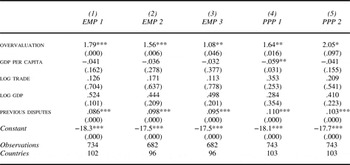
Table 1 shows the results of several models. Column (1) reports estimates of our model using an EMP-based measure for REER overvaluation, EMP 1, that focuses entirely on reserve losses (that is, α = 1). The results support our hypothesis. The positive and significant coefficient on the variable overvaluation indicates that reserve losses under managed exchange rates are associated with more trade disputes. Moving from stable reserves, which indicates an equilibrium real exchange rate, to a reserve loss of 25 percent is associated with an increase in the number of dispute initiations of more than 60 percent.Footnote 54 Moving to the sample maximum, which is a reserve loss of more than 90 percent, results in a more than fivefold increase in the number of dispute initiations.
Overvaluation and trade disputes

Notes: Dependent variable: number of trade disputes. Negative binomial regression, coefficient estimates with p-values in parentheses. Standard errors are clustered on countries. Years 1994–2004, non-OECD countries with managed exchange rates (plus Turkey and Mexico). EMP 1: reserve losses. EMP 2: reserve losses and interest rate changes. EMP 3: reserve losses and interest rate changes net of US interest rate changes. PPP 1: following Rodrik 2008. PPP 2: Hodrick-Prescott filtered exchange rate data. *p < .10; **p < .05; ***p < .01.
Column (2) reports the results of estimating the same model using an EMP measure that places equal weight on changes in reserve levels and changes in interest rates (EMP 2). The results are not meaningfully affected by this change. The model reported in column (3) uses the same definition of overvaluation as in column (2) (an EMP measure with equal weight placed on interest rates and reserves), but considers interest rate changes net of changes in the US interest rate, which are typically considered the risk-free asset to which other investments are compared. The results are robust to this modification: overvaluation is associated with more trade disputes.
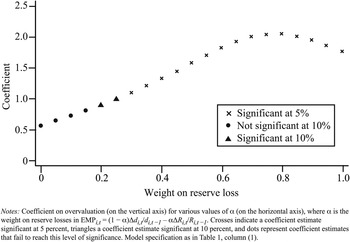
To assess the robustness of our results to any weighting scheme, Figure 1 reports the coefficient estimates on overvaluation across the range of values of α. The horizontal axis represents the weight on reserve losses, α, and the vertical axis represents the coefficient estimate on overvaluation. The crossed marker indicates a coefficient estimate significant at the 5 percent level, while dots and triangles represent coefficient estimates that fail to reach that level of significance. As the figure shows, for all values of α, the coefficient on overvaluation is positive, and for most values it is statistically significant at 5 percent. For the most part, our hypothesis fairs better—in terms of magnitude and statistical significance—the more heavily the EMP index is weighted toward reserves and away from interest rates. This result could be interpreted as providing support for Willett, Kim, and Bunyasiri's argument that the interest rate component of the EMP index is relatively noisy.Footnote 55
EMP-based measures of overvaluation

Columns (4) and (5) report results from two PPP-based measures of REER overvaluation. The model estimate reported in column (4) uses PPP 1, the measure of REER overvaluation generated following Rodrik.Footnote 56 The results suggest that REER overvaluation is associated with more trade disputes, corroborating the previous results. An increase in REER overvaluation from the mean to one standard deviation above the mean increases the number of dispute initiations by almost 30 percent. Column (5) uses PPP 2, which was derived from the Hodrick-Prescott filtered series. As column (5) shows, this measure similarly suggests that real exchange rate overvaluation is associated with more trade disputes, though the effect is statistically significant at only the .1 level.
These results provide empirical support for our main hypothesis that REER overvaluation should lead to more frequent use of the WTO dispute settlement mechanism. The effect is evident using several different measures of REER overvaluation.
Additional Results
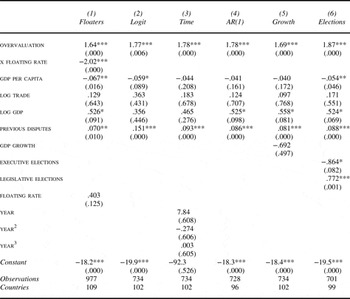
The following robustness checks all take the specification in column (1), Table 1—our preferred specification—as our baseline.Footnote 57 The results of these robustness checks are listed in Table 2. Column (1) expands the sample to include countries with flexible exchange rates, and interacts the variable denoting floating exchange rate regimes (coded 1 if floating, and 0 otherwise) with our measure for REER overvaluation. Under floating exchange rates, reversion to the equilibrium REER tends to be faster, lessening governments’ need to compensate exporters for sustained periods of REER overvaluation. Our main models assumed this dynamic by limiting the sample to countries with managed exchange rate regimes. The model reported in column (1) tests this explicitly. The results indicate that overvaluation results in trade disputes under managed exchange rate regimes, but not under floating regimes, which is what we would expect. Where the nominal exchange rate is able to adjust, governments do not respond to REER overvaluation with trade disputes.
Overvaluation and trade disputes: Robustness checks

Notes: Dependent variable: number of trade disputes (except for column (2), which uses a binary indicator). Columns (1), (3), (5), and (6): negative binomial regression. Column (2): logit. Column (4): GEE. Coefficient estimates with p-values in parentheses. Standard errors are clustered on countries. Years 1994–2004, non-OECD countries with managed exchange rates (plus Turkey and Mexico). *p < .10; **p < .05; ***p < .01.
The model reported in column (2) replaces the dependent variable—an annual count of trade disputes—with a binary indicator of whether a country initiated a dispute in the respective year. Doing so guards against the possibility that a few countries initiating a large number of disputes in a given year drove our results. We estimate this specification using a logit model. The results are robust to this modification. The model reported in column (3) replicates our baseline model, but includes a year polynomial of degree three (year, year squared, and year cubed) to account for common time trends in dispute initiations across countries. The results are robust to this specification as well. Column (4) reports the results of a model that incorporates a first-order autoregressive error process. The results remain largely the same. We also obtain similar results when estimating a Poisson model with normally distributed random effects at the country-year and at the country level to account for the panel data (not reported). A zero-inflated negative binomial regression, where the inflation equation includes log trade, GDP per capita, and an indicator if a country initiated a trade dispute in the past, also yields similar results (not reported).Footnote 58 The estimates reported in column (5) include the percentage change in GDP as an additional control variable. Changes in GDP might be associated with a country's exchange rate level as well as dispute behavior because governments may be more inclined to blame other countries through disputes for poor economic growth. Again, the results are robust to this modification. The results reported in column (6) consider electoral cycles as an omitted variable. Elections might drive both dispute initiations and, based on the Mundell-Fleming model, pressure on the nominal exchange rate during fiscal expansions. The results are robust to including indicators for years in which legislative and executive elections are held.
Changes to the Dispute Settlement Body
The previous samples were restricted to the time period after 1994, when, for a number of reasons, the relationship between overvalued REERs and trade disputes is likely to be especially strong. The transition from the General Agreement on Tariffs and Trade (GATT) to the WTO streamlined and legalized the dispute settlement process in ways that plausibly have made it easier for developing countries to successfully bring disputes.Footnote 59 This shift should have increased the appeal and incidence of governments using the dispute settlement mechanism as a means of mollifying exporter interests during times of REER overvaluation. Additionally, the 1994 transition from GATT to WTO limited access to safeguard protections meant to shield the balance of payments.Footnote 60 Such safeguards were used in more than 3,400 cases as of 1992 and were often seen as a cover for sectoral protection.Footnote 61 After 1994, countries with balance-of-payments problems—a common symptom of REER overvaluation—were denied a popular means of providing WTO compliant sectoral compensation.
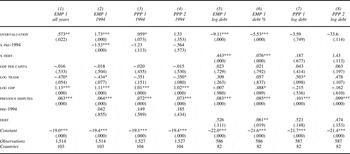
Whether primarily driven by the changes to the DSM, or the reduction in the availability of alternative, WTO-compliant forms of sectoral compensation for REER overvaluation, these facts suggest that the effects of exchange rate overvaluation on trade dispute filings should increase after 1994. To test this, column (1) in Table 3 replicates our first model from Table 1, but expands the sample to include years from 1974 through 2004. As the results show, the coefficient on overvaluation decreases in size, but retains statistical significance at the 5 percent level. Column (2) interacts the variable on reserve losses with a dummy distinguishing years prior to 1994 and after 1994. Given the variable definitions, the coefficient on overvaluation should be positive and significant, while the interaction with prior 1994 should be negative. The results support these expectations. The size of the coefficient on the interaction terms suggests that the effects of overvaluations are significantly reduced, and indeed eliminated almost entirely, prior to 1994. Columns (3) and (4) replicate column (2), but use the alternative, PPP-based measures of REER overvaluation used in columns (4) and (5) from Table 1. The estimates listed in column (3) are substantively similar to those noted in column (2). There is a statistically significant (albeit only at the .1 level) and positive relationship between REER overvaluation and WTO dispute initiation in the post-1994 period, but no evidence of such a correlation during the pre-1994 period. Our estimates fail to reach statistical significance altogether when we use the second PPP-based measure, as noted in column (4). The coefficient on both overvaluation and the interaction term have the correct sign, but neither coefficient is statistically significant.
Additional results: GATT/WTO years and foreign currency debt

Notes: Dependent variable: number of trade disputes. Negative binomial regression. Coefficient estimates with p-values in parentheses. Standard errors clustered on countries. Columns (1) to (4): years 1975–2004. Columns (5) to (8): years 1994–2004. Non-OECD countries with managed exchange rates (plus Turkey and Mexico). *p < .10; **p < .05; ***p < .01.
The Role of Foreign Currency Debt
Finally, we look at whether the relationship between REER overvaluation and dispute initiations is more evident in countries for which abandonment of the exchange rate peg would be especially harmful. Although every country in our sample operates a de facto managed exchange rate regime, exchange rate regimes can be abandoned, and the decision not to allow REER equilibration to occur externally through nominal exchange rate devaluation is still a choice. This choice is more feasible for some countries than it is for others. The less feasible the alternative of exchange rate adjustment, the more likely it is that the relevant actors will understand REER overvaluation to be a long-standing feature, and the more likely they should be to invest in alternative means of demanding and providing compensation for it.
One important deterrent to nominal exchange rate flexibility is the presence of large stocks of foreign-currency-denominated debt. Nominal exchange rate devaluations increase the cost of servicing foreign-denominated debt from revenue streams denominated in the (then relatively weaker) domestic currency. Public entities that borrow in foreign currencies but tax in local currency must increase taxation, reduce primary fiscal outlays, or draw on reserves to meet their debt repayments. Private borrowers—notably including financial institutions that borrow on international markets but lend locally—risk insolvency when their foreign-denominated debts are inflated relative to domestic-currency-denominated assets. Given the dangers of nominal devaluation in the presence of foreign currency debt, governments in countries with large foreign-currency-denominated debts often react to an overvalued REER by doing little beyond waiting for domestic prices to adjust and hoping for an exogenous change in the economic environment—falling interest rates in a country's trade partners, or a rise in the price of a country's commodity exports, for example—and drawing on foreign debt and foreign reserves to finance the current account deficit in the interim.Footnote 62 This waiting game can last a long time. Estimates vary, though Ghosh, Qureshi, and Tsangarides estimate the half-life of a REER disequilibrium under managed exchange rates at five years.Footnote 63 While governments may be able to wait out periods of REER overvaluation by financing the trade deficit out of reserves or by borrowing, delaying readjustment exacerbates discontent among actors in the tradable sector that are hurt by the loss of competitiveness.
Foreign-currency-denominated debt is widespread among most low- and middle-income countries, which are typically unable to borrow substantial amounts of money externally (and sometimes, domestically) in their domestic currency. This inability is commonly known as “original sin.”Footnote 64 Although some of the richer developing countries escaped original sin during the 1990s and 2000s by deepening domestic financial markets and successfully marketing domestic-currency-denominated debt to foreign buyers, original sin remains a substantial problem for most developing countries. Even the extent to which richer (or formerly) developing countries such as Hungary, Turkey, Brazil, or Chile have rid themselves of original sin is debatable because many continue to borrow in dollars.Footnote 65 And these countries are in any event exceptional—most low- and middle-income countries in our sample owe a substantial portion of their debt in major foreign currencies such as the US dollar, euro, or yen. If governments are more likely to turn to alternative means of compensation when maintaining the nominal exchange rate is especially important, the effect of REER overvaluation on trade dispute filings should increase in the size of a country's foreign-currency-denominated debt load.
We capture foreign currency debt by the logged value of a country's external, public, and publicly guaranteed debt stock (PPG debt) denominated in foreign currencies (available from the World Bank). External PPG debt covers all obligations of government entities and public bodies as well as all obligations of private debtors that are guaranteed by public entities. The World Bank's measure of foreign currency debt comprises debt denominated in French francs and Deutsche marks (prior to 2000), euros (after 2000), Swiss francs, Japanese yen, US dollars, British pounds, and debt denominated in multiple currencies. We assume that debt issued in these foreign currencies constitutes the vast majority of all foreign-currency-denominated debt. This is a simplification, of course, but we are unaware of any significant exceptions.
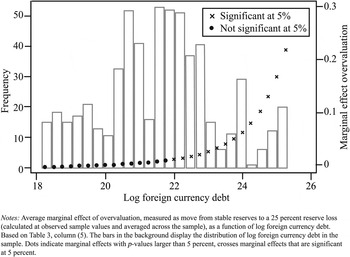
The estimates reported in column (5) of Table 3 interact our EMP-based measure for exchange rate overvaluation with the size of a country's foreign-currency-denominated debt. As expected, the interaction between debt and overvaluation is positive and statistically significant. The coefficient on overvaluation now loses a substantive interpretation, since no country in the sample has zero foreign currency liabilities. Figure 2 illustrates the marginal effect of moving from stable reserves to a 25 percent reserve loss at varying levels of foreign-currency-denominated debt. The distribution of debt in the sample is illustrated by the histogram in the background. Overvaluation has a statistically significant effect above the sample median, and the effect increases rapidly at higher levels of foreign currency debt. Moreover, the average effect of overvaluation—that is, the marginal effect calculated at observed sample values and averaged across all observations in the sample—remains positive and statistically significant: on average, moving from stable reserves to a 25 percent reserve loss increases the number of dispute initiations by about 60 percent.
Margnial effect overvaluation

Column (6) in Table 3 replaces our measure of foreign currency debt with the percentage of debt denominated in major currencies and multiple currencies. This measure has the advantage of being independent of total debt stocks, which in turn may be associated with institutional or economic factors correlated with dispute initiations. The results are consistent with the previous results: the effect of overvaluation, as measured by reserve losses, increases in foreign currency debt, and is positive and statistically significant at the largest debt levels. We obtain similar results (not reported) when using a measure of foreign currency debt provided by Cowan and colleagues who collected data on the debt composition and stock for the Americas, New Zealand, Pakistan, and South Africa.Footnote 66 These data capture foreign currency debt net of debt cross-holdings by central banks, are of better quality, and plausibly were obtained from more accurate sources.
We obtain weaker support for this conditional hypothesis when using PPP-based variables. While the coefficient on the interaction term has the expected sign, it is no longer statistically significant at the 5 or 10 percent level using a PPP-based measure of REER overvaluation (columns 7 and 8). There are several potential explanations for the conditional effect being more evident in models using the EMP-based measure than the PPP-based measure. It could be that the PPP-based measures are simply noisier measures of the underlying concept than the EMP-based measures. A more interesting possibility is that the main conditioning role of foreign debt is to heighten the relevance of the revenue-seeking motive for dispute initiation: higher levels of foreign currency debt might not heighten sensitivity to exporter interests per se, but may heighten sensitivity to any threat to the available stock of foreign exchange.
Conclusion
Governments may use the WTO dispute settlement mechanism to aid exporters when the currency is overvalued. WTO disputes serve an analogous role for exporting firms as antidumping duties play for import-competing firms. Although this theory is simple, it undermines the conventional view in the literature that REER overvaluation, especially in concert with nominal exchange rate rigidity, results in illiberal and protectionist policies.
We also emphasized how the WTO provides a liberal avenue for governments to address domestic political demands arising from international economic pressure that, in the past, could be addressed only through illiberal means such as subsidies or market restrictions. The WTO does this in a relatively decentralized and inclusive manner: although the burden to filing trade disputes is not insignificant, especially for developing countries, the WTO provides a forum that is more accessible than informal gatherings to coordinate exchange rate policies internationally. Additionally, the benefits of dismantling trade barriers through the WTO's dispute settlement system accrue not only to the country filing the trade dispute, but also to other countries with similar export profiles. In that regard, the impact of the WTO in enabling a liberal response to exchange rate imbalances is potentially more far reaching than the typical, unilateral, illiberal response of protectionist trade policies emphasized in the extant literature.
Our argument is notable in several other respects. First, we link an important literature on the original sin of foreign-currency-denominated debt to policy-making in an important and, to our knowledge, previously unexamined way.Footnote 67 Second, we provide an explanation of why and when developing country governments bring trade disputes to the WTO. Many countries have a deep bench of available cases they could file at the WTO at any given point in time yet they often refrain from doing so. While financial conditions have often been understood as an important driver of trade policies, they have largely been absent in the literature on dispute initiations.Footnote 68 Our theory provides an explanation of the timing of dispute filings, and it suggests that macroeconomic factors can explain both when disputes are filed against other governments and who is filing these disputes. This focus on conditions in the (potential) complainant's economy complements existing arguments that focus on conditions in the (potential) defendant's economy.Footnote 69
Finally, this article adds to our understanding of political reactions to and consequences of REER overvaluation and foreign-currency-denominated debt accumulation. While countries with overvalued exchange rates and large foreign currency debt loads suffer from a variety of macroeconomic disadvantages, the evidence in this study suggests that those disadvantages can catalyze them to secure a better trading environment for their exporters. In the process, these countries can build up the legal capacity and experience to help them participate in international institutions more fully in the future.Footnote 70 This has an interesting and nonobvious implication for the distribution of WTO-specific legal capacity across the developing world. Those countries that are least capable of providing a macroeconomic environment amenable to exporting firms are the most likely to defend those exporting firms at the WTO.
Supplementary Material
Supplementary material for this article is available at https://doi.org/10.1017/S0020818316000278.