




No CrossRef data available.
Article contents
Clinical- and cost-effectiveness of pegylated interferon alfa in the treatment of chronic hepatitis C: A systematic review and economic evaluation
Published online by Cambridge University Press: 02 March 2005
Abstract
Objectives: To assess the clinical-effectiveness and cost-effectiveness of pegylated interferon alfa (2a and 2b) combined with ribavirin in previously untreated patients with moderate to severe chronic hepatitis C, compared with the current standard treatment, which is nonpegylated interferon alfa combined with ribavirin.
Methods: Systematic review and economic evaluation. A sensitive search strategy was applied to several electronic bibliographic databases. Relevant studies were critically appraised and meta-analyzed. A hypothetical cohort of 1,000 patients entered a Markov model and were followed up for a more than 30-year period to predict natural history, duration spent in each health state, and treatment costs.
Results: Two fully published Phase III randomized controlled trials were included. Methodological quality was generally good. Dual therapy with pegylated interferon was significantly more effective than nonpegylated dual therapy with a pooled sustained virological response rate (SVR) of 55 percent (95 percent confidence interval [CI], 52–58 percent) compared with 46 percent (95 percent CI, 43–49 percent). The pooled relative risk of remaining infected was 0.83 (95 percent CI, 0.76–0.91 percent). Genotype was the strongest predictor of outcome, with SVRs in patients with the more responsive genotypes 2 and 3 reaching up to 80 percent. The incremental cost per quality-adjusted life year (QALY) for pegylated dual therapy compared with nonpegylated dual therapy was £12,123. The cost per QALY remained under £30,000 for most patient subgroups and in sensitivity analyses.
Conclusions: Pegylated interferon is clinically effective, represents good value for the money, and is a significant advance in the treatment of this insidious disease.
Information
- Type
- GENERAL ESSAYS
- Information
- International Journal of Technology Assessment in Health Care , Volume 21 , Issue 1 , January 2005 , pp. 47 - 54
- Copyright
- © 2005 Cambridge University Press
Chronic hepatitis C (HCV) is a slowly progressive disease of the liver caused by the hepatitis C virus. It is believed that 100–170 million people worldwide are infected, and in the United Kingdom, the prevalence is estimated at between 0.1 percent and 1 percent. Around two thirds of those infected are men. The number of people presenting with liver complications is expected to rise considerably over the coming decades.
The natural history of the disease is not completely understood, but after exposure, around 20 percent will develop acute hepatitis, some of whom will experience malaise, weakness, and anorexia. Up to 85 percent of those exposed fail to clear the virus and go on to develop chronic hepatitis (21). Disease progression is slow and variable, occurring over 20–50 years. Approximately 20–30 percent of people initially infected develop cirrhosis within 20 years (16), and 1–4 percent of these people are at high risk of hepatocellular carcinoma (6). One third may never progress to cirrhosis or will not progress for at least 50 years (16), and patients often do not become symptomatic until liver disease is advanced. Some patients with end-stage liver disease or hepatocellular carcinoma may require liver transplantation, with HCV being the major cause of transplantation in Europe and the United States.
HCV genotype, of which there are up to 11, is the most important factor predicting treatment outcome. In general, genotypes 1a, 1b, and 4 respond less favorably to treatment in comparison to other genotypes. Prevalence varies geographically with genotype 1a common in North and South America, and Australia, and 1b mostly found in Europe and Asia. Genotype 2a is common in Japan and China, 2b is prevalent in the United States and Northern Europe; genotype 3a is most common in Australia and South Asia, whereas 4 is commonly found in Egypt and central Africa. Baseline viral load also predicts treatment outcome.
Until several years ago, patients with moderate to severe chronic HCV were treated with interferon alfa monotherapy by means of subcutaneous injection approximately three times a week for 24–48 weeks, but only around 17 percent of patients achieved a sustained virological response (SVR) (12). More recently, dual therapy consisting of interferon alfa-2b (IFN) with the oral anti-viral drug ribavirin (RBV) led to response rates of 41 percent in patients not previously treated with interferon (17) and 49 percent in those who had relapsed following previous interferon treatment (5). In October 2000, the National Institute for Clinical Excellence (NICE) issued guidance to the health service in England and Wales supporting dual therapy (13;19). Since then, there has been increasing interest in a newer “pegylated” form of interferon (3).
“Pegylation” involves the addition of polyethylene glycol (PEG) molecules to the interferon alfa active molecule to delay renal clearance of the drug, thus prolonging action, and necessitating fewer doses (e.g., once instead of three times a week). Currently there are two preparations, 40-kDa (kilodaltons) pegylated interferon 2a and 12-kDa pegylated interferon alfa-2b. Although in the same class, they differ in the size and structure of their PEG molecule, and the bond between the PEG molecule and the interferon.
The question now is whether the combination of pegylated interferon and ribavirin should replace dual therapy with interferon alfa and ribavirin. However, pegylated interferon is more expensive, although this expense may be off-set by savings both in the shorter term (from the reduced frequency of injections) and in the longer term (from avoiding some of the large costs of long-term liver complications). Potential savings also may be realized through discontinuing treatment early (e.g., after 12 weeks) in patients who are not likely to experience a later, sustained response, thus reducing drug costs and sparing potential adverse effects.
The aim of this study, therefore, is to systematically assess the clinical-effectiveness and cost-effectiveness of pegylated interferon alfa as dual therapy (with ribavirin) in previously untreated patients with moderate to severe chronic HCV. The comparator is the current standard of treatment, nonpegylated interferon alfa.
METHODS
Clinical Effectiveness
A priori inclusion criteria specified the relevant patients, interventions, studies, and outcomes. We included randomized controlled trials (RCTs) published in English, evaluating the effectiveness of dual therapy (pegylated interferon alfa and ribavirin versus nonpegylated interferon alfa and ribavirin) and monotherapy (pegylated interferon alfa versus interferon alfa) on SVR in patients with moderate to chronic moderate to severe HCV infection not previously treated with interferon. SVR is defined as the absence of viral ribonucleic acid (RNA) 6 months or longer after the end of treatment and is generally used as a proxy for cure. Moderate to severe chronic HCV was defined as histological evidence of significant scarring (fibrosis) and/or significant necrotic inflammation. A secondary outcome was adverse effects associated with treatment.
We developed a sensitive search strategy and applied it to several electronic bibliographic databases (e.g., Medline; The Cochrane Library) up to March 2003. Contact was also made with experts in the field to identify relevant trials, and relevant Internet sites were searched. Documents made available by the drug manufacturers were also scrutinized for relevant studies. Inclusion criteria were applied to titles and abstracts and, where necessary, full reports were retrieved for further inspection.
Included studies underwent detailed data extraction to a standardized electronic template. Methodological quality was assessed using criteria devised by the UK NHS Centre for Reviews and Dissemination (NHS CRD) (15). Extraction and appraisal were performed by one reviewer and checked by a second, with disagreements resolved through discussion.
Both qualitative and quantitative approaches were used to synthesize the results of the RCTs. Data extraction tables were used to compile a narrative summary of the main characteristics and results of the trials. In addition, a meta-analysis was performed using Cochrane Review Manager Software (Version 4.1) using a random effects model.
Cost-Effectiveness
A state transition Markov model was devised to estimate annual costs and benefits, in terms of cost utility, from the perspective of the UK National Health Service (NHS). The model follows a hypothetical cohort of 1000 individuals with chronic moderate to severe HCV infection over a 30-year period. (The average age at diagnosis is 36 years). It aims to predict the natural history of the disease, the health states through which the cohort passes, how long they spend in each state, and the NHS costs of treating a patient in each state. The states included chronic hepatitis C, progression to cirrhosis, development of ascites, development of variceal bleeds, development of hepatic encephalopathy, progression to hepatocellular cancer, liver transplantation, and death. The comparison was dual therapy with pegylated interferon and ribavirin (PEG+RBV) versus dual therapy with interferon alfa and ribavirin (IFN+RBV), both for 48 weeks.
Disease progression over time was modeled by use of annual transition probabilities, taken from the published literature (6;21) or estimated through clinical consensus. SVRs were entered into the model from our meta-analysis except for patient subgroup analyses (e.g., genotype, baseline viral load), which were taken from the pivotal RCTs (8;11). Utility values were taken from the published studies, whereby a panel of hepatologists estimated the likely quality of life of patients using a time trade-off procedure as part of a Delphi consensus-based exercise (1;10;23–25).
To estimate resource use marginal cost principles were followed. Investigation, monitoring, and treatment costs were provided by an English NHS Hospitals Trust using 2002 values. Capital and overhead costs were not included. Drug costs were taken from the British National Formulary (Issue 44), based on recommended doses of PEG 2b (1.5 μg per kilogram per week based on an average patient weight of 79 kg); IFN 2b (3 million international units (MIU) 3 times per week) and RBV (1,200 mg per day). (NB. The two pegylated interferons cost broadly the same). To estimate uncertainty surrounding assumptions and inputs to the model, three parameters were included in a sensitivity analysis: variations in SVRs, discount rates, and drug costs.
Total discounted treatment costs were divided by the total number of quality-adjusted life years to estimate the incremental cost per QALY for the cohort. Benefits and costs were discounted at 1 percent and 6 percent, respectively. Sensitivity analyses were performed to test the robustness of the model.
RESULTS
Characteristics of Included Studies
A total of 996 possibly relevant reports were identified. After screening, a total of two fully published Phase III RCTs were included. One trial evaluated PEG IFN alfa-2a at a dose of 180 μg/wk+RBV 1,000–1,200 mg/day (n=453) against IFN alfa-2b at a dose of 3 MIU 3x/wk+RBV 1,000– 1,200 mg/day (n=444) (8). The other tested PEG IFN alfa-2b at a dose of 1.5 μg/kg per wk+RBV 800 mg/day (n=511) against IFN alfa-2b at a dose of 3 MIU 3x/wk+RBV 1,000–1,200 mg/day (n=505) (11).
Both trials excluded participants who had significant comorbidities (e.g., HIV). Patients with decompensated cirrhosis or decompensated liver disease were also generally excluded. In one trial, the average baseline viral load was over 6 million copies/ml (8), whereas in the other, it was less than 3.5 million copies/ml (11).
In both trials, treatment was given for 48 weeks with a follow-up interval of 24 weeks (final evaluation at 72 weeks from inception). The trials were similar in methodological characteristics and generally were of good quality, although reporting of methodological details could have been more thorough. Relatively high numbers of patients withdrew from treatment (approximately 20–30 percent) because of adverse effects or other reasons (e.g., voluntary withdrawal after failing to achieve a response at 12 or 24 weeks).
Clinical Effectiveness
In both trials, dual therapy with PEG+RBV was significantly more effective than dual therapy with IFN+RBV with a pooled SVR of 55 percent (95 percent confidence interval [CI], 52–58 percent) compared with 46 percent (95 percent CI, 43–49 percent) for dual therapy with IFN+RBV, and the pooled relative risk for remaining infected was 0.83 (95 percent CI, 0.76–0.91 percent). (Chi squared test for heterogeneity=1.14; df=1; p=.29.)
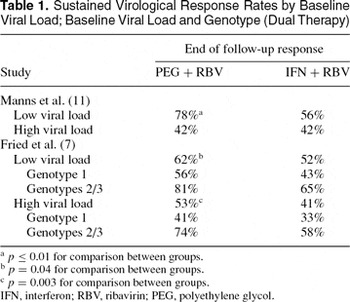
Across the genotypes patients treated with PEG+RBV had higher SVRs than those treated with IFN+RBV. Response rates for patients with the harder to treat genotype 1 were significantly higher for patients treated with PEG+RBV than those treated with IFN+RBV, in the range 42–46 percent compared with 33–36 percent, respectively. Patients with genotypes 2 and 3 generally had higher SVRs than those with genotypes 1, 4, 5, and 6. However, there were some key differences between the two trials. Whereas patients with genotypes 2 and 3 did better on PEG+RBV in the trial by Fried et al. (76 percent versus 61 percent; p<0.05), there was only a marginal difference for such patients in the trial by Manns et al., where SVRs were 82 percent and 79 percent for pegylated and nonpegylated interferon, respectively. However, in the subgroup of patients in whom ribavirin was dosed according to body weight and the dose was greater than 10.6 mg/kg (the dose considered to be optimum and upon which a European license was granted), SVRs were 88 percent and 80 percent, respectively.
Both trials reported SVRs according to baseline viral load, another key prognostic factor, stratified into low or high load ([les ]2 million copies per ml versus >2 million copies per ml, respectively) (Table 1). In both trials, patients with low baseline viral load had higher SVRs than those with higher load. Patients in the trial of Fried et al., with a high baseline viral load, were significantly more likely to have an SVR if treated with PEG+RBV than IFN+RBV (53 percent versus 41 percent, respectively, $p=0.003$). However, in the trial by Mann et al., there was no statistically significant difference in SVRs for these patients between treatments (42 percent versus 42 percent, respectively; p=0.94).

Fried et al. also reported SVRs for patients with high or low baseline viral load stratified according to genotype. Patients with a high baseline viral load and genotype 1 (i.e., harder to treat successfully) had lower SVRs than patients who also had a high baseline viral load but were infected with genotypes 2 and 3. However, these patients tended to do better on PEG+RBV than IFN+RBV (SVRs 41 percent versus 33 percent, respectively).
A separately published meta-analysis pooled early virological response (EVR) rates after 12 weeks of treatment from the PEG+RBV arms of the two dual-therapy RCTs (4). Of the 965 patients analyzed, an EVR was achieved in 778 (81 percent) (276 genotype 2/3 patients; 502 genotype 1). Of the 187 (19 percent) patents (mostly genotype 1) who failed to respond at 12 weeks, only 3 (2 percent) had an SVR. If a 12-week stopping rule had been initiated, only 3 of the 529 patients who had an SVR would have had treatment stopped prematurely, and costs would have been reduced by 16 percent. It was recommended that patients with genotype 1 without an EVR at 12 weeks should discontinue treatment and that EVR does not need to be assessed in patients with genotypes 2 or 3, who should be treated for 24 weeks as standard.
Although not a comparison of pegylated and non- pegylated interferon alfa, Hadziyannis et al. (9) reported the results of a multicenter double-blinded, factorial RCT (n=1,311) comparing different durations of pegylated interferon alfa-2a dual therapy (24 versus 48 weeks) and different doses of ribavirin (low fixed dose 800 mg per day versus standard weight based dose 1,000–1,200 mg per day). This is the first published RCT to investigate the effectiveness of treatment duration less than 48 weeks. The highest overall SVR was achieved in patients treated for 48 weeks with standard dose ribavirin, 63 percent (95 percent CI, 59–68 percent). (NB. This is a higher SVR than achieved in the corresponding arms of the pivotal RCTs). For patients with genotype 1, 48 weeks treatment was significantly more effective than 24 weeks, and standard ribavirin dose was significantly more effective than low dose. The SVR in this group was 52 percent (95 percent CI, 46–58 percent) and is higher than achieved in the dual-therapy trials reported earlier. SVRs for patients with genotypes 2 and 3 were 84 percent, 81 percent, 79 percent, and 80 percent for 24 weeks treatment with low fixed RBV dose, 24 weeks standard weight-based RBV dose, 48 weeks low fixed RBV dose and 48 weeks standard RBV dose, respectively. Genotype 2 and 3 patients, therefore, did not achieve any greater benefit from 48 weeks treatment or from a higher dose of ribavirin.
Adverse Effects
In both trials, there were a large number of possible adverse events, many of which occurred in a large proportion of patients (e.g., flu-like symptoms, psychiatric symptoms, gastrointestinal symptoms, and hematological events). Generally, the levels of adverse events were similar between regimens involving PEG and those involving IFN.
Cost-Effectiveness
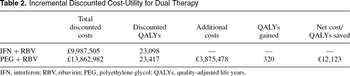
Table 2 presents incremental discounted cost-utility estimates for PEG dual therapy. The incremental cost per QALY for PEG+RBV dual therapy compared with IFN+RBV for 48 weeks was £12,123.

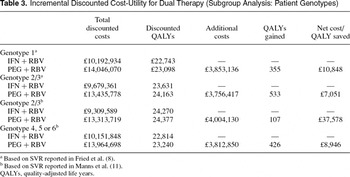
Table 3 presents cost-utility estimates for patients treated with dual therapy stratified by genotype. The most favorable estimates are for genotype 2 and 3 patients (cost per QALY, £7,051, based on the Fried et al. trial). However, when the SVR for the trial by Mann et al. is modeled, estimates for these patients are much higher (cost per QALY, £37,578). As noted earlier, in this trial there was only a marginal difference in SVRs for PEG- and IFN-treated genotype 2 and 3 patients (82 percent versus 79 percent).

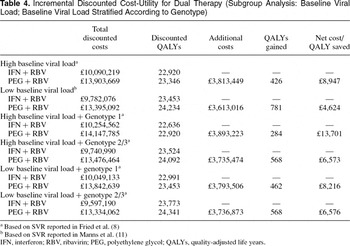
Table 4 presents cost-utility estimates for patients with high and low baseline viral load. In general, estimates were more favorable for patients with a lower baseline viral load. Predictably, patients with a high baseline viral load and genotype 1 had the highest estimates (£13,701).

Sensitivity analysis illustrated the extent to which the cost-utility estimates differed according to variations in assumptions and costs (Table 5). Estimates were most sensitive to variations in SVR (corresponding to the upper and lower ends of the confidence interval surrounding the pooled estimate in our meta-analysis). The highest estimate was £37,611 based on an SVR of 49 percent for IFN+RBV dual therapy and 52 percent for PEG+RBV (i.e., only a 3 percent difference in effectiveness between the two treatments). Changing the discount rate to 6 percent for both costs and benefits yielded an estimate of £23,357, whereas increasing drug costs by 50 percent generated an estimate of £18,517. These can all be considered worst case scenarios.

To estimate the likely cost utility of stopping treatment after 12 weeks in patients who had not achieved a viral response at that time, the pooled SVRs derived by Davis (4) reported earlier were applied to the current model. If it is assumed that the 19 percent of patients (most of whom are genotype 1) without an early viral response discontinue treatment after 12 weeks, and nothing else changes except savings in treatment costs, the total discounted costs are £11,683,203, with a cost saving of £2,188,772 (15.7 percent). Treating the 19 percent of patients who failed to respond by week 12 for the remaining 36 weeks (bearing in mind that only 2 percent of them achieve a SVR) results in total discounted costs of £14,968,965 and a total of 21,521 QALYs. When comparing this finding with that of no active treatment (total discounted costs of £2,054,290 and total QALYs 21,464), the incremental discounted cost per QALY was £226,573. These data, therefore, illustrate that excluding from dual therapy nonresponding patients after 12 weeks can lead to savings of around 16 percent, a similar figure to that quoted by Davis.
The incremental cost per QALY for 12 months PEG+RBV dual therapy based on the overall SVR of 63 percent from the Hadziyannis et al. trial was £5,450. (Note, as this trial has no nonpegylated interferon dual therapy as a comparator, we have compared it with corresponding arm from the other seminal RCT of pegylated interferon 2a (8). Although these two trials were similar in design and case mix, this approach is an indirect comparison, thus caution is advised in interpretation.) The incremental cost per QALY for 48 versus 24 weeks treatment with pegylated interferon alfa-2a dual therapy for patients with genotype 1 is in the range £15,278 to £20,429 (low fixed dose of ribavirin, and standard weight-based dose, respectively). For genotypes 2 and 3, as reported earlier, SVRs after 24 weeks treatment were higher than after 48 weeks treatment, resulting in increased costs but a loss of QALYs.
DISCUSSION
This study demonstrates that pegylated interferon as dual therapy is more clinically effective than nonpegylated interferon. Fifty-five percent of patients can be treated successfully using pegylated dual therapy, compared with only 46 percent with the previous standard treatment, nonpegylated dual therapy. (Supplemental evidence shows that the sustained viral response rate in patients treated with pegylated interferon alfa-2a dual therapy can reach as high as 63 percent (9).) SVRs can also reach as high as 82 percent in patients with genotypes 2 and 3.
Pegylated interferon can also be considered cost-effective with most estimates falling within the range considered by NHS decision-makers to represent good value for the money. Cost per QALY estimates appear to correspond with what one would expect for patients with a better prognosis (i.e., lower estimates for genotypes 2 and 3 and low baseline viral load) and for harder to treat patients (i.e., higher estimates for genotype 1 and high baseline viral load). Estimates also remained favorable even when subjected to worst case scenario assumptions in sensitivity analyses. In most cases, the cost per QALY remained under £30,000.
Our results are broadly comparable with other recent economic evaluations. Siebert et al. (20) and Buti et al. (2) both used Markov decision analytic models featuring hypothetical cohorts of patients followed up over time, using efficacy rates from the same pivotal trial of pegylated interferon alfa-2b dual therapy (11). The cost-utility estimates are slightly lower than those presented in the current study, although comparisons are necessarily constrained by differences in assumptions (e.g., discount rates) and input parameters (e.g., health care organization and costs).
Although this study was conducted in a rigorous and systematic manner, there may be some limitations. First, the natural history of HCV unfolds over several decades as the disease progresses in infected patients. Given its relatively recent identification, there are a lack of prospective long-term studies to inform cost-effectiveness analyses. We have, therefore, used a predictive model to estimate long-term cost-effectiveness, supported by the best available published data and, where necessary, clinical consensus. Second, although the included RCTs were broadly similar in terms of intervention, participants, and methodology, there were some differences. Although the two pegylated interferons are considered a class, they are nevertheless distinct compounds with different molecular structures. However, no known head to head comparisons have yet been published.
Evidence is awaited from a UK RCT on the effectiveness of anti-viral therapy (nonpegylated interferon alfa dual therapy) in patients with mild HCV, a group who generally are not eligible for treatment, but who nevertheless experience impaired quality of life (7). A previous RCT of nonpegylated interferon dual therapy reported an SVR of 54 percent in this patient group (22), and it would be reasonable to assume an even higher rate if pegylated interferon was given. If it can be demonstrated that treatment significantly improves quality of life, this could be an argument for treating all those with mild disease without necessarily the need for liver biopsy, which has traditionally been used to stage disease severity and guide treatment decisions. This strategy would reduce the costs and adverse effects associated with biopsy, although this savings would be offset by treating a much larger group of people.
CONCLUSIONS
Based on our meta-analysis, just over half of patients experience a sustained viral response to HCV when given pegylated interferon alfa dual therapy, and additional evidence shows that nearly two thirds of patients may achieve a sustained response. More patients with the harder to treat genotype 1 achieve a response with pegylated dual therapy than with nonpegylated, and patients with more responsive genotypes 2 and 3 can be treated for a shorter duration. Generally, incremental cost-utility estimates were within a range considered acceptable to health-care commissioners.
Therefore, pegylated interferon represents a significant advance in the treatment of this insidious disease, and in England and Wales at least, it is supported by the health service. Additional economic evaluation will be required to take into account emerging evidence for the effectiveness of diagnosis and treatment of mild HCV, and as well as further evidence for patients with moderate to severe disease, to support policy and practice decisions.
POLICY IMPLICATIONS
There are several implications for policy from our results. The first is that health-care commissioners are likely to face significant demand to direct resources into providing pegylated rather than nonpegylated interferon. In England and Wales, health authorities are now required to do so based on an update of NICE's original guidance for nonpegylated interferon (14;18). However, the cost of therapy may vary geographically because of differences in prevalence. Health services in cities or districts with large numbers of previously injecting drug users (now abstaining to be eligible for treatment) might have a much higher total cost than others, although economies of scale may be achieved through treating sufficient numbers of patients. Some pharmacies may be able to negotiate discounts, and our sensitivity analyses show that reducing the drug costs improves cost-utility estimates. Furthermore, the availability of more effective treatment may influence the active search for infected patients in the population, potentially increasing demand and expenditure. Commissioners also need guidance on optimal treatment strategies to facilitate more cost-effective targeting, such as recommending different durations of treatment in patient subgroups or using early stopping rules. Again, NICE has addressed these issues, recommending that genotype 2 and 3 patients only receive 24 weeks of treatment and that patients with genotypes 1, 4, 5, or 6 are tested at 12 weeks for an early viral response, and only continuing treatment for the remaining 36 weeks in those who have responded at that time.
CONTACT INFORMATION
Jonathan Shepherd, MPhil, Senior Research Fellow (jps@soton.ac.uk), Håkan F. T. Brodin, PhD, Senior Research Fellow/Health Economist (h.brodin@soton.ac.uk), Carolyn Backer Cave, PhD, Senior Researcher (ccave@hcc.mass.edu), Southampton Health Technology Assessment Centre, Wessex Institute for Health Research and Development, University of Southampton, Mailpoint 728, Boldrewood, Bassett Crescent East, Southampton SO16 7PX, UK
Norman R. Waugh, MB, ChB, Professor (N.R.Waugh@ abdn.ac.uk), Department of Public Health, University of Aberdeen, Foresterhill, Aberdeen AB25 2ZD, UK
Alison Price, MSc, Information Scientist (Alison@soton.ac.uk), John Gabbay, FFPH, Director and Professor (j.gabbay@soton.ac.uk), Southampton Health Technology Assessment Centre, Wessex Institute for Health Research and Development, University of Southampton, Mailpoint 728, Boldrewood, Bassett Crescent East, Southampton SO16 7PX, UK
We are grateful to Cathy Benyon, Finance Department, Southampton University Hospitals Trust for providing cost data; Joanna Kirby for checking the accuracy of extracted data; and advisory group members for advice and peer review. This report builds upon the earlier work of the following: Andrew Walker, Kirsten Major, Helen Howie, and Paul Hewitson. Funding was provided by The UK National Health Service (NHS) Research and Development Health Technology Assessment Programme. The views and opinions expressed therein are those of the authors and do not necessarily reflect those of the NHS Executive.
References
Bennett WG,
Inoue Y,
Beck JR, et al.
1997
Estimates of the cost-effectiveness of a single course of interferon-alpha 2b in patients with histologically mild chronic hepatitis C.
Ann Intern Med.
127:
855–
865.Google Scholar
Buti M,
Medina M,
Casado MA, et al.
2003
A cost-effectiveness analysis of peginterferon alfa-2b plus ribavirin for the treatment of naive patients with chronic hepatitis C.
Aliment Pharmacol Ther.
17:
687–
694.Google Scholar
Davis GL.
2002
Monitoring of viral levels during therapy of hepatitis C.
Hepatology.
36:
S145–
S151.Google Scholar
Davis GL,
Esteban MR,
Rustgi V, et al.
1998
Interferon alfa-2b alone or in combination with ribavirin for the treatment of relapse of chronic hepatitis C. International Hepatitis Interventional Therapy Group.
N Engl J Med.
339:
1493–
1499.Google Scholar
Forton DM,
Thomas HC,
Murphy CA, et al.
2002
Hepatitis C and cognitive impairment in a cohort of patients with mild liver disease.
Hepatology.
35:
433–
439.Google Scholar
Fried MW,
Shiffman ML,
Reddy KR, et al.
2002
Peginterferon alfa-2a plus ribavirin for chronic hepatitis C virus infection.
N Engl J Med.
347:
975–
982.Google Scholar
Hadziyannis SJ,
Sette H,
Morgan TR, et al.
2004
Peginterferon-á 2a and ribavirin combination therapy in chronic hepatitis C: A randomized study of treatment duration and ribavirin dose.
Ann Intern Med.
140:
346–
355.Google Scholar
Kim WR,
Poterucha JJ,
Hermans JE, et al.
1997
Cost-effectiveness of 6 and 12 months of interferon-alpha therapy for chronic hepatitis C.
Ann Intern Med.
127:
866–
874.Google Scholar
Manns MP,
McHutchison JG,
Gordon SC, et al.
2001
Peginterferon alfa-2b plus ribavirin compared with interferon alfa-2b plus ribavirin for initial treatment of chronic hepatitis C: A randomised trial.
Lancet.
358:
958–
965.Google Scholar
Myers RP,
Regimbeau C,
Thevenot T et al.
2002;
Interferon for interferon naive patients with chronic hepatitis C (Cochrane Review).
Cochrane Database Syst Rev
CD000370.
National Institute for Clinical Excellence.
2000.
Guidance on the use of ribavirin and interferon alpha for hepatitis C.
London:
National Institute for Clinical Excellence;
National Institute for Clinical Excellence (NICE).
2004.
Interferon alfa (pegylated and non pegylated) and ribavirin in the treatment of chronic hepatitis C (TA075).
London:
National Institute for Clinical Excellence;
NHS Centre for Reviews and Dissemination.
2001.
Undertaking systematic reviews of research on effectiveness: CRD's guidance for those carrying out or commissioning reviews,
2nd ed.
York:
York Publishing Services Ltd;
Poynard T,
Bedossa P,
Opolon P.
1997
Natural history of liver fibrosis progression in patients with chronic hepatitis C.
Lancet
349:
825–
832.Google Scholar
Poynard T,
McHutchison J,
Goodman Z, et al.
2000
Is an “a la carte” combination interferon alfa-2b plus ribavirin regimen possible for the first line treatment in patients with chronic hepatitis C? The ALGOVIRC Project Group.
Hepatology.
31:
211–
218.Google Scholar
Shepherd J,
Brodin H,
Cave C, et al.
2004;
Pegylated interferon alpha 2a and 2b in combination with ribavirin in the treatment of chronic hepatitis C: A systematic review and economic evaluation.
Health Technol Assess.
8.Google Scholar
Shepherd J,
Waugh N,
Hewitson P.
2000
Combination therapy (interferon alfa and ribavirin) in the treatment of chronic hepatitis C: A rapid and systematic review.
Health Technol Assess.
4.Google Scholar
Siebert U,
Sroczynski G,
Rossol S, et al.
2003
Cost-effectiveness of peginterferon 2 b plus ribavirin versus interferon 2b plus ribavirin for initial treatment of chronic hepatitis C.
Gut.
52:
425–
432.Google Scholar
Thomas HC.
1996:
Clinical features of viral hepatitis.
In: Weatherall DT,
Ledingham J,
Warrell DA, eds.
Oxford textbook of medicine.
3rd ed.
Oxford:
Oxford University Press;
2061–
2069.
Verbaan HP,
Widell HE,
Bondeson TL,
Lindgren SC.
2002
High sustained response rate in patients with histologically mild (low grade and stage) chronic hepatitis C infection. A randomized, double blind, placebo controlled trial of interferon alpha-2b with and without ribavirin.
Eur J Gastroenterol Hepatol.
14:
627–
633.Google Scholar
Wong JB.
1998
Interferon treatment for chronic hepatitis B or C infection: Costs and effectiveness.
Acta Gastroenterol Belg.
61:
238–
242.Google Scholar
Wong JB.
2000
Estimating the cost-effectiveness of ribavirin and pegylated interferon alfa-2B for chronic hepatitis C.
Hepatology.
32:
1062.Google Scholar
Wong JB,
Bennett WG,
Koff RS,
Pauker SG.
1998
Pretreatment evaluation of chronic hepatitis C: Risks, benefits, and costs.
JAMA.
280:
2088–
2093.Google Scholar
Sustained Virological Response Rates by Baseline Viral Load; Baseline Viral Load and Genotype (Dual Therapy)
Incremental Discounted Cost-Utility for Dual Therapy
Incremental Discounted Cost-Utility for Dual Therapy (Subgroup Analysis: Patient Genotypes)
Incremental Discounted Cost-Utility for Dual Therapy (Subgroup Analysis: Baseline Viral Load; Baseline Viral Load Stratified According to Genotype)
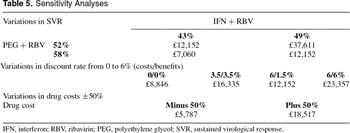
Sensitivity Analyses
 You have
Access
- 32
- Cited by