INTRODUCTION
Radical hypofractionated thoracic radiotherapy (HFTR) with 55 Gy in 20 fractions (#) is the most commonly used radiotherapy schedule for inoperable non-small-cell lung cancer (NSCLC) in the United Kingdom.Reference Prewett, Aslam and Williams1 This schedule is recommended by the National Institute for Health and Care Excellence2 for medically inoperable NSCLC, where continuous hyperfractionated accelerated radiotherapy (CHART) is unavailable and for patients considered unsuitable for concurrent chemoradiotherapy. The level of evidence to support this schedule remains poor and recent attempts to perform prospective randomised trials with this schedule have failed to recruit.Reference Price, Yellowlees and Russell3, Reference Maguire, Khan and McMenemin4 It is hypothesised that advantages of a hypofractionated schedule over the conventional 60–66 Gy in 6–6·5 weeks include reduced tumour repopulation, potentially conferring advantages in disease control.Reference Withers, Taylor and Maciejewski5 The dose fractionation restrictions within the United Kingdom, which has created a significant gap in radiotherapy provision, further adds to the appeal of a hypofractionated schedule within the National Health Service.Reference Williams and Drinkwater6
This single cancer centre retrospective data analysis outlines 10 years of experience with HFTR in North Wales for inoperable NSCLC. It aims to add a mature data series to existing published retrospective data in order to build further evidence to support its use in routine clinical practice.
MATERIALS AND METHODS
A retrospective analysis of all patients treated in the North Wales Cancer Treatment Centre (NWCTC) with HFTR for NSCLC between 2001 and 2011 was performed. Patients were identified through the Varian ARIA® database at the NWCTC and patients receiving 52·5–55 Gy in 20# were included. Electronic and clinical case notes, radiology and pathology records were reviewed and outcomes were updated using the National Indexes of Deaths in England and Wales. Univariate analyses of survival were carried out for stage and histological diagnosis using MedCalc® statistical software.
RESULTS
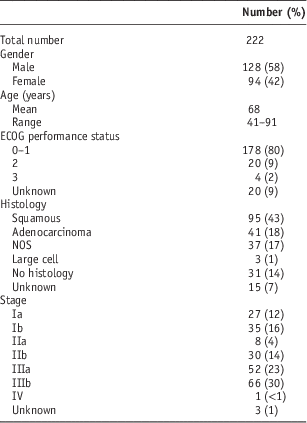
Radiotherapy at the 52·5–55 Gy in 20# schedule was administered to 222 patients (128 male, 94 female) during the 10-year study period. Median follow-up was 61·6 months (range 17·1–147). The median age was 68 years (range 41–91). Performance status was 0–1 in 80% of cases and three in 2% (four cases). Tumour stage was I, II and III in 28, 18 and 53% of cases, respectively. One patient was stage IV (T2a, N2, M1b) and three cases had no recorded stage. Histological diagnosis was squamous in 43% of cases and adenocarcinoma in 18%. There was no histological diagnosis in 31 patients (14%). Patient- and disease-related demographics are shown in Table 1. 3D conformal radiotherapy planning technique was used in every case.
Patient and disease characteristics
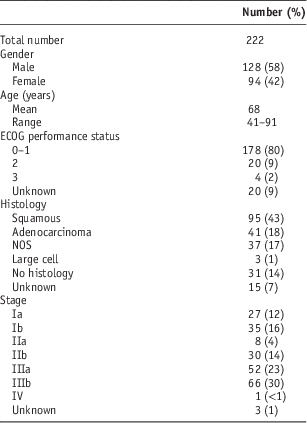
Abbreviations: ECOG, Eastern Co-Operative Oncology Group; NOS, not otherwise specified.
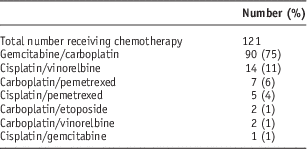
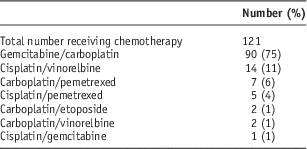
All patients received radiotherapy: 209 (94%) had 55 Gy in 20# and 13 (6%) had 52·5 Gy in 20#. The lower dose was used when the higher dose could not be safely administered owing to normal tissue constraints. Induction chemotherapy (chemotherapy before radiotherapy) was administered in 121 cases (55%). The regimens utilised are shown in Table 2.
Induction chemotherapy regimens
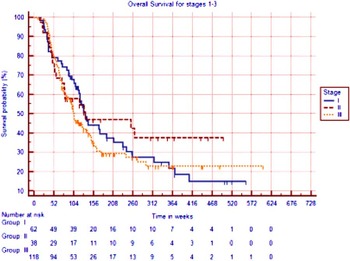
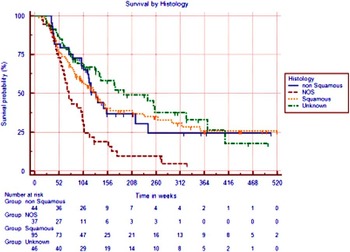
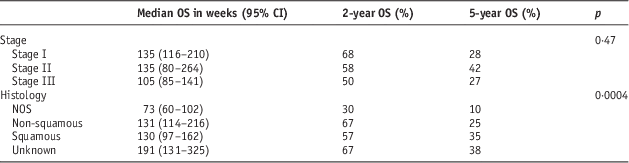
At the time of analysis, 76 of the 222 patients (34%) remained alive, 59 without documented relapse. The median survival for the entire cohort is 28·6 months (95% confidence interval 24·2–32·5). Survival outcomes by stage and histology are shown in Figures 1 and 2, respectively, and summarised in Table 3. Survival at 2 and 5 years for stage are 68 and 28% for stage I; 58 and 42% for stage II; and 50 and 27% for stage III.
Overall survival of patients receiving radical hypofractionated thoracic radiotherapy by stage in the North Wales.

Overall survival of patients receiving radical hypofractionated thoracic radiotherapy by histology in the North Wales.

Overall survival (OS) by stage and histological subgroups
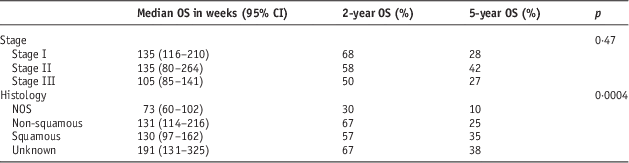
Abbreviations: CI, confidence interval; NOS, not otherwise specified.
DISCUSSION
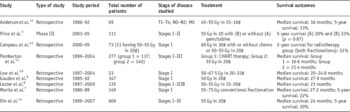
Although there are no validated phase III data to support the use of HFTR with the 55 Gy in 20# regimen in NSCLC, there is an increasing body of evidence (predominantly retrospective) to confirm its efficacy, tolerability and deliverability in every day clinical practice for those patients deemed unsuitable for surgery.Reference Price, Yellowlees and Russell3, Reference Morita, Fuwa and Suzuki7–Reference Din, Harden and Hudson14 In this series, we report median overall survival (OS) figures of 28·6 months, which not only compares favourably with the previously published OS of between 16 and 27·9 months for this schedule, but also with the 16·5 months median survival reported for CHART radiotherapy in the landmark phase III clinical trial.Reference Price, Yellowlees and Russell3, Reference Morita, Fuwa and Suzuki7–Reference Saunders, Dische and Barrett15Table 4 summarises the published data of HFTR for NSCLC to date.
Existing published data of experiences with hypofractionated thoracic radiotherapy in non-small-cell lung cancer

Abbreviation: CHART, continuous hyperfractionated accelerated radiotherapy.
When Goldstraw et al.Reference Goldstraw, Crowley and Chansky16 compiled the data from 67,725 cases of NSCLC, they reported 5-year OS rates of 43–50%, 25–36% and 7–19% for stages I, II and III, respectively. The results presented here for stages II and III are comparable with these figures. The stage I cohort compares less favourably. Despite a respectable 2-year OS, the 5-year OS (28%) for stage I patients is considerably lower than these international figures.Reference Goldstraw, Crowley and Chansky16 The performance status of our stage I cohort is not sufficiently different from the stage II/III patients to account for this poor outcome; however, most cases would have had a higher burden of co-morbidities preventing them from receiving surgery and increasing the likelihood of death from other causes. Analysis of published retrospective data for patients medically unfit for surgery with stage I disease reveals 5-year OS rates of 21–37·6%, reflecting the overall poor prognosis of medically inoperable patients with lung cancer.Reference Morita, Fuwa and Suzuki7, Reference Gauden, Ramsay and Tripcony9, Reference Din, Harden and Hudson14
Pathological stage is known to be highly predictive of prognosis. In addition, the degree of cellular differentiation on histological analysis is also thought to influence outcomes.Reference Lipford, Eggleston and Lillemoe17, Reference Takise, Kodama and Shimosato18 NSCLC histology not otherwise specified is a group characterised by poor cellular differentiation. Their tendency to behave more aggressively comparative with the differentiated adenocarcinoma and squamous carcinoma subtypes is well described and was confirmed in our study population. The best outcomes by histology in our data series was for those patients with unknown histological subtype (a combination of no histological diagnosis and unknown histological diagnosis). This unexpected outcome is difficult to explain. We believe it is plausible that non-malignant lung lesions with radiological changes mimicking NSCLC could have been included within this subgroup. As a result, we feel this gives further justification for pursuing histological diagnosis wherever possible.
The retrospective nature of this data series demands cautious interpretation; however, the authors believe it unlikely that a prospective randomised study comparing HFTR with the conventional radiotherapy schedule will ever be completed. This publication therefore strives to supplement the existing body of retrospective data. The need for increased evidence to support HFTR is highlighted by the failure to recommend this schedule in the published guidance of both the Royal College of Radiologists19 and Scottish Intercollegiate Guidelines Network,20 despite its frequent use in the United Kingdom.
CONCLUSIONS
Our experience of HFTR with the 55 Gy in 20# schedule over a decade in North Wales adds further weight to the existing data, suggesting this regimen to be efficacious in routine clinical practice. We believe that the growing body of evidence for this schedule, confirming survival outcomes comparable with internationally accepted results, is sufficient to support its future use in inoperable NSCLC.
Acknowledgement
None.
Financial Support
This research received no specific grant from any funding agency, commercial or not-for-profit sectors.
Conflicts of Interest
None.