1. Introduction
Linguistic landscape refers to the visible displays of language that can be observed in public spaces, which encompasses all written signs, advertisements, placards, street signs, shop signs, and public notices that appear in the environment (Landry and Bourhis Reference Landry and Bourhis1997). In the past decades, scholars have delved into various facets of the linguistic landscape. From a sociocultural perspective, researchers have probed the interplay between language visibility and cultural identity, scrutinizing how the use of language in public venues mirrors collective values, historical legacies, and cultural stories (Taylor–Leech Reference Taylor–Leech2012). From an economic angle, studies have focused on how language on commercial signs affects consumer choices and informs marketing and branding tactics, particularly within regions characterized by linguistic diversity and tourism (Ferguson and Sidorova Reference Ferguson and Sidorova2018; Liu and Ma Reference Liu and Ma2024; Wang et al. Reference Wang, Gao, Sun and Wang2024). From an educational standpoint, the linguistic landscape has been investigated as a tool for language education and cultural enrichment within scholastic environments (Pakarinen and Björklund Reference Pakarinen and Björklund2018; Suuriniemi and Satokangas Reference Suuriniemi and Satokangas2023). Lastly, in the political realm, the manifestation of languages in public spaces has been scrutinized as an embodiment of political forces, policy-making, linguistic rights, and the assertion of national identity (Ben–Rafael et al. Reference Ben–Rafael, Shohamy, Amara and Trumper–Hecht2006; İnal et al. Reference İnal, Bayyurt, Özturhan and Bektaş2021). In sum, the study of linguistic landscapes sheds light on how language is used and displayed in public spaces, offering a lens to view the broader socio-cultural, economic, and political contexts of a region.
Luang Prabang, a UNESCO-designated World Heritage Site, is renowned for its well-preserved architectural and cultural heritage. This status has significantly influenced its linguistic landscape, fostering a unique blend of traditional Lao language and global languages, particularly English. As a major tourist destination, the presence of English in public signage, commercial spaces, and educational institutions highlights the city's adaptation to international tourism and its impact on local linguistic practices. Understanding this dynamic provides valuable insights into the interactions between global influences and local cultural identity. In this sense, this study employs a combination of photographic evidence with interviews to explore the roles of English in Luang Prabang's linguistic landscape, unveiling its unique characteristics and multifaceted functions.
2. Methodology
2.1 The research context
Luang Prabang, a UNESCO World Heritage Site in Laos, presents a rich linguistic landscape characterized by multilingualism. The community primarily speaks Lao, the national language, supported by national language policies that promote its use in education, government, and public life. Additionally, the area's historical and cultural significance as a former royal capital attracts tourists from around the globe, further enhancing its linguistic diversity. English, although not native to the region, is widely learned and used, particularly in tourism, education, and business sectors. According to The Revised Education Law of 2015, English must be taught starting in primary school, where students aged 6 to 11 receive two hours of English instruction per week from grades 3 to 5, totaling approximately 70 hours per academic year. This multilingual environment makes Luang Prabang a unique case study for examining how different languages coexist and influence the local linguistic landscape.
2.2 Research questions
Based on this background, we propose the following three research questions:
RQ1: What are the characteristics of English presentation within the linguistic landscape of Luang Prabang?
RQ2: What roles does English play in the linguistic landscape of Luang Prabang?
RQ3: How do merchants and consumers perceive the use of English in the linguistic landscape of Luang Prabang?
2.3 Data collection
Data collection in this study was carried out in two primary stages, conducted by the researcher on January 30 and February 5 2024. The initial stage involved sampling the linguistic landscape through photographic evidence, where a single photograph was selected to represent each shop, ensuring a focused and representative data set. In the second stage, the research delved into the perceptions held about the English language within the linguistic landscape. This was achieved through semi-structured interviews with 20 merchants (M1-M20) and 20 consumers (C1-C20) in Luang Prabang, who were selected using purposive sampling to ensure a diverse representation of business types and consumer demographics. These interviews, conducted entirely in English, provided qualitative insights into the attitudes and opinions of local business owners and consumers regarding the role and prevalence of English in the city's linguistic landscape. The interview questions focused on several key areas: the frequency and contexts in which English is used, the perceived importance of English for business and daily interactions, challenges faced in using English, and the impact of English on the local culture and identity. Ethical considerations were meticulously addressed; participants were fully informed about the study's purpose and procedures, assured of their anonymity and confidentiality, and provided with the option to withdraw at any time without consequence.
2.4 Data analysis
This study conducted its data analysis through a three-tiered approach. Initially, a comprehensive sorting of the collected images was undertaken, where duplicates and images of poor quality were eliminated, yielding a total of 849 viable photographs. These images were then quantitatively analyzed across three dimensions – language combinations, geographic distribution, and priority code – to address the first research question. Subsequently, two researchers independently examined the roles played by English in these images, categorizing them into several principal roles to respond to the second research question. Finally, for the third research question, interview data were transcribed, coded for analysis, and translated into English to present the conclusive findings of the study. This methodical process ensured a rigorous and systematic examination of the linguistic landscape, facilitating a nuanced understanding of the multifaceted roles English plays within it.
3. Findings
3.1 The characteristics of English in the linguistic landscape
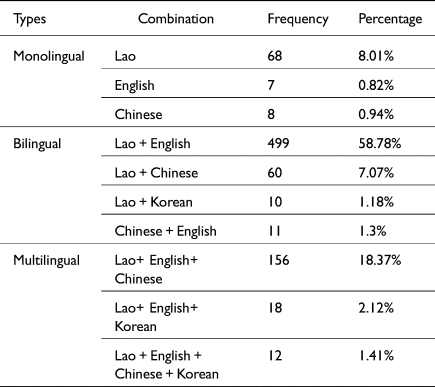
In the linguistic landscape of Luang Prabang, English emerges as a significant component, particularly in bilingual and multilingual contexts. Accounting for 58.78% of bilingual signs, the combination of Lao and English dominates, underscoring the city's strategic adaptation to global tourism and commerce. This prevalence indicates a prioritization of English as a facilitator of communication with international consumers, reflecting the region's economic and cultural openness. Furthermore, multilingual signage, where English is combined with Lao and other languages like Chinese and Korean, constitutes a substantial 18.37% (see Table 1). This not only demonstrates English's role as a global lingua franca but also highlights Luang Prabang's diverse visitor demographic and the local businesses’ response to cater to a multilingual clientele. English's presence on monolingual signs is relatively minor, suggesting that while it's important for international outreach, the local language retains its prominence in monolingual communications. The overall linguistic landscape reveals English as a bridge between Lao culture and the global community, striking a balance between local identity preservation and international engagement.
English in the language combination

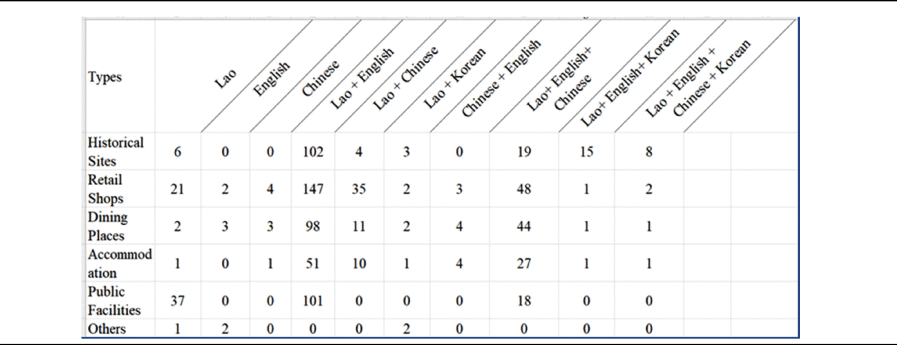
In the linguistic landscape of Luang Prabang, the prevalence of English varies across different types of establishments, illustrating its nuanced role in commerce and culture (see Table 2). Historical sites predominantly feature bilingual Lao-English signage, indicating an effort to cater to the diverse linguistic backgrounds of consumers, while retaining the local language for cultural preservation. This is likely due to the international appeal of these sites and the need for effective communication of historical narratives to a global audience. Retail shops also show a strong presence of Lao-English bilingual signs, suggesting that these businesses prioritize accessibility for both local and international customers, likely aiming to maximize commercial reach and facilitate transactions with consumers. The presence of English in dining places, especially when combined with Lao, underscores the importance of appealing to foreign consumers who contribute significantly to the local economy. Accommodation services display a similar trend, with English being used alongside Lao, reflecting the need to provide clear information to travelers who may not speak Lao. The use of English in public facilities, often in a monolingual format, can be attributed to the necessity for a universal understanding of important information by all consumers, regardless of their origin. Lastly, the minimal use of English in the ‘Others’ category, which includes diverse business types, may indicate a more localized customer base or a less tourist-focused service offering. The varied usage of English across these sectors reveals its critical function as a tool for engagement and inclusivity in a region that is both historically rich and economically dependent on tourism.
English in the different types of shop signs

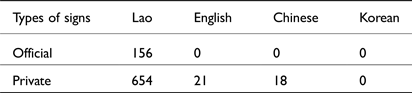
The priority code, which refers to the language or text given prominence in a multilingual setting, is typically placed above the secondary code in vertical orientations, while in horizontal orientations, it is generally positioned to the left (Scollon and Scollon Reference Scollon and Scollon2003). In Table 3, English appears as a secondary but significant language within private signs, while being completely absent in official signage. The exclusive use of Lao in official signs suggests a strong institutional emphasis on maintaining the national language for governmental and formal public communications. This could be a deliberate effort to preserve the national identity and cultural integrity in official matters. On the other hand, the presence of English in private signs, although relatively low compared to Lao, indicates its importance in the private sector. Private businesses seem to utilize English to a certain extent, likely to appeal to international consumers and expatriates, a key demographic that frequents private establishments such as shops, restaurants, and other services. This strategic use of English highlights the recognition of its global reach and the need for businesses to attract a wider audience for economic reasons. The limited but targeted use of English in the private sphere suggests a pragmatic approach by local businesses, aiming to balance the cultural prominence of Lao with the commercial advantages of using a global language. This careful incorporation of English into the linguistic landscape reflects the dual goals of respecting local language traditions while engaging with the global economy.
Priority code in the official and unofficial linguistic signs

3.2 The role of English in the linguistic landscape
3.2.1 Cultural heritage bearers
In the linguistic landscape of Luang Prabang, English plays the critical role of a custodian of cultural heritage. The use of English on informational placards and signs throughout the city, especially at historical and cultural sites, ensures that the rich narratives and traditions of Laos are accessible to an international audience. This not only aids in the preservation of cultural knowledge but also its dissemination across linguistic boundaries, allowing consumers from around the world to engage with and appreciate the local heritage. The provided image of the informational placard about Hor Prabang (Figure 1) exemplifies how English facilitates the transmission of historical knowledge as a cultural custodian. The English text narrates the history of Hor Prabang, detailing its construction, purpose, and significance within Laotian culture. By doing so in English, the placard communicates this heritage beyond the local people to a global audience, ensuring that the story of Hor Prabang and its cultural resonance is shared widely. Such bilingual information sharing is an essential aspect of cultural preservation in the age of global tourism and international cooperation.
Hor Prabang informational placard.

3.2.2 Tourism information provider
In the language landscape of Luang Prabang, English emerges prominently as a provider of tourism information. This role is crucial in a city that is a designated UNESCO World Heritage Site, where a steady flow of international consumers requires access to clear and comprehensible guidance. English-language maps, signs, and informational displays serve as invaluable resources for navigation and cultural education, ensuring that consumers can explore the area with a degree of autonomy and a deeper understanding of their surroundings. The image of the Luang Prabang city map (Figure 2), with its bilingual labels, is a clear representation of how English, as a provider of tourism information, is indispensable for consumers. The map provides essential information such as distances, landmarks, and points of interest in both the local language and English, demonstrating an effort to be inclusive and user-friendly for non-Lao speakers. This accessibility not only enhances the visitor experience but also underlines the importance of English in supporting the tourism industry of Luang Prabang by making the city's rich heritage and attractions approachable and understandable to a wider audience.
Luang Prabang city map.

3.2.3 Cultural exchange facilitator
In Luang Prabang's linguistic landscape, English serves as a facilitator of cultural exchange. The signage in English, placed at historical sites and points of cultural interest, does more than just translate; it opens a dialogue between the local Lao culture and the international consumers. It allows the rich stories and traditions of Laos to be shared with a global audience, fostering a mutual understanding and appreciation of cultural diversity. Figure 3 tells the tale of Mount Phousi and its link to an old Lao folk story with roots in the Ramayana, an ancient Indian epic. By presenting this story in English, the sign invites consumers to delve deeper into the cultural fabric of the region. It encourages consumers to engage with traditional storytelling, thereby deepening their cultural experience. This use of English not only educates consumers about the local heritage but also invites them to participate in the living culture of Luang Prabang, bridging gaps and knitting a closer global community through shared narratives.
Mount Phousi sign.

3.2.4 Economic opportunities creator
In the linguistic landscape of Luang Prabang, English functions as a creator of economic opportunities. By featuring prominently on signs for services such as vehicle rentals, English signals to international consumers that these services are accessible and tailored to their needs. This inclusivity not only fosters a welcoming atmosphere for tourism but also drives economic activity by tapping into the market of English-speaking consumers seeking convenient transportation options during their stay. The image showcasing motorbike and bicycle rentals with text in Lao, English, and Chinese (Figure 4) caters to a diverse clientele, thus reflecting how English, as a creator of economic opportunities, contributes to the local economy. The use of English in advertising these services broadens the customer base, allowing local businesses to capitalize on the tourism industry. It ensures that consumers, regardless of their native language, have the information they need to engage with local commerce, thereby boosting economic growth and supporting the livelihoods of those in the vehicle rental industry.
Motorbike and bicycle rentals sign.

3.2.5 Educational resource provider
In the context of Luang Prabang's linguistic landscape, English emerges as a pivotal provider of educational resources. Its presence on educational posters and programs reflects an understanding of its international significance and its role in equipping Lao children with necessary skills to thrive in a globalized world. English education initiatives exemplify the language's capacity to offer access to a vast array of knowledge and opportunities that are otherwise inaccessible through local languages alone. The content of the image underscores the importance of English as an educational resource in fostering the development of education in Laos. The poster in Figure 5 highlights various programs aimed at enhancing English proficiency among young learners, suggesting that English is a key to creating a better future for Lao children and youth. By advocating for volunteer participation in English conversation practice and sponsorship of classrooms, the initiatives depicted are actively working to integrate English into the educational framework. This integration not only enriches the curriculum but also prepares the students for future educational and professional environments where English is often essential, thereby contributing to the overall educational advancement in Laos.
Poster promoting educational programs.

3.2.6 International image broadcaster
In the linguistic landscape of Luang Prabang, English serves as a broadcaster of an international image. By including English on signs for local businesses, such as hotels, it communicates a message of global engagement and accessibility. The use of English suggests a readiness to welcome and serve guests from all over the world, projecting a cosmopolitan and tourist-friendly image vital for a city with a strong international visitor presence. The image of the Ananta Hotel signboard (Figure 6), which features both Lao and English text, illustrates how adopting an international image can contribute indirectly to the development of education. By creating an environment that is attractive to consumers, the local economy benefits from increased revenue, part of which can be reinvested into educational infrastructure and resources. This economic boost can lead to better school facilities, higher quality teaching materials, and potentially more language education programs, which in turn can improve overall educational outcomes for the local community.
Ananta Hotel signboard.

3.3 Merchants and consumers’ attitudes to the linguistic landscape
3.3.1 Merchants
English is important here. Using English on our signs has significantly increased foot traffic from international consumers. They feel more welcomed and can navigate our offerings easily. (Merchant 1)
In Luang Prabang, merchants are embracing English signage as a strategic tool to attract international consumers. This approach acknowledges English's role as a global lingua franca, enabling businesses to communicate effectively with a diverse audience.
English is an international language. English on our storefronts presents a professional image that aligns with our brand's global perspective. It's about more than just language; it's a branding strategy. (Merchant 3)
For many merchants in Luang Prabang, the choice to incorporate English into their storefronts goes beyond basic communication – it's about crafting a brand image that resonates on a global scale. English signage is seen as a marker of professionalism and international appeal, helping local businesses project a modern, sophisticated identity.
I'm Lao, and I want to contribute to promoting our culture. Using bilingual signs is a great way to do that. We view our English signs as a bridge between cultures, inviting people from all backgrounds to explore what we have to offer. (Merchant 14)
Luang Prabang's adoption of English shop signs symbolizes the city's rich tapestry of cultural influences. Merchants view these bilingual signs as a testament to the area's history of cultural exchange and openness to global influences. This blend of local and international elements showcases the city's unique identity, celebrating its ability to adapt and thrive in a globalized context.
There's a concern that too much English could overshadow our rich cultural heritage. We strive to maintain a harmony between appealing to international consumers and preserving our cultural identity. (Merchant 17)
Amid the trend towards English signage in Luang Prabang, some merchants express concerns about the potential erosion of local culture and language. They navigate the delicate balance between catering to international consumers and preserving the unique cultural heritage of the city. These concerns highlight the ongoing dialogue about how to maintain Luang Prabang's distinctive character in the face of globalization.
3.3.2 Consumers
As a traveler who doesn't speak Lao, I found the English signs incredibly helpful. It made shopping and dining out so much easier and influenced where I chose to spend my money. (Consumer 1)
The presence of English signage in Luang Prabang significantly enhances the travel experience for international consumers. For those unfamiliar with the Lao language, English signs offer a crucial bridge to understanding and accessing services and products. Consumers appreciate the ease with which they can navigate the city, underscoring the importance of language accessibility in fostering a positive and stress-free travel environment.
I don't understand Lao, I only know English, and the English on these shop signs looks like they're welcoming me. It felt like the local businesses were going out of their way to accommodate non-Lao speakers. I feel like a VIP here. (Consumer 5)
English signage in Luang Prabang extends beyond mere convenience, embodying a gesture of welcome and acceptance towards international consumers. This inclusivity is keenly felt by consumers, who view the effort to accommodate non-Lao speakers as a sign of hospitality and openness. The presence of English signs is seen as an invitation to all, breaking down barriers and creating a more inviting and friendly atmosphere. Consumers share their feelings of being valued and respected, highlighting the role of language in crafting inclusive travel experiences.
When I see an English sign, I automatically feel a bit more trust towards the establishment. It suggests they're accustomed to serving foreign consumers well. It also indicates a certain level of professionalism and adherence to international standards. This makes me feel more confident about the quality and reliability of their products or services. (Consumer 8)
For many consumers, English signage serves as a marker of trust and professionalism in Luang Prabang's businesses. It signals to consumers that an establishment is geared towards meeting international standards of quality and service. This trust is foundational in the decision-making process, guiding consumers towards businesses that display a commitment to transparency and reliability.
I appreciate the English in the shop signs, but the prevalence of English signs made some areas feel less authentic. I missed seeing the beauty of the Lao language displayed more prominently. (Consumer 11)
While English signage offers some benefits, it also raises concerns about the dilution of local culture and language. Some consumers seek a deep immersion into the local heritage of Luang Prabang, including its linguistic landscape. The prevalence of English signs, though helpful, can sometimes overshadow the authentic cultural experience, leaving consumers yearning for more exposure to the Lao language and its nuances. Consumers reflect on the balance between convenience and cultural authenticity, emphasizing the desire for a richer cultural engagement.
I could only understand Chinese, navigating shops with only Lao and English signage was challenging. It felt like these businesses weren't considering consumers like me. (Consumer 18)
The focus on English signage, while beneficial to many, can inadvertently exclude non-English speaking consumers. This exclusion is felt by consumers who navigate the city with a sense of being overlooked, highlighting the need for more linguistic diversity in tourist communications. Consumers express feelings of alienation and the importance of inclusivity in language use. The experiences of non-English speakers underscore the challenge of catering to a diverse international audience without sidelining any group, advocating for a more multilingual approach in public signage.
4. Discussion
4.1 The characteristics of English in linguistic landscape
In Luang Prabang, the interplay of Lao and English within the linguistic landscape reflects a synergistic language combination that caters to both domestic and international interactions. This bilingualism is consistent with scholarly discussions that view English as a global lingua franca, often incorporated into local settings to facilitate cross-cultural communication (Bruyèl–Olmedo and Juan–Garau Reference Bruyèl–Olmedo and Juan–Garau2009). The prominence of Lao-English bilingual signs indicates an adaptive strategy that acknowledges English's supportive role, without allowing it to supplant the primary local language. This approach resonates with İnal et al's (Reference İnal, Bayyurt, Özturhan and Bektaş2021) observations of English in multilingual settings, where it serves as a bridge language rather than a dominant medium. In Luang Prabang, the linguistic landscape is thus not merely a reflection of language use but a strategic instrument in navigating the global-local nexus. The city's cosmopolitan nature as a tourist hub is underscored by the presence of English, which, while subordinate to Lao, is indispensable in engaging the international community and enhancing the city's global accessibility.
The distribution of English in the commercial fabric of Luang Prabang is indicative of the linguistic language's functional role in areas of economic interest, particularly those frequented by consumers. English's prevalence at historical sites, retail outlets, and dining establishments corresponds with studies that examine the correlation between linguistic landscape and economic imperatives (Yan Reference Yan2019). In these sectors, English serves as a magnet for international clientele, suggesting that linguistic choices in signage are driven by market considerations as well as communicative needs. The lesser presence of English in official and public domains, however, resonates with Manan et al. (Reference Manan, David, Dumanig and Naqeebullah2015)'s findings, where language in public signage reflects national identity and governmental authority. This sector-specific linguistic dichotomy in Luang Prabang suggests that while English is harnessed for its global appeal in private commerce, it is consciously eschewed in public sectors to preserve the sanctity of the Lao language, aligning with the tendency to employ languages in a manner that reinforces cultural and administrative sovereignty (Ferguson and Sidorova Reference Ferguson and Sidorova2018).
The distinctive use of English in private signage as opposed to its exclusion from official signs in Luang Prabang can be interpreted through the lens of language policy and economic pragmatism. Official signs uphold Lao exclusively, echoing Taylor–Leech's (Reference Taylor–Leech2012) findings of language policy serving as a guardian of national identity. This exclusion of English from the official domain underscores a deliberate cultural choice, reinforcing the primacy of the Lao language in public and formal communications. Contrastingly, the adoption of English within private signage reveals an economic strategy that aligns with Wang et al. (Reference Wang, Gao, Sun and Wang2024)'s perspective on language as a tool for commercial engagement. English in this context is not merely a communicative medium but an economic asset, essential for tapping into the global market. This strategic employment within the private sector highlights Luang Prabang's dual commitment to preserving the Lao language and culture while also engaging with the broader international community for economic vitality.
Additionally, the presence of other languages, such as Korean and Chinese, further enriches the linguistic landscape. English often appears alongside these languages in multilingual signs, particularly in the private sector, serving as a common denominator that bridges different linguistic communities. However, English primarily addresses international tourists who do not speak Korean or Chinese, providing a broader communication tool. Meanwhile, the inclusion of Korean and Chinese specifically caters to tourists from those linguistic backgrounds, ensuring that communication is accessible and relevant to the diverse groups visiting the city. This layered approach highlights the complementary roles of these languages, where English enhances overall accessibility, while Korean and Chinese offer more targeted communication for specific tourist populations.
4.2 The role of English role in the linguistic landscape
In Luang Prabang, the role of English within its linguistic landscape can be viewed through various prisms, each highlighting the language's multifaceted influence. As cultural heritage bearers, English translations on signs perform an essential role in the preservation and sharing of Laotian history and traditions, resonating with existing literature that emphasizes the significance of language in safeguarding cultural narratives (Lu et al. Reference Lu, Li and Xu2020). Similarly, English's function as a tourism information provider is inextricably linked to its status as a global lingua franca. This aligns with the role of English highlighted in the literature as a key facilitator of tourism, where its usage in signage is a strategic response to the needs of international consumers (Bruyèl–Olmedo and Juan–Garau Reference Bruyèl–Olmedo and Juan–Garau2020; Xiao and Lee Reference Xiao and Lee2022). The language's capacity as a cultural exchange facilitator and an economic opportunities creator further cements its importance. English signage at cultural sites invites consumers to delve into local traditions, fostering a dialogue between cultures (Lu et al. Reference Lu, Li and Xu2020). Moreover, by signaling the availability of services in English, local businesses extend their reach to an international clientele, driving economic growth (Karam et al. Reference Karam, Warren, Kibler and Shweiry2020). English's role as an educational resource provider is evident in its inclusion in educational materials, underscoring the language's perceived utility in equipping the younger generation with global competencies. This reflects global educational trends where English proficiency is increasingly seen as a valuable asset (Suuriniemi and Satokangas Reference Suuriniemi and Satokangas2023). Lastly, as an international image broadcaster, English on signage projects a globally engaged identity for local businesses, enhancing the city's appeal to a diverse international audience. This portrayal aligns with Luang Prabang's status as a world heritage site and a tourist-friendly destination, echoing findings about the relationship between language and economic development (Manan et al. Reference Manan, David, Dumanig and Naqeebullah2015).
4.3 Merchants and Consumers’ attitudes towards the English in linguistic landscape
In Luang Prabang, merchants adopt English signage as a strategic response to globalization, aiming to engage the influx of international consumers and create an accessible commercial environment. This reflects a broader trend identified in the literature, where English is used as a global lingua franca within business contexts to cater to international consumers (Bruyèl–Olmedo and Juan–Garau Reference Bruyèl–Olmedo and Juan–Garau2009). Furthermore, English signage is not just a communicative tool; it's an integral part of brand strategy. Merchants utilize English to project a modern and professional image, aligning with Ben–Rafael et al's (Reference Ben–Rafael, Shohamy, Amara and Trumper–Hecht2006) discussion on the symbolic capital of English in non-English speaking markets. Additionally, by easing communication barriers, English signage improves transactional efficiency and customer satisfaction, supporting the notion that language can significantly impact consumer behavior (Touchstone et al. Reference Touchstone, Koslow, Shamdasani and D'Alessandro2017). Merchants also express a commitment to cultural fusion, using bilingual signs to reflect the city's historical openness to cultural exchange. However, amidst these strategic and inclusive uses of English, some merchants remain cautious, and wary of compromising the city's unique cultural identity, echoing concerns about language and cultural preservation in tourist destinations (Leeman and Modan Reference Leeman and Modan2009).
For consumers, particularly international consumers, the presence of English in Luang Prabang facilitates accessibility and inclusivity, enhancing their overall experience. This perspective is supported by research indicating that language accessibility is pivotal in shaping tourist satisfaction (Lu et al. Reference Lu, Li and Xu2020). English signage, therefore, is not only a practical tool but also a symbol of hospitality, fostering a sense of trust in the professionalism of local businesses. However, the prevalence of English has sparked a dialogue about the balance between convenience and cultural immersion. Consumers express a desire for authentic experiences, underlining the tension between the utility of English and the preservation of the Lao language, a concern reflected in the discourse on linguistic landscapes (Pakarinen and Björklund Reference Pakarinen and Björklund2018). Moreover, the challenge of ensuring inclusivity for non-English speakers resonates with the need for a more multilingual approach to public signage, as advocated by scholars focusing on linguistic diversity (Artawa et al. Reference Artawa, Mulyanah, Atmawati, Paramarta, Satyawati and Purnawati2023).
5. Conclusion
This paper delves into the intricate dynamics of English usage within the linguistic landscape of Luang Prabang, leveraging both visual and verbal data to dissect the language's characteristics, functions, and the perceptions it garners from both merchants and consumers. Our findings illuminate the strategic use of English, often in conjunction with Lao, to cater to the needs and curiosities of a diverse international audience, primarily in tourist-centric areas. English emerges not merely as a communicative tool but as a multifaceted actor within the linguistic landscape, serving roles that range from preserving cultural heritage to facilitating economic transactions, and from enhancing educational opportunities to broadcasting a global image. The general consensus among local business owners and international consumers points towards a positive reception of English, lauded for its role in fostering economic prosperity, cultural dialogue, and brand recognition. Nonetheless, the study also brings to light certain reservations regarding the potential overshadowing of indigenous culture and the perceived exclusion of non-English speakers. These insights underscore the complex interplay between global languages and local identities, highlighting the necessity for nuanced language policies that support both the economic ambitions and cultural heritage of Luang Prabang. This research thus contributes valuable perspectives to the ongoing discourse on linguistic landscapes, suggesting pathways for reconciling the global appeal of English with the preservation and promotion of local linguistic and cultural authenticity.
 XIAOCHEN WANG is a PhD student at Xi'an Jiaotong University, where Professor Gao supervises him. His research interests are language education, positive psychology, and linguistic landscape. Email: wangxiaochen666666@outlook.com
 YANG GAO is currently a researcher and associate professor in the School of Foreign Studies at Xi'an Jiaotong University (XJTU), where he supervises students in the PhD program specializing in language teacher education. He taught at San Jose State University, Kent State University, and Dalian Maritime University before XJTU. His research interests include language teacher education (beliefs and practices; agency and identity), linguistic landscapes, and language policy and planning. Email: gaoyang666@xjtu.edu.cn