Introduction
Common bean (Phaseolus vulgaris L.) is one of the most important grain legume crops grown in Latin America, Sub-Saharan Africa and Asian countries, including India. It has a global cultivated area of 34.80 million ha and a total annual production of 27.54 million tons in more than 120 different nations and regions (FAOSTAT, 2020). It is an inexpensive source of protein, dietary fibre, carbohydrates, vitamins and minerals, particularly micronutrients like iron and zinc, which are essential in human nutrition (Choudhary et al., Reference Choudhary, Gupta, Shafi, Jan, Mir, Singh and Mir2022). However, despite its ability to contribute to food security and reduce hunger in India, it needs to be more utilized (Rana et al., Reference Rana, Sharma, Tyagi, Chahota, Gautam, Singh, Sharma and Ojha2015). The microenvironment of the farmland, which varies in latitude and altitude, may have a considerable impact on the domestication of this crop (Castro-Guerrero et al., Reference Castro-Guerrero, Isidra-Arellano, Mendoza-Cozatl and Valdés-López2016; Rendón-Anaya et al., Reference Rendón-Anaya, Montero-Vargas, Saburido-Álvarez, Vlasova, Capella-Gutierrez, Ordaz-Ortiz, Aguilar, Vianello-Brondani, Santalla, Delaye and Gabaldón2017). This crop grows in generally humid and chilly settings, with daily average temperatures ranging from 25 to 30°C optimal for the reproductive stage (Beebe et al., Reference Beebe, Rao, Blair and Acosta-Gallegos2013; De Ron et al., Reference De Ron, Rodiño, Santalla, González, Lema, Martín and Kigel2016).
In India, the common bean is also called Rajmash; it is traditionally a rainy season crop in the foothills of the Himalayan region, grown in traditional farming systems in association or rotation with maize, sugarcane, potato, apples or other crops (Sharma et al., Reference Sharma, Rana, Sharma, Rathour and Sharma2006; Basavaraja et al., Reference Basavaraja, Manjunatha, Chandora, Singh, Rathod, Dubey, Kanishka, Singh and Singh2022). However, during the last three decades, this crop has grown in popularity in India's northern and central plains, particularly in parts of Uttar Pradesh, Bihar, Maharashtra and Andhra Pradesh. Farmers are highly interested in cultivating bush-type varieties as a sole crop in the winter because of their early maturation qualities, suitability to the local production environment and higher acceptability with customer demand in the local market (Basavaraja et al., Reference Basavaraja, Manjunatha, Chandora, Singh, Rathod, Dubey, Kanishka, Singh and Singh2022). Currently, a few varieties are available for common bean cultivation. The farmers in mountainous regions of the Himalayas grow bean local cultivar seed mixtures over monocropping to control disease and pests and increase yield stability, household consumption and income generation (Rana et al., Reference Rana, Sharma, Tyagi, Chahota, Gautam, Singh, Sharma and Ojha2015). Adaptive features such as early maturity, grain yield and plant growth habit are critical in maintaining common bean production in Indian production conditions (Sharma et al., Reference Sharma, Rana, Sharma, Rathour and Sharma2006; Rana et al., Reference Rana, Sharma, Tyagi, Chahota, Gautam, Singh, Sharma and Ojha2015; Basavaraja et al., Reference Basavaraja, Manjunatha, Chandora, Gurumurthy and Singh2021, Reference Basavaraja, Manjunatha, Chandora, Singh, Rathod, Dubey, Kanishka, Singh and Singh2022). As a result, developing early-maturing cultivars is a valuable component of common bean breeding in India as the first step towards enhancing adaptability and grain yield. Therefore, it is imperative to characterize and evaluate collections of common bean germplasm and select promising and suitable germplasm for developing breeding populations for high-yielding and earliness traits (Abaidoo et al., Reference Abaidoo, Dare, Killani and Opoku2017; González et al., Reference González, Yuste-Lisbona, Weller, Vander Schoor, Lozano and Santalla2021). Recently, national bean research programmes at the Indian Institute of Pulses Research (IIPR) in India have introduced an extensive collection of new germplasm from the gene bank unit of the International Center for Tropical Agriculture (CIAT) in Cali, Colombia (Basavaraja et al., Reference Basavaraja, Manjunatha, Chandora, Singh, Rathod, Dubey, Kanishka, Singh and Singh2022). The introduction of novel alleles from exotic germplasm was employed to improve elite cultivars (Holland, Reference Holland2004). However, in most cases, breeders rely only on their working collection, which they recycle multiple times throughout the breeding process. The utilization of exotic germplasm in breeding programmes is needed to enhance the productivity and diversity of cultivars (Pratap et al., Reference Pratap, Das, Kumar and Gupta2021). Several qualitative and quantitative traits have been characterized in a wide range of common bean germplasm (Islam et al., Reference Islam, Basford, Redden, González, Kroonenberg and Beebe2002; Rana et al., Reference Rana, Sharma, Tyagi, Chahota, Gautam, Singh, Sharma and Ojha2015; González et al., Reference González, Yuste-Lisbona, Weller, Vander Schoor, Lozano and Santalla2021; Basavaraja et al., Reference Basavaraja, Manjunatha, Chandora, Singh, Rathod, Dubey, Kanishka, Singh and Singh2022). The GGE-biplot analysis was used to investigate 183 Andean bean genotypes in Tanzania. The results showed that seed yield was affected by the environment (E), genotype (G) and genotype × environment (GE) (Mndolwa et al., Reference Mndolwa, Msolla, Porch and Miklas2019). Therefore, crop enhancement requires understanding genetic variability in bean germplasm and the interrelationship between desired traits and phenotypic expression in diverse bean production environment (Amini et al., Reference Amini, Ghannadha and Abd-Mishani2002; Govindaraj et al., Reference Govindaraj, Vetriventhan and Srinivasan2015; Ndlangamandla and Ntuli, Reference Ndlangamandla and Ntuli2021). As a result, there is a great need to screen exotic bean germplasm collections to identify those with consistent performance under varying environmental conditions. This study aimed to evaluate the performance of a broad range of exotic bean germplasm in different environments, recognize the extent of genetic variability, and recognize superior germplasm sources with solid results in earliness and yield attributes across environmental factors for use in bean varietal development programmes.
Material and methods
Experimental material
In the present investigation, 29 exotic, diverse common bean germplasm lines and three control varieties (Arun, Uday and Utkarsh) were used, and details are furnished in Table 1. Further, the experimental materials for this study materials were selected from last year's 2018–19 investigations on germplasm evaluation and characterization of 506 common bean accessions based on superior agronomic performance, flowering time, maturity period (early to medium), pods/plant and yield. This material was procured legally in 2018 and 2019 from the CIAT in Cali, Colombia, after an import permit from the National Bureau of Plant Genetic Resources (NBPGR), New Delhi, for research purposes under plant quarantine.
The biological status and morphological descriptors of 29 promising common bean germplasm lines and control cultivars utilized in the study

Experimental design and site characteristics
The study was conducted in randomized complete block design with two replicates in diverse agroecological environments. First, the three experiments were conducted at the Indian Institute of Pulse Research (IIPR) in Kanpur during the winters of 2019–20, 2020–21 and 2021–22. This area is at 2607′N latitude, 80014′E longitude, and about 152.4 m above mean sea level. At the start of the experiment site at 0–15 cm depth, the soil type was sandy-loam, the pH value ranged from 7.8 to 8.1, the soil organic carbon was 2.8 gm/kg, the available nitrogen was approximately 182 kg/ha, phosphorus (18.6 kg/ha) and potassium (159 kg/ha). This location receives medium–low rainfall, with an average annual rainfall of about 784 mm, around 89% of the annual rainfall falls during the southwest monsoon season only, and temperatures range from 28°C during the day to 10°C at night. Second, the experiment was conducted to examine the performance of the stable germplasm in terms of phenological traits and grain yield during the rainy season of 2021 in a hilly area of Himachal Pradesh at the NBPGR regional station, Phagli, Shimla. The crop was planted in June and harvested in October or November, depending on the maturity of the accessions. The experimental location is located at 31°05′53.89′′N and 77°09′34.92′′E, at an elevation of 1920 m above sea level, and has a subtropical humid climate with a mean annual rainfall of around 1250 mm. The soil texture is from sandy loam to clay loam, the pH ranges from 5.45 to 7.18, the soil organic carbon ranges from 9.8 to 22.2 gm/kg, and the available soil nitrogen is 282–502 kg/ha, phosphorus is 2.3–37.3 kg/ha and potassium is 67–504 kg/ha. To obtain the best crop performance across all experiments and conditions, recommended chemical pesticides and fertilizers were applied, with no weeds, pests or illnesses reducing bean yield.
Field data collection
All phenotypic data were collected from five randomly selected and tagged plants in each plot at two experiment locations. The days to initial flowering (DIF) feature was assessed as the number of days from the planting date to the emergence of the first bloom. The days to 50% flowering (DFF) characteristic was measured as the number of days from the sowing date to the opening of 50% of flowers in plants; the reproductive period (RP) was assessed as the number of days from the initial flower to physiological pod maturity; the days to maturity (DM) trait was determined as the number of days from the planting date to the appearance of a mature, dry pod on a primary branch. The pod length (PL) was evaluated in centimetres as the exterior distance from the peduncle. In addition, seeds per pod (SP) and pods per plant (PP) were collected in five randomly selected plants from each germplasm line, and all seed yields per plot (g/plot) were measured and recorded. The weight of seeds per plot was later converted into kg/ha.
Statistical data analysis
Using the statistical software Rstudio R, version 4.2.0, the pooled mean value of three seasons of data from the Kanpur region was analysed over several statistical parameters, including mean, range, variances, Pearson phenotypic correlation coefficients and genetic diversity, to determine genetic similarity or dissimilarity and principal component analysis (PCA) (dated: 2022-04-22). The coefficient of variability was calculated at the phenotypic and genotypic levels for all variables, as stated by Burton and Devane (Reference Burton and Devane1953). Heritability (H2) was assessed as proposed by Webber and Moorthy (Reference Webber and Moorthy1952). Accordingly, the genetic advance (GA) and genetic advance as a percentage of the mean (GAM) were determined using the error mean square for genotype and environment, as given by Johnson et al. (Reference Johnson, Robinson and Comstock1955). In addition, we used the mean phenotypic data of the Shimla region to compare the performance of selected bean accessions in two bean production environments.
Results
Variation in weather conditions
The growing season and experimental site weather conditions are significantly different regarding topography, rainfall distribution, air temperature and soil properties. Therefore, to better understand the phenological developments of the common bean germplasm in response to the two highly elevated environments studied. The crop was planted in Kanpur (low altitude region) during the winter season, in the first week of November, in 2019–20, 2020–21 and 2021–22. Over 3 years, the daily mean air temperature was around 15–20°C during the average flowering time (52 days after sowing, DAS) and about 5–10°C during the pod formation stage (61–82 DAS) (Fig. S1). Furthermore, from the second week of December to the second week of January, the crop was subjected to extreme cold conditions (10°C). Frequent harsh frost or low-temperature events are associated with unpredictable temperature fluctuations. On the contrary, we planted this crop in the Himalayan foothills of Shimla during the rainy season during the first week of June 2021; the daily mean air temperature was approximately 30°C during the mean blooming time (46 DAS) and around 33°C during the pod formation stage (55–70 DAS) (Fig. S1). As a result of the rainfall distribution pattern and the optimum temperature (30–35°C) throughout the crop growth time, the growing season and environment show a more substantial productive potential.
Genetic variability of agronomic traits
The genetic variability of an agronomic trait was analysed using several statistical parameters such as mean, range, variance components and coefficients of variation, and the results are shown in Table 2. The DIF ranged from 29.20 (EC932021) to 82.0 (EC931163), with an average value of 49.6. The DFF ranged from 35.20 (EC932021 and EC932189) to 91.0 (EC931163), with a mean value of 57.20. Likewise, DM had a mean value of 123.6, which ranged from 92.40 (EC932021) to 138.0 (Utkarsh and EC931115). Similarly, yield and its component traits, PP, recorded a mean value of 12.8, which ranges from 8.30 (EC931113 and EC931105) to 21.0 (EC931275). PL ranges from 6.10 (EC931158 and EC931115) to 15.40 (EC931972 and EC932047), with a mean value of 11.0. Seed per pod ranges from 3.60 (EC931113) to 5.70 (EC931972), with a mean value of 4.4. Hundred-seed weight (gm) has a mean value of 28.7, which ranged from 10.00 (EC931163) to 60.00 (EC931972), and seed yield (kg/ha) ranged from 256.0 (EC931163) to 2256.0 (EC931452) with a mean value of 833.60 kg/ha.
Estimation of descriptive statistics and genetic variability parameters for agronomic traits studied

DIF, days to initial flowering; DF, days to 50% flowering; DM, days to maturity; PP, pods per plant; SP, seeds per pod; PL, pod length; RP, reproductive period; HSW, 100-seed weight; Sy, seed yield (kg/ha).
The genotypic and phenotypic coefficients of variation (GCV and PCV) for each trait were determined, and the results are shown in Table 2. The GCV ranged from 6.62% (DM) to 60.30% (seed yield), while the PCV ranged from 6.90% (DM) to 36.70% (seed yield). Traits that showed high GCV combined with high PCV were seed yield (60.30 and 68.70%) followed by 100-seed weight (48.00 and 49.20%), PP (20.85 and 24.00) and PL (19.42 and 20.10%). The estimates of heritability obtained from the study varied between 75.10% (pods/plant) and 95.40% (100-seed weight (g)). Accordingly, the estimated GAM ranged from 13.07 (DM) to 109.31 (seed yield, kg/ha) (Table 2). Additionally, the high heritability combined with high GAM recorded in seed yield (77.00 and 109.31%) followed by 100-seed weight (95.4 and 96.70%), PL (92.40 and 38.50%) and PP (75.10 and 37.20%).
Correlation coefficients among the traits
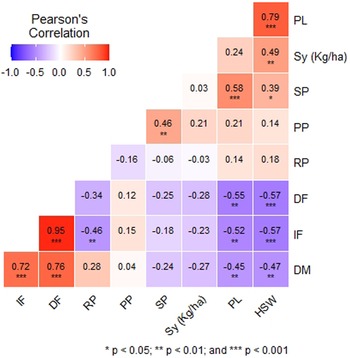
Pearson correlation analysis was used to evaluate the phenotypic correlations between the traits studied and are shown in Fig. 1. The results exhibited that DM had a strong positive association with DIF (r = 0.72) and DFF (r = 0.76). It had a significant negative association with 100-seed weight (r = 0.470), PL (r = 0.450), SP (r = −0.24) and grain yield (r = −0.27). Likewise, initial flowering had a highly effective association with DFF (r = 0.95). Further, PP had a highly significant correlation with SP (r = 0.46). On the contrary, SP were strongly associated with PL (r = 0.58) followed by 100-seed weight (r = 0.39). Seed yield per ha had a highly significant correlation with 100-seed weight (r = 0.49), and PL was strongly associated with 100-seed weight (0.79).
Pearson's correlation coefficients estimated among eight agronomic traits in 29 common bean germplasm.

Principal component analysis among traits
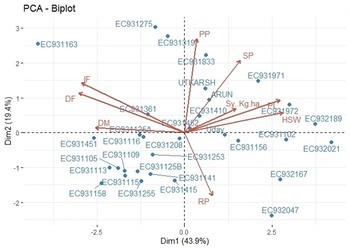
Interrelationships among the different characteristics were studied using PCA. The results revealed that significant variation among the features studied and the first four principal components (PCs) could explain 87.6% of the total variation in the dataset. The scree plot displays the number of the PC vs its corresponding percentage of explained variance for the PCA's nine PCs (Fig. S2). The proportion of PC variation was explained, and the eigenvalue is given in Table S1. The first PC explained 43.9% of the total phenotypic variation, followed by the second PC, which explained 19.4% of the total phenotypic variation, followed by subsequent PCs. The germplasm that contributed the most phenotypic variation to PC1 and PC2 components were EC931163, EC932021, EC932189 and EC932047 (Fig. S3). The PCA biplot depicts the correlations between germplasm and characteristics (Fig. 2). The essential variables were PP, SP, PL and a 100-seed weight, which were inversely connected with PC1 and associated genotypes (EC931319, EC931833, EC931971, Arun, Urakrsh) loading on PC1 components. PL and 100-seed weight were positively associated with genotypes EC931972 and EC932189 and form clusters. Similarly, DIF and DFF are highly associated with and form another group and respective genotypes loaded on PC2 components. The germplasm that contributed the most phenotypic variation to PC1 and PC2 components were EC931163, EC932021, EC932189 and EC932047 (Fig. S3). The PCA biplot depicts the correlations between germplasm and characteristics (Fig. 2). The essential variables were PP, SP, PL and a 100-seed weight, which were inversely connected with PC1 and associated genotypes (EC931319, EC931833, EC931971, Arun, Utkarsh) loading on PC1 components.
Principal component analysis (PCA) correlation biplots depicting the relationship between nine traits in 29 common bean accessions.

Cluster analysis for agronomic traits
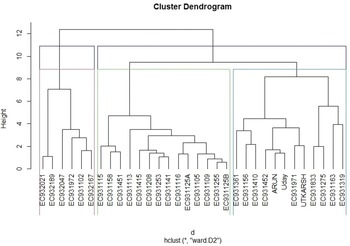
We performed a hierarchical cluster analysis to estimate the degree of similarity or dissimilarity among the germplasm. The clustering algorithm K-means obtained the optimal number of clusters (Fig. S4). The results revealed that a dendrogram or hierarchy was generated by utilizing the germplasm's mean value of agronomic data through the agglomerative approach (Fig. 3). The highest number of germplasm groups was observed in cluster II (14 accessions), followed by cluster III (9 accessions) and cluster I (6 accessions). The accessions for early to initial flowering and DFF are grouped in cluster I. Accordingly, the accessions with a higher RP and later maturity duration fall in the cluster II. The accessions were recorded with the maximum number of PP and higher grain yield, and the highest range of PL was classified in cluster III.
Grouping of 29 common bean germplasm based on the mean value of nine agronomic traits using Euclidean distance.

Performance of promising germplasm in diverse production environments
We investigated the response of 29 exotic bean germplasms to phenological development and agronomic traits in two bean production conditions. Each combination of the season with the location was considered an environment. We observed various variations for phenological and yield-attributing traits among the germplasm across the environments and seasons. The mean data obtained from the three consecutive years in the low-altitude Kanpur region were assessed and compared with high-yielding checks in each season, and the results are presented in Table 3. Out of 29 bean germplasm, we found that EC932021 and EC932189 were the most stable germplasm and performed superior for earliness over three consecutive years (Kanpur), with a mean value of 29.2 and 32.6 for DIF, 35.2 and 38.6 for DFF and 92.8 and 98.6 for DM respectively. Further, we observed that the mean value of grain yield was 1456.5 and 1256.4 kg/ha, respectively. Furthermore, the germplasm EC931452 and EC931971 found consistent performance and higher grain yield than the control cultivars, with the mean value of grain yield for three consecutive years being 2255.7 and 2084.7 kg/ha, respectively. On the contrary, based on the 1-year phenotypic evaluation in high-altitude Shimla region, the 29-bean germplasm mean value was estimated and compared with the high-yielding cultivars. Unexpectedly, we identified that the germplasm EC932021 and EC932189 exhibited extra earliness for DIF with a mean value of 35.4 and 37.3, DFF (35.4 and 37.3) and maturity (75.6 and 88.3) with mean grain yield of 1685.2 and 1546.3 kg/ha, respectively. In addition, the germplasm EC931452 and EC931971 recorded a higher grain yield of 2834.2 and 2456.3 kg/ha, respectively, over the check varieties.
Performances of selected high-yielding and early maturing germplasm in winter and rainy seasons at two bean production environments

Discussion
The genetic composition of bean germplasm and the environmental factors of the locations were found to have a considerable impact on the phenological development and yield components of common bean genotypes. For the traits studied in multi-season environments, there were highly significant phenotypic differences among common bean germplasm lines. The results exhibited that the values for mean and ranges were higher and found significant variation for phonological traits such as DIF, DFF and DM (Table 2). It indicated that even within this set of diverse exotic lines, there is scope for selecting accessions with different maturity durations. It also provides an excellent opportunity for yield improvement. Our results agree with Islam et al. (Reference Islam, Basford, Redden, González, Kroonenberg and Beebe2002); Shiferaw et al. (Reference Shiferaw, Melis, Sibiya, Assefa and Keneni2020); Choudhary et al. (Reference Choudhary, Gupta, Shafi, Jan, Mir, Singh and Mir2022). Higher mean values of yield-attributing characteristics, such as PP, PL, SP and 100-grain weight, were found to be responsible for high grain production. It indicates that there were sufficient variations among the tested germplasm lines. Therefore, selection based on these traits would be effective for common bean crop improvement programmes. Our results were consistent with the findings of Kumar et al. (Reference Kumar, Sharma, Sharma, Kumar, Sharma, Malik, Singh, Sanger and Bhat2014); Basavaraja et al. (Reference Basavaraja, Manjunatha, Chandora, Gurumurthy and Singh2021); Basavaraja et al. (Reference Basavaraja, Manjunatha, Chandora, Singh, Rathod, Dubey, Kanishka, Singh and Singh2022). Despite this, plant breeding relies mainly on the presence of enormous genetic variation to address the maximum genetic yield potential of the crops and exploitation of this variation through effective selection for improvement. In this study, traits that showed a high GCV combined with a high PCV were seed yield followed by 100-seed weight, PP and PL. This suggests that these traits are influenced by genetic control and less affected by the environment. Hence, these traits can be relied upon, and simple selection can be practiced for further improvement. Therefore, selection based on phenotype for these traits is likely to affect similar observations recorded by Boru (Reference Boru2014) and Barecha (Reference Barecha2015). Consequently, heritability and GA are critical aspects of the selection process. Selection becomes more valuable when combined with high heritability and GA (Johnson et al., Reference Johnson, Robinson and Comstock1955). A high degree of heritability estimate was found for all traits under study, indicating that the environment has little or no influence on the expression of these traits, which may respond to selection for improvement. Seed yield, followed by 100-seed weight, PL and PP, showed high heritability and GAM. As a result, these are inherited traits, and the heritability is most likely due to additive gene effects, and selection for these traits may be effective in early generations. Similar findings were reported by Asfaw et al. (Reference Asfaw, Blair and Almekinders2009). Therefore, crop species with the most significant genetic variation have more potential for adapting to environmental conditions (Govindaraj et al., Reference Govindaraj, Vetriventhan and Srinivasan2015).
The understanding of inter-character association is critical for the successful selection of desirable genotypes from the entire germplasm. In this study, phenological parameters such as DM demonstrated a high positive correlation with DIF and DFF (Fig. 1). It implies that DIF and DFF are essential indicators of early maturity that could be employed in breeding for earliness. Similar findings were recorded by Seyoum et al. (Reference Seyoum, Alamerew and Bantte2012) and González et al. (Reference González, Yuste-Lisbona, Weller, Vander Schoor, Lozano and Santalla2021). The yield-attributing trait SP has a significant positive association with PL and 100-seed weight. It suggests that PL and 100-seed weight indirectly enhance the SP, resulting in higher grain yield. It indicates that the superiority in yield performance of the early maturing lines is reflected in the significant negative genetic correlations between yield and DM at both locations (Fig. S5). Further, PP significantly correlated with SP. It suggests that a positive association between PP and SP's most crucial yield component traits would imply that the breeder should select a higher number of PP to enhance seed yield. This results in agreement with the study of Manggoel et al. (Reference Manggoel, Uguru, Ndam and Dasbak2012) and Basavaraja et al. (Reference Basavaraja, Manjunatha, Chandora, Singh, Rathod, Dubey, Kanishka, Singh and Singh2022).
On the contrary, SP was strongly associated with PL followed by 100-seed weight. Therefore, the indirect selection of higher grain yields is strongly influenced by SP, PP and 100-seed weight. Among these components, the number of pods and SP significantly influences the enhanced grain yield; selecting these traits in the breeding programme is highly effective. There have been similar reports in previous studies by Frank and Fehr (Reference Frank and Fehr1981); Fukuta et al. (Reference Fukuta, Fukuzono, Kawaide, Abe and Nakayama2006); Yang et al. (Reference Yang, Shi, Wang, Liu and Wang2016) and García-Fernández et al. (Reference García-Fernández, Campa, Garzón, Miklas and Ferreira2021). Seed yield per ha had a highly significant correlation with 100-seed weight, and PL was strongly associated with 100-seed weight. It is indicated that the indirect selection of 100-seed weight and PL will enhance the seed yield, and selecting these traits in the breeding programme is highly beneficial. Similar findings were reported by Zakizadeh et al. (Reference Zakizadeh, Moghaddam and Kahrizi2010) and Zarei et al. (Reference Zarei, Kahrizi, Aboughadareh and Sadeghi2012).
The PCA biplot displays the relationships between genotypes and traits (Fig. 2). The first two PCs (explaining a total of 63.3% of the variation) depicted a high diversity among the exotic bean lines of the common bean for the traits analysed. It suggests a considerable diversity across locations and seasons among all genotypes evaluated for agronomic traits; similar findings were reported by Al-Naggar et al. (Reference Al-Naggar, Shafik and Musa2020) and Ndlangamandla and Ntuli (Reference Ndlangamandla and Ntuli2021). The most important traits were PP, SP, PL and 100-seed weight, which are highly correlated. They formed as clusters and associated genotypes (EC931319, EC931833, EC931971, Arun, Urakrsh) loading on PC1 components. The test genotypes clustered together on the right side of the biplot were selected as a candidate and possible parental genotypes to improve these agronomic traits in a breeding programme. These results were supported by the finding of previous researchers (Upadhyaya et al., Reference Upadhyaya, Dwivedi, Gowda and Singh2007; Asfaw et al., Reference Asfaw, Blair and Almekinders2009; Basavaraja et al., Reference Basavaraja, Manjunatha, Chandora, Singh, Rathod, Dubey, Kanishka, Singh and Singh2022). Cluster analysis traced the astonishing patterns of exotic germplasm dispersion and diversification of the common bean (Fig. 3). The highest number of accessions was observed in cluster II (14), followed by cluster III (9) and cluster I (6). These results follow the findings of Basavaraja et al. (Reference Basavaraja, Manjunatha, Chandora, Singh, Rathod, Dubey, Kanishka, Singh and Singh2022). These findings demonstrated that different source locations and geographic localities had no apparent effect on the diversity pattern of agronomic traits. Even ecotypes from different localities are clustered in the same groups at the exact linkage distances on the dendrogram. Exotic bean lines possess a high diversity in days to flowering, PP, grain yield and maturity duration. Our findings are consistent with a recent study by Choudhary et al. (Reference Choudhary, Gupta, Shafi, Jan, Mir, Singh and Mir2022). The selection of such diverse and genetically influential traits may help design new breeding programmes for common bean improvement and develop a new variety. The accessions early to initial flowering and DFF are grouped in cluster I. Accordingly, the accessions with a higher RP and later maturity duration fall in cluster II. The accessions were recorded with the maximum number of PP and higher grain yield, and the highest range of PL was classified in cluster III. Similar conclusions were drawn by Amini et al. (Reference Amini, Ghannadha and Abd-Mishani2002) and Basavaraja et al. (Reference Basavaraja, Manjunatha, Chandora, Singh, Rathod, Dubey, Kanishka, Singh and Singh2022). It is indicated that genotypes from cluster I will be crossed with genotypes from cluster II to improve seed yield with early maturity because cluster I contained early maturing genotypes, and cluster III had genotypes with high seed yield, more PP and PL.
Evaluation and selection of the best performing and stable accessions under multi-environment/year were also one of the aims of this study. The evaluation of bean germplasm in the plain region (Kanpur) during the winter season exposed to a wide range of temperature variations. Over three consecutive years, the crop experienced a sub-optimal temperature of 15°C, and the average daily air temperature was less than the optimum temperature of 24–30°C for common beans (Fig. 1) (Balardin et al., Reference Balardin, Costa, Ribeiro, Dutra and Costa2000; Reichert et al., Reference Reichert, Rodrigues, Awe, Riquelme, Kaiser and Reinert2015), and the effect of low-temperature stress may slow down plant growth from vegetative to reproductive growth, flowering and grain filling stages affected grain production (Krishnamurthy et al., Reference Krishnamurthy, Gaur, Basu, Chaturvedi, Tripathi, Vadez, Rathore, Varshney and Gowda2011; Abaidoo et al., Reference Abaidoo, Dare, Killani and Opoku2017). On the contrary, the germplasm is planted in the rainy season in the high-altitude region (Shimla) with favourable crop growth and development conditions. During the growing period, the average daily air temperature ranged between 30 and 32°C (Fig. S1). Therefore, it was generally observed that in comparison to higher altitude regions (Shimla), the bean germplasm took more days to flower and mature in the lower altitude/plain region (Kanpur).
Further, there were large and highly significant differences in the seed yield of the accessions in both the sowing times and locations. The germplasm EC932021 and EC932189 showed stable performance for earliness (flowering and maturity). Similarly, EC931452 and EC931971 were noticed for higher grain yield in both locations across all seasons (Table 3); this germplasm was identified as better adaptable towards environmental changes. It suggests that the timing of flowering within a season is determined mainly by responses to temperature and photoperiod (Wallace and Yan, Reference Wallace and Yan1998). Thus, to improve the relationship between DM with yield in these bean-growing areas, it is paramount to ensure that favourable conditions for flowering are obtained during the growing cycle.
Conclusion
This investigation revealed that the evaluation of exotic germplasm in two diverse production regions suggests the presence of high levels of genetic diversity for valuable traits and a wide range of variability observed among the evaluated germplasm. In response to varied environmental conditions in both locations, a sizeable phenological variation was observed from early flowering to the pod-filling stage. The results again suggest that temperature is the main driver behind the phenological changes in both environmental conditions. Therefore, the phenotypic characterization of exotic bean germplasm enables the discovery of valuable sources and predicts the genetic potential of underutilized materials in gene banks. The unique early maturity (EC932021 and EC932189) and high grain yielding (EC931452 and EC931971) germplasm sources identified in this study are agronomically superior and expected to provide better opportunities for developing early maturity cultivars suitable for varied agro-ecological locations.
Supplementary material
The supplementary material for this article can be found at https://doi.org/10.1017/S1479262123000618.
Data availability
All data presented in this article are available with the authors.
Acknowledgement
The authors acknowledge ICAR-NBPGR, New Delhi, and CIAT, Cali Colombia, for providing the exotic germplasm for research.
Author contributions
T. Basavaraja and Aditya Pratap – conceptualization of research; T. Basavaraja, Mohar Singh, Anupam Tripathi, L. Manjunatha and Rahul Chandora – execution of field experiments and data collection; J. C. Rana and P. K. Katiyar – research work guidance and support; S. Gurumurthy and S. D. Nitesh Kumar – analysis of data and interpretation; T. Basavaraja, J. C. Rana and Aditya Pratap – writing, review and editing; Bansa Singh – project administration and institute resource facilitated; T. Basavaraja and L. Manjunath – preparation of the manuscript. All authors commented and reviewed the manuscript.
Financial support
This study was funded by the Indian Council of Agricultural Research (ICAR), New Delhi, and the Science and Engineering Research Board, Government of India [project sanction file: EEQ/2018/000966].
Competing interest
None.