Introduction
The provision for direct general practitioner referral to audiology clinics, and the subsequent provision of hearing aids by audiologists, was introduced to the National Health Service (NHS) in order to reduce waiting times and pressure on ENT clinics. Many of the patients thus referred do not need to be seen in a general ENT clinic. It has been estimated that only 16 per cent will require subsequent referral to ENT services for further management.Reference Eley and Fitzgerald1
One of the reasons for such referral is asymmetrical sensorineural hearing loss on the audiogram, because of the possible diagnosis of vestibular schwannoma.
Vestibular schwannomas are nerve sheath tumours of the vestibulocochlear nerve (the VIIIth cranial nerve) and have a reported annual incidence of one to two cases per 100 000.Reference Stangerup, Tos, Thomsen and Caye-Thomasen2, Reference Howitz, Johansen, Tos, Charabi and Olsen3 Common symptoms suggesting the need for further investigation include asymmetrical sensorineural hearing loss, sudden or fluctuating hearing loss, unilateral tinnitus, and persistent dizziness. One in five patients who present to the ENT clinic have symptoms compatible with a diagnosis of vestibular schwannoma.Reference Harcourt, Vijaya-Sekaran, Loney and Lennox4 However, only 1–2 per cent of these patients will ultimately be found to have a vestibular schwannoma.Reference Obholzer and Harcourt5
Methods for investigating this tumour have evolved dramatically over the last 20 years. Audiovestibular and auditory brainstem response tests are now rarely performed as magnetic resonance imaging (MRI) has become widely available. Whilst MRI is the ‘gold standard’ investigation for vestibular schwannoma identification, it would be a burden on the health system to use it as a screening tool. However, if a scan was not offered, some clinicians may fear litigation due to delayed diagnosis. For these reasons, it has been suggested that an agreed protocol is needed in order to support clinicians in deciding whether or not an MRI scan is indicated.Reference Fisher, Parikh, Harcourt and Wright6
The direct referral audiology clinic
It is recommended that patients with symptomatic asymmetrical deafness should be referred to an ENT clinic rather than to a direct referral audiology clinic, because of the possibility of vestibular schwannoma. This means that symptomatic asymmetrical deafness should rarely been found amongst patients referred to direct referral audiology clinic.
In the UK, it has been estimated that approximately 11 per cent of men and 5.6 per cent of women aged 18–80 years in the normal population, with no previous significant noise exposure, will have hearing asymmetry which warrants further investigation.Reference Lutman and Coles7 Therefore, it is not surprising that this group of patients is found amongst direct referral audiology clinic patients. However, there has been no previous investigation of how many direct referral audiology clinic patients are subsequently found to have vestibular schwannoma.
An audit performed in the ENT department at Doncaster Royal Infirmary between July and September 2003 found that 50.4 per cent of patients seen in the direct referral audiology clinic were referred on to the ENT clinic because they failed to meet local criteria for treatment solely within the audiology clinic. After assessment in the ENT clinic, many of these patients received no further investigation or treatment other than request for MRI scans.
In an attempt to reduce the number of ENT clinic appointments, we altered the criteria for management within the direct referral audiology clinic, by redefining the level of hearing asymmetry that required medical attention.
A re-audit the following year showed that the cross-referral rate had reduced to 29.4 per cent. As many of these patients had asymmetrical sensorineural hearing loss (and a small number unilateral tinnitus), we decided in such cases to omit the initial ENT appointment and to offer an MRI scan on the basis of the audiogram in the direct referral audiology clinic, with a subsequent letter to explain the results. Patients with conductive hearing loss or apparently abnormal tympanic membranes were still offered an ENT clinic appointment.
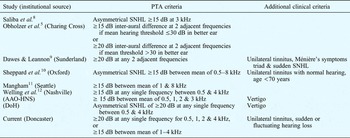
There are several screening protocols for vestibular schwannoma in the literature (Table I).Reference Saliba, Martineau and Chagnon8–Reference Welling, Glasscock, Woods and Jackson12 Our scanning criteria have been in use since 2003.
Published asymmetrical hearing loss protocols

PTA = pure tone audiometry; SNHL = sensorineural hearing loss; AAO-HNS = American Academy of Otolaryngology – Head and Neck Surgery; DoH = Department of Health
The aim of the current study was to identify the incidence of vestibular schwannoma diagnosed within direct referral audiology clinic. With this knowledge, we hoped to optimise our service provision within the NHS. We also present our experience with our protocol, compared with findings for published protocols. Lastly, we report the frequency of incidental findings from the scans undertaken in the same patients.
Patients and methods
This study was carried out at Doncaster Royal Infirmary, UK, between January 2007 and June 2010. Patients over 50 years of age with suspected hearing loss were referred to the audiology department by their general practitioner for hearing assessment and hearing aid provision as required. Those patients with asymmetrical hearing loss, sudden or fluctuating hearing loss, or unilateral tinnitus were offered an MRI scan. This was changed to a computed tomography (CT) scan if relevant patient factors existed. We considered asymmetrical hearing loss to be clinically significant if there was an inter-aural mean difference of ≥15 dB across the frequencies 1 to 4 kHz, or a single frequency difference of ≥20 dB at 0.5, 1, 2 or 4 kHz.
The MRI and CT scans were assessed and reported by consultant radiologists. Scan results and basic patient demographic details were recorded onto a spreadsheet. Relevant audiograms were retrieved retrospectively from the audiology department's database and entered into the spreadsheet.
We defined incidental findings as asymptomatic intracranial abnormalities found on scan images which were unexplained by any previous diagnosis. When such findings required further attention, investigation or management, we considered them to be clinically significant.
Results
During the study period, 480 MRI scans were offered but 84 patients declined. One hundred MRI scans were changed to CT scans due to patient factors (mainly a metal body part or claustrophobia). A total of 296 MRI and 100 CT scans were subsequently carried out.
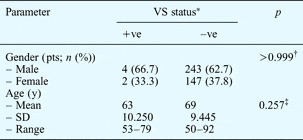
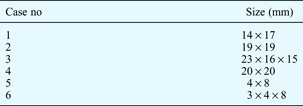
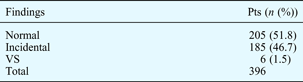
Vestibular schwannoma was identified in six (1.5 per cent) patients (four men and two women; age range 53–79 years; mean age 63 years) (Table II). There was no association between disease status and gender (Fisher's exact test, p > 0.999). There was no difference in the mean age between disease and non-disease groups (t-test, p = 0.257, 95 per cent confidence intervals 5.38–16.11). The size of the vestibular schwannomas is shown in Table III. Other, incidental findings were found in 185 cases (46.7 per cent) (Table IV), of which 12 (3 per cent) were of clinical significance (Table V). Two hundred and five scans were reported as normal (52 per cent) (Table IV).
Vestibular schwannoma patients' demographic data

*From scan. †Fisher's exact test; no difference in disease status by gender. ‡T-test, mean difference = 5.4 years, 95 per cent confidence interval = −5.38 to 16.11; no difference in disease status by mean age. VS = vestibular schwannoma; +ve = positive; –ve = negative; pts = patients; y = years; SD = standard deviation
Vestibular schwannoma size
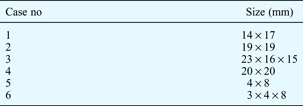
No = number
Scan results
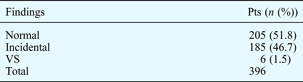
Pts = patients; VS = vestibular schwannoma
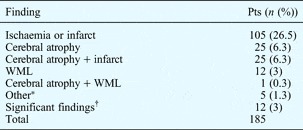
Incidental findings

*Clinically insignificant. †Patient numbers: demyelination = 3; vascular anomaly = 3; pituitary mass = 2; meningioma = 2; arachnoid cyst = 1; middle-ear findings = 1; Pts = patients; WML = white matter lesion
Of the six patients with vestibular schwannoma confirmed on MRI, all qualified for MRI scanning on the basis of both the single frequency asymmetry criterion (range of difference, 25–80 dB) and the inter-aural average frequency asymmetry criterion. If our patients had been assessed using other published protocols (Table I), all would have been offered a scan, and all patients with vestibular schwannoma would have been identified, except in the case of the Saliba et al. and Oxford protocols.Reference Saliba, Martineau and Chagnon8, Reference Sheppard, Milford and Anslow10 The use of either of these protocols would have resulted in one patient failing to be offered a scan, resulting in one vestibular schwannoma diagnosis being missed. In this patient's case, Saliba and colleagues' protocol would not have offered a scan because there was no asymmetry at 3 kHz, while the Oxford protocol would not have offered a scan because of its age criterion.
Ischaemia and infarction were the most common incidental findings (Table V), with 105 patients (26.5 per cent) being affected. This was followed by cerebral atrophy with infarct and cerebral atrophy alone, comprising 25 cases (6.3 per cent) each. White matter lesions (defined as hyperintense white matter foci) were found in 12 cases (3 per cent). There was one case (0.3 per cent) of a white matter lesion with atrophy. White matter lesions consistent with ischaemia were included in the ischaemia or infarct category. Five scans (1.3 per cent) showed clinically insignificant findings, ranging from age-related changes (e.g. prominent sulci and ventricles) to a dominant right vertebral artery.
Of the 12 cases (3 per cent) with clinically significant findings, three showed possible demyelination and required referral to neurology. In addition, there were three cases of vascular anomaly (one aneurysm, one haemangioma and one arteriovenous malformation), two meningiomas, two pituitary masses, one arachnoid cyst and one possible cholesteatoma. Appropriate appointments for the neurosurgery, endocrinology or ENT clinic were arranged.
Discussion
Doncaster Royal Infirmary is a large district hospital serving a local population of approximately 290 000. During the three and a half year study period, 396 scans were carried out and six cases of vestibular schwannoma were identified amongst patients seen in the direct referral audiology clinic. This represents a detection rate of 1.5 per cent, which is lower than the 3–5 per cent rate in the published literature.Reference Sheppard, Milford and Anslow10, Reference Dawes13
There could be several explanations for this.
First, our protocol criteria may have been too lax, allowing more scans to be offered and hence resulting in a lower detection rate.Reference Mahrous and Kalepu14 A total of 4100 patients were seen in the direct referral audiology clinic during the study period. Four hundred and eighty scans (11.7 per cent of the total) were offered and 396 scans (9.7 per cent) were subsequently carried out. To achieve a 5 per cent detection rate with our current data, approximately 120 scans (2.9 per cent) would have had to have been offered over the study period. However, Lutmen et al. reported that, in a non-noise-exposed population, about 11 per cent of men and 5.6 per cent of women aged 18–80 years had hearing asymmetry on audiometry which could qualify them for further medical attention and investigation.Reference Lutman and Coles7 Fisher et al. reported that 11.6 per cent of patients in a general ENT clinic required further investigation because of unilateral or asymmetrical deafness.Reference Fisher, Parikh, Harcourt and Wright6 Although our study sample differed from that of Lutmen et al. and Fisher et al., these authors' publications provide an estimate of a reasonable number of scans to be offered in such a population. One hundred and twenty scans (2.9 per cent) seem restrictive in comparison with these authors' numbers; thus, we feel that the number of scans we offered was not excessive.
Second, our data only reflected primary care referrals to the direct referral audiology clinic. Our sample group thus differed from those of other comparable studies, which assessed the overall detection rate for the whole ENT department. Patients presenting to the direct referral audiology clinic had no subjective asymmetrical hearing loss, and the primary aim of attendance was the provision of hearing aids. Our study population was aged 50 years or above, as per referral criteria. In contrast, the ENT clinic sees patients with symptomatic asymmetrical hearing loss referred by their general practitioner with the aim of excluding serious pathology; thus, this group generally includes the entire adult population. Although vestibular schwannoma is more common in the elderly population and our study was skewed towards the older age group, this did not result in a high detection rate. It seems that patients' subjective symptoms also play a significant role in suggesting the diagnosis.
Lastly, we had a relatively large number of CT requests in this study, due to patient factors. Computed tomography scans are known to be less sensitive in detecting small tumours, compared with MRI. It has been reported that the average size of a vestibular schwannoma at presentation is 11 mm, and that modern CT can detect tumours larger than 10 mm.Reference Donnelly, Cass and Ryan15, Reference Yoshimoto16 This means that, while CT scans can probably detect a good proportion of tumours, small tumours will inevitably be missed. This may have contributed to the lower detection rate in our study.
Direct referral audiology clinics in the National Health Service
Direct referral audiology clinics were introduced to the NHS to relieve the pressure on ENT clinics, as most referred patients only require a hearing assessment for a hearing aid. Most direct referral audiology clinics do not accept referrals if symptoms are unilateral or asymmetrical, because of the risk of missing serious pathology such as vestibular schwannoma.
However, such concern may be unwarranted. If the otologist's suspicion is raised by asymmetrical findings on audiography, then this should equally be the case for the audiologist.Reference Swan and Browning17 Therefore, it may not be unreasonable to have an initial hearing assessment performed in the direct referral audiology clinic, with an MRI plus ENT follow up requested if indicated.
• The vestibular schwannoma detection rate was lower for audiology clinic referrals than general ENT clinic patients
• Detection of incidental findings (generally ischaemia or infarcts) was similar to earlier reports
• Direct referral audiology clinic referral criteria could be expanded to include asymptomatic unilateral hearing loss
This management pathway could potentially reduce the overall cost to the NHS, as a general practitioner referral to the direct referral audiology clinic will be cheaper than an ENT clinic referral.Reference Eley and Fitzgerald1 If our audiology clinic protocol had not been in place, over 300 extra patients would have been added to our ENT clinic list. Of course, if the cause of asymmetrical hearing loss is evident upon initial clinical examination in the general practice clinic (e.g. unilateral otitis media with effusion), then patients should be seen in the ENT clinic first. Patients referred to the direct referral audiology clinic should be referred on to the ENT clinic if assessment of the audiological findings is beyond the audiologist's experience.
As vestibular schwannoma has a very low incidence and a low detection rate, many of the scans undertaken to investigate this diagnostic possibility would be expected to be normal or to have incidental findings. In our series, 205 scans (51.8 per cent) were reported as normal, which is similar to published rates of 52–62 per cent.Reference Chisholm, Savy, Geyer and Choa18–Reference Mirza, Malik, Ahmed, Willatt and Hughes20 Reports of incidental findings are variable, as they depend upon what is considered incidental. Papanikolaou et al. reported incidental findings (defined as any abnormal finding) in 47.5 per cent of their series; however, only 2.5 per cent of these cases required further management.Reference Papanikolaou, Khan and Keogh19 Similarly, Mirza et al. reported incidental findings in 45 per cent of cases, but only 1.7 per cent were considered to be serious abnormalities.Reference Mirza, Malik, Ahmed, Willatt and Hughes20 Morris et al. conducted a systematic review of incidental findings on brain MRI scans, assessing 16 studies, and concluded that 2.7 per cent of patients undergoing a brain MRI scan will have incidental findings on the scan.Reference Morris, Whiteley, Longstreth, Weber, Lee and Tsushima21 They did not include white matter hyperintensities, silent infarcts or brain microbleeds, as the prevalence of these lesions increases with age. Although, Morris and colleagues' reporting methods differed from those used in our study, the incidence of significant pathology detection (on the scan) was similar, in the region of 2–3 per cent. This is comparable with our 3 per cent incidence of significant incidental findings.
Conclusion
The vestibular schwannoma detection rate is lower amongst patients referred to a direct referral audiology clinic (1.5 per cent) than amongst general ENT clinic patients (3–5 per cent in the literature). Patients attending direct referral audiology clinics usually do not have symptomatic asymmetrical hearing loss, which could explain the lower vestibular schwannoma detection rate in this group. The incidence of significant incidental findings in this study (3 per cent) is similar to previous reported findings.
Many patients with unilateral hearing loss are not found to have vestibular schwannoma. Therefore, we believe that the general practitioner referral criteria for direct referral audiology clinics could be expanded to include patients with unilateral hearing loss, provided there is no obvious clinical cause. This could enable further savings for the NHS.
Acknowledgement
We thank Sara Hilditch, Director at the Statistical Services Unit, University of Sheffield, for her help with the statistics in this study.