



1 Introduction
In several European languages, words may display a suprasegmental contrast associated with the stressed syllable that manifests itself through differences in pitch, phonation, duration or a combination thereof. For example, Swedish and Norwegian display two distinctive tonal accents, Accent 1 and Accent 2, while the cognate opposition in Danish is realised by a form of glottalisation known as stød (Gårding Reference Gårding1977). Similarly, some Franconian dialects contrast two tonal accents, accompanied by differences in duration (Gussenhoven & Peters Reference Gussenhoven and Peters2004, Peters Reference Peters and de Vaan2006), and heavy stressed syllables in Estonian distinguish normal length and overlength, each with its own characteristic pitch contour (Lehiste Reference Lehiste1960). As noted by Ternes (Reference Ternes1980, Reference Ternes2006: ch. 5), a microcosm of these phenomena is found in Scottish Gaelic, where forms belonging to two phonological classes – termed Class 1 and Class 2 in this paper – are distinguished in different dialects by means of either tonal accent, glottalisation or overlength. Tonal accent is used in Lewis (Borgstrøm Reference Borgstrøm1940, Oftedal Reference Oftedal1956), glottalisation in Islay (Holmer Reference Holmer1938) and overlength in Applecross, Ross-shire (Borgstrøm Reference Borgstrøm1941, Ternes Reference Ternes1973), as shown in (1).
(1)

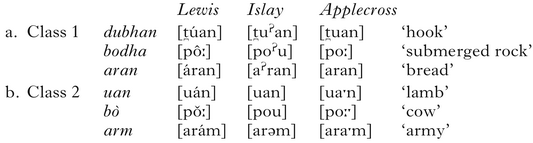
In Lewis, Class 1 forms display a pitch peak on the first mora and Class 2 forms on the second. In Islay, Class 1 forms are distinguished from Class 2 forms by a period of glottalisation between the first two moras. Finally, in Applecross, Class 1 forms show normal length, while Class 2 forms exhibit overlength through elongation of the second mora.
It has long been argued that the contrast between long and overlong syllables in Estonian reflects a difference in the extent of the foot (Prince Reference Prince1980, Odden 1997), and a number of recent analyses have likewise invoked metrical structure in order to derive the tonal accent contrasts in Swedish (Morén-Duolljá Reference Morén-Duolljá2013) and Franconian (Köhnlein Reference Köhnlein2011, Reference Köhnlein2016, Hermans Reference Hermans, Botma and Noske2012, Kehrein Reference Kehrein2018, van Oostendorp Reference Oostendorp2018), as well as Danish stød (Iosad Reference Iosad2016). The contrast between Class 1 and Class 2 forms in Scottish Gaelic has also been ascribed to metrical structure in various ways, sometimes involving complex multi-layered structures such as ‘super-syllables’ (Bosch & de Jong Reference Bosch and de Jong1998) or recursive syllables (Smith Reference Smith, van der Hulst and Ritter1999). In accordance with numerous other authors (Oftedal Reference Oftedal1956, Hind Reference Hind1996, Reference Hind1997, Ladefoged et al. Reference Ladefoged, Ladefoged, Turk, Hind and Skilton1998, Hall Reference Hall2003, Reference Hall2006, Ladefoged Reference Ladefoged, Local, Ogden and Temple2003, Wentworth Reference Wentworth2005, Iosad Reference Iosad, Hilpert, Östman, Mertzlufft, Rießler and Duke2015), I argue that the contrast directly reflects the extent of the stressed syllable: in Class 1 forms the stressed syllable contains only the first mora, while in Class 2 forms it contains the first two moras. Unlike most of the aforementioned analyses of other languages, however, I will argue that the metrical structure – and hence the phonological class membership – of a form in Scottish Gaelic is predictable from its underlying segmental content: in other words, the metrical contrast between Class 1 and Class 2 forms is a derived one. Scottish Gaelic can therefore be thought of as representing an intermediate step on the diachronic trajectory that led to the lexically contrastive metrical structure proposed for those languages in the present day.
The analysis presented in this paper uses the framework of Stratal Optimality Theory (Kiparsky Reference Kiparsky2000, Bermúdez-Otero Reference Bermúdez-Otero, Hannahs and Bosch2018), according to which an utterance undergoes several rounds of phonological computation acting upon successively larger morphosyntactic domains, viz. the stem, the word and the phrase. I argue that metrical structure in Scottish Gaelic is built in the stem-level phonology in a regular manner, but may subsequently be rendered opaque by segmental operations at the word level – in particular, a process of copy epenthesis known as svarabhakti, which creates syllables containing two vocalic sonority peaks. In this way, the present analysis is similar to van Oostendorp's (Reference Oostendorp2018) analysis of tonal accent on pre-obstruent short vowels in Moresnet Franconian. Drawing on the proposals of Köhnlein (Reference Köhnlein2016) for Franconian tonal accent, I claim that faithfulness to foot structure preserves the stem-level syllable count when svarabhakti occurs, resulting in a word-level contrast between disyllabic and monosyllabic feet – even in sequences with identical segmental content. These differing metrical structures are then reflected on the surface by means of tonal accent, glottalisation or overlength, depending on dialect.
This paper demonstrates the ability of Stratal Optimality Theory to account for the highly complex intricacies of Scottish Gaelic phonology in a principled manner, and aims to provide the most complete analysis to date of the Class 1–Class 2 contrast in Scottish Gaelic. Additionally, by demonstrating how the same surface metrical contrast may be realised in different dialects of a single language by means of either tonal accent, glottalisation or overlength, this paper hopes to bring closer together the various existing metrical analyses of these phenomena in languages such as Swedish, Danish, Franconian and Estonian.
1.1 Sources and transcription
A considerable amount of dialectal variation exists in Scottish Gaelic, and it is necessary to limit any detailed analysis to a single variety. This paper will focus primarily upon the dialect of Lewis in the Outer Hebrides, where the Class 1–Class 2 contrast is realised through tonal accent. When not stated otherwise, all forms cited in this paper are from this dialect. For Lewis, Borgstrøm (Reference Borgstrøm1940) provides a detailed description of the dialect of Bernera in the west, as well as some additional notes on that of Ness in the far north, while Oftedal (Reference Oftedal1956) describes in detail the dialect of Leurbost in the east. As far as possible, the Lewis forms cited in this paper are limited to those found either in those two sources or in Ladefoged et al. (Reference Ladefoged, Ladefoged, Turk, Hind and Skilton1998), which revisits the dialect of Bernera; however, they are occasionally supplemented by forms from Ó Dochartaigh (Reference Ó Dochartaigh1994–97; henceforth SGDS) or from my own fieldwork in Ness. When a generalisation is made over all of the Lewis data, this should be taken to encompass all Lewis forms cited in Borgstrøm (Reference Borgstrøm1940), Oftedal (Reference Oftedal1956) and Ladefoged et al. (Reference Ladefoged, Ladefoged, Turk, Hind and Skilton1998), with the exception of compound forms, on which too little data is available for any systematic treatment, and transparent English or Scots loans, which do not always display full assimilation into the phonological system of Scottish Gaelic.
Due to the diverse transcription practices employed by the various sources cited in this paper, a large amount of normalisation has been necessary. Although the forms cited here may therefore differ considerably from those in my sources both in terms of the symbols employed and the degree of phonetic detail included, I have endeavoured throughout to accurately mark all aspects of their pronunciation that are relevant to the present analysis. All symbols have their IPA values, except for the coronal sonorants, for which a more abstract notation is employed (see §1.2). English glosses have also been normalised, in order to facilitate cross-dialectal comparison of cognate forms.
1.2 Palatalisation and the fortis–lenis contrast
Before we proceed with the analysis, it is necessary to introduce two important aspects of the sound system of Scottish Gaelic. For a general overview of the Scottish Gaelic sound system, the reader may wish to consult handbook chapters by MacAulay (Reference MacAulay and MacAulay1992), Gillies (Reference Gillies, Ball and Müller2009) or Bosch (Reference Bosch, Watson and Macleod2010). First of all, coronal and dorsal consonants in Scottish Gaelic may be either palatalised (traditionally ‘slender’) or non-palatalised (traditionally ‘broad’). Numerous morphological categories, such as the genitive case in many nouns and the comparative degree in adjectives, are marked by means of a morphophonological process of palatalisation, which targets consonants in the stem-final rhyme. If the stem is monosyllabic, palatalisation is often accompanied by an alternation in the vowel, which I will refer to as ablaut.
Secondly, again following traditional terminology, sonorants may be either fortis or lenis. The set of fortis sonorants [m N Nʲ L Lʲ R] is defined as those which may freely occur in initial position in unmutated stems, while the remaining sonorants [n lʲ r rʲ] – which normally occur initially only as a result of the lenition mutation – are lenis. The fortis coronal sonorants [N Nʲ L Lʲ R] are equivalent to IPA [n̪ˠ ɲ l̪ˠ ʎ rˠ], and the lenis coronal sonorants [n lʲ r rʲ] to IPA [n lʲ ɾ ðʲ]; however, I will follow Celticist tradition and employ the former, more abstract, notation throughout this paper in order to emphasise the phonological relationships that exist between these sounds. Note that both fortis [N] and lenis [n] alternate with fortis [Nʲ] under palatalisation, and fortis [L] may alternate with either fortis [Lʲ] or lenis [lʲ] under palatalisation, as in (2).
(2)

I take these alternations to indicate the existence of word-level fortition processes that convert certain underlyingly lenis coronal sonorants into fortis ones, resulting in the absence of palatalised lenis *[nʲ] and non-palatalised lenis *[l] on the surface. I will assume that fortis [Nʲ] and [L] represent underlyingly lenis sonorants whenever they alternate with lenis [n] and [lʲ] respectively. Throughout the present paper, palatalisation alternations will occasionally be used in examples to show that a particular instance of [Nʲ] or [L] is underlyingly lenis.
The structure of the paper is as follows. §2 shows that the Class 1–Class 2 contrast directly reflects the extent of the stressed syllable, and establishes the surface metrical structure of various types of Class 1 and Class 2 forms. It is shown that, in most cases, this follows from surface segmental content. §3 argues that the remaining cases – containing monosyllabic sequences with two vocalic sonority peaks – result from a regular phonological process of copy epenthesis known as svarabhakti. §4 argues that svarabhakti is a word-level process that depends on a mora projected by a coda sonorant at the stem level, and establishes the stem-level outputs upon which svarabhakti acts, while §5 offers an optimality-theoretic account of svarabhakti, showing how faithfulness to input foot structure can bring about the observed monosyllabic sequences. §6 discusses how the differing metrical structures of Class 1 and Class 2 forms are realised on the surface in different dialects of Scottish Gaelic. §7 provides some general discussion, and §8 concludes the paper.
2 Surface metrical structure
Almost all non-compound content words in Scottish Gaelic bear initial stress. No secondary stress occurs, except in synchronic compound forms, which will not be considered here since too little data is available for any systematic treatment of words of this type. In most cases, whether a form belongs to Class 1 or Class 2 simply depends on the length of the stressed vowel: if the stressed vowel is short then the form belongs to Class 1, realised in Lewis with a pitch peak on the first mora of the word, and if the stressed vowel is long then it belongs to Class 2, with a peak on the second mora. More generally, the pitch peak can thus be said to occur on the rightmost mora of the stressed vowel. However, under certain circumstances, the phonological class of a form may not follow straightforwardly from its overt surface segmental content. This can result in minimal pairs, as in (3).
(3)

In this section I show that the Class 1–Class 2 contrast directly reflects the extent of the stressed syllable in forms such as those in (3). I provide independent evidence that in Class 1 forms – which bear the first-mora pitch peak typical of a short stressed vowel – the stressed syllable contains only the first mora of the word, while in Class 2 forms – which bear the second-mora peak typical of a long stressed vowel – it contains the first two. This in turn leads to a difference in foot structure: in Class 1 forms the foot consists of two monomoraic syllables, while in Class 2 forms it consists of one bimoraic syllable. This section will move upwards through the prosodic hierarchy, from the mora in §2.1 through the syllable in §2.2 to the foot in §2.3, in order to establish the surface metrical structure of the various types of Class 1 and Class 2 forms illustrated in (3).
2.1 The mora
I will assume that onset consonants are attached directly to the syllable node, while coda consonants may either head a mora of their own, in which case they contribute to syllable weight, or else attach to the nearest mora to their left, in which case they are weightless (Hayes Reference Hayes1989, Broselow et al. Reference Broselow and Chen1997). Geminate consonants are overtly moraic; otherwise, moraic consonants may be diagnosed in codas whenever VC rhymes are seen to pattern with VV rhymes in some way, for example by attracting stress (as in Latin) or satisfying a word-minimality condition (as in English). Smith (Reference Smith, van der Hulst and Ritter1999: 618) and Hall (Reference Hall2003: 109) claim that evidence of the latter type exists in Lewis Gaelic, citing a process of final h-epenthesis that affects short open monosyllables, e.g. crodh [kʰroʰ] ‘cattle’, dubh [t̪uʰ] ‘black’. According to their analysis, h-epenthesis serves to satisfy a word-minimality condition by providing a monomoraic word with a coda. It follows from this that coda consonants must generally be moraic in Lewis Gaelic – at least when preceded by a short stressed vowel. However, h-epenthesis normally only occurs utterance-finally (Borgstrøm Reference Borgstrøm1940: 74, Oftedal Reference Oftedal1956: 116), which is unexpected if it serves to satisfy a general word-minimality condition. Additionally – and in agreement with Ternes (Reference Ternes1973: 84) for Applecross and with Wentworth (Reference Wentworth2005: 446) for Gairloch, Ross-shire – my own observations suggest that h-epenthesis forms just part of a more general devoicing process that also affects all voiced coda consonants in exactly the same environment (e.g. bean [pεn̥] ‘wife’, geal [kʲaL̥] ‘white’), and thus cannot be motivated by the need for a coda consonant (cf. also the distribution of glottalisation reported by Sommerfelt Reference Sommerfelt1922 for an Ulster dialect of Irish). In accordance with Green (Reference Green1997) on modern Goidelic in general, I therefore believe there is no evidence that coda consonants are moraic on the surface in Lewis Gaelic – although I will claim in §4 that moraic coda consonants do occur at an intermediate stage of the phonological derivation before subsequently transferring their mora to adjacent vowels. It will also be seen that overtly moraic (i.e. geminate) coda consonants may occur on the surface in dialects which lack these mora-transfer processes.
2.2 The syllable
There are three sets of circumstances under which the phonological class of a form in Lewis Gaelic may not follow straightforwardly from its overt surface segmental content. In each case, there is independent evidence that the stressed syllable contains only the first mora in Class 1 forms and the first two moras in Class 2 forms. First of all, certain ˈViVj sequences (where Vi and Vj are short vowels) may occur with either the first-mora pitch peak of Class 1 or the second-mora peak of Class 2, as in (4).
(4)
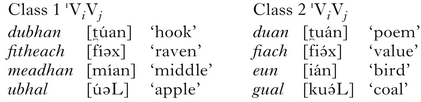
There is evidence that Class 1 ˈViVj sequences are hiatus sequences and Class 2 ˈViVj sequences are diphthongs. Phonotactically, a Class 1 ˈViVj sequence may generally contain any vowel that is allowed in a stressed syllable followed by any vowel that is allowed in an unstressed syllable; on the other hand, Class 2 ˈViVj sequences are restricted to certain pairs of vowels, viz. [iə́ iá uə́ uá] and various combinations ending in [í] or [ú]. Additionally, under palatalisation, Class 2 ˈViVj sequences behave as if they are monosyllabic. Recall from §1.2 that palatalisation may be accompanied by vowel ablaut in monosyllabic stems. Under palatalisation, Class 2 ˈViVj sequences frequently display ablaut alternations with long vowels, as in (5).
(5)

Accordingly, I will consider a Class 1 ˈViVj sequence to consist of two vowels in hiatus, so that only the first mora belongs to the stressed syllable; I will also consider a Class 2 ˈViVj sequence to represent a diphthong, so that the stressed syllable contains the first two moras. We can therefore maintain the generalisation that the stressed syllable is monomoraic in Class 1 forms, e.g. dubhan [t̪úμ]σ[aμn]σ ‘hook’, and bimoraic in Class 2 forms, e.g. duan [t̪uμáμn]σ ‘poem’.
Secondly, a word-final long vowel may occur in some dialects with the first-mora pitch peak of Class 1 rather than the second-mora peak of Class 2, as in (6).
(6)

There is evidence that Class 1 long vowels are actually hiatus sequences. Forms of this type generally exist in free variation with forms containing a straightforward hiatus sequence of a short vowel + [ə], e.g. [póə], and only the latter allomorph occurs under suffixation, as in (7).
(7)

Accordingly, I will consider a Class 1 long vowel to simply be a special case of hiatus, in which an optional word-level phonological process has caused underlying word-final /ə/ to assimilate in quality an immediately preceding short stressed vowel. We can therefore again uphold the generalisation that the stressed syllable is monomoraic in Class 1 forms, e.g. bodha [póμ]σ[oμ]σ ‘submerged rock’.
For the phonological representation of hiatus sequences I expand on Clements’ (Reference Clements, Bogers, van der Hulst and Mous1986) approach, by assuming that all apparently empty onsets in Scottish Gaelic actually contain an underspecified consonant [X(ʲ)], e.g. dubhan [t̪úXan], bodha [póXo]. Similar consonants have been proposed for independent reasons for both Scottish Gaelic and Irish. Vowel-initial words in Irish select either palatalised or non-palatalised allomorphs of proclitic particles on a lexically specific basis, leading a number of authors to propose the existence of an initial underspecified consonant carrying secondary place features (Gussmann Reference Gussmann, Kastovsky and Szwedek1986, Ní Chiosáin Reference Ní Chiosáin1991, Anderson Reference Anderson2016), and Morrison (Reference Morrison2018a) shows that a similar representation is required for Ness Gaelic. Additionally, the distribution of front and back vowels in Ness leads Morrison (Reference Morrison2018a) to propose that a consonant of this type also occurs in hiatus. The differing syllabification of hiatus sequences, on the one hand, and long vowels and diphthongs, on the other, therefore follows from their surface segmental content – as with an ordinary VCV sequence, two vowels separated by [X(ʲ)] project two separate syllables, while a long vowel or diphthong projects a single syllable.
Finally, a ˈViCVi sequence (where Vi is a short vowel) containing a sonorant may occur with the second-mora pitch peak of Class 2 rather than the first-mora peak of Class 1, as in (8).
(8)
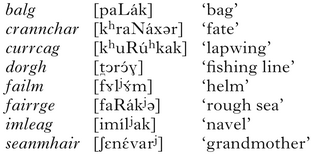
Class 2 ˈViCVi sequences are referred to as svarabhakti groups and the second vowel is often referred to as a svarabhakti vowel. There is evidence that svarabhakti groups are in fact monosyllabic. Phonotactically, svarabhakti vowels display the full range of qualitative contrasts found in stressed syllables, and are not subject to the same restrictions as unstressed vowels. Additionally, as noted by Hall (Reference Hall2003: 101–102, Reference Hall2006: 400) and Iosad (Reference Iosad, Hilpert, Östman, Mertzlufft, Rießler and Duke2015: 31), svarabhakti groups behave as if they are monosyllabic under palatalisation. Recall from §1.2 that palatalisation normally targets consonants in stem-final rhymes, and that it may be accompanied by ablaut in monosyllabic stems. If the consonant immediately following a svarabhakti group undergoes palatalisation, so does the intervening sonorant; meanwhile, ablaut affects both vowels, as shown in (9).
(9)

Accordingly, I will consider svarabhakti groups to be monosyllabic. Once again, we can therefore maintain the generalisation that the stressed syllable is bimoraic in Class 2 forms, e.g. balg [paμLáμk]σ ‘bag’.
These syllable counts are supported by speaker intuitions at least to some extent (Borgstrøm Reference Borgstrøm1937: 78, Reference Borgstrøm1940: 153, Oftedal Reference Oftedal1956: 29, Wentworth Reference Wentworth2005: 19, Hammond et al. Reference Hammond, Warner, Davis, Carnie, Archangeli and Fisher2014), and are consistently reflected in poetic metre (Oftedal Reference Oftedal1956: 29, O'Rahilly Reference O'Rahilly1972: 201, Wentworth Reference Wentworth2005: 19–20). Many other authors have reached similar conclusions, particularly with regard to svarabhakti groups (Oftedal Reference Oftedal1956, Hind Reference Hind1996, Reference Hind1997, Ladefoged et al. Reference Ladefoged, Ladefoged, Turk, Hind and Skilton1998, Hall Reference Hall2003, Reference Hall2006, Ladefoged Reference Ladefoged, Local, Ogden and Temple2003, Wentworth Reference Wentworth2005, Iosad Reference Iosad, Hilpert, Östman, Mertzlufft, Rießler and Duke2015). Although a syllable containing a svarabhakti group therefore has a highly marked sonority profile containing two vocalic sonority peaks, Oftedal (Reference Oftedal1956: 29) points out that this is consistent with the fact that only the most sonorous consonants are allowed to intervene between the two vowels.
2.3 The foot
Since words in Scottish Gaelic almost always have initial stress, I assume that every non-compound content word with non-exceptional stress contains a trochaic foot aligned with its left edge. The least marked type of trochaic foot is generally said to be one that contains either two monomoraic syllables or one bimoraic syllable (Hayes Reference Hayes1995, Hyde Reference Hyde, van Oostendorp, Ewen, Hume and Rice2011), so I will assume by default that all feet (in words of two or more moras) are of this type in Scottish Gaelic. Coupled with the facts of moraic and syllabic structure established in the previous sections, this leads to the phonological surface representations in (10) for the minimal pairs in (3).Footnote 1
(10)

Note that this now allows us to view the Class 1–Class 2 contrast as reflecting a difference in foot structure: in Class 1 words the foot consists of two monomoraic syllables, while in Class 2 words it consists of one bimoraic syllable.
3 The synchronic status of svarabhakti
Although I argued in §2.2 that the differing syllabification of hiatus sequences on the one hand and long vowels and diphthongs on the other follows from their surface segmental content, the unusual syllabification of svarabhakti groups is yet to be explained. In this section I argue that svarabhakti represents a regular phonological process of copy epenthesis that breaks up heterorganic consonant clusters whose first member is a sonorant. §3.1 discusses the regular distribution of svarabhakti vowels in Lewis Gaelic, and §3.2 deals with some apparent irregularities. §3.3 discusses the manner in which svarabhakti interacts with a phenomenon of stem-internal /ə/-syncope in suffixed forms, and shows that the latter represents suppletive stem allomorphy.
3.1 The distribution of svarabhakti vowels
Virtually all phonological work on svarabhakti in Scottish Gaelic has either argued or assumed that svarabhakti vowels are not present underlyingly but rather are derived via either epenthesis (Ó Dochartaigh Reference Ó Dochartaigh1981, Clements Reference Clements, Bogers, van der Hulst and Mous1986, Bosch Reference Bosch, Davison, Maier, Silva and Yan1994, Halle Reference Halle1995, Ní Chiosáin Reference Ní Chiosáin1995, Green Reference Green1997, Smith Reference Smith, van der Hulst and Ritter1999, Halle et al. Reference Halle, Vaux and Wolfe2000, Iosad Reference Iosad, Hilpert, Östman, Mertzlufft, Rießler and Duke2015, Stanton & Zukoff Reference Stanton and Zukoff2018) or gestural realignment (Hind Reference Hind1996, Reference Hind1997, Hall Reference Hall2003, Reference Hall2006). The quality of the svarabhakti vowel is predictable from its environment: in Lewis it is of the same quality as the preceding vowel (Borgstrøm Reference Borgstrøm1940, Oftedal Reference Oftedal1956), in Barra it is of the same height as the preceding vowel but assimilates in backness to the intervening sonorant (Borgstrøm Reference Borgstrøm1937, Reference Borgstrøm1940) and in Argyll it is realised as [ə] (Holmer Reference Holmer1938). Normally, the svarabhakti vowel must be followed by a consonant that is heterorganic with the intervening sonorant, and for any heterorganic pair of a sonorant + another consonant there is a complementary relationship between the circumstances under which they may surround a svarabhakti vowel and those under which they may form a cluster. The rule and some corresponding examples are given in (11), with the relevant consonants and any intervening svarabhakti vowel underlined in each case (note that preaspiration of a stop is realised as devoicing of a preceding sonorant).Footnote 2
(11)

Unfortunately, the morphology of Scottish Gaelic provides almost no opportunity to demonstrate the productivity of svarabhakti through alternations. Although there is a phenomenon of stem-internal /ə/-syncope that feeds svarabhakti when it brings together clusters of the appropriate type, I show in §3.3 that syncopated stems are synchronically suppletive. Consonant-initial suffixes are rare in Scottish Gaelic, and those that do occur with any degree of productivity all begin with a coronal – meaning that the only logically possible way for suffixation to feed svarabhakti is if one of these suffixes happens to combine with a stem ending in /m/. Such a combination does not occur in the Lewis data, but Wentworth (Reference Wentworth2005) records the form cuimte [kʰumúʰtʲə] ‘well-shaped’ for Gairloch – from the verb cum ‘shape’ (which he does not record) + the adjectival suffix -te [ʰtʲə] – in which svarabhakti occurs as predicted. Svarabhakti can also be observed in English loans such as bargan [parákan] ‘bargain’ or targaid [t̪ʰarákatʲ] ‘target’, but the exact age of these loans is not clear. The claim that svarabhakti is a productive process is therefore based primarily on the predictable quality and regular distribution of svarabhakti vowels. I will assume that all forms with svarabhakti contain an underlying sonorant + heterorganic consonant cluster (e.g. fairrge /faRkʲə/ ‘rough sea’, dorgh /t̪ɔrɣ/ ‘fishing line’), and that svarabhakti occurs in order to break up clusters of this type unless either (i) the sonorant is lenis and the other consonant is a preaspirated stop, or (ii) the sonorant is preceded by a long vowel or diphthong. I follow various authors in assuming that the svarabhakti vowel acquires its quality through autosegmental feature spreading (Clements Reference Clements, Bogers, van der Hulst and Mous1986, Halle Reference Halle1995, Ní Chiosáin Reference Ní Chiosáin1995, Halle et al. Reference Halle, Vaux and Wolfe2000), but this aspect of the phenomenon lies outwith the scope of the present paper.
3.2 Apparent irregularities
Lewis Gaelic displays a number of apparent exceptions to the rule in (11), most of which fall into two groups. First of all, a set of forms exists in which svarabhakti appears to overapply before hiatus, as in (12).Footnote 3
(12)
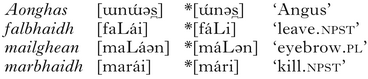
Recall from §2.2, however, that for independent reasons I consider hiatus to contain an underspecified consonant [X(ʲ)] in Scottish Gaelic. Accordingly, I assume that the forms in (12) contain an underlying sonorant + /X/ cluster, e.g. Aonghas /XɯnXəs̪/ ‘Angus’. I will regard a cluster as heterorganic whenever both consonants bear non-identical primary place features, including when one of them is unspecified for place (note that svarabhakti can occur before placeless [h], e.g. onfhadh [ɔnɔ́həɣ] ‘stormy sea’). An underlying sonorant + /X/ cluster is thus heterorganic and is broken up by svarabhakti in the usual manner. Svarabhakti in these forms therefore does not display overapplication at all, but rather reflects covert phonological structure.
Secondly, another set of forms exists in which svarabhakti underapplies before [h], as in (13).
(13)
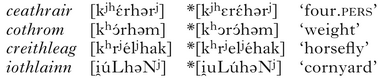
However, there is clear independent evidence for a phrase-level process that metathesises underlying /h/ + sonorant clusters in Scottish Gaelic. This metathesis can be seen affecting the word-initial clusters /t̪ʰr s̪N ʃNʲ s̪L ʃLʲ s̪R/ when they undergo the lenition mutation in some of the dialects of Skye described by Borgstrøm (Reference Borgstrøm1941: 41–42). In the dialects in question, these clusters normally become [hr hn hn hL hlʲ hr] under lenition, but are metathesised to [rh], etc. when preceded by a vowel. In Lewis, the lenited grades of word-initial /s̪ ~ ʃ/ + sonorant clusters do not contain [h], but Oftedal (Reference Oftedal1956: 162) reports for Leurbost exactly the same alternation between [hr] and [rh] in the lenited grade of /t̪ʰr/, and this is confirmed by my own observations in Ness.Footnote 4 I therefore assume that the forms in (13) contain an underlying /h/ + sonorant cluster, e.g. ceathrair /kʲʰεhrərʲ/ ‘four.pers’, and that svarabhakti is counterfed by this phrase-level metathesis.
Once these two sets of forms are accounted for, there remain in the Lewis data a small number of forms in which svarabhakti appears to misapply. First of all, for Leurbost, Oftedal (Reference Oftedal1956: 239) notes that a svarabhakti vowel may occur word-finally in two common verbs. These verbs both display final [v] when a vowel-initial word follows, but not elsewhere, as in (14).
(14)
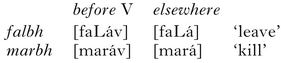
Only the forms with [v] occur in Bernera and Ness. I assume that these two verbs underlyingly contain a floating final /v/ in Leurbost, i.e. /faL(v)/, /mar(v)/, which triggers svarabhakti, yet is itself realised only when followed by a vowel-initial word. ‘Liaison’ consonants such as these are not unprecedented in Scottish Gaelic, and occur frequently in function words, e.g. the 3rd singular feminine possessive particle a (h-) [ə ~ əh] and the preposition do (dh’) [t̪ə ~ t̪əɣ].Footnote 5 Secondly, the form toirbhsgeir [t̪ʰaráʃkʲər] ‘peat-iron’ displays a svarabhakti vowel between two coronal consonants [r] and [ʃ]. This form reflects a borrowing of Old Norse torfskeri, containing the sequence /rvs/ (Oftedal Reference Oftedal1956: 55), which leads Smith (Reference Smith, van der Hulst and Ritter1999: 598–599) to propose that /v/ is still present underlyingly in the Scottish Gaelic form, i.e. /t̪ʰarvʃkʲər/. Although there is no independent evidence for underlying /v/ in this particular form, there is certainly evidence for a synchronic process that deletes /v/ before obstruents at some stage in the phonological derivation, e.g. meanbh [mεnἐv] ‘tiny’, but meanbh-chuileag [ˈmεnἐˌxulʲak] ‘midge’ (lit. ‘tiny fly’). Finally, the form cainb [kʰanáʰp] ‘hemp’, reported by Oftedal (Reference Oftedal1956) for Leurbost, displays a svarabhakti vowel between a lenis sonorant and a preaspirated stop. This is the one form in the Lewis data that we can say with certainty is truly irregular, and we will return to it in §4.4.
3.3 /ə/-syncope and svarabhakti
Svarabhakti interacts in an interesting manner with a phenomenon of stem-internal /ə/-syncope that often affects suffixed forms. In Scottish Gaelic, many stems display an alternation between a disyllabic allomorph with [ə] in the second syllable and a monosyllabic allomorph without. The disyllabic allomorph occurs in unsuffixed forms and the monosyllabic one when a vowel-initial suffix is present, as in (15).
(15)

The alternations accompanying /ə/-syncope are often highly complex. Interestingly, (16) shows that [ə] can also alternate with a svarabhakti vowel in exactly those cases where syncope would bring about a cluster of the type targeted by svarabhakti.
(16)

Although a number of authors treat /ə/-syncope as a synchronically productive process (Bosch Reference Bosch, Davison, Maier, Silva and Yan1994, Smith Reference Smith, van der Hulst and Ritter1999, Hall Reference Hall2003, Iosad Reference Iosad, Hilpert, Östman, Mertzlufft, Rießler and Duke2015), certain stems do not undergo the process in Lewis Gaelic, as in (17).
(17)

Given the lexically specific nature of the phenomenon, I assume that no synchronic phonological process is involved. Instead, I propose that the forms in (15) and (16) have stems represented lexically by two listed allomorphs, e.g. tachair /{t̪ʰaxərʲ, t̪ʰaxr}/ ‘happen’, fairich /{farʲəxʲ, farʲxʲ}/ ‘feel’, and that the disyllabic allomorph is selected in unsuffixed forms and the monosyllabic allomorph in suffixed forms. If a form such as fairchidh [farʲáxʲ-i] ‘feel-npst’ is derived from a monosyllabic stem allomorph /farʲxʲ/, then svarabhakti is predicted to occur in the usual manner.
4 Stem-level weight-by-position
In preparation for a discussion of the derivation of svarabhakti groups, this part of the analysis examines the moraicity of coda consonants at the stem level in Lewis Gaelic. By considering svarabhakti in parallel with a process of lengthening that affects vowels before tautosyllabic fortis sonorants, I offer a unified account in which both processes occur in the word-level phonology and make use of moras headed by coda sonorants in the stem-level output. I propose that, under certain circumstances, coda sonorants are subject to weight-by-position (WBP; Hayes Reference Hayes1989) at the stem level. Although these moras are subsequently transferred onto adjacent vowels at the word level in Lewis Gaelic, I show that the stem-level representations proposed here are directly observable in other dialects in which lengthening and/or svarabhakti do not occur. Only stressed syllables are considered, since lengthening and svarabhakti do not affect unstressed syllables. §4.1 considers stem-final sonorants, §4.2 stem-internal sonorants before preaspirated stops and §4.3 stem-internal sonorants before other consonant types. §4.4 provides a summary, and shows how the system of stem-level WBP proposed here correctly predicts a particular case of underapplication of svarabhakti in certain non-Lewis dialects, as well as the existence of exceptional items like cainb [kʰanáʰp] in Lewis.
4.1 Stem-final sonorants
In Lewis Gaelic, monosyllabic stems ending in fortis sonorants display alternations whereby the sonorant is preceded by a long vowel or diphthong when in the coda, and by a short vowel when resyllabified into the onset, as in (18).
(18)

Diphthongs ending in [u] occur before [N L], diphthongs ending in [i] before [Nʲ Lʲ] and long monophthongs before [R]; all three may occur before [m], depending on circumstances that need not be discussed here. Forms such as ceannard [kʲʰaúNəʈˠ] ‘chief’ and gàrradh [kǎːRəɣ] ‘wall’ show that there is no general shortening process in this position; note also the direction of neutralisation of the vowels in cum and pronn. I therefore assume that these forms contain a short vowel underlyingly, e.g. caill /kʰaLʲ/ ‘lose’, and that a word-level phonological process triggers lengthening or diphthongisation of an underlying short vowel before a tautosyllabic fortis sonorant. For simplicity, I will refer to this process as lengthening, since the qualitative distinction between long vowels and diphthongs is not relevant here.
Lengthening displays underapplication under certain circumstances. First of all, recall from §1.2 that word-level fortition processes convert certain underlyingly lenis coronal sonorants into fortis ones. These processes fail to feed lengthening, as shown in (19).
(19)
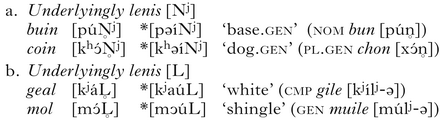
Additionally, another word-level fortition process converts lenis /n/ into fortis [N] before a coronal stop. This process, shown in (20), fails to feed lengthening.
(20)

Here we seem to have what is effectively a chain shift in the word-level phonology: various fortition processes trigger [Vn(ʲ) Vl] → [VN(ʲ) VL], while lengthening triggers [VN(ʲ) VL] → [VːN(ʲ) VːL], but the former fails to feed the latter. At first glance, this is highly problematic for an optimality-theoretic analysis. Simply being fortis is not enough to guarantee that a stem-final coda sonorant triggers lengthening in the word-level output: apparently, lengthening may only occur if the sonorant is already fortis in the word-level input. The simplest solution to this paradox – assuming only traditional optimality-theoretic markedness and faithfulness constraints – is to propose that there is in fact no chain shift at all, and that stem-final fortis coda sonorants exit the stem-level phonology bearing some additional marking besides whatever featural properties are responsible for the fortis–lenis contrast in general. Evidence from other dialects of Scottish Gaelic suggests that this additional marking is a mora.
In parts of Argyll, such as Islay (Grannd Reference Grannd1985) and Jura (Jones Reference Jones2000, Reference Jones2010), lengthening does not occur before stem-final fortis coda nasals and laterals (for simplicity, historically fortis rhotics – which do trigger lengthening – will be set aside here). Instead, as in (21), they are geminated when (underlyingly) fortis but not when lenis (all Islay forms in this section are from SGDS).
(21)
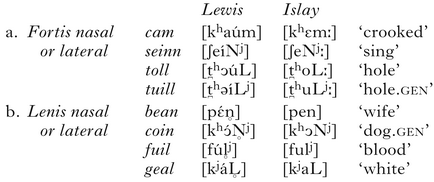
Islay Gaelic therefore displays an overtly moraic sonorant wherever Lewis displays lengthening of the preceding vowel. I propose that – ignoring occasional differences in segmental quality – the Lewis stem-level outputs for the forms in (21a) are in fact identical to the Islay surface forms: specifically, stem-final fortis sonorants are subject to WBP in the stem-level phonology, thus rendering them moraic, while lenis ones are not. The crucial difference between the two dialects is that Lewis Gaelic has a word-level phonological process that subsequently transfers a mora from a moraic coda sonorant onto a preceding tautosyllabic vowel, triggering lengthening, while Islay Gaelic does not. I assume that if the sonorant is resyllabified into an onset at the word level, as occurs before a vowel-initial suffix, then this mora is lost. This approach allows us to account for the lengthening alternations in (18), as well as the paradoxical underapplication of lengthening in (19) and (20), while simultaneously reducing the difference between the Lewis and Islay forms in (21a) to the presence of a word-level mora-transfer process in the former dialect but not the latter. Note that what I propose here is effectively a stratal version of Ní Chiosáin's (Reference Ní Chiosáin1991) analysis of the cognate phenomenon in Irish. The qualitative fortis–lenis distinction has been lost in the Irish variety in question, but historically fortis stem-final sonorants trigger lengthening alternations similar to those in (18). Ní Chiosáin analyses these sonorants as lexically moraic, and this mora is either transferred or lost, just as I claim occurs at the word level in Lewis Gaelic.
When a stem-final fortis sonorant is preceded by an underlying long vowel or diphthong, no lengthening occurs in Lewis and no gemination occurs in Islay. In the forms in (22), the quality of the preceding long vowel or diphthong indicates that it is not the product of lengthening.
(22)

Since Islay Gaelic realises moraic coda consonants as geminates, the final sonorant in these Islay forms cannot be moraic. I therefore assume that stem-level WBP is blocked when the preceding vowel is bimoraic, which can be accounted for by common constraints against superheavy syllables. We can therefore now make the generalisation in (23).
(23)

In the following sections, we will build upon this generalisation in order to include stem-internal coda sonorants.
4.2 Stem-internal sonorants before preaspirated stops
When followed by a preaspirated stop, stem-internal fortis and lenis sonorants behave in different ways in Lewis Gaelic. If the cluster is homorganic, various phonotactic restrictions mean that it is possible to independently distinguish between underlyingly fortis and lenis sonorants only in the case of the laterals. The effects of lengthening can be observed before fortis laterals, while lenis laterals may freely be preceded by a short vowel, as in (24) (recall that preaspiration of stops is realised as devoicing of any preceding sonorant).
(24)
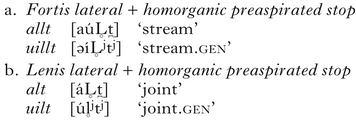
If the cluster is heterorganic, recall from §3.1 that svarabhakti occurs if the sonorant is fortis, but not if it is lenis, as in (25).
(25)
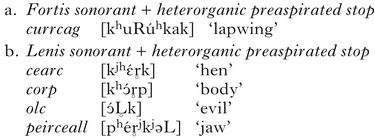
These forms reveal an important parallel between lengthening and svarabhakti. Both processes occur before a preaspirated stop only if the sonorant is fortis, with the choice between the two determined by whether the cluster is homorganic or heterorganic. This complementary relationship suggests that a similar mechanism lies behind both processes, allowing us to generalise the mora-transfer analysis from lengthening to svarabhakti. In order to provide a maximally simple and unified account of the two processes, I therefore propose that svarabhakti represents a word-level mora-transfer process just like lengthening, and thus may only occur if the sonorant is moraic in the stem-level output. Since I have assumed that there is a constraint against superheavy syllables which blocks WBP when the preceding vowel is bimoraic, this approach also captures the fact that svarabhakti never occurs after a long vowel or diphthong. Note that this analysis is again similar to that proposed for the cognate phenomenon in Irish by Ní Chiosáin (Reference Ní Chiosáin1991), who also recognises a link between svarabhakti and lengthening (see also Ó Baoill Reference Ó Baoill1980, who discusses this link from a diachronic perspective, and Cyran Reference Cyran1996, who unifies the two phenomena in a Government Phonology framework). According to Ní Chiosáin's rule-based analysis, sonorants are subject to WBP under certain conditions, and this mora is subsequently transferred to a svarabhakti vowel. Similarly, Hall's (Reference Hall2003) analysis also considers svarabhakti to be dependent upon the moraicity of a coda sonorant. We can therefore now amend the generalisation in (23) as in (26), in order to include stem-internal sonorants before preaspirated stops.
(26)

4.3 Stem-internal sonorants before other consonant types
When the following consonant is not a preaspirated stop, stem-internal fortis and lenis sonorants behave in the same way in Lewis Gaelic. If the cluster is homorganic, only fortis sonorants are found, as in (27), and the effects of lengthening can again be observed (note that a velarised retroflex consonant is the regular outcome of /R/ + coronal).
(27)
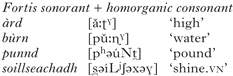
If the cluster is heterorganic, recall from §3.1 that svarabhakti occurs regardless of whether the sonorant is fortis or lenis, as in (28).
(28)

A maximally simple and unified account of lengthening and svarabhakti therefore requires that all stem-internal coda sonorants – not just fortis ones – are subject to stem-level WBP when followed by a consonant that is not a preaspirated stop (unless this would result in a superheavy syllable). We can therefore further amend (26) as in (29), in order to include stem-internal sonorants before other consonant types.
(29)
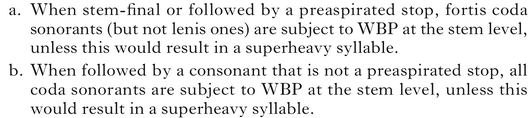
The generalisation now covers all coda sonorants in Lewis Gaelic.Footnote 6 We therefore have the stem-level outputs in (30) for forms such as those in (11).
(30)
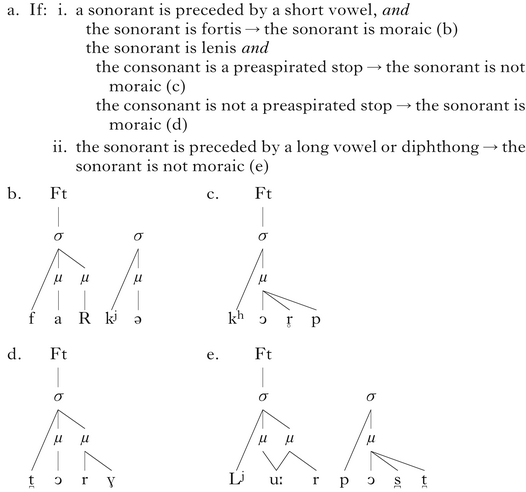
In §5 it will be shown how the observed surface forms are derived from these stem-level outputs.
Importantly, this analysis leads us to expect that any dialect lacking svarabhakti will display a moraic coda sonorant on the surface wherever svarabhakti occurs in Lewis Gaelic. It will therefore now be useful to look at the dialect of East Perthshire described by Ó Murchú (Reference Ó Murchú1989), in which svarabhakti does not occur. This dialect differs from that of Lewis in several important ways. First of all, as shown in (31), the qualitative fortis–lenis distinction has been lost in East Perthshire, but historically fortis stem-final nasals and laterals are realised as geminates in coda position – i.e. they are overtly moraic – while historically lenis ones are not (again for simplicity, historically fortis rhotics will be set aside here).
(31)
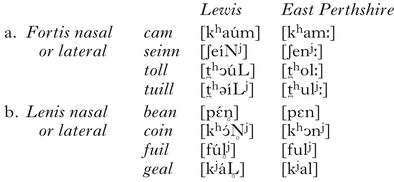
The fact that East Perthshire Gaelic has preserved the historical fortis–lenis contrast stem-finally by means of lexically contrastive moraicity suggests an earlier diachronic stage at which stem-final fortis coda sonorants were obligatorily moraic, while lenis ones were not, just as is observed on the surface in present-day Islay Gaelic, and just as proposed in (29) for the stem-level output in Lewis. Secondly, preaspiration has been lost in East Perthshire, but the historical contrast between plain and preaspirated stops is reflected in the moraicity of a preceding historically lenis sonorant. Historically preaspirated stops are preceded by singleton sonorants, and historically plain stops by geminate sonorants (where Lewis Gaelic displays svarabhakti), as in (32).
(32)
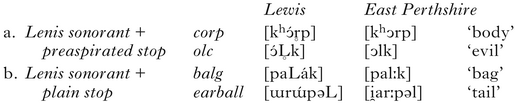
This suggests an earlier diachronic stage at which lenis coda sonorants were obligatorily moraic before plain stops but not before preaspirated stops, again in accordance with (29) for the stem-level output in Lewis. Finally, historically lenis stops are always geminate before other consonant types (where Lewis displays svarabhakti), as in (33).
(33)
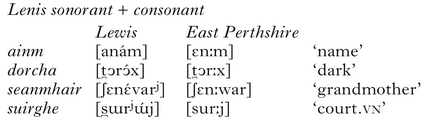
Lenis coda sonorants are therefore obligatorily moraic before other consonant types, yet again in accordance with (29). The moraicity of coda sonorants in East Perthshire thus exactly matches what I propose for the stem-level output in Lewis in every single case.Footnote 7
4.4 Summary
To summarise, I have argued that stem-level WBP in Lewis Gaelic affects coda sonorants according to the generalisation in (29). Certain aspects of this system are typologically unsurprising. Sonorants are the only consonants that show any evidence of being moraic at the stem level in Lewis, which is consistent with the fact that WBP tends to target coda consonants that exceed a language-specific threshold of sonority (Zec Reference Zec1995, Morén Reference Morén1999). I assume that the blocking of WBP on a stem-final lenis coda sonorant is due to a constraint against moraic consonants in final position, while the blocking of WBP on a lenis coda sonorant followed by a preaspirated stop is due to a constraint against moraicity on voiceless consonants (which have relatively low sonority) – recall that preaspiration is here realised as devoicing of the sonorant. Although the featural content of the fortis–lenis contrast is unclear, I assume that these blocking processes are overridden by a stem-level requirement for fortis sonorants to project a mora wherever possible. Coupled with an undominated constraint against superheavy syllables, this generates the observed system.
By ascribing the blocking of svarabhakti between a lenis sonorant and a preaspirated stop to the absence of an available mora in the stem-level output, the analysis correctly predicts the behaviour of a particular set of forms that display underapplication of svarabhakti in a number of non-Lewis dialects. Where Lewis has a contrast between preaspirated [ʰk] and a cluster [xk], dialects such as that of Barra instead merge both to [xk] (Borgstrøm Reference Borgstrøm1937, Reference Borgstrøm1940), as in (34).
(34)
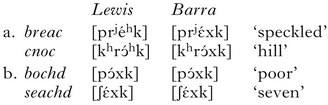
In Lewis, stem-final [ʰk] can undergo palatalisation, but [xk] is immune to the process (Borgstrøm Reference Borgstrøm1940: 84, Oftedal Reference Oftedal1956: 172). In Barra, [xk] can undergo palatalisation only when it corresponds to Lewis [ʰk], but not when it corresponds to [xk] (Borgstrøm Reference Borgstrøm1940: 175), e.g. Barra bhric [vrʲíxʲkʲ] ‘speckled.masc.gen’, but bhochd [vɔ́xk] ‘poor.masc.gen’. Since the distinction is evidently visible to inflectional processes, I assume that /ʰk/ and /xk/ both exist underlyingly in Barra, and remain distinct until the word-level phonology. The analysis correctly predicts that svarabhakti will underapply in Barra when a lenis sonorant is followed by an instance of [xk] that can undergo palatalisation, as in (35) (from Borgstrøm Reference Borgstrøm1937).
(35)
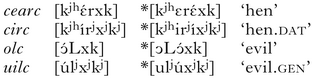
This is because a lenis coda sonorant is not subject to stem-level WBP when followed by an underlying preaspirated stop such as /ʰk/. Since the sonorant is not moraic in the word-level input, svarabhakti is blocked, even though word-level insertion of [x(ʲ)] after the sonorant brings about the surface conditions under which svarabhakti is normally observed. A stratal analysis such as this, in which both svarabhakti and lengthening are word-level processes that make use of moras projected by stem-level coda sonorants under certain conditions, is therefore able to account for instances of opacity not only in Lewis, but in other dialects of Scottish Gaelic as well.
Since the stem-level phonology assigns moras to coda sonorants under well-defined circumstances, the present analysis offers no means by which a sonorant could possibly fail to be moraic in the stem-level output if it meets the conditions for stem-level WBP. This leads to the prediction that all cases of underapplication of lengthening or svarabhakti in Lewis Gaelic can be ascribed to the counterfeeding effects of independently motivated post-stem-level processes. Sure enough, the underapplication of lengthening before derived fortis sonorants in (19) and (20) can be ascribed to word-level fortition processes, while the underapplication of svarabhakti in sonorant + [h] clusters in (13) can be ascribed to a phrase-level process of metathesis. However, this analysis does not exclude the possibility that coda sonorants may be exceptionally moraic under certain circumstances. If the faithfulness constraints protecting underlyingly moraic coda sonorants are ranked sufficiently high in the stem-level phonology, then a sonorant might be moraic in the stem-level output despite not fulfilling the conditions for stem-level WBP. The form cainb [kʰanáʰp] mentioned in §3.2 is an example of exactly the type of exception that would be predicted to occur. Although a lenis sonorant does not automatically become moraic at the stem level when followed by a preaspirated stop, it can be assumed that /n/ in this form is underlyingly moraic, and that the relevant markedness and faithfulness constraints are ranked in such a way as to ensure that it remains moraic in the stem-level output. This allows svarabhakti to occur at the word level in this form. The present analysis is therefore able to account for exactly the type of misapplication of svarabhakti that occurs in the Lewis data, while simultaneously disallowing phenomena that are never observed to occur.
5 The derivation of svarabhakti groups
This part of the analysis offers an optimality-theoretic account of the derivation of svarabhakti groups in the word-level phonology of Lewis Gaelic, showing how the surface structures established in §2 for svarabhakti forms are derived from the stem-level outputs proposed in §4. §5.1 discusses forms in which svarabhakti occurs in order to break up a heterorganic cluster, and §5.2 considers cases in which it is blocked. §5.3 deals with cases involving the interaction of svarabhakti with /ə/-syncope.
5.1 Occurrence of svarabhakti
According to the analysis so far, svarabhakti forms such as fairrge [faRákʲə] and dorgh [t̪ɔrɔ́ɣ], underlyingly /faRkʲə/ and /t̪ɔrɣ/, have the stem-level outputs shown in (30), and surface forms similar to that of balg [paLák] in (10). It was proposed in §4 that svarabhakti is a word-level process that transfers a mora from a coda sonorant onto an epenthetic vowel. A form such as dorgh therefore has the word-level input and output in (36).
(36)

The input syllable count is preserved when svarabhakti occurs, so that the entire svarabhakti group remains monosyllabic. This is in spite of the fact that it is generally assumed that faithfulness constraints cannot directly refer to input syllable structure (e.g. McCarthy Reference McCarthy2002: 73–74). In order to account for this, I borrow insights from Köhnlein (Reference Köhnlein2016), who proposes that the foot head is located at the highest level of metrical representation at which the foot displays binarity. In a foot containing two syllables (a syllabic trochee) the head is the first syllable, while in a foot containing one bimoraic syllable (a moraic trochee) the head is the first mora, as in (37).
(37)
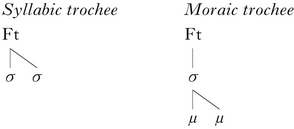
Secondly, I follow McCarthy (Reference McCarthy2000) and Köhnlein (Reference Köhnlein2011, Reference Köhnlein2016) in claiming that metrical heads are subject to faithfulness. I therefore define a constraint HeadMatch(Ft) as in (38a), adapted from Köhnlein (Reference Köhnlein2011: 187, Reference Köhnlein2016: 98). When highly ranked, this constraint can drive faithfulness to input syllable count by ensuring that a monosyllabic foot does not become disyllabic, and vice versa. I also assume the constraints in (38b–e), all of which are common in the phonological literature.
(38)
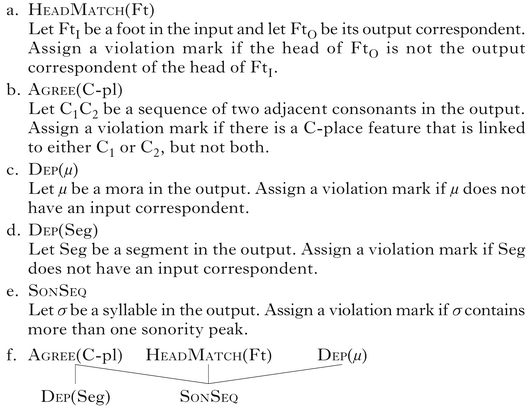
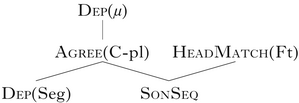
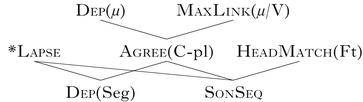
Since svarabhakti targets heterorganic clusters, I assume that it is driven by Agree(C-pl). If Agree(C-pl) is ranked above Dep(Seg), and Agree(C-pl), HeadMatch(Ft) and Dep(μ) above SonSeq, as in (38f), then we obtain the observed result for the word-level input established in (30) for dorgh [tɔrɔ́ɣ], as shown in the tableau in (39).
(39)
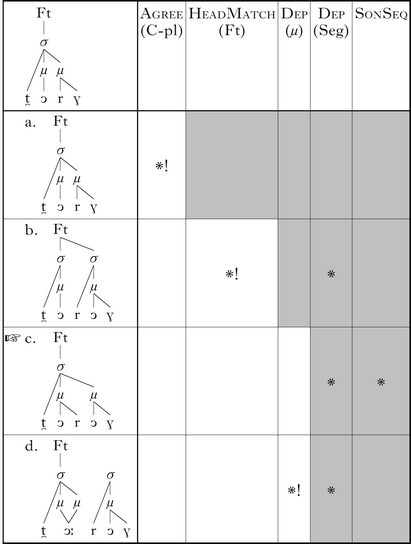
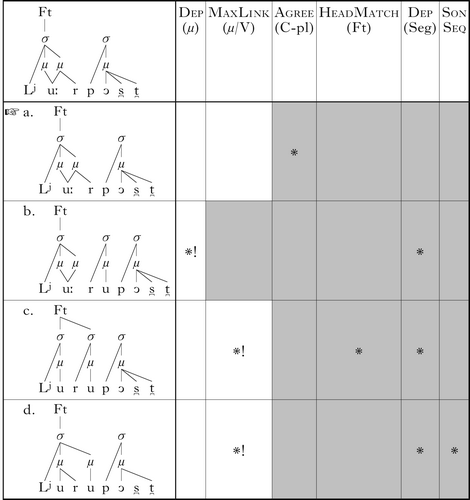
The fully faithful candidate violates high-ranked Agree(C-pl), due to the presence of a heterorganic cluster, forcing epenthesis to occur, in violation of Dep(Seg).Footnote 8 If the svarabhakti vowel were to project a syllable of its own, this would incur a violation of HeadMatch(Ft), so the entire svarabhakti group remains monosyllabic, in violation of SonSeq. An alternative repair, in which the svarabhakti vowel projects a new syllable but the first syllable remains bimoraic, is blocked by Dep(μ), because it requires the insertion of a mora.
5.2 Blocking of svarabhakti
Recall from §3.1 that svarabhakti fails to occur in a cluster of a sonorant + a heterorganic consonant under two conditions: (i) the sonorant is lenis and the other consonant is a preaspirated stop, or (ii) the sonorant is preceded by a long vowel or a diphthong. In §4 I proposed that this is because a coda sonorant is not subject to stem-level WBP in either of those positions. The coda sonorant in forms such as corp [kʰɔ́r̥p] ‘body’ and Liùrbost [Lʲǔːrpɔs̪t̪] ‘Leurbost’, underlyingly /kʰɔrʰp/ and /Lʲuμ μrpɔs̪t̪/, is therefore non-moraic in the word-level input, and the form is unchanged in the word-level output.
I assume that Dep(μ) is responsible for the blocking of svarabhakti when the sonorant is lenis and the other consonant is a preaspirated stop. If we extend the partial word-level ranking in (38f) by ranking Dep(μ) above Agree(C-pl), as in (40), then we obtain the observed result for the word-level input established in (30) for corp [kʰɔ́r̥p], as shown in (41). Although the fully faithful candidate violates Agree(C-pl), any candidate in which epenthesis occurs must necessarily violate higher-ranked Dep(μ) by inserting a mora.Footnote 9
(40)
(41)
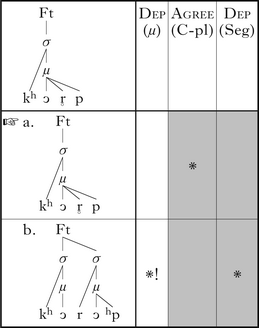
For the analysis of forms in which the sonorant is preceded by a long vowel or a diphthong, I adopt the additional constraint in (42), taken from the constraint family proposed by Morén (Reference Morén1999).
(42)

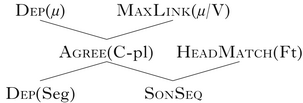
I assume that Dep(μ) is once again responsible for the blocking of svarabhakti in forms of this type. If we add to the partial word-level ranking in (40) by ranking MaxLink(μ/V) above Agree(C-pl), as in (43), then we obtain the observed result for the word-level input established in (30) for Liùrbost [Lʲǔːrpɔs̪t̪], as shown in (44). Although the fully faithful candidate again violates Agree(C-pl), any candidate in which epenthesis occurs must necessarily violate either higher-ranked Dep(μ), by inserting a mora, or higher-ranked MaxLink(μ/V), by shortening the vowel.Footnote 10
(43)
(44)
5.3 /ə/-syncope and svarabhakti
In §3.3 I argued that /ə/-syncope in Scottish Gaelic is not a synchronically productive phonological process, but rather involves suppletive stem allomorphy. Therefore a form such as fairchidh [farʲáxʲ-i] ‘feel-npst’ is derived from a monosyllabic stem allomorph /farʲxʲ/, rather than the disyllabic allomorph /farʲəxʲ/ found in unsuffixed forms. I assume the constraint in (45), which is common in the phonological literature.
(45)

I assume that, in items with two listed stem allomorphs, both allomorphs are evaluated in parallel in the phonology and *Lapse motivates the selection of the monosyllabic stem allomorph in suffixed forms. A form such as fairchidh [farʲáxʲ-i] therefore has the competing word-level inputs [faμrʲəμxʲ+i] and [faμrʲμxʲ+i] in (46).
(46)
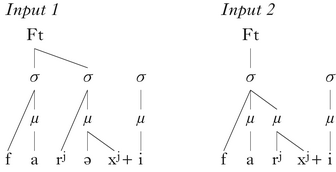
If we add to the partial word-level ranking in (43) by ranking *Lapse above both Dep(Seg) and SonSeq, as in (47), then we obtain the observed result, as shown in (48). High-ranked *Lapse ensures that a form is selected containing the monosyllabic stem allomorph, and svarabhakti proceeds as normal.
(47)
(48)

6 The realisation of the Class 1–Class 2 contrast
This part of the analysis explores the ways in which the Class 1–Class 2 contrast is realised in different dialects of Scottish Gaelic. Pitch and duration are discussed together in §6.1, and glottalisation in §6.2, showing how the various surface manifestations of the contrast correspond to the metrical structures established in §2.
6.1 Pitch and duration
The distinction between Class 1 and Class 2 forms is reflected in Lewis Gaelic primarily by means of tone (Borgstrøm Reference Borgstrøm1940: 53–54, Oftedal Reference Oftedal1956: 25–27, Ladefoged et al. Reference Ladefoged, Ladefoged, Turk, Hind and Skilton1998, Brown Reference Brown2009, Nance Reference Nance2015). Class 1 forms – in which the stressed syllable is monomoraic – typically display a rising pitch on the first mora, while Class 2 forms – in which the stressed syllable is bimoraic – display a rising pitch spread across the first two moras; the pitch then falls sharply on any following syllable. As a result, a pitch peak occurs on the rightmost mora of the stressed syllable.Footnote 11 As well as in Lewis, this realisation of the Class 1–Class 2 contrast is also found in parts of Ross-shire (Borgstrøm Reference Borgstrøm1941: 89, Wentworth Reference Wentworth2005: 15–17). In accordance with recent analyses of tonal accent in Swedish (Morén-Duolljá Reference Morén-Duolljá2013) and Franconian (Köhnlein Reference Köhnlein2011, Reference Köhnlein2016, Hermans Reference Hermans, Botma and Noske2012, Kehrein Reference Kehrein2018), this tonal contrast can be analysed as reflecting not lexical tone, but rather the alignment of intonational tonal autosegments with differing metrical structures in the phrase-level phonology. On the basis of the instrumental data presented by Ladefoged et al. (Reference Ladefoged, Ladefoged, Turk, Hind and Skilton1998) for Bernera Gaelic, Ladefoged (Reference Ladefoged, Local, Ogden and Temple2003: 275) suggests that, at least in isolated citation forms, the stressed syllable is assigned a LH tonal contour followed by a trailing L tone on any following unstressed syllable. Since the stressed syllable contains only the first mora in Class 1 forms and the first two moras in Class 2, this brings about the observed differences in the timing of the pitch peak, which is always aligned with the right edge of the stressed syllable. However, it is likely that a certain amount of variation exists, depending on dialect and phrasal context. Borgstrøm's (Reference Borgstrøm1940: 53–54) impressionistic description of Bernera Gaelic intonation very closely matches Ladefoged et al.’s (Reference Ladefoged, Ladefoged, Turk, Hind and Skilton1998) instrumental results, but he specifies that the pitch rise on the stressed syllable is often ‘very reduced’ in phrase-final position. This suggests the presence of a L% boundary tone, which may suppress the H tone of the stressed syllable. Meanwhile, Oftedal's (Reference Oftedal1956: 26–27) description of Leurbost Gaelic notes that the stressed syllable may be either rising or high, suggesting that the first L tone may not always be realised. Interestingly, in an instrumental study on Ness Gaelic encompassing a variety of phrasal contexts, Brown (Reference Brown2009) finds that words in focus position display essentially the opposite tonal pattern to that assumed throughout this paper, with the right edge of the stressed syllable displaying a pitch trough followed by a sharp rise on the following syllable; meanwhile, no pitch differences are reported for non-focus, non-final contexts. In all of these cases, however, the accent contrast can be described in terms of the alignment of intonational tones with either monomoraic or bimoraic stressed syllables.
Unlike in Lewis, Class 1 and Class 2 forms are distinguished in Applecross, Ross-shire primarily by means of duration (Borgstrøm Reference Borgstrøm1941: 128–129, Ternes Reference Ternes1973: 102–107), as shown in (1) above. Class 1 forms display normal length, while Class 2 forms display overlength through elongation of the second mora. However, Ternes (Reference Ternes2006: ch. 5) reports a slight difference in pitch contour accompanying this durational distinction: Class 1 forms display a single early pitch peak followed by a sharp fall, just as in Lewis, while Class 2 forms display a subtly double-peaked, but overall more level, pitch contour. Conversely, Brown (Reference Brown2009) reports differences in both duration and intensity accompanying the tonal contrast between Class 1 and Class 2 forms in Lewis Gaelic, and these differences remain even in non-focus, non-final contexts, where no difference in pitch is reported. In Barra Gaelic, where the primary cue appears to be more difficult to pin down, Bosch & de Jong (Reference Bosch and de Jong1997) find differences in both pitch and duration between svarabhakti groups and ordinary ˈVCV sequences: svarabhakti groups display a later pitch peak – although not as late as in Lewis – and svarabhakti vowels are longer. As discussed in detail by Köhnlein (Reference Köhnlein2015), close relationships between pitch and duration are common cross-linguistically. For instance, in many Franconian dialects, the sharply falling pitch of Accent 1 is accompanied by considerably shorter duration than the more level Accent 2, and in certain phrasal contexts duration may even replace pitch as the primary cue to the contrast (Gussenhoven & Peters Reference Gussenhoven and Peters2004, Peters Reference Peters and de Vaan2006) – similar to Brown's (Reference Brown2009) findings for Lewis Gaelic. The opposite pattern is found in Estonian, in which overlength is associated with falling pitch (Lehiste Reference Lehiste1960). Interactions between pitch and duration also occur in Swedish and Norwegian (Gårding Reference Gårding1977: 44), Serbo-Croatian (Lehiste & Ivić Reference Lehiste and Ivić1986: 59ff) and Livonian (Kiparsky Reference Kiparsky2018). Since it is clear that a trade-off between pitch and durational cues is often involved in the realisation of a single phonological opposition, there is no need to ascribe the Lewis and Applecross forms in (1) to different phonological surface representations. I therefore assume that Lewis and Applecross Gaelic differ only at the phonetic level with respect to the Class 1–Class 2 opposition. While Lewis Gaelic assigns greater weight to pitch in the phonetic interpretation of tone, Applecross Gaelic favours durational cues. Barra Gaelic can be taken to represent an intermediate dialect, in which pitch and duration are assigned more equal importance.
6.2 Glottalisation
While the dialects of the Outer Hebrides, Skye and Ross-shire distinguish Class 1 and Class 2 forms primarily by means of various combinations of pitch and duration, glottalisation may also play a small role in the realisation of the contrast. Throughout this region, Borgstrøm (Reference Borgstrøm1937: 74–77, Reference Borgstrøm1940: 55–56, 152–153, Reference Borgstrøm1941: 32, 89) reports the occurrence of a slight ‘break in tension’ between the first and second moras of Class 1 forms, which in Barra may even be realised as a full ‘glottal catch’ in hiatus sequences. In many Argyll dialects, including those of Islay (Holmer Reference Holmer1938), Jura (Jones Reference Jones2000, Reference Jones2010) and Colonsay (Scouller Reference Scouller2017), the Class 1–Class 2 contrast is realised exclusively by means of glottalisation. Class 1 forms display a period of glottalisation between the first two moras, while Class 2 forms do not, again as shown in (1).
The distribution of glottalisation on vowels and sonorants in Argyll Gaelic exactly matches the distribution of the two tonal contours in Lewis. However, in order to determine the general distribution of glottalisation, it is necessary to take a closer look at its occurrence on obstruents. In Lewis Gaelic, a ˈVCV sequence containing an obstruent is always disyllabic, and therefore bears the first-mora pitch peak of Class 1. According to SGDS, Jones (Reference Jones2000, Reference Jones2010) and Scouller (Reference Scouller2017), glottalisation occurs as expected in Argyll when the obstruent is a plain stop or a voiced fricative, but not when it is a preaspirated stop (realised as a voiceless fricative + plain stop cluster in this dialect) or a voiceless fricative, as shown in (49) for Islay forms from SGDS.
(49)
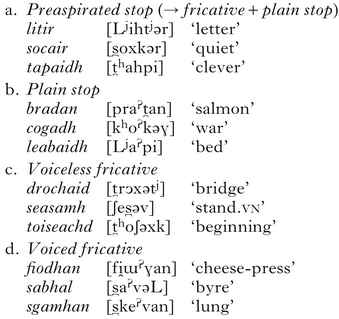
I assume that preaspirated stops and voiceless fricatives in Scottish Gaelic bear the feature [+spread glottis], while other consonants do not. Given the foot structures proposed in §2.3, we can make the generalisation that glottalisation occurs whenever two syllables are parsed into a single foot, unless they are separated by a [+spread glottis] consonant. Glottalisation, which I assume consists of epenthesis of [+constricted glottis], may represent a process of fortition that serves to enhance the boundary between two syllables that are in particularly close metrical contact, i.e. belong to a single foot, although this would run contrary to the cross-linguistic tendency for foot-medial consonants to be targets for lenition rather than fortition. Presumably, it is blocked by the presence of [+spread glottis] because these two features are articulatorily incompatible with one another.
Smith (Reference Smith, van der Hulst and Ritter1999), Hall (Reference Hall2003, Reference Hall2006) and Iosad (Reference Iosad, Hilpert, Östman, Mertzlufft, Rießler and Duke2015) offer a different analysis of the distribution of glottalisation in Argyll Gaelic, regarding it as a segmental glottal stop which is inserted in the coda of a stressed monomoraic syllable in order to render it bimoraic and thus satisfy a stress-to-weight condition. Scouller (Reference Scouller2017) reaches a similar conclusion, although he regards glottalisation as suprasegmental. The stress-to-weight analysis of glottalisation appears to be primarily motivated by Holmer's (Reference Holmer1938: 36–37) claim that it occurs at the end of short open monosyllables, e.g. teth [tʲʰeˀ] ‘hot’, math [mεˀ] ‘good’. However, all other first-hand accounts disagree with Holmer on this vital point.Footnote 12 Glottalisation in this environment is not reported by Jones (Reference Jones2000, Reference Jones2010) for Jura Gaelic, and is not recorded in SGDS for any dialect. Scouller (Reference Scouller2017) himself finds that it does not occur in this environment in Colonsay, but is forced by his own analysis to conclude that it must be ‘at least notionally present in such cases’ (Reference Scouller2017: 261). Under the stress-to-weight approach, the absence of glottalisation in the forms in (49a) is taken to be because the voiceless fricatives are moraic codas, which is at odds with the present analysis. However, the forms in (49c) show that voiceless fricatives block glottalisation even when they are not codas, which none of these authors accounts for. Yet another problem for the stress-to-weight approach is that it requires that glottalisation serve as a moraic coda even when intervocalic, i.e. in hiatus forms such as dubhan [t̪uˀan] and bodha [poˀu], which would involve extremely unusual leftward syllabification of an intervocalic consonant.Footnote 13 I therefore conclude that glottalisation in Argyll Gaelic is best analysed as marking the boundary between two syllables that belong to a single foot, unless they are separated by a [+spread glottis] consonant.
7 Discussion
In this section I offer some general discussion of the analysis presented in this paper. §7.1 outlines other analyses of the Class 1–Class 2 contrast in Scottish Gaelic, and evaluates them against the present analysis. §7.2 places this analysis of Scottish Gaelic in its wider context by exploring how it relates to existing metrical analyses of tonal accent, glottalisation and overlength in languages such as Swedish, Danish, Franconian and Estonian.
7.1 Other analyses
The claim that the Class 1–Class 2 contrast in Scottish Gaelic reflects metrical structure has been put forward by numerous authors in the past. However, analyses disagree on the exact nature of the metrical structures involved and the manner in which they are derived, particularly with regard to svarabhakti groups. Some authors tackle the problem by viewing svarabhakti vowels as entirely non-phonological. Iosad (Reference Iosad, Hilpert, Östman, Mertzlufft, Rießler and Duke2015) analyses svarabhakti as a purely phonetic process, so that svarabhakti vowels are invisible to the surface phonology, and are therefore unable to project a syllable of their own. Within the framework of Articulatory Phonology, Hind (Reference Hind1996, Reference Hind1997) and Hall (Reference Hall2003, Reference Hall2006) ascribe svarabhakti to the relative realignment of overlapping articulatory gestures, which causes a consonantal gesture to occur in the middle of a single long vocalic gesture. However, these approaches have difficulty dealing with the various cases of opacity in svarabhakti, such as the apparent overapplication before hiatus in (12) and the underapplication in sonorant + [h] clusters in (13) or before Barra Gaelic [xk] in (35). Hall's (Reference Hall2003) analysis is equipped with a means to account for lexically specific overapplication of svarabhakti, but she does not consider these cases of underapplication. Clearly, any successful account of svarabhakti must be capable of handling its complex interactions with other phonological processes.
Some authors propose complex multi-layered structures to represent the contrast between Class 1 and Class 2 forms. On the basis of phonetic data from Barra Gaelic, Bosch & de Jong (Reference Bosch and de Jong1998) argue that each of the two vowels in a svarabhakti group heads a syllable within a larger domain, which they term a ‘super-syllable’. The existence of the lower ‘syllable’ level – where the two vowels in a svarabhakti group belong to separate domains – is based on an observed asymmetry between the two vowels with respect to both stress and backness. Specifically, svarabhakti vowels in Barra Gaelic display greater stress than the preceding vowel according to phonetic criteria such as pitch and duration, and receive their backness specification from the intervening consonant, rather than from the preceding vowel. However, it is not clear why the phonetic correlates of stress should be expected to remain constant throughout the duration of a stressed syllable, nor is there any reason why two vowels in a single syllable should necessarily agree in backness. There is therefore very little motivation for positing an entirely new level of prosodic representation, instead of simply equating the higher-level domain – which contains both vowels in a svarabhakti group – with a traditional syllable.
Smith (Reference Smith, van der Hulst and Ritter1999) argues that a svarabhakti vowel heads a syllable that is recursively embedded within a larger syllable headed by the preceding vowel. The embedded syllable is posited for theory-internal reasons, and Smith does not justify its existence using data from Scottish Gaelic. Although this representation can account for the monosyllabic nature of svarabhakti groups, the derivational part of Smith's analysis relies on a family of constraints whose precise definitions are unclear. For instance, the constraint SonCSep is formulated as in (50) (Reference Smith, van der Hulst and Ritter1999: 613).
(50)

Contrary to the core principles of Optimality Theory, this constraint simultaneously states not only the output structure that it disfavours (a particular type of cluster) but also the repair that is to be carried out in order to satisfy it (insertion of an epenthetic vowel in a recursively embedded syllable). If we attempt to convert this into a standardly formulated markedness constraint targeting clusters of the appropriate type, we are left with no motivation for placing the epenthetic vowel in a recursively embedded syllable rather than an ordinary non-embedded one. Smith's analysis therefore brings us no closer to understanding how the special prosodic properties of svarabhakti groups might be derived.
Not all analyses of the Class 1–Class 2 contrast in Scottish Gaelic involve metrical structure. Ternes (Reference Ternes1980, Reference Ternes2006: ch. 5) argues that Scottish Gaelic has lexical tone, and draws a comparison with languages such as Swedish and Norwegian, for which tonal analyses were predominant at the time. However, this approach does not account for the many ways in which the Class 1–Class 2 contrast interacts with segmental structure (see the discussion in §2.2 and §3.1). A very different non-metrical analysis is offered by Stanton & Zukoff (Reference Stanton and Zukoff2018), who regard the special prosodic properties of svarabhakti groups as reflecting the fact that both vowels are stressed. The presence of stress on both vowels in a svarabhakti group is of course consistent with the present analysis, and forms part of many impressionistic descriptions of the Class 1–Class 2 contrast for various Scottish Gaelic dialects (Fraser Reference Fraser1914, Borgstrøm Reference Borgstrøm1937, Reference Borgstrøm1940, Reference Borgstrøm1941, Oftedal Reference Oftedal1956, Dilworth Reference Dilworth1972, Wentworth Reference Wentworth2005). However, rather than regarding both vowels as belonging to a single stressed syllable, Stanton & Zukoff ascribe this stress pattern to correspondence constraints that motivate identity between epenthetic vowels and their hosts with respect to prosodic properties. As discussed by Morrison (Reference Morrison2018b), this analysis is problematic because it considers svarabhakti in isolation, rather than in the context of the Class 1–Class 2 contrast, and some aspects of the analysis rely on incorrect assumptions about the distribution of vowel length in Scottish Gaelic.
7.2 Wider context
In ascribing the Class 1–Class 2 contrast in Scottish Gaelic to differences in metrical structure, the analysis presented in this paper bears a degree of similarity to analyses proposed for contrasts of tone, glottalisation and overlength in other languages. Morén-Duolljá (Reference Morén-Duolljá2013) argues that Swedish words with Accent 2 contain a recursive foot, while those with Accent 1 do not, and the tonal accent opposition results from the alignment of intonational tones with these differing metrical structures. Meanwhile, Iosad (Reference Iosad2016) analyses Danish stød as reflecting recursive foot structure in a similar manner. For Franconian, Hermans (Reference Hermans, Botma and Noske2012) and Kehrein (Reference Kehrein2018) analyse Accent 1 words as containing a monosyllabic foot and Accent 2 words a disyllabic foot, whereas Köhnlein (Reference Köhnlein2011, Reference Köhnlein2016) proposes the opposite. Finally, Prince (Reference Prince1980) and Odden (1997) argue that long syllables in Estonian belong to a disyllabic foot, while overlong syllables constitute a foot on their own. Although the exact nature of the relevant contrast varies from one account to another, what unites the present analysis with most of the aforementioned analyses is that the surface contrast is mediated through faithfulness to foot structure.
While most of these analyses derive the relevant surface contrasts through faithfulness to lexically stored metrical structure, the present analysis shows, using the framework of Stratal Optimality Theory, that the surface contrast between Class 1 and Class 2 forms in Scottish Gaelic is predictable on the basis of their underlying segmental content. In this respect, this account bears a striking similarity to van Oostendorp's (Reference Oostendorp2018) analysis of tonal accent on pre-obstruent short vowels in Moresnet Franconian. According to his analysis, metrical structure is built at the stem level, and is sensitive to the voicing specification of the obstruent, but may subsequently be rendered opaque by final devoicing or voice assimilation at the word level. In diachronic terms, when viewed in the light of the life cycle of phonological processes (Bermúdez-Otero Reference Bermúdez-Otero, Honeybone and Salmons2015), it can be assumed that languages displaying contrastive metrical structure must at one time have gone through a similar stage, where metrical structure ceased to be completely surface-true, and began interacting opaquely with phonological or morphological processes, before eventually undergoing lexicalisation. Scottish Gaelic can therefore be regarded as a missing link in the evolution of lexically contrastive metrical structure.
By highlighting the connection between tonal accent, glottalisation and overlength in different dialects of Scottish Gaelic, I hope to have helped to consolidate the relationship between these three phenomena in other languages in which they occur. As discussed in §6.1, the link between tone and duration is well-known. Köhnlein (Reference Köhnlein2015) proposes a recurring diachronic pathway in which phonetically longer units first come to bear more complex tonal contours. A tendency to lengthen units with level tones then results in a durational reversal, so that the originally shorter unit becomes the longer one. A language in which longer duration is associated with a contour tone, e.g. Estonian, can be assumed to lie at an early stage of this pathway, while one in which longer duration is associated with a more level tone, e.g. Franconian, represents a later stage. Applying this to Scottish Gaelic, it appears that Applecross represents a particularly progressive dialect, in which the relatively level tone of Class 2 forms has been replaced by longer duration. As for the link between tone and glottalisation, it is known that the sharp pitch fall inherent in a HL tonal contour is liable to result in creaky voice (e.g. Lindblom Reference Lindblom2009, Riad Reference Riad2009). The cognate relationship between the typically early-peaked Accent 1 in Swedish and stød in Danish is clearly paralleled by the Class 1–Class 2 contrast in Scottish Gaelic, where Class 1 is characterised by an early pitch peak in Lewis and by glottalisation in Argyll. Finally, the various realisations of the Class 1–Class 2 contrast in Scottish Gaelic are perfectly matched in Livonian, in which one of two phonological classes is distinguished from the other by means of a simultaneous combination of falling pitch, glottalisation and shorter duration (Kiparsky Reference Kiparsky2018).
8 Conclusion
This paper has used the framework of Stratal Optimality Theory to build a thorough analysis of the Class 1–Class 2 contrast in Scottish Gaelic, which is realised by means of tonal accent, glottalisation or overlength, depending on dialect. In line with a number of recent analyses of similar phonological oppositions in other European languages, this contrast was ascribed to differences in metrical structure. It was shown that metrical structure in Scottish Gaelic is built in the phonology in a regular manner, but may be rendered opaque by complex interactions with other phonological processes. This results in the observed surface contrast between Class 1 and Class 2 forms. In §7 it was argued that this analysis outperforms others in explaining the extremely complex facts of Scottish Gaelic phonology. It was also argued that Scottish Gaelic can be thought of as representing an intermediate stage in the diachronic trajectory that has led to the lexically contrastive metrical structure observed in other languages today, and can inform us about the relationship between the oppositions of tone, glottalisation and overlength found in those languages. The contrast between Class 1 and Class 2 forms in Scottish Gaelic is just one of the myriad ways in which the intricacies of the Scottish Gaelic sound system can enhance our understanding of the kinds of phonological phenomena that occur in the languages of the world.


