INTRODUCTION
The genus Patella Linnaeus, 1758 comprises nine species and is restricted to the north-eastern Atlantic Ocean and Mediterranean Sea (Ridgway et al., Reference Ridgway, Reid, Taylor, Branch and Hodgson1998).
Patella candei d' Orbigny, 1840 is an endemic species of the Macaronesian archipelagos, highly exploited for human consumption (Hawkins et al., Reference Hawkins, Côrte-Real, Pannacciulli, Weber and Bishop2000). In the Canary Islands, intense exploitation of rocky intertidal limpets led to a dramatic reduction in these populations as well as to the local extinction of Patella candei which is restricted to the island of Fuerteventura (Côrte-Real et al., Reference Côrte-Real, Hawkins and Thorpe1996; Weber & Hawkins, Reference Weber and Hawkins2002; Navarro et al., Reference Navarro, Ramírez, Tuya, Fernández-Gil, Sánchez-Jerez and Haroun2005) and referred to as an endangered species in the Spanish Catalogue of Endangered Species. In the Madeira archipelago this species is caught in mixed exploitation with Patella aspera Röding, 1798 and has relevant commercial importance reaching annual catches of up to 100 tons (Henriques, Reference Henriques2010).
Patella candei is a gastropod mollusc found on rocky shores from the lower intertidal to the subtidal as deep as 5 m (Côrte-Real et al., Reference Côrte-Real, Hawkins and Thorpe1996). It has a suboval to stellate shell with an internal white or yellow to orange scar surrounded by a bluish-purple iridescent colour with a thin brown border (Christiaens, Reference Christiaens1973). After fixation to the substrate this herbivore grazer is considered a sessile organism; however, it exhibits homing behaviour executing minor feeding migrations and according to Iwasaki (Reference Iwasaki1999) larger migrations may occur between relatively distant habitats. In general limpets play an important role in regulating the ecological balance of rocky shores. Boaventura et al. (Reference Boaventura, Alexander, Della Santina, Smith, Ré, da Fonseca and Hawkins2002) showed that a decrease in limpet population density leads to an increase in algal abundance. Other authors suggest that the decrease in population density of limpets favours colonization by competitors such as barnacles and sea urchins (Menge, Reference Menge1995; Kido & Murray, Reference Kido and Murray2003; Arrontes et al., Reference Arrontes, Arenas, Fernández, Rico, Oliveros, Martínez, Viejo and Alvarez2004).
Knowledge of life history traits of limpet populations plays an important role in providing proper background for effective management of these resources, however, most information available on the biology of Patella species is focused on Patella vulgata Linnaeus, 1758. Nonetheless some aspects of limpet biology such as reproduction have been studied for other species such as Patella ulyssiponensis Gmelin, 1791 and Patella depressa Pennant, 1777 (Bowman & Lewis, Reference Bowman and Lewis1986; Guerra & Gaudêncio, Reference Guerra and Gaudêncio1986; Delany et al., Reference Delany, McGrath, O'Riordan, Myers and Myers2002; Brazão et al., Reference Brazão, Boaventura, Morais, Narciso and Ré2003). From a fisheries point of view growth and recruitment are important life history traits that influence the sustainable catch weight that can be taken from stock (King, Reference King1995). Growth studies on limpets have been focused on mark–recapture methods (Orton, Reference Orton1929), nonetheless current studies apply the von Bertalanffy growth model successfully to limpets (Balaparameswara Rao, Reference Balaparameswara Rao1976; Branch, Reference Branch1981; Kido & Murray, Reference Kido and Murray2003). This model based on physiological concepts has been most commonly used in studies on marine species and has been found to fit data from a wide range of species (King, Reference King1995).
Due to the lack of studies about life history traits of P. candei, this study aimed to provide information on biological parameters and exploitation rate in the north-eastern Atlantic, thus contributing to the sustainability of exploited stocks and conservation of the species.
MATERIALS AND METHODS
Collection of data
Monthly fresh samples of Patella candei were collected between January and December 1999 at Madeira Island, north-eastern Atlantic located between 33°07′41″–30°01′40″N and 15°51′13″–17°15′58″W, encompassed in a Fisheries Research Project of DSIP. All samples were collected randomly from the subtidal, where it is most abundant, by snorkellers executing several dives during 30 minutes, without selecting size of specimens. Total length (TL) of 8317 individuals was measured using a Vernier caliper (±0.1 mm) and all individuals were weighed on an electronic scale with 0.01g accuracy. Sexes and gonad maturation stages were macroscopically identified according to Orton et al. (Reference Orton, Southward and Dodd1956).
Data analysis
The size–frequency distribution of the studied samples was determined by the Kolmogorov–Smirnov two-sample test and differences between sexes were tested by analysis of variance (ANOVA) with significance level of 0.05 (Sokal & Rohlf, Reference Sokal and Rohlf1995).
WEIGHT–LENGTH RELATIONSHIP
Total weight–shell length relationship was calculated using the equation W = aLb (Bagenal & Tesch, Reference Bagenal, Tesch and Bagenal1978), where W is the total weight (g), L the shell length (mm), a is the intercept (condition factor) and b is the slope (relative growth rate). The parameters a and b were obtained by least square method on logarithmic transformed data: log10 W = log10 a + b log10 L. The coefficient of determination r2 was used as an indicator of the quality of the linear regression (King, Reference King1995) and the nature of growth was tested using the Student's t-test with a significance level of 0.05 (Zar, Reference Zar1996).
AGE AND GROWTH
Size–frequency distributions of P. candei were plotted for each month from January to December 1999. Identification of modes in the polymodal length–frequency of P. candei was performed using Bhattacharya's method, included in the package FISAT II (Gayanilo et al., Reference Gayanilo, Sparre and Pauly1996). All the identified size-age groups were derived from at least three consecutive points and selection of the best results was based on the values of the separation index (>2) for the different age groups and the number of individuals per age group (Sparre & Venema, Reference Sparre and Venema1992). NORMSEP by Hasselblad & Tomlinson (Reference Hasselblad, Tomlinson and Abramson1971) was used to decompose the mixtures of normal distributions based on Hasselblad's maximum likelihood method (Hasselblad, Reference Hasselblad1966).
The parameters of von Bertalanffy growth function (VBGF) asymptotic length (L∞) and growth coefficient (K) were estimated by means of Gulland & Holt's (Reference Gulland and Holt1959) method and ELEFAN I (Gayanilo & Pauly, Reference Gayanilo and Pauly1997): Lt = L∞(1−exp[−K.(t−t0)]), where Lt is the mean length at age t (mm), L∞ is the asymptotic length (mm), K the growth coefficient (year−1), t the age of P. candei (years) and t0 is the hypothetical age at which the length is zero (years)
Estimated L∞ and K were used to calculate the growth performance index (φ′) using the equation φ′= log10 (K) + 2 log10 (L∞) (Pauly & Munro, Reference Pauly and Munro1984).
The inverse von Bertalanffy growth equation t = t0−(1/K) ln (1−Lt/L∞) was used to determine the age at length L of P. candei (King, Reference King1995). The frequency of specimens per age-class was plotted considering the amplitude and number of classes estimated according to Sturges' rule (Sturges, Reference Sturges1926)
Potential longevity (A0.95) of P. candei was estimated from the equation A0.95 = t0 + 2,996/K (Taylor, Reference Taylor1960).
REPRODUCTION AND RECRUITMENT
The spawning season of P. candei was estimated by plotting the proportion of mature individuals per month. Individuals with gonad maturation stage equal or superior to 3, according to the maturation scale proposed by Orton et al. (Reference Orton, Southward and Dodd1956) were considered mature. ANOVA was used to test the proportions of mature individuals between months (Zar, Reference Zar1996).
The sexual maturity curve was estimated for P. candei using the balanced logistic function P = 1/(1 + exp−(a+b.L)), where P is the balanced probability, a and b were the equation parameters estimated by the linear least squares method using the logarithmic transformation ln((1/P)−1) = (a−b).L (Sparre & Venema, Reference Sparre and Venema1997). The mean size at maturity was defined as the size at which 50% of the population is mature, when P = 0.5 then Lm50 = −a/b (King, Reference King1995).
The recruitment pattern was determined by the backwards projection of the length–frequency data on the time axis for a year period using the growth parameters of the VBGF (Pauly, Reference Pauly1983; Moreau & Cuende, Reference Moreau and Cuende1991) and the NORMSEP routine was used to decompose the composite data into two Gaussian distributions (Pauly & Caddy, Reference Pauly and Caddy1985) representing the recruitment pulses.
MORTALITY AND EXPLOITATION RATE
Total mortality (Z) was given by the change of the sign of the slope (b) of the linearized length-converted catch curve estimated from the formula ln (Nt/Δt) = a + bt (Pauly, Reference Pauly1990), where, Nt is the number of individual of relative age t, Δt is the time needed for the limpet to grow through a length class, a is the intersection and b the slope of the curve.
Natural mortality (M) was determined using the empirical relationship log10 M = − 0.0066 – 0.279 (log10 L∞) + 0.6543 (log10 K) + 0.4634 (log10 T) (Pauly, Reference Pauly1980), where M represents the natural mortality, L∞ the asymptotic length (mm), K the growth coefficient (year−1) and T the annual mean habitat temperature (°C), 20.1°C in the study area. Even though Pauly's equation was originally developed to determine natural mortality in fish populations, it is also suitable to determine natural mortality in marine invertebrates since these organisms share the same habitat and resources and are affected by the same environmental factors (Pauly, Reference Pauly1984). This is particularly true for the studied species since all specimens were captured from sub-tidal populations.
Fishing mortality (F) was estimated by the relation F = Z – M (Pauly, Reference Pauly1984), where Z is the total mortality and M is the natural mortality and the exploitation rate (E) was obtained from E = F/Z (Gulland, Reference Gulland1971).
PROBABILITY OF CAPTURE
The probability of capture of P. candei was estimated using the ascending left arm of the length-converted catch curve, by plotting the cumulative probability of capture against middle length of class intervals. The length at first capture (Lc) was obtained from the resultant curve and represents the length which corresponds to the cumulative probability of 50%. The values of Lc25 and Lc75 (lengths at which limpets are subject to 25% and 75% probability of capture) were also estimated.
RELATIVE YEILD- AND BIOMASS-PER-RECRUIT
Relative yield-per-recruit (Y/R) and the maximum sustainable exploitation (Emax) were obtained according to the Beverton & Holt (Reference Beverton and Holt1966) length-based method modified by Pauly & Soriano (Reference Pauly, Soriano, Maclean, Dizon and Hosillos1986) using the knife-edge selection: Y/R = EUM/K {1− 3U/(1 + m) + 3U2/(1 + 2m) − U3/(1 + 3m)}, where E is the exploitation rate, U = 1−(Lc/L∞), M is the natural mortality, K is the growth coefficient and m = (1−E)/(M/K).
The relative biomass-per-recruit (B/R) and the exploitation rate at which the stock has been reduced to 50% of its unexploited biomass were estimated from: B/R = (Y/R)/F, where Y/R is the relative yield-per-recruit and F the fishing mortality.
RESULTS
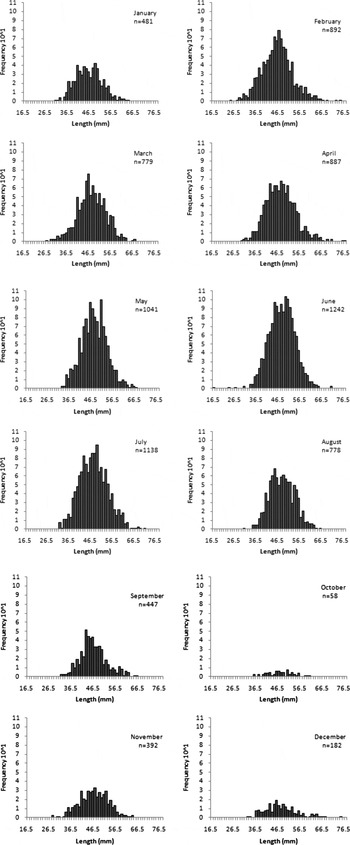
The number of individuals studied was 3110 (37.39%) males, 2622 (31.53%) females and 2585 (31.08%) neuters. In males the minimum and maximum shell lengths were 24 and 76 mm, in females 27 and 74 mm and in neuters 16 and 60 mm. The mean shell length was 47.7 ± 6.3 mm for males, 47.8 ± 6.3 mm for females and 43.7 ± 5.4 mm for neuters. The size–frequency did not show a normal distribution of the Patella candei population (Z = 4.054; P < 0.05), however the large sample size makes it robust to deviations from normality (Case & Ambrosius, Reference Case, Ambrosius and Ambrosius2007). No significant differences were found for mean shell length between sexes (F = 0.192, P > 0.05) therefore monthly length–frequency was estimated for the combined sexes. The largest sampled specimen was collected in April with 76 mm and the smallest in June with 16 mm. Specimens with less than 30 mm were only collected in February, March, April and November (Figure 1).
Monthly length–frequency distributions of Patella candei collected in Madeira Island, north-eastern Atlantic.

Weight–length relationship
Total weight (W) and shell length (L) of P. candei ranged from 1 to 43 g and from 16 to 76 mm respectively. The regression between W and L showed a positive relationship and the parameters of the regression were established as: W = −10.198 × 3.141 × L, r2 = 0.87, P < 0.05.
Age and growth
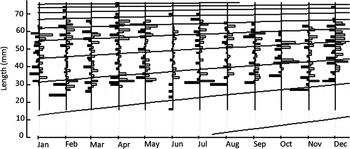
The VBGF parameters L∞ and K, were obtained for the best fit with L∞ = 80.81 mm, K = 0.32 year−1 (Figure 2) and an estimated growth performance index (φ′) of 3.32.
Von Bertalanffy growth curves of Patella candei superimposed on the restructured length–frequency histogram. Black and white bars represent positive and negative deviation from the weighed moving average of modal classes and represent pseudo-cohorts.

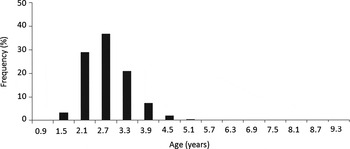
The age structure of P. candei ranged between 0.69 and 9.14 years with an average age of 2.76 ± 0.63 years. 99.6% of the individual's age was inferior to 4.8 years and 0.6% ranged from 4.8 to 9.6 years (Figure 3). Potential longevity assuming t0 = 0 (Pauly & David, Reference Pauly and David1981) was 9.36 years.
Age–frequency distribution for Patella candei for all data collected across the year from Madeira Island, north-eastern Atlantic.

Reproduction and recruitment
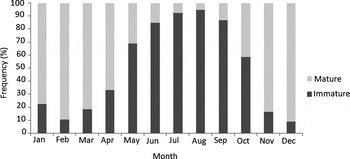
Mature individuals were collected during all months of sampling, being more abundant from November to April. The highest proportion of mature individuals was found in December (91.21%) and the lowest in August (5.53%). The spawning season for P. candei occurred from November to March (Figure 4). Size at maturity (Lm50) was 36.7 mm and corresponded to 1.89 years.
Monthly distribution of immature and mature individuals of Patella candei from Madeira Island, north-eastern Atlantic.

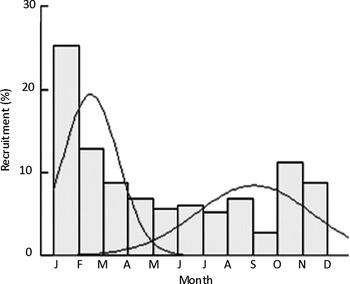
The recruitment pattern was continuous throughout the year, with a major peak being identified in January with 25.12% and a minor peak in October with 11.01% (Figure 5). Even though the smallest specimen was collected in June, the recruitment analysis did not result in a peak in this month with a relative recruitment of 6.17%. The smallest recruitment value was estimated for September with 2.72%.
Recruitment pattern of Patella candei of Madeira Island, north-eastern Atlantic.

Mortality and exploitation rate
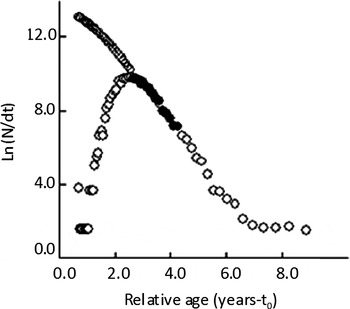
Total mortality (Z) using the length converted catch curve was 1.79 year−1 (Figure 6). Estimated natural mortality (M) was 0.55 year−1 and fishing mortality (F) 1.24 year−1. Exploitation rate obtained from fishing and total mortality was 0.69.
Length-converted catch curve of Patella candei. The dark dots represent the points used in the determination of Z using the least square linear regression and the white dots represent the points excluded for not being fully recruited or nearing to asymptotic length.

Probability of capture
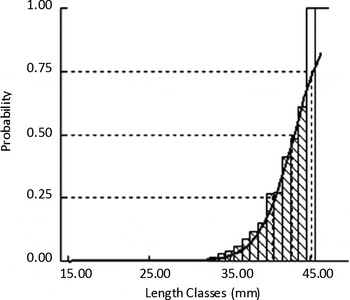
The length at first capture, at which 50% of the population of limpets is vulnerable to harvest, was 42.7 mm during the study period and corresponded to 2.35 years. The lengths at which 25% (Lc25) and 75% (Lc75) of limpets are susceptible to harvest were 40.4 and 45.1 respectively (Figure 7).
Probability of capture of each length-class for Patella candei from Madeira Island, north-eastern Atlantic.

Relative yield and biomass-per-recruit
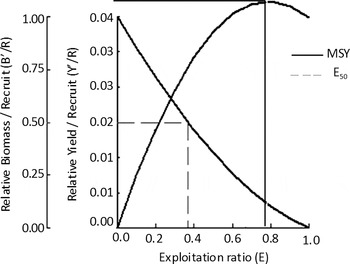
The calculated maximum sustainable exploitation rate (Emax) that gives the maximum relative yield-per-recruit at maximum sustainable yield (MSY) level for P. candei was 0.779, and the exploitation rate (E50) which corresponds to 50% of the relative biomass-per-recruit of the unexploited stock was 0.370 (Figure 8).
Yield-per-recruit and biomass-per-recruit models, showing maximum sustainable yield (MSY) and exploitation rate (E50) for Patella candei from Madeira Island, north-eastern Atlantic.

DISCUSSION
This study was the first dealing with population dynamics of Patella candei, therefore it will fill the gap on the knowledge of life history traits of this species.
Data analysis shows that no significant differences were found in length–frequency distribution by sex, suggesting that this species does not exhibit sexual dimorphism and therefore analysis was performed for combined sexes.
Weight–length relationship
The relative growth coefficient (3.141) detected for P. candei was significantly higher than 3 indicating that this species growth has a positive allometric nature (P < 0.05). Considering that the correlation coefficient was high (0.87) there is a substantial degree of predictability between weight and shell length. These results suggest that weight increases more rapidly than shell length. Baxter (Reference Baxter1983) obtained a similar allometric pattern for P. vulgata with a higher relative growth coefficient (3.252). A variety of factors control relative growth in limpets, both environmental factors such as temperature, food availability and wave action and biotic factors like age and sex (King, Reference King1995). The oligotrophic nature of the seawater in the archipelago of Madeira (Caldeira et al., Reference Caldeira, Groom, Miller, Pilgrim and Nezlin2002) translates into low levels of food availability which is the most likely factor responsible for the less accentuated growth observed for P. candei since it leads to lower levels of available energy on the habitat (King, Reference King1995). The positive allometric pattern observed might also be related to the stability of the environmental conditions in the subtidal, since this species is not vulnerable to non-marine factors such as desiccation, insolation and air temperature fluctuation and less vulnerable to marine factors such as wave action which was shown by Thompson (Reference Thompson1979) to influence growth in P. vulgata and P. aspera.
Age and growth
The calculated asymptotic length for P. candei at 80.81 mm is consistent with the length of the largest limpet sampled (76 mm). Population density, predation, competition and limited food resources are indicated as influencing growth rates on molluscs (Haven, Reference Haven1973; Black, Reference Black1977; Underwood, Reference Underwood1979; Clarke et al., Reference Clarke, Prothero-Thomas, Beaumont, Chapman and Brey2004). The estimated growth rate of 0.32 year−1, is relatively low and probably explained by the oligotrophic nature of the water in the region (Caldeira et al., Reference Caldeira, Groom, Miller, Pilgrim and Nezlin2002). Clarke et al. (Reference Clarke, Prothero-Thomas, Beaumont, Chapman and Brey2004) showed that the growth performance index value decreases with the increase of latitude. Latitude is a conventional geographical term, therefore, some environmental factors that covary with latitude are responsible for this pattern, such as temperature, insulation or photoperiod. For P. candei the calculated growth performance index was 3.32, however growth performance index values for species from the genus Patella from different latitudes are unavailable for comparison as far as the authors are aware. Longevity of P. candei extends up to 9.36 years, therefore this species could be considered moderately long lived. Estimated longevity is similar to the longevity of Lottia gigantea from southern California obtained by Kido & Murray (Reference Kido and Murray2003), higher than in the tropical species Cellana testudinaria reported by Khow (Reference Khow2007) and within the range observed by Espinosa et al. (Reference Espinosa, González, Maestre, Fa, Guerra-García and García-Gómez2008) for Patella ferruginea endemic to the Mediterranean, which is in accordance with Clarke et al. (Reference Clarke, Prothero-Thomas, Beaumont, Chapman and Brey2004) who suggest that limpets in temperate regions grow more slowly and reach larger maximum size and therefore have a longer lifespan than tropical limpets.
Reproduction and recruitment
Our results indicate that P. candei is a winter breeder, with spawning peaking in late autumn–early winter like P. vulgata from the British Isles (Orton, Reference Orton1929; Orton et al., Reference Orton, Southward and Dodd1956) and unlike Patella ulyssiponensis and Patella depressa, from the central Portuguese coast, which were described as summer breeders with spawning occurring in late September and from July to early September respectively (Bowman & Lewis, Reference Bowman and Lewis1986; Guerra & Gaudêncio, Reference Guerra and Gaudêncio1986; Brazão et al., Reference Brazão, Boaventura, Morais, Narciso and Ré2003). Even though conditions affecting spawning in Patella species are widely unknown, Orton et al. (Reference Orton, Southward and Dodd1956) suggested that for winter breeders, high wind speed allied to stimulation by wave action might induce spawning, acting as environmental triggers. Increase in phytoplankton concentration may also be responsible for the spawning pattern observed. As Underwood (Reference Underwood1979) suggested, gastropod species with planktotrophic larvae spawn when phytoplankton concentration is higher, a condition that in Madeira Island occurs from late autumn to early spring (Caldeira et al., Reference Caldeira, Groom, Miller, Pilgrim and Nezlin2002). Estimated shell length at maturity was 36.7 mm which corresponded to 1.89 years of age, since most of the sampled population was distributed between two and three years of age (36.70%) this would mean that the majority of individuals in the population are sexually mature.
Specific physical factors like temperature, topography of the bottom and humidity of surface and biological factors such as the presence of competitor species like barnacles are believed to strongly influence recruitment (Lewis & Bowman, Reference Lewis and Bowman1975). The recruitment pattern observed in this study for P. candei was continuous throughout the year, with a major peak in January and a less prominent peak in October. Silva et al. (Reference Silva, Boaventura and Ré2003) found a similar pattern for P. depressa on the central Portuguese coast, with two major recruitment pulses occurring in the autumn–winter period. The observed pattern may be explained by the decrease in temperature as described by Bowman & Lewis (Reference Bowman and Lewis1977) or to rougher sea conditions as indicated by Blackmore (Reference Blackmore1969) that occur in the autumn–winter period; however, further research is needed in order to establish the impact of these factors on the recruitment pattern of this species. The early juvenile groups of shell length inferior to 16 mm were not sampled during the present study, suggesting the existence of a specific nursery habitat for the species. In this case juveniles would migrate to the adult population after reaching a determined shell length/age as reported for Patella pellucida by McGrath & Foley (Reference McGrath, Foley and Wilson2005) and other mollusc species (Stoner, Reference Stoner2003).
Mortality and exploitation rate
Total mortality rate was estimated from the length converted catch curve as 1.79 year−1. The initial ascending data were not included in the regression analysis, since they represent younger individuals, not entirely recruited to the adult population and therefore subject to lower fishing mortality, this could also be related to the fact that limpet collection is size selective. Additionally the final data were not included since the closeness to the asymptotic length makes the relationship between age and length inaccurate (Sparre & Venema, Reference Sparre and Venema1992; King, Reference King1995).
Natural mortality was 0.55 year−1. Even though Pauly's M formula was developed for fish its usage in determining natural mortality in marine invertebrates is supported by the fact that these organisms share the same habitat and resources and are bound to be affected by the same environmental factors not differing in their vital parameters (Pauly, Reference Pauly1984). Furthermore, in the present study all sampled populations were sub-tidal and therefore not subjected to non-marine factors such as desiccation or air temperature changes. Natural mortality (M = 0.55 year−1) was inferior to fishing mortality (F = 1.24 year−1) and exploitation rate (E = 0.693), indicating that the fisheries exert considerable pressure on the stock of P. candei since professional harvest focuses preferentially on subtidal populations in the Madeira archipelago (Delgado et al., Reference Delgado, Alves, Góis and Faria2005). This could also result from the fact that the studied populations were all subtidal and as such are not subjected to the same environmental stresses as intertidal populations which are subjected to air temperature fluctuations, insolation and desiccation.
Probability of capture
Analysis of probability of capture resulted in 42.7 mm for the length at first capture which corresponded to 2.35 years of age, suggesting that most of capture occurs about six months after P. candei reaches sexual maturity at 1.89 years which seems to ensure reproduction of the species, as long as the minimum capture size allowed (40 mm) and the closed season (from November to March) are respected.
Relative yield and biomass-per-recruit
Our estimated exploitation rate, based on the fishing mortality, of 0.69 was lower than both the maximum sustainable yield (Emax = 0.779) and the exploitation rate which corresponds to 50% of the relative biomass-per-recruit of the unexploited stock (E50 = 0.370) calculated for P. candei, in the investigated area, indicating that this species stock is under-exploited and below maximum fishing pressure according to the methodology used and for the studied period.
CONCLUSIONS
This study showed that P. candei is a moderately long lived species with slow growth, reaching sexual maturity at about 2 years of age. Even though its stock was found to be under-exploited in the investigated area these life history traits make this species extremely vulnerable to over-exploitation. In order to ensure a more effective sustainable management of this resource a possible measure would be to increase the length of the closed season up to six months from November to April. Additionally, considering there is unremitting and intense pressure acting on this resource, continuous monitoring of population status is required to assess stock vulnerability and evolution in order to assure its sustainable management.
ACKNOWLEDGEMENTS
The authors wish to thank the Fisheries Research Service (DSIP) from the Regional Directorate of Fisheries (DRP) of the Autonomous Region of Madeira for providing the data used in this study. We are also grateful to the technicians of DSIP for their help in the course of this work.