1. Introduction
The Dabie orogenic belt is the largest ultrahigh-pressure (UHP) metamorphic belt in the world (Hacker, Wang & Eide, Reference Hacker, Wang, Eide and Harrison1996) and was formed by a Triassic collision between the North China and Yangtze blocks (Zhai & Cong, Reference Zhai and Cong1996; Hacker et al. Reference Hacker, Ratschbacher, Webb, Ireland, Calvert, Dong, Wenk and Chateigner2000). Cretaceous intrusive and volcanic rocks comprise 47% of the surface exposure of the Dabie Orogen (Ratschbacher et al. Reference Ratschbacher, Hacker, Webb, McWilliams, Ireland, Dong, Calvert, Chateigner and Wenk2000) and were emplaced into the Dabie orogen at c. 120–145 Ma (Ma et al. Reference Ma, Li, Ehlers, Yang and Wang1998; Jahn et al. Reference Jahn, Potel, Villa, Whitehouse and Andriessen1999; Ma et al. Reference Ma, Yang, Xu, Li and Carl1999; Chen, Jahn & Wei, Reference Chen, Jahn and Wei2002; Wang et al. Reference Wang, Fan, Peng, Zhang and Guo2005b; Wang et al. Reference Wang, Wyman, Xu, Jian, Zhao, Li, Xu, Ma and He2007). It is still uncertain whether Triassic collision events directly gave rise to these extensive magmatic rocks. The time interval between the emplacement of the magmatic rocks and collision of the North China and Yangtze blocks is c. 100 Ma (Ma et al. Reference Ma, Zhang, Liu and Wang2008) greater than that seen in typical orogenic belts elsewhere; for example, post-collisional granites in the European Variscan orogenic belt appeared c. 50 Ma after collision (Finger et al. Reference Finger, Roberts, Haunschmid, Schermaier and Steyrer1997; Van Wagoner et al. Reference Van Wagoner, Leybourne, Dadd, Baldwin and McNeil2002). Late Mesozoic magmatism in Eastern China has recently attracted much attention because of its relationship to Palaeo-Pacific Plate subduction (Zhang et al. Reference Zhang, Gao, Zhong, Zhang, Zhang and Hu2002; Wu et al. Reference Wu, Lin, Wilde, Zhang and Yang2005; Huang et al. Reference Huang, Li, Dong, Li, Chen, Wang and Yang2007; Zhao et al. Reference Zhao, Zheng, Wei and Wu2007), although the Dabie orogen is over 900 km from present-day subduction zones of the Palaeo-Pacific Plate. Thus the tectonic setting of Late Mesozoic magmatism in the Dabie orogenic belt is still an open question, and the widespread granitoids provide insights into this discussion. Previous studies of granitoids of the Dabie orogen have focused on I-type granites, although A-type granites also occur but are as yet undated (Wang, Zhao & Xiong, Reference Wang, Zhao and Xiong2000). Whalen and others argued that although A-type granitoids occur in various locations all over the world, they are all found in extensional settings, and have great significance for the interpretation of geodynamic processes (Whalen, Currie & Chappell, Reference Whalen, Currie and Chappell1987; Eby, Reference Eby1992; Bonin, Reference Bonin2007). The A-type granitoids of the Dabie orogenic belt are representative examples and deserve further investigation.
In this paper, we present new zircon U–Pb ages, geochemical and isotopic data for the Baiyashan aluminous A-type granitic pluton, which was previously thought to be an Early Cretaceous I-type granite (Li & Wang, Reference Li and Wang1991). We discuss the petrogenetic and geodynamic implications of our data.
2. Geological setting and petrography
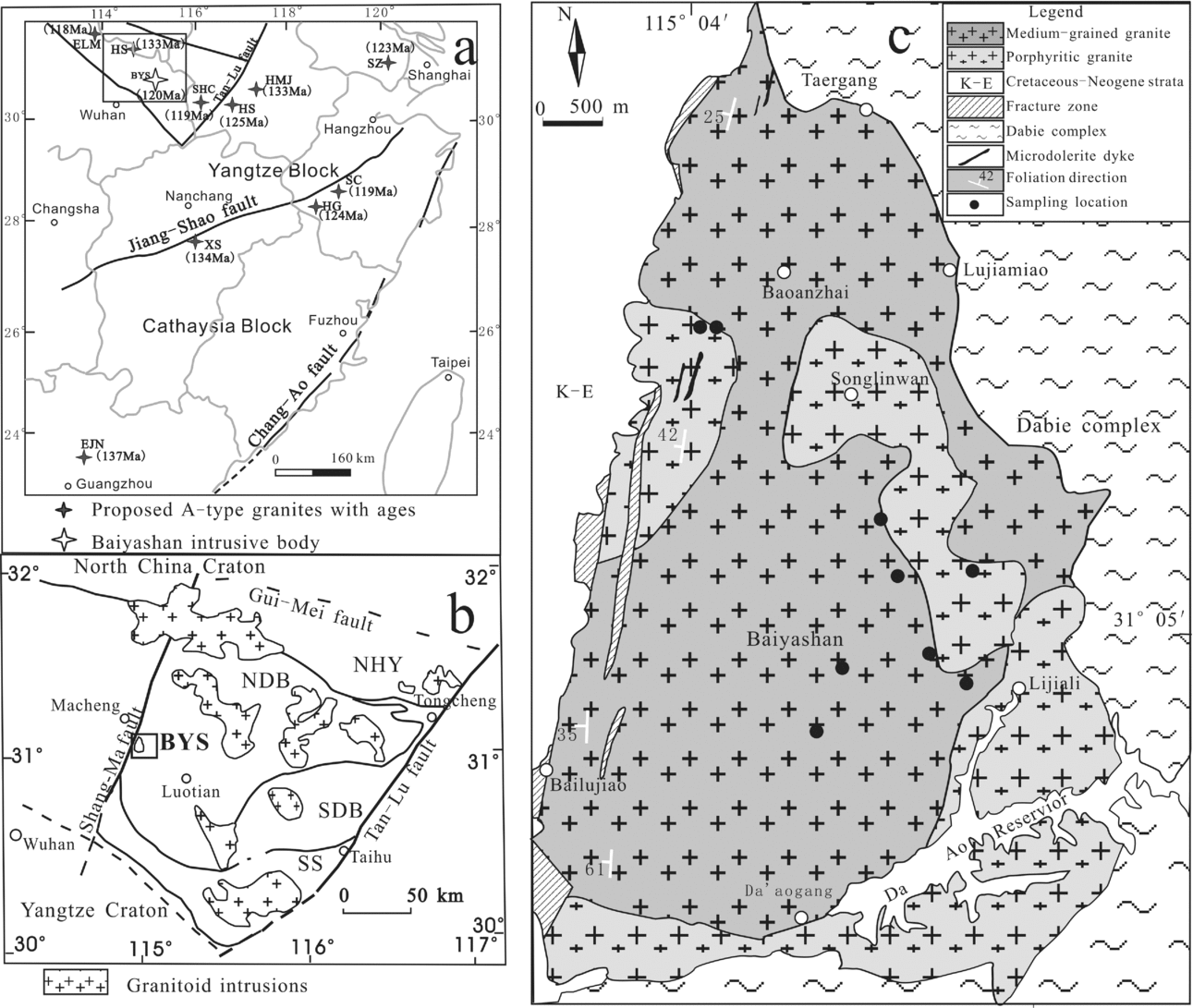
The geology of the Dabie orogenic belt (Fig. 1b) has been described in many recent publications (Cong & Wang, Reference Cong, Wang and Cong1996; Ma et al. Reference Ma, Li, Ehlers, Yang and Wang1998; Ma et al. Reference Ma, Ehlers, Xu, Li and Yang2000; Mason & Sang, Reference Mason and Sang2007; Xu, Ma & Ye, Reference Xu, Ma and Ye2007). From south to north, the eastern part of the Dabie orogenic belt comprises: (1) the Su Song (SS) high pressure belt, (2) the South Dabie HP/UHP metamorphic complex, (3) the North Dabie orthogneiss unit and (4) the North Huaiyang greenschist-facies meta-sedimentary unit. All four tectonic units were intruded by large volumes of Cretaceous magmatic rocks. Compared with other metamorphic belts, the North Dabie metamorphic core complex was exhumed from deep levels and modified by intensive intrusion of Early Cretaceous granitoids. It therefore presents an ideal opportunity for studying granitoids (Ma et al. Reference Ma, Li, Ehlers, Yang and Wang1998; Huang et al. Reference Huang, Li, Dong, Li, Chen, Wang and Yang2007; Xu, Ma & Ye, Reference Xu, Ma and Ye2007). This study focuses on the Baiyashan granitic intrusive body in the North Dabie complex as a typical representative example (Fig. 1).
(a) Sketch map showing the location of the Dabie orogenic belt and distribution of Early Cretaceous A-type granites in SE and Central China with ages. Abbreviations represent the names of the A-type granitoids (see Table 3). (b) Geology of the Dabie orogenic belt, modified from Zhang et al. (Reference Zhang, Gao, Zhong, Zhang, Zhang and Hu2002). NHY – North Huaiyang block; NDB – North Dabie orthogneiss unit; SDB – South Dabie HP/UHP metamorphic complex; SS – Susong high pressure belt. (c) Simplified geological map of Baiyashan.

The Baiyashan granitic body covers an area of 22 km2 in the Baiyashan–Taergang area (31°05′ N, 115°05′ E), and is intruded into the North Dabie orthogneiss unit near the Shang-Ma (Shangcheng-Macheng) Fault (Fig. 1b). It has the form of a stock, triangular in plan, trending NNE, consistent with the regional tectonic strike. Neogene sediments cover the intrusion to the west. Near its western margin, the granite has an imposed gneissose foliation parallel to the regional tectonic strike, and away from the western part, magma has often been emplaced along the gneissose foliation of the metamorphic country rocks. The Baiyashan granitic body is composed of medium-grained biotite granite and porphyritic biotite granite, with the former dominating. Observations at outcrop show porphyritic biotite granite intruded by medium-grained biotite granite. The porphyritic biotite granite contains ~ 10 mm phenocrysts of microcline perthite, plagioclase antiperthite (An26), quartz and biotite (40–50%) in a groundmass of subhedral K-feldspar, quartz, plagioclase (An25), biotite, apatite, sphene and Fe–Ti oxides. Plagioclase displays normal zoning; biotite is green or green-brown and sometimes altered to chlorite. Grain boundaries are irregular, and myrmekitic intergrowths occur in the groundmass. The medium-grained biotite granite also contains quartz (25–30%), plagioclase (An25) (15–20%), alkali-feldspar (40–45%), biotite (10–15%) and accessory minerals (< 1%), including zircon, sphene and Fe–Ti oxides, and is similar to the porphyritic biotite granite except that the crystals are uniform in size, ranging up to about 10 mm. Both textural types of granite almost always display deformation features such as strain shadowing in quartz, and cracks and deformed twin lamellae in feldspars. Where deformation is strongest, granite has been metamorphosed into mylonite containing feldspar augen in a blastomylonite matrix with ribbon microstructure (Mason & Sang, Reference Mason and Sang2007).
Mafic microgranular enclaves (MMEs) occur sparsely in the porphyritic biotite granite and rarely in the medium-grained biotite granite. They are elliptical to lens-shaped, flattened parallel to foliation planes of the granite, have igneous textures and range from quartz-diorite to monzonite in composition, typically consisting of 20–25% biotite, 25–40% K-feldspar, 15–25% plagioclase, 15–20% quartz, 5% hornblende and accessory minerals (< 1%) including zircon, sphene and Fe–Ti oxides. Fine-grained, igneous-textured enclaves from I- and A-type granites are usually thought to represent remnant mafic end-members of a mafic liquid component added to intermediate or felsic magma chambers (Bonin, Reference Bonin2004; Perugini, Poli & Bonin, Reference Perugini, Poli and Bonin2004) or alternatively, hybrids of mafic and felsic components (Yang et al. Reference Yang, Wu, Chung, Wilde and Chu2006). The enclaves in the Baiyashan have igneous textures with acicular apatite and allotriomorphic overgrowths of plagioclase round euhedral cores, typical features of magmatic enclaves (Sparks & Marshall, Reference Sparks and Marshall1986). Acicular apatite has been attributed to rapid cooling caused by mingling of small volumes of hot basalt with cool granitic melt (D'Lemos, Reference D'Lemos1996; Yang et al. Reference Yang, Wu, Chung, Wilde and Chu2006, Reference Yang, Wu, Wilde, Chen, Liu and Xie2008). ‘Dents de cheval’ K-feldspar megacrysts growing across the boundaries of enclaves and biotite-rich basic fronts in the outer layers show that the enclaves were still liquid when the megacrysts were growing in the granite magmas.
A few microdolerite dykes up to 0.3 m wide typically strike N30° and dip 70° NE parallel to the regional tectonic strike. They have grain sizes less than 0.2 mm, chilled margins and columnar joints and were intruded during a separate magmatic event after the granite body had cooled.
Although Li & Wang (Reference Li and Wang1991) considered the Baiyashan intrusion to be an I-type granitic body and reported a crystallization age of 105 Ma obtained by zircon U–Pb isotope dilution, this age has been questioned (Zhao, Yang & Shen, Reference Zhao, Yang and Shen2002) and may represent a mixed age rather than the actual time of crystallization. Our new results revise their conclusions.
3. Analytical methods
3.a. Zircon U–Pb dating
Rock samples were crushed in a steel jaw crusher, and shaking bed and heavy liquid techniques were used to concentrate heavy minerals. Zircon crystals were separated from heavy minerals by hand-picking under a binocular microscope. Sample zircons were mounted in epoxy, and the resin discs were polished until less than half the zircon grains were exposed. Before in situ U–Pb isotope analyses, the morphology and internal structure of these zircons were studied by binocular microscope and cathodoluminescence (CL) imaging, which were used as guides to find appropriate spots for the isotope analyses. Representative zircon crystals were prepared for the CL investigations and in situ isotope analyses by mounting in epoxy resin and polishing down to expose the grain centres. CL images were obtained using a JEOL JXA-8900RL microprobe at the Chinese Academy of Geological Sciences (CAGS), Beijing at 15 kV. U–Pb dating was performed using a laser ablation inductively-coupled plasma-mass spectrometer (LA-ICPMS) at the State Key Laboratory of Geological Processes and Mineral Resources (GPMR), China University of Geosciences, Wuhan. The method of LA-ICPMS zircon U–Pb age dating is described by Yuan et al. (Reference Yuan, Gao, Liu, Li, Günther and Wu2004). Data were reduced using the in-house Glitter online software, which provides for selection of stable intervals in each time-resolved analysis. Subsequent data processing was carried out using the ISOPLOT program (Ludwig, Reference Ludwig1997), and measured 204Pb was applied for common lead correction (Andersen, Reference Andersen2002). Errors are quoted at the 1σ level for individual analyses, whereas the error for weighted mean ages is quoted at the 2σ (95% confidence) level.
3.b. Major and trace element analysis
Fresh whole-rock samples were crushed in a steel crusher and powdered to < 200 mesh using an agate mill. Major element oxides were measured using a Regaku 3080E1 XRF spectrometer at the Analytical Institute of the Bureau of Geology and Mineral Resources, Hubei Province (BGMRHP). Analytical procedures are described in detail by Gao et al. (Reference Gao, Zhang, Xie, Gu, Ouyang, Wang and Gao1991, Reference Gao, Zhang, Gu, Xie, Gao and Guo1995). Relative standard derivations for major element oxides are within 5%.
Trace and rare earth elements were analysed at the State Key Laboratory of Geological Processes and Mineral Resources (GPMR), China University of Geosciences, using an Agilent 7500a ICP-MS. Methods of sample preparation and digestion are described in Zhang et al. (Reference Zhang, Gao, Zhong, Zhang, Zhang and Hu2002). Analytical precision (relative standard deviation) estimated from repeated analyses of three standard reference samples G-2, AGV-1 and GSR-3 is better than 5% for rare earth elements and 5–12% for other trace elements.
3.c. Rb–Sr and Sm–Nd isotope analysis
Whole rock Sr–Nd isotopic ratios were obtained using a Finnigan Triton thermo-ion mass isotope spectrometer at GPMR, China University of Geosciences, following the methods of Zhang et al. (Reference Zhang, Harris, Parrish, Kelley, Zhang, Rogers, Argles and King2004). Reported 87Sr/86Sr and 143Nd/144Nd ratios were measured by ICP-MS and normalized to 86Sr/88Sr = 0.1194 and 146Nd/144Nd = 0.7219, respectively. Total analytical blanks were 5 × 10⁻¹¹ g for Sm and Nd and (2–5) × 10−10 g for Rb and Sr.
4. Zircon U–Pb geochronology
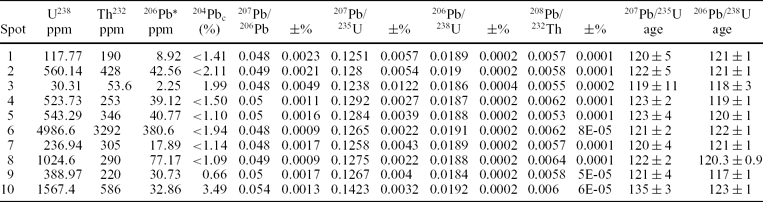
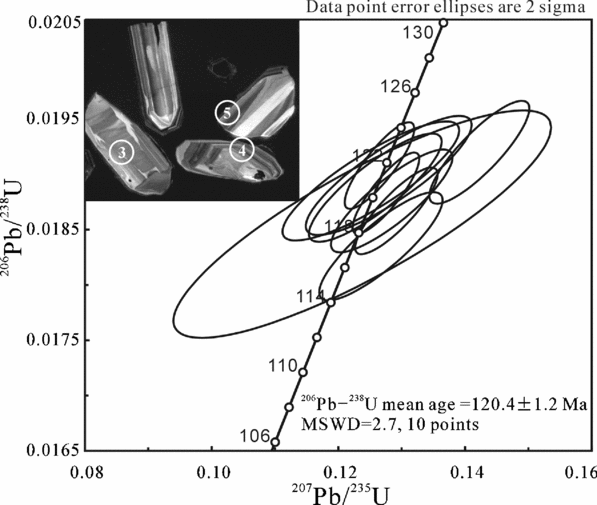
A representative sample of medium-grained biotite granite (MC04, sampling location: 115°04.606′ E, 31°04.592′ N) was selected for LA-ICPMS dating. The zircons selected for analysis were prismatic, highly transparent and free of visible inclusions. They were mostly pale yellow to colourless euhedral crystals, ranging from 120 μm to 350 μm in length, with length/width ratios of 1:1 to 3:1. Ten analyses were performed on ten crystals that were light coloured in cathodoluminescence (CL) images and had high Th/U ratios (0.28 to 1.77), indicative of a magmatic origin (Xu et al. Reference Xu, Luo, Huang, He, Xiao, Xie and Shi2008). Data are listed in Table 1 and shown in a concordia diagram (Fig. 2). The inset in Figure 2 shows that zircons from the Baiyashan pluton exhibit well-developed oscillatory zoning, confirming their magmatic origin, and none contain xenocrystic cores. The ten analyses yield concordant 206Pb/238U ages ranging from 118 ± 3 Ma to 123 ± 1 Ma, with a weighted mean age of 120.4 ± 1.2 Ma (95% conf., MSWD = 2.7).
LA-ICPMS zircon U–Pb data for Baiyashan granite (MC04)

Errors are 1-sigma; Pbc and Pb* indicate the common and radiogenic portions, respectively. Common Pb corrected using measured 204Pb.
LA-ICPMS zircon U–Pb concordia diagram. Inset: representative CL images of zircons from the sample MC04 of the Baiyashan granite; the numbers represent spot numbers.

5. Geochemistry
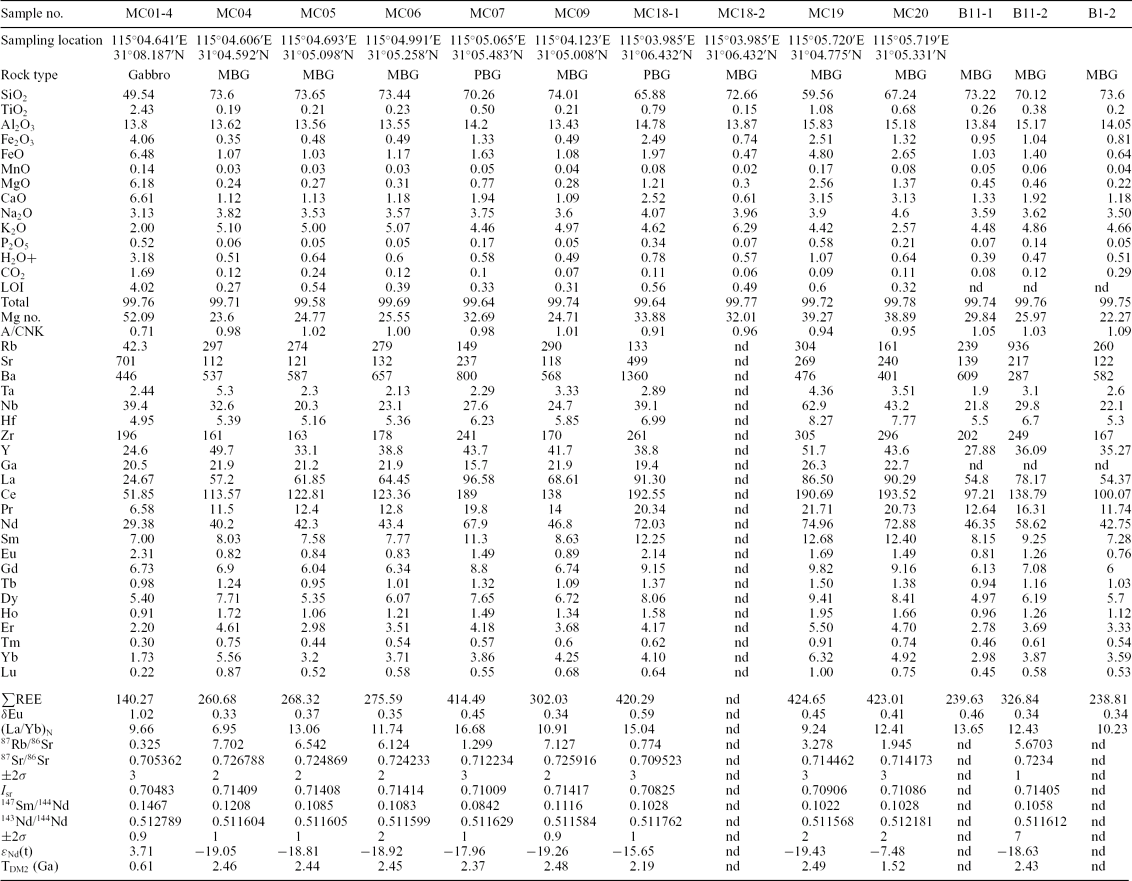
Ten of the least-altered samples were chosen for major, trace, rare-earth element and Sr–Nd isotopic analyses: seven host rock samples consisting of five medium-grained biotite granites (MC04, MC05, MC06, MC09, MC18-2), two porphyritic biotite granites (MC07, MC18-1), two enclaves (MC19, MC20) from porphyritic biotite granite and one microdolerite dyke sample (MC01-4). Major, trace, rare-earth element and Sr–Nd isotope data are given in Table 2.
Chemical compositions for Baiyashan granitic body; major (wt%) and trace elements (ppm)
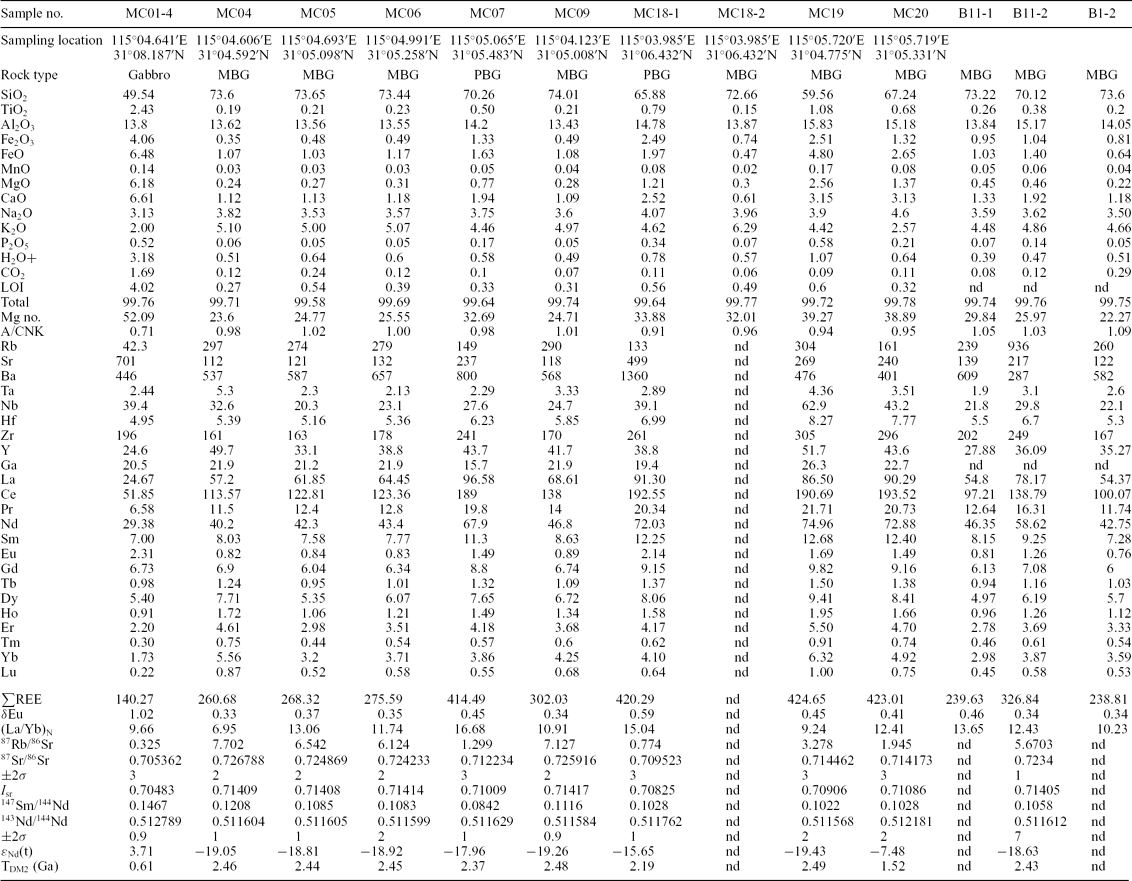
*Data from Ma et al. (Reference Ma, Li, Ehlers, Yang and Wang1998) and Ma et al. (Reference Ma, Yang, Xu, Li and Carl1999); nd – not detected; MBG – medium-grained biotite granite; PBG – porphyritic biotite granite.
δEu=2EuN/(SmN+GdN), (La/Yb)N=LaN/YbN.
ISr and ɛNd(t) values are calculated at t=120 Ma based on present-day (147Sm/144Nd)CHUR=0.1967 and (143Nd/144Nd)CHUR=0.512638.
TDM2 values are calculated based on present-day (147Sm/144Nd)DM=0.2137 and (143Nd/144Nd)DM=0.51315.
5.a. Major, trace and rare-earth elements
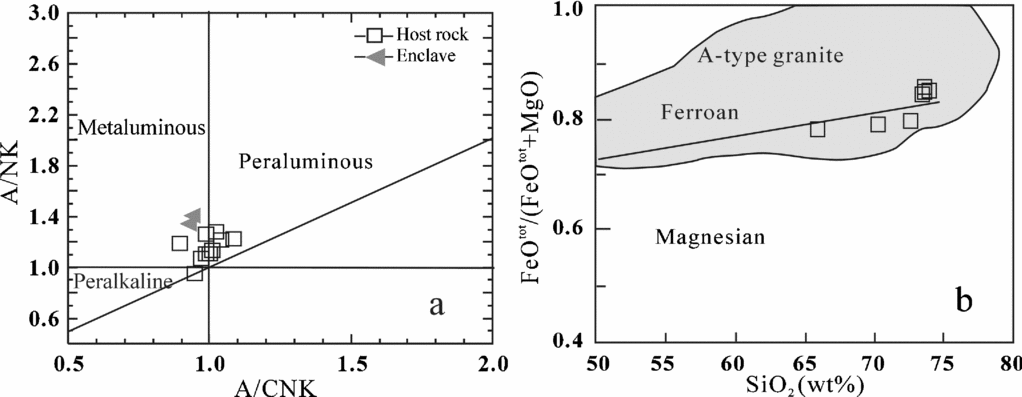
As shown in Table 2, the Baiyashan granites (including medium-grained biotite granite, porphyritic biotite granite) are siliceous, with SiO2 ranging from 65.9% to 74.0%, and enriched in alkalis (K2O = 4.46–6.29%, Na2O = 3.50–4.07% and K2O + Na2O = 8.07–10.25%). They have low Fe2O3 (0.35–2.49%), FeO (0.47–1.97%), MnO (0.02–0.08%), CaO (0.61–2.52%), P2O5 (0.05–0.34%) and MgO (0.24–1.21%) contents. Mg numbers range from 23.3 to 33.9 and FeOtot/MgO ratios vary from 3.48 to 5.77 with an average of 4.82, higher than I-type granite (average of 991 samples FeOtot/MgO value is 2.27), S-type granite (average of 578 samples FeOtot/MgO value is 2.38) and M-type granite (average of 17 samples FeOtot/MgO value is 2.37) (Whalen, Currie & Chappell, Reference Whalen, Currie and Chappell1987). Figure 3a shows that the Baiyashan granites are metaluminous or weakly peraluminous, and strongly peraluminous compositions are absent. According to the classification scheme for granitoids proposed by Frost et al. (Reference Frost, Barnes, Collins, Arculus, Ellis and Frost2001), the Baiyashan granites are ferroan granites, like other A-type granites worldwide (Fig. 3b). The lack of inherited zircons in granitic igneous rocks may indicate that most of the zircons in the Baiyashan granites nucleated and crystallized near the liquidus, a conclusion supported by their euhedral form. Zr and P saturation temperatures were calculated after Watson & Harrison (Reference Watson and Harrison1983) as 780 °C for MC 04, 786 °C for MC 05, 792 °C for MC 06, 813 °C for MC 07, 789 °C for the most felsic component MC09, 806 °C for MC 18-1, 808 °C for B11–1, 821 °C for B11–2 and 794 °C for B1-2.
(a) Molar Al/(K+Na) v. Al/(Ca+Na+K) diagram. (b) Mass% FeOtot/(FeOtot+MgO) v. SiO2. A-type granite field after Frost et al. (Reference Frost, Barnes, Collins, Arculus, Ellis and Frost2001).

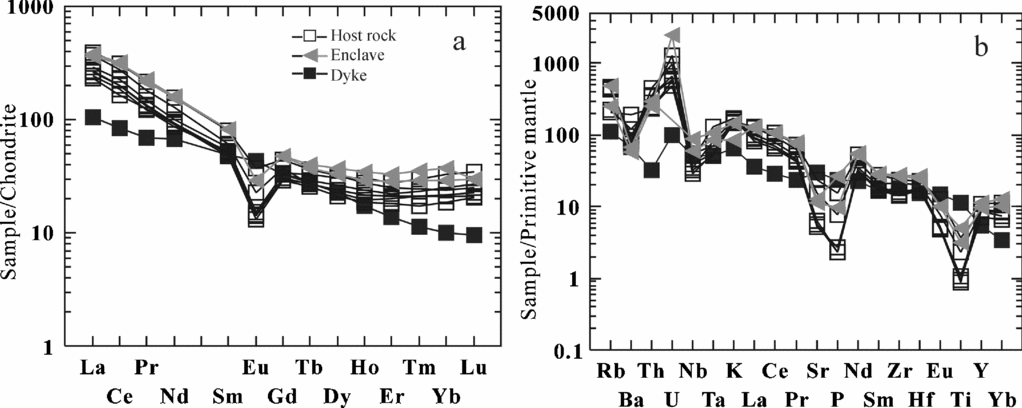
The Baiyashan granites are characterized by high Ga/Al ratios, Ga/Al × 104 ranging from 2.43 to 3.06, and all samples fall in the field of A-type granites in discrimination diagrams. The Baiyashan granites are also enriched in rare-earth elements (REE) with total concentrations of 238.8–420.3 ppm. The light rare earth elements (LREE) display a strong negative correlation with increasing SiO2, typical of A-type granites (Rajesh, Reference Rajesh2000; Wu et al. Reference Wu, Sun, Li, Jahn and Wilde2002). Chondrite-normalized REE patterns show enrichment of LREE relative to heavy rare earth elements (HREE), with (La/Yb)N ratios of 6.95–16.68 and strongly negative Eu anomalies (Eu*/Eu = 0.33–0.59) (Fig. 4a). In a spider diagram (Fig. 4b), the Baiyashan granites show negative anomalies of Ba, Sr, P, Eu and Ti, and positive anomalies of Ce and Y, consistent with the patterns of A-type granites (Wu et al. Reference Wu, Sun, Li, Jahn and Wilde2002), and also suggesting a continental crust affinity. Negative anomalies of P and Ti probably reflect fractionation of apatite and ilmenite/sphene, respectively. These geochemical characteristics combined with high zircon saturation temperatures show beyond doubt that the Baiyashan granites are aluminous A-type granites. The MMEs have higher Fe2O3 (1.32–2.51%), FeO (2.65–4.80%) and Mg numbers (38.9–39.3), and lower FeOtot/MgO (2.76–2.80) than the host Baiyashan granites. However, similar enrichment and depletion patterns shown in the spider diagram (Fig. 4b) suggest that they belong to the same magmatic suite. The microdolerite dyke rock is different: enriched in LREE with (La/Yb)N ratios of 9.95 and having a weak positive Eu anomaly (Eu*/Eu = 1.05), indicating that there has been no plagioclase fractional crystallization. In Figure 4b, the microdolerite displays negative Th, Nb, Ta, Sr, P, Y and Yb anomalies, confirming field and petrographic evidence that it represents magma from a source unrelated to the Baiyashan intrusion. Its Zr/Ba ratio of 0.42, higher than 0.2, suggests a depleted mantle origin (Ormerod et al. Reference Ormerod, Hawkesworth, Rogers, Leeman and Menzies1988).
(a) Chondrite-normalized REE patterns, normalizing values from Taylor & McLennan (Reference Taylor and McLennan1985); (b) primitive mantle-normalized element spider diagram, normalizing values from Sun & McDonough (Reference Sun, McDonough, Saunders and Norry1989).

5.b. Sr and Nd isotopes
Initial 87Sr/86Sr (ISr) and ɛNd(t) values for the granite samples were back-calculated for a magma crystallization age of 120 Ma. Calculated ISr and ɛNd values range from 0.708 to 0.714 and −7.48 to −19.43, respectively, giving mantle-depletion Nd model ages (TDM2) in the range 1.5–2.5 Ga, indicating that the magma of the Baiyashan granite was derived from an old crustal source. Sr–Nd isotopic data ISr = 0.705 and ɛNd = 3.71 with TDM2 = 0.61 Ga (t = 120 Ma) for the microdolerite dyke suggest that the magma had a young depleted mantle source.
6. Discussion
6.a. Magma source
The origin of A-type granites is still an active subject of discussion among petrologists, mainly because so many compositional variants have been found, and there is no consensus on the origin of A-type granites (Bonin, Reference Bonin2007). There are aluminous A-type granites, in which the sum of Na and K is more or less equal to Al, others are decidedly alkaline, and still others are peraluminous. The Baiyashan granite is an aluminous A-type granite. A number of petrogenetic schemes have been proposed for the magma sources of A-type granites (Martin, Reference Martin2006; Bonin, Reference Bonin2007; Zhang et al. Reference Zhang, Parrish, Zhang, Xu, Yuan, Gao and Crowley2007) which mostly fall into two categories, one invoking crustal, one mantle sources, while a few advocate mixing between crustal and mantle sources (Schmitt et al. Reference Schmitt, Emmermann, Trumbull, Buhn and Henjes Kunst2000; Bonin, Reference Bonin2007). Derivation by fractional crystallization from alkaline basalts or other mantle-derived magmas and melting of residual granulitic sources have also been proposed (King et al. Reference King, White, Chappell and Allen1997).
We have used Rb–Sr and Sm–Nd isotopic data to elucidate the source magma of the Baiyashan granite because isotopic ratios are useful indicators of granite source regions. The Sr and Nd isotopic results (ISr =0.708–0.714, ɛNd = −7.48 to −19.43) indicate a crustal source but do not rule out contributions from enriched mantle material. Eby (Reference Eby1992) suggested that the Y/Nb ratio could distinguish between A-type granite with mantle (Y/Nb < 1.2) and crustal (Y/Nb > 1.2) origins. Most of the Baiyashan granite samples have Y/Nb > 1.2, implying that they are largely crustal in origin.
Mineralogical and geochemical features show that the Baiyashan A-type granite crystallized at a high temperature from relatively anhydrous magma, and possible crustal source rocks are present in the North Dabie basement and adjacent areas. We have therefore evaluated various potential crustal sources in the North Dabie belt to see if they could make plausible contributions to the magma source of the Baiyashan A-type granites. Proposed sources vary from granodiorite, tonalite and quartz diorite to tholeiites and their differentiated products (Xu, Ma & Ye, Reference Xu, Ma and Ye2007).
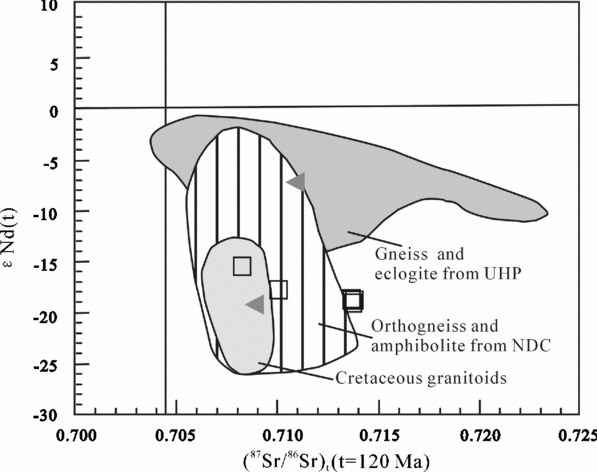
A great deal of published Sr–Nd isotopic data shows that ɛNd(t) and (87Sr/86Sr)t values for the Northern Dabie Complex are characterized by more negative ɛNd(t) values (−8.84 to about −23.56) and restricted narrow (87Sr/86Sr)t variation (~ 0.707 to ~ 0.715) compared with South Dabie UHP gneiss (Chen & Jahn, Reference Chen and Jahn1998; Ma et al. Reference Ma, Ehlers, Xu, Li and Yang2000; Wang, Zhao & Xiong, Reference Wang, Zhao and Xiong2000; Zheng et al. Reference Zheng, Jin, Zhai and Shi2000; Zhang et al. Reference Zhang, Gao, Zhong, Zhang, Zhang and Hu2002; Xu, Ma & Ye, Reference Xu, Ma and Ye2007; Xu, Ye & Ma, Reference Xu, Ye and Ma2008). As shown in Figure 5, the Baiyashan A-type granites occupy almost exactly similar ranges to the Northern Dabie Complex. The Cretaceous granitoids, irrespective of tectonic unit, show identical Sr–Nd isotopic compositions, which agree with the Northern Dabie Complex and differ distinctly from the UHP metamorphic rocks. Ma et al. (Reference Ma, Li, Ehlers, Yang and Wang1998) and Zhang et al. (Reference Zhang, Gao, Zhong, Zhang, Zhang and Hu2002) have proposed that the Early Cretaceous granitoids in Dabie are products of anatexis of the Dabie Complex, and experiments also prove that dehydration and partial melting of tonalite (P ≤ 1.0 Gpa, T ≤ 950 °C) can produce melts with chemical compositions close to Dabie granitoids (Patiño-Douce, Reference Patiño-Douce1997). King et al. (Reference King, White, Chappell and Allen1997) pointed out that aluminous A-type granites are generally produced by high-temperature partial melting of felsic infracrustal sources. We therefore favour the derivation of Baiyashan A-type granite magmas by direct partial melting of middle to lower crustal intermediate-felsic igneous rocks, similar to those now occurring in the North Dabie Complex.
ɛNd(t) v. (87Sr/86Sr)t diagram for the Cretaceous granitoids. Each sample calculated at t = 120 Ma, selected mean magma emplacement age for the Cretaceous granitoids. Fields for the Northern Dabie complex and UHP metamorphic rocks at t = 120 Ma shown for comparison from data by Chen & Jahn (Reference Chen and Jahn1998), Ma et al. (Reference Ma, Ehlers, Xu, Li and Yang2000) and Zheng et al. (Reference Zheng, Jin, Zhai and Shi2000). NDC – North Dabie complex. Symbols as in Figure 3.

6.b. Petrogenesis
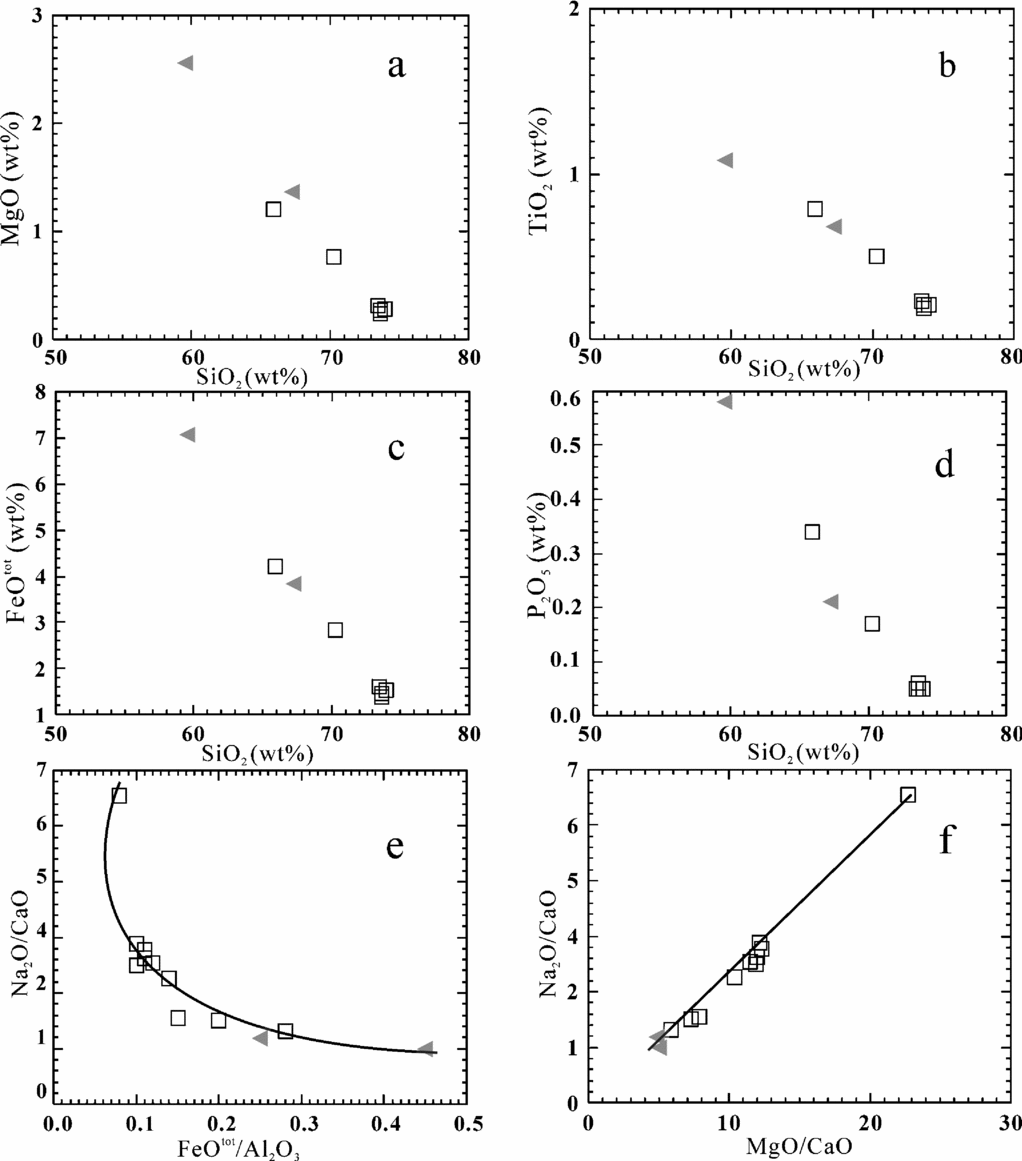
Many workers have suggested that A-type granites are produced by combined partial melting and fractional crystallization (King et al. Reference King, White, Chappell and Allen1997; Wei, Zhao & Spicuzza, Reference Wei, Zhao and Spicuzza2008). The MMEs and their host granites show continuous variation in SiO2 from 59.56% to 74.01%, producing tight linear or slightly curved trends on Harker diagrams (Fig. 6a–d), well explained by fractional crystallization of magma close to the low SiO2 end of the range. The felsic end-member could have a composition close to MC04 and the mafic member close to MC19 (Fig. 6e, f). This variation provides strong support for a genetic link between the enclaves and host granites, supported by field relations and petrography of the enclaves. We cannot entirely rule out alternative explanations for the trends, such as restite unmixing, crystal fractionation of basaltic magma or two-component magma mixing (Arvin, Dargahi & Babaei, Reference Arvin, Dargahi and Babaei2004; Yang et al. Reference Yang, Wu, Chung, Wilde and Chu2006), but a restite model predicts metamorphic xenoliths of metamorphic rocks rather than magmatic enclaves and is therefore unlikely (Mason, Reference Mason, Bennett, Doyle, Larwood and Prosser1996).
Representative variation diagrams for Baiyashan rock samples. Harker variation diagrams for (a) MgO, (b) TiO2, (c) FeOtot, (d) P2O5. (e) FeOtot/Al2O3 v. Na2O/CaO; (f) MgO/CaO v. Na2O/CaO. Symbols as in Figure 3.

The decreasing trends of MgO, FeOtot, TiO2 and P2O5 may be correlated with the crystallization of accessory phrases (Fig. 6a–d). Variations of incompatible trace elements such as Eu, Sr and Ba, in the major phases K-feldspar, plagioclase and biotite are useful for estimating the extent of fractionation of these minerals and whether magmatic evolution was controlled dominantly by fractional crystallization. Positive correlations between Ba–Sr and Eu–Sr argue against a fractional crystallization model, but a positive correlation of CaO/Eu with Eu indicates plagioclase fractional crystallization (Zhang et al. Reference Zhang, Chen, Xu, Liu, Yuan and Liu2006). Halliday et al. (Reference Halliday, Davidson, Hildreth and Holden1991) pointed out that high Rb/Sr ratios are a possible consequence of fractionation processes, in contrast to the low Rb/Sr ratios of the Baiyashan granitic samples. These conflicting trends may mean that magma evolution involved limited fractional crystallization dominated by fractional crystallization of plagioclase. There is no evidence of other complex processes having controlled the magmatic evolution. The high temperatures required to produce the Baiyashan A-type granite may have been initiated by mantle upwelling or basic magma influx into a localized area of the crust, but there is no direct evidence for the latter at Dabie.
The petrography, geochemistry and isotopic compositions of the Baiyashan intrusion indicate that the host granites and their enclaves are the result of compositional mixing between mafic and intermediate to felsic magmas combined with plagioclase-dominated fractionation. The microdolerite dykes represent a later, unrelated intrusion of basic magma derived from the mantle.
6.c. Geodynamic implications
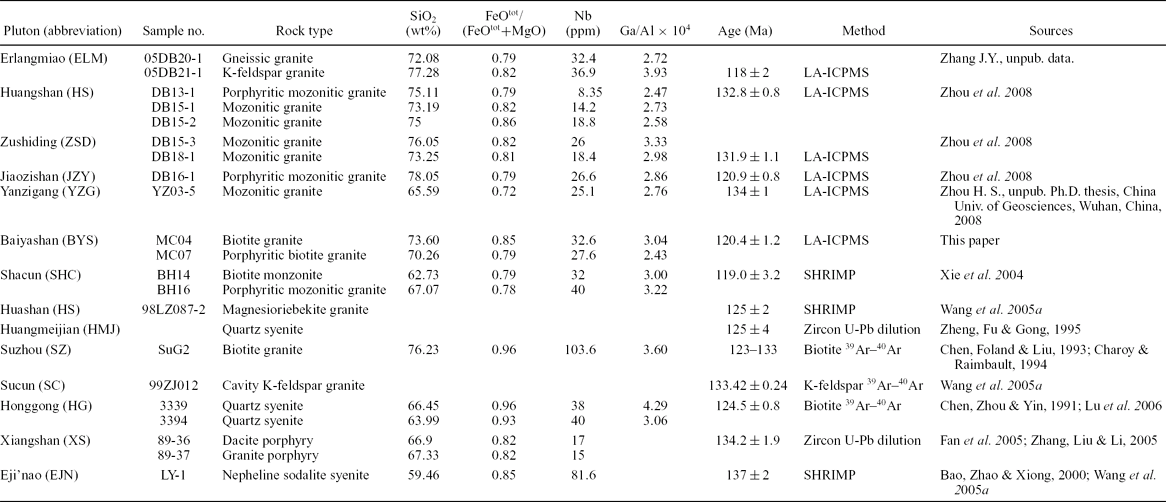
It is generally accepted that A-type granites formed in crustal extensional environments in both post-orogenic and anorogenic settings (Collins et al. Reference Collins, Beams, White and Chappell1982; Whalen, Currie & Chappell, Reference Whalen, Currie and Chappell1987; Eby, Reference Eby1992; Frost et al. Reference Frost, Frost, Bell and Chamberlain2002). As explained above, the Baiyashan A-type granite intrusion was emplaced in Early Cretaceous times. Here we review geochemical and age data from Early Cretaceous A-type granites in SE and Central China in order to determine their tectonic environment (Table 3).
Representative geochemical data and age of the A-type granites in Southeastern and Eastern China
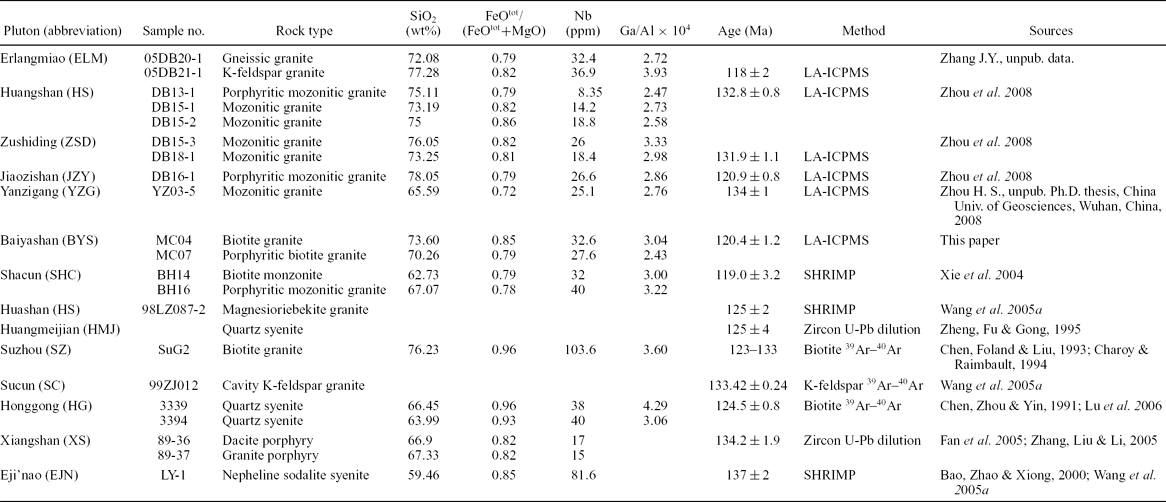
SHRIMP – Sensitive High Resolution Ion MicroProbe.
As shown in Figure 1a, Early Cretaceous A-type granites are also sparsely distributed in South China, but widely distributed in SE China (Wang et al. Reference Wang, Zhao, Jian, Xiong and Bao2005a). To the west of SE China, Early Cretaceous aluminous A-type granites are said to occur in the Dabie orogenic belt (Wang, Zhao & Xiong, Reference Wang, Zhao and Xiong2000), although this paper presents the first fully documented example. Early Cretaceous A-type granites have also been identified further west in the East Qinling orogenic belt (Zhang J. Y., unpub. data; Fig. 1a) and a crystallization age of one, the Er Langmiao intrusive body, is 118 Ma. All the A-type granites appear to have the same geochemical features, rich in total alkalis and depleted in Fe2O3 and FeO. In spider diagrams they also show depletion in Ba, Sr, P, Eu and Ti. Table 3 lists representative geochemical data on these granites. Because of their similarity to granites outside the collision zone between the North China and Yangtze blocks, we reckon that the A-type granites in the Dabie orogenic belt were not a direct product of a post-collision environment. A-type magmatism of similar age is also widely distributed in NE China, and the resultant granites share the same age, geological and geochemical characteristics (Wang, Zhao & Qiu, Reference Wang, Zhao and Qiu1995; Wu et al. Reference Wu, Sun, Li, Jahn and Wilde2002). This stage also coincides with large-scale mineralization (Yang, Wu & Wilde, Reference Yang, Wu and Wilde2003), magmatic underplating (Liu et al. Reference Liu, Gao, Yuan, Zhou, Liu, Wang, Hu and Wang2004), extension of terrigenous sedimentary basins (Li, Reference Li2000), and uprise of metamorphic core complexes (Ratschbacher et al. Reference Ratschbacher, Hacker, Webb, McWilliams, Ireland, Dong, Calvert, Chateigner and Wenk2000) in Eastern China. Wu et al. (Reference Wu, Lin, Wilde, Zhang and Yang2005) have pointed out that the structural framework of Eastern China was dominated by extensional deformation in Early Cretaceous times.
Thus all the A-type granites in SE China and the Dabie orogenic belt appear to be controlled by the same tectonic regime. What was this regime? Previous studies have proposed that Early Cretaceous magmatism in Eastern China was related either to the earlier Triassic collision between the Yangtze and the North China cratons (Gao et al. Reference Gao, Rudnick, Carlson, McDonough and Liu2002) or to subduction of the Palaeo-Pacific Plate towards the Asian continent (Chen et al. Reference Chen, Tian, Zhai and Arakakwa2005; Wang et al. Reference Wang, Zhao, Jian, Xiong and Bao2005a; Wu et al. Reference Wu, Lin, Wilde, Zhang and Yang2005; Zhao, Maruyama & Omori, Reference Zhao, Maruyama and Omori2007). We have eliminated the first alternative and therefore conclude that oblique subduction of the Palaeo-Pacific Plate may have given rise to the emplacement of A-type granites in Eastern and Central China (Ma et al. Reference Ma, Zhang, Liu and Wang2008). This subduction also caused NE–NNE extensional shear zones and continuous fault activity in eastern Asia (Gilder et al. Reference Gilder, Gill, Coe, Zhao, Liu, Wang, Yuan, Liu, Kuang and Wu1996; Li et al. Reference Li, Zhou, Li, Fu and Li2001; Li & Li, Reference Li and Li2007). Some of the shear zones or faults might have cut through to the mantle, releasing the basaltic magma that intruded microdolerite dykes into the Baiyashan granites. This conclusion is supported by the suggestion that the eastern part of Shangma fault is a deep ductile shear zone (Wang et al. Reference Wang, Wang, Liu, Wang and Ye2008).
In summary, we speculate that all the Early Cretaceous A-type granites of SE China are related to rifting of the Asian Plate following subduction of the Palaeo-Pacific Plate beneath Eastern China in Early Cretaceous times.
7. Conclusions
(1) Zircon U–Pb isotopic dating of the Baiyashan medium grained biotite granite yields a crystallization age of 120.4 ± 1.2 Ma.
(2) Its geochemical characteristics combined with the presence of alkali-feldspar show that the Baiyashan granite is an aluminous A-type granite.
(3) Trace element and isotopic data show that the principal source of magma for the Baiyashan A-type granites is partial melting of middle to lower crustal intermediate-felsic igneous rocks, but contributions from enriched mantle cannot be ruled out. A combination of magma mixing between mafic and intermediate to felsic magmas, partial melting and plagioclase-dominated fractionation seems to be the most viable mechanism to explain the features of the Baiyashan granite.
(4) The close spatial–temporal relationship of A-type granitoid magmatism with metamorphic core complexes like Dabie and extensional terrigenous basins confirms that the Early Cretaceous was a period of extension in Eastern China. Data compiled from Early Cretaceous A-type granites in SE and Central China show that these granites spread all the way from South China to the Dabie orogenic belt, and even into the eastern Qinling. This magmatism was controlled by subduction of the Palaeo-Pacific Plate under Eastern China in the Early Cretaceous and the A-type granites are most likely related to rifting following subduction.
Acknowledgements
This study was financially supported by the Key International S & T Cooperation Project (no. 20071077) of the Ministry of Science and Technology, the National Nature Science Foundation of China (nos 40521001 and 40334037), and the Program for Changjiang Scholars and Innovative Research Teams in Universities (IRT0441). Prof. Yongsheng Liu and Prof. Wenli Ling in GPMR are thanked for their help in LA-ICPMS zircon U–Pb dating and Sr–Nd isotope analysis, respectively. We are also grateful to Prof. Yusheng Wan in CAGS for his help in zircon CL imaging. We are indebted to Dr David Pyle and two anonymous reviewers for their constructive comments and Mrs Jane Holland for editorial handling.