Introduction
The growth of incapacity-related beneficiaries across OECD countries during recent decades has constituted a great concern to national governments. In response, the UK and Norway (among several countries) have introduced an activation policy instrument for assessing working capability and promoting the employability of sick and disabled people (Baumberg et al., Reference Baumberg, Warren, Garthwaite and Bambra2015; Heum, Reference Heum, Hernes, Heum and Haavorsen2010). The introduction of such assessments represents an extension of activation policies targeting groups such as the unemployed to policies increasingly aimed at sick and disabled people. Some scholars have argued that the introduction of common instruments, target groups and the governance of activation services across Western welfare states has resulted in a ‘contingent convergence’ (Konle-Seidl and Eichhorst, Reference Konle-Seidl, Eichhorst, Eichhorst, Kaufmann and Konle-Seidl2008: 432). A previous comparative study including the UK and Norway suggests that there has been a convergence with regard to the extension of workfare measures to sick and disabled people (Nilssen, Reference Nilssen, Aasen, Gloppen, Magnussen and Nilssen2014). However, similar activation policy actions are shaped within different national welfare state contexts, which is likely to influence policy implementation (Christensen and Pilling, Reference Christensen and Pilling2014). In particular, a review of work capability assessments across European countries points to the different approaches to disability determination as “deeply embedded in national institutions” (Mabbett, Reference Mabbett2003: 14).
In essence, work capability assessments are concerned with how sick and disabled people access incapacity benefits and services in the era of activation policies. Therefore, this paper argues that such assessments are just as important a research object within the welfare state as the respective risks that are insured, the level of generosity and the conditions for benefit receipt. Moreover, as argued by Hagelund (Reference Hagelund2014), it is important to study the more subtle governance of claimants at street-level as this might escape public attention more easily than, for instance, cutbacks in benefits.
This paper concentrates on the implementation of two Work Capability Assessment Schemes (hereafter WCA) introduced in 2008 within the different institutional contexts of the UK and Norway. I argue that such assessments represent certain normative orientation(s) of how to administer access to incapacity benefits; hence, the WCA is a matter of ‘administrative justice’ (Mashaw, Reference Mashaw1983). The mode of decision-making in the two WCAs differ. While the UK assessment primarily aims to accurately decide benefit eligibility according to rules in a highly standardized assessment design, the Norwegian assessment concentrates on the need for work-related follow-up services via the use of discretion in a strongly professionalised front-line service.
However, in both countries, the assessments have been subject to critique. In the UK, the assessment's ideological underpinnings are claimed to be unfair because the assessment makes a distinction between the ‘deserving’ and the ‘undeserving’ (Garthwaite et al., Reference Garthwaite, Bambra, Warren, Kasim and Greig2014; Grover and Piggott, Reference Grover and Piggott2010; Roulstone and Prideaux, Reference Roulstone and Prideaux2012). Part of the assessment is outsourced to a private company, and this implies an emphasis on efficiency gains typical of a managerial model of administrative justice. Claimants perceive this part of the assessment as harsh and rigid and the assessment has become subject to public controversy. As a result, several commentators have made calls for a ‘real world’ assessment that takes into account broader considerations than the current assessment design (Baumberg et al., Reference Baumberg, Warren, Garthwaite and Bambra2015; Berthoud, Reference Berthoud2011; Spartacus Network, 2014). In Norway, the WCA, while not subject to controversy, has nevertheless been criticised for not succeeding in getting sick and disabled people into work (Vågeng Expert Committee, 2015; Mandal et al., Reference Mandal, Ofte, Jensen and Ose2015) and, from a juridical perspective, for potentially weakening sick and disabled people's welfare rights (Svele, Reference Svele2012).
In analysing the administrative justice of the two WCAs, both in terms of design and experiences, the country-specific characteristics of the two welfare systems are taken into account in order to better understand how the WCAs are influenced by organisational design and professional attitudes, as well as the policy outcomes of the two assessments. The analysis is based on documentary data and fieldwork conducted in Norwegian local welfare agencies.
Normative models of administrative justice
The WCA constitutes a decision-making process that affects how people are treated by welfare agencies when they apply for incapacity benefits. Hence, the assessment is a matter of procedural fairness that may vary according to different normative models of administrative justice. These models are defined as “those qualities of a decision process that provide arguments for the acceptability of its decisions” (Mashaw, Reference Mashaw1983: 24–25).
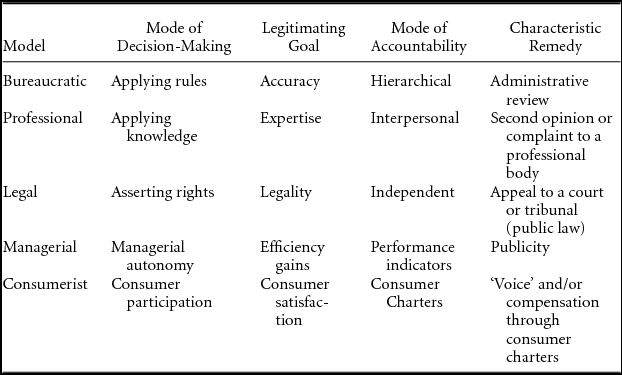
Table 1 depicts four features of administrative justice that make up five different normative models as developed by Mashaw (Reference Mashaw1983) and Adler (Reference Adler2003; Reference Adler2006). According to the ‘bureaucratic’ model, decision-making should be carried out by trained personnel who are coordinated “via rules and hierarchical lines of authority, and hierarchical review of the accuracy and efficiency of decisionmaking” (Mashaw, Reference Mashaw1983: 26). Claimants may have the decision redressed through administrative, internal review.
Five Normative Models of Administrative Justice

Source: Adler (2003: 333)
The ‘professional’ model is client-oriented and decision-making is based on the application of a professional body of knowledge. Decisions take the form of prognoses and efforts to support clients, rather than aiming for accuracy (Mashaw, Reference Mashaw1983). Furthermore, the ‘legal‘ model of administrative justice is characterised by processes for resolving ‘disputes about rights’ (Mashaw, Reference Mashaw1983: 29), which are the typical disputes for independent tribunals. Adler (Reference Adler2003; Reference Adler2006) argued that the ‘managerial’ and ‘consumerist’ models of administrative justice that have arisen within public administration during the last few decades have increasingly challenged the three described models.Footnote 1
The managerial and consumerist models represent ideas from the private market. The managerial model is characterised by audited, managerial autonomy in the decision-making for improved services and efficiency gains. The characteristic remedy for claimants is through getting publicity. The consumerist model “embodies a more active view of the service user who is seen as an active participant in the process rather than a passive recipient of bureaucratic, professional or managerial decisions” (Adler, Reference Adler2006: 623).
Adler's additional models have been critiqued for not being distinct approaches to administrative justice like the bureaucratic, professional and legal models (Halliday, Reference Halliday2003; Sainsbury, Reference Sainsbury2008). Although this seems like a reasonable critique, the managerial and consumerist models nevertheless reflect administrative justice as “different orientations to administration, that is, to how programs should be run” (Adler Reference Adler2003: 332). In this sense, they add analytical distinctions that are relevant for the scope of this article. For instance, the idea of active participants in the consumerist model reflects a concept that is central to activation policies.
An important aspect of the analytical framework is that the five models are competitive rather than mutually exclusive (Mashaw, Reference Mashaw1983). This means that the models may coexist, but the emphasis on one model decreases the importance of another. This allows for an understanding of the trade-offs between different models (Adler, Reference Adler2003).
Institutional contexts
The implementation of the WCA schemes is likely to be shaped by institutional context, and the policy approaches in the UK and Norway differ in significant ways. According to Esping-Andersen's (Reference Esping-Andersen1990) welfare regime types, the British and Norwegian welfare states are situated on each side of a distinct dividing line, as liberal and social-democratic welfare regimes, respectively.
The UK's liberal welfare state is based on a belief that market mechanisms regulate individual risks like unemployment and disability and place less emphasis on the responsibility of the state and the family (Esping-Andersen, Reference Esping-Andersen1990). The establishment of a national, centralised and universal social insurance programme after the Second World War was intended to abolish the local and discretionary poor relief that had created stigma, thus strengthening individual rights and impartial treatment of claimants. Nevertheless, the UK model has retained a residual benefit system with a relatively high degree of means-testing (Nilssen, Reference Nilssen, Aasen, Gloppen, Magnussen and Nilssen2014). The activation policy approach centres on the use of incentives, such as strict availability criteria, low replacement rates and mandatory activity measures (Adler, Reference Adler, Brodkin and Marston2013; Dingeldey, Reference Dingeldey2007; Lindsay et al., Reference Lindsay, McQuaid and Dutton2007; Barbier and Ludwig-Mayerhofer, Reference Barbier and Ludwig-Mayerhofer2004).
In Norway, the state has a predominant role in welfare distribution characterised by universal and generous benefits and the combination of a strong work ethic and a principle of solidarity (Esping-Andersen, Reference Esping-Andersen1990; Bradshaw and Terum, Reference Bradshaw and Terum1997; Halvorsen and Stjernø, Reference Halvorsen and Stjernø2008). Within public service delivery, professionals have traditionally had a strong role in policy implementation, legitimized by their professional knowledge and skills (Terum, Reference Terum1996). For instance, in the administration of social assistance benefits, social workers form the principal professional group. Thus, control of beneficiaries is not handled through a tough benefit system but rather through pedagogical measures and making demands on claimants’ behavior. In an activation policy context, Norway could be said to more strongly emphasize supportive measures, such as work training and rehabilitation for beneficiaries, although these measures have increasingly become mandatory (Barbier and Ludwig-Mayerhofer, Reference Barbier and Ludwig-Mayerhofer2004; Gilbert, Reference Gilbert2002; Kildal and Nilssen, Reference Kildal, Nilssen, Betzelt and Bothfeld2011). Although the strong role of the state involves a great deal of interference in the lives of the beneficiaries, it also entails strong, legally founded rights to Norway's national insurance benefits (Nilssen, Reference Nilssen, Aasen, Gloppen, Magnussen and Nilssen2014).
The professionalised front line service in Norway can be linked to ‘Scandinavian professionalism’, which is connected to the growth of the state and to state bureaucracies in which university-educated officials execute public authority. The Anglo-American type of professionalism, on the other hand, is characterised by a distance from state bureaucracy (Svensson and Evetts, Reference Svensson, Evetts, Svensson and Evetts2010).
Data
The empirical data consists of documents and fieldwork. Most of the documentary data concerning the UK assessment was collected during a three-month academic visit to the Social Policy Research Unit at the University of York in the UK. The documents were retrieved through a desk-based review. Systematic searches for the WCA were conducted. These searches were directed at academic texts, policy documents and other public documents from stakeholders. The results included information and documents published by the authorities, such as guidelines to the assessments aimed at work capability assessors. Furthermore, the search results included research publications and publications from disability rights movements.
Authorities in both countries have commissioned several reviews of the assessments in recent years. These reviews contain insights and information about the two WCAs in terms of policy implementation.
Important insights into the design of the Norwegian WCA are available from a book about labour and welfare politics and implementation in Norway, authored by a senior advisor in the Norwegian Directorate for Labour and Welfare Services (Heum, Reference Heum, Hernes, Heum and Haavorsen2010).
The second data source is from fieldwork conducted in Norwegian local welfare agencies (NAV offices – Norwegian Welfare and Labour Service) in 2012/13. The fieldwork includes 25 interviews with frontline workers, observational studies of staff meetings and claimant conversations in connection with the WCA, as well as WCA documents. It would be desirable to have one's own data of the UK assessors as well. However, the comprehensive official reviews that have been conducted in the UK draw on WCA-staff interviews and thus provide indirect access to WCA implementation in this country.
The author has conversed with several academic experts in the field of activation policies towards sick and disabled people in general, and the WCA in particular – both in the UK and Norway. These conversations have provided valuable supplements and surety to the data collection.
The WCA in the UK and Norway
UK
The WCA in the UK was introduced as part of the Welfare Reform Act 2007. Previous assessments include the ‘Own Occupation Test’, ‘All Work Test’ and ‘Personal Capability Assessment’. In particular, the All Work Test, which was introduced in 1995, entailed a tightened assessment through the exclusion of broad considerations in favour of a narrower focus on the physical and mental functions of the individual and whether they were capable of doing any work.
The current WCA determines eligibility for the Employment and Support Allowance (ESA). ESA is time-limited and is the main benefit for long-term sick and disabled people. The decision maker assigns points for physical and mental limitations against 17 specific activities (known as descriptors). The following excerpts provide some representative examples of such limitations:
• Cannot mobilise more than 100 meters on level ground without stopping in order to avoid significant discomfort or exhaustion (9 points)
• Cannot learn anything beyond a simple task, such as setting an alarm clock (9 points)
• Frequently has uncontrollable episodes of aggressive or disinhibited behavior that would be unreasonable in any workplace (15 points)
(DWP, 2013: 18–25)
The limitations noted in the descriptors each carry a certain number of points and the total sum determines whether ESA should be granted. It is stressed that the assessment should focus on functional ability, not merely the health condition per se. This means that the assessment examines what a person can or cannot do in everyday life in relation to his/her health condition. Hence, the functions do not specifically relate to the work environment (Harrington, Reference Harrington2010).
The outcome of the sum of points assigned in the decision-making is as follows: if the applicant scores 15 points or more, then that person has met the criterion for limited capability for work for ESA entitlement purposes. The ESA is a two-tier system, which means that the decision maker considers whether the claimant is to be assigned to the Work Related Activity Group (WRAG) or to the Support Group (SG). The WRAG is for those who are expected to engage in paid work, and benefit receipt is conditional upon participation in activation schemes. To reach a decision on placement in the SG, an additional assessment is carried out, with 16 other limitations (DWP, 2013). The SG is for claimants considered to have a severe illness or disability and has no activity requirements attached to benefit receipt. Beneficiaries in the SG receive a higher level of benefit than those in the WRAG. Furthermore, the ESA is either contribution-based or means-tested. A contribution-based ESA is time-limited to one year for those in the WRAG, but not for the SG. Those who receive the means-tested ESA are not subject to any time limitations, either in the WRAG (as long as they comply with the activity requirements) or in the SG. Lastly, if a claimant scores fewer than 15 points in the WCA, the person is not entitled to ESA and may claim Jobseeker's Allowance.
The decision makers in the WCA are civil servants and have no face-to-face contact with the applicants. The civil servants are mostly administrative or executive officers who have undergone specific training for carrying out the WCA (Litchfield, Reference Litchfield2013). The decision-making process is the last stage in the WCA, based on evidence from a questionnaire filled out by the applicant (first stage), as well as a report from a medical test (second stage). Both the questionnaire and the medical test correspond to the content in the descriptors (Jobcentre Plus, 2014; DWP, 2013; Litchfield, Reference Litchfield2013).
The medical test is outsourced to a private healthcare company contracted by the Department of Work and Pensions (DWP). The medical assessment should be conducted face-to-face (unless the claimant is considered too ill) and the resulting report contains a recommended score, which is sent to the decision maker. Other relevant evidence can also be considered, such as evidence from the treating doctor. However, the medical test is a part of the WCA design, and may thus be assumed to be more significant in the decision-making process.
If a claimant wishes to appeal against a WCA decision on ESA eligibility, he/she must first request a review of the decision by a DWP decision maker, a so-called Mandatory Reconsideration. If the DWP decides that the decision should stand, the claimant may lodge an appeal with an independent tribunal. During the entire appeal process (both mandatory reconsideration and the tribunal), the claimant is not entitled to ESA but may apply for the Jobseeker's Allowance in which the person must comply with the requirements that apply to ordinary jobseekers.
Experiences of the assessment
The WCA in the UK has been subjected to a barrage of public criticism. Both researchers and disability rights activists have highlighted that the assessment has created a great deal of frustration and despair among those who have been assessed, especially those who feel they have been wrongly assessed (Garthwaite, Reference Garthwaite2014; Spartacus Network, 2014). The great dissatisfaction with the WCA is especially related to the medical test, which was outsourced to the private healthcare company Atos. Atos was then replaced by Maximus beginning in March 2015. The medical test is perceived as harsh, and claimants have reported that they are not listened to during the test, nor met in a respectful and empathetic manner. The test is considered to be too technical and purely computer driven instead of being based on human interaction (Harrington, Reference Harrington2010; Litchfield, Reference Litchfield2013). While the medical test should support and advise decision makers, it has been claimed that it has been relied on too heavily by decision makers and thus that they lack autonomy (Harrington, Reference Harrington2010). Hence, medical assessors are perceived as the ones making the decision, which has led to a feeling among claimants that the assessment is not being carried out fairly.
When introducing the ESA, the Government estimated that 90 per cent of claimants would be placed in the WRAG and only 10 per cent in the SG (Kemp and Davidson, Reference Kemp and Davidson2010). In effect, this meant that the boundaries between able-bodied and disabled people were redrawn because those in the WRAG, who are deemed short- to medium-term unemployable, are required to attend employment-related activity that previously was only directed at the (healthy) unemployed (ibid.). In the first years after the WCA was introduced, ESA rejections and the frequent placement of beneficiaries in the WRAG led to a vast number of appeals to the tribunal, resulting in over 40 per cent of the appealed decisions being overturned (Baumberg et al., Reference Baumberg, Warren, Garthwaite and Bambra2015; Harrington, Reference Harrington2010).
Since 2013, the number of appeals has decreased significantly. However, this decrease has been linked to the introduction of the Mandatory Reconsideration, which is seen as acting as a disincentive to challenging benefit decisions because the process is perceived by claimants as time-consuming, financially insecure and stressful (Baumberg et al., Reference Baumberg, Warren, Garthwaite and Bambra2015; Litchfield, Reference Litchfield2014).
There are also signs that the decision makers’ autonomy has been strengthened. During the last couple of years, an increasing number of ESA recipients have been placed in the SG. This increase can be explained by changes made to the WCA in 2011 and 2013, which aimed “to increase the numbers going into the support group” (Baumberg et al., Reference Baumberg, Warren, Garthwaite and Bambra2015: 32). In addition, there are indications that decision makers are increasingly making use of a discretionary ‘special circumstances’ regulation that allows claimants to be deemed unfit for work if they are considered “to be at a substantial risk of harm if found fit for work” (ibid.).
Nevertheless, the roles of the medical assessors and the decision makers remain somewhat unclear, and the WCA remains contentious (Baumberg et al., Reference Baumberg, Warren, Garthwaite and Bambra2015; Litchfield, Reference Litchfield2014). Commentators have claimed that the design of the WCA, with its points system related to functional impairments, is not a real assessment of capability for work as it does not take into account broader considerations (Warren et al., Reference Warren, Garthwaite and Bambra2014; Baumberg et al., Reference Baumberg, Warren, Garthwaite and Bambra2015; Berthoud, Reference Berthoud2011; Litchfield, Reference Litchfield2014; Spartacus Network, 2014). These broader considerations include, for example, skills, age and labour market conditions, which are seen as factors that affect a person's working capability. Hence, a ‘real-world’ assessment is called for that takes into account what work people can actually do (ibid.).
Bureaucratic and managerial models of administrative justice
In the UK, the WCA is designed as a specialised and standardized task to be performed by trained decision makers. The assignment of points based on documentary evidence implies that the decision-making process is rules-based and aimed at obtaining accuracy. This is also evident in the formal aims of the assessment, which is ”to distinguish between those people who could work; those people who could work at some point with the right support; and those people who cannot work” (Harrington, Reference Harrington2011: 7). Hence, the mode of decision-making in the WCA can be connected to the bureaucratic model of administrative justice. Because the assessment design is standardized, only a limited skill set is needed by the decision makers. Employability is assessed as a matter of functional health. Furthermore, the civil service builds on a hierarchical mode of accountability, which is also a key characteristic of the bureaucratic model. The Mandatory Reconsideration is consistent with an ‘administrative review’. Administrative reviews and appeals “constitute the characteristic modes of redress associated with the bureaucratic and legal models of decision-making” (see far-right column in Table 1, ‘Characteristic Remedy’) (Adler, Reference Adler, Brodkin and Marston2013: 241). However, the critique aimed at the redress mechanisms indicates that the legal model may have been weakened.
The outsourcing of the medical test to a private healthcare company implies that an external actor is given autonomy for the provision of a public service. There is an emphasis on the managerial model of administrative justice. Because the contentious nature of the assessment is linked to the strong role of the healthcare company, this further indicates that the managerial model of administrative justice has a strong position. In particular, the outcry from disability rights movements over the treatment from the medical assessors reinforces the assumption that this is a managerial model because claimants feel the need to use publicity as a remedy, which is a key characteristic of such a model.
Norway
In Norway, an assessment instrument like the WCA is quite new and only has a few forerunners. A previous version was introduced in 2004. It was designed for deciding on eligibility for the national insurance benefit ‘vocational rehabilitation allowance’, as well as for assessing the need for follow-up and work training services for those with socially related problems (sosialt yrkeshemmede). ‘Mapping in the Social Assistance Service’ (Kartlegging i sosialtjenesten – KIS)) was an assessment instrument which existed from 2003 until 2008. KIS mainly consisted of a self-assessment by the claimant, upon which the social worker would base decisions.
The purpose of Norway's current WCA is twofold. First, it should decide the most appropriate level of follow-up based on the individual's working capability. Second, it should inform the subsequent decision on incapacity benefit entitlement. The WCA is legally established in the NAV (Norwegian Welfare and Labour Service) Act, 2006, giving individuals the right to have a WCA for assessing their work-related needs. The assessment should be broad and include a person's needs in terms of remaining in or obtaining work (NAV, 2010).
In the assessment process, the advisor completes a so-called Resource Profile (Heum, Reference Heum, Hernes, Heum and Haavorsen2010). The Resource Profile comprises six individual factors: 1) working experience, 2) education, competence and skills, 3) leisure activities, 4) personal opportunities and challenges, 5) social and material issues and 6) health, as well as two external factors: 1) requirements and expectations of working life and the labour market, 2) daily life conditions (ibid.). Both resources and barriers are linked to the above six factors. When taking into account all of the elements, the advisor must also consider the ‘any-work criterion’, which states that all labour market possibilities that match the person's qualifications must be taken into consideration (NAV, 2010). Finally, the advisor summarizes the case and makes a decision that results in one out of four possible outcomes that state the level of follow-up needed from NAV. The outcome is a precondition for entitlement to an incapacity benefit:
1) ‘Standard follow-up’ (standardinnsats): the claimant is not considered to have reduced working capability.
2) ‘Situation-dependent follow-up’ (situasjonsbestemt innsats): the claimant is considered not to have reduced working capability, but is in need of participating in short-term active measures in order to remain in, or obtain, employment.
3) Specially adjusted follow-up (spesielt tilpasset innsats): the claimant's working capability is considered temporarily impaired owing to health- and/or social-related problems. The claimant is in need of long-term services such as re-education, work training or medical rehabilitation in order to remain in, or secure, employment.
i) If the person has a medical diagnosis, he/she may be eligible for the main time-limited national insurance benefit ‘work assessment allowance’ (WAA) (arbeidsavklaringspenger). Benefit receipt is conditional upon work-related activity. The WAA is income-based and not means-tested. Those with low or no previous income receive a flat-rate benefit. The WAA can be granted for up to four years.
ii) If there is no medical diagnosis, the person may be offered a one-year participation in the ‘qualification program’ (QP) (kvalifiseringsprogrammet) and receive a flat-rate, non-means-tested benefit. The QP is a full time activation programme targeted at claimants with socially related problems, typically long-term recipients of social assistance who do not qualify for the medical criteria of the national insurance benefits.
4) Permanently adjusted follow-up (varig tilpasset innsats): the claimant's working capability is considered permanently impaired. The claimant may apply for the national insurance benefit ‘disability pension’ (DP) (uførepensjon) which is granted on the basis of sufficient medical evidence and sufficient work training evidence. The DP has no time limitation and no activity conditions. The benefit is income-based and not means tested. Those with low or no previous income receive a flat-rate benefit.
The assessment procedure is informed by evidence from the treating doctor as well as information provided by the claimant, which may be both a questionnaire known as the ‘self-assessment’ (egenvurdering) and a report from a conversation between an advisor and the claimant. Other reports of relevance may be previous work training reports or medical reports from specialists. The topics in the self-assessment correspond to the Resource Profile and include topics like personal goals and preferences, work experience, education, skills, interests, requirements in order to obtain work (e.g., education, medical treatment) and health (NAV, 2012).
The assessment process is conducted by an advisor in a local NAV office. Two-thirds of the advisors have a university degree, and one-third of these are social workers (Terum et al., Reference Terum, Tufte, Jessen and Stjernø2012). The broad design of the Resource Profile requires a face-to-face assessment and the use of discretion. It is stressed that the advisors should have labour market knowledge and guidance skills (Heum, Reference Heum, Hernes, Heum and Haavorsen2010). In practice, the majority of the advisors report being given a large amount of discretion (Jessen and Tufte, Reference Jessen and Tufte2014).
A WCA decision can be reviewed by NAV only. Decisions concerning the WAA and the DP may be taken to the independent Social Security Appeal Tribunal. However, if the tribunal overturns NAV decisions on declining of benefits, a decision on fitness for work reached in the WCA will automatically be put aside. This means that, in practice, a WCA decision can be appealed against indirectly by lodging an appeal for benefit decline (Svele, Reference Svele2012). Claimants who are refused participation in the qualification programme have the right to appeal to the County Governor. However, this appeal body has limited authority for overturning such decisions, i.e., they can only be overturned if the decision is obviously unreasonable.
Experiences of the assessment
A key idea of the Norwegian WCA is to increase the attention given by frontline workers to the working capability of sick and disabled people, rather than just their incapabilities. However, recent research suggests that a large number of long-term sick and disabled people remain in receipt of temporary benefits (Fevang et al., Reference Fevang, Markussen and Røed2014; Kalstø and Sørbø, Reference Kalstø and Sørbø2014).
Several reviews and research reports have critiqued the use of the WCA. They claim that advisors rely too heavily on the WCA for determining benefit eligibility and consequently pay too much attention to the claimants’ barriers to work rather than their resources and their needs for support in order to achieve labour market integration (Vågeng Expert Committee, 2015; Fosstestøl et al., Reference Fosstestøl, Breit and Borg2014; Galaasen and Lima, Reference Galaasen and Lima2014; Mandal et al., Reference Mandal, Ofte, Jensen and Ose2015; Office of the Auditor General of Norway, 2014; Proba, 2012). Overall, claimants are considered not to be sufficiently involved in the assessments (Aasback et al., Reference Aasback, Kiik and Skjefstad2013). For instance, many claimants are not scheduled for a meeting with an advisor prior to the Resource Profile (Vågeng Expert Committee, 2015). As a result of this critique, a recent expert committee set up by the government has called for a new WCA that can better contribute to the transfer from incapacity benefits to work by concentrating more on the claimants’ need for activation (ibid.).
The fieldwork conducted in local NAV offices amplifies the critique of the WCA. Key findings centre on the fact that the advisors’ attention tends to be directed at securing their claimants’ income by trying out different activation schemes (Gjersøe, Reference Gjersøe2015). Looking at the possibilities in the labour market is perceived as complicated and the advisors report difficulties in acquiring knowledge on the labour market and establishing contact with employers. As a result, they often consider it unlikely that people with, for instance, a chronic illness will be employed.
Bureaucratic, professional and consumerist models of administrative justice
The Norwegian assessment is implemented within a public, bureaucratic institution where evidence is collected and rules applied for obtaining accurate decisions. In this sense, the bureaucratic model of administrative justice is evident in the Norwegian WCA. The critique, which reveals that the assessment is, to a large extent, used in a bureaucratic manner – for assessing benefit rights – enforces the perception of a bureaucratic model.
Nevertheless, given how the assessment is designed and critiqued, it can be argued that the bureaucratic model is challenged by the emphasis on having a more professional approach. The advisors are expected to apply knowledge of the labour market and exercise discretion as to what the claimants need in order to improve their employability.
Although the Resource Profile is designed into pre-defined factors, it leaves the advisors with discretionary powers when considering the evidence. Overall, the assessment aims to identify sick and disabled people's need for follow-up services and how to achieve a state of employability. This resembles a professional decision because its effort is put into support and prognoses, which is typical for the professional model of administrative justice (Mashaw, Reference Mashaw1983). The provision of a public service, which is the legitimating goal of the professional model, seems as (or perhaps even more) important than accurate decisions. This is evident both in the assessment design and in the findings of reviewers and commentators.
Another important feature of the assessment design, which is called for by reviewers, is the desired involvement of claimants. In the self-assessment, claimants are encouraged to describe more than just capabilities and incapabilities, and to include their wishes for the future. The conversation with an advisor likewise allows for claimants’ participation in the WCA process. This claimant-oriented approach strengthens not only the professional model, but also the consumerist model.
Because it is not possible to directly appeal against a WCA decision to the tribunal it entails a weak redress mechanism, which reduces the legal model of administrative justice. From a juridical perspective, the lack of a clear right to appeal against a WCA decision to an independent tribunal can be claimed to be problematic because the WCA involves increased discretionary powers of frontline workers (Svele, Reference Svele2012).
Comparative overview
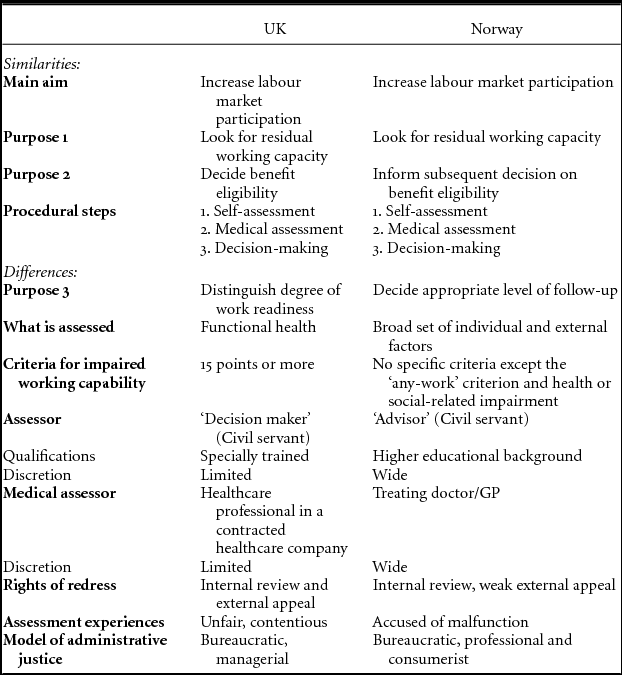
Table 2 provides a comparative overview of the main features of the WCA in the UK and Norway. It is notable that the assessment designs in both countries share the overall aim, purpose (at least partly) and procedural steps. Both assessments are comprehensive. However, after this point, the similarities weaken, which can be linked to the emphasis on different models of administrative justice.
Comparative overview of the WCA in the UK and Norway
(Source: Own depiction)
The variances in administrative justice in the two WCAs can be explained by the different institutional contexts of the UK and Norway. The emphasis on the bureaucratic and managerial model of administrative justice in the UK signals the importance of values such as impartial treatment of citizens and a less active role of the state. In Norway, the strongly developed role of a professionalised frontline service may explain the importance and the legitimacy of the professional model, as well as the consumerist model. The advisors’ concerns, which emerged from the fieldwork, centred on activating beneficiaries and securing their benefit rights instead of concentrating on work potentials. This may be explained by the more autonomous role of professionals as well as the strong and active state support that is typical within the Norwegian context.
Discussion – the WCA as a real-world assessment?
It can be argued that the Norwegian assessment design employs the ‘real world’ assessment that has been called for by British commentators. However, Norwegian advisors are given a great deal of discretion, something that should be avoided according to the British call for a new assessment design that seeks to ‘ensure consistency’, (Baumberg et al., Reference Baumberg, Warren, Garthwaite and Bambra2015: 14, 55). It is argued that (based on other countries’ experiences) a ‘real world’ assessment can be standardized by using databases that match labour market information and occupational information with individual characteristics (ibid.). According to this argument, an accurate allocation of benefits is seen as important, which is typical for the bureaucratic model of administrative justice. Hence, the British call for a new WCA seems to place itself within one of the same models as the policy makers. However, it could be argued that a ‘real world’ assessment is too complex to be standardized, as there are too many individual considerations to make in the ‘real world’. According to this line of argument, a standardized ‘real world’ assessment risks being too rigid, which may not improve the perceived fairness among claimants. From a Norwegian social work-perspective, there have even been calls for a more extended ‘real world’ assessment than the current one, which employs stronger emphasis on the complex social aspects of claimants’ lives (Caswell and Innjord, Reference Caswell and Innjord2011).
Hence, it may be claimed that ‘purpose 1’ and ‘purpose 2’ in Table 2 are incompatible. The first requires a knowledge-based, need and client-oriented assessment, which is consistent with a professional model of administrative justice. The second requires a rules-based and accurate assessment – in line with the bureaucratic model of administrative justice.
Conclusion – towards managerialism and professionalism
The shared name of the two WCAs, their overall aims and procedural steps bear witness that the WCA is an activation policy instrument that has spread across different welfare regimes. While the bureaucratic model is the traditional and dominant model in the administration of social security (Adler, Reference Adler2006), it seems that the introduction of the WCAs represents a challenge to this model by placing emphasis on the professional and the managerial model.
In the UK, the WCA constitutes a standardized sorting instrument that has been increasingly tightened over the years and subject to managerialism to such an extent that it has aroused strong contention. In this sense, the British assessment can be interpreted as a means to decrease the inflow into the incapacity benefit system. The UK approach involves a less active role of the state, typical of the welfare system in general.
The central role of professionals in the Norwegian assessment is typical for ‘Scandinavian professionalism’. On the one hand, the broad considerations inherent in the assessment could be considered as means for limiting the inflow to the permanent disability pension by concentrating on what a person can do. On the other hand, however, the attention directed towards sick and disabled people's need for subsequent follow-up, rather than on strict availability criteria, points to the fact that the assessment seems to be primarily designed to increase the outflow from the temporary benefits. This may explain why the Norwegian assessment is not as contentious as the UK’s.
Consequently, it could be argued that the WCAs, as activation policy instruments, intensify the country-specific characteristics within which the instruments are introduced. Given the critique and perceived failure of both assessments, the answer of how to get sick and disabled people off benefits and into the labour market does not necessarily seem to depend on any specific model of administrative justice. Rather, one could claim that both WCAs centre too much attention on sick and disabled people themselves, and not enough on the demand side of the labour market.
Acknowledgements
A special gratitude goes to Jacqueline Davidson for giving me insight into the British social security system as well as commenting on earlier versions of the paper. I am very thankful for my visit to the Social Policy Research Unit (SPRU) at the University of York, UK. I would like to express my very great appreciation to my supervisors Lars Inge Terum and Anniken Hagelund for their excellent guidance. I am grateful for comments and suggestions to earlier versions by two anonymous referees, Anders Molander, Ivar Lødemel, Jochen Clasen, my colleagues in the research group Professions and Governance, the participants at the 2012 seminar Trygdeforskningsseminaret in Oslo, and stream 9B Welfare and Work at the 2014 ESPAnet conference in Oslo. Thanks also to Ben Baumberg for an instructive meeting in Oslo in the spring of 2015. Responsibility for the contents of the article rests solely with the author.