Introduction
Stiff-person syndrome is a rare chronic neurological condition characterised by episodic involuntary rigidity of axial muscles with superimposed painful spasms resembling a chronic form of tetanus.Reference Moersch and Woltman1–Reference Shaw4 Electromyographic findings during attacks show continuous motor activity that could be abolished by diazepam.Reference Lorish, Thorsteinsson and Howard5, Reference Solimena and De Camilli6 An autoimmune origin of the disease has been proposed. Autoantibodies against glutamic acid decarboxylase (anti-GAD65 and 67) and anti-amphiphysin antibodies have been found in serum and cerebrospinal fluid of 60 per cent of patients affected by this disorder.Reference Butler, Solimena, Dirkx, Hayday and De Camilli7, Reference Meinck, Ricker, Hulser, Schmid, Peiffer and Solimena8 A striking association with organ-specific autoimmune diseases, primarily insulin dependent diabetes mellitus has been emphasised. Most patients show normal intellect and normal findings on motor and sensory nerve examination during the intercritical period.
More recently at least three different groups of patients have been identified on clinical grounds: stiff-limb, stiff-man and progressive encephalomyelitis, which makes stiff-person syndrome an extremely heterogeneous disease. In a subset of patients generally positive for anti-amphiphysin autoantibodies, stiff-person syndrome has an autoimmune paraneoplastic origin. Amphiphysin isoforms are expressed at high levels in brain and skeletal muscle and are often overexpressed in breast cancer. High levels of anti-GAD antibodies have also been reported in some patients with cerebellar ataxia; the presence of cerebellar ataxia in stiff-person syndrome has only been documented in five case reports, three of which mentioned the presence of nystagmus.
Epilepsy affects 10 per cent of patients having stiff-person syndrome with GAD-Ab. Very high titres of GAD-Ab have been associated with cases of temporal lobe epilepsy (with or without hippocampal sclerosis) and extratemporal epilepsy (with cortical dysplasia or without lesion), as well as with juvenile myoclonic epilepsy.Reference Tinsley, Barth, Black and Williams9, Reference Giometto, Nicolao, Macucci, Tavolato, Foxon and Bottazzo10
In this report, we describe a case of stiff-person syndrome with acute otovestibular clinical manifestations. The authors are unaware of any reports regarding association of stiff-person syndrome and peripheral vestibular pathology.
Case report
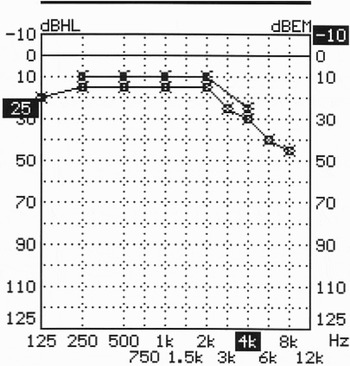
We report a case of a 58-year-old man suffering from recurrent vertigo (three episodes in one year) lasting from hours to one day, and described as rotational with intense nausea and vomiting but without cochlear symptoms. He also described episodes of discomfort and stiffness in his entire back worsening with tension or stress that also occurred in periods without vertigo. During vertiginous crises, bedside examination showed signs of acute peripheral vestibular loss (third degree horizontal nystagmus, positive head-thrust and harmonic pattern of vestibulo–spinal reflexes). A Dix–Hallpike bithermal caloric vestibular test performed 10 days after recovery from spontaneous nystagmus showed impaired vestibulo-oculomotor reflexes for a 58 per cent right unilateral weakness. Video-oculographic registration was performed using an Interacoustics VO25 (Interacoustics As, Assen, Denmark) module with simultaneous binocular registration. A geotropic positional nystagmus was present in supine position with head turned on left position. Pursuit showed symmetrical moderate gain reduction (78 per cent and 75 per cent in the left and right cycle for a 0.5 Hz stimulation, ±20° amplitude); saccades were normal for latency, velocity and accuracy. The patient had a symmetrical hearing loss on acute frequencies from 3 kHz with transiently evoked otoacoustic emissions compatible with presbyacusis. No fluctuating hearing loss temporally related to vertigo has been referred to by the patient. Nuclear magnetic resonance and angio-RNM of the central nervous system were normal. Blood tests were normal, in particular, glycaemic rate, glucose tolerance test and screening for autoantibodies. Blood coagulation showed a normal pattern.
Shortly after the last acute vertiginous episode, he developed increasing symptoms of burning muscle pain, muscle twitching, weight gain and fatigue. On this occasion, blood tests showed only high titres of anti-glutamic acid decarboxylase (GAD 67) autoantibodies (130 u/ml). Anti-GAD 67 autoantibodies were also found in cerebrospinal fluid (39 000 u/ml). The cerebrospinal fluid to serum albumin ratio was normal, indicating an intact blood–brain barrier. Electrocardiogram findings were normal. Anti-amphiphysin autoantibodies were negative. Diagnosis of stiff-person syndrome was made based on electromyographic findings of persistent motor unit activity.
Therapy based on methylprednisolone and benzodiazepines (Lorazepam 5 mg/day) drastically reduced muscular symptoms and abolished vertiginous episodes in a two-year follow up. Audiometric examinations and otoacoustic emissions did not show variation after therapy (Figure 1).
Audiometric examination of patient showing symmetrical sensorineural hearing loss; the threshold did not vary after therapy.

Discussion
Gamma aminobutyric acid (GABA) is the predominant inhibitory neurotransmitter mediating commissural inhibition between the two vestibular complex nuclei as well as descending inhibition from the cerebellar flocculus; it seems to play an important role in the process of behavioural recovery from monolateral vestibular loss.Reference Horii, Kitahara, Smith, Darlington, Masumura and Kubo11
Anti-glutamic acid decarboxylase (Anti-GAD) antibodies have been demonstrated in a few cases of progressive cerebellar ataxia, presenting with abnormal eye movements. In recent papers, two cases were discussed; one patient presented a periodic alternating nystagmus, whereas the other presented a downbeat nystagmus and slow vertical saccades.Reference Tilikete, Vighetto, Trouillas and Honnorat12, Reference Zivotofsky, Siman-Tov, Gadoth and Gordon13 In contrast, our patient presented an almost pure peripheral vestibular loss pattern with the presence of horizontal nystagmus with positive head-thrust and a harmonic pattern of vestibulo–spinal reflexes (in our experience the only presence of pursuit alterations is not surely significative for a Central Nervous System damage); caloric tests too were indicative of peripheral damage, possibly of the inner-ear receptor. Examination did not show any cochlear or auditory pathway damage that could be related to the patient's disease.
Recent papers have discussed the possible role of GABA as a neurotransmitter in the inner ear since Flock and Lam first demonstrated that GABA synthesis takes place in the labyrinthine sense organs of the bullfrog and skate.Reference Flock and Lam14 Experimental reports on the localisation and function of GABA in the vestibular afferent or efferent system are contradictory.
Some radiochemical experiments have shown that GAD, the synthesizing enzyme of GABA, is present in the vestibular periphery of the frog and does not decrease after the VIIIth nerve ablation. The authors suggested that GAD might be located in the hairy cells.Reference Lopez and Meza15 Further papers have focused on the role of GABA in the afferent vestibular system. During embryonic development, the presence of GAD in the vestibular periphery of chicks and guinea pigs increases during the maturation of hairy cells and is not modified by the arrival of efferent innervation.Reference Meza and Hinojosa16, Reference Iturbe and Meza17 Moreover, GAD depletion in the vestibular periphery could be demonstrated after injection of streptomycin causing damage to hairy cells but not to the nerve in the ears of guinea pigs.Reference Meza, Lopez, Paredes, Penaloza and Poblano18 On the other hand, a possible role in the efferent vestibular system is suggested in the works of Kong, providing ultrastructural evidence of GABA-like immunoreactivity in the efferent periphery of the ratReference Kong, Egg, Hussl, Spoendlin and Schrott-Fischer19 and human utricule.Reference Kong, Hussl, Thumfart and Schrott-Fischer20
As far as we know, no other clinical case of acute vestibular damage with a possible correlation with anti-GAD antibodies has been described. In our opinion, the contemporary presence of recurrent peripheral vertigo and stiff-person syndrome symptoms and, above all, the improvement of both conditions with stiff-person syndrome therapy indicate a common aetiology. Moreover, peripheral vertigo possibly related to a lack of GABA underlines a possible role of GABA as a neurotransmitter in the peripheral afferent vestibular system.