Crisis lending is intended to restore confidence in capital markets. For example, efforts to shore up the euro zone have focused on conditional lending to reassure investors in sovereign bonds. The IMF has long claimed that its lending acts as a ‘seal of approval’ on national economic policies, which catalyzes private capital flows.Footnote 1 The evidence about whether crisis lending succeeds in restoring market confidence, however, is mixed. A likely explanation for the mixed findings is that the political incentives to engage in crisis lending and borrowing lead to multiple countervailing effects, and quantitative studies of market reactions to crisis lending have not captured all of the mechanisms. International lending is a political decision that results from bargaining between the borrower and the lender, and its terms depend on the parties’ relative bargaining power and the quality of their relationship. Furthermore, the inferences that private investors draw from observing crisis lending depend on what new information it reveals, which in turn depends on this bargaining process.
The recent debt crisis in the euro zone illustrates the countervailing effects of four mechanisms by which crisis lending influences the calculations of private actors. When multilateral actors lend to Greece, for example, the infusion of liquidity reduces the short-term risk of involuntary default, which should reassure bond holders. This is a liquidity effect. In addition, any new commitments that Greece makes to undertake fiscal reforms as a condition for receiving the loan should improve its prospects for long-term solvency. This is a conditionality effect. On the other hand, the Greek decision to accept a bailout reveals information about the severity of the crisis. The fact that the government is willing to accept a particular deal reveals private information, because governments that were more confident about the future would hold out for more generous terms. As a result, there is adverse selection into the set of countries that participates in IMF programs, so investors update their expectations to reflect more risk when a new program is announced.Footnote 2 Finally, the capital market must make an assessment of how likely the promised reforms are to be implemented. Since powerful or well-connected countries are treated more leniently when they fail to comply with conditions,Footnote 3 investors expect them to be less likely to comply. This moral hazard effect undermines the benefits of policy commitments.
Lender motivations play an important role in these calculations. For example, bargaining between Greece and the ‘troika’ of the European Commission, the IMF and the European Central Bank reflects the priority of maintaining political and economic union in Europe. Greece is critical because the fiscal vulnerabilities in Spain, Italy and other countries raise the risk that a default in one euro country could lead to rapid contagion. Moreover, Greece is important because German and French banks are heavily exposed to Greek debt, so a Greek default might lead to a banking crisis in the core countries. Consequently, creditors are anxious to make a deal. These considerations should be reflected in the bargaining over loan terms: Greece likely received more generous loans than less pivotal countries facing similar circumstances, and the conditions attached to the loans may be less rigorous. For the same reasons, future enforcement of those conditions is expected to be lax, which undermines the reassurance that conditionality provides. Thus strategic importance influences the terms of loan packages through several channels that can have countervailing effects on the reactions of capital market participants.
Since the effect of crisis lending on market expectations depends on bargaining, we do not expect to observe a straightforward ‘catalytic’ effect. On the positive side, liquidity and conditionality should improve the investment climate and lower interest rates, and countries that are the favorites of lenders should receive more of the former and less of the latter. On the negative side, because of adverse selection, we expect the effect of new lending announcements to be harmful to the investment climate, once we control for the salutary effects of liquidity and conditionality. Furthermore, we expect lending to have less beneficial effects in countries that are especially favored by the IMF’s principals. The net effects of crisis lending should depend on the various elasticities involved, so we make no predictions about them, but the four mechanisms are straightforward and amenable to quantitative testing. We test these hypotheses using data from the IMF’s Monitoring of Agreements (MONA) database for the period 1992–2002, and we find evidence consistent with the operation of all four mechanisms.
Our central empirical finding concerns the distinctiveness of countries that are geopolitically or economically important to the United States. These countries are offered larger loans, on softer terms, and with less rigorous enforcement of conditionality. The perverse effect is that crisis lending is least effective, in terms of lowering bond yields, in the countries of greatest importance. The net effect of lending can reduce or increase bond yields, depending on the relative weights of the countervailing influences of the liquidity, adverse selection and moral hazard effects. However, the evidence clearly shows that IMF lending causes market confidence to deteriorate when the borrowing country is politically or economically important. This suggests that design features of international organizations that may be necessary to secure the ‘buy in’ of major powers – such as the IMF governance structure, which allows key shareholders to exert informal influence over lending decisions – can have unintended consequences that undermine their effectiveness.Footnote 4
Market Reactions To Imf Lending
Restoring investor confidence is a key element of the IMF mission and a critical component in evaluating whether IMF programs are beneficial to participating countries. IMF loans are intended as bridge finance for countries that are going through a process of adjustment to overcome balance-of-payments disequilibria. Consequently, IMF financial programming estimates the size of the financing gap that has to be covered in the short term to prevent default or a collapse of central bank reserves, and allocates a portion of the gap to IMF resources, a portion to short-term policy adjustment measures and a portion to private financing. Critical to this feasibility calculus is the assumption that government commitments to carry out reform, backed by the IMF, will sufficiently reassure private creditors that private capital flows will provide the necessary support for the adjustment effort. If market confidence does not materialize, the program will fail.
The effectiveness of IMF programs in catalyzing private capital flows has received considerable attention in the economics literature, but the empirical findings are mixed.Footnote 5 For instance, correcting for selection, Edwards finds that IMF programs generate net outflows of portfolio investment, and Jensen finds a similar effect for foreign direct investment (FDI).Footnote 6 Mody and Saravia find a positive effect of IMF programs only in cases of intermediate financial risk, which the authors characterize as instances when IMF programs are viewed as joint commitments between a government and the IMF.Footnote 7 Eichengreen, Gupta and Mody find evidence that IMF lending decreases bond spreads, while Cottarelli and Giannini find little evidence that IMF interventions catalyze investment.Footnote 8 It is clear that catalytic effects vary considerably across types of countries, but there is little consensus about the systematic sources of this variation.Footnote 9 To date, the question of how IMF programs influence international markets has not been studied with sensitivity to international bargaining or the political interests of the IMF’s major shareholders.
Bargaining influences the effects of IMF lending in the first place by determining its terms. IMF programs are heterogeneous treatments: some loans are larger, others are smaller; some require extensive policy reforms, while others entail much more limited conditions. Thus empirical studies that estimate a uniform effect of such diverse treatments will be misspecified – in principle, the effects of IMF programs should be conditional on their terms. Liquidity and conditionality, in turn, depend on bargaining, and in particular on the relationships that borrowing countries have with the major IMF principals. Cross-national empirical research confirms that international politics influences multilateral lending decisions. The interests of the United States have been shown to exert a broad influence over IMF lending, including the likelihood of receiving an IMF programFootnote 10 and loan size.Footnote 11 US interests in borrowing countries are also associated with less extensive conditionality required by IMF programs.Footnote 12 While these relationships are widely understood, this is the first article to investigate their impact on market reactions to IMF lending.
Bargaining has a second influence on the effects of IMF lending because it reveals information to market actors. Consider a simple bargaining model, in which the borrower has private information about a variable that affects the state of the economy, the IMF makes an ultimatum offer concerning the terms of a loan (which the borrower accepts or declines) and the investor observes and decides whether to invest. A sophisticated investor understands that governments become more eager to accept loans when their private information is unfavorable, so observing an agreement causes the investor to update beliefs about the state of the economy in an unfavorable direction. The investor understands that there is adverse selection into IMF programs – the worst candidates are the most likely to accept the IMF’s terms – so observing an agreement with the IMF causes capital flight and higher loan yields.Footnote 13 Bas and Stone use a structural model to test for adverse selection into IMF programs, and find that countries with the poorest growth prospects are the most interested in participating.Footnote 14 Correcting for adverse selection, they find that IMF programs are associated with increased short-term growth on average and in the majority of cases. Nevertheless, output is likely to decline when an IMF program is announced, because the announcement reveals that the government’s private information is unfavorable.
Bargaining has a third influence on the effect of IMF lending, through expectations about renegotiation. The only mechanism available to the IMF to enforce conditionality is to withhold tranches of funding at periodic program reviews if the associated conditions have not been fulfilled. The problem is that the IMF’s commitment to rigorously enforce conditionality may not be fully credible, because these agreements are not renegotiation proof. At any point in time, the IMF is tempted to negotiate the best feasible package of policy concessions going forward in return for disbursing the current tranche, while treating any past misbehavior by the borrower as a sunk cost. However, behaving this way undermines the incentives for borrowers to comply in the future. The best credible enforcement strategy balances the future benefits of maintaining a reputation for enforcement against the short-term benefits of getting a particular country back ‘on track’. The short-term benefits depend on the importance of the borrower to the IMF’s principals, so this trade-off varies systematically across borrowers. In a repeated-game model of the IMF, multiple borrowers and a representative investor, Stone demonstrates that the best reputational equilibrium the Fund can achieve under these circumstances treats the most important borrowers differently from the rest, playing a less rigorous ‘tit-for-tat’ enforcement strategy with important borrowers and a rigorous ‘hold-the-line’ strategy with less important ones.Footnote 15 In equilibrium, important borrowers are punished less when they renege, so they renege more often; thus investors charge higher risk premiums for important countries. This is a form of moral hazard: important countries are spared rigorous punishment when they renege, so they have incentives to do so.
Stone finds quantitative evidence that weak enforcement of conditionality in post-communist countries was associated with US foreign aid,Footnote 16 and that weak enforcement in African countries was associated with US aid, UN voting similarity with the United States, and post-colonial ties to the UK and France.Footnote 17 Global samples show similar associations with aid, UN voting, US bank exposure, US exports and alliances.Footnote 18 Extant work has not examined whether this influence affects the responses of private capital markets to lending, however.
The empirical analysis in the next section is designed to decompose the countervailing effects of crisis lending that operate through the channels of liquidity, conditionality, adverse selection and enforcement, and to examine how these mechanisms are affected by the political relationship between the borrower and the lender.
Hypotheses
Our first set of hypotheses concerns the effect of bargaining on loan terms. The interest of the leading IMF shareholders in supporting a particular borrower – their political bias in favor of the borrower – is hypothesized to increase loan size and decrease conditionality. Following most of the literature, we focus on the interests of the United States, which are either considered to be decisive in IMF governance or broadly representative of the decisive coalition of leading states.
Hypothesis 1 (Bargaining and loan terms): Political biases (US interests in the loan recipient) are associated with higher liquidity and lower conditionality.
Loan terms, in turn, influence the market interest rate because they affect the probability of an involuntary default. Increased liquidity – an expanded crisis loan – decreases the probability that capital outflows will exceed the available resources in the short term, which decreases the risk premium. Similarly, increased conditionality reduces the probability of a liquidity crisis, because implementing economic reforms reduces the size of the financing gap that must be filled by the private sector. Consequently, conditionality is expected to reduce the market interest rate. Our model predicts that more conditionality and larger loans will depress interest rates.
Hypothesis 2 (Loan size and interest rates): Larger crisis loans are associated with lower interest rates.
Hypothesis 3 (Conditionality and interest rates): Higher conditionality is associated with lower interest rates.
Note that our first three hypotheses lead to an indeterminate prediction about the effect of political bias on bond yields in studies that fail to control for loan size and conditionality. This is because bias leads to larger loans with less conditionality, and while larger loans decrease bond yields, lower conditionality has the opposite effect. Controlling for loan size and conditionality, however, will capture both of these effects, so any remaining effects of bias must be attributed to a different mechanism.
Our next hypothesis reflects adverse selection. Crisis lending is not randomly distributed, so the class of countries that negotiates crisis loans differs systematically from the population of non-participants.Footnote 19 We assume that governments have private information about factors related to the probability of default, which influences the returns that private market actors can expect. This could be because the government deliberately hides bad news, as was the case with Mexico in 1994–95, Korea in 1997 and Russia in 1998, each of which concealed the deterioration in its usable foreign reserves. Alternatively, it could be because the government has superior information about domestic political constraints that will skew economic policy and make a crisis more likely. For example, the Argentine government knew that it would not be able to meet its budget targets when it negotiated them in 2000. Governments that face weaker economic fundamentals have stronger incentives to accept a loan, so countries that accept lending packages reveal themselves to be in worse circumstances than the average country without a loan, and thus, on average, more prone to subsequent crisis. This is the adverse selection effect we referred to above. Therefore, after controlling for the effects of loan size and conditionality – the two mechanisms by which IMF programs are supposed to exercise their beneficial effects – we expect the onset of a loan to generate increased bond yields.
Hypothesis 4 (Adverse selection): Controlling for the amount of financing and conditionality, IMF lending announcements are associated with higher bond yields.
Our final hypothesis concerns moral hazard. Following Stone,Footnote 20 we assume that it is more costly for lenders to deny support to politically influential borrowers, which reduces the sanctions that influential borrowers face when they renege on their commitments to implement reforms. In the model in Lending Credibility, the IMF withholds financing from countries that renege in order to build a reputation for enforcing conditionality, but has lower standards for allowing important countries to return to good standing. (The maximum level of punishment that is credible is a function of the importance of the borrower.) Because they are offered less onerous terms for returning to good standing, influential countries face punishment intervals with a shorter expected duration, which are therefore less costly in expectation. As a result, their incentives to comply with conditionality are weaker. Influential countries implement a lower proportion of their policy commitments, so they are more subject to financial crises; consequently, they pay higher risk premiums. This effect should be present for influential countries regardless of whether they are currently participating in a conditional lending program, since participating in an IMF program in the future is always a possibility. That is, the fact that a country would not be subject to effective discipline if it turned to the IMF for a bailout in the future has an impact on its credit rating, even if it is not currently participating in a program. However, the effect should be strongest for countries that are currently participating, because future participation is discounted and uncertain.
Hypothesis 5 (Moral hazard): Controlling for the amount of financing and conditionality, political bias exerts an upward pressure on bond yields, and this effect is strongest for countries that are crisis borrowers.
Research Design
To capitalize on data availability and a comparable set of cases of lending, we focus on crisis lending by the IMF, using data drawn from its MONA database. The data span the period from 1992 to 2002 and cover the sixty-six countries that were not members of the Organisation for Economic Co-operation and Development and for which data on bond yields were available from International Financial Statistics. Our dependent variable is the nominal yield of short-term sovereign bonds issued in home country currency and measured at the end of each month.Footnote 21 Our quantities of interest are the effect of new program announcements (conditional on measures of US influence over the IMF), the effects of those measures of influence when a new program is announced, and the effects of conditionality and loan size. We treat conditionality and loan size as endogenous.Footnote 22 We use a dummy variable for the month in which a new program is announced to capture the short-term effects of new program announcements. Any information contained in the lending decision should be reflected in this short-term effect. To capture conditional effects, we regress interest rates on the new program dummy, influence variables × new program, influence variables × no new program, conditionality and loan size, and controls.
Measures of US Influence
Our theory does not provide guidance about which particular interests motivate the United States to interfere in IMF program design, so we take an eclectic approach and allow for a range of variables to exert effects that reflect alternative interests. Following extant studies, we operationalize US interests in terms of similarity of the borrowing country with the United States in UN General Assembly voting patterns,Footnote 23 similarity to the United States in alliance portfolios and exposure of US banks to loans to recipient countries.Footnote 24
Instrumental Variables
We have argued that IMF loan size and conditionality affect bond yields and depend on variations in US interests in particular countries, but that US interests also have direct effects on bond yields through the moral hazard mechanism, so we adopt an instrumental variables approach in order to identify the separate mechanisms by which US interests exercise their hypothesized effects. The validity of instrumental variables analysis depends on the strength and exogeneity of the instruments, which we explore further below. We use the following instrumental variables, which are correlated with loan size and conditionality, but are not strongly correlated with bond yields.Footnote 25 These instruments consistently satisfy the benchmarks commonly recommended in the literature to identify strong instruments.Footnote 26
Number of countries participating
Przeworski and Vreeland and Vreeland argue that the IMF becomes reluctant to lend when its resources are stretched thin because of the need to hold something in reserve for future crises.Footnote 27 This might lead the Fund to make smaller loans or extract more extensive conditionality in return for scarce funds. Alternatively, the number of countries participating in IMF programs might be an index for systemic vulnerabilities that magnify the risks of contagion. This could lead the IMF to offer more generous lending terms, including larger loans and more limited conditionality.
Ratio of prior commitments of IMF financing to IMF quota
The IMF has formal rules about access to credit, which are measured in terms of multiples of a country’s contributed quota. These rules can be waived, but the Executive Board is reluctant to extend credit substantially beyond previous precedents. To the extent that quotas represent constraints on IMF lending, previous commitments reduce the amount of credit available, and should reduce the size of new lending arrangements. Alternatively, the defensive lending hypothesis holds that countries that owe substantial amounts to the IMF may more easily qualify for additional credits because the Fund seeks to prevent any of its debtors from going into default. We find support for the hypothesis that prior commitments constrain new credits, but not for the defensive lending hypothesis.
Extended program
This is a dummy variable that codes arrangements designed to be disbursed over more than one year, including the Extended Fund Facility, the Enhanced Structural Adjustment Facility and the Poverty Reduction and Growth Facility. Such programs are typically intended to follow successful Stand-By arrangements and deepen structural reforms, so they typically involve more extensive conditionality and larger financing commitments.
Control Variables
We control for economic variables that are correlated with interest rates and the terms of crisis lending (foreign debt, GDP per capita, reserves as a share of GDP, population). In addition, we control for missing data, which is a measure derived from a principal components analysis of the missingness of nineteen time series reported by member countries to the IMF. Countries that fail to report these data are likely to have low administrative capacity, and this is associated with higher conditionality and higher interest rates. IMF standing is a measure of past non-performance of conditionality, which is derived from a twelve-month moving average of a dummy variable that measures whether a country has an IMF program that has been suspended for non-performance. Past non-performance is associated with additional conditionality and higher interest rates.
Results
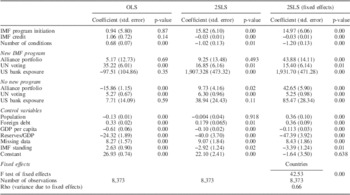
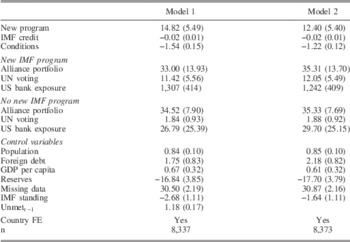
The results of three models are presented in Table 1 below. The first model uses ordinary least squares (OLS) to provide a baseline for comparison, and the second and third use instrumental variables (two-stage least squares, 2SLS) to model the endogeneity of conditionality and the size of IMF lending facilities predicted by our model. The second model allows for cross-sectional and time-series variation, and the third uses country fixed effects to focus on over-time variation within countries.Footnote 28 It is important to control for fixed effects for several reasons in this particular analysis; for example, this prevents country heterogeneity in the size of bond markets across countries from biasing the results.Footnote 29 The results are broadly consistent across the three models, but there are important differences that we highlight below. The coefficient of IMF program initiation is statistically insignificant in the first model when the three US influence variables take a value of 0, but is significantly associated with higher interest rates in the two-stage and fixed-effects specifications, just as the adverse selection hypothesis suggests. As we will see below when we interpret the conditional effects, however, IMF program initiation is statistically significant in all three models across most of the range of the US influence variables. Note that this variable measures the short-term effect of initiating a new IMF program, which is our theoretical quantity of interest, not the steady-state effect of having an IMF program.
Effect of IMF Program Initiation and US Influence on Bond Yields

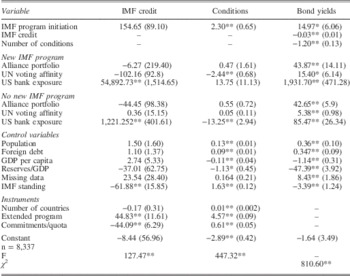
In the 2SLS estimates we focus on the second-stage estimates that predict interest rates; the first-stage estimates (presented in Table 3) confirm our theoretical expectation that political importance increases loan size but depresses the number of conditions attached to a loan, as Hypothesis 1 predicts. IMF credit is measured as the monthly change in aggregate IMF commitments in the month in which a new program is introduced, so it represents a short-term effect. The effect is substantively and statistically insignificant in the baseline OLS model. In the second model, which treats the loan amount as endogenous, however, IMF credit is highly significant, and is estimated to reduce interest rates, as Hypothesis 2 anticipates. This variable is measured in millions of special drawing rights (SDRs), so a coefficient of −0.03 means that a one-standard-deviation increase in IMF credit for countries receiving IMF loans (equivalent to roughly 1.4 billion SDRs) generates a decrease of 44 percentage points. The coefficient remains highly significant with a nearly identical substantive effect in the fixed-effects specification. Countries experience greater gains in investor confidence, all else equal, when they receive larger infusions of IMF credit, and the effects can be substantial.
The estimated effect of conditionality on bond yields differs across the three models, but does so in a way that makes us confident in our interpretation of the results. The OLS estimate indicates that conditionality, contrary to theory, increases bond yields. However, when we model the endogeneity of conditionality, and when we control for fixed effects that capture a wide range of country-level variables that affect both conditionality and credit worthiness, the result is reversed. Focusing on the 2SLS results with fixed effects, it is clear that when a particular country is subject to more conditionality, its interest rates are lower, as predicted by Hypothesis 3. The results indicate that conditionality has a substantial depressing effect on bond yields. Conditionality is measured as a count of types of conditions contained in a particular program review, ranging from zero to nineteen and averaging almost six, so conditionality is estimated to depress bond yields under IMF programs by just over 7.2 percentage points on average. A one-standard-deviation increase in conditionality, or 3.6 more conditions, is sufficient to depress interest rates by another 4.3 percentage points.
The results for our three measures of US influence generally support the model’s prediction that bias increases bond yields, as Hypothesis 5 predicts. The results strengthen when we control for endogeneity and become uniformly significant across measures of influence when we also control for country fixed effects. The similarity in alliance portfolios has a consistently positive coefficient, but is only significant when we control for fixed effects. This suggests that the variation in alliance commitments that is important is taking place within countries over time, for example, as East European countries dropped out of the Warsaw Pact and joined NATO. In the fixed-effects specification, increasing alliance similarity with the United States by one standard deviation is estimated to increase interest rates by 2.3 per cent in the month of a new IMF program announcement. To put this result into context, the alliance similarity between the United States and Poland increased by 65 per cent of one standard deviation in this sample between 1990 and 2000. UN voting similarity also has consistently positive coefficients, which are significant in the OLS, 2SLS and 2SLS with fixed-effects specifications. The estimated marginal effect of increasing voting similarity with the United States by one standard deviation is to increase interest rates by just under 5 per cent in the month of a program announcement. These increases represent direct effects, estimated after controlling for the indirect effects of political influence through liquidity and conditionality.
The exposure of US banks to particular countries tells a similar story: the OLS coefficient is negative. However, modeling the endogeneity of conditionality and IMF credit reverses the effect, and shows that countries that are important to US banks pay much higher interest rates when they receive new IMF programs. Examining the results of the reduced-form equations makes clear why endogeneity plays an important role in the interpretation of these effects (see Table 3). The exposure of US banks plays a major role in explaining the size of IMF loans to particular countries, and IMF credit, in turn, reduces interest rates. When we control for the indirect effect of bank exposure that operates through IMF credit, we find that the direct effect of US bank exposure (which our model attributes to the moral hazard effect) is to substantially increase interest rates by 7.7 per cent on average. Increasing the exposure of US banks by one standard deviation increases interest rates by an estimated 29 per cent. One standard deviation is a bit under 2 per cent of total US foreign bank assets, so it is not near the high water mark set by Mexico in 1995 of 18 per cent. This is approximately the level reached by Colombia in the early 1990s, and by Greece, the Philippines, South Korea, South Africa and Venezuela in the late 1990s. This effect is stronger in the model with fixed effects, indicating that cross-country variation masked some of the effects due to over-time variation within particular countries.
We argued above that variations in IMF credibility should affect bond yields regardless of whether a country is currently participating in a program, because resorting to IMF financing is always an available strategy. In other words, the existence of the IMF creates moral hazard for influential potential borrowers that are not IMF program participants. The effects should be smaller for non-participants, however, because the possibility of future program participation would be uncertain and discounted. Four of the six hypothesis tests that we perform with models that account for endogeneity support this hypothesis. Similarity of alliance portfolios with the United States has essentially the same effect when there is no new program as when there is a new program announcement in the 2SLS specification with fixed effects. Similarity of UN voting records has significant effects that raise bond yields, although the effects when a country does not have a new program announcement are only 34 per cent as large as when a new program is announced.Footnote 30 Bank exposure has statistically significant effects that are 4.4 per cent as large when there is no new program as when there is a program announcement. These results broadly support our conjecture that potential (but not current) borrowers are also exposed to some moral hazard effect. Our control variables have the expected effects. Foreign debt increases bond yields, richer countries pay lower interest rates, central bank reserves lower interest rates and missing data increases interest rates.
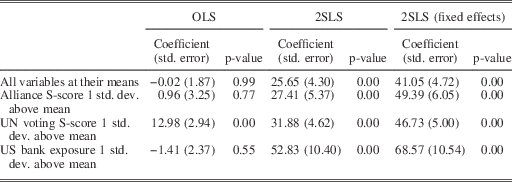
Because the interpretation of interaction effects is not straightforward, Table 2 presents the conditional effects of announcing a new IMF program with US influence measures fixed at their means and at one standard deviation above their means. The effect of initiating a new IMF program is highly significant in the 2SLS equations when all three US influence measures are fixed at their mean, and extracts a risk premium of 25.65 percentage points (the 95 per cent confidence interval of the effect runs from 17.23 to 34.08 percentage points). The effects are stronger in the fixed-effects specification, and the effects become stronger still when the US influence measures are increased. Increasing alliance similarity with the United States by one standard deviation increases the estimated coefficient by 20 per cent, and the estimated effect of a new program is approximately 14 per cent greater in countries that vote in alignment with the United States in the UN to a degree that puts them one standard deviation above the mean.
Conditional Effects of New IMF Program Announcements

What is the total effect of political influence on bond yields for IMF program participants? In other words, what is the cumulative effect of our measures of US influence on bond yields, both operating directly and indirectly through IMF credit and conditionality? Table 3 displays the results of Model 3, but now with first-stage estimates reported. By adding the coefficients of US influence across the stages, we can estimate the aggregate (net) effect as it operates through increasing loan size, decreasing conditionality, and the direct moral hazard and adverse selection effects. Consider the loan that the IMF extended to Russia to counter a crisis of confidence in the sovereign bond market in July 1998. At the time, Russia’s alliance profile and UN voting profiles vis-à-vis the United States were close to their average levels, so they are estimated to have had no substantial effects on the terms of the loan, but Russia’s share of US bank lending had risen over the previous two years to almost 5 per cent of total foreign assets (approximately 3 per cent above the mean for Russia in this sample period). Under US pressure, the IMF scrambled to assemble its largest loan to Russia, activating its General Arrangements to Borrow in order to secure the necessary resources. This in turn required US Congressional action, prompting Treasury Secretary Robert Rubin to write to House Speaker Newt Gingrich, ‘Our interest in successful political and economic reform in Russia is compelling. A collapse of the ruble would undoubtedly strengthen Russian opponents of reform, who include ultra-nationalists and Communists.’Footnote 31 According to Model 3, the scale of US bank exposure is estimated to have boosted the size of the IMF loan to Russia by 1.65 billion SDRs, or approximately 26 per cent of the 6.3 billion SDRs that the IMF committed.Footnote 32 The portion of the size of the loan attributed to US bank exposure, in turn, is estimated to have depressed bond yields by 54 points. On the other hand, the large scale of US bank exposure is estimated to have had the direct effect of raising Russian bond yields by 58 percentage points, which is attributable to moral hazard. In addition, program initiation is estimated to have raised the premium on Russian bonds by another 15 percentage points, which is attributable to adverse selection. The net effect of political influence, as measured through US bank exposure, is thus estimated to be 19 percentage points.
Fixed Effects IV Regression

**Significant at the 0.01 level. *Significant at the 0.05 level. Standard errors in parentheses.
Capital markets initially reacted to the loan announcement with some optimism, and Russian bond yields declined in anticipation of the loan package announcement. Yet shortly after the announcement, bond yields began to rise to crisis levels, reaching 75 per cent by early August – 25 points above the Russian average Treasury bill rate for the sample – and soared to 150 per cent by the middle of August as it became clear that the Russian government was considering default.Footnote 33 Amid increasing market panic, Russia defaulted on some obligations, suspended interbank payments and devalued the ruble in late August. The dynamics driving investor expectations during the crisis were complex, but our theoretical model suggests that the terms of the bailout may have signaled that first, the extent of the Russian crisis was larger than anticipated, and second, that the importance of the Russian economy to IMF principals was such that it could acquire bailout funding without implementing the longer-term structural reforms necessary to return to fiscal solvency. Indeed, although the July program included a far-reaching set of reforms intended to restore fiscal solvency, signals began to leak out within days of signing the accord that the Russian government did not seriously intend to implement them. As Blustein puts it, ‘during the 1990s, the Russians had usually heard “yes” when it came to seeking aid from the IMF, to the point that the mantra “too big and too nuclear to fail” pervaded attitudes of many market participants about the country’.Footnote 34 Russia’s geopolitical and economic importance created a perception that it would continue to receive IMF funding, making the IMF’s ultimate decision to allow default a surprise for many. At the same time, however, perceptions of geopolitical importance created concerns about the underlying state of the Russian economy and fears about future crises. These concerns created a self-fulfilling prophecy as the combination of rising bond yields, capital flight and bank runs drove the economy into collapse. Blustein concludes that ‘it is reasonable to wonder whether Russia was set up for the colossal letdown of 1998 because it had been told “yes” too many times in the past’.Footnote 35
In summary, we find several pieces of evidence that support our model. We find that conditionality decreases (and the scale of financing increases) with some of our measures of IMF bias, as hypothesized. We also find that conditionality and liquidity exert strong depressing effects on bond yields. We find robust direct effects of measures of US influence – alliances, UN voting patterns and US bank exposure – on the yields of sovereign bonds, which are consistent with the moral hazard hypothesis that countries that enjoy privileged access to US decision makers pay additional risk premia. We find that the initiation of new IMF programs is associated with an increase in the risk premium, controlling for conditionality and loan size, and that the risk premium increases more sharply in the presence of US influence. These results hold in models that treat conditionality and loan size as endogenous variables, as the theory specifies is appropriate, and in a model with country fixed effects.
Robustness
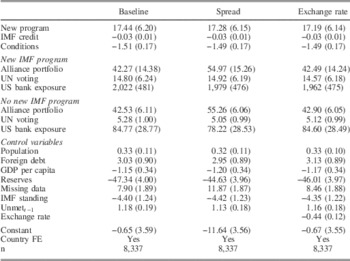
This section presents a number of additional analyses that probe the robustness of the results to alternative specifications and assumptions. We start with our preferred model, Model 3 in Table 1, which includes instrumental variables for IMF credit and conditionality and country fixed effects. First we eliminate control variables and add additional control variables. Next we add year fixed effects. Next we drop the identification restrictions used to estimate the instrumental variables one by one. Finally we replicate the results using bond spreads over US Treasury bills rather than nominal yields as the dependent variable. The results demonstrate a high degree of resilience to these alternative procedures.
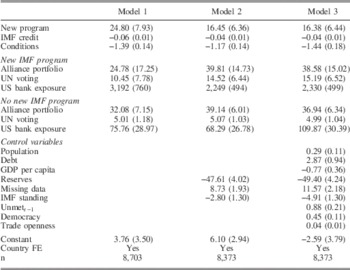
The first three models illustrate the effects of excluding or adding groups of variables to our preferred model, and the results are in Table 4. The first model excludes all of the country-level variables, the second excludes only descriptive country-level variables but includes economic-policy variables, and the third includes all of the variables in the main model in addition to the number of unmet conditions from the previous program (if any), democracy (Polity2, which ranges from −10 to 10) and trade openness (exports plus imports divided by GDP).
Robustness to Control Variables

Standard errors in parentheses.
The results are broadly consistent across the models, and neither excluding nor adding control variables changes the signs of any of the quantities of interest. Two US influence variables have only marginally significant effects in the model that drops all country covariates, but their substantive effects remain significant. All of the relationships are robust to including additional covariates.
The next set of models (Table 5) controls for year as well as country fixed effects, in order to address the possibilities that macroeconomic events at the international level could have confounding effects across a number of countries in our sample, that there could be trends in the data over time or that contagion (for example, of financial crises, such as the Asian Crisis and the Mexican Peso Crisis) could undermine the inferences that we draw from the data.
Year Fixed Effects

Standard errors in parentheses.
The results are impressively robust to the inclusion of year as well as country fixed effects. None of the estimated coefficients of interest changes signs, and the substantive effects remain significant, with no dramatic changes in the sizes of the estimated effects. However, the inclusion of year fixed effects does reduce the magnitude of the effects of all three measures of US influence when there is a program initiation, which suggests that a portion of the substantive effect estimated in Table 1 may be due to contemporaneous shocks or contagion effects. An alternative interpretation, however, is that over-time variation in some of our measures of US influence, particularly US bank exposure, is correlated with financial crises in a number of countries, and controlling for time fixed effects attributes this effect to exogenous shocks. In other words, part of the apparent effect of contagion likely operates through our quantities of interest, so the conservative strategy of controlling for time effects may bias our estimated effects downwards.
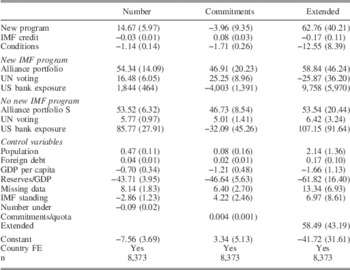
The next three models, the results of which are presented in Table 6, drop the exclusion restrictions on our instruments one at a time. (A minimum of two instruments is required to identify the model, since there are two endogenous variables.) The first model drops the restriction on Number Under. The second drops the restriction on the lagged level of Prior IMF Commitments. The third drops the restriction on Extended Program. The results are robust to dropping the exclusion restriction on Number Under. This is the instrument that appears to be most likely to violate exclusion restrictions from a theoretical standpoint: the number of countries under existing IMF programs is not only a good indicator of how thinly spread IMF resources are, but may also be an indicator of global economic recession. As such, it might be a proxy for exogenous shocks that would affect interest rates across emerging markets. However, none of the coefficients of interest changes appreciably when we drop the restriction that the number of countries participating only affects interest rates through its effects on IMF credit and conditionality. This is consistent with the result reported above that our findings are robust to including year fixed effects in the specification. Number Under is a statistically significant predictor of the number of conditions (coefficient of 0.984, standard error of 0.028 in an auxiliary regression), but is not a statistically significant predictor of IMF credit.
When we drop the restriction that prior IMF commitments only affect the interest rate through their effects on IMF credit and conditionality, three of our six coefficients of interest retain the expected signs and are significant at p=0.02 or lower. Two measures of US influence continue to have strong positive effects on interest rates when new programs are announced, conditionality continues to depress interest rates, and the effect of a new program announcement is to increase interest rates for US allies and countries that vote like the United States in the UN General Assembly. (New program announcements have an insignificant negative coefficient, but the interaction effects make the coefficient positive and significant for most of the range of the data.) Two of our results do not hold in this specification: IMF credit increases interest rates, rather than decreasing them; and US bank exposure decreases interest rates, rather than increasing them. These results are parallel to the effects that we found in the baseline OLS specification in Model 1, which does not control for the endogeneity of IMF credit. As prior work has shown,Footnote 36 IMF credit is closely related to US bank exposure, so failing to treat IMF credit as endogenous attributes a portion of the positive effect of bank exposure on bond yields to IMF credit. Prior IMF commitments play an important role in identifying the effect of bank exposure on IMF credit, so the results are similar to naïve OLS estimates when that restriction is removed.
We believe that the argument for using the ratio of prior IMF commitments to IMF quotas as an instrument is well grounded. The logic relies directly on the IMF’s internal technical rules for approving loans, which set credit limits explicitly in terms of the ratios of prior IMF lending to IMF quotas. The numerator, prior commitments, is accumulated before a new program is announced and is publicly available information, so it should not be responsible for one-month bond price movements. In addition, the denominator, IMF quota, is remarkably arbitrary. Although quotas are officially based on formulas that incorporate macroeconomic variables, multiple alternative formulas have been introduced for parallel use over the years, none of which closely tracks actual quotas. Quotas are exogenous to short-term movements of capital flows because they are adjusted at irregular intervals as part of multilateral agreements to expand the capital base of the IMF, and only one quota expansion occurred during the period we study. Furthermore, the ratio is a strong instrument because it is a good predictor of IMF credits and conditions. An auxiliary regression of the ratio of prior commitments to the quota on the amount of IMF financing yields a coefficient of −12.24 (1.62), meaning that a one-unit change (just over one standard deviation) in this ratio translates into a reduction in new credit of just over 12 million SDRs. A similar regression of the ratio of the number of conditions applied to a given country yields a coefficient of 0.9 (0.02), meaning that a one-unit change in the ratio adds one additional condition to a program. The mean number of conditions for a country receiving a new IMF program in a given period is just over 6, so an additional condition increases conditionality by about 17 per cent for the average new borrower.
When we drop the restriction that extended programs only affect interest rates through their effects on conditionality and IMF credit, the estimates’ standard errors increase substantially. Five of the coefficients of interest retain the expected signs in this specification, but their significance drops to the 0.1 level. In an alternative specification that controls for unmet conditionality, the significance of the coefficients is somewhat greater, ranging from 0.06–0.09. The substantive magnitude of the estimated effects is considerably increased when we drop this restriction, however. This indicates that the restriction was not biasing our results against the null hypothesis, but rather the opposite. At the same time, it apparently increased the precision of our estimates.
Extended, as noted in the article, is a dummy variable indicating whether IMF loans are designed to be disbursed over multiple years. This can be done for a variety of reasons. Sometimes a multi-year program is designed to achieve deep structural reforms, which may be difficult to implement within a single year. This would suggest a correlation with unfavorable economic conditions. Alternatively, an extended program is sometimes used as a capstone after successful stabilization has been achieved, which suggests a correlation with favorable conditions. Extended programs are available to borrowers at every income level. The decision to design a multi-year program appears to lie primarily with the IMF staff, which uses its own technical criteria to decide when it is appropriate, and an element of exogeneity is introduced by the fact that IMF standard procedures do not allow a country to participate in an extended program until after completion of a one-year Stand-by arrangement. Extended is a good predictor of the number of conditions, with a coefficient of 5.48 (0.036) in an auxiliary regression. Recall the mean number of conditions for a new borrower is about 6 with a standard deviation of about 3.5, so extended programs tend to entail more than a standard deviation of additional conditions, and almost double the level required in the average program. Extended does not predict IMF financing, as it has a coefficient statistically indistinguishable from 0 in auxiliary regressions.
Finally, in response to comments by anonymous reviewers, we checked the robustness of our results to including a control for the nominal exchange rate and to using the spread between the nominal yield and the interest rate on US Treasury bonds as the dependent variable (‘spreads’) instead of the nominal yield (Table 7).
Spreads and Exchange Rates

Standard errors in parentheses.
As expected, neither of these changes in our specification affected our results in any substantial way. The coefficients and standard errors are essentially unchanged. Using the spread rather than the yield as the dependent variable substantially changed only the constant. The nominal exchange rate, surprisingly, is significantly correlated with the bond yield in spite of the fact that this is calculated as a percentage, but including it in the specification does not affect any of the other estimates.
Conclusion
Here we return to our original motivation: how does multilateral lending affect financial market conditions? As we noted at the outset, the existing findings are quite mixed, and our analysis provides a compelling reason for inconsistencies across different research designs. Namely, multilateral crisis lending affects markets not in one, simple way, but through multiple (and often countervailing) mechanisms. Providing liquidity and conditionality presumably reassures bond markets, although demonstrating even this much has proved elusive until now. On the other hand, announcing a new program reveals private information, and if IMF programs are subject to adverse selection, this can result in negative market responses. Finally, the effect of a new program depends on expectations about compliance with conditionality and enforcement if the program goes off track. If enforcement systematically depends on the interests of major IMF shareholders, this should influence market expectations. Which of these effects dominates in a particular case depends on bargaining between the lender and the borrower, and the inferences that market observers draw from what they observe.
Our empirical results can be read as qualified support for the practice of conditional lending, since we find that increasing the scope of conditionality reduces the yield on government bonds. This indicates that market actors believe that the reforms promoted by the IMF improve the probability that they will be repaid. Since the Fund’s success in managing financial crises and limiting international contagion depends on the perception that its programs are successful, this suggests that – rather than implementing plans to streamline conditionality – it might better serve its purposes by expanding it. In addition, we find that larger IMF loans are more effective at stemming capital flight than smaller ones, all else equal.
On the other hand, we find evidence that the net effect of announcing a new program, controlling for the effects of liquidity and conditionality, is to raise the cost of borrowing. This indicates that on average, program announcements do not serve as seals of approval, but instead reveal that the government’s financial situation is insecure. Furthermore, we find that the negative effect of announcing a program on market confidence increases when the borrowing country is important to US foreign policy. This is consistent with our conjecture that enforcement of conditionality is less rigorous for influential borrowers, which consequently are less likely to implement conditionality, and more likely to suffer financial crises. This interpretation is also consistent with the finding that measures of US interest in potential borrowing countries are directly associated with higher bond yields, and that these effects are greatest when a new program is announced.
Although the mechanisms are complex, the results provide a clear picture of the effects of informal influence on capital markets. When borrowing countries are able to draw on US influence, conditionality is reduced but liquidity is increased. These effects can work at cross purposes: markets tend to respond positively to increased liquidity but negatively to reduced conditionality. When informal influence is at its peak, however, our analysis indicates that the announcement of a new IMF program leads to capital flight. That is, in the time period that we study, the effect of moral hazard was sufficiently intense that bondholders were more discouraged than encouraged, on balance, by the observation that a borrower had close ties to the United States. The weakened credibility of reform commitments outweighed the benefits of the super-sized loans that cozy relationships could provide. As a result, the net effect of borrowing from the IMF was to raise bond yields for the most prominent borrowers. This study therefore provides an example of the broader trade-off involved in governance arrangements that allow powerful countries to exert informal influence in exchange for ‘buy-in’ to multilateral institutions. Such arrangements exacerbate the time consistency problems that powerful states face, and frequently lead to unintended policy outcomes. In this case, the countries that the United States most wants to help avoid financial crises may be least able to derive benefit from IMF involvement.
Dropping Identification Restrictions

Standard errors in parentheses.