1 Introduction
Flow induced motion (FIM) has been the focus of intense research due to its influential role in engineering, environment and energy harvesting, among others. A well-documented, canonic case of FIM is the vibration of circular cylinders induced by periodic vortex shedding that results in unsteady lift (Sarpkaya Reference Sarpkaya2004; Williamson & Govardhan Reference Williamson and Govardhan2004; Wu, Ge & Hong Reference Wu, Ge and Hong2012). Experimental evidence has shown that the vortex formation can be modulated by the presence of a rigid splitter located along the axis of the wake. Indeed, the vortex shedding can be suppressed, and the drag coefficient and Strouhal number can be reduced with a sufficiently long splitter attached to the rear base of a cylinder (Apelt & West Reference Apelt and West1975). Ozono (Reference Ozono1999) showed that the surface pressure distribution on a cylinder and Strouhal number become sensitive to the location of a short splitter detached from a cylinder. More recent studies have focused on the effect of non-fixed splitters past a cylinder as a potential control mechanism. In addition to the ability to suppress vortex-induced vibrations (VIV) in cylinders, splitters and related concepts show potential in energy harvesting (Allen & Smits Reference Allen and Smits2001). Uncovering their dynamics can shed light on their distinctive use in nature including animal locomotion (Dudley, King & Wassersug Reference Dudley, King and Wassersug1991) and common phenomena such as fluttering (Argentina & Mahadevan Reference Argentina and Mahadevan2005; Eloy et al.
Reference Eloy, Lagrange, Souilliez and Schouveiler2008). Shukla, Govardhan & Arakeri (Reference Shukla, Govardhan and Arakeri2009) studied the pitching of a splitter free-to-rotate around the rear base of a stationary cylinder. They showed that a sufficient increase of the splitter length results in a transition from high-amplitude periodic oscillations to small-amplitude chaotic motions. Assi, Bearman & Kitney (Reference Assi, Bearman and Kitney2009), Gu et al. (Reference Gu, Wang, Qiao and Huang2012), Lu et al. (Reference Lu, Guo, Tang, Liu, Chen and Xie2016) investigated the passive pitching of a splitter with the axis of rotation coincident with that of the cylinder for various Reynolds numbers (
 $Re$
). Interestingly, the equilibrium position of the splitter might shift from the wake centre to one side of the cylinder at sufficiently high
 $Re$
. In these cases, the symmetry of the wake is broken and a net shift perpendicular to the incoming flow is possible (Lācis et al.
Reference Lācis, Brosse, Ingremeau, Mazzino, Lundell, Kellay and Bagheri2014). Numerical simulations of actively controlled pitching of splitters have shown that multiscale motions from the vortex shedding and plate dynamics can be induced in the wake and the mean drag coefficient can also be substantially affected (Sudhakar & Vengadesan Reference Sudhakar and Vengadesan2012).
Although significant effort has been placed on characterizing FIM of circular cylinders with splitters, cases of cylinders with elliptical cross-section have received much less attention. They represent intermediate scenarios of two limiting cases given by circular cylinders and thin flat plates; equivalently, aspect ratios
 $AR=b/a\in [0,1]$
, where
 $a$
and
 $b$
are the semimajor and semiminor axes, in which plates and circular cylinders have
 $AR=0$
and 1. In elliptic cylinders, the angle of attack (
 $AoA$
) and
 $AR$
are two additional variables that influence the dynamics of the flow; the interaction of vortex shedding from the leading and trailing edges can result in additional unsteadiness in the lift and drag coefficients (Nair & Sengupta Reference Nair and Sengupta1997). Modi et al. (Reference Modi, Wiland, Dikshit and Yokomizo1992) systematically studied the aerodynamic force and vortex shedding frequencies for various
 $AR$
and
 $AoA$
, and indicated that these parameters are insensitive to
 $Re\in (3,10)\times 10^{4}$
. Direct numerical simulations by Nair & Sengupta (Reference Nair and Sengupta1997) showed that at relatively large
 $AoA$
, the shed vortices are energetic and can remain coherent over larger distances. A recent study by Thompson et al. (Reference Thompson, Radi, Rao, Sheridan and Hourigan2014) showed that with the major axis perpendicular to the flow, a decrease of
 $AR$
leads to the occurrence of parallel vortex shedding closer to the cylinder.
In spite of these efforts, the interaction between flow with the system defined by elliptic cylinder with splitter has not been uncovered. Understanding the dynamics of splitters in the wake of elliptic cylinders can provide more specific insights into the fluid-structure feedback mechanism, locomotion of marine species, flow mixing and heat exchange, lift and drag fluctuations, among others. Previous investigations of related FIM have mainly focused on the dynamics of structures under low turbulence. Tamura & Miyagi (Reference Tamura and Miyagi1999), Irwin (Reference Irwin2008) and Pastò (Reference Pastò2008) pointed out that the turbulence intensity
 $I_{u}$
of the incoming flow plays a significant role in the flow fluctuations and dynamics of the structure. A very recent study by Jin, Ji & Chamorro (Reference Jin, Ji and Chamorro2016a
) showed the linkage between the structure of the turbulence and body rotations and oscillations. In this work, we aim to provide quantitative description of FIM of hinged splitter in the wake of elliptic cylinders under various combinations of
 $AoA$
,
 $AR$
, mean flow and turbulence levels. For this purpose, we performed a comprehensive experimental investigation and characterized the temporal features of the plate motions and wake of cylinder–plate systems. The experimental set-up is described in § 2, the results and discussion are presented in § 3 and main conclusions are summarized in § 4.
2 Experimental set-up
The passive pitching of splitters hinged at the trailing edge of elliptical cylinders was characterized for various mean flows, turbulence levels and geometrical configurations. Various cylinder–splitter systems were placed in the freestream region of the Talbot laboratory wind tunnel of the University of Illinois at Urbana-Champaign. The Eiffel-type wind tunnel has a test section 0.914 m wide, 0.45 m high and 6.1 m long. See Adrian, Meinhart & Tomkins (Reference Adrian, Meinhart and Tomkins2000) for additional details of the facility.
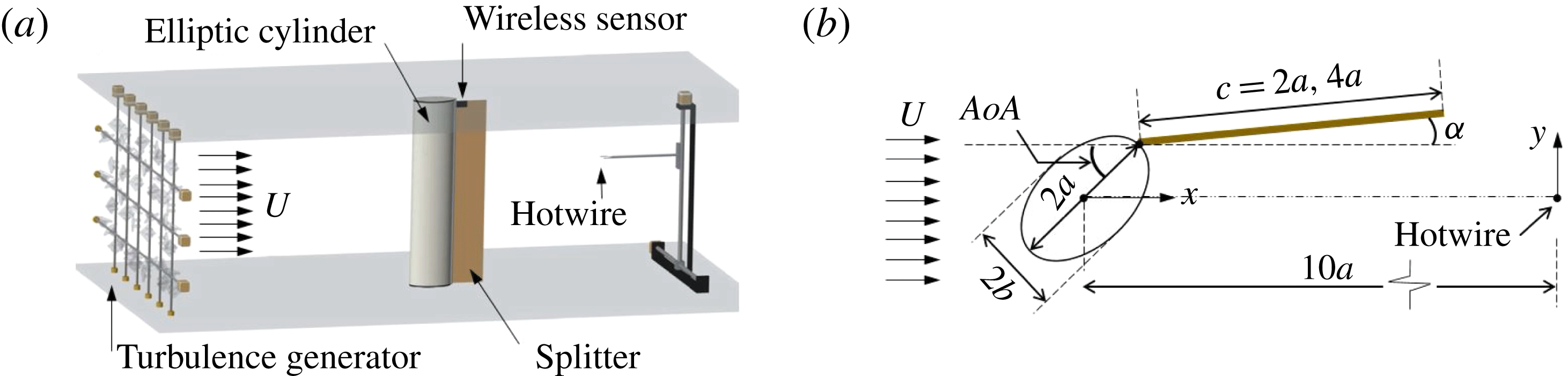
(a) Schematics of the elliptic cylinder and splitter system in the wind tunnel; (b) plain view with basic variables.

Two smooth elliptic cylinders were made with acrylic and placed vertically in the wind tunnel with their cross-section spanning from the bottom to the top walls, resembling a two-dimensional (2-D) body. They had the same semimajor axis of
 $a=50~\text{mm}$
but semiminor axes of
 $b=15~\text{mm}$
and 30 mm, i.e.
 $AR=b/a=0.3$
and 0.6 (here on referred as thin and thick ellipses). Two rigid flat plates made from balsa material of density
 $\unicode[STIX]{x1D70C}_{b}=107.5~\text{kg}~\text{m}^{-3}$
, thickness
 $k=6~\text{mm}$
and chords
 $c=2a$
and
 $4a$
(here on referred as short and long splitters) were vertically hinged along the full span of the trailing edge of the cylinders. The plates were supported by two low-resistance ball bearings at the top and bottom side of the cylinders, allowing free oscillations of the plates even at very low wind speed of
 ${\approx}1.5~\text{m}~\text{s}^{-1}$
with minimum resistance (figure 1
a). Indeed, autorotation tests showed nearly linear relation between flow and angular velocities, which ensured negligible influence of the bearing friction; see more details in Jin et al. (Reference Jin, Ji, Liu and Chamorro2016b
). The moment of inertia of the assembly for the short and long plates were
 $I=1.6\times 10^{-4}~\text{kg}~\text{m}^{2}$
and
 $8.5\times 10^{-4}~\text{kg}~\text{m}^{2}$
. Note that the added mass of the air is negligible respect to the comparatively large mass ratio (
 $O(10^{2})$
). The dynamics of the plate pitching was characterized for various flow velocities ranging from
 $U=2.8~\text{m}~\text{s}^{-1}$
to
 $8.6~\text{m}~\text{s}^{-1}$
, resulting in Reynolds numbers of
 $Re=U2a/\unicode[STIX]{x1D708}\in (1.9,5.7)\times 10^{4}$
, where
 $\unicode[STIX]{x1D708}$
is the kinematic viscosity of the air. For each velocity, each cylinder was placed with
 $AoA=0^{\circ },30^{\circ },45^{\circ }$
and
 $60^{\circ }$
(figure 1
b). The orientation of the cylinders was controlled by a Velmex rotary table located outside the test section with an accuracy of 100 arc-second. To assess the effect of the freestream turbulence, the plate pitching was characterized under turbulence levels
 $I_{u}=\unicode[STIX]{x1D70E}_{u}/U$
, where
 $\unicode[STIX]{x1D70E}_{u}$
denotes the standard deviation of the streamwise velocity fluctuations, of
 $I_{u}\approx 0.05\,\%$
and
 $10.5\,\%$
. The high
 $I_{u}$
was induced via an active turbulence generator (
 $TG$
), whereas the negligible
 $I_{u}$
was obtained without the
 $TG$
.
A small, low-weight high-resolution wireless accelerometer was placed at the top side of the plate to track the instantaneous angular velocity at a frequency of
 $f=256~\text{Hz}$
with an uncertainty of
 $0.07^{\circ }~\text{s}^{-1}$
. The
 $I$
of the assembly included the minor effect of the accelerometer. A hotwire anemometer was used to obtain high-resolution measurements of the streamwise velocity. The probe is made of
 $5~\unicode[STIX]{x03BC}\text{m}$
tungsten wire, connected to a Dantec dynamics system and operated at a sampling frequency
 $f_{s}=10~\text{kHz}$
, where the calibration was conducted against a Pitot tube. The anemometer was moved with a Velmex traversing system with a position accuracy of 0.03 % at transverse locations
 $y/a=0,\pm 1/5,\pm 2/5,\pm 3/5,\pm 4/5$
and
 $\pm 1$
, where the origin of the coordinate was located
 $x=10a$
downstream from the centre of the cylinders within the streamwise symmetry axis. Here,
 $x$
represents the streamwise coordinate with the origin fixed at the cylinder centre. Complementary measurements of the lift and drag forces on the elliptic cylinder were conducted with an ATI Gamma force sensor fixed at the top side of the elliptic cylinder at a frequency of
 $f=1~\text{kHz}$
with an accuracy of
 $1\,\%$
. In addition, qualitative video visualizations were used to inspect the plate motions. For each set-up, the accelerometer and hotwire signatures were sampled for periods of 120 s and 60 s only after the dynamics of the plate reached the steady state; this occurred at least 60 s after the constant flow was obtained in the tunnel.
3 Results
In this section, we describe and discuss the characteristic pitching of splitters triggered by the flow fluctuations as a function of the
 $Re$
,
 $I_{u}$
,
 $AR$
,
 $AoA$
and
 $c/a$
ratio. Details of the velocity fluctuations in the wake at various transverse locations are also included to gain insight on the flow signature induced by the splitter and cylinder system.
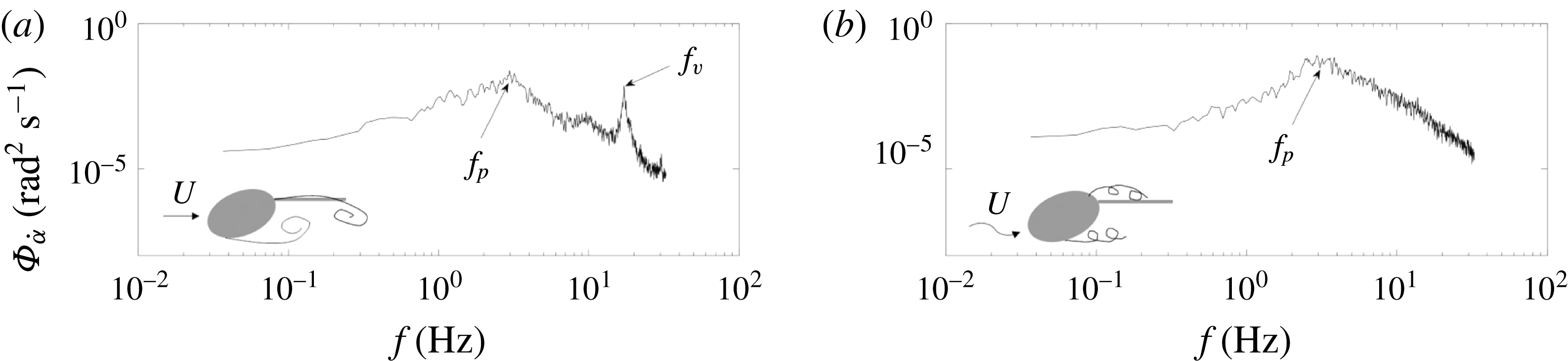
Angular velocity spectra
 $\unicode[STIX]{x1D6F7}_{\dot{\unicode[STIX]{x1D6FC}}}$
of the short splitter with the cylinder at
 $AoA=30^{\circ }$
and
 $Re=3.8\times 10^{4}$
under (a) low and (b) high
 $I_{u}$
.

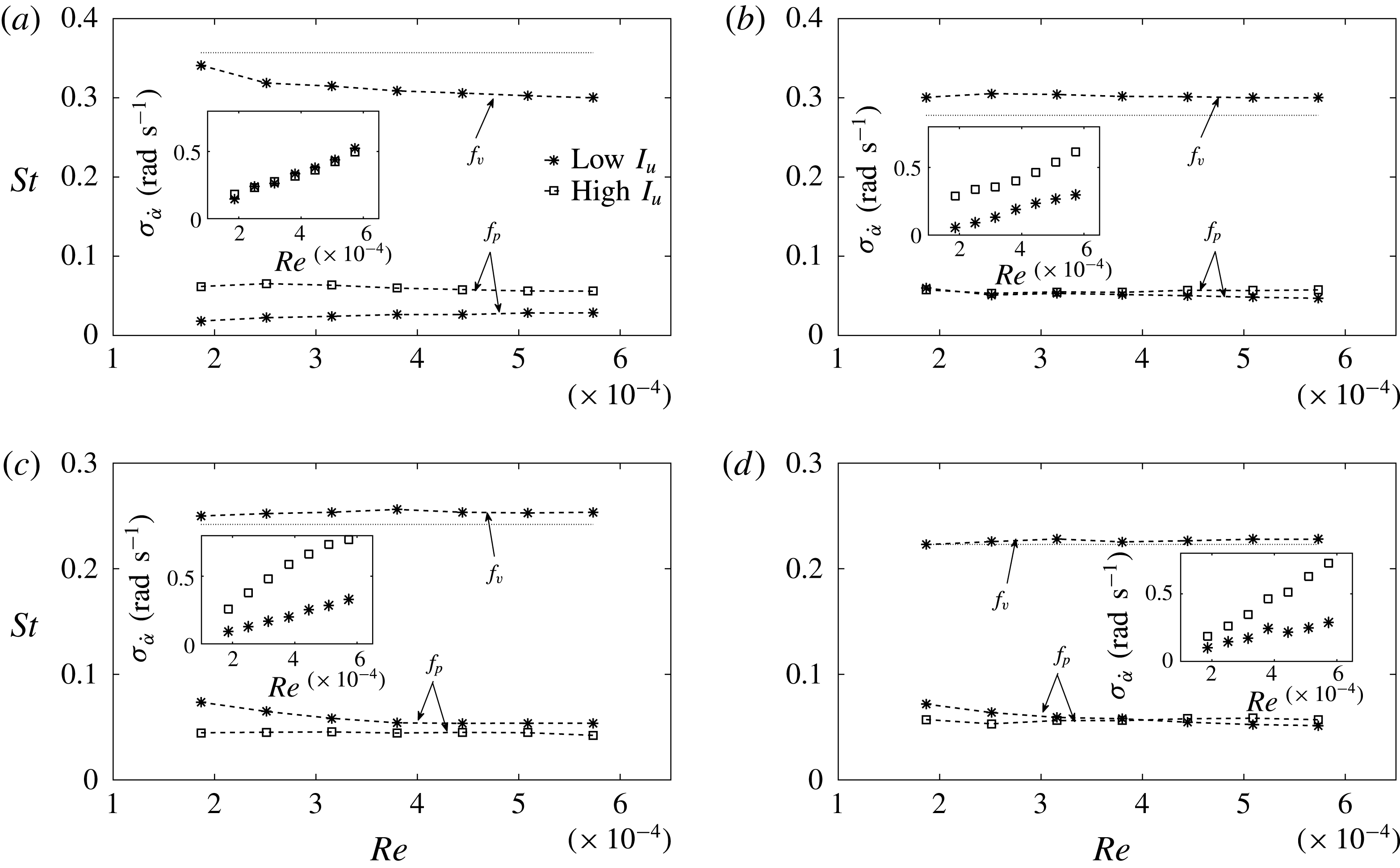
Dimensionless pitching frequencies
 $f_{p}$
and
 $f_{v}$
of the short splitter with cylinder at
 $AoA=$
(a)
 $0^{\circ }$
, (b)
 $30^{\circ }$
, (c)
 $45^{\circ }$
and (d)
 $60^{\circ }$
. The dashed lines represent the vortex shedding frequencies of the bare cylinder under low
 $I_{u}$
. Inserts show the standard deviation of the angular velocity
 $\unicode[STIX]{x1D70E}_{\dot{\unicode[STIX]{x1D6FC}}}$
.

3.1 Thick cylinder with short splitter (
 $AR=0.6$
and
$c/(2a)=1$
)


This configuration is first characterized for low and high
 $I_{u}$
at various
 $Re$
and
 $AoA$
of the cylinder. Here, the splitter exhibits small-amplitude oscillations (
 ${<}8^{\circ }$
, with the maximum achieved for the highest flow and turbulence levels) around the equilibrium position, which is nearly parallel to the direction of the mean flow. Spectral decomposition of the instantaneous angular velocity
 $\dot{\unicode[STIX]{x1D6FC}}$
of the splitter,
 $\unicode[STIX]{x1D6F7}_{\dot{\unicode[STIX]{x1D6FC}}}$
, reveals the dominant motions and the distinctive effects of the turbulence. This is illustrated in figure 2 with representative cases at
 $Re=3.8\times 10^{4}$
and cylinder with
 $AoA=30^{\circ }$
for the low and high
 $I_{u}$
. The
 $\unicode[STIX]{x1D6F7}_{\dot{\unicode[STIX]{x1D6FC}}}$
under low
 $I_{u}$
exhibits two distinctive peaks, namely
 $f_{p}$
and
 $f_{v}$
; whereas
 $f_{v}$
is missing in the high-turbulence counterpart. This phenomenon is observed in all
 $AoA$
and
 $Re$
; where the non-dimensional dominant pitching frequencies
 $f_{p}$
and
 $f_{v}$
are summarized in figure 3 as Strouhal number
 $St=f(2a)/U$
. In general, nearly constant
 $St$
is observed across the
 $Re$
, which reveals a linear increase of
 $f_{p}$
with
 $U$
regardless of
 $I_{u}$
. Also noted a linear relation for
 $f_{v}$
but at much larger growth rate. Jin et al. (Reference Jin, Ji, Liu and Chamorro2016b
) reported similar linear increase of pitching frequency with flat plates under uniform incoming flow. This suggests that the dynamics of the splitter can be approximated by the equation
 $$\begin{eqnarray}I\ddot{\unicode[STIX]{x1D6FC}}=-\unicode[STIX]{x1D6FD}\dot{\unicode[STIX]{x1D6FC}}+M_{w},\end{eqnarray}$$
where
 $\unicode[STIX]{x1D6FD}$
represents the damping of the system and
 $M_{w}$
embodies all the torques generated from the wind. Considering the modulation of the cylinder in the wake, we assume
 $M_{w}=M_{\unicode[STIX]{x1D6FC}\bar{u}}+M_{\unicode[STIX]{x1D6FC}u^{\prime }}$
, where
 $M_{\unicode[STIX]{x1D6FC}\bar{u}}$
and
 $M_{\unicode[STIX]{x1D6FC}u^{\prime }}$
indicate the angle-dependent moment generated from the mean and fluctuating velocities
 $\bar{u}$
and
 $u^{\prime }$
. For thin flat plates,
 $M_{\unicode[STIX]{x1D6FC}\bar{u}}=1/2C_{m}\unicode[STIX]{x1D70C}_{a}\bar{u}^{2}c^{2}L$
, where
 $C_{m}$
is the moment coefficient around the leading edge and
 $\unicode[STIX]{x1D70C}_{a}$
is the air density. Noting that the velocity distribution along the chord of the splitter can be non-uniform in the wake region, here
 $\bar{u}$
represents the effective velocity that embodies the averaged aerodynamic moment on the splitter. Considering a small-amplitude assumption,
 $C_{m}\approx -\unicode[STIX]{x03C0}\unicode[STIX]{x1D6FC}/2$
, and ignoring other potential disturbances as a first-order approximation, the equation (3.1) can be rearranged as:
 $$\begin{eqnarray}I\ddot{\unicode[STIX]{x1D6FC}}+\unicode[STIX]{x1D6FD}\dot{\unicode[STIX]{x1D6FC}}+1/4\unicode[STIX]{x03C0}\unicode[STIX]{x1D6FC}\unicode[STIX]{x1D70C}_{a}c^{2}L\bar{u}^{2}=M_{\unicode[STIX]{x1D6FC}u^{\prime }}.\end{eqnarray}$$
The equivalent counterpart in the Fourier domain, shown in (3.3), reveals insight on the dominating frequencies.
 $$\begin{eqnarray}{\mathcal{F}}(\unicode[STIX]{x1D6FC})=\hat{\unicode[STIX]{x1D6FC}}=\frac{{\mathcal{F}}(M_{\unicode[STIX]{x1D6FC}u^{\prime }})}{1/4\unicode[STIX]{x03C0}\unicode[STIX]{x1D70C}_{a}c^{2}L\bar{u}^{2}-(2\unicode[STIX]{x03C0})^{2}If^{2}+2\unicode[STIX]{x03C0}\text{i}f\unicode[STIX]{x1D6FD}}.\end{eqnarray}$$
Indeed, note that when
 $f\rightarrow f_{p}=\sqrt{\unicode[STIX]{x03C0}\unicode[STIX]{x1D70C}_{a}L/I}(c\bar{u}/4\unicode[STIX]{x03C0})$
, the norm of the denominator is minimized and
 $\hat{\unicode[STIX]{x1D6FC}}(f_{p})$
is locally maximized; this also corresponds to the governing frequency observed in the pitching of a flat plate under uniform incoming flow (Jin et al.
Reference Jin, Ji, Liu and Chamorro2016b
).
Under very low turbulence, the influence of vortex shedding from the elliptic cylinder results in periodic fluctuations of
 $M_{\unicode[STIX]{x1D6FC}u^{\prime }}$
, where
 $f_{v}$
dominates in
 ${\mathcal{F}}(M_{\unicode[STIX]{x1D6FC}u^{\prime }})$
. However, turbulence may severely dampen the coherence of the vortex shedding and lead to a broader spectral distribution (Tamura & Miyagi Reference Tamura and Miyagi1999) with
 $f_{v}$
non-distinctive, as shown in figure 2(b). Within the range of
 $Re$
investigated, both the vortex shedding frequency and
 $\bar{u}$
are proportional to the mean incoming flow. This leads to the quasi-linear increase of both
 $f_{p}$
and
 $f_{v}$
with
 $U$
, as reflected by the constant
 $St$
in figure 3. To further explore the influence of the splitter on the vortex shedding,
 $St$
of the bare elliptic cylinder under low
 $I_{u}$
is also included as a reference. This particular measurement shows good agreement with the experimental study by Modi et al. (Reference Modi, Wiland, Dikshit and Yokomizo1992), where
 $St$
is independent of
 $Re\in (3,10)\times 10^{4}$
. The comparison of
 $St$
with and without the splitter indicates that for the cylinder at
 $AoA=0^{\circ }$
, the small-amplitude pitching of the splitter results in a reduction of the vortex shedding rate
 $f_{v}$
of
 ${\approx}15\,\%$
, which is similar to a fixed splitter in the wake of a circular cylinder (Apelt & West Reference Apelt and West1975). However, for
 $AoA=30^{\circ },45^{\circ }$
and
 $60^{\circ }$
, the
 $f_{v}$
under the influence of the splitter is close (slightly higher) to the case with bare cylinder. Similar phenomenon was reported by Ozono (Reference Ozono1999); a distinctive rise of
 $St$
was observed with a short splitter attached to a circular cylinder and shifted half a diameter from the wake centreline. Roshko (Reference Roshko1955) pointed out that the vortex shedding frequency can be approximated as
 $f_{v}=St^{\ast }U/d^{\prime }$
, where
 $St^{\ast }$
is the wake Strouhal number and
 $d^{\prime }$
represents the distance between free streamlines in the wake region. As suggested by Roshko (Reference Roshko1955),
 $St^{\ast }$
remains nearly constant regardless of the cylinders geometry. Numerical and experimental studies with dual parallel splitters attached at the two transverse edges of circular and semicircular cylinders have shown that the flow separation point is shifted from the cylinder towards the trailing edge of the splitter. Here, the spanwise extent of the wake decreases which leads in a smaller
 $d^{\prime }$
compared to the bare cylinder case (Bao & Tao Reference Bao and Tao2013; Hamed et al.
Reference Hamed, Vega, Liu and Chamorro2017). Further inspection suggests that
 $St^{\prime }=f(2a^{\prime })/U$
, where
 $2a^{\prime }$
is the frontal width of the elliptic cylinder under various
 $AoA$
, remains nearly constant for the short splitter; however, this does not hold for the bare case and that with the long splitter (shown later). This highlights the dominant influence of the spanwise extent of the wake on the vortex shedding frequency. Unlike the case of flat plate pitching under uniform flow, where the dynamics exhibits a quasi-sinusoidal pattern (Jin et al.
Reference Jin, Ji, Liu and Chamorro2016b
), the
 $\dot{\unicode[STIX]{x1D6FC}}$
is very irregular even under low
 $I_{u}$
; their standard deviation
 $\unicode[STIX]{x1D70E}_{\dot{\unicode[STIX]{x1D6FC}}}$
is provided in the subplots of figure 3(a–d). For all cases,
 $\unicode[STIX]{x1D70E}_{\dot{\unicode[STIX]{x1D6FC}}}$
increases monotonically with
 $Re$
due to higher velocity fluctuations. As expected, this quantity is larger with higher turbulence levels. Also, the differences of
 $\unicode[STIX]{x1D70E}_{\dot{\unicode[STIX]{x1D6FC}}}$
between the low and high
 $I_{u}$
increases with
 $Re$
under large cylinder
 $AoA$
(
 $45^{\circ }$
and
 $60^{\circ }$
; see subplots of figure 3). Note that the high asymmetry of the system at large
 $AoA$
and the increased plate pitching at higher
 $Re$
enhance the transverse flow and, consequently, wake mixing.
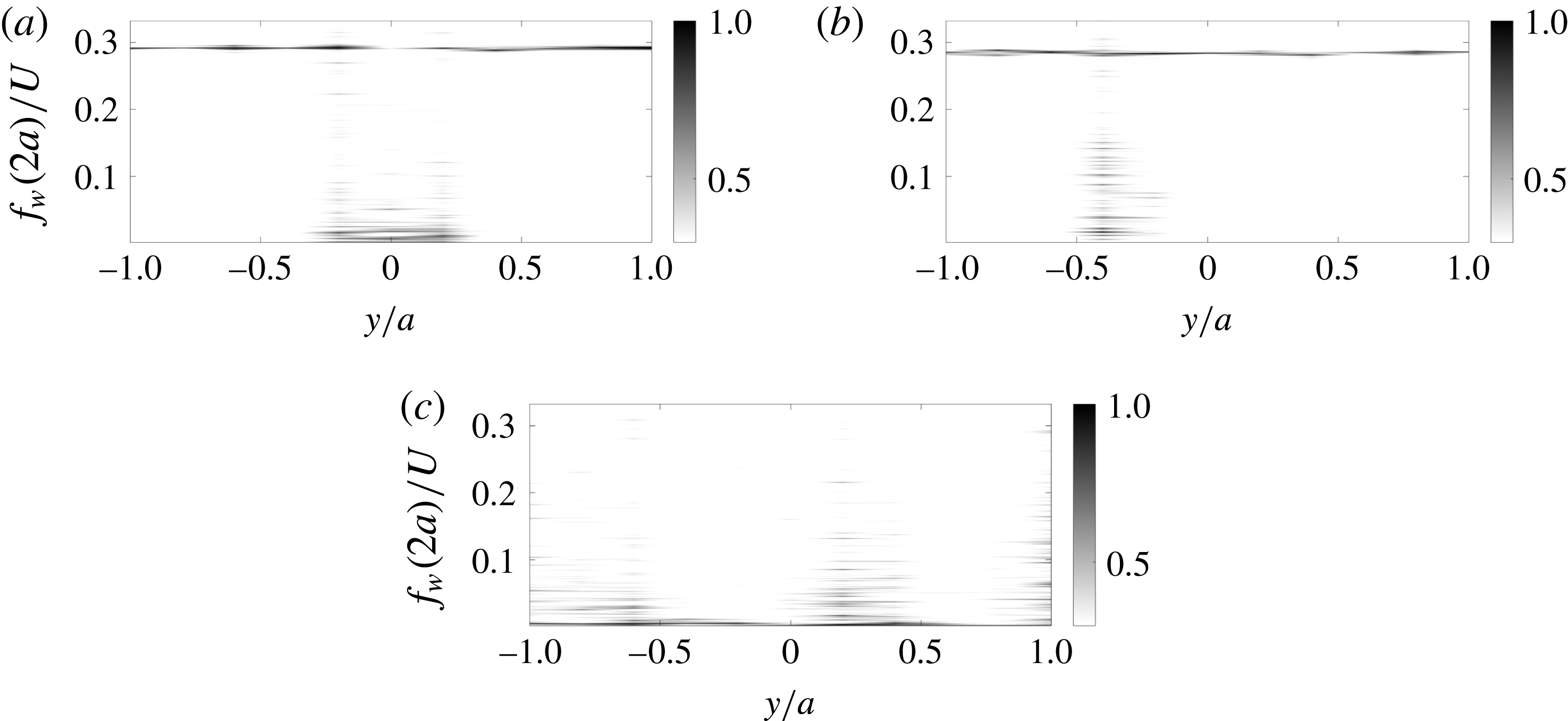
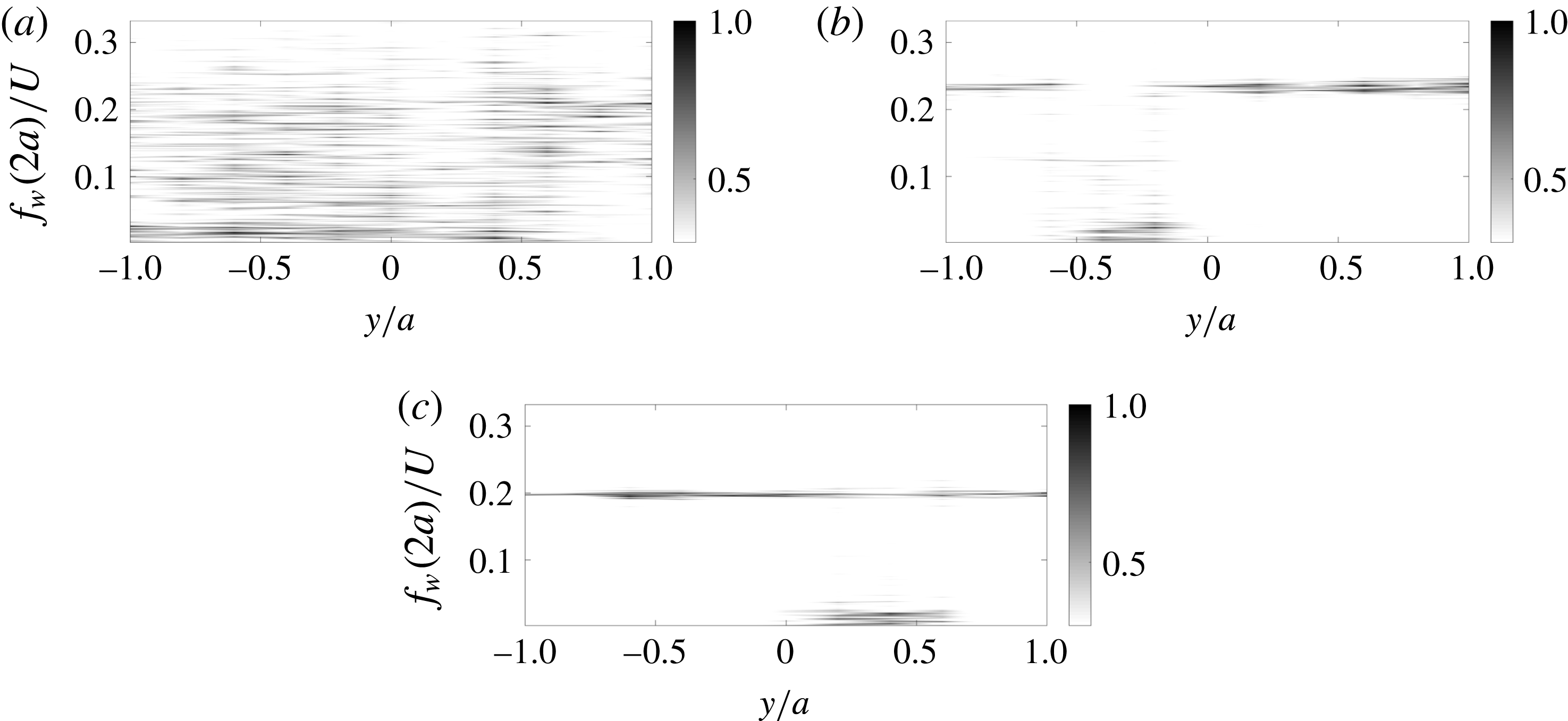
2-D spectra of the streamwise velocity
 $\unicode[STIX]{x1D6F7}_{u}/[\unicode[STIX]{x1D6F7}_{u}]_{max}$
at various transverse locations downstream of the short splitter at
 $Re=3.8\times 10^{4}$
. (a)
 $AoA=0^{\circ }$
, low
 $I_{u}$
;(b)
 $AoA=30^{\circ }$
, low
 $I_{u}$
; (c)
 $30^{\circ }$
, high
 $I_{u}$
.

The structure of the velocity fluctuations in the wake of the cylinder–splitter system carries the signature of the energetic and dominant motions in the various configurations. This is illustrated in the 2-D spectra of the streamwise velocity fluctuations shown in figure 4 for selected cases. Under low
 $I_{u}$
,
 $f_{v}$
is dominant along the transverse direction; whereas the influence of the low-frequency pitching
 $f_{p}$
is reflected around
 $y/a=0$
for the cylinder at
 $AoA=0^{\circ }$
. Interestingly, at cylinder
 $AoA=30^{\circ }$
, the footprint of
 $f_{p}$
is presented at
 $y<0$
(figure 4
b). Numerical simulations of a splitter deflected to one side of a circular cylinder by Lu et al. (Reference Lu, Guo, Tang, Liu, Chen and Xie2016) indicates an asymmetric pressure distribution and transverse wake profile. The signature of
 $f_{p}$
induced by the splitter is then transmitted following the trace of the flow and shifted to
 $y<0$
. This ‘flow shifting’ is also noted for cylinder
 $AoA=45^{\circ }$
, and
 $60^{\circ }$
, not shown for brevity. Different signature arises under high
 $I_{u}$
(figure 4
c); there,
 $f_{v}$
is non-distinctive and the footprint of
 $f_{p}$
in the wake is not local, suggesting that the signal of slow-pitching model induced via
 $\bar{u}$
can be significantly disturbed by the surrounding turbulence.
3.2 Thick cylinder with long splitter (
$AR=0.6$
and
$c/(2a)=2$
)


The increase of the splitter length to twice the semimajor axis of the cylinder leads to very distinctive motions; representative features are illustrated at
 $Re=3.8\times 10^{4}$
for the low
 $I_{u}$
in figure 5. Specifically, figure 5(a) shows
 $\unicode[STIX]{x1D6F7}_{\dot{\unicode[STIX]{x1D6FC}}}$
for the cylinder aligned with the flow, i.e.
 $AoA=0^{\circ }$
. The motion is characterized by a comparatively broad frequency distribution with no dominant peak. In this condition, the splitter undergoes chaotic-like behaviour with very small amplitude. Shukla et al. (Reference Shukla, Govardhan and Arakeri2009) reported that for splitters freely hinged in the centre of the wake of a circular cylinder, the periodic vortex shedding is suppressed with a significant decrease of pitching amplitude for splitter larger than
 ${\sim}3$
cylinder diameters. It is worth noting that the ratio of chord length to the hydraulic diameter of the elliptic cylinder
 $D_{H}=4A/P$
, where
 $A$
and
 $P$
are the cross-sectional area and perimeter of the ellipse, is close to 3. In contrast, the high background turbulence increases the flow mixing in the wake resulting in higher
 $\bar{u}$
; this leads to an increased influence of
 $M_{\unicode[STIX]{x1D6FC}\bar{u}}\propto \bar{u}^{2}$
, sufficient for the
 $f_{p}$
signature. More energetic vortex shedding from the cylinder occurs at larger
 $AoA$
, and the dynamics of the splitter becomes highly influenced by
 $M_{\unicode[STIX]{x1D6FC}\bar{u}}$
and
 $M_{\unicode[STIX]{x1D6FC}u^{\prime }}$
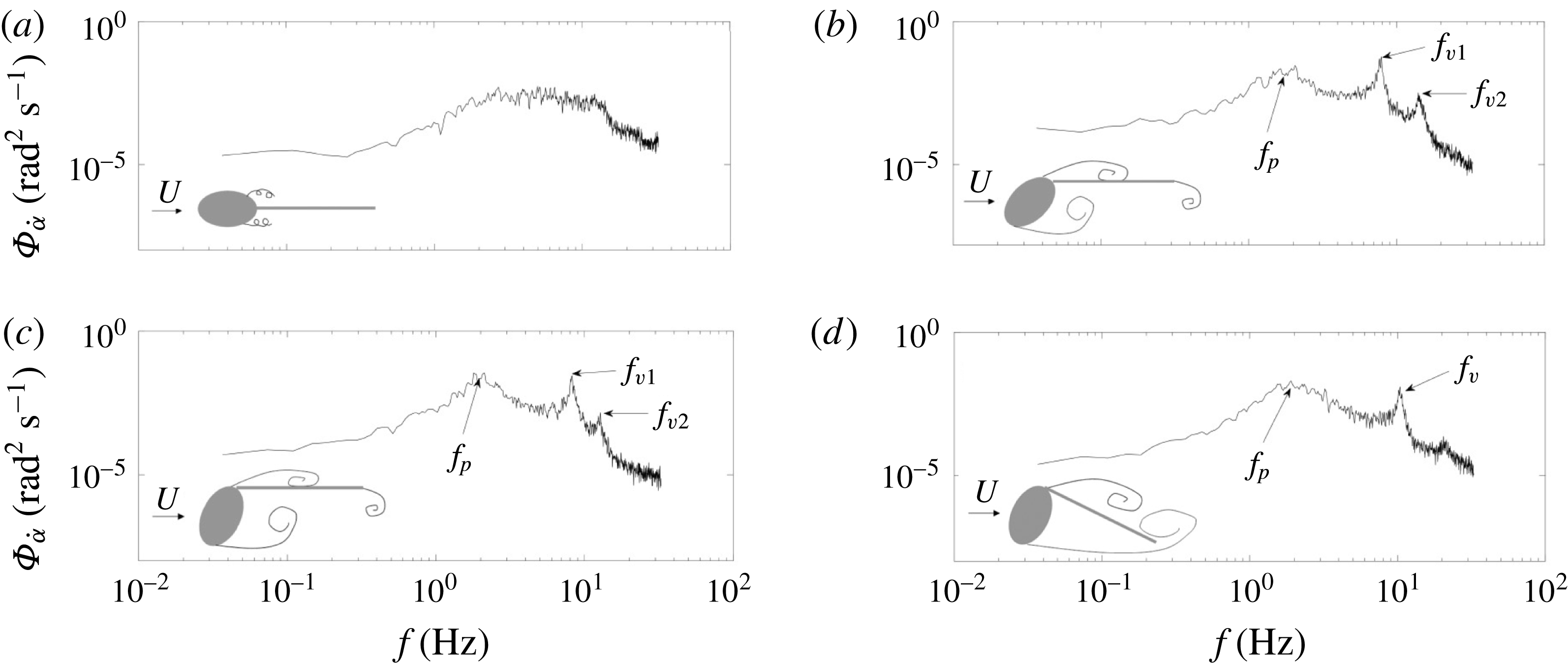
. Figure 5(b) shows a representative spectrum of
 $\dot{\unicode[STIX]{x1D6FC}}$
for
 $AoA=45^{\circ }$
. In addition to
 $f_{p}$
, it shows two distinctive vortex shedding at frequencies
 $f_{v1}$
and
 $f_{v2}$
. We noted that similar phenomenon occurred with the cylinder
 $AoA=30^{\circ }$
and
 $60^{\circ }$
for all
 $Re$
. Knisely (Reference Knisely1990) experimentally investigated the body force fluctuations of a rectangular cylinder with aspect ratio
 $B/G=2$
, where
 $G$
and
 $B$
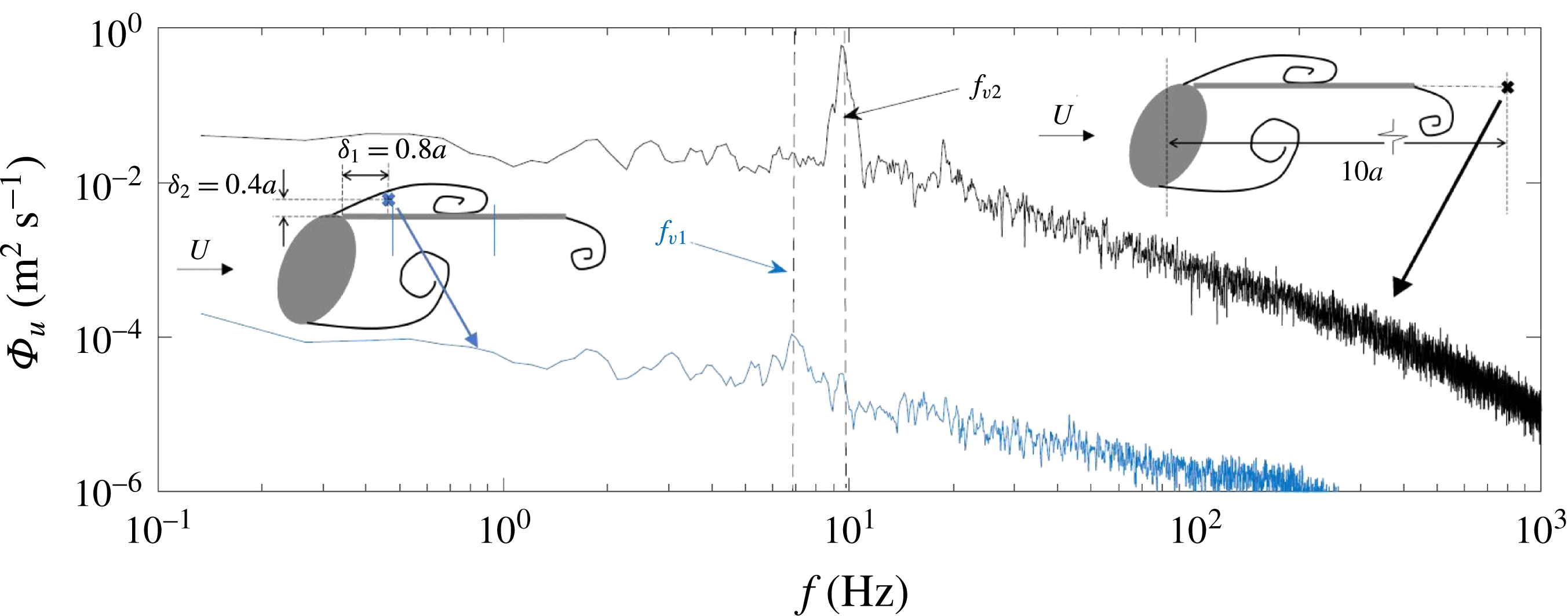
are the sides with the shorter one facing the flow. There, the fluctuating lift also exhibits multiple modes with two dominating peaks. Other studies with detailed flow visualizations including Laneville & Yong (Reference Laneville and Yong1983) and Yu et al. (Reference Yu, Butler, Kareem, Glimm and Sun2012) indicate that two vortex shedding modes coexist for the long splitter case. This is illustrated here in the subplot of figure 5(b); those modes correspond to a main vortex shedding starting close to the leading edge of the splitter from the cylinder (
 $f_{v1}$
) and a secondary vortex close to the trailing edge of the splitter (
 $f_{v2}$
). We further verified this with additional flow measurement in the vicinity of the leading edge of the splitter fixed parallel to the flow to exclude the influence of pitching. Figure 6 shows the lower vortex shedding frequency corresponding to the peak
 $f_{v1}$
close to the leading edge of the splitter; whereas the higher-frequency component
 $f_{v2}$
dominates in the wake region.
Angular velocity spectra
 $\unicode[STIX]{x1D6F7}_{\dot{\unicode[STIX]{x1D6FC}}}$
of the long splitter at
 $Re=3.8\times 10^{4}$
and low
 $I_{u}$
with the cylinder at
 $AoA=$
(a)
 $0^{\circ }$
, (b)
 $45^{\circ }$
, and (c)
 $60^{\circ }$
; (d)
 $AoA=60^{\circ }$
with splitter in inclined equilibrium.

Velocity spectra
 $\unicode[STIX]{x1D6F7}_{u}$
close to the leading edge of the splitter (blue) and in wake region (black) at
 $Re=3.1\times 10^{4}$
,
 $AoA=60^{\circ }$
highlighting distinctive vortex shedding modes.

For all the cases discussed, the equilibrium position of the pitching is nearly coincident with the direction of the mean flow. Notably, there are two pitching equilibria for sufficiently high
 $AoA$
of the cylinder. Figure 5(c,d) illustrates the dynamics of the splitter with the cylinder at
 $AoA=60^{\circ }$
and low
 $I_{u}$
for the two equilibria. In the new splitter (inclined) equilibrium, the trailing edge of the splitter intersects with the downstream line from the leading edge of the elliptic cylinder; this is illustrated in the schematic of figure 5(d). The existence of multiple equilibria was first noted in hinged splitters in the wake of circular cylinders at sufficiently high
 $Re$
. In those scenarios, the stable equilibrium is in either side of the cylinder (Assi et al.
Reference Assi, Bearman and Kitney2009; Gu et al.
Reference Gu, Wang, Qiao and Huang2012; Lu et al.
Reference Lu, Guo, Tang, Liu, Chen and Xie2016). Lācis et al. (Reference Lācis, Brosse, Ingremeau, Mazzino, Lundell, Kellay and Bagheri2014) pointed out that the recirculation zone behind the circular cylinder generates low pressure region at both sides of the wake, which allows a splitter to oscillate in either side. In our measurements, the larger and stronger recirculation at large cylinder
 $AoA$
, e.g.
 ${\sim}45^{\circ }$
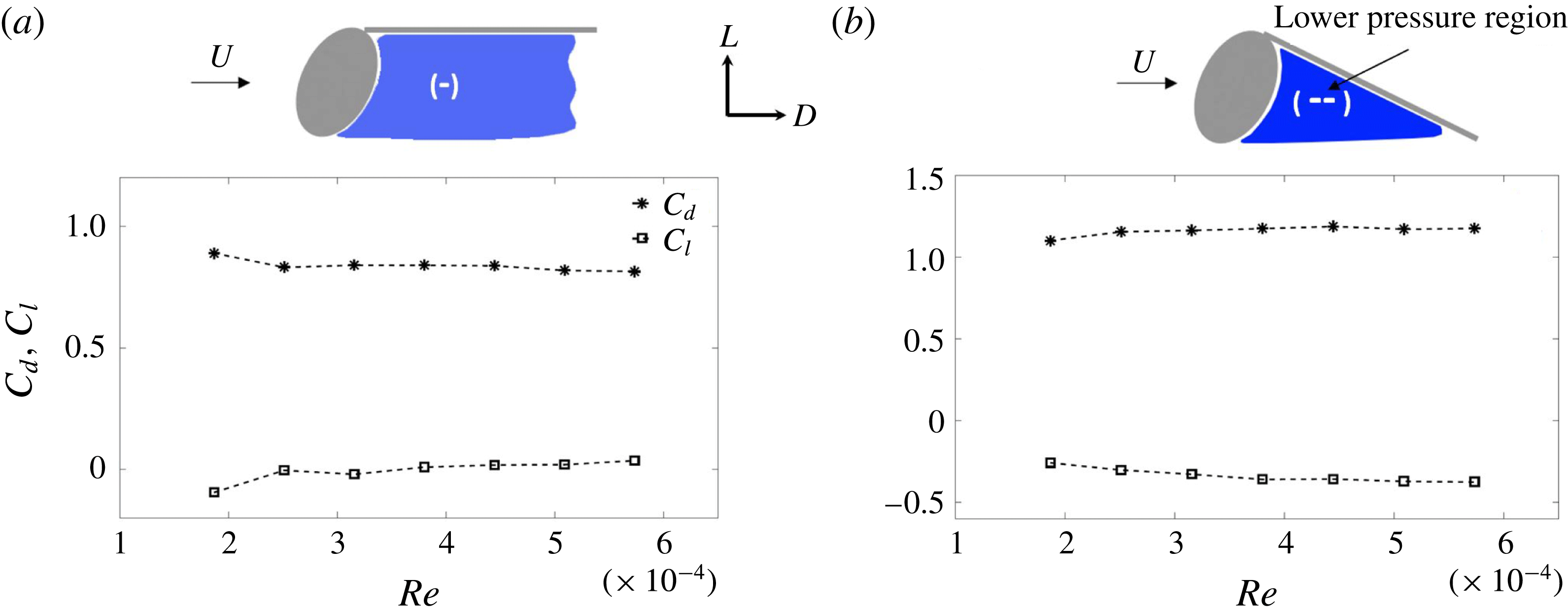
or larger (Paul, Arul Prakash & Vengadesan Reference Paul, Arul Prakash and Vengadesan2014), allows the inclined equilibrium. In this inclined state, the dual vortex shedding mode vanishes and only one distinctive vortex shedding frequency component is prominent. To further explore the effect of the secondary equilibrium, complementary measurement of the lift and drag forces were carried out on the cylinder. Lācis et al. (Reference Lācis, Brosse, Ingremeau, Mazzino, Lundell, Kellay and Bagheri2014) pointed out that a drift force towards the inclined splitter is produced as a result of the symmetry breaking. Smoke flow visualizations by Gu et al. (Reference Gu, Wang, Qiao and Huang2012) suggested that a lower pressure region compared to the other equilibrium counterpart is generated between the base of the cylinder and the splitter. As illustrated in the schematics of figure 7, this lower pressure region results in stronger drag
 $D$
and lift
 $L$
forces in
 $y<0$
direction as reflected by the averaged drag and lift coefficients
 $C_{d}=D/(\unicode[STIX]{x1D70C}_{a}U^{2}Ha)$
and
 $C_{l}=L/(\unicode[STIX]{x1D70C}_{a}U^{2}Ha)$
across
 $Re$
; here,
 $H$
denotes the span of the cylinder. The cylinder–splitter system can stay in either equilibrium depending on the initial location of the splitter or the external disturbances. The distinctive variation of the
 $C_{d}$
and
 $C_{l}$
between the two equilibria may induce instability on the structure when hinged splitters are used as a passive flow control mechanism.
Drag
 $D_{d}$
and lift
 $C_{l}$
coefficients at
 $AoA=60^{\circ }$
with the splitter equilibrium (a) parallel to the flow and (b) inclined towards the cylinder leading edge. The schematics highlight the low pressure region in each case.

Dimensionless pitching frequencies
 $f_{p}$
,
 $f_{v1}$
and
 $f_{v2}$
of the long splitter with cylinder at
 $AoA=$
(a)
 $0^{\circ }$
, (b)
 $30^{\circ }$
, (c)
 $45^{\circ }$
, (d)
 $60^{\circ }$
. The subplots in (c) and (d) show the inclined cases under low
 $I_{u}$
.

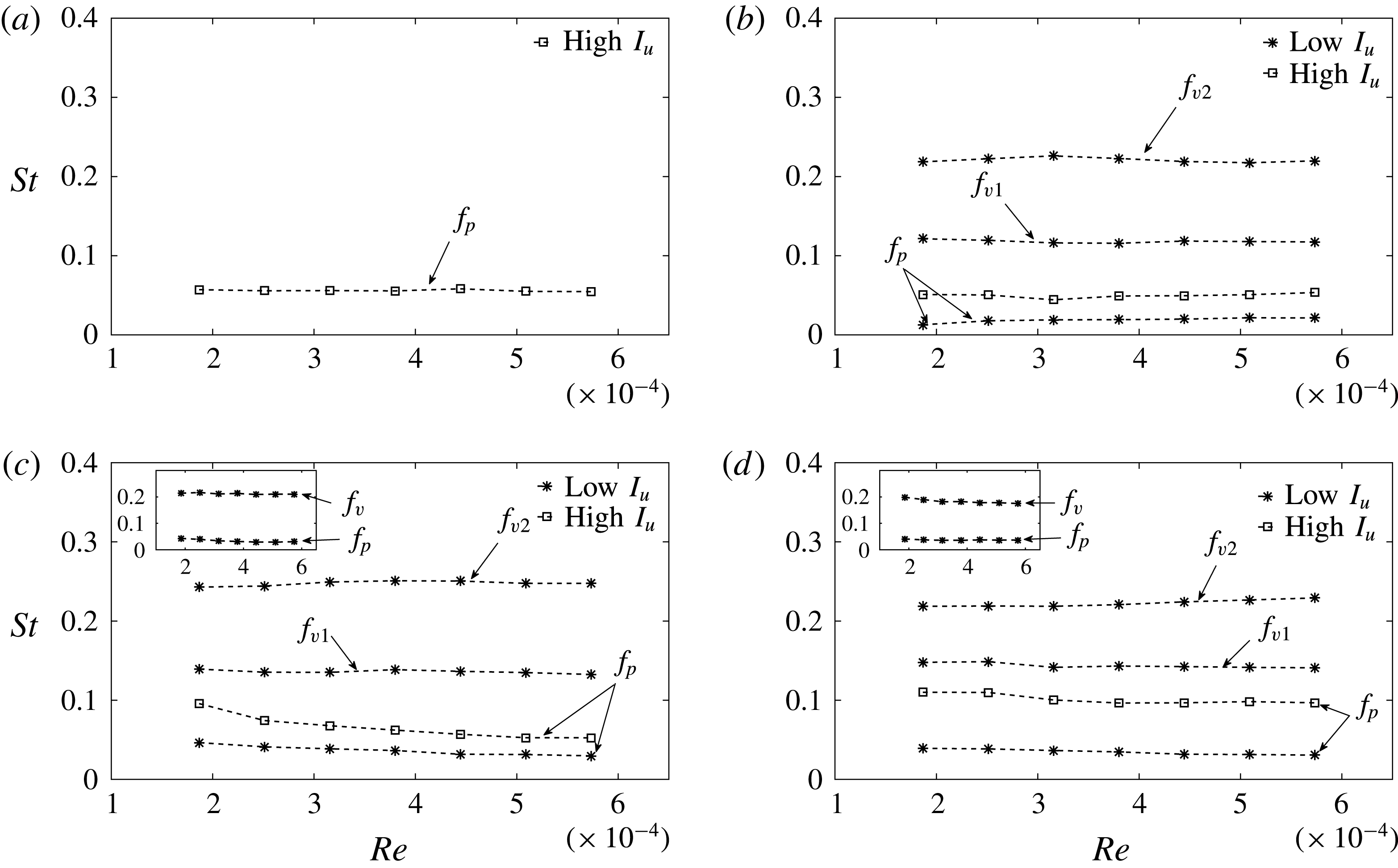
The normalized
 $f_{p}$
and
 $f_{v}$
as a function of the
 $Re$
is summarized in figure 8. Similar to the short splitter, the evolution of
 $f_{p}$
,
 $f_{v1}$
and
 $f_{v2}$
exhibit a quasi-linear relation with
 $U$
(figure 8
a–d). It is possible to infer that the ratio
 $f_{v2}/f_{v1}$
decreases from 1.92 to 1.64 when the
 $AoA$
of the cylinder increases from
 $30^{\circ }$
to
 $60^{\circ }$
, suggesting a converging trend to
 $f_{v2}/f_{v1}=1.625$
measured by Knisely (Reference Knisely1990) in rectangular plates with
 $B/G=2$
; this roughly resembles the case of the
 $AoA=90^{\circ }$
. Similar to the short splitter, i.e.
 $c/(2a)=1$
, the influence of periodic vortex shedding from the cylinder is non-distinctive for all the high
 $I_{u}$
cases. Interestingly,
 $f_{p}(Re)$
with the long splitter exhibits larger differences between high and low
 $I_{u}$
cases compared to those with the short splitter. This suggests a stronger wake mixing with incoming turbulence and, therefore, higher
 $\bar{u}$
compared to the low
 $I_{u}$
counterpart at
 $x/(2a)\approx 2$
. Similar flow recovery with turbulence has been reported in various cases including wind turbine wakes (Jin et al.
Reference Jin, Liu, Aggarwal, Singh and Chamorro2016c
) and rectangular cylinders (Naimul Haque et al.
Reference Naimul Haque, Katsuchi, Yamada and Nishio2014). The
 $f_{p}$
and
 $f_{v}$
for the inclined equilibrium as a function of
 $Re$
under low
 $I_{u}$
is given in the subplots of figure 8(c,d). Here,
 $f_{p}$
remains almost the same between the two equilibria, suggesting that the effective averaged velocity
 $\bar{u}$
is not sensitive to the orientation of the splitter. It is noted that the high
 $I_{u}$
significantly reduces the recirculation region and induces flow disturbances (Naimul Haque et al.
Reference Naimul Haque, Katsuchi, Yamada and Nishio2014; Liu et al.
Reference Liu, Hamed, Jin and Chamorro2017), which hinders the formation of an inclined equilibrium; the inclined state was also observed at
 $AoA=45^{\circ }$
and
 $60^{\circ }$
for the short splitter. However, due to the geometry of the elliptic cylinder, the large inclination of the splitter resulted in a collision with the cylinder, affecting the unsteady pitching. The wake signature at various transverse locations within
 $y/a\in [-1,1]$
is highlighted in the 2-D spectra of the streamwise velocity fluctuations
 $\unicode[STIX]{x1D6F7}_{u}$
for selected cases in figure 9. At cylinder
 $AoA=0^{\circ }$
(figure 9
a) and low
 $I_{u}$
, there is no clear dominant frequency across the wake region. For cases where the splitter motion contain dominant
 $f_{v1}$
and
 $f_{v2}$
, it is interesting to note that although
 $f_{v2}$
is less energetic in the splitter pitching (figure 5
b,c), it is prominent in the wake. Knisely (Reference Knisely1990) also reported a reversed order of the predominant peak from fluctuating lift and wake in a rectangular plate of aspect ratio
 $B/G=2$
. This, with flow visualizations of Laneville & Yong (Reference Laneville and Yong1983) and Yu et al. (Reference Yu, Butler, Kareem, Glimm and Sun2012), suggests that the primary vortex shedding from the elliptic cylinder may be severely disturbed before reaching the wake due to a reattachment with the splitter. Also, secondary vortex generated near the splitter tip (
 $f_{v2}$
) may increase wake fluctuation. The wake spectra of the corresponding inclined splitter is presented in figure 9(c); there, the influence of
 $f_{p}$
appears at
 $y>0$
coincident with the ‘flow shifting’ observed at the parallel equilibrium of the splitter.
2-D spectra of the streamwise velocity
 $\unicode[STIX]{x1D6F7}_{u}/[\unicode[STIX]{x1D6F7}_{u}]_{max}$
at various transverse locations downstream of the long splitter at
 $Re=3.8\times 10^{4}$
under low
 $I_{u}$
. Cylinder at
 $AoA=$
(a)
 $0^{\circ }$
, (b)
 $45^{\circ }$
, (c)
 $45^{\circ }$
with splitter in inclined equilibrium.

3.3 Thin cylinder
$(AR=0.3)$

As discussed above, sufficient recirculation in the wake can result in an inclined equilibrium of the splitter; complementary measurements with a slender elliptic cylinder of
 $AR=0.3$
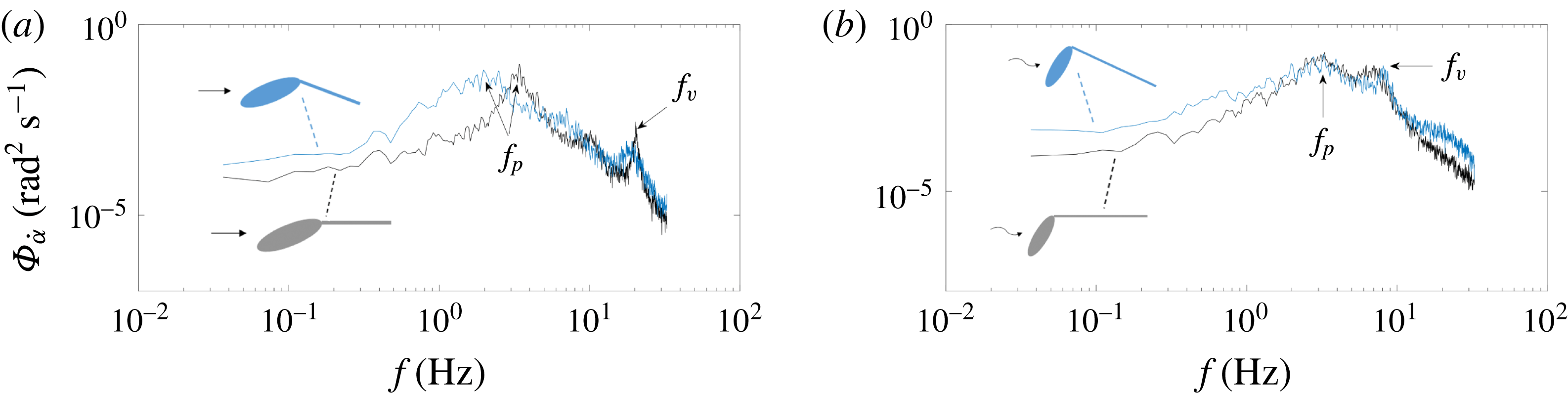
stress the phenomenon. Figure 10(a) and subplot show the existence of a second equilibrium at
 $AoA=30^{\circ }$
and low
 $I_{u}$
for the short splitter, where no inclination occurred for the thick cylinder. It is noted that elliptic cylinders with low
 $AR$
facilitate more abrupt flow separation at the leading edge, which induce longer and stronger recirculation regions (Paul et al.
Reference Paul, Arul Prakash and Vengadesan2014). The extended recirculation can result in splitter inclination even under high background turbulence. Indeed, as illustrated in figure 10(b) for
 $AoA=60^{\circ }$
, the splitter pitches stably when inclined to the leading edge side under high
 $I_{u}$
. Note that the more severe flow separation results in stronger vortex shedding from cylinder, where the corresponding frequency component
 $f_{v}$
in the dynamics of the splitter is noticeable even under high
 $I_{u}$
.
4 Conclusions
The dynamics of a splitter in the trailing edge of an elliptic cylinder is significantly modulated by the mean and fluctuating velocities in the wake region under very low
 $I_{u}$
. Turbulence can severely alter vortex shedding from the cylinder, and the coherence of the pitching from the unsteady flow may be reduced. For sufficiently long splitters (e.g.
 $c/(2a)\sim 2$
), multiple vortex shedding modes coexist close to both the leading and trailing edges of the splitter. A large recirculation region facilitates an inclined equilibrium for a splitter pitching, which is stressed with the low
 $AR$
elliptic cylinder. Measurements of the wake fluctuation at various transverse locations indicate that the signature of the low-frequency splitter pitching is shifted inside the wake. Although the splitter pitching exhibits two dominant vortex shedding modes in various setups, only the higher frequency is transmitted to the wake. The cases studied bridge those of passive splitter pitching in the wake of circular cylinders and plates. The elliptic and splitter configurations also provide insight for animal locomotion, stability of structures and energy harvesting. Following work will focus on specific details of aerodynamic forces, under various configurations, the effect of actively controlled splitters (tails) and complementary flow visualizations.
Spectra of the angular velocity
 $\unicode[STIX]{x1D6F7}_{\dot{\unicode[STIX]{x1D6FC}}}$
of the short and long splitters at
 $Re=3.8\times 10^{4}$
. (a) Cylinder at
 $AoA=30^{\circ }$
with the short splitter under low
 $I_{u}$
; (b) cylinder at
 $AoA=60^{\circ }$
with the long splitter under high
 $I_{u}$
. The blue distributions indicate the cases with the splitter in inclined equilibrium.

Acknowledgements
This work was supported by the Department of Mechanical Science and Engineering, University of Illinois, as part of the start-up package of L.P.C. The authors are grateful for the help of undergraduate student S. Ji.