Introduction
The evergreen azaleas (Rhododendron subgenus Tsutsusi; Rhodoreae, Ericoideae, Ericaceae) are among the most popular of the cultivated azaleas. Native to Asia, many species of Tsutsusi azaleas were cultivated in China and Japan long before collectors such as Robert Fortune and Carl Maximowicz introduced them to European gardens (Wilson, Reference Wilson, Wilson and Rehder1921). Today the evergreen azaleas are a major component of the florist and nursery trades, being grown as landscape plants in areas with warm climates, bonsai, and potted plants. Rhododendron subgenus Tsutsusi is one of several (the number varies depending on the author) subgenera currently recognised within the genus Rhododendron by Chamberlain et al. (Reference Chamberlain, Hyam, Argent, Fairweather and Walter1996; Table 1). This group of azaleas can be recognised by the presence of terminal buds that contain both floral and vegetative shoots. Flattened ferrugineous hairs and/or pseudoverticillate leaves that are rhombic in outline are also common in some members of the group.
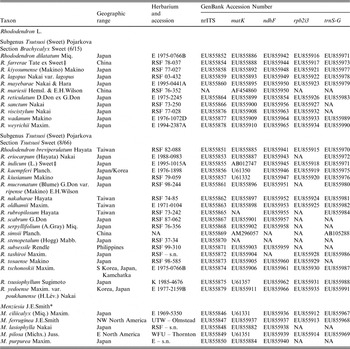
Taxa sampled in the analysis of nrITS, matK, ndhF, rpb2 intron3 (rpb2i3) and trnS-G (see text) sequence data for species of Rhododendron and Menziesia

Herbarium acronyms follow Index Herbariorum, except RSF = Rhododendron Species Foundation, and are followed by accession numbers. Asterisk indicates outgroup taxon. ‡ indicates type species for Rhododendron sections Brachycalyx and Tsutsusi. NA = not available.
Tsutsusi azaleas occur in temperate and subtropical zones at a variety of elevations in Mainland China and Japan. A few species also occur in Korea, and in Burma, Arunchal-Pradesh (India), Laos and Thailand (Chamberlain & Rae, Reference Chamberlain and Rae1990).
Rhododendron subgenus Tsutsusi has consistently been considered a distinctive group because most members possess flattened multicellular hairs that are often ferrugineous. In some species these hairs cover the leaves and stems and give the plant an almost coppery sheen. Other species have less dense coverage with hairs found only in the axils of the leaves or at the base of the floral buds. Sleumer (Reference Sleumer1949) considered the inclusion of both vegetative and floral buds within the same shoot a significant feature, but this character has apparently evolved at least twice in Rhododendron, occurring also in R. schlippenbachii and in R. quinquefolium (Judd & Kron, Reference Judd and Kron1995; Goetsch et al., Reference Goetsch, Eckert and Hall2005). Neither of these two species possess other characteristics of Rhododendron subgenus Tsutsusi and were not included in this study.
Most authors have recognised two groups within Rhododendron subgenus Tsutsusi – section Tsutsusi and section Brachycalyx (Wilson, Reference Wilson, Wilson and Rehder1921; Chamberlain & Rae, Reference Chamberlain and Rae1990). Rhododendron section Brachycalyx is characterised in these treatments as possessing deciduous leaves that are rhombic in outline and crowded at the shoot apex, appearing verticillate (i.e. pseudoverticillate). Most of the recognised species in Rhododendron section Brachycalyx are reported to lack the characteristic flattened and ferrugineous multicellular hairs found in Rhododendron section Tsutsusi. However, herbarium specimens of Rhododendron weyrichii, R. wadanum, etc. refute this as these hairs are present in the axils of leaves and flowers or flower buds in all specimens examined. Of the approximately 15–16 species currently recognised in Rhododendron section Brachycalyx, only R. farrerae and R. mariesii are native to China (R. daiyunicum also is reported from Mainland China but is known only from the type specimen) and not found in the Japanese archipelago.
Rhododendron section Tsutsusi is morphologically well defined by the distinctive hairs (but see above) and many species possess dimorphic leaves. In these taxa some leaves (usually the ones scattered along the stem) are annually deciduous whereas others (usually those crowded towards the stem apex) over winter and are retained on the plant for two seasons or more. Although occasionally Rhododendron tashiroi has been placed in Rhododendron section Tsusiopsis, as in the recent treatment in the Flora of China (He & Chamberlain, Reference He, Chamberlain, Wu and Raven2005), it was placed in Rhododendron section Tsutsusi by Chamberlain & Rae (Reference Chamberlain and Rae1990) based on its possession of flattened brown hairs. Chamberlain & Rae (Reference Chamberlain and Rae1990) noted that the leaves of Rhododendron tashiroi are similar to those of Rhododendron section Brachycalyx (i.e. monomorphic and pseudoverticillate), making R. tashiroi an anomalous member of Rhododendron section Tsutsusi. Recently, Rhododendron tashiroi was placed in a clade with species from Rhododendron section Brachycalyx in a molecular phylogenetic analysis of Rhododendron based on matK sequence data (Kurashige et al., Reference Kurashige, Mine, Kobayashi, Handa, Takayanagi and Yukawa1998). Rhododendron subgenus Tsutsusi has consistently been recognised as a group but evolutionary relationships have rarely been addressed with more than a few species (Kurashige et al., Reference Kurashige, Mine, Kobayashi, Handa, Takayanagi and Yukawa1998; Kron et al., Reference Kron, Judd, Stevens, Crayn, Anderberg and Gadek2002; Goetsch et al., Reference Goetsch, Eckert and Hall2005). Other published studies of the evergreen azaleas include revisions by Chamberlain & Rae (Reference Chamberlain and Rae1990) and by Yamazuki (Reference Yamazuki1996). Others have been floristic, descriptions of new species or studies of population-level variation. Molecular work on the Tsutsusi group (Rhododendron subgenus Tsutsusi) has been published regarding population-level variation in selected cultivars and in selections from the wild (e.g. De Riek et al., Reference De Riek, Dendauw, Mertens, De Loose, Heursel and Van Bockstaele1999; Scariot et al., Reference Scariot, De Keyser, Handa and De Riek2007). Phylogenetic studies have been limited to a few representative species of Rhododendron subgenus Tsutsusi (Kurashige et al., Reference Kurashige, Mine, Kobayashi, Handa, Takayanagi and Yukawa1998; Kron et al., Reference Kron, Judd, Stevens, Crayn, Anderberg and Gadek2002; Goetsch et al., Reference Goetsch, Eckert and Hall2005) as part of a larger analysis of Rhododendron as a whole. This study tests evolutionary relationships in the Tsutsusi group using two nuclear and three chloroplast molecular markers.
Material and Methods
We used DNA sequence data from five regions, three chloroplast (matK, ndhF and trnS-trnG) and two nuclear (nrITS and the third intron of rpb2), in order to investigate relationships in Rhododendron subgenus Tsutsusi (Chamberlain & Rae, Reference Chamberlain and Rae1990; Chamberlain et al., Reference Chamberlain, Hyam, Argent, Fairweather and Walter1996) and the relationships of members representing Rhododendron sections Brachycalyx and Tsutsusi.
Taxon sampling
DNA sequence data were collected for 30 species of Rhododendron subgenus Tsutsusi and five species of Menziesia (Table 1). Previous analyses have shown Rhododendron subgenus Tsutsusi to be monophyletic (Kurashige et al., Reference Kurashige, Mine, Kobayashi, Handa, Takayanagi and Yukawa1998; Goetsch et al., Reference Goetsch, Eckert and Hall2005) even though different taxa were used as representatives of the subgenus. This molecular evidence combined with the distinctive morphological features provide a well-supported argument for the monophyly of Rhododendron subgenus Tsutsusi. Therefore this study focused on the relationships within the Tsutsusi group.
Many of the species described in Rhododendron subgenus Tsutsusi are known from few specimens (Chamberlain & Rae, Reference Chamberlain and Rae1990), are not in cultivation or are otherwise difficult to obtain. Of the 76 described species listed in Rhododendron section Tsutsusi by Chamberlain & Rae (Reference Chamberlain and Rae1990), 27 were known from nine or fewer localities within China and of these 13 were known only from a single locality (8 of these only from the type specimen). The Chamberlain et al. (Reference Chamberlain, Hyam, Argent, Fairweather and Walter1996) classification lists 22 recognised species in Rhododendron section Brachycalyx and 86 species in Rhododendron section Tsutsusi for a total of 108 described species. The more recent treatment of Rhododendron in the Flora of China (He & Chamberlain, Reference He, Chamberlain, Wu and Raven2005) indicates 85 recognised species in Rhododendron section Tsutsusi and 23 recognised species in Rhododendron section Brachycalyx (R. tashiroi is placed in a separate section – Tsusiopsis) for a total of 109 species. It should be noted that there is significant morphological diversity among the species of Rhododendron section Tsutsusi within Mainland China that is not represented in this study. Unfortunately this material was unavailable at the time of our investigation.
We have sampled from both Brachycalyx and Tsutsusi groups based on morphological variation, geographic distribution, and the availability of reliably identified material. Additionally we took care to sample from material that could be verified as naturally occurring such as in the case of Rhododendron yedoense var. poukhanense, R. mucronatum var. ripense, and R. lagopus var. lagopus. Sampling from the Brachycalyx group included 11 species, two (of the four) from Mainland China (Rhododendron farrerae, R. mariesii) and one species that occurs in southern Korea and Japan (R. weyrichii). The remaining eight species sampled are endemic to Japan. Sampling within Rhododendron section Tsutsusi included 19 species: one endemic to the Philippines (R. subsessile), four species endemic to Taiwan (R. breviperulatum, R. nakaharae, R. oldhamii and R. rubropilosum), 11 species endemic to Japan, two species that occur in northern Japan and southern Korea (R. tschonoskii, R. yedoense), and the widespread R. simsii. Material for representatives of Rhododendron section Tsutsusi from mainland Asia was limited to R. simsii for this study. This species has a wide geographic range and occurs in China, northern Burma, Thailand, Laos, Taiwan and Japan. Examples of the range of morphological sampling included species with very small flowers as well as those with large ones, those species densely covered with flattened hairs and those sparsely covered, etc. Although the species sampling was not comprehensive it is sufficient to test the monophyly of the sections and for an initial investigation into relationships among species within Rhododendron subgenus Tsutsusi.
DNA extraction and sequencing
Fresh or silica gel-dried leaf tissue was broken up using liquid nitrogen and a mortar and pestle or a mini-beadbeater and 2.5 mm zirconia/silica beads (Biospec Products, Inc., Bartlesville, OK, USA; M. Kallersjö, Swedish Museum of Natural History, pers. comm.). Total genomic DNA was extracted using the Epicentre MasterPure Plant Leaf DNA Purification kit (Epicentre Technologies, Madison, WI, USA) or a modification of the CTAB method (Doyle & Doyle, Reference Doyle and Doyle1987). Five DNA regions (6602 base pairs total) were amplified for this study: matK, ndhF and trnS-trnG from the chloroplast genome and nuclear ribosomal internal transcribed spacer (nrITS) and the third intron of rpb2 (rpb2i3) from the nuclear genome. All DNA regions were amplified from the same accession for each species. PCR protocol for the ribosomal genes trnS and trnG spacer region follows Shaw et al. (Reference Shaw, Lickey, Beck, Farmer, Liu and Miller2005), those for ndhF, matK and ITS follow Kron et al. (Reference Kron, Judd, Stevens, Crayn, Anderberg and Gadek2002) and those for rpb2i3 follow those from Goetsch et al. (Reference Goetsch, Eckert and Hall2005). Products were cleaned using the Qiagen Qiaquick PCR Cleanup Kit (Qiagen, Santa Clarita, CA, USA) and sequenced on an Applied Biosystems Model 3100 Genetic Analyzer at the Wake Forest University DNA Sequencing and Gene Analysis Laboratory at the Wake Forest University School of Medicine. Sequences were edited using Sequencher 3.1.1 (Gene Codes Corp. Inc. 1998) and were aligned manually with MacClade 4.0 (Maddison & Maddison, Reference Maddison and Maddison2000).
Twenty-nine matK sequences and all rpb2i3, trnS-trnG, ndhF and nrITS data were produced for this study (Table 1). Kron (Reference Kron1997) and Kurashige et al. (Reference Kurashige, Mine, Kobayashi, Handa, Takayanagi and Yukawa1998) have shown that matK is phylogenetically informative in the Rhodoreae. Kurashige et al. (Reference Kurashige, Mine, Kobayashi, Handa, Takayanagi and Yukawa1998) showed that matK contained sufficient phylogenetic signal to support the monophyly and sister relationship of Rhododendron subgenus Tsutsusi sections Tsutsusi and Brachycalyx (if the problematic Rhododendron tashiroi was excluded). RPB2 encodes the second-largest subunit of nuclear RNA polymerase II (Sawadogo & Sentenac, Reference Sawadogo and Sentenac1990) and is involved in the transcription of protein encoding genes. Oxelman & Bremer (Reference Oxelman and Bremer2000) found two paralogs of RPB2, RPB2-i and RPB2-d, in taxa from the Gentianales. Goetsch et al. (Reference Goetsch, Eckert and Hall2005) used several portions of rpb2 to investigate phylogenetic relationships within Rhododendron. For this study we used Benjamin Hall's primers (19F and 20R – unpublished, used with permission, B. Hall, University of Washington, Seattle, WA) to amplify rpb2i3 and assess its phylogenetic utility within Rhododendron subgenus Tsutsusi. The trnS-trnG region is found in the large single-copy region of the chloroplast genome and includes the trnS GCU-trnG intergenic spacer (exon 1 of trnG UCC), and the trnG UCC intron (Shaw et al., Reference Shaw, Lickey, Beck, Farmer, Liu and Miller2005; shortened to trnS-G in this study). Shaw et al. (Reference Shaw, Lickey, Beck, Farmer, Liu and Miller2005) showed that this region contained phylogenetically useful variation at the interspecific level and should be helpful in elucidating phylogenetic relationships among closely related taxa. This is the first study to assess the phylogenetic utility of trnS-G in the Ericaceae. Primers for trnS-G follow Shaw et al. (Reference Shaw, Lickey, Beck, Farmer, Liu and Miller2005). The aligned length and number of informative characters for each data set are shown in Table 2.
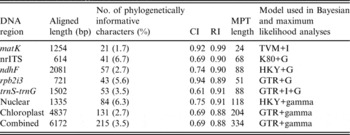
Aligned length, number of phylogenetically informative characters, tree statistics and models used for phylogenetic analyses of Rhododendron subgenus Tsutsusi

CI = consistency index; RI = retention index; MPT = most parsimonious tree.
Phylogenetic analyses
Phylogenetic analyses were conducted using PAUP* 4.0b8 (Swofford, Reference Swofford2002) and trees were rooted with Menziesia ciliicalyx based on previous studies that show a close relationship between Rhododendron subgenus Tsutsusi and Menziesia (Kron, Reference Kron, Argent and McFarlane2003; Goetsch et al., Reference Goetsch, Eckert and Hall2005). The five individual data sets, the chloroplast data partition, and the nuclear data partition were analysed using maximum parsimony, Bayesian analysis (MrBayes 3.2), and maximum likelihood (implemented in GARLi 0.951) (Table 2). Model estimates were performed in Modeltest 3.7. Trees were examined to look for well-supported topological incongruence (bootstrap > 85%) among the data partitions. The nuclear and chloroplast data sets were each combined and analysed as above. Subsequently all five data partitions were then combined (Combined; Table 2) and analysed using parsimony, Bayesian and likelihood methods.
For all analyses characters were unordered and equally weighted, and gaps were treated as missing data. Relative clade support was assessed using 1000 heuristic bootstrap replicates (Felsenstein, Reference Felsenstein1985) or posterior probabilities (Bayesian analyses). Phylogenetically informative indels were scored (present/absent) and were mapped onto a single most parsimonious tree (MPT) obtained from the combined data analysis using MacClade 4.0 (Maddison & Maddison, Reference Maddison and Maddison2000).
Results
The aligned length of the matK region is 1254 base pairs (bp) among the taxa [Menziesia (5 spp.) and Rhododendron subgenus Tsutsusi (30 spp.)] sampled and 1.7% of the sites are phylogenetically informative. This region contains the least percentage of potentially informative sites compared with the nuclear rpb2i3 region at 5.6% and ITS at 6–7%. Variation in both the individual (Figs 1, 2) and combined analyses (Fig. 3) appear to be confined to the deeper nodes of the tree as none of them resolves the relationships of most of the species of Rhododendron subgenus Tsutsusi. Some of this lack of resolution may be due to missing data in some species of Rhododendron section Tsutsusi (5 species). Differences among several species in the intron of rpb2i3 were so minor (1–2 bases) that rpb2i3 was not sequenced for the remaining taxa.
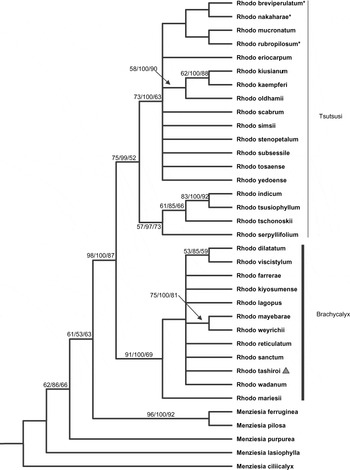
Strict consensus of > 80,000 most parsimonious trees (L = 118, CI = 0.75, RI = 0.91) found in the maximum parsimony analysis of the combined data set (ITS, rpb2i3). Support values are shown above the branches in the following order: parsimony bootstrap (BS)/posterior probability (PP)/maximum likelihood bootstrap (ML). Terminal names are shortened to species in the case of Rhododendron yedoense var. poukhanense, R. lagopus var. lagopus, and R. mucronatum var. ripense. Tree is rooted with Menziesia ciliicalyx. Triangle =formerly placed in Rhododendron section Tsutsusi. Asterisk = Bayesian analysis placed these taxa in a clade but with very low posterior probability.

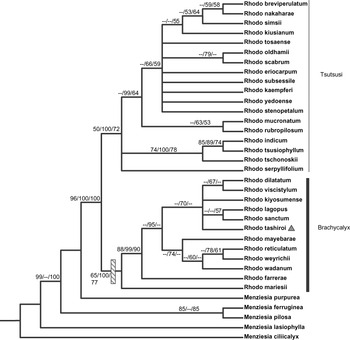
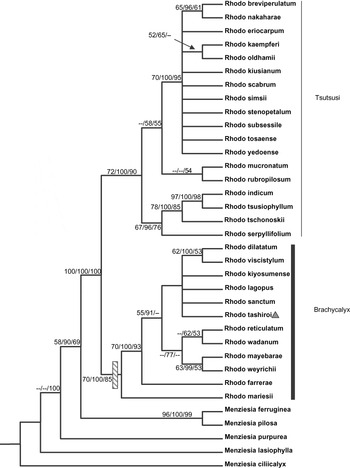
Strict consensus of > 77,000 trees (L = 204, CI = 0.69, RI = 0.88) obtained in the maximum parsimony analysis of combined (matK, ndhF, trnS-G) chloroplast data. Support values as in Fig. 1 (BS/PP/ML). Terminal names are shortened to species in the case of Rhododendron yedoense var. poukhanense, R. lagopus var. lagopus, and R. mucronatum var. ripense. Tree is rooted with Menziesia ciliicalyx. Triangle = formerly placed in Rhododendron section Tsutsusi. Hatched bar = 17 base-pair insertion in trnS-G spacer.

Strict consensus of > 46,000 trees (L = 334, CI = 0.69, RI = 0.88) obtained in the maximum parsimony analysis of combined chloroplast and nuclear data (matK, ndhF, trnS-G, ITS, rpb2i3). Support values as in Fig. 1 (BS/PP/ML). Terminal names are shortened to species in the case of Rhododendron yedoense var. poukhanense, R. lagopus var. lagopus, and R. mucronatum var. ripense. Tree is rooted with Menziesia ciliicalyx. Triangle = formerly placed in Rhododendron section Tsutsusi. Hatched bar = 17 base-pair insertion in trnS-G spacer.

Likewise, individual analyses of matK, ndhF and trnS-G data showed no topological conflict (trees not shown) and these data generally supported the results obtained from the nuclear data. There was no strongly supported conflict between the different chloroplast data partitions so all data were combined (Fig. 2). Maximum parsimony and maximum likelihood analyses of the combined chloroplast data partitions often resulted in low or no support for clades with at least some support in the nuclear data analyses (Fig. 2). This may be due to the lack of variation in the chloroplast regions used for this study. Bayesian posterior probability support was high for the Tsutsusi and Brachycalyx clades as found in the combined nuclear analyses (Fig. 1). Bayesian analysis also supported the clade containing Rhododendron indicum, R. tsusiophyllum and R. tschonoskii in agreement with the nuclear tree (Fig. 1). Both the combined nuclear data analyses and combined chloroplast analyses include the placement of Rhododendron tashiroi within the Rhododendron section Brachycalyx group. The clade containing members of Rhododendron section Brachycalyx and R. tashiroi (also contains the type species of Rhododendron section Brachycalyx, R. farrerae) shows some structure with the two sampled Mainland China species falling at the deeper nodes within the group and the Japanese species placed in more derived positions within the group. Also within the Brachycalyx clade the trnS-G intergenic region has a 17-base insertion (11 bases in Rhododendron weyrichii) compared with the rest of Rhododendron subgenus Tsutsusi and Menziesia. This insertion can be mapped onto the branch leading to Rhododendron mariesii at the base of the Brachycalyx clade (Figs 2, 3). The insertion is present in all sampled members of Rhododendron section Brachycalyx including R. tashiroi. [Due to technical difficulties we were not able to completely sequence through the trnS-G region of Rhododendron viscistylum and R. sanctum to verify the possession or lack of this insertion, but predict its presence in these species.]
Phylogenetic relationships
Rhododendron subgenus Tsutsusi is supported as monophyletic (Fig. 1). Within Rhododendron subgenus Tsutsusi neither sections Tsutsusi nor Brachycalyx, as currently recognised, are monophyletic. This is due to the position of Rhododendron tashiroi, currently placed in Rhododendron section Tsutsusi by Chamberlain & Rae (Reference Chamberlain and Rae1990), which is strongly supported (100%) as a member of Rhododendron section Brachycalyx (Figs 1, 3) in this study. Rhododendron tashiroi is closely related to species from Rhododendron section Brachycalyx in both the chloroplast and nuclear analyses and is not closely related to other taxa from Rhododendron section Tsutsusi sampled in any phylogenetic analysis conducted. Within Rhododendron section Brachycalyx, R. tashiroi is placed within a large polytomy that includes a few moderately supported pairs of species. These species pairs are Rhododendron mayebarae and R. weyrichii, as sister to R. wadanum and R. reticulatum (Fig. 3). Rhododendron dilatatum and R. viscistylum also form a moderately supported clade (Fig. 3). Within Rhododendron section Tsutsusi (Fig. 3), two clades are indicated. Rhododendron serpyllifolium is sister to R. tschonoskii, plus R. indicum plus R. tsusiophyllum. These relationships are well supported especially by Bayesian and maximum likelihood results. Another well-supported clade within Rhododendron section Tsutsusi contains 12 of the 18 species sampled in Rhododendron section Tsutsusi. However, of these 12 species only four show minor resolution: Rhododendron breviperulatum sister to R. nakaharae and R. kaempferi sister to R. oldhamii. The remaining eight species are unresolved with respect to each other and to the two clades mentioned above. For each parsimony analysis (individual or combined) thousands of trees were obtained and searches were stopped due to lack of memory. Random inspection of individual trees from each of these analyses showed trees with branch lengths of one or zero among terminals within the majority of Tsutsusi clade taxa (excluding Rhododendron serpyllifolium, R. tschonoskii, R. tsusiophyllum and R. indicum) and very short branch lengths among the Brachycalyx representatives as well.
Discussion
Although each section within Rhododendron subgenus Tsutsusi is well supported as a clade (as above), within each section relationships are not well supported. The lack of resolution at the terminal nodes of the trees obtained may be due to lack of variation in the genes or regions chosen, but it is also possible that many of the species represented in this study are very closely related. In the revision of Rhododendron subgenus Tsutsusi Chamberlain & Rae (Reference Chamberlain and Rae1990) noted only slight differences in morphology between numerous species. More recent studies of Tsutsusi azaleas have addressed variations in morphology through investigations of the leaf epidermis (Wang Yu-Guo et al., Reference Wang, Li, Zhang, You and Chen2007) and indumentum (Jin et al., Reference Jin, Ding, Jin, Zhang and Fu2007). Jin et al. (Reference Jin, Ding, Jin, Zhang and Fu2007) also used style indumentum, anther length and indumentum and whether or not the lateral veins of the adaxial leaf surface were obvious or obscure as taxonomic indicators of relationship. In most of these studies many character differences were either continuously varying among the species sampled or only slightly different between recognised taxa. Scariot et al. (Reference Scariot, De Keyser, Handa and De Riek2007) addressed relationships using DNA fingerprinting techniques among a selected group of horticultural forms within Rhododendron subgenus Tsutsusi. This included some selections of known hybrid origin and some listed only under a species name. Using data from AFLP, STMS and EST markers their results placed Rhododendron tashiroi in the Rhododendron section Brachycalyx clade with R. mariesii. Even with these fingerprinting data, branch lengths among exemplars (terminals) used in the Scariot et al. (Reference Scariot, De Keyser, Handa and De Riek2007) study were not very long. However, the Scariot et al. (Reference Scariot, De Keyser, Handa and De Riek2007) study was limited in its sampling of (assumed) naturally occurring species with many terminals representing selected cultivated varieties from possibly a single species or hybrid. The systematics of Rhododendron subgenus Tsutsusi may thus be complicated by its long history of horticulture, especially in Japan. Many forms and varieties have been given ‘legitimate’ names that are only later found to be of hybrid origin. An example of this is Rhododendron yedoense. Rhododendron yedoense is recognised in two varieties: R. yedoense var. yedoense and R. yedoense var. poukhanense. In this example, the second name is native to southern Korea, but the first is of cultivated origin. Therefore, caution must be exercised when obtaining material for DNA studies and identification should be verified by an expert before proceeding. Even with these precautions many very old cultivated varieties undoubtedly exist within the Tsutsusi group and as the Scariot et al. (Reference Scariot, De Keyser, Handa and De Riek2007) study shows, numerous lines of data will be necessary before relationships among this complex group can be fully resolved.
In this study we sampled four species native to Taiwan (Rhododendron breviperulatum, R. nakaharae, R. oldhamii and R. rubropilosum). Rhododendron breviperulatum and R. nakaharae are likely closely related and this relationship is moderately supported by the combined evidence (Fig. 3). Chamberlain & Rae (Reference Chamberlain and Rae1990) consider Rhododendron oldhamii to be an isolated species with no close relatives within Rhododendron section Tsutsusi. Rhododendron oldhamii has spreading hairs, a large corolla, and 8–10 stamens. This combination of characteristics is found in only one other species within Rhododendron section Tsutsusi, R. macrosepalum (not available for this study) that is native to the Japanese islands of Honshu and Kikoshu. Chamberlain & Rae (Reference Chamberlain and Rae1990) consider Rhododendron kaempferi to be more closely related to R. indicum and possibly conspecific with it. The results of this study do not support such a relationship. Rhododendron indicum is sister to R. tsusiophyllum and this clade is sister to R. tschonoskii. These relationships indicate that often neither flower colour, corolla size, nor whether leaves are mono- or dimorphic, appear to be very reliable as phylogenetic characters within Rhododendron section Tsutsusi. However, the taxon sampling in this study is primarily of Japanese species. A more comprehensive study of species relationships requires better sampling of the 62 species in Mainland China within the section. In the Brachycalyx clade, Rhododendron mariesii, then R. farrerae, branch sequentially to remaining members of the section sampled. Rhododendron mariesii is a shrub or small tree and R. farrerae is a dwarf shrub. Both are widespread and represent the only members (with the exception of Rhododendron daiyunicum which is known only from the type) of Rhododendron section Brachycalyx that occur in Mainland China (Chamberlain & Rae, Reference Chamberlain and Rae1990). The rest of the species recognised within Rhododendron section Brachycalyx are Japanese. Rhododendron dilatatum is the only species within Rhododendron section Brachycalyx that possesses five stamens instead of the usual 10. The relationships among the sampled members of Rhododendron section Brachycalyx in the study are not strongly supported. Only Rhododendron mayebarae and R. weyrichii are moderately supported as sister taxa, but in Chamberlain & Rae's (Reference Chamberlain and Rae1990) revision these two species were not considered closely related. The placement of Rhododendron tashiroi within Rhododendron section Brachycalyx in this study supports the results of Kurashige et al. (Reference Kurashige, Mine, Kobayashi, Handa, Takayanagi and Yukawa1998) and Scariot et al. (Reference Scariot, De Keyser, Handa and De Riek2007), but not Chamberlain & Rae's (Reference Chamberlain and Rae1990) decision to put R. tashiroi in Rhododendron section Tsutsusi. The presence of a 17-base insertion in the trnS-G-G sequence of Rhododendron tashiroi also supports the placement of this species within Rhododendron section Brachycalyx. Based on the evidence of this study Rhododendron tashiroi should likely be placed in Rhododendron subgenus Tsutsusi section Brachycalyx. However, additional sampling from plants of Mainland China will undoubtedly increase our understanding of the evolution of the evergreen azaleas.
Acknowledgements
The authors thank the following institutions and people for their helpful contributions of material for use in this study: Royal Botanic Garden Edinburgh, Royal Botanic Gardens, Kew, Rhododendron Species Foundation, Tacoma WA, David F. Chamberlain, Benjamin Hall, and Steven Hootman. We also gratefully acknowledge primer sequence information provided by Joey Shaw. This study was supported by NSF grant DEB-0234043 and by Wake Forest University.