In his famous study, The City in History, Lewis Mumford denounced the classic industrial city of the nineteenth century in the sharpest possible terms. In a chapter sarcastically called ‘Paleotechnic paradise: Coketown’, the great urbanist deplored the way in which the industrial revolution had transformed towns into ‘dark hives, busily puffing, clanking, screeching, smoking for twelve and fourteen hours a day’.Footnote 1 The first edition of The City in History was published in 1961. It may serve as a salutary reminder that urban modernity was subjected to a scathing critique long before de-industrialization brought in its wake challenges of its own. Indeed, Mumford's concern with the environmental and social fallout of industrialism stretched back to the inter-war period. To Mumford, the classic industrial city was but the built manifestation of much broader atrophying tendencies that had swept western civilization since the onset of the industrial revolution. Far from marking an advance over previous centuries, laissez-faire capitalism had brought forth a ‘New Barbarism’, representing ‘the lowest point in social development Europe had known since the Dark Ages’, as he put it in Technics and Civilisation in 1934.Footnote 2
To Mumford, pecuniary self-interest and utter disregard for organic traditions were epitomized above all by an activity that had become one of the ‘generating agents’ of this rise of ‘paleotechnic civilisation’ itself: the mining of coal.Footnote 3 Writing when coal was still among the most important sources of energy, Mumford explicitly linked mining with industrialism and the industrial city. He emphasized the instability inherent in the activity of coal getting and felt that there was little direct connection between effort and reward in mining.Footnote 4 In doing so, Mumford drew a stark contrast between mining and agriculture: while agriculture was restorative, creating ‘a balance between wild nature and man's social needs’, mining was ‘destructive’: ‘Mining thus presents the very image of human discontinuity, here today and gone tomorrow, now feverish with gain, now depleted and vacant.’Footnote 5
A very different set of associations can be observed when we turn to popular representations of mining and miners in Britain today. Far from embodying the social and cultural ills of urban modernity, mining is more commonly associated with practices and modes of consciousness that carry distinctly organicist and anti-urban characteristics, this article argues. This ‘ruralized’ image finds in miners and their communities repositories of qualities which in continental Europe have been most commonly associated with the peasantry: rootedness, community, endurance, conservatism.Footnote 6 Working its way backwards from contemporary articulations to the early 1970s and drawing on published as well as archival sources, the article proceeds in three stages. First, it examines depictions of coal miners in contemporary popular culture in order to outline a ‘structure of feeling’ that ‘ruralizes’ coal mining. In a second step, the article traces the genealogy of this structure by locating its origins in competing political discourses at the time of the miners’ strike of 1984/85 and further back into the 1970s. Finally, the article offers some observations on ideas of ‘the urban’ that went with the ruralization of the miner and examines the political implications of this process.
The term ‘structure of feeling’ is borrowed from the British cultural Marxist Raymond Williams, who coined it to capture the articulation of ‘affective elements of consciousness and relationships’, of ‘meanings and values as they are actively lived and felt’.Footnote 7 Williams was concerned to develop a framework that would allow for the study of change over time, but which would also be able to register elements of continuity. Williams recognized that culture tends to be an ‘internal[ly] dynamic’ process with constant movement between often conflicting imaginaries and articulations.Footnote 8 To this end, Williams refined the Gramscian concept of ‘hegemony’ by distinguishing between ‘dominant’, ‘residual’ and ‘emergent’ processes.Footnote 9 Williams also recognized that the various elements of a particular cultural formation can travel at different speeds.
While in its classic articulation, as found in Marxism and Literature (1977), Williams was above all concerned with change over time, this article will seek to bring the temporal dimension into dialogue with spatial categories. In doing so, it draws on another of Williams’ works, The Country and the City (1973), in which Williams examined contrasting images of the urban and the rural in British literature from the Middle Ages to the early twentieth century.Footnote 10 As Williams demonstrates, both were dynamic concepts, encompassing a range of meanings that oscillated between contrasting poles: the country could be imagined, at one extreme, as a place of ‘pastoral innocence’, or, at the other, as a residuum of ‘rural idiocy’. The city, meanwhile, could be depicted as the seat of civilization or, alternatively, as a hotbed of corruption.Footnote 11 Furthermore, as Williams emphasizes, images of the urban and the rural were in correspondence with each other, but this relationship was informed by an asymmetrical distribution of political, social and cultural resources: it was the city, and the metropolis of London in particular, that shaped the material environment and social composition of the countryside. Crucially, it was also from within the city that the dominant modes of representation for the countryside emerged: the city represented both itself and the rural, which was othered into a counter-image of the relational and temporal qualities that were ascribed to urban life.Footnote 12 In what follows, this article will show what the ruralizing of the miner entailed, who was behind this project and what the political consequence were.
The ruralized miner
The image of the ‘ruralized miner’ tends to dominate popular memories of the coal miner in Britain today. The constituent parts of this structure may be illustrated by examining a cultural artefact which was released in 2014 to critical acclaim and popular success, the feature film Pride. Footnote 13 Directed by Matthew Warchus, the film is set in Thatcher's Britain. It takes an episode from the 1984/85 miners’ strike as its subject matter. The strike in question was the bitter stand-off over pit closures between the National Union of Mineworkers (NUM), on the one hand, and the National Coal Board (NCB) and the Thatcher government on the other; a year-long struggle around which most cultural memories of coal mining have been crystallized and which ended, as is well known, with the defeat of the union.
Pride tells the story of the encounter between a group of metropolitan-based gay and lesbian activists, on the one hand, and striking miners living in a closely knit community in an industrial pit village in South Wales, on the other.Footnote 14 The idiom of the Welsh valleys, pit villages and community mediates this encounter. Indeed, the vast gulf separating the two communities is one of the central structuring principles of the film. It is symbolized by the visual prominence of the Severn estuary bridge that the metropolitan activists need to cross on their way from London to the Dulais valley. The distance separating the two communities is as much socio-cultural as it is spatial. The feature film's official trailer accentuates this contrast further by opening with the lines, ‘In a small Welsh mining village / Deep in the Valleys / The locals are about to get / the surprise of their lives’, all set to the tune of the Welsh hymn Cwm Rhondda (Bread of Heaven).Footnote 15
Initially, it is above all the shared experience of victimhood in Thatcher's Britain that draws the two groups into an uneasy alliance. As might be expected, there is plenty of misunderstanding and suspicion on both sides – a rich seam for the slapstick comedy that punctuates the film. But ultimately, the two groups learn from each other, transcending their own limitations and thereby turning defeat in the larger struggle over pit closures into a moral victory. This is illustrated by the closing scene, in which a miners’ delegation from South Wales joins the activists on the London Gay Pride parade in the summer of 1985. It is not so much that in Pride straight masculinity gets a ‘moral makeover’ by ‘magical queers’, as Brendan O'Neill has alleged in a scathing blogpost written for The Telegraph,Footnote 16 but that both groups, gay and lesbian activists as well as miners, are transformed: the individualism that threatens to tear apart the identity-politics of the metropolitan activists is tempered by the discovery of a collective purpose. Meanwhile, the class-based communitarian struggle of the ‘industrial proletarians’ is enriched by learning of the value of individual self-expression. As if to underline this point, the character Cliff Barry, a retired miner and active trade unionist, reveals himself to be gay towards the end of the film.
In the contemporary cultural imagination, then, the miners feature as ghosts from a bygone era. They are imagined as ‘industrial proletarians’ who live in ‘occupational communities’ far away from the London metropolis in villages in rural Yorkshire, County Durham or the valleys of South Wales.Footnote 17 The miners serve as powerful reminders of the Old England that was lost in the de-industrial revolution of the 1980s; they embody the values of communitarianism, solidarity and endurance that seem the very opposite of the hyper-individualism, acquisitive materialism and ubiquitous marketization that characterize the present. They also serve as reminders that there was a time in which people could take pride in what they did rather than in who they were or in what they consumed.
Village radicals
The juxtaposition between the country and the city, between a set of values and beliefs emphasizing roots, tradition and communitarianism, on the one hand, and an opposing set of values, on the other, is not a twenty-first-century invention. Ever since the 1930s, there had existed a strand in metropolitan culture that looked to Britain's coalfields as repositories of social values and patterns of sociability that appeared to have been marginalized by the frantic pace of change characteristic of high modernity. It was in the primitive art of ‘pitmen painters’ such as the Ashington group or the Polish emigré Josef Herman and, later, in miners’ ballads and songs that bohemian intellectuals found the authentic expression of English and Welsh folk culture.Footnote 18
The juxtaposition between the rural and the urban also formed an important structuring principle during the time of the miners’ strike of 1984/85: it resonated throughout the spheres of popular culture, political discourse and scholarly understanding. Perhaps one of the clearest expositions of this contrast can be found in the sphere of popular culture, in an alternative rock song by the Yorkshire-based post-punk formation New Model Army, which was called ‘The Charge’.Footnote 19 Released in the aftermath of the strike in 1987, the song uses Alfred Lord Tennyson's famous poem ‘The Charge of the Light Brigade’ as a template. In that, it is possible that the band was inspired by a journalistic piece on the strike published in the Daily Mail on 7 March 1984.Footnote 20
The song tells the history of the strike as the story of a civil war in which the miners have been doubly betrayed: lured into a trap by the Conservative government of the day, the miners are urged on by their ‘leaders at the back’ to embark on a suicidal charge ‘into the valley of death’, just as the cavalry brigade in the Crimean war that was immortalized by Tennyson's poem.Footnote 21 In contrast to the heroic tone struck by the original poem, however, the prevailing mood in the song is one of desperation. The ‘massacre’ leaves in its wake nothing but mutual recrimination and isolation: ‘Their leaders offer the cliché words, so righteous in defeat / But no one needs morality when there isn't enough to eat / The unity bonds is broken and the loyalty songs are fake / I'll screw my only brother for even a glimpse at the piece of the cake’, as the lyrics put it in almost Brechtian terms.
More generally, the strike is described as a conflict between the world of ‘the village hall’ and the world of ‘the city’: ‘Our history speaks in thunder from a thousand village halls / In blood and sweat and sacrifice, in honouring every call’, the song opens to the beat of marching drums. The lines conjure up a set of associations that revolve around the values of collective struggle and sacrifice, of loyalty and solidarity that derive their power from an unbroken line of continuity between the past and the present. The radicalism resides in the rural environment of ‘the village’. In some respects, then, the miners are placed in a long tradition of indigenous radicalism whose excavation was one of the central concerns of the cultural Marxist tradition ever since the 1950s.Footnote 22 By designating this rural tradition as part of an ‘olden world’ to which the lyrical narrator juxtaposes a metropolitan ‘brave new world’, the song conceives of the miners’ strike as a contest between different temporalities just as much as between different spaces. There is clinical preparation on one side, the ‘baiting’ of snares and ‘the laying of traps’; an emotional invocation of past struggles and of tribal loyalties on the other. The village and its attendant values represent the past. The future lies with the city and an altogether different set of values. In ‘The Charge’, then, the contrast between country and city, between ‘village hall’ and ‘offices of the city’ is not between identity politics and class politics, as in Pride, but between organized labour and the neo-liberal state.
Turning from popular culture to scholarly interventions, we find a similar process of ‘ruralization’ at work. The most prominent example is The Enemy Within: Pit Villages and the Miners’ Strike of 1984–5, a collection of oral testimonies that was edited by the Marxist historian Raphael Samuel and published in 1986.Footnote 23 As Samuel's private papers make clear, the book was self-consciously intended as a political intervention and an attempt to shape the memory of the strike. As Samuel and his co-editors put it in a call for first-hand testimony for the book in early 1985, ‘The meaning of the coal strike will [be determined] by the way in which it is assimilated in popular memory, by the retrospective understanding both in the pit villages themselves and in the country at large.’Footnote 24 While Samuel professed to give a voice to rank and file stories ‘from below’, he took great care to integrate these experiences into a very specific interpretative framework. In a lengthy preface and introduction, Samuel likened the miners’ struggle in 1984/85 to the ‘village radicalism of nineteenth century England’.Footnote 25 ‘One sees the same preference for direct action … One finds the same attachment to customary rights, the same territorial sense of place’, as he put it. On this interpretation, the guiding ideology of the strike was what Samuel called ‘radical conservatism’ – defensive in nature, wedded to a received way of life and resistant to change.
Not everybody was impressed by Samuel's recasting of the highest paid and, in some respects, most privileged industrial workers of the 1980s as nineteenth-century village radicals. Jean McCrindle, for example, a lecturer at Northern College and influential protagonist in Women against Pit Closures,Footnote 26 found the introduction ‘rather too romantic and mythologised’. ‘My own impression of the strike as it was lived by people here was a lot more painful, difficult and black, than your account makes room for’, she wrote in a letter to Samuel.Footnote 27 Beatrix Campbell, too, disapproved of both the conduct of the strike and of Samuel's interpretation of it. As Campbell wrote in a letter to Samuel, ‘I think the strike was doomed from the beginning, though I myself supported it and went on supporting it like an awful lot of people despite my criticism of the first fatal mistake.’Footnote 28 In an earlier intervention in the New Statesman, Campbell found noteworthy not so much the rural dimension of the miners’ struggle but its peculiarly ‘English tone’, which she equated with muscular masculinity:
Something stiffer, more strident, more English [than the poetic politics of working-class culture found in Scotland and Wales] has dominated the political conversation. Violence isn't, of course, a peculiarly English problem. It is enclosed within an English culture that once ruled the world by brute force … it appears on the terraces and playing fields of England. It is a peculiarly masculine characteristic. Which perhaps explains the tendency of the male left to equate ‘muscular militancy’ and violence with political strength.Footnote 29
The irony that the ‘ruralization’ of the miner was most vigorously promoted by metropolitan intellectuals such as Samuel was not lost on critics from the Right either. In a scathing review written for the Sunday Telegraph, the ex-Marxist Bruce Anderson claimed that the book's authors ‘belong to that group of anthropologically minded North London and north Oxford intellectuals, who really enjoyed themselves during the strike, because the proletariat was at last behaving as it ought to’.Footnote 30
The ‘ruralized’ view of the coal miner as an industrial proletarian living in closely knit village communities did have some grounding in the social reality of the lives of the 200,000 or so industrial workers employed by the NCB across Britain's coalfields in the early 1980s. But it was a highly selective view that prioritized certain environments, circumstances and outlooks over others. It focused heavily on the coalfields of South Yorkshire, the north-east and South Wales, disregarding, for the most part, the much less homogeneous coalfields of Nottinghamshire, North Wales, Derbyshire, Lancashire and others. The view took as representative the relatively few environments in which, by the 1980s, coal was still the main source of employment and where there were limited opportunities for women.Footnote 31 Finally, it was a view that was incapable of accommodating the substantial evidence of mineworkers actively seeking to leave the industry, if not for themselves then at least for their children. Indeed, this was an image of coal miners that owed as much to the classic sociological study of a Yorkshire pit village from 1956, Coal Is Our Life, and to sociologist David Lockwood's construction of the miner as a ‘traditional proletarian’ as to careful observation of the social realities of miners’ lives in the 1970s and 1980s.Footnote 32
More importantly, in the 1970s and 1980s, the ‘ruralized’ image of the mineworker as promoted by Raphael Samuel and other sympathetic observers on the Left was just one strand among several competing imaginaries of who the mineworkers really were. It was one strand in a complex power struggle that was fought out between the NUM and the NCB, the nationalized industry and the state, and crucially, inside the NUM itself. In his book, Samuel aligned himself with a structure of feeling that had been promoted by self-confessed militants inside the NUM from the late 1960s onwards. Throughout the 1970s, this was an emergent structure that mobilized residual imaginaries from the inter-war period to advocate a decisive break with the corporatist settlement that had characterized the 1950s and 1960s. To this end, the militants sought to dismantle the hegemonic structure which had been put in place jointly by the NCB and the so-called ‘moderates’ in the NUM. This structure had wedded the Coal Board's modernization narrative to a vision of miners as ‘affluent workers’, and, thereby, the militants believed, bred defeatist acquiescence and sapped the miners’ strength.
Both militants and moderates drew on the example of historical miners’ leaders to lend legitimacy to their views. The militants looked to Arthur James Cook (1883–1931), the general secretary of the Miners’ Federation of Great Britain at the time of the 1926 General Strike.Footnote 33 Cook was a radical socialist and ‘crusader’ under whose leadership the miners continued the desperate struggle against the coal owners long after the General Strike had collapsed.Footnote 34 While reviled as a demagogue by some contemporary observers inside the labour movement, Cook was elevated to the status of a legendary figure by Robin Page Arnot, the official historian of mining trade unionism. To the new radicals of the 1970s, Cook was the embodiment of a leader who had stayed true to his principles and who had refused to be bought off, whatever the consequences. In a revealing interview with researchers from Swansea University in 1981, Arthur Scargill, then president of the Yorkshire Area, remarked that Cook was the only miners’ leader that he respected.Footnote 35 A radio feature broadcast in 1979 went so far as to speak of an ‘uncanny similarity’ between the two leaders, suggesting that ‘Arthur Scargill could almost be Arthur Cook’. Scargill himself referred to the comparison as the ‘greatest compliment’.Footnote 36
By contrast, the moderates pointed to the example of the American miners’ leader, John L. Lewis (1880–1969), as an inspiration. Lewis was a complex figure, but by the early 1970s his name was invoked in support of a policy that cared less about the size of the industry than the size of the miner's wage packet. He was remembered as a leader who had actively collaborated with management in the rationalization of the industry, accepting the consequence of fewer employment opportunities for as long as those who remained would be better off as a consequence. As then North-Western Area secretary and future national president, Joe Gormley, put it in an open letter to the chairman of the NCB, Lord Robens, in September 1970, ‘I personally wouldn't mind if I went down in history as a miners’ leader who, like John L. Lewis, brought British miners to the top of the wage table for industrial workers … So, whatever the size of the Industry, the wages paid must be amongst the highest to be earned by any industrial workers.’Footnote 37 Upon succeeding Gormley as president of the union in 1982, Arthur Scargill drew an explicit contrast between himself and his predecessor by repudiating the legacy of the American miners’ leader: ‘I do not subscribe to the philosophy of John L. Lewis, who encouraged contraction so that the wages of those who remain could be raised’, as he told the delegates in his first Presidential Address in 1982. ‘If we do not save our pits from closure, then all our other struggles become meaningless.’Footnote 38
Affluent workers
The hegemonic structure within the industry that the militants sought to displace can be illustrated with the help of two figures. The first is taken from a recruitment leaflet of the NCB from the mid-1970s.Footnote 39 Produced by Colbear Advertising, the leaflet employs a brightly coloured comic-strip aesthetic. It emphasizes the skilled nature of ‘modern mining’, security of employment and the social value of mining. Above all, however, the advertisement celebrates the material and social rewards – notice the flashy motorbike and the smiling girl – that would flow from employment in the industry (Figure 1).
The image of the ‘affluent miner’ as promoted by the NCB in a recruitment leaflet from the mid-1970s. Reproduced with kind permission of the Department of Energy and Climate Change.

The militants and their supporters on the radical Left despised the Coal Board for the promotion of an image of miners that, they reasoned, would cut them loose from their history. In an autobiographical account co-authored with the American political scientist Joel Krieger, ‘active revolutionary’ and working miner David Douglass self-consciously took on what he considered to be the Coal Board's deliberate attempt to ‘sever’ the miner from his past.Footnote 40 In a chapter called ‘The pit is still the pit’, Douglass explicitly referred to the Coal Board's cartoon-style promotional literature explored above: ‘The NCB works hard to embellish mining's new image … The NCB public relations department has even produced a promotional pamphlet for recruitment which features multi-coloured day-glow pits and colliers on fast motorcycles with pretty girls in tow.’Footnote 41
Douglass considered publications such as this as part of a broader campaign to ‘deny the miner his claim to continuity with the past’. This was particularly insidious as ‘without this sense of continuity, work down the pit would be meaningless’. To Douglass, ‘History’ – a carefully selected ‘parade of events, some lived and all remembered’ – was an essential political resource which helped the miners in promoting industrial and political action in the present. Douglass concluded that:
between the pitmen and the Board … the most scarring battles are over the meaning of the industry – about whether the present can be severed from the past. Is the contemporary face worker a collier or a machine operator? When the collieries are closed and the men moved into spanking new cosmopolitan installations, can they still claim their pride of place beside the big hewer?
Significantly, just like other militants, Douglass generalized his view, purporting to speak not just for himself, but for miners in general, or, at the very least, for ‘real’ miners. It was therefore no coincidence that his autobiographical account was called A Miner's Life.
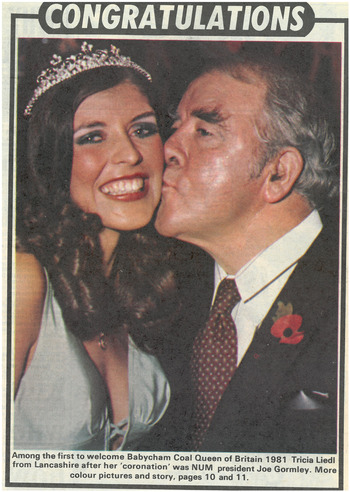
The second strand of the hegemonic structure revolved around the notion of miners as affluent workers. It can be illustrated with the help of another image, which was published in the Coal Board's paper, Coal News, in November 1981. The press photograph shows NUM president Joe Gormley kissing Tricia Liedl, the Coal Queen of Britain for 1981 (Figure 2). It celebrates male status – notice Gormley's immaculate suit and tie – and female beauty alike as symbols of the quality of life in Britain's coalfields, a message powerfully celebrated at the annual Mining Weekend held at the British seaside resort of Blackpool.
The annual Coal Queen of Britain beauty pageants received extensive coverage in the coal industry's journal Coal News throughout the 1970s and early 1980s. Reproduced with kind permission of the Department for Business, Energy and Industrial Strategy.

Indeed, the beauty pageants, first held at local colliery level in the aftermath of World War II, but elevated to an industry-wide event in 1969, were designed to emphasize the modernity of life in the coalfields. They underlined the extent to which the dark past of the inter-war years, with its drudgery, misery, unemployment and despair, had been left behind.Footnote 42 Although likely to offend early twenty-first-century sensibilities on account of the blatant objectification of women, contemporary news reporting emphasized the self-confidence, (financial) independence and agency of the female contestants. The world that they inhabited and the lives that they led had nothing in common with the ‘slum girl’ so powerfully evoked by George Orwell in his travelogue, The Road to Wigan Pier, in 1937. In the book, Orwell recorded his impressions of a young woman whom he observed through the window of his carriage as he departed from the first leg of his journey as follows:
At the back of one of the houses a young woman was kneeling on the stones, poking a stick up the leaden waste-pipe which ran from the sink inside and which I suppose was blocked. I had time to see everything about her – her sacking apron, her clumsy clogs, her arms reddened by the cold. She looked up as the train passed, and I was almost near enough to catch her eye. She had a round pale face, the usual exhausted face of the slum girl who is twenty-five and looks forty, thanks to miscarriages and drudgery; and it wore, for the second in which I saw it, the most desolate, hopeless expression I have ever seen … For what I saw in her face was not the ignorant suffering of an animal. She knew well enough what was happening to her – understood as well as I did how dreadful a destiny it was to be kneeling there in the bitter cold, on the slimy stones of a slum backyard, poking a stick up a foul drain pipe.Footnote 43
Orwell's observation may have been dramatized for effect, and it was, in any case, based on the author's reading of someone else's life of which he knew very little. But vignettes such as this had come to shape the cultural memory of a time that was separated from the present of the late 1960s by no more than one generation, but which seemed to hail from a different epoch altogether. Of the 14 contestants that were presented in Coal News for the 1972 pageant, for example, only two gave ‘housewife’ as their occupation. One was described as a ‘mining mum’. One woman still went to school, another attended university as a drama student. The other contestants gave occupations as diverse as typist, civil servant, wages clerk, drama student, bank clerk, NCB film unit interviewer, hairdresser and ‘bunny girl’.Footnote 44 All contestants were linked to the coalfields by virtue of kinship ties, but they were depicted and, as far as can be judged from the surviving evidence, saw themselves as thoroughly modern women, fully availing themselves of the opportunities that the contest offered.Footnote 45
Looking back on the contests of the 1970s and early 1980s as part of an exhibition held at the National Coal Mining Museum for England in 2010, positive memories predominated. The former ‘Coal Queens’ spoke of how important and proud they felt, and how thrilled they were at winning cash prizes, visiting London, travelling abroad and representing the coal industry and coal communities – ‘like a fairy tale’, as Elizabeth Thornton, the Nottinghamshire Area Queen of 1975, put it.Footnote 46 By staging the Coal Queen of Britain contest at the Derbyshire Miners’ Holiday Centre in Skegness between 1969 and 1976, and making them the central event of the annual Mining Weekend at Blackpool between 1977 and 1983, the coalfields celebrated themselves as both ‘special’ and as fully partaking in the comforts and delights of industrial modernity. Not only were the Beauty Contests and Mining Weekends designed to show off the modernity of life in the coalfields and the relevance of the industry for contemporary Britain. They also served as an example of the success of corporatism between the NCB and the NUM. The events were co-organized by Coal News, the Coal Industry Social Welfare Organization (CISWO) and the NUM.Footnote 47
Cosmopolitan underminers
As part of their endeavour to displace the dominant structure of feeling inside the industry, the militants adopted an anti-urban and especially anti-metropolitan rhetoric. During his election campaign for national president of the NUM in 1981, Arthur Scargill presented himself as a man who under no circumstances would ever ‘prostitute’ his principles – unlike the leaders who had come before him, the unspoken assumption went.Footnote 48 While the militants sought to reassert a strict ‘them’ and ‘us’ dichotomy between management and miners,Footnote 49 they despised the union's National Executive Committee (NEC) even more than the NCB for what they saw as the moderates’ eagerness to strike dirty deals in the corridors of power in Whitehall and Hobart House, the seat of the NCB. The militants considered the NUM president, Joe Gormley, as one of the driving forces behind the introduction of area incentive schemes to the industry in 1978, which the NEC had condoned despite an annual conference decision and a subsequent pithead ballot to the contrary.Footnote 50 The incentive scheme was bitterly opposed by the Left because it was seen, in Scargill's words, as ‘setting area against area, pit against pit, man against man’ and thus as undermining the cross-coalfield unity that had underpinned the successful strike actions of 1972 and 1974.Footnote 51
The antagonism reached its climax in the transition period between Arthur Scargill's election as the new union president in the autumn of 1981 and the retirement of Joe Gormley in the summer of the following year. When the outgoing president intervened in a pithead ballot on industrial action by publishing an opinion piece in the Daily Express in which he urged fellow mineworkers to go against the NEC's recommendation and accept the Coal Board's offer, the Left accused him of treasonous collusion with the employer.Footnote 52 In its February 1982 edition, the Yorkshire Miner reported Gormley's intervention under the headline of ‘Joe's Rich Seam – Thousands for Gormley as miners accept peanuts’.Footnote 53 In a commentary headlined with ‘Time is on our side’, Arthur Scargill reassured fellow radicals that ‘next year things will be very different … most important of all, we shall no longer be burdened with a Judas at the head of our union’. In a separate comment, the paper's editor wrote:
A man's retirement is something special in life. No matter what differences there were in the past, all unpleasant feelings are temporarily suspended as the new pensioner is wished well in his later years. However, we should be wise to forget all such courtesies when it comes to the retirement of Joseph Gormley as President of the NUM … We cannot wish him a happy retirement. All we can say is bloody good riddance.Footnote 54
To the militants, there was an important spatial dimension to the union's malaise. One of the reasons the leadership of the past had so frequently fallen short of what the ‘rank and file’ expected of them was the location of the NUM headquarters in the centre of London, on 222 Euston Road. The leaders were simply too close to the centres of power and too far removed from the coalfields, they reasoned. Lest power corrupt and the perks of office continue to drive a wedge between the leaders and the ‘rank and file’, militant coalfield areas campaigned for a removal of the head offices from their present premises in the centre of London back to the coalfields. To that end, the Kent area submitted a resolution to the 1982 NUM National Conference which demanded that ‘the Headquarters … shall in future be situated at a suitable venue within the coalfield areas’.Footnote 55
To be sure, there was a consensus that the present offices on Euston Street, into which the National NUM had moved in 1960, were no longer fit for purpose. There was also an economic argument to be made for selling the property in London and using the proceeds to build a spacious and modern headquarters that would provide for research facilities and a library in addition to staff and executive offices, boardrooms and meeting rooms.Footnote 56 Even more important than the financial benefits, however, were the anticipated political gains. ‘For a long time there has been a feeling among the membership that the Headquarters has been too remote and divorced from the pits and the miners it serves’, as the mover of the resolution, Kent miner J. Moyle, put it.Footnote 57
This point was underlined and fleshed out by the seconder of the resolution, G. Crawford, who spoke on behalf of the Scottish Area. He argued that the matter was of ‘great importance to the rank and file miners’ as one of ‘the great fears of ordinary miners is that our National Officials get out of touch, out of sympathy and out of control, that they will be subdued, seduced by the life in London’. It was above all the leaders’ proximity to the centres of privilege and political power that made them vulnerable, Crawford claimed. To him, ‘London’ was a symbol of all the corrosive pressures to which miners’ leaders had repeatedly fallen victim in the past. ‘London is a prostituting place. It is not in a coalfield … It is full of undermining influences from the media, the hostile politicians and the N.C.B. The only safeguard or safe way we have of protecting our Officials from its influence is by moving them into a coalfield.’ Although Crawford did not expect the new president to be susceptible to the lure of the metropolis, he invoked past experience to back up his claim. In his opinion, ‘only [General Secretaries] Horner and Paynter [had] been immune to the effects of London life, so let us lift them out of London and plant them where the miners work and live’.Footnote 58
In the debate following the moving of the resolution, concerns were raised about the treatment of the London office staff and the ‘double standards’ of the NUM: ‘Remember we have rank-and-file members employed at Euston Road’, as delegate I. Morgan, representing the Cokemen Area, expressed it: ‘They are our employees and we should treat them with the respect we demand from the National Coal Board.’Footnote 59 More broadly, J. Varley, representing the white-collar section of the NUM, argued that the ‘efficiency’ and reputation of the union rested precisely upon the ability of the leadership to leave behind the coalfields both physically but also, to some extent, intellectually and emotionally.
Let me remind delegates here, that the National Union of Mineworkers has made its reputation, served its members and has been led by a string of National Officials who were household names, who left the coalfields and went to London to do their jobs … Where, I ask you, is the logic of moving away our office away from the places where our National Official need to do their business?Footnote 60
Rather than return union leaders to their roots, Varley argued, it would cut them off from the corridors of power. Referring to an earlier delegate's polemical demand that the prime minister come up to the coalfields if she wanted to talk to the miners’ leaders, Varley pointed out sarcastically, ‘You might talk about Maggie getting in her helicopter to come and see Arthur. There is no way she will come down to see him. We will become isolationists.’ Arthur Scargill intervened personally in the debate from the presidential chair in order to, as he put it, ‘dispel some of the assertions’ that had been made in opposition to the resolution and to express the support of the NEC.Footnote 61 The motion to move the NUM headquarters was carried ‘overwhelmingly’ as the minutes recorded.Footnote 62
As we have seen, to the militants, Joe Gormley, the recently retired president, was the most notorious example of a miners’ leader who had turned his back on the ‘real’ interests of the miners. But the most painful case from the point of view of the Left was the development of Lawrence Daly, the hugely talented Scottish miners’ leader who had become the torchbearer of a ‘new Left’ radicalism in the coalfields in the late 1960s.Footnote 63 Within months of being elected to the post of general secretary as the candidate of the Left in December 1968 and of taking up his post in London, he seemed to have moderated his views, notoriously failing to come out in support of the unofficial strike action over surface hours that spread across the coalfields in the autumn of 1969. In the judgment of Vic Allen, professor of sociology at the University of Leeds and himself an active agent in the radicalization of the coalfields, ‘Daly's reputation amongst his friends suffered and was never fully restored … So although Lawrence Daly was actively associated with the left-wing until after the 1974 miners’ strike and played a prominent leadership part in the 1972 miners’ strike, the stain caused by his 1969 intervention was indelible.’Footnote 64
To be sure, not everybody's verdict was as uncompromising as Allen's ex post judgment from 1981. In 1972, at the height of the first official national miners’ strike since 1926, E.P. Thompson compared Daly's intellectual stature in the trade union movement to that of Raymond Williams among intellectuals: ‘In his stamina, in his search for the uniting affirmatives, in his sense of solidarity against the real enemy, Daly performs among the trade unionists of the left something of the same role as Raymond Williams performs among intellectuals.’Footnote 65 But soon after the triumph of 1972, Daly would embark on his long descent into alcoholism, forcing him into early retirement in 1984. Friends had voiced concern over his drinking habits since 1969.Footnote 66 In an autobiographical sketch penned in rehabilitation in the mid-1970s, Daly himself expressed the view that the frequent commuting between London and the coalfields had worsened his ‘drinking problem’. The root cause, however, he located elsewhere altogether, in the traumatic after effects of two visits to the Nazi Death Camp at Auschwitz in 1965 and North Vietnam in 1968.Footnote 67
Echoing the sentiments expressed at the 1982 National Conference, Scargill would later declare in an interview that at last the NUM had returned to where it belonged, in the heart of the coalfields; and of how glad he was to be away from ‘that rather sinful city of London’ where all ‘the underminers’ were engaged in their schemes of betrayal and collusion. While Scargill here drew on the well-established trope of the metropolis as a hotbed of corruption, in the NUM's wider campaign against pit closures of the early 1980s another set of images was mobilized: the spectre of the ‘ghost town’, the colonization of the coalfields, so to speak, by the blight of the inner cities. As Raphael Samuel has observed, ‘A spectre which Arthur Scargill conjured up … was that of the urban disaster, the “helplessness” and the “hopelessness” of youth in the big city … in which the reality of life becomes something to escape from on the end of a hypodermic syringe.’Footnote 68
Whatever the prospects of pit villages turning into inner-city zones of devastation as a result of colliery closures,Footnote 69 there can be little doubt that the adoption by the NUM of a traditionalist stance at the expense of a ‘modernizing’ vision made the miners vulnerable to the claim that, in the last analysis, they were engaged in nothing more than a Luddite attempt to stop the tide of change itself. In one of her rare public interventions into the miners’ strike, Prime Minister Margaret Thatcher declared that Britain must not turn into a ‘museum society’. As the prime minister put it to an Independent Television News interviewer on a visit to York on 26 September 1984, ‘Just think, if the argument had been used – old uneconomic factories, uneconomic farms, uneconomic machinery – “Old? Uneconomic? It must never close!” We should be a museum society, and you wouldn't have a fraction of the standard of living you've got now.’Footnote 70 Her advisor Alfred Sherman, another ex-Marxist who had turned neo-liberal, put the case more aggressively in an article that was published in The Times in August 1984: ‘I argue advisedly that social as well as economic change is resisted by the NUM. [The effect of the NUM's reactionary policy] is to keep [the miner] in the equivalent of what Marx called “rural idiocy”, in an isolated quasi-tribal one-class society.’Footnote 71
While opponents of the NUM seized upon the image of the ruralized miner in order to portray the 1984/85 strike as a backward-looking Last Stand against the tide of History itself, it was from inside Britain's big cities, and the capital in particular, that striking miners received the most sustained support.Footnote 72 According to a survey undertaken by the Labour Research Department in 1985, the network of support groups comprised at least 300 organizations.Footnote 73 Support for the miners in 1984/85 most typically took the form of donations in cash or kind rather than secondary strike action. To Raphael Samuel, outside support for the miners was based on a sense of difference rather than of shared interests: ‘it owed more to Christian notions of charity … or “good works” than to class-consciousness as classically conceived’, as he wrote shortly after the end of the strike in 1986.Footnote 74 This emphasis on the miners’ ‘otherness’ formed a central strand in Samuel's ruralization of the miners as ‘village radicals’. Samuel's interpretation has recently been contested by social geographer Diarmaid Kelliher, who emphasizes a more egalitarian, and mutually transformative, relationship between mining communities and support groups in 1984/85, the beginnings of which he traces back to the late 1960s.Footnote 75
Conclusion
Following the 1982 Annual Conference decision, the NEC accepted an offer by Sheffield City Council of a freehold site in a prime location adjacent to City Hall in the centre of town. In a circular letter inviting local architects to submit designs for the new headquarters, the NUM stipulated a useable floor space of approximately 50,000 square feet, incorporating office accommodation for 50 to 60 staff, executive offices, board and committee rooms, but also space for a library of working-class history, an exhibition centre with research facilities, lecture rooms and other educational facilities.Footnote 76 Clearly, the new headquarters were designed to showcase the self-confidence of the miners and to underline their special role in British society not just in the present and the past, but for generations to come.
The NUM vacated their London premises soon after the conference decision and moved into temporary accommodation in St James’ House on Vicar Lane in Sheffield in April 1983.Footnote 77 By the time the new headquarters was completed five years later in December 1988, the status of the miners had changed dramatically.Footnote 78 Operating in the aftermath of the defeat in the strike and within a fast contracting industry, the NUM was rapidly becoming a shadow of its former self, isolated within the Labour movement, ignored by the NCB and increasingly occupied within acrimonious infighting. Even to their erstwhile enemies (although not to Margaret Thatcher herself), the miners were starting to look pitiful rather than dangerous. Under the pressure of financial constraints, the NUM vacated their National Offices in July 1994 and relocated to the Yorkshire Area Headquarters on Huddersfield Road in Barnsley where they still reside at the time of writing.Footnote 79 It was in the wake of defeat in the 1984/85 strike that the notion of the ‘ruralized miner’ finally became hegemonic,Footnote 80 crowding out alternative structures of feeling which had offered a contrasting vision and sought to locate the miner at the very heart of urban modernity.