INTRODUCTION
Earth has experienced episodes of abrupt climate change in the recent geologic past that are similar in direction and scale to those predicted for the future (IPCC, 2014). To better anticipate future climate variability and prepare for the potential impacts on society, the development of paleoclimatic proxies is needed to quantify the magnitude, spatial variability, and timing of past climatic fluctuations. A number of well-calibrated and robust geochemical proxies exist for marine settings (e.g., oxygen isotopes of foraminifera, Mg/Ca ratios of calcitic organisms, and organic biomarkers such as alkenones and glycerol dialkyl glycerol tetraether [GDGT] lipids), which have been key for reconstructing past changes in the oceans. Many of these proxies also have been applied to lacustrine systems in continental settings, but few quantitative proxies for past climate change are available for use in arid environments where perennial lakes are typically absent.
Over the past several decades, oxygen isotope (δ18O) records from speleothems have become an important terrestrial paleoclimatic proxy because of their ability to document climatic changes at exceptionally high temporal resolutions (Wang et al., Reference Wang, Cheng, Edwards, An, Wu, Shen and Dorale2001; Dykoski et al., Reference Dykoski, Edwards, Cheng, Yuan, Cai, Zhang, Lin, Qing, An and Revenaugh2005; Fleitmann et al., Reference Fleitmann, Burns, Mangini, Mudelsee, Kramers, Villa and Neff2007). Speleothems have proven especially useful in arid environments, including those in the southwestern U.S., where they have been used to reconstruct the δ18O of paleo-precipitation (Polyak et al., Reference Polyak, Rasmussen and Asmerom2004, Reference Polyak, Asmerom, Burns and Lachniet2012; Asmerom et al., Reference Asmerom, Polyak, Burns and Rassmussen2007, Reference Asmerom, Polyak and Burns2010, Reference Asmerom, Polyak and Lachniet2017; Wagner et al., Reference Wagner, Cole, Beck, Patchett, Henderson and Barnett2010; Lachniet et al., Reference Lachniet, Denniston, Asmerom and Polyak2014). Further, speleothem records have demonstrated that brief periods of aridity in the southwestern U.S. during the last glacial period coincided temporally with warm conditions in the North Atlantic, highlighting their role in understanding how abrupt changes in climate are propagated globally through atmospheric teleconnection processes (e.g., Wagner et al., Reference Wagner, Cole, Beck, Patchett, Henderson and Barnett2010).
Despite their utility, speleothems are limited in spatial extent because only ~15% of the Earth's ice-free continental surface is characterized by carbonate rocks, and many of these cannot produce caves (Goldscheider et al., Reference Goldscheider, Chen, Auler, Bakalowicz, Broda, Drew and Hartmann2020). Moreover, most cave systems do not meet the requirements for oxygen isotopic equilibrium necessary to produce robust records of past climate (Quade, Reference Quade, Gillespie, Porter and Atwater2003). When the requirements are met, speleothems generally record the δ18O of local paleo-precipitation, and are typically used to reconstruct past climates for the surrounding region, often without a quantitative understanding of how far the data can or should be extrapolated.
A potential source of paleoclimatic data that is complementary to speleothems is the δ18O values of fossil terrestrial gastropod shells (Yapp, Reference Yapp1979; Lecolle, Reference Lecolle1985; Goodfriend and Ellis, Reference Goodfriend and Ellis2002; Balakrishnan and Yapp, Reference Balakrishnan and Yapp2004; Balakrishnan et al., Reference Balakrishnan, Yapp, Meltzer and Theler2005a, Reference Balakrishnan, Yapp, Theler, Carter and Wyckoffb; Yanes et al., Reference Yanes, Romanek, Delgado, Brant, Noakes, Alonso and Ibáñez2009, Reference Yanes, Yapp, Ibáñez, Alonso, De la Nuez, Quesada, Castillo and Delgado2011, Reference Yanes, Riquelme and Camara2013; Paul and Mauldin, Reference Paul and Mauldin2013). Gastropods are one of the most abundant fossil groups in the terrestrial geologic record and their shells are preserved in a wide variety of depositional settings, including loess, eolian sand, alluvial and fluvial sequences, and geologic deposits associated with desert wetland ecosystems. Their abundance, preservation, and broad spatial and temporal coverage make fossil gastropod shells a potentially important archive of past environmental and climatic conditions in the terrestrial realm, provided the isotopic system is well constrained (Goodfriend and Ellis, Reference Goodfriend and Ellis2002; Yanes et al., Reference Yanes, Romanek, Delgado, Brant, Noakes, Alonso and Ibáñez2009; Nash et al., Reference Nash, Conroy, Grimley, Guenthner and Curry2018; Grimley et al., Reference Grimley, Counts, Conroy, Wang, Dendy and Nield2020).
Terrestrial gastropod shells are composed primarily of aragonite (CaCO3), and their δ18O values depend on local climatic and environmental parameters at the time of shell formation (Balakrishnan and Yapp, Reference Balakrishnan and Yapp2004). Shell δ18O values can be affected by several atmospheric variables that vary between ecological habitats and even microhabitats, including δ18O of precipitation, temperature, δ18O of water vapor, and relative humidity. These values also are affected by the proportion of water derived from different hydrologic pathways (e.g., direct precipitation, dew, surface water, groundwater discharge) that are utilized by gastropods. Despite these potential complexities, a recent study of modern small (<10 mm) terrestrial gastropods in North America has shown that the δ18O value of local precipitation is the dominant driver of shell δ18O values (Yanes et al., Reference Yanes, Al-Qattan, Rech, Pigati, Dodd and Nekola2019). Therefore, much like speleothems, fossil gastropod shells have the potential to track changes in the δ18O of paleo-precipitation through time, but over much broader spatial scales.
In this study, we measured the δ18O values of 456 fossil gastropod shells collected from late Pleistocene and early Holocene paleowetland deposits in southeastern Arizona. These data were analyzed and compared with independent δ18O records derived from speleothems in the American Southwest to determine if gastropod shell δ18O values track the same environmental trends over geologic timescales. If so, this would allow researchers to obtain paleoclimate information that is complementary to speleothems, thereby improving our understanding of past climate conditions in arid environments.
STUDY AREA
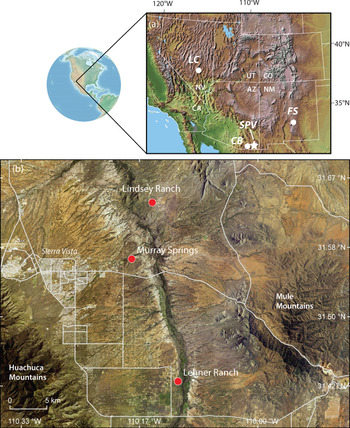
The San Pedro Valley of southeastern Arizona is located in the southernmost portion of the Basin and Range Province, at the border between the Sonoran and Chihuahuan deserts (Fig. 1a). Late Pleistocene and early Holocene paleowetland deposits are exposed discontinuously over ~150 km of the roughly north-south valley and represent periods of high water table conditions resulting from increased effective precipitation and groundwater recharge (Pigati et al., Reference Pigati, Quade, Shanahan and Haynes2004, Reference Pigati, Bright, Shanahan and Mahan2009). The deposits are especially prevalent in the southwest part of the valley, where groundwater is fed by precipitation falling in the Huachuca Mountains to the west, which include peaks of Paleozoic sedimentary rocks that exceed 3000 m in elevation (Reynolds, Reference Reynolds1988).
(a) Location of the San Pedro Valley (SPV; denoted by white star) and key speleothems in the region (white circles); LC = Leviathan Cave, NV (Lachniet et al., Reference Lachniet, Denniston, Asmerom and Polyak2014); CB = Cave of the Bells, AZ (Wagner et al., Reference Wagner, Cole, Beck, Patchett, Henderson and Barnett2010); FS = Fort Stanton Cave, NM (Asmerom et al., Reference Asmerom, Polyak and Burns2010). Western states shown include California (CA), Nevada (NV), Arizona (AZ), New Mexico (NM), Colorado (CO), and Utah (UT). (b) Landsat image from 2017 of the southern part of the valley showing the locations of sampling sites (red circles). Landsat image is courtesy of the U.S. Geological Survey's Earth Resources Observation and Science Center. (For interpretation of the references to color in this figure legend, the reader is referred to the web version of this article.)

In the late 1800s, rapid erosion and valley head cutting caused a precipitous drop in water table levels in the San Pedro Valley and surrounding areas (Cooke and Reeves, Reference Cooke and Reeves1976; Waters and Haynes, Reference Waters and Haynes2001). At this time, arroyos formed as streams incised into alluvial fan sediments along the eastern flanks of the Huachuca Mountains. This exposed an unusually complete sequence of late Quaternary paleowetland deposits at a number of sites on the west side of the valley (Haynes, Reference Haynes and Titley1968, Reference Haynes1987, Reference Haynes, Haynes and Huckell2007). The sediments include marls and organic-rich silts informally referred to as “black mats,” which represent spring ecosystems (e.g., marshes and wet meadows) that prevailed in the valley during wetter times (Pigati et al., Reference Pigati, Quade, Shanahan and Haynes2004, Reference Pigati, Bright, Shanahan and Mahan2009). Fossil gastropods are most abundant in the carbonate-rich marls of these depositional sequences, which represent periods of greatest groundwater discharge. Gastropod shells are less commonly preserved in black mats, which is likely the result of acidic conditions in these organic-rich deposits rather than lack of original prevalence.
METHODS
Collection and cleaning of fossil shells
Fossil gastropod shells analyzed in this study were collected from marls at three sites within the San Pedro Valley, including Murray Springs, Lehner Ranch, and Lindsey Ranch, and from a black mat at Lindsey Ranch (Fig. 1b). At Murray Springs and Lehner Ranch, bulk samples of marl containing fossil gastropod shells were collected in 10-cm intervals at the same locations where Succineidae shells were collected previously for dating. Samples also were collected in 10-cm intervals from a previously undated marl and black mat at Lindsey Ranch. In all cases, shells were extracted from the host sediment by placing the samples in a plastic bin with water and putting them through a series of 5–10 freeze-thaw cycles on a daily basis. Once the marl was disaggregated and softened, the samples were wet-sieved through a 600 μm mesh screen, which allowed us to pick the shells and sort them taxonomically based on morphological features. The shells were then identified to the most precise taxonomic level possible, to species in most cases, with the exception of shells attributed to the Succineidae family. Succineidae shells exhibit few diagnostic characteristics and taxonomic identification is based on soft-body reproductive organ morphology, which is not preserved in the fossil record. Identification of these shells was therefore limited to the family level.
Methods for additional cleaning were determined based on the thickness and durability of the shell material. Succineidae shells were the largest and most robust, so were cleaned using an ultrasonic bath for 10–20 seconds, followed by multiple rinses with deionized water until the shells were free of detrital material. Shells of the other taxa were smaller and more fragile, so the ultrasonic bath was not used to avoid damaging them. This was a key concern because these other taxa were also limited in abundance. The smaller shells were soaked in a 1% Alconox solution for 30 minutes to remove sediment adhering to shells, and then rinsed with deionized water. All shells were dried at room temperature for at least 24 hours and then examined with a microscope for cleanliness. This process was repeated until the shells were visually free of detritus.
Radiocarbon dating
Age control for the marls at Murray Springs and Lehner Ranch was determined previously using accelerator mass spectrometry (AMS) 14C dating of Succineidae shells (Pigati et al., Reference Pigati, Quade, Shanahan and Haynes2004, Reference Pigati, Bright, Shanahan and Mahan2009). Radiocarbon dating of Succineidae shells and organic matter was also used to determine the ages of the marl and black mat at Lindsey Ranch using the following procedures. Clean shell carbonate was partially leached with HCl to remove any secondary carbonate and then converted to CO2 using American Chemical Society (ACS) reagent grade 85% H3PO4 under vacuum at 50°C until the reaction was visibly complete (ca. 1 hour). Organic matter was treated using the standard acid-base-acid (ABA) procedure before being washed with ASTM Type 1, 18.2 MΩ water, dried, and combusted online at 625°C in the presence of excess high-purity oxygen. For all samples, water and other contaminant gases were removed by cryogenic separation, and the resulting purified CO2 gas was measured manometrically and converted to graphite via hydrogen reduction using an iron catalyst (Vogel et al., Reference Vogel, Southon, Nelson and Brown1984). Carbon isotope ratios of the graphite targets were measured by AMS, and the resulting 14C ages, as well as those reported by Pigati et al. (Reference Pigati, Quade, Shanahan and Haynes2004, Reference Pigati, Bright, Shanahan and Mahan2009), were calibrated using the IntCal20 dataset and CALIB 8.2 (Reimer et al., Reference Reimer, Austin, Bard, Bayliss, Blackwell, BronkRamsey and Butzin2020; Stuiver et al., Reference Stuiver, Reimer and Reimer2020). Ages are presented in thousands of calibrated years (ka) before present (BP; 0 yr BP = 1950 AD), and uncertainties are given at the 95% (2σ) confidence level.
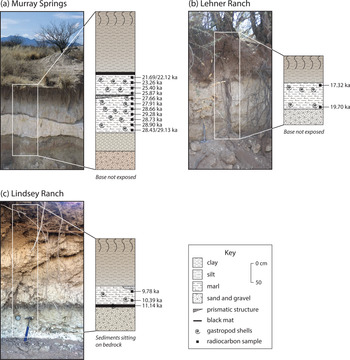
For the Murray Springs chronology, a few of the ages at depths between 40 and 110 cm were either statistically indistinguishable from those above or below or did not maintain stratigraphic order (Table 1; Fig. 2a). Therefore, we used Bacon v. 2.2 modeling software (Blaauw and Christen, Reference Blaauw and Christen2011) to construct an age-depth model for this interval (Supplementary Figure 1).
(color online) Stratigraphy, calibrated ages (in ka), and photographs of sediments at (a) Murray Springs, (b) Lehner Ranch, and (c) Lindsey Ranch. Photographs courtesy of Jeff Pigati.

Summary of AMS sample information, 14C ages, and calibrated ages. Uncertainties for the calibrated ages are given at the 2σ (95%) confidence level. All other uncertainties are given at 1σ (68%).

1 ABA = acid-base-acid; HCl = acid leach.
2 Calibrated ages were calculated using CALIB v.8.2html, IntCal20.14C dataset; limit 55.0 calendar ka B.P. Calibrated ages are reported as the midpoint of the calibrated range. Uncertainties are reported as the difference between the midpoint and either the upper or lower limit of the calibrated age range, whichever is greater. Ages are reported when the probability of a calibrated age range exceeds 0.05.
3 P = probability of the calibrated age falling within the reported range as calculated by CALIB.
4 1 = this study; 2 = Pigati et al., Reference Pigati, Bright, Shanahan and Mahan2009; 3 = Pigati et al., Reference Pigati, Quade, Shanahan and Haynes2004.
Oxygen isotope geochemistry
Oxygen isotopes of the fossil gastropod shells were measured at the Department of Earth and Planetary Sciences Stable Isotope Laboratory at the University of New Mexico using the method described by Spotl and Vennemann (Reference Spotl and Vennemann2003). Briefly, each shell was powdered to homogenize the sample and ~200 μg of shell aragonite was loaded into 12-ml borosilicate Exetainer® vials. The vials were flushed with helium and then allowed to react for 24 hours with phosphoric acid (H3PO4) at 50°C. The evolved CO2 was measured by continuous flow isotope ratio mass spectrometry using a Thermo Scientific™ GasBench device coupled to a Finnigan Mat Delta V isotope ratio mass spectrometer. The results are reported using the standard delta notation against the VPDB standard (Coplen et al., Reference Coplen, Brand, Gehre, Groning, Meijer, Toman and Verkouteren2006). Reproducibility was better than 0.15‰ for both δ13C and δ18O based on repeated measurements of the Carrara Marble standard (IAEA-CO-1).
RESULTS
Stratigraphy and chronology
At Murray Springs, the Coro Marl member of the Murray Springs formation of Haynes (Reference Haynes and Titley1968, Reference Haynes, Haynes and Huckell2007), which has been alternately referred to as Unit E and the upper member of the Boquillas formation by Haynes (Reference Haynes and Titley1968), is ~110 cm thick and consists of massive, hard, white to light-gray, calcareous silty clay (marl) that contains abundant fossil shells of terrestrial and aquatic gastropods (Fig. 2a). This unit dates to ca. 29.1–21.7 ka based on 14C ages of Succineidae shells originally reported by Pigati et al. (Reference Pigati, Quade, Shanahan and Haynes2004) and recalibrated here using the IntCal20 calibration curve (Reimer et al., Reference Reimer, Austin, Bard, Bayliss, Blackwell, BronkRamsey and Butzin2020; Stuiver et al., Reference Stuiver, Reimer and Reimer2020) (Table 1). Our new examination of the sequence at Murray Springs identified that the Coro marl does not represent a continuous depositional sequence as previously reported, but rather contains a stratigraphic break in the marl marked by a contact with a light-green silty clay with prismatic structure at a depth of ~40 cm below the top of the unit. This break is bounded by calibrated 14C ages of 27.66 ± 0.24 ka and 25.87 ± 0.19 ka (Fig. 2a; Table 1).
At Lehner Ranch, fossil shells were collected from a hard, light-gray marl that is ~50 cm thick (Fig. 2b). This unit was also called Unit E by Haynes (Reference Haynes and Titley1968) and was incorrectly attributed to the Coro marl by Pigati et al. (Reference Pigati, Bright, Shanahan and Mahan2009), as it dates to between ca. 19.7 and 17.3 ka based on 14C ages of Succineidae shells originally reported in Pigati et al. (Reference Pigati, Bright, Shanahan and Mahan2009) and recalibrated here (Table 1). Although the marl at Lehner Ranch was deposited in a similar environment (marshes and wet meadows) as the Coro marl at Murray Springs, it is significantly younger and therefore is not an equivalent unit.
Fossil gastropod shells were collected at Lindsey Ranch from a thin black mat and an overlying massive, light-gray marl that is ~50 cm thick (Fig. 2c), both of which are indicative of a marsh or wet meadow setting. Calibrated 14C ages from organic matter within the black mat at Lindsey Ranch yielded multiple calibrated age ranges, with 11.14 ± 0.07 ka having the highest probability, and Succineidae shells from the overlying marl produced calibrated ages of 10.39 ± 0.12 ka at the bottom and 9.78 ± 0.13 ka at the top (Fig. 2; Table 1). Although the marl at Lindsey Ranch was also called Unit E by Haynes (Reference Haynes and Titley1968), these new ages show that it is actually much younger than paleowetland deposits referred to as Unit E elsewhere in the San Pedro Valley, and is also younger than the marl at Lehner Ranch.
Finally, we note that the 10-cm sampling units utilized in this study represent various time intervals because the deposits at the three sites have different sedimentation rates. At Murray Springs, for example, 10 cm represents 600–1200 years (depending on the sample depth), whereas the same sampling interval represents ca. 200 and 400 years at Lehner Ranch and Lindsey Ranch, respectively.
Isotopic results
Terrestrial gastropod shells recovered from the full glacial deposits at Murray Springs and late glacial deposits at Lehner Ranch were consistent with assemblages documented by Mead (Reference Mead, Haynes and Huckell2007) and include Euconulus fulvus, Gastrocopta cristata, Gastrocopta tappaniana, Pupilla hebes, Pupilla sonorana, Pupoides hordaceus, Succineidae, Vallonia gracilicosta, and Vertigo berryi. Individual shells of the aquatic snails Fossaria sp. and Gyraulus sp. also were recovered, as was the aquatic bivalve Pisidium sp. At Lindsey Ranch, gastropod shells were more limited and included Succineidae and G. tappaniana, as well as a few Fossaria sp. and rare Pupilla sp.
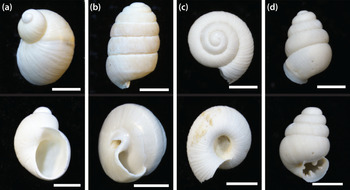
Shells of Succineidae (n = 156), P. hebes (n = 75), V. gracilicosta (n = 83), and G. tappaniana (n = 142) were chosen for isotopic analysis because they were the most abundant (Fig. 3) and have been validated as reliable paleoenvironmental proxies in North America (Yanes et al., Reference Yanes, Nekola, Rech and Pigati2017). All four taxa were analyzed from the marls at Murray Springs and Lehner Ranch, whereas only Succineidae and G. tappaniana were analyzed from Lindsey Ranch. For each sampling interval, we measured 10 individual shells of the same taxon, unless there were fewer than 10 shells, in which case we analyzed all available shells. In total, we measured 456 fossil shells from the three sites, including 359 shells from Murray Springs, 37 shells from Lehner Ranch, and 60 shells from Lindsey Ranch (Supplementary Table 1).
(color online) Photographs of select fossil gastropod taxa collected from Murray Springs. Scale bars are all 1 mm in length. (a) Succineidae; (b) Pupilla hebes; (c) Vallonia gracilicosta; and (d) Gastrocopta tappaniana. Photographs courtesy of Stephanie Bosch.

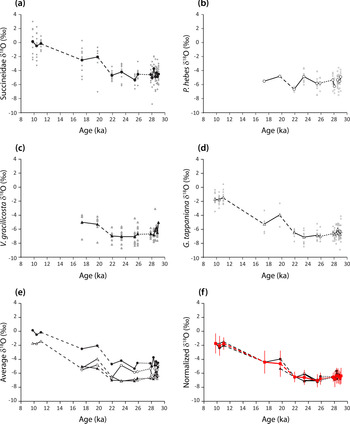
The δ18O values generally increase over time, as shells from the full glacial age Coro marl at Murray Springs yielded the lowest isotopic values, shells from the late glacial marl at Lehner Ranch yielded intermediate values, and shells from the early Holocene black mat and marl at Lindsey Ranch yielded the highest values (Table 2; Fig. 4a–d). We also observed a range of ~2.5–4.0‰ in the δ18O values of fossil shells between individual taxa within each sampling interval (Supplementary Table 1). However, δ18O values for shells of the same taxa within a given interval were relatively consistent; standard deviations of data with n > 5 averaged ~1‰ and were similar between taxa: 1.26‰ for Succineidae (n = 16), 0.87‰ for P. hebes (n = 6), 0.98‰ for V. gracilicosta (n = 8), and 0.79‰ for G. tappaniana (n = 14).
δ18O values of fossil gastropod shells. Individual data points are shown in light gray; average values at each sampling interval are shown in black. Solid lines connect isotopic values from the same site; dashed lines connect data from different sites; dotted lines connect values across the depositional hiatus at Murray Springs. (a) Succineidae; (b) Pupilla hebes; (c) Vallonia gracilicosta; (d) Gastrocopta tappaniana; (e) average values for each taxon plotted together; (f) average δ18O values normalized against G. tappaniana values for each taxon (shown in black) and average normalized δ18O values for all taxa (shown in red). Uncertainties in the normalized δ18O values are given at the 68% (1σ) confidence level. All plotted ages are given as calibrated ages (in ka). (For interpretation of the references to color in this figure legend, the reader is referred to the web version of this article.)

Summary of measured and normalized δ18O values1.

1 All δ18O values are reported relative to the VPDB standard; uncertainties are reported as the standard deviation from the mean.
2 Individual normalized values were calculated using the following offsets relative to G. tappaniana : Succineidae, -1.92 ± 0.55‰; P. hebes, -1.21 ± 0.51‰; V. gracilicosta, +0.01 ± 0.22‰.
3 Ages in regular font are standard calibrated ages; those presented in italics are the product of Bacon age-depth modeling. See Supplementary Figure 1 for details.
4 Uncertainties include all internal and external sources of error. See Supplementary Tables 1 and 2 for details.
5 Average of two calibrated ages at this depth interval (see Table 1 for individual ages).
Much of the observed isotopic variability within a given sampling interval is the result of differences between the four taxa (Table 2; Fig. 4e). The specific cause(s) of this variability is unknown, but may reflect small differences in micro-habitats, snail ecology, and possibly vital effects. Regardless, the magnitude of these inter-taxa isotopic differences is similar to those documented by Yanes et al. (Reference Yanes, Nekola, Rech and Pigati2017) who found systematic offsets of 2–3‰ in δ18O values between modern Succineidae, V. gracilicosta, and G. tappaniana in Minnesota, USA. In our study, inter-taxa differences of the fossil shells are consistent across location and time, with Succineidae always yielding the highest δ18O values, P. hebes typically yielding the next highest values, and either G. tappaniana or V. gracilicosta yielding the lowest.
To quantify these differences, we determined isotopic offsets of Succineidae, P. hebes, and V. gracilicosta relative to G. tappaniana, which was the most common taxon identifiable to the species level. Offsets for the individual taxa were -1.92 ± 0.55‰ for Succineidae, -1.21 ± 0.51‰ for P. hebes, and +0.01 ± 0.22‰ for V. gracilicosta (Supplementary Table 2). We then calculated normalized δ18O values by subtracting the isotopic offsets for Succineidae, P. hebes, and V. gracilicosta, and determined the average δ18O value for all shells in a given 10-cm sampling interval (Supplementary Table 1; Table 2; Fig. 4f).
DISCUSSION
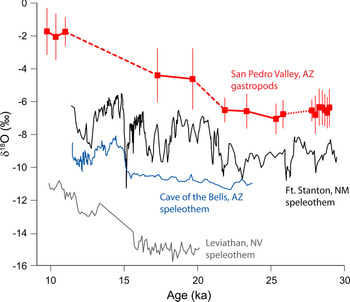
The composite isotopic record reveals that fossil gastropod δ18O values increased by ~2‰ between the last glacial maximum and the late glacial period, and another ~2‰ between the late glacial period and the early Holocene (Table 2; Fig. 4f). Previous studies have shown that shell δ18O values of the taxa analyzed here are determined largely by the δ18O of precipitation (Yanes et al., Reference Yanes, Al-Qattan, Rech, Pigati, Dodd and Nekola2019), but they could also be affected to a lesser degree by other atmospheric variables, including temperature, the δ18O of water vapor, and relative humidity (Balakrishnan and Yapp, Reference Balakrishnan and Yapp2004). Increases in temperature between the late Pleistocene and early Holocene would have reduced isotopic fractionation during shell formation and caused shell δ18O values to decrease over time, which is the opposite of what we observe in our record. Therefore, the influence of temperature on fractionation during shell formation is not a driving factor. Similarly, the δ18O of water vapor and relative humidity should be relatively constant in perennial wetland ecosystems because of the continuous availability of water, so it is unlikely that these parameters varied enough to significantly affect the isotopic composition of the gastropod shells. Consequently, we interpret the changes observed in the composite isotopic record to reflect changes primarily in the δ18O of precipitation.
The observed trends in the δ18O values of the fossil gastropod shells suggest they have utility as a paleoclimate proxy record by tracking changes in the oxygen isotopic composition of paleo-precipitation over time in this region. Today, the climate of the San Pedro Valley is semi-arid, with average monthly high temperatures that range from ~33°C in the summer months (JJA) to ~17°C in the winter (DJF), and mean annual precipitation of ~36 cm/yr (https://www.usclimatedata.com/climate/sierra-vista/arizona/united-states/usaz0214; accessed 9/6/20). The effect of the North American monsoon on the seasonal distribution of precipitation is clear—nearly 60% of the annual precipitation falls between July and September with the remainder falling mostly between December and February. During the late Pleistocene and early Holocene, however, the strength of the North American monsoon was likely much less than today (Metcalfe et al., Reference Metcalfe, Barron and Davies2015), so annual precipitation in the valley was probably dominated by winter precipitation, as it was throughout much of the southwestern U.S. at that time (Lora and Ibarra, Reference Lora and Ibarra2019).
The distribution of modern winter precipitation in the southwestern U.S. is characterized by a pronounced north-south dipole pattern in which conditions at latitudes north of ~40–42°N are generally wet whereas those to the south are relatively dry (Wise, Reference Wise2010). The position of this dipole boundary is controlled by the interaction of westerly storm tracks and the atmosphere over the Pacific and Atlantic oceans, and has been hypothesized to be a fairly stable feature of western U.S. climate during the Quaternary (Hudson et al., Reference Hudson, Hatchett, Quade, Boyle, Bassett, Ali and DelosSantos2019). This implies that during the late Pleistocene and early Holocene, paleoclimate proxies from sites located well south of ~40–42°N latitude should record similar paleoclimatic information, at least at broad temporal and spatial scales.
Three speleothem δ18O records from south of this boundary in the American Southwest were chosen for comparison with the San Pedro Valley gastropod δ18O data, including the nearby Cave of the Bells in southern Arizona (Wagner et al., Reference Wagner, Cole, Beck, Patchett, Henderson and Barnett2010), Fort Stanton Cave, New Mexico (Asmerom et al., Reference Asmerom, Polyak and Burns2010), and Leviathan Cave, Nevada (Lachniet et al., Reference Lachniet, Denniston, Asmerom and Polyak2014) (see Fig. 1a for locations). These well-dated records also have been interpreted as tracking the δ18O of paleo-precipitation. They exhibit a steady increase in δ18O values of ~2‰ between the last glacial maximum and the late glacial period, which is particularly prominent in the Fort Stanton speleothem, and a similar increase in δ18O values between the late glacial and early Holocene, which is captured in all three records. The long-term isotopic trends recorded by these speleothems are similar in temporal range, magnitude, direction, and rate of change to those observed in the San Pedro Valley gastropod δ18O data. Importantly, there is no discernable difference in the timing of the isotopic changes between the speleothem and gastropod shell records, which would be expected if there was a significant lag between precipitation in the recharge areas and either groundwater discharge in the San Pedro Valley or calcite precipitation at the three speleothem sites. Together, the data suggest that the oxygen isotopic composition of the gastropod shells and speleothems were driven by the same environmental parameters, primarily the δ18O of precipitation, over millennial timescales during the late Quaternary (Fig. 5).
Average normalized shell δ18O values for all gastropod taxa from the San Pedro Valley (red) compared to isotopic records of speleothems from Fort Stanton, NM (Asmerom et al., Reference Asmerom, Polyak and Burns2010), Cave of the Bells, AZ (Wagner et al., Reference Wagner, Cole, Beck, Patchett, Henderson and Barnett2010), and Leviathan Cave, NV (Lachniet et al., Reference Lachniet, Denniston, Asmerom and Polyak2014). As in Figure 4, solid lines connect gastropod shell δ18O values from same site; dashed lines connect data from different sites; dotted lines connect values across the depositional hiatus at Murray Springs. All plotted ages are given as calibrated ages (in ka). (For interpretation of the references to color in this figure legend, the reader is referred to the web version of this article.)

The results of our study support the use of gastropod shell δ18O as a paleoclimatic proxy, but with a clear understanding of its limitations and strengths, particularly with regard to the host sediments. The San Pedro Valley gastropod isotopic record exhibits temporal gaps that are consistent with the intermittent nature of groundwater-fed paleowetlands, resulting in chronologic resolution on the order of millennial to sub-millennial timescales. In contrast, the regional speleothem δ18O data are more continuous and the temporal resolution of all three compared records is extremely high, exhibiting isotopic variations at centennial and even sub-centennial timescales. Future work should focus on improving the temporal resolution of gastropod shell records by targeting known paleowetland sedimentary sequences that exhibit extremely high rates of sedimentation (e.g., Springer et al., Reference Springer, Manker and Pigati2015, Reference Springer, Pigati, Manker and Mahan2018; Pigati et al., Reference Pigati, Springer and Honke2019). An additional depositional setting suitable for gastropod shell δ18O investigations is the thick packages of terrestrial shell-rich glacial age loess, which occur in the midwestern and south-central U.S. (Pigati et al., Reference Pigati, McGeehin, Muhs and Bettis2013, Reference Pigati, McGeehin, Muhs, Grimley and Nekola2015; Nash et al., Reference Nash, Conroy, Grimley, Guenthner and Curry2018; Grimley et al., Reference Grimley, Counts, Conroy, Wang, Dendy and Nield2020). Together, these deposits could provide gastropod shell isotopic records that span large portions of North America.
The worldwide geographic distribution of terrestrial gastropods in the fossil record opens a new avenue of study in which the δ18O of gastropod shells could be used to examine spatial patterns in the δ18O of paleo-precipitation at specific snapshots in time over large areas. The data presented here show that isotopic values of gastropod shells in some settings track environmental changes in a manner that is similar to speleothems, but potentially with much greater spatial coverage, although additional studies are needed to realize their full potential as a paleoclimatic proxy.
CONCLUSIONS
Terrestrial gastropod shells are one of the most common fossils in the Quaternary geologic record and are preserved in a wide array of depositional settings. Previous studies of modern taxa have shown that the δ18O of gastropod shells is driven largely by the δ18O of precipitation, and therefore the δ18O of fossil shells could potentially be used to reconstruct the δ18O of paleo-precipitation, provided the isotopic system of the gastropods and potential hydrologic pathways are well understood. This would allow researchers to obtain paleoclimatic information that is complementary to other geologic proxy records, such as speleothems, and improve our understanding of past climates, particularly in arid environments where long-lived records are relatively rare.
The fossil gastropods studied here, which include Succineidae, Pupilla hebes, Gastrocopta tappaniana, and Vallonia gracilicosta, exhibit differences in δ18O values of up to ~2‰ between taxa for shells recovered within the same sampling interval, which is nearly identical to inter-taxa differences observed in modern gastropods. Normalized gastropod shell δ18O values increased by ~4‰ between the last glacial maximum and early Holocene, similar to the magnitude, direction, and rate of change recorded by speleothems in the region during the same period of time. This suggests that both systems are driven by the same environmental parameters, primarily the δ18O of paleo-precipitation, and that the shells track climatic variability in this region in a manner that is similar to speleothems, albeit currently at coarser temporal resolution.
Constructing δ18O records based on small gastropod shells allows for large numbers of shells to be analyzed per sampling interval and for systematic differences between taxa to be quantified. Future work is needed to determine if gastropod shell isotope records can be improved by amalgamating shells, rather than analyzing individual shells, much like methods that have been developed for isotopic studies of marine foraminifera (Groeneveld et al., Reference Groeneveld, Ho, Mackensen, Mohtadi and Laepple2019). Additional work is also needed to improve the chronologic control and spatial coverage of δ18O records derived from gastropod shells by focusing on paleowetland, loess, and other sedimentary sequences that exhibit exceptionally high sedimentation rates at sites throughout the western and central U.S. Such efforts ultimately will enhance our understanding of past climate conditions over large parts of the North American continent during the Quaternary, and will assist in anticipating and preparing for societal impacts of climate change projected for the future.
Supplementary Material
The supplementary material for this article can be found at https://doi.org/10.1017/qua.2021.18
Acknowledgments
We thank associate editor Kathleen Johnson and reviewers David Dettman, Dan Muhs, and an anonymous reviewer for providing constructive comments that greatly improved the quality of the manuscript. We also thank Paco van Sistine (U.S. Geological Survey) for assistance with the site location figure. Any use of trade, product, or firm names is for descriptive purposes only and does not imply endorsement by the U.S. Government. Downloadable files of the data presented in the Supplementary Information can be found at https://doi.org/10.5066/P9EISWFZ.
Financial Support
This project was funded by a National Science Foundation grant (EAR-1529133) and the USGS Climate and Land Use Change Research and Development Program through the Quaternary Hydroclimate Records of Spring Ecosystems project.