Neck pain and/or stiffness of musculoskeletal origin are common reasons for referral by general practitioners (GPs) to primary-care physiotherapy departments for treatment in the United Kingdom. Although the condition has been regarded as self-limiting and benign, it does consume significant quantities of health care resources (11;12;23). However, little evidence is available with respect to the effectiveness and cost-effectiveness of routinely used physiotherapy interventions for neck pain in the United Kingdom. We conducted a multicenter randomized controlled trial comparing costs and health outcomes with the brief intervention based on cognitive behavior principles against usual physiotherapy. The aim of this study is to present a cost-effectiveness analysis comparing the two interventions based on the results of the trial.
MATERIALS AND METHODS
Trial Design
Full details of the design of this trial have been reported elsewhere (10). Briefly, patients were recruited who were over the age of 18 years, with neck pain of musculoskeletal origin lasting at least 2 weeks. Exclusion criteria were a potentially serious pathological condition, primary pain was in another part of the body, coexisting significant other problem, recently received treatment for a neck problem, previous surgery on the neck, or intended to pursue additional concurrent treatment.
All consenting eligible patients were randomized to receive either the brief intervention or usual physiotherapy. Twelve physiotherapists of the twenty-eight involved in the trial participated in a full day's training by a consultant clinical psychologist and experienced research physiotherapists to enable them to deliver the brief intervention, which consisted of a one off session initially but could be extended to a maximum of three sessions. The approach was based on cognitive–behavioral principles and encouraged a return to normal daily activities as soon as possible through self-management by the application of cognitive-behavioral principles. Participants randomized to the usual physiotherapy group were treated in the same way as usual by the physiotherapists according to their individual judgment. This treatment included electrotherapy, manual therapy, advice, acupuncture, and other treatments (10). The twelve physiotherapists trained in the brief intervention delivered both treatments offered in the trial, while the remaining physiotherapists provided only usual physiotherapy.
Resource Use Measurement
Health care resource utilization data were collected during the study period using a combination of patient health care diaries and case record forms (CRFs). The latter were sent out at 3 and 12 months from randomization as postal questionnaires to be completed by each patient. The CRF asked participants to recall the number of National Health Service (NHS) GP, physiotherapist, hospital specialist and other outpatient visits, the number and cost of private health care consultations (excluding travel), and type and cost of anything else bought to help the person's neck pain since the previous follow-up assessment. To minimize recall bias, patients were also invited to complete diaries recording the date, the type of health care, the length of the appointment, the total time including travel, and the personal cost every time they visited a health care professional or bought something to help their neck problem, including medications. Finally, patients were asked to recall the number of days off work because of their neck pain if in paid employment, or the number of days unable to carry out normal duties (such as household chores) if not in paid employment.
Unit Costs
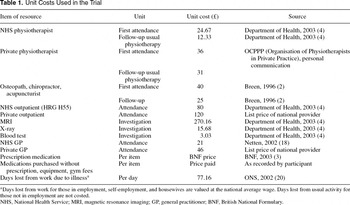
Resources used in the trial were valued using national average unit costs estimates, at 2001–02 prices from the perspective of the UK NHS. Table 1 details the key unit cost estimates used. Where medications were obtained by prescription, the cost to the NHS was found by estimating the full cost of the product using national sources (3) and subtracting any private co-payment. Following the recently issued guidelines for technology appraisal issued by the UK National Institute for Health and Clinical Excellence (NICE) (19), private costs incurred by patients on non–health care items and medicinal products are not included in the base case analysis but are reported separately here (19), together with information regarding days lost from paid employment or housework valued at the national average wage (20).

Health Outcomes
Patient-specific quality-adjusted life years (QALYs) were estimated using participants' responses to the EuroQol-5 Dimensions (EQ-5D) questionnaires at baseline, 3 and 12 months from randomization (9). The EQ-5D is a generic and easy to complete health-related quality of life questionnaire, widely used in cost-effectiveness analysis. Its descriptive system comprises five dimensions of health (mobility, self-care, usual activities, pain/discomfort, anxiety/depression). Each dimension has three possible levels of severity (i.e., no problems, moderate, extreme problems), generating a total of 243 theoretically possible health states, to which two additional health states have been added: death and unconsciousness. These 245 health states have been valued by a representative sample of 3,395 members of the UK general public using a choice-based method for use in health care economic evaluation (5). The health utility measurements obtained at different time points during the study period can be translated into QALYs using the area under the curve method (15;16). The QALY is the measure of health benefits for use in cost-effectiveness analysis preferred by the National Institute for Health and Clinical Excellence (19).
Concerns regarding the relative insensitivity of the EQ-5D instrument to detect small changes in health states in populations with low morbidity (27), such as that analyzed in this trial, led us to use the Northwick Park Questionnaire (NPQ) as a secondary outcome measure. The NPQ score was the primary outcome measure used to assess the clinical effectiveness of the brief intervention versus usual physiotherapy in the initial clinical analysis of this trial (10). The NPQ, which measures the level of neck pain and the resulting disability, is a nine-item questionnaire with five possible responses for each question. NPQ scores were collected at the same time intervals as the EQ-5D questionnaire (10). It has been shown elsewhere (14) that the calculation of the area under the curve using a pain questionnaire is a valid and reliable approach that allows one to capture the magnitude and the duration of the episode. Therefore, we followed the same methodology used to calculate QALYs and estimated patient-specific area under the NPQ score curve using the data collected in the trial.
Patient Preferences
Given the nature of the treatment being delivered, it was not possible to blind patients or physiotherapists with regard to the treatment allocation. This finding raises the possibility that the observed treatment effect (on costs and health outcomes) may be influenced by patients' a priori preferences as well as therapeutic efficacy. In this trial, patient preferences were elicited before randomization and used as the basis of a subgroup analysis to provide a full, unbiased estimate of the effects of preferences on treatment outcomes (26).
Analysis
The primary economic analysis was undertaken in the form of cost-effectiveness analysis relating differential mean cost to differential mean QALYs associated with the alternative treatment strategies in the trial. Differential mean QALYs were adjusted for EQ-5D baseline values, to obtain more accurate and precise estimates (15).
In terms of results of the analysis, the following scenarios can arise:
a) The brief intervention, on average, costs more and produces less QALYs than usual physiotherapy;
b) The brief intervention, on average, is less costly and more effective (in terms of QALYs gained) than usual physiotherapy;
c) The brief intervention, on average, is both more (less) costly and more (less) effective, in which case the decision problem is to determine whether the additional cost that needs to be born to obtain a unitary increment in the effectiveness measure (here QALYs) is worth paying. This determination is achieved by calculating the incremental cost-effectiveness ratio (calculated as the difference in mean costs divided by the difference in mean QALYs) in the trial, and comparing this ratio against the maximum amount the decision maker is willing to pay for an additional QALY.
Relevant 95 percent confidence intervals for differential costs and QALYs were calculated using bias corrected and accelerated non-parametric bootstrap (1;6;17). To reflect the decision uncertainty regarding the cost-effectiveness of the intervention, we plotted cost-effectiveness acceptability curves (7;28). Given the data collected in the trial, this curve shows the probability of one of the two strategies being cost-effective for a range of possible values the decision maker may be willing to pay for additional QALY. As the time horizon of the analysis was 1 year, total costs and QALYs were not discounted. Furthermore, because a proportion of observations were missing due to incomplete follow-up, mean costs and QALYs were estimated using statistical methods to adjust for censored cost-effectiveness data (13).
Finally, patients were asked before randomization whether they had a preference for usual physiotherapy, the brief intervention or were indifferent. Adopting the approach proposed by Hoch et al. (8), patients' treatment preferences were used to undertake a secondary exploratory analysis investigating whether prior treatment preferences could lead to relevant differences in the cost-effectiveness of the therapies being considered. The analysis was conducted using STATA 7SE (24).
RESULTS
A total of 268 participants were recruited to the study (129 and 139 randomly assigned to usual physiotherapy and the brief intervention, respectively). Of these, 101 (78 percent) in the usual physiotherapy and 113 (81 percent) in the brief intervention group returned questionnaires at both 3 months and 1 year after randomization. There was no evidence that drop-out from the trial was associated with whether patients received their choice of treatment (Pearson's 2×2 Chi-squared test, p=.288).
Resource Use
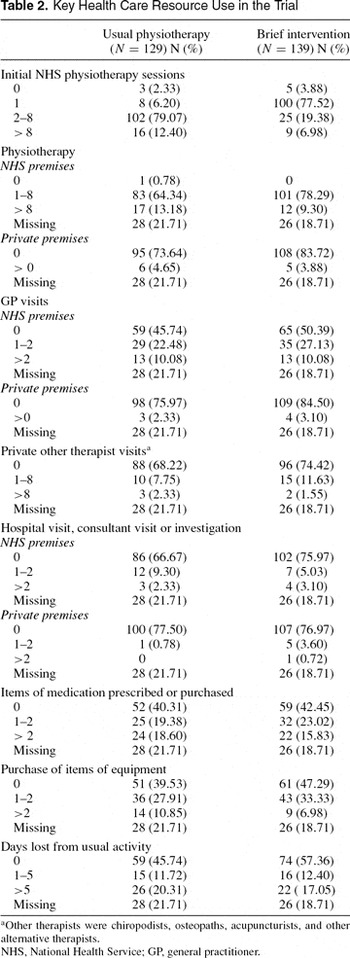
Table 2 summarizes resource utilization data over the 12-month study period. In total, including initial physiotherapy sessions, the brief intervention group had fewer NHS physiotherapist visits compared with usual physiotherapy over the study period (mean visits = 2.78 (SD 4.55) versus 6.82 (SD 6.55), for the brief intervention and usual physiotherapy respectively).

The use of other health care resources during 12-month follow-up period was similar between the two groups. The usual physiotherapy group lost a mean of 6.27 (SD 12.54) days from usual activities over the year compared with 7.66 (SD 28.66) days in the brief intervention group.
One participant in the control arm lost 255 days of usual activities. The proportion of participants not reporting any unproductive days was 46 percent in the usual physiotherapy and 57 percent in the brief intervention group.
As expected, the quality of responses on the use of medications was variable, with missing data on this question in the second follow-up period. However, most of the recorded medications were inexpensive painkillers; therefore, these missing data are unlikely to influence the overall results of the analysis.
Costs
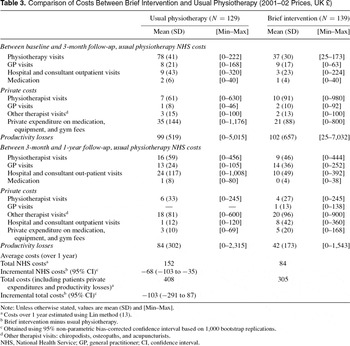
Cost results are reported in Table 3. The usual physiotherapy group displayed higher average NHS direct costs compared with the brief intervention group in the first 3 months of the study period, which was mainly driven by the cost of physiotherapy visits (£78 versus £37). NHS and private health care costs other than physiotherapists' visits were similar between the two arms. By the end of the study period, the brief intervention compared with usual physiotherapy resulted in a reduction of direct NHS mean costs (i.e., cost saving) per patient (£−68; 95 percent CI, −103 to −35).

In addition, usual physiotherapy was associated with a higher cost due to productivity losses between 3 months and 1 year (£84 versus £42), while the brief intervention group displayed higher private expenditures on equipment and gym fees (£35 versus £21). In total, including patients' private costs, as well as productivity costs (i.e. time lost from usual activities) the reduction in mean cost increased (£−103; 95 percent CI, −291 to 87), indicating a larger saving with brief intervention.
Health Outcomes
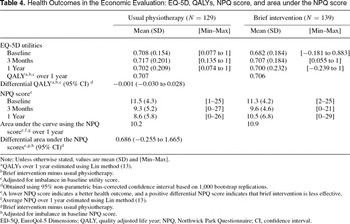
Table 4 shows the EQ-5D and NPQ scores at baseline, 3- and 12-month follow-up, together with the QALY and the area under the NPQ scores estimates. In both arms of the trial, participants showed on average small improvements between baseline and 3 months, with a small decline between 3 months and 1 year.

Differential QALYs were 0.001 (95 percent CI, −0.028 to 0.030) in favor of usual physiotherapy, after adjusting for baseline difference in EQ-5D score between the trial arms. Similarly, the differential area under the NPQ score of 0.686 (95 percent CI, −0.255 to 1.665) was in favor of usual physiotherapy.
Cost-effectiveness
Based on the results concerning the difference in costs and QALYs, this study falls under category (c) presented in the methods section, that is, on average, usual physiotherapy intervention costs more and produces slightly more QALYs than the brief intervention. Relating mean differences in costs (to the NHS) and QALYs produced an incremental cost-effectiveness ratio of £68,000 (i.e., 68/0.001). This value is above the implicit threshold of £30,000 that NICE showed itself to be willing to pay in the past (22), suggesting usual physiotherapy may not be a cost-effective treatment compared with the brief intervention in this patient population. That is, the small additional benefit produced by a more intense physiotherapy management in this patient group, comes at a high additional cost.
Furthermore, even if the decision maker were willing to pay £68,000 or more for additional QALY in this patients' population, Figure 1 shows that there is still considerable uncertainty regarding the cost-effectiveness in this result. The cost-effectiveness acceptability curve (Figure 1) shows that, for values of the decision maker's maximum “willingness to pay” for additional QALYs greater than 20,000, the probability that usual physiotherapy is cost-effective is only 50 percent. This finding is mainly due to the fact that the differential QALYs are nearly zero. On the other hand, when the decision maker is only interested in the cheaper option, the brief intervention physiotherapy has a probability of 100 percent to be cost-saving.

Cost-effectiveness acceptability curve.
Effect of Patient Preferences
The preference cost-effectiveness subgroup analysis indicated that, for patients preferring the brief intervention, the latter was associated with lower NHS costs (−£96) and improved health outcomes (+0.039). This result was confirmed when the outcomes measure used in the analysis was NPQ score.
For patients who did not have a treatment preference, there was a small increase in costs (+£14) and QALYs (+0.023) for usual physiotherapy compared with the brief intervention, resulting in an incremental cost per QALY of £609 (obtained as 14/0.023). Again, the NPQ results support this finding.
Finally, the group of participants who expressed a preference toward usual physiotherapy produced higher mean costs (£206 versus £70) and lower mean QALYs (0.711 versus 0.724) compared with the group who expressed a preference toward the brief intervention. This conclusion was not supported by the use of the NPQ. The area under the NPQ score showed that neck pain symptoms were better in the usual physiotherapy group.
DISCUSSION
This study presents the results of a UK multicenter trial-based cost-effectiveness analysis comparing a brief intervention versus usual physiotherapy in patients with neck pain of musculoskeletal origin in the community setting.
The results of our study suggest that usual physiotherapy costs the NHS per patient with neck pain £152 per year on average. This finding is within the range of results of studies of the cost of physiotherapy from other countries (12;24). Our study estimates the cost of the brief intervention at £84, which represents a cost saving (i.e., £68) strategy for the NHS. Our companion clinical paper concluded that the brief intervention was not clearly as effective as usual physiotherapy when comparing the change in NPQ score over 1 year (10). Consistent with the findings of the clinical paper, we found that, when health benefits are measured using QALYs, the brief intervention provides only slightly less health benefit on average. Those in the NHS who are responsible for public health care resource allocation decisions are constantly required to make sure these resources are invested efficiently. In economic terms, this efficiency principle translates into the maximization of the population total health benefits, given a fixed public budget constraint. In this context, the implementation of the brief intervention, on average, is cost-effective if the maximum willingness to pay for health benefits is less than £68,000 per QALY.
Exploratory subgroup analysis suggests that patients' preferences may play an important role in both the design and conduct of health care research to inform resource allocation decisions in the UK NHS. In this trial, for patients who were indifferent to treatment allocation, the results of the subgroup economic analysis mimicked those of the base case analysis, where the brief intervention was cost saving (£14) but came with a reduction in QALYs (0.023) compared with usual physiotherapy. However, in patients who expressed a preference toward either the brief intervention or usual physiotherapy, the former was found to reduce costs and marginally increase QALYs. In other words, when patients' who wanted the brief intervention were given it, its cost-effectiveness was undisputed, as this strategy reduced costs and increased QALY, as well as clinical effectiveness. That patients who preferred usual physiotherapy but received the brief intervention instead benefited slightly more in terms of QALYs was a surprising result. This finding could be just an artefact due to the relative insensitivity of the EQ-5D instrument. A subgroup cost-effectiveness analysis conducted using the area under the NPQ score results suggested that this might indeed be the case. Incidentally, Thomas and colleagues (25) found that the functional outcome in a trial for shoulder pain was not affected by whether preferences were met or not. Similarly, a previous study of exercise for primary-care back pain patients found that patients' preferences for the exercise class did not influence outcome (11).
A note of warning is due at this stage to indicate that the results of the subgroup cost-effectiveness analysis reported here should in fact be treated with caution by the reader and have been reported for hypotheses generating purposes (21). Nevertheless, these findings suggest there may not be a single “optimal” treatment for all patients with neck pain and that it is important to systematically take account of the role of patients' preferences when conducting trial-based economic studies for which patients are not blinded to treatment allocation. It is also important in the clinical setting to routinely discuss treatment options with patients and ask if they have a preference for a particular treatment.
In conclusion, giving the brief intervention to neck pain patients will lead to a reduction in costs albeit with a small reduction in quality of life. In circumstances in which physiotherapy resources are scarce, then the brief intervention could be a cost-effective alternative to usual physiotherapy. For patients with a preference for brief intervention, this therapy is the dominant treatment and such patients should receive this treatment.
POLICY IMPLICATIONS
The findings from this study suggest that a brief intervention based on cognitive–behavioral principles should be offered to patients as an alternative to usual physiotherapy for neck pain. Our cost-effectiveness analysis indicates that, on average, brief intervention and usual physiotherapy can be comparable in terms of effectiveness, and brief intervention costs less. Exploratory work found that costs and effects may be sensitive to patients' treatment preferences. Further studies should consider collecting information about patients' preferences to inform a more efficient allocation of the health care resources.
CONTACT INFORMATION
Andrea Manca, MSc, PhD (am126@york.ac.uk), Research Fellow, David M. Epstein, MSc (dme2@york.ac.uk), Research Fellow, Centre for Health Economics, David J. Torgerson, PhD (djt6@york.ac.uk), York Trials Unit, Director, Department of Health Sciences, University of York, Heslington, York YO10 5DD, UK
Jennifer A. Klaber Moffett, PhD (j.k.moffett@hull.ac.uk), Professor of Rehabilitation Therapies and Deputy Director, Institute of Rehabilitation, University of Hull, 215 Anlaby Road, Hull HU3 2PG, UK
Simon Coulton, BSc (sc21@york.ac.uk), Senior Research Fellow, Department of Health Sciences, University of York, Heslington, York YO10 5DD, UK
Amanda J. Farrin, MSc (a.j.farrin@leeds.ac.uk), Senior Medical Statistician, Clinical Trials Research Unit, University of Leeds, 17 Springfield Mount, Leeds LS2 9NG, UK
Seokyung Hahn, PhD (hahs@snu.ac.kr), Assistant Professor, Medical Research Collaborating Centre, Seoul National University College of Medicine, 28 Yongon-Dong, Jongno-Gu, Seoul, Korea 110-744
David A. Jackson, MSc (d.a.jackson@hull.ac.uk), Research Facilitator, Institute of Rehabilitation, University of Hull, 215 Anlaby Road, Hull HU3 2PG, UK
Stewart J. Richmond, MSc (s.j.richmond@hull.ac.uk), Trials Manager, Department of Public Health and Primary Care, University of Hull, 301 Hertford Building, Cottingham Road, Hull HU6 7RX, UK
The authors' gratefully acknowledge the participation in this trial of all patients and staff in all the collaborating centres. Thanks are due also to Professor Ian Russell, for his advice on the trial design and to Professor Leslie G Walker for his contribution in training the physiotherapists in the Brief Intervention. Thanks are also due to the late Patty Collier who acted as a very effective trial coordinator for 18 months.
Ethical approval has been given by Hull and East Riding Research Ethics Committee, Scarborough and North East Yorkshire Locally Organised Research Ethics Committee, South Humber Health Authority Local Research Committee.
This study was funded by the Northern and Yorkshire R&D Executive and Trent Region NHS Executive.