Introduction
Recent years have witnessed a growing number of empirical studies investigating various dimensions of oral negative feedback. One line of research has focused on the effectiveness of different types of negative feedback (Carroll & Swain, Reference Carroll and Swain1993; Ellis, Reference Ellis and Mackey2007; Ellis, Loewen & Erlam, Reference Ellis, Loewen and Erlam2006; Goo, Reference Goo2012; Loewen & Nabei, Reference Loewen, Nabei and Mackey2007; Sheen, Reference Sheen and Mackey2007; Yilmaz, Reference Yilmaz2012). A parallel line of research has targeted factors moderating the extent to which learners benefit from negative feedback. Within this group, several studies have revealed that there are cognitive abilities that can moderate the effectiveness of feedback (Mackey, Philp, Egi, Fujii & Tatsumi, Reference Mackey, Philp, Egi, Fujii, Tatsumi and Robinson2002; Sagarra, Reference Sagarra and Mackey2007; Sheen, Reference Sheen and Mackey2007; Trofimovich, Ammar & Gatbonton, Reference Trofimovich, Ammar, Gatbonton and Mackey2007).
The aptitude-treatment-interaction (ATI) paradigm (Cronbach & Snow, Reference Cronbach and Snow1977), motivated by the ultimate purpose of matching cognitive strengths to optimal instructional practices, provides an excellent framework for the investigation of the relationship between cognitive factors and negative feedback effectiveness. In addition to its practical pedagogical applications, ATI research can provide valuable insights about how learners process the information provided in different feedback conditions by testing the relative contribution of a particular cognitive aptitude. For example, if cognitive aptitudes that have been theoretically linked to a particular type of language learning and processing are found to be related to learning outcomes under a given instructional treatment, this can constitute potential evidence for the underlying learning processes engaged by that particular treatment.
A typical ATI research design includes: a) teaching of the same content through alternative methods (i.e., treatments), b) pseudo-random assignment to treatment groups (to make sure that the cognitive profiles investigated, matching and mismatching the treatments, are equally distributed in the treatment groups), and c) utilization of tests measuring attributes predicted to be more relevant to one treatment than another. However, in the L2 feedback literature, with the exception of a few studies (e.g., Sheen, Reference Sheen and Mackey2007; Yilmaz, Reference Yilmaz2013a), most research has examined the relationship between cognitive variables and L2 outcome measures using designs that have included a single feedback group, often receiving recasts, and a no-feedback control group (Mackey et al., Reference Mackey, Philp, Egi, Fujii, Tatsumi and Robinson2002; Sagarra, Reference Sagarra and Mackey2007; Trofimovich et al., Reference Trofimovich, Ammar, Gatbonton and Mackey2007). In addition, despite the fact that previous research has singled out a range of cognitive variables to study their influence on the effectiveness of feedback (Mackey et al., Reference Mackey, Philp, Egi, Fujii, Tatsumi and Robinson2002; Sagarra, Reference Sagarra and Mackey2007; Sheen, Reference Sheen and Mackey2007; Trofimovich et al., Reference Trofimovich, Ammar, Gatbonton and Mackey2007; Yilmaz, Reference Yilmaz2013a), no study so far has focused on explicit language aptitude (ELA) as a broader type of aptitude capturing various explicit cognitive abilities (Granena, Reference Granena, Granena and Long2013), such as explicit inductive learning ability, explicit associative learning and rote memory ability, and the extent to which this type of aptitude is associated with learning conditions that induce learners to process language explicitly and/or implicitly.
Relative effectiveness of feedback types
The majority of L2 researchers (e.g., Gass, Reference Gass1997; Long, Reference Long2007; Pica, Reference Pica1988) believe that negative feedback (i.e., input indicating that the learner's utterance is not targetlike) has a beneficial role in L2 acquisition. Previous research has shown that negative feedback is an effective instructional technique. Negative feedback groups have been found to outperform no-feedback control groups (e.g., Doughty & Varela, Reference Doughty, Varela, Doughty and Williams1998) and positive-evidence-only groups (Leeman, Reference Leeman2003; Ortega & Long, Reference Ortega and Long1997). In addition, several meta-analyses (Goo, Granena, Yilmaz & Novella, Reference Goo, Granena, Yilmaz, Novella and Rebuschatin press; Li, Reference Li2010; Lyster & Saito, Reference Lyster and Saito2010; Mackey & Goo, Reference Mackey, Goo and Mackey2007; Russell & Spada, Reference Russell, Spada, Norris and Ortega2006) have revealed that negative feedback has a medium-to-large effect on L2 acquisition. Another question that has occupied the mind of the negative feedback researcher is what type of feedback is the most effective. In the literature, a distinction is made between implicit and explicit feedback, a distinction that is understood in relative, not absolute terms, because it is often difficult to classify a single feedback type as implicit or explicit in the absence of another. Feedback types lacking metalinguistic information and/or directness about the inaccuracy of learners’ utterances (e.g., clarification requests and recasts) have been considered relatively more implicit, whereas feedback types that include metalinguistic information (e.g., metalinguistic feedback) and/or direct reformulations of learners’ incorrect utterances (e.g., explicit correction) have been considered relatively more explicit (see Loewen & Nabei, Reference Loewen, Nabei and Mackey2007 and Lyster & Saito, Reference Lyster and Saito2010, for more detailed categorizations of feedback types).
Several studies have compared the relative effectiveness of explicit versus implicit feedback by operationalizing explicit feedback as metalinguistic feedback and implicit feedback as recasts. One can broadly define metalinguistic feedback as information, comments or questions about the accuracy of learners’ utterances (Lyster & Ranta, Reference Lyster and Ranta1997), and recasts as targetlike reformulations of learners’ non-targetlike utterances. Several studies that have compared the relative effectiveness of these two feedback types have revealed results in favor of metalinguistic feedback (Carroll & Swain, Reference Carroll and Swain1993; Ellis, Reference Ellis and Mackey2007; Ellis, Loewen & Erlam, Reference Ellis, Loewen and Erlam2006; Sheen, Reference Sheen and Mackey2007). However, these results should be interpreted with caution, first, because some studies (e.g., Loewen & Nabei, Reference Loewen, Nabei and Mackey2007) have produced conflicting findings and, second, because there has been considerable methodological variability across the studies (e.g., treatment tasks employed, definition of feedback types, outcome measures, target structure choice, number of treatment sessions, duration of the treatment sessions; see Goo & Mackey, Reference Goo and Mackey2013 and Lyster & Ranta, Reference Lyster and Ranta2013, for some important methodological concerns in feedback research).
In addition to metalinguistic feedback, explicit feedback has also been operationalized as explicit correction. Lyster and Ranta (Reference Lyster and Ranta1997) defined explicit correction as the explicit provision of targetlike forms. Yilmaz (Reference Yilmaz2012) compared the relative effectiveness of explicit correction versus recasts in the acquisition of two Turkish structures (i.e., locative and plural). Forty-eight learners who had no previous exposure to Turkish carried out two communicative tasks with the researcher, one through computer-mediated communication and one through face-to-face communication. Learner errors on the target morphemes were corrected according to group assignment. Explicit correction included the explicit rejection of the learner's utterance (“X is wrong”) followed by the explicit provision of the targetlike form (“You should say Y”). Recasts reformulated the erroneous part of the learner's utterance. Oral production, comprehension and recognition tests were administered to measure learners’ performance. Results revealed that explicit correction was more effective than recasts on the oral production and comprehension tasks regardless of time, communication mode and target structure.
Another study (Yilmaz, Reference Yilmaz2013b) based on the same data set as that analyzed in the present study also compared the relative effectiveness of explicit versus implicit feedback, operationalizing them like Yilmaz (Reference Yilmaz2012) as explicit correction and recasts. The study included two other feedback groups: mixed (i.e., partially explicit, including both explicit correction and recasts), and reduced-explicit (i.e., only including two instances of feedback, both explicit correction). The results of the study showed that the explicit correction group outperformed the recast group on both posttests, but this difference reached statistical significance only on the immediate, not on the delayed posttest.
Several researchers (Carroll, Reference Carroll2001; Lyster & Ranta, Reference Lyster and Ranta1997) have explained the difference in effectiveness between explicit and implicit feedback by arguing that the recognition of the corrective function is a precondition for shifting attention from meaning to form; and that it is more likely that this precondition is met if feedback is explicit, as it makes the corrective function more salient (Carroll, Reference Carroll2001; Lyster & Ranta, Reference Lyster and Ranta1997). Salience in this sense relates to how the learner interprets feedback.
Although an explanation based on salience is consistent with previous research, relying solely on the salience of feedback would be a simplistic approach to the task of determining the feedback type to be used in a pedagogical context. Many other factors (i.e., psycholinguistic, social and practical) that are left unaccounted for by the notion of salience may influence pedagogical decisions about the feedback type to use. For instance, it has been argued that explicit feedback types are more obtrusive and likely to interfere with communication because they direct learners’ attention to target structures, whereas more implicit types attract learners’ attention to the structures and minimize any interruption to the communication of meaning (Doughty & Williams, Reference Doughty and Williams1998)Footnote 1 .
Explicit feedback is also more time-consuming. Long (Reference Long2007) argued that “. . .even if more explicit alternatives are eventually found to work, or even to work better then implicit feedback of some kind, it will be at a cost to coverage of tasks, curricular subject matter, or other syllabus content” (p. 103). In addition, explicit feedback can be expected to trigger some negative affective consequences. Especially in classroom contexts, and in the presence of others, learners whose errors are corrected may feel embarrassed, frustrated or angry. For example, Yoshida (Reference Yoshida2010) demonstrated that teachers avoided explicit feedback not to undermine learners’ confidence because they considered that explicitly pointing out their errors was intimidating.
An additional factor to consider when making pedagogical decisions about what feedback type to use is the role of individual learner differences. Among these, cognitive individual differences have stood out as some of the most important mediating factors in feedback effectiveness. It is to these that we turn now.
Cognitive aptitudes and the relative effectiveness of feedback types
A factor that may moderate the effectiveness of different feedback types along the explicitness/implicitness continuum is cognitive ability. Cognitive abilities may influence the extent to which individual learners attend to and process different types of feedback. In addition, investigating the relationship between selected cognitive abilities and the extent to which learners benefit from feedback can provide indirect evidence of how different feedback types are processed. Different feedback types are likely to engage different cognitive processes and these mental processes can be either facilitated or hampered by the learner's specific cognitive aptitudes (DeKeyser, Reference DeKeyser2012). For example, if explicitness, or “obtrusiveness” as Doughty and Williams (Reference Doughty and Williams1998, p. 229) put it, is characterized by how overtly attention is directed to form, learning under more explicit instructional techniques should draw more heavily on cognitive abilities that play a role when attention is consciously and intentionally directed to form. A relationship between selected cognitive abilities and learning under one feedback condition, but not another, would be consistent with the claim that learners process feedback types differently.
Previous studies have investigated whether cognitive variables, such as phonological short-term memory (Mackey et al., Reference Mackey, Philp, Egi, Fujii, Tatsumi and Robinson2002; Trofimovich et al., Reference Trofimovich, Ammar, Gatbonton and Mackey2007), working memory capacity (Mackey et al., Reference Mackey, Philp, Egi, Fujii, Tatsumi and Robinson2002; Sagarra, Reference Sagarra and Mackey2007; Yilmaz, Reference Yilmaz2013a), attention control (Trofimovich et al., Reference Trofimovich, Ammar, Gatbonton and Mackey2007), and language analytic ability (Sheen, Reference Sheen and Mackey2007; Yilmaz, Reference Yilmaz2013a), are related to L2 outcome measures after negative feedback instruction. This research has offered useful evidence regarding the instructional relevance of cognitive individual differences, since the majority of studies have produced significant findings (e.g., Sagarra, Reference Sagarra and Mackey2007; Trofimovich et al., Reference Trofimovich, Ammar, Gatbonton and Mackey2007). However, only two of those studies (Sheen, Reference Sheen and Mackey2007; Yilmaz, Reference Yilmaz2013a) included more than one feedback condition, and, thus, contributed to the ATI research paradigm by investigating how different feedback treatments can be differentially effective depending on cognitive ability level.
Yilmaz (Reference Yilmaz2013a) and Sheen (Reference Sheen and Mackey2007) both investigated the relationship between language analytic ability (LAA) and L2 outcomes under explicit and implicit feedback conditions. In Yilmaz (Reference Yilmaz2013a), LAA was measured using one of the subtests in the LLAMA aptitude test battery (Meara, Reference Meara2005), LLAMA F, a grammatical inferencing test consisting of phrases in an artificial language, each describing a picture, and in which participants, after studying test materials, have to select a sentence for a picture out of a choice of two. Sheen (Reference Sheen and Mackey2007) measured LAA by means of the Otto test (Otto, Reference Otto2002). This test consists of sentences in an artificial language and their corresponding English translations. With the help of a glossary, participants’ task is to select the correct translation for a sentence out of a choice of four. As for feedback type, explicit feedback was operationalized as metalinguistic feedback in Sheen and as explicit correction in Yilmaz, whereas implicit feedback was operationalized as recasts in both. Finally, Sheen (Reference Sheen and Mackey2007) investigated English articles, while Yilmaz (Reference Yilmaz2013a) looked at the Turkish plural and locative morphemes.
Both studies found that the relationship between LAA and learning outcomes differed depending on feedback type. In Sheen (Reference Sheen and Mackey2007), LAA correlated positively and significantly with L2 learning under the explicit feedback condition (r = .69 for the immediate posttest and .68 for the delayed posttest), but not under the implicit feedback condition (r = −.13 and −.07). Similarly, in Yilmaz (Reference Yilmaz2013a), there was a strong relationship between LAA and posttest performance in the explicit feedback condition (locative, r = .72 and .72; plural, r = .52 and .88), but not in the implicit condition (locative, r = .19 and −.02; plural, r = .20 and .11). Explicit feedback was more effective than implicit feedback among high LAA learners, but not among low LAA learners.
LAA is defined as the learner's capacity to identify linguistic patterns in the input and infer rules (Skehan, Reference Skehan1998) and it has been proposed as a factor that moderates explicit language learning (DeKeyser, Reference DeKeyser2000). Skehan (Reference Skehan1989) further reconceptualized LAA as including grammatical sensitivity and inductive language learning abilityFootnote 2 , arguing that they only differ in their degree of emphasis (Skehan, Reference Skehan1998). According to Skehan, these are abilities that play a role in the same L2 processing stages (i.e., identification and generalization of patterns). More specifically, these are cognitive aptitudes that belong to the domain of explicit cognitive processes, engaged when learning is conscious and intentional, and that recent views in cognitive and educational psychology have distinguished from aptitudes in the domain of implicit cognitive processes (e.g., Kaufman, DeYoung, Gray, Jiménez, Brown & Mackintosh, Reference Kaufman, DeYoung, Gray, Jimenez, Brown and Mackintosh2010; Woltz, Reference Woltz2003). The distinction between implicit and explicit cognition is frequently made in cognitive psychology, even though it is acknowledged that even the most carefully designed learning and testing conditions can hardly be considered process-pure and will involve implicit and explicit processes to different degress (e.g., Jacoby, Reference Jacoby1991). Explicit cognitive processes are characterized by online deliberate processing, and active and effortful cognitive control at the expense of cognitive resources, whereas implicit cognitive processes are automatic, effortless, and involuntary.
The investigation of whether a broader domain of explicit cognitive aptitudes is related to outcomes in different feedback conditions could provide further evidence of the learning processes taking place under those conditions. If instructional conditions that direct learners’ attention to form (Doughty & Williams, Reference Doughty and Williams1996) do in fact induce learners to process language more explicitly, a relationship would be expected between cognitive aptitudes that moderate explicit learning and learning outcomes under these conditions.
In sum, although only a handful of studies have investigated the potential role of cognitive factors in moderating the relative effectiveness of explicit and implicit feedback types, they have produced significant findings, indicating that such research is warranted. Two studies found a relationship between LAA and learners’ performance under explicit feedback, but not under implicit feedback.
Although it would be premature to conclude that learners rely on certain cognitive resources only under explicit conditions, these results suggest that learners display differences in the cognitive abilities they resort to during the processing of different feedback types. We propose that these cognitive resources can be investigated within a framework of cognitive aptitudes that distinguishes between aptitudes for implicit and explicit learning. In the present study, we focus on aptitudes for explicit learning.
Explicit language aptitude (ELA)
Language aptitude has been conceptualized as a combination of cognitive and perceptual abilities (i.e., aptitudes) (Carroll, Reference Carroll and Diller1981; Linck, Hughes, Campbell, Silbert, Tare, Jackson, Smith, Bunting & Doughty, Reference Linck, Hughes, Campbell, Silbert, Tare, Jackson, Smith, Bunting and Doughty2013). On the basis of a series of factor analytic studies, Carroll and Sapon (Reference Carroll and Sapon1959) put forward four main aptitude subcomponents: phonemic coding ability, grammatical sensitivity, rote memory, and inductive language learning ability. Skehan (Reference Skehan and Robinson2002) also proposed that language aptitude is composed of different abilities (auditory processing, language analysis, and memory) and that these abilities are differentially important according to learning stage and task. More recently, Sparks, Patton, Ganschow and Humbach (Reference Sparks, Patton, Ganschow and Humbach2011) further supported the view that aptitude is componential by means of a factor analysis that yielded four main factors, labeled as language analysis, inductive learning, memory, and self-perceptions of language skills.
Also by means of factor analytic techniques, Granena (Reference Granena2012, Reference Granena, Granena and Long2013) investigated the underlying structure of the LLAMA Language Aptitude Tests (Meara, Reference Meara2005), a recently developed aptitude test battery consisting of four subtests that has been used in several SLA studies either in its current form (e.g., Xiang, Dediu, Roberts, van Oort, Norris & Hagoort, Reference Xiang, Dediu, Roberts, van Oort, Norris and Hagoort2012) or in its earlier version, the LAT (e.g., Abrahamsson & Hyltenstam, Reference Abrahamsson and Hyltenstam2008). A series of factor analyses showed that three of the four LLAMA subtests (LLAMA B, E and F) consistently loaded together onto a common factor, separately from LLAMA D and other cognitive measures. These three LLAMA subtests have in common a study phase that gives test-takers time to rehearse materials, focus on language forms, and use problem-solving strategies. In addition, they include instructions that create learning conditions that are closer to explicit induction (i.e., intentionally figuring out rules and relations) than implicit induction (i.e., exposure to a set of instances resulting in facilitation and non-intentional learning of patterns). Overall, LLAMA B, E, and F all involve forming associations consciously and intentionally, and working out relations in datasets, and can be, therefore, expected to draw on explicit learning processes (controlled, reflective processes characterized by active and effortful cognitive control). As a result, Granena (Reference Granena2012, Reference Granena, Granena and Long2013) argued that LLAMA B, E and F were tapping a dimension of aptitude characterized by explicit cognitive processes, involved in explicit inductive learning, explicit associative learning, and rote learning ability, and labeled this dimension as ELA. These are abilities that are relevant to learn a language explicitly, that is, intentionally, through reasoning, deliberate hypothesis testing and memorization.
Present study
Previous research has shown that explicit feedback in the form of explicit correction is more effective than implicit feedback in the form of recasts. However, it is also necessary to investigate the effectiveness of these two feedback types in relation to individual differences that stand out as playing an important mediating role in SLA, such as cognitive individual differences. This type of research typically requires a design that can test the statistical interaction between the effectiveness of different feedback types and cognitive abilities. Previous research following this design has shown that a particular cognitive ability, i.e., LAA, was associated with the performance of explicit feedback groups, but not with the performance of implicit feedback groups (Sheen, Reference Sheen and Mackey2007; Yilmaz, Reference Yilmaz2013a).
Since it has been proposed that LAA moderates explicit language learning (DeKeyser, Reference DeKeyser2000), this result could suggest that explicit and implicit feedback types engage qualitatively different cognitive processes or, at least, that they engage explicit language processes to a different extent. Also, given that LAA is a cognitive ability in the domain of explicit cognition, this result could imply that other abilities in the same cognitive domain are also differentially associated with the performance of explicit and implicit feedback groups. A combination of these abilities could be more sensitive than LAA to the variability due to explicit cognitive processes. The present study set out to investigate the potential interaction between a broader type of aptitude hypothesized to capture various explicit cognitive processes (i.e., ELA) and the effectiveness of explicit and implicit feedback conditions. The following research question was addressed:
Is there a significant interaction between learners’ ELA and the effectiveness of two feedback types (i.e., explicit and implicit)?
Method
The data reported in the present study belong to a larger project that aimed to determine the factors that mediate the effectiveness of feedback. The study is an extension of Yilmaz (Reference Yilmaz2013b), which, as summarized above, investigated the relative effects of feedback type (i.e., explicit, implicit, mixed, reduced-explicit and no-feedback) on the use of English articles. In this follow-up regression study, we focus on two of the feedback types examined by Yilmaz (Reference Yilmaz2013b), explicit and implicit, and investigate whether individual differences in ELA mediate their effectiveness.
Participants
Forty-eight learners volunteered to participate in this study. The mean age of the participants (15 males and 33 females) was 19.81 (SD = 1.15). On average, they had received 7.88 (SD = 2.05) years of English language instruction. At the time of the study, participants were first-year undergraduate students in math, science, preschool education or English language teaching at a Northwestern university in Turkey and they were taking either a 3-credit hour general English course or a 6-credit hour English speaking course. As a measure of the participants’ general proficiency, the Michigan English Placement Test (EPT) was administered. Scores in this test range from 0 to 100. The results of the EPT revealed that the level of the participants was low intermediate (M = 35.81, SD = 10.81). One of the researchers, hereafter, the experimenter, who was also the participants’ English instructor, made sure that they did not receive any type of instruction on English articles during the study to prevent any potential confounds with treatment effects.
Target structure
The English indefinite article was selected as the target structure of the study, specifically the indefinite article to indicate noun phrases referring to entities that are newly introduced in the discourse (i.e., first mention). The rationale behind this choice of structure is the important learning challenge that articles pose for L2 learners. Even though the indefinite article “a” is the fifth most frequently occurring word in English (Master, Reference Master2002), it is not easily acquired. Master (Reference Master2002) discusses three factors that contribute to its difficulty. First, articles occur very frequently in English, which makes the consistent application of conscious rules very difficult. Second, they are unstressed and, therefore, it becomes difficult to notice them in the spoken mode. Finally, they resist learners’ tendency to look for a one-to-one mapping between form and function, as they serve multiple functions. In addition, learners coming from languages lacking an article system suffer from not being able to find a corresponding structure expressing the same feature in their native languages. Turkish is one of those languages that do not have articles to express (in)definiteness. Traditionally, the unstressed numeral bi(r) has been regarded as an indefinite article (e.g., Underhill, Reference Underhill1976). However, the use of bi(r) to indicate indefiniteness is optional (Küntay, Reference Küntay2002). That is, its presence gives the noun an indefinite interpretation, but its absence does not necessarily exclude an indefinite interpretation. Case morphology and word order function as other means of expressing in(definiteness) in Turkish.
Pretest/posttest/delayed posttest
Different versions of an Oral Production Elicitation Tool (OPET) were used as pretest, posttest and delayed posttest measures. The OPETs included three controlled oral-production tasks: a guided oral-production task (GOP), a spot-the-difference task (SPD), and a story-retelling task (RET). The tasks created 40 obligatory contexts for the use of the indefinite article (GOP = 24; SPD = 8; RET = 8). Half of the items in each task were targeted in the treatment and half were novel.
Guided oral production
In this task (see Appendix A), each learner saw a series of objects in a PowerPoint presentation and was asked to talk about them by answering the questions shown on the slides. There were 24 objects in total. Learners first saw two different objects in two consecutive slides. In each of the slides, the object appeared with a question such as “what can you see?” Then, learners saw both of these objects on the same slide along with one of the following questions: “how much are they?”, “what color are they”, or “what is their size?”
Spot-the-difference
In this task (see Appendix B), the learner and the researcher carried out a one-way information gap task. The task consisted of two pictures of a room with eight objects. The pictures differed with respect to the type and location of the objects. The goal of the learner was to help the researcher find the differences between the pictures without having visual access to the researcher's picture. In order to do so, the learner was instructed to say the name of each object and then talk about its location. The researcher listened and took notes.
Story retelling
In this task (see Appendix C), the learners were asked to read a very short story in Turkish. Then, they were asked three questions in Turkish to ensure they had understood the story. After that, each learner was provided with a set of English words and instructed to use them to retell the story in English. Each OPET included two stories and each story created four obligatory contexts for the use of the indefinite article.
Treatment tasks
Each of the two treatment sessions included three oral production tasks that had a similar format to the tests used in the OPET. The main difference between the tasks used for treatment purposes and the tasks used for test purposes was the provision of negative feedback to the learners during the treatment tasks (except in the case of the learners in the control group).
Guided oral production
Learners saw the pictures of 16 objects in a PowerPoint presentation, but this time the slides did not include any written questions. Instead, the researcher asked the questions to the learner. To create a communicative need for the questions, the researcher had a paper form to fill out using the information the learner provided. The first time the learner saw the object, the researcher asked questions such as, “what can you see in your picture?” Then, the learner was asked to talk about one of the features of the object in question (i.e., color, size, or price) in response to questions such as “what color are they?”
Spot-the-difference
The format of this task was exactly the same as the spot-the-difference task used for testing purposes. The learner and the researcher had two different pictures of a room with eight objects each and the learner had to help the researcher find the differences between the two pictures.
Story retelling
The format of this task was also the same as the story retelling task used for testing purposes. Learners were presented with two stories in Turkish. The researcher checked their comprehension level and, then, learners were asked to retell the stories in English using a specific set of words.
Explicit language aptitude tests
Three of the subtests in the LLAMA Language Aptitude Test battery (Meara, Reference Meara2005) were used as a measure of explicit language aptitude. The LLAMA is a computer-based test battery developed out of a series of projects carried out by students of English Language and Linguistics at the University of Wales, Swansea, and, as cautioned by Meara, the tests have an exploratory nature and should be avoided in high-stakes situations. The battery is loosely based on the Modern Language Aptitude Test (MLAT; Carroll & Sapon, Reference Carroll and Sapon1959), but, unlike the MLAT, it is language-independent, since it relies on picture stimuli and verbal materials adapted from a British-Columbian indigenous language and a Central-American language.
The three subtests that were used to measure explicit language aptitude were LLAMA B, a test of vocabulary learning, LLAMA E, a test of sound-symbol associations, and LLAMA F, a test of grammatical inferencing. LLAMA B measures the ability to learn unknown words in a relatively short period of time. Test-takers see 20 objects on their computer screen and they are asked to learn their names. After studying these words for two minutes, the program displays the name of an object, and test-takers identify the correct object by clicking on it. LLAMA E presents 22 recorded syllables and their transcription in an unfamiliar alphabet. The test-takers’ task is to study this material for two minutes to work out the relationships between the sounds and their corresponding orthographic characters, and then to identify the correct spelling of a set of aural stimuli presented by the program. Finally, in LLAMA F, test-takers are asked to learn the grammar of an unfamiliar language in five minutes by viewing some picture-sentence pairs. At the end of the learning phase, they are presented with items consisting of a picture and two sentences and have to select the grammatically correct sentence.
The LLAMA tests are automatically scored out of a total score of 100. The internal consistency (Cronbach's alpha) of the three subtests used in the present study was minimally acceptable, according to DeVellis (Reference DeVellis2003)Footnote 3 . LLAMA B (k = 20) had an internal consistency of .77, LLAMA E (k = 20) of .71, and, finally, LLAMA F (k = 20) of .60.
Treatment groups
Participants in the study were randomly assigned to feedback groups (see Table 1). Participants in one of the groups (i.e., no-feedback) did not receive any feedback. Participants in the other two groups (i.e., explicit, and implicit) received negative feedback when they produced non-targetlike utterances involving the use of the indefinite article depending on their group assignment. Explicit feedback consisted of a repetition of the learner's error and a statement that the previous utterance was incorrect. This feedback move was followed by a statement indicating what the learner should have said. The learners’ L1 was used to give explicit feedback because of the learners’ low proficiency level. Learner errors involving article omission or overuse of the definite article where an indefinite article was required were directly rejected together with the noun that followed the article, and, then, the correct version was provided. Below is an example of an explicit feedback episode that took place during the guided oral production task between the experimenter (E) and the learner (L):
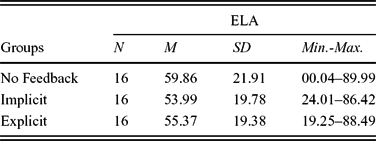
Descriptive statistics for ELA.

Note: For ease of interpretation, ELA scores are expressed as percentage scores (0–100).
E: What can you see?
L: This is a jacket.
E: What can you see in this picture?
L: I can see bag.
E: Bag yanlış, a bag demen lazım.
“Bag is incorrect, you should say a bag.”
E: How much are they?
Recasts were used to operationalize implicit feedback. A recast was defined as the targetlike reformulation of the erroneous part of a learner's utterance. The reformulation also included the noun following the article. Below is an example of an implicit feedback episode that took place during the spot-the-difference task:
E: What can you see in your picture?
L: I can see shirt
E: a shirt, and?
L: a shirt and a pencil
E: Where are they?
What follows is a detailed description of each of the treatment conditions. See Appendix D for a summary of the descriptive statistics regarding the number of feedback and uptakeFootnote 4 instances by treatment condition.
The learners in the explicit group received explicit feedback in the form of explicit correction throughout the tasks whenever they produced a non-targetlike utterance. The learners in the implicit group received implicit feedback in the form of recasts whenever they produced a non-targetlike utterance. The learners in the no-feedback control condition carried out the treatment tasks without receiving any form of feedback.
Procedure
The 48 participants were randomly assigned into one of the three groups in the study: explicit, implicit, or no-feedback. Each group consisted of 16 participants. Participants met three times with the experimenter. When the learner and experimenter met for the first time, the learner was administered the first OPET as the pretest. Following the first OPET, the learner carried out a guided oral production, a spot-the-difference task and a story-retelling task as the first feedback treatment session. In the second meeting, which was held 7–10 days after the first, the learner performed a guided oral production, a spot-the-difference task and a story-retelling task as the second feedback treatment session. After that, the learner carried out another OPET as the immediate posttest. Each treatment session lasted approximately 25 minutes, and each testing session (e.g., pretest) lasted approximately 15 minutes. The learner met with the experimenter for a third and last meeting two monthsFootnote 5 after the second meeting and the last OPET was administered as the delayed posttest. To control for any task order effects in the tests and treatments, Latin-square designs were used to create three different task orders. The learners under each treatment condition were randomly assigned to each of these three task orders. Finally, in the last session, and in a randomized order for every participant, each learner took the LLAMA aptitude tests.
Scoring
The oral production tasks included in the OPET were scored following the target-language use (TLU) formula provided in Pica (Reference Pica1983):
 \begin{equation*}
\hspace*{4pc} \frac{{(\# \,{\rm correct}\,{\rm responses}\,{\rm in}\,{\rm obligatory}\,{\rm contexts})}}{{(\# \,{\rm obligatory}\,{\rm contexts} + \# \,{\rm suppliance}\,{\rm of}\,{\rm the}\,{\rm target}\,{\rm structure}\,{\rm in}\,{\rm non} - {\rm obligatory}\,{\rm contexts})}}
\end{equation*}
Ten percent of the data were coded by a second rater. Percentage agreement and Cohen's Kappa (where applicable) were used to measure interrater reliability. Overall, interrater reliability was high for obligatory contexts (GOP, 99.8%; SPD, 99.9%; RET, 98%), correct responses in obligatory contexts (GOP, 99.86%, κ = .93; SPD, 99.89%, κ = .78; RET, 98.93%, κ = .84), and suppliance in non-obligatory contexts (GOP, 97.89%; SPD, 95.89%; RET, 92.97%). Disagreements in scoring were discussed between the two raters and resolved.
The LLAMA aptitude subtests B, E and F were automatically scored by the computer. In order to assess whether the three LLAMA subtests could be combined into a single equally weighted composite score, a principal components analysis was performed. The Kaiser-Meyer-Olkin measure of sampling adequacy was .55, greater than the recommended minimum value of .50 (Pett, Lackey & Sullivan, Reference Pett, Lackey and Sullivan2003). The Barlett's test of sphericity was significant (p < .05) indicating that the data were suitable for the analysis. The analysis showed that the common variance shared by the three subtests was 44.1% and that they loaded onto a single common factor with an eigenvalue greater than 1.0 (1.32). The subtests contributed to the underlying factor with similar loadings (LLAMA B = .77, LLAMA E = .65, LLAMA F = .60). Given that the principal component analysis suggested a single factor underlying the three subtests, a composite score was derived by converting the scores on each of the three subtests into z-scores and adding them.
Results
The first step in the analysis, before checking for any interactions in the data, involved testing whether the three treatment groups were comparable in terms of the cognitive variable of interest, ELA, and in terms of pretest scores. To this end, a one-way analysis of variance (ANOVA) was first computed on ELA scores (see Table 1). ELA scores were normally distributed in each of the three groups of participants (Kolmogorov-Smirnov test > .05) and no outliers were present in the data according to boxplots. The results of the ANOVA were not significant (F(2, 45) = .36, p = .67, d = .24), indicating no differences in ELA among the groups.
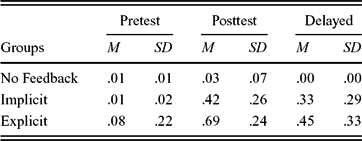
Then, a Kruskal-Wallis testFootnote 6 , the non-parametric equivalent of a one-way ANOVA, was carried out to check whether the groups differed on their pretest scores (see Table 2 for a summary of descriptive statistics for all the tests). The analysis did not reveal any statistical differences among the groups, χ2 (2) = 1.70, p = .42, η2 = .04, indicating that the learners’ pretest scores were comparable and, therefore, that any differences in their posttest scores could be attributed to the effects of the treatment they received.
Descriptive statistics for test scores.

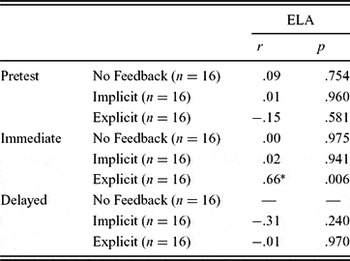
Next, bivariate correlational analyses were conducted between posttest scores (immediate and delayed) and ELA scores by group (see Table 3). As can be seen, immediate posttest performance was only significantly related to ELA scores under the explicit feedback condition. This relationship was moderately strongFootnote 7 and positive. Table 3 also shows that there were no significant correlations between ELA and delayed posttest performance two months after the treatment.
Correlations between ELA scores and OPET scores by group.

Note: Correlations between delayed posttest scores and ELA for the no-feedback condition could not be calculated because learners’ score was a constant.
To investigate whether there was an interaction between ELA and feedback condition, multiple regression models with dummy coding were run for each posttest. These models included the interaction terms between each dummy variable and ELA scores. The no-feedback control group was used as a reference category in dummy coding. The model for the immediate posttest was significant (F(5, 42) = 19.65, p < .001) and it was associated with a large effect size (f 2 = 2.34). The amount of total variance explained (R2 ) was .70 (i.e., 70%). Adjusted R 2 (i.e., corrected for sample size) was .66 (i.e., 66%). Both dummy-coded variables were also significant predictors, indicating that the feedback groups outperformed the no-feedback control group: the implicit group (β = .39, t = 5.44, p < .001) and the explicit group (β = .67, t = 9.43, p < .001). ELA was not a significant predictor overall (β = .00, t = .06, p = .95). The interaction between ELA and feedback type, however, was significant for the explicit group, (β = .06, t = 2.19, p = .03), but not for the implicit (β = .00, t = .36, p = .73).
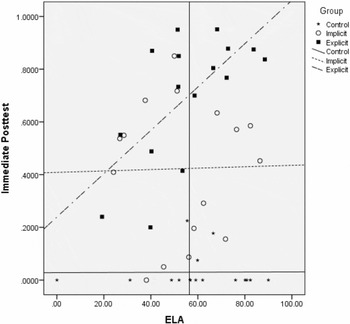
Figure 1 displays immediate posttest scores as regressed on ELA scores. As can be seen, the regression line for the explicit feedback condition displays a strong positive relationship between immediate posttest scores and ELA, whereas the lines for the implicit feedback and control conditions display negligible relationships between immediate posttest scores and ELA. The vertical line in the middle of the graph indicates the average ELA score. The figure shows that the learners in the explicit group who had above-average ELA scores behaved homogenously. The scores of these learners were very close to each other and each of them scored higher than the learners in the implicit and control groups who had above-average ELA scores. The learners in the explicit group who had below-average scores on ELA, however, behaved heterogeneously. Some scored high and some scored low. Interestingly, the scores of these learners were not clearly different from the learners in the implicit group who had below-average ELA scores. Both subgroups included low and high scorers. In sum, the results of the interaction analysis run on the immediate posttest scores indicated that ELA was only a significant predictor of posttest performance when the learners received explicit feedback. The inspection of the interaction graph also revealed that for learners who had above-average ELA scores, explicit feedback was clearly a better alternative. For learners who had below-average ELA scores, however, the explicitness of the treatment did not make a differenceFootnote 8 .
Interaction between ELA and feedback group in the immediate posttest

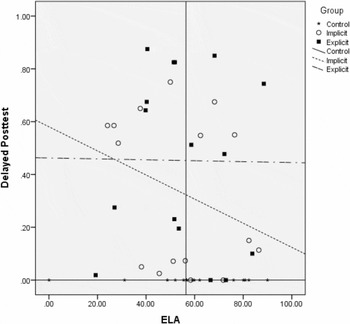
The second regression model, the model for the delayed posttest, was also significant (F(2, 45) = 5.72, p < .001) and associated with a large effect size (f 2 = .66). R 2 was .40 (i.e., the model accounted for 40% of the total variance), and adjusted R 2 was .32 (i.e., 32% of the total variance was accounted for). As can be seen from the R 2 value, the regression model explained less variability in the delayed posttest than in the immediate posttest (40% vs. 70%, respectively). Like in the immediate posttest, all dummy-coded variables were significant predictors, indicating that all the feedback groups outperformed the no-feedback control group: the implicit group (β = .32, t = 3.51, p = .001), and the explicit group (β = .45, t = 4.87, p < .001). ELA was not a significant predictor (β = −.00, t = −.61, p = .54). Finally, unlike in the immediate posttest, there were no significant interactions between ELA and any of the feedback groups: implicit (β = −.02, t = −.06, p = .57), and explicit (β = .03, t = .74, p = .46). As can be seen in Figure 2, although the relationship between ELA and learners’ delayed posttest performance in the explicit condition is negative, this relationship was not statistically significant. Figure 2 also shows that the regression lines for the control and implicit conditions are flat, indicating no relationship between learners’ delayed posttest performance and ELA in these conditions.
Interaction between ELA and feedback group in the delayed posttest

Discussion
This study set out to investigate the relationship between a combination of cognitive abilities hypothesized to be relevant for explicit language learning (ELA) and L2 learning outcomes under three feedback conditions (i.e., explicit, implicit, and no-feedback). The 16 EFL participants in the experimental conditions (i.e., explicit and implicit) received corrective feedback on the indefinite article. The research question addressed in the study asked whether there would be a significant interaction in posttest performance between ELA and L2 learning outcomes under any of the feedback treatments investigated. The study found a significant interaction only in the explicit feedback condition. Therefore, ELA was only able to predict the learning outcomes of those L2 learners who received explicit correction, a finding that is consistent with the idea that certain types of instruction can match L2 learners’ cognitive abilities better, as defended within the ATI framework (Corno, Cronbach, Kupermintz, Lohman, Mandinach, Porteus & Talbert, Reference Corno, Cronbach, Kupermintz, Lohman, Mandinach, Porteus and Talbert2002).
These results suggest that L2 learners with high aptitude for explicit learning may benefit more from negative feedback delivered in an explicit, direct manner. Explicit correction in the present study consisted of a direct rejection of the learner's error (“X is wrong”) followed by a correction of the error, which was also directly presented (“you should say Y”). Perhaps by being direct in both rejecting the error and presenting the correct form, this type of feedback was more likely to focus learners’ attention on language forms in comparison to recasts, which lacked this directness. The learners might have easily noticed the negative evidence and quickly deployed their cognitive resources to tackle the remainder of the task, identify what they did wrong, and how it could be corrected. Given that L2 learners with high aptitude for explicit learning are more able to handle an analytical approach to linguistic structure (DeKeyser, Reference DeKeyser2000), they can be expected to be more successful at forming hypotheses and inferring rules from instances of feedback such as “Bag is incorrect, you should say ‘a bag’.” Therefore, they might have relied on this ability to benefit from explicit feedback and applied their hypotheses immediately after receiving corrections.
Learners’ performance under the implicit feedback condition was not related to ELA. One possible reason for this finding could be the lower levels of awareness created by the implicit condition with regard to the presence of errors. Doughty and Williams (Reference Doughty and Williams1998) have argued that intervention techniques can be considered as having varying levels of obtrusiveness with respect to how attention is manipulated. According to this view, feedback techniques that break the flow of communication and that direct learners’ attention to form more overtly are considered more obtrusive. It is possible that the presence or absence of the explicit markers used to introduce the error and the correction might be responsible for creating different levels of obtrusiveness and for shaping subsequent learning processes. These metalinguistic markers might have put pressure on the learners receiving explicit feedback to switch their focus of attention from meaning to form and to search for rules and/or formulate and test hypotheses. Conversely, in the absence of these markers, the learners receiving implicit feedback might have engaged in learning processes that did not involve searching for rules or formulating and testing hypothesis.
The results of the study did not reveal significant interactions between ELA and learners’ L2 performance under any of the feedback conditions on the delayed posttest. This means that ELA predicted learning under the explicit condition only immediately after the treatment, but not two months after the treatment. More specifically, the lack of a relationship in the explicit condition indicates that some of the learners with high ELA who performed well on the immediate posttest may have performed poorly on the delayed posttest, whereas some learners with low ELA who performed poorly on the immediate posttest may have performed well on the delayed posttest. One possibility is that such changes in performance and the lack of a relationship with aptitude were the result of uncontrolled external factors that took place in the two-month period between the immediate and the delayed posttest. For example, some participants could have been exposed to positive evidence containing the indefinite article in their language classes and this additional exposure could have interacted with the type and amount of cognitive resources they resorted to on the delayed posttest. As a result, our delayed posttest data might have been less sensitive to the role of individual differences in the different treatments. We should also add that having a delayed posttest two months after the treament is not common practice in feedback studies. Li's (Reference Li2010) meta-analysis included two studies with long term posttests (Kang, Reference Kang2010; Sheen, Reference Sheen and Mackey2007) and, even in these two studies, the time difference was only four weeks in Kang (Reference Kang2010), and five to six weeks in Sheen (Reference Sheen and Mackey2007).
Although it would be premature to draw conclusions from the results of a single study, some tentative pedagogical implications arise from the current study that can be discussed in light of Vatz, Tare, Jackson and Doughty (Reference Vatz, Tare, Jackson, Doughty, Granena and Long2013). The immediate posttest results showed that explicit feedback was different from implicit feedback in that it might have created processing conditions that called for learners’ use of ELA. This means that the outcome of the explicit treatment was different from the outcome of the implicit treatment from the point of view of the cognitive processes engaged. Furthermore, from the point of view of learning, explicit feedback was more effective than implicit feedback, as shown in Yilmaz (Reference Yilmaz2013b). Therefore, explicit feedback was more effective than implicit feedback, but it also engaged learners’ ELA, and, by doing so, it favored those learners with high ELA. Vatz et al. (Reference Vatz, Tare, Jackson, Doughty, Granena and Long2013) consider this type of interaction as one that does not level the playing ground. In other words, the effect of the explicit treatment was not applicable to all learners, but gave an advantage to a subgroup of learners. The analysis of the interaction graph revealed that learners who had an above-average ELA score clearly benefitted from explicit feedback. The learners who had below-average ELA scores, however, benefitted less from explicit correction. These results are very similar to those reported in Yilmaz (Reference Yilmaz2013a), which showed that explicit correction was clearly a better alternative to recasts for learners who had high LAA, but not for learners who had low LAA. Taken together, these results suggest that explicit correction is not preferable for all learners. Although high ELA learners benefit from explicit correction more than they benefit from recasts, low ELA learners benefit to a similar extent regardless of whether they receive explicit correction or recasts.
One caveat to this tentative pedagogical implication is the result of the delayed posttest, which revealed that ELA did not predict learners’ performance in the long run. In addition, Yilmaz (Reference Yilmaz2013b) reported that the feedback groups were not statistically different from one another in the delayed postest. Their performance had also dropped considerably. These findings render it impossible to favor one feedback type over the other based on Vatz et al's (Reference Vatz, Tare, Jackson, Doughty, Granena and Long2013) criteria. One possible reason for the loss of effects in the delayed posttest could have been the short duration of the treament. Norris & Ortega (Reference Norris and Ortega2000) reported that treatment length might be a factor determining the durability of treatment gains. Future research should further investigate ATI effects in both immediate and delayed posttest performance in order to determine the extent to which results are generalizable.
Conclusion
Cognitive factors may moderate the extent to which L2 learners benefit from various instructional interventions, such as corrective feedback. This is the main focus of ATI studies, which are not only concerned about the overall effectiveness of one treatment with respect to another, but also about its effectiveness relative to particular individual differences of interest. In the present study, we focused on a broad type of aptitude capturing various explicit cognitive processes and on its effects on L2 learning under different feedback conditions. We hypothesized that any relationships between particular cognitive aptitudes and learning outcomes could inform about the underlying learning processes taking place under a particular instructional treatment. The interaction observed in the explicit feedback group suggested that this type of feedback directed learners’ attention to target structures and might have put more pressure on rule search.
The explicit feedback used in this study was explicit correction. Explicit correction is different from the metalinguistic feedback used in many previous feedback comparison studies (Carroll & Swain, Reference Carroll and Swain1993; Ellis, Reference Ellis and Mackey2007; Ellis, Loewen & Erlam, Reference Ellis, Loewen and Erlam2006; Sheen, Reference Sheen and Mackey2007) in that explicit correction requires L2 learners to infer grammatical rules inductively without providing them with any metalinguistic information (i.e., clues or comments). Future research should investigate whether ELA is also related to learning in metalinguistic feedback conditions that require the learner to apply grammatical rules. Further research should also investigate other cognitive aptitudes, such as aptitude for implicit language learning, as well as the role of specific aptitude components. Regarding aptitude for implicit learning, if high-ELA L2 learners fare well under explicit learning conditions, L2 learners with high implicit language aptitude may display a greater rate of learning under implicit learning conditions.
A number of caveats need to be noted that limit the generalizability of the findings. First, the sample size in each of the groups was small and not necessarily indicative of the population as a whole. Second, the present study focused on a single linguistic target. Future studies should focus on different target structures since the relationship between ELA and the explicit feedback might be different in contexts where feedback is provided to other linguistic targets. Third, the participants in the study had a relatively low proficiency level. Further research should investigate whether the same type of aptitude also mediates learning under explicit conditions in beginners and more advanced L2 learners, where research is scarce. Fourth, the tests used in this study did not place any time constraints on learners, which might have allowed them to monitor their language use and resort to explicit knowledge. Future studies can include measures with time pressure (e.g., elicited imitation) to eliminate the possibility of using explicit knowledge during the tests. Finally, ATI research typically assigns individuals with certain cognitive aptitudes (e.g., high and low) to particular treatments. However, in the present study, participants were not systematically matched to treatments. This would have required an assessment of aptitude prior to the experiment, followed by pseudo-random assignment of high- and low-aptitude participants into treatment groups. Still, as noted by Vatz et al. (Reference Vatz, Tare, Jackson, Doughty, Granena and Long2013), studies that lack systematic matching can inform our understanding of ATIs in SLA. The fact that the majority of these studies report significant findings suggests that further research on cognitive aptitudes and L2 instruction is clearly warranted.
Appendix A
Guided oral production item
-
1. Slide 1:
What can you see?

-
2. Slide 2:
What do you have in your picture?
-
3. Slide 3:
What size are they?


Appendix B
Spot-the-difference task
Researcher's version

Student's version

Appendix C
Story retelling task
L1 version
English version
A postman, a cook and a dentist went on a picnic.
The postman and the cook brought a cake. The dentist didn't eat the cake.
Comprehension Questions
Who went on a picnic?
Who brought what?
Who did not eat the cake?
Vocabulary
-
• Postman/chef/dentist/picnic
-
• Postman/chef/cake
-
• Dentist/cake
Appendix D
Amount of feedback and uptake by treatment group