Introduction
We report the first use in Australia of hyperbaric oxygen therapy for sudden hearing loss following head trauma in a child with large vestibular aqueduct syndrome.
Case report
A 12-year-old boy with large vestibular aqueduct syndrome presented with a sudden acute sensorineural hearing loss following a significant blunt head injury. This had followed several years of stable bilateral sensorineural hearing loss (SNHL), with successful use of hearing aids. Bilateral large vestibular aqueduct syndrome had been diagnosed six years previously based on computed tomography (CT). Hearing aids had been fitted, and counselling provided to avoid contact sports.
At the time of the injury, dizziness and headache had been reported and an altered conscious state had been noted. The child's hearing had been reported to be significantly decreased from the time of the injury onwards, with no hearing at all reported in the right ear despite using aids.
A non-contrast CT brain scan was performed by the child's local doctor the day after the injury, and demonstrated no evidence of acute intracranial injury.
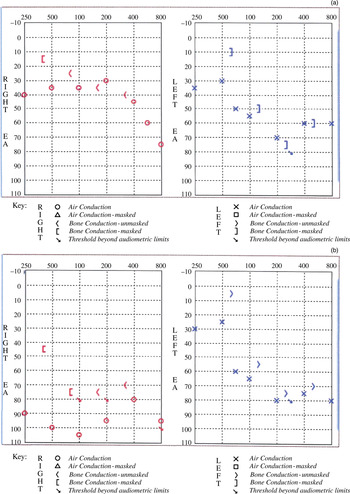
Audiological testing revealed an acute hearing loss from baseline of up to 70 dB in the (previously better hearing) right ear, and milder loss of 10–20 dB in the left ear (Figure 1a and 1b).
(a) Pre-trauma (5 July 2010) and (b) post-trauma (16 June 2011) pure tone audiograms.

The child attended specialist review 4 days after the injury. Oral steroids were commenced and further treatment discussed. Based on the reports by Nakashima et al. and Muzzi et al., the child was referred for hyperbaric oxygen therapy.Reference Nakashima, Ueda, Furuhashi, Yasue, Beppu and Ogawa1, Reference Muzzi, Zennaro, Visentin, Soldano and Sacilotto2 Despite treatment refusals at several centres, a hyperbaric centre was eventually found which was willing to offer treatment.
Fifteen hyperbaric oxygen sessions were provided on weekdays over three weeks, which were tolerated well. The sessions involved attaining a pressure of 2.0 absolute atmospheres (200 kPa) over 10 minutes (10 kPa/minute), followed by 90 minutes at 2.0 absolute atmospheres and then depressurisation over 10 minutes, in a large chamber containing seven patients and a nurse. An Amron hood was used with a latex seal around the neck and two pipes that delivered 100 per cent oxygen and removed exhaled gases. One session was cancelled after another patient had difficulty equalising their ears. During the rapid and noisy depressurisation required to remove this patient from the chamber, our patient experienced some right ear pain and did not proceed with therapy that day, giving a total of 14 sessions.
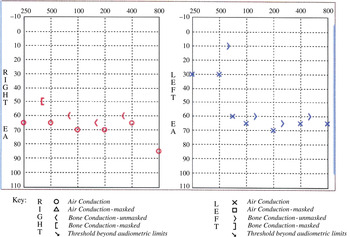
Post-treatment audiography showed a significant improvement in auditory thresholds in both ears. We noted a 40 dB threshold shift in the right ear and a return to pre-injury levels in the left ear.
At three month follow-up audiography, the patient's hearing had stabilised at the immediate post-treatment levels (Figure 2).
Post-treatment pure tone audiogram taken after three months' follow up (27 September 2011).

Discussion
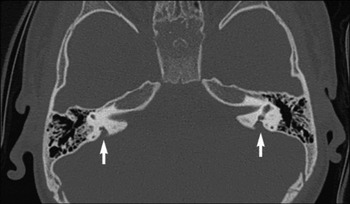
Large vestibular aqueduct syndrome was first described in 1978 by Valvassori and Clemis, who reported a series of 50 radiological investigations of enlarged vestibular aqueducts ranging from 1.5 to 8 mm in width and occurring in association with other inner ear anomalies and types of congenital hearing loss.Reference Valvassori and Clemis3 An aqueduct is considered enlarged if its anteroposterior diameter exceeds 1.5 mm. The condition is bilateral in most cases, and usually there is no history of hearing loss in the family.Reference Valvassori and Clemis3 A CT image demonstrating enlarged vestibular aqueducts is shown in Figure 3.
Axial computed tomography scan showing enlarged vestibular aqueducts (arrows). Reproduced with permission.Reference Kim, Song, Bae, Choi, Kim and Choi4

Large vestibular aqueduct syndrome is a congenital anomaly that is characterised by pre-lingual SNHL which is mild in the first few years of life but which thereafter deteriorates at a rate of 4 dB/year, resulting in severe hearing loss or deafness by adulthood.Reference Govaerts, Casselman, Daemers, De Ceulaer, Somers and Offeciers5
In 1989, Levenson et al. described large vestibular aqueduct syndrome as a distinct entity in the paediatric population, in a series of 12 cases in children aged between three and nine years.Reference Levenson, Parisier, Jacobs and Edelstein6 They proposed that the syndrome represented an aberration of the normal process by which the developing vestibular aqueduct and endolymphatic sac increase in size to reach maturity by the age of four years; in aberrant cases, hyperplasia occurs, predisposing to reflux of endolymphatic fluid into the basal end of the cochlear duct. Levenson et al. hypothesised that this was the cause of the progressive SNHL (with characteristic down-sloping pattern on pure tone audiography) seen in their patient group in association with trauma or other activities that caused sudden fluctuation in cerebrospinal fluid (CSF) pressure.
Madden et al. reviewed 1200 hearing-impaired paediatric patients and identified 77 with an enlarged vestibular aqueduct.Reference Madden, Halsted, Benton, Greinwald and Choo7 In this group, audiography results were stable in 51 per cent, fluctuated in 28 per cent and progressively worsened in 21 per cent. Vestibular aqueduct size at the operculum was significantly larger in patients with progressive hearing loss, compared with those with stable or fluctuating hearing.
Mild head trauma and intracranial pressure changes are widely noted to cause sudden SNHL in patients with large vestibular aqueduct syndrome.Reference Levenson, Parisier, Jacobs and Edelstein6–Reference Jackler and De La Cruz8
Long term management of large vestibular aqueduct syndrome may include the use of hearing aids and cochlear implants, which are safely fitted and beneficial in patients with this condition.Reference Asma, Anouk, Luc, Brokx, Cila and Van De Heyning9 Endolymphatic sac surgery has been shown to have no overall significant benefit in terms of hearing preservation.Reference Jackler and De La Cruz8, Reference Welling, Slater, Martyn, Antonelli, Gantz and Luxford10
Patients with large vestibular aqueduct syndrome and acute SNHL are difficult to treat due to the lack of convincing evidence that any one treatment regime improves outcome. Oral steroid therapy is frequently prescribed for idiopathic SNHL, as indicated by a survey of 266 UK otolaryngologists; however, other management varies widely.Reference Jarvis, Giangrande, John and Thornton11 Reviews of the use of both intratympanic steroids and oral steroids in acute SNHL concluded that intratympanic steroids may play a role in salvage therapy but that their effect appears equivalent to that of high dose oral prednisolone therapy.Reference Spear and Schwartz12, Reference Wei, Mubiru and O'Leary13 Agarwal and Pothier's review of the use of vasodilators and vasoactive substances similarly failed to find conclusive evidence of any benefit from these therapies.Reference Agarwal and Pothier14
• Traumatic hearing loss in large vestibular aqueduct syndrome is difficult to manage, with no successful treatment reported
• A paediatric case is presented, successfully treated with hyperbaric oxygen therapy
• Treatment was well tolerated
• Such treatment may benefit other paediatric patients
• It may be used together with oral steroid therapy
Hyperbaric oxygen therapy has been successful for SNHL which has failed to respond to medical therapy.Reference Muzzi, Zennaro, Visentin, Soldano and Sacilotto2 It has also shown benefit when used as an adjunctive therapy to steroids in acute hearing loss, with significant improvements compared with steroids only, steroids plus dextran and hyperbaric oxygen therapy alone.Reference Liu, Kang, Lee, Lin, Huang and Liu15, Reference Alimoglu, Inci, Edizer, Ozdilek and Aslan16 A Cochrane database review has also validated the use of hyperbaric oxygen therapy for early presentation idiopathic sudden SNHL, showing significant improvement in hearing loss.Reference Bennett, Kertesz and Yeung17
Factors identified as improving the outcome of hyperbaric oxygen therapy include early use of therapy, greater numbers of sessions, adjuvant steroid usage, profound hearing loss and low frequency hearing loss.Reference Muzzi, Zennaro, Visentin, Soldano and Sacilotto2, Reference Korpinar, Alkan, Yigit, Gor, Toklu and Cakir18
The use of hyperbaric oxygen therapy to treat sudden hearing loss in large vestibular aqueduct syndrome patients has been previously reported only twice, with both papers originating from Japan. The original case report involved a 14-year-old girl with acute, right-sided hearing loss.Reference Nakashima, Ueda, Furuhashi, Yasue, Beppu and Ogawa1 She was administered intravenous steroids for 7 days, followed by 7 days of alprostadil. She had no hearing improvement, and an auditory brainstem response could not be recognised. She subsequently received 22 sessions of hyperbaric oxygen therapy, following which her right-sided hearing gradually improved to the previous level.
A case series of 25 patients with large vestibular aqueduct syndrome has also been published by the same group.Reference Furuhashi, Sato, Nakashima, Miura, Nakayama and Mori19 Eleven of these patients suffered acute hearing loss. If there had been no spontaneous recovery by one week, patients received intravenous therapy including steroids, adenosine triphosphate disodium and vitamin B12. Three of the 11 patients recovered either spontaneously or with intravenous therapy. The remaining eight received hyperbaric oxygen therapy. In this group, the mean ± standard deviation of hearing recovery was 20.8 ± 12.1 dB, compared with 2.3 ± 7.2 dB for intravenous therapy. The authors suggested that hyperbaric oxygen therapy improves outcomes in large vestibular aqueduct syndrome patients as it lowers CSF pressure, thus reducing reflux of hyperosmolar endolymph into the cochlear duct. It also increases oxygen tension in the inner ear fluid, which suffers from impaired cochlear capillary blood flow in times of increased inner ear pressure.
Conclusion
This case highlights the safe and therapeutic use of hyperbaric oxygen therapy in a child with large vestibular aqueduct syndrome and sudden hearing loss. This is the first reported use of hyperbaric therapy for this indication in Australia. Following combined steroid and hyperbaric oxygen therapy, the patient had a 40 dB recovery in the right ear and a return to near-baseline in the left ear.
Large vestibular aqueduct syndrome is uncommon, and treatments for sudden hearing loss following head trauma in such patients remain empirical, as no medical or surgical interventions have been demonstrated to be significantly effective. Spontaneous recovery, particularly partial, does occur, although the rate of significant recovery is unknown. Long term, the usual course of hearing loss in this syndrome is one of inevitable decline.
Due to the rarity of large vestibular aqueduct syndrome, especially in Australian settings, large, prospective, randomised trials of treatment are unlikely to occur. In the presented patient, we observed a significant recovery in hearing thresholds after treatment with steroids and hyperbaric oxygen; however, whether this is more than could be expected after no treatment is as yet unclear. The potential therapeutic efficacy of hyperbaric oxygen in this condition would benefit from further study in a controlled trial.
Hyperbaric oxygen therapy can be tolerated well by children, and may be a potential treatment for SNHL in cases of large vestibular aqueduct syndrome. It can be used in combination with systemic steroids. This is the third paper to report hearing recovery after the use of hyperbaric oxygen in a child with large vestibular aqueduct syndrome.