INTRODUCTION
Episodic memory impairment is a key feature of Alzheimer dementia (AD) and its preclinical stage, often referred to as Mild Cognitive Impairment (MCI), which is related to atrophy of the medial temporal lobe, specifically the hippocampus (Tepest et al., Reference Tepest, Wang, Csernansky, Neubert, Heun and Scheef2008). Much research has focused on the early detection of episodic memory deficits to resolve the differential diagnosis, determine the disease progression, and determine whether a patient is eligible for a possible therapeutic intervention. One of the less investigated memory functions in dementia is spatial memory, although remembering where things are in our environment is a prominent aspect of episodic memory (i.e., remembering contextual information). In addition, memory for object locations, as part of spatial memory, is largely dependent on the hippocampus (Milner, Johnsrude, & Crane, Reference Milner, Johnsrude and Crane1997), making this potentially a sensitive measure of detection memory decline in the early stages of AD.
While evidence on object-location memory performance in MCI patients is lacking altogether, only a few studies have examined object-location memory in AD. In all these studies, objects were presented within a grid, thus limiting the number of locations, making the spatial tasks categorical in nature. For example, Bucks and Willison (Reference Bucks and Willison1997) showed that the performance of AD patients on the Location Learning Test (LLT), using 10 objects placed in a 5 × 5 grid, was already impaired in the early stages of the disease. In addition, Alzheimer patients have also been found to be impaired on the Hopkins Board consisting of a 3 × 3 grid with nine objects (Brandt, Shpritz, Munro, Marsh, & Rosenblatt, Reference Brandt, Shpritz, Munro, Marsh and Rosenblatt2005). Although profound deficits in object-location memory may be expected in patients with hippocampal dysfunction, memory for positional information (i.e., the actual locations regardless of the item identity), may be affected to a lesser degree. That is, dissociations have been reported between tasks in which objects have to be bound to locations in a grid compared with tasks, in which only positional information in a grid is relevant. For, example, categorical object-location binding was found to rely on the hippocampal formation (Kessels, Hendriks, Schouten, Van Asselen, & Postma, Reference Kessels, Hendriks, Schouten, Van Asselen and Postma2004; Piekema, Kessels, Mars, Petersson, & Fernández, Reference Piekema, Kessels, Mars, Petersson and Fernández2006), whereas categorical positional memory has been found to be mediated by the posterior parietal cortex (Postma, Kessels, & Van Asselen, Reference Postma, Kessels and Van Asselen2008). With respect to categorical positional memory, Adelstein, Kesner, and Strassberg (Reference Adelstein, Kesner and Strassberg1992) examined a group of Alzheimer patients in the mild-to-moderate stages of the disease. Subsequent trials consisting of a 4 × 4 grid with an X in one of the cells were presented and the participants had to remember the locations of this X. Here, memory for the last three presented trials was relatively preserved in the mild, but not in the moderate, AD patients. Thus, it can be hypothesized that amnestic MCI patients, in which the neocortical atrophy may be relatively mild in comparison to the hippocampal atrophy, may show intact positional recall compared to object-location binding. Using the LLT, the current study disentangles categorical positional recall and object-location recall in a group of AD and MCI patients.
METHODS
Participants
Patients were examined at the outpatient memory clinic of the Alzheimer Centre Nijmegen at Radboud University Nijmegen Medical Centre, The Netherlands. Thirty AD patients participated (10 males), all fulfilling the AD criteria described by McKhann, Drachman, Folstein, Katzman, Price, and Stadlan (Reference McKhann, Drachman, Folstein, Katzman, Price and Stadlan1984), that is, overall cognitive decline as measured with the Mini Mental State Examination (MMSE; Folstein, Folstein, & McHugh, Reference Folstein, Folstein and McHugh1975), next to a deficit in episodic memory as measured with the Rey Auditory Verbal Learning Test (RAVLT; Van der Elst, Van Boxtel, Van Breukelen, & Jolles, Reference Van der Elst, Van Boxtel, Van Breukelen and Jolles2005) and a functional decline in activities of daily life. In addition, 30 patients were included who were diagnosed with amnestic MCI, fulfilling the Petersen (Reference Petersen2004) criteria (17 males). Here, a deficit in episodic memory had to be present as measured with the RAVLT, without a functional decline in activities of daily living (i.e., no dementia). All diagnoses were made using a multidisciplinary approach, supported by clinical interviews, physical examination, or cerebrospinal fluid abnormalities or neuroradiological findings to exclude other etiologies, such as intracranial tumors or stroke. A group of 40 healthy matched older volunteers without cognitive decline (26 males; MMSE > 27) was recruited for control purposes. The data collection was completed in accordance with the ethical guidelines outlined in the declaration of Helsinki.
Materials and Procedure
The Dutch version of the National Adult Reading Test (NART) (Schmand, Lindeboom, & Van Harskamp, Reference Schmand, Lindeboom and Van Harskamp1992) was used to estimate premorbid verbal intelligence level. The LLT was administered to examine memory for object locations. This test was developed by Bucks and Willison (Reference Bucks and Willison1997) and a slightly modified administration procedure was applied here using a shorter presentation time and a longer delay period (Kessels, Nys, Brands, Van den Berg, & Van Zandvoort, Reference Kessels, Nys, Brands, Van den Berg and Van Zandvoort2006). The test consists of a 40 × 40 cm board on which 10 gray-scaled pictures of every-day, asy to name objects (umbrella, wallet, scissors, book, envelope, knife, coffee cup, glasses, box of matches, boot) were placed at different locations in a 5 × 5 grid. This board was presented for 15 seconds, after which the objects (using cards) had to be relocated as accurately as possible on an empty 5 × 5 grid, with no time restriction. After five learning trials, in which the same stimulus was shown, delayed recall was tested after 20–30 min.
Two performance measures were computed for the LLT. First, for each of the five learning trials as well as for the delayed trial, the displacement score was determined, that is, the sum of the errors made for each object placement on that trial. A placement error was calculated by counting the number of cells the object had to be moved both horizontally and vertically to be in the correct location (Bucks, Willison, & Byrne, Reference Bucks, Willison and Byrne2000). The displacement score reflects the ability to bind objects to their locations in memory. Second, a positional error measure was calculated, using the Object Relocation software (Kessels, Postma, & De Haan, Reference Kessels, Postma and De Haan1999), analyzing only the locations of the relocated objects and discarding the objects’ identities. Because it is difficult to determine which relocated position belongs to which original position, a best-fit score was computed: all possible deviations between original and relocated positions were computed (based on the coordinates of the center of the grid cells), and the fit resulting in the smallest error (in cm) is considered to be the best-fit configuration (see Kessels et al., Reference Kessels, Postma and De Haan1999, for a detailed discussion). Although the best-fit error is presented in cm, this is for presentation purposed only, since the positions within the grid are obviously defined by the grid cells and thus categorical in nature. However, larger deviations present a worse positional recall (Van Asselen, Kessels, Kappelle, & Postma, Reference Van Asselen, Kessels, Kappelle and Postma2008). The area under the curve (AUC) of the receiver operating characteristics curve was computed for the mean performance of the five learning trials for the best-fit score and displacement score of the LLT as an estimate of diagnostic accuracy for discriminating AD from MCI patients.
RESULTS
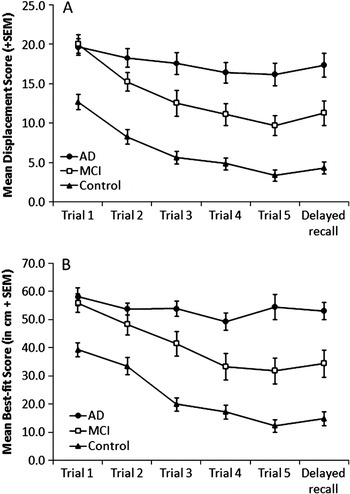
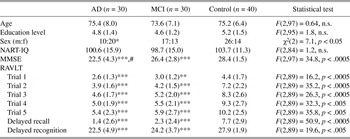
Table 1 shows the results for the three groups on the demographic and background variables RAVLT, MMSE, and NART-IQ. Figure 1 shows the displacement scores and the best-fit deviation scores for the learning trials and delayed recall of the LLT for the three groups. A doubly multivariate analysis of repeated measures (General Linear Model) was performed with Trial (six levels: five learning trials + delayed recall) as within-subject factor, the factor Group (controls vs. MCI vs. AD) as between-subject factor, with two Measures (displacement scores and best-fit deviation scores), including sex as a covariate to control for the unequal sex distribution across the groups. Post hoc testing was performed using Bonferroni correction. Multivariate results showed a main effect of Group (F(4,190) = 13.2; p < .0005;  = .22); post hoc testing indicated significant differences in performance between all three groups, with the AD patients performing worse than the MCI group and the MCI group performing worse than the controls, both for the displacement scores (p values < .013) and the best-fit deviation scores (p values < .009). In addition, an overall main effect for Trial was found (F(10,86) = 2.7; p < .007;
 = .24), as well as an interaction between Group and Trial (F(20,174) = 1.7; p < .04;
 = .16). The covariate sex did not significantly contribute to these results (F(2,94) = .12). Subsequent univariate analyses for both error measures separately showed a significant main effect of Group (F(2,96) = 34.9; p < .0005;
 = .42) and Trial (F(5,480) = 47.7; p < .0005;
 = .33), as well as a Group × Trial interaction (F(10,480) = 4.1; p < .0005;
 = .08) for the displacement scores. Post hoc testing showed that both the AD and the MCI group performed worse than controls (p < .0005) and that the AD group performed worse than the MCI group (p < .02). For the best-fit deviation scores, significant main effects of Group (F(2,96) = 34.5; p < .0005;
 = .42) and Trial (5480) = 36.9; p < .0005;
 = .28) were found also, as well as a Group × Trial interaction (F(10,480) = 6.1; p < .0005;
 = .11). Post hoc testing showed that significant Group × Trial interaction was found for the AD group compared with the MCI group (p < .0005) and the controls (p < .0005). No Group × Trial interaction was found for the MCI group compared with the controls. The diagnostic value to discriminate MCI from AD patients was higher for the LLT best-fit deviation score (AUC = 0.76; p < .001; 95% confidence interval [CI] = .64–.89) than the LLT displacement score (AUC = .69; p < .011; 95% CI = .56–.83).
Mean (+SEM) displacement score (A) and best-fit score in cm (B) on the five learning trials and the delayed recall on the Location Learning Test for the Alzheimer (AD), Mild Cognitive Impairment (MCI), and control group.

Demographic variables (mean+SD), NART-IQ, MMSE, and RAVLT performance for the Alzheimer dementia (AD) patients, the MCI group, and the healthy controls

Note
NART = National Adult Reading Test; MMSE = Mini Mental State Examination; RAVLT = Rey Auditory Verbal Learning Test; post hoc comparison with MCI group: #p < .05; post hoc comparison with control group: *p < .01, **p < .001, ***p < .0005.
DISCUSSION
Results show that the AD group performed worse than the MCI patients on the LLT. Both patient groups performed worse than the controls and the LLT was also able to discriminate between MCI and AD patients. Although the MCI group performed overall worse than the controls, the learning curves for both positional and object-location recall were the same. In contrast, the learning curves for the AD group was relatively flat for both recall measures. Interestingly, no evidence for rapid forgetting was found on the LLT, neither in the MCI group nor in the AD patients. Our findings extend previous results showing that the LLT can be used to discriminate AD patients from healthy older participants (Bucks et al., Reference Bucks, Willison and Byrne2000). Because spatial memory function strongly relies on the hippocampus, these findings are in line with the hippocampal atrophy that is consistently found in amnestic MCI patients and that gradually increases during the conversion from MCI to AD (Tepest et al., Reference Tepest, Wang, Csernansky, Neubert, Heun and Scheef2008). Focusing on the distinction between positional recall (i.e., recall of the positions regardless of the object identity) and object-location recall, both measures appear to distinguish between MCI and AD patients equally well, although the diagnostic value of the best-fit score was slightly higher. Since we do not have detailed neuroimaging data of all our participants, future studies should focus in more detail on the relation between positional and object-location recall and measures of hippocampal volume in MCI and AD patients. Since the LLT only measures memory for categorical spatial information, it would be interesting to directly compare categorical spatial memory with coordinate spatial memory tests (i.e., which require relocation within an empty square with no grid or premarked dots present, see, e.g., Postma et al., Reference Postma, Kessels and Van Asselen2008). Furthermore, the best-fit score that we have computed is a measure of positional recall, that is, the ability to retrieve (categorical) positional information independent of the object present. However, it is not a pure measure of positional encoding, because 10 different objects were always presented at the different locations during the learning trials.
Of interest, there was no performance difference between MCI and AD patients on the RAVLT. Although we are reluctant to interpret this finding in great detail, because the RAVLT performance was used in the diagnostic process to support the clinical diagnosis of MCI or AD, this is not in agreement with a previous study demonstrating that the RAVLT is potentially useful in discriminating MCI and AD patients (Estévez-González, Kulisevsky, Boltes, Otermín, & García-Sanchéz, Reference Estévez-González, Kulisevsky, Boltes, Otermín and García-Sánchez2003). However, the groups included in that study were not age-matched (with the controls on average being over 10 years younger than the AD group and the age of the MCI patients in between). Because age greatly affects performance on the RAVLT (Van der Elst et al., Reference Van der Elst, Van Boxtel, Van Breukelen and Jolles2005), this may have been the primary reason for the large performance differences between the AD and MCI groups in that study. This finding also emphasizes that a single memory test does not validly contribute to the differential diagnosis of MCI and AD, since it is the functional decline that is the defining criterion and not the extent of the memory impairment per se, especially in comparing MCI patients with AD patients in the early stages, as is the case in the present study. Still, our differential findings between the RAVLT and the LLT are in line with other studies. Although free recall, as applied in the RAVLT, has been found to be sensitive in discriminating MCI and AD patients, the ability to use cues to facilitate memory performance may be even a more valid measure (Ivanoiu et al., Reference Ivanoiu, Adam, Van der Linden, Salmon, Juillerat and Mulligan2005). Clearly, the LLT is a cued-recall test, in which participants do not have to remember the objects themselves, but relocate given objects to the correct position within the grid. Free recall of words is also more susceptible to other disturbing factors, such as mood or attention deficits, than cued recall of visual information (Ivanoiu et al., Reference Ivanoiu, Adam, Van der Linden, Salmon, Juillerat and Mulligan2005). Moreover, the cued-recall aspect may also explain why no evidence for rapid forgetting on the delayed trial was found on the LLT, whereas this is commonly found in verbal learning tests. The finding that only moderately large correlations between the RAVLT and LLT were demonstrated in a large sample of healthy participants (Kessels et al., Reference Kessels, Nys, Brands, Van den Berg and Van Zandvoort2006) supports the notion that both memory tests may rely—at least in part—on different neurocognitive processes.
In all, the LLT as a measure of cued recall of object locations is able to distinguish between MCI and AD patients. Investigating the ability to recall the positions regardless of the objects presented adds little information compared to the object-location binding measure of the LLT. Still, the LLT as a nonverbal memory test may have important advantages over other nonverbal memory tests that often rely on visuoconstructional ability (e.g., Rey’s complex figure test) or consist of only a single learning trial per stimulus (e.g., the Doors Test or the Benton Visual Retention Test). In addition, spatial memory can be regarded as an ecologically valid cognitive function, but future studies should examine the relation between the LLT and every-day measures of spatial memory, such as way-finding or spatial navigation that has been found to be impaired in MCI and AD (Hort, Laczó, Vyhnálek, Bojar, Bures, & Vlcek, Reference Hort, Laczó, Vyhnálek, Bojar, Bures and Vlcek2007). Moreover, prospective research on the diagnostic accuracy of the LLT should be performed and its relation with medial temporal lobe function should be clarified.
ACKNOWLEDGMENTS
Roy Kessels was supported by a VIDI innovational research grant awarded by the Netherlands Organization for Scientific Research (NWO), #452-08-005. The authors would like to thank Mrs. Arenda van Beek for her assistance in recruiting the healthy volunteers and Mrs. Sanne van den Berg and Mrs. Ilja Klabbers for their assistance in testing the patients. None of the authors have any conflicts of interest to report.