Introduction
A considerable volume of research has been conducted examining the impact that the proportion of males in a specified context can have on a range of outcomes. These outcomes include marriage, divorce and fertility behaviour, but also outcomes that have been suggested to be influenced by relative competition for a sexual partner, such as labour supply. However, relatively little research has been conducted examining whether imbalances in the adult sex ratio might have an impact on health. Examples of the research that has been done include studies investigating how the contextual sex ratio at sexual maturity affects mortality risk (Jin et al., Reference Jin, Elwert, Freese and Christakis2010), how occupational segregation by gender affects a range of health outcomes, and whether the sex composition of workplaces affects morbidity and sickness absenteeism. However, studies investigating the effect of the sex ratio within workplaces have generally been limited by access to data. Subsequently, most research in this field has focused upon whether males and females have occupations that are male- or female-dominated, or whether these occupations fall within male- or female-dominated sectors of the economy (Alexanderson & Östlin, Reference Alexanderson, Östlin and Marklund2001).
Research into occupational segregation by gender has mainly used this measure as a proxy for the actual sex composition of the workplace at which an individual works (Leijon et al., Reference Leijon, Hensing and Alexanderson2004; Mastekaasa, Reference Mastekaasa2005; Östlin et al., Reference Östlin, Klerdal and Hammar2008). However, knowing that a male or female works in a male- or female-dominated occupation does not necessarily tell us very much about the sex ratio within his or her actual workplace, and thus is not a suitable proxy measure (Mastekaasa, Reference Mastekaasa2005). Measures of occupational segregation by gender are also an attempt to capture the extent to which a job has, in broad terms, developed over time to suit one gender or another (Leijon et al., Reference Leijon, Hensing and Alexanderson2004), leaving the minority gender at a systematic disadvantage. Past research on occupational segregation by gender has often found that men and women in occupations dominated by the opposite sex have poorer health, usually as measured by sickness absenteeism, or self-reports.
This study uses Swedish register data to identify the sex ratio within discrete workplaces to investigate how the sex composition of one's work site may affect mortality risk. To the knowledge of the author, only four studies have been conducted examining the relationship between the sex ratio within the actual worksite and health (Hensing & Alexanderson Reference Hensing and Alexanderson2004; Mastekaasa, Reference Mastekaasa2005; Svedberg et al., Reference Svedberg, Bildt, Lindelöw and Alexanderson2009; Bryngelson et al., Reference Bryngelson, Hertzman and Fritzell2011). Only one of these used administrative register data (Mastekaasa, Reference Mastekaasa2005), and all four examined morbidity, measured by self-reported health and/or sickness absenteeism. The studies conducted by Hensing and Alexanderson (Reference Hensing and Alexanderson2004), Svedberg et al. (Reference Svedberg, Bildt, Lindelöw and Alexanderson2009) and Bryngelson et al. (Reference Bryngelson, Hertzman and Fritzell2011) used survey data. Svedberg et al. (Reference Svedberg, Bildt, Lindelöw and Alexanderson2009) found that sex segregation was associated with a wide range of self-reported ill-health symptoms for men, but not for women. Hensing and Alexanderson (Reference Hensing and Alexanderson2004) found that in general women working as metal workers at female-dominated work sites took more sick leave than women in the same occupation working at male-dominated work sites.
The study conducted by Mastekaasa (Reference Mastekaasa2005) used Norwegian administrative register data and found that sickness absenteeism for men was largely unrelated to the workplace sex ratio, but sickness absenteeism for women was higher in female-dominated workplaces – results corroborated by Bryngelson et al. (Reference Bryngelson, Hertzman and Fritzell2011). Interestingly, the effect of occupational segregation by gender on health diminished substantially after controlling for the actual sex ratio within the workplace (Mastekaasa, Reference Mastekaasa2005). To a certain extent, research on mortality avoids a number of the problems involved with investigating sickness absenteeism. Part of the theoretical analysis of how the gender composition of the workplace and occupational segregation by gender affects sickness leave is through changing individual norms regarding how and when they ought to take remedial steps to care for their own health, and how this will be affected by the behaviour in this regard of those around them. This is the absence culture hypothesis (Mastekaasa, Reference Mastekaasa2005). For example, individuals in an environment where people tend to be stoical about illness may be less likely to take sick days themselves for minor problems. Likewise, in an environment where people take days off from work because they have a headache, the threshold for acceptable and legitimate absenteeism is considerably lower. Mortality in the working age population is rather different as individuals have less choice in regards to this outcome.
Sex ratios in the workplace: the Swedish civil service
This study will focus upon the Swedish civil administrative service (Vinde, Reference Vinde1970). There are two main reasons for this selection. The first is that it was judged important to consider a work environment that could neither be described as highly dangerous, nor unduly stressful in relative terms (Marmot, Reference Marmot2004). By the term ‘Swedish civil service’, this study refers to the public administrative bureaucracy. This group of workers within the public sector is not as clearly delineated in Sweden as it could be said to be in other EU countries such as the UK or Germany, but by identifying workplaces that are filled with white-collar administrative and managerial workers within the public sector, it can be argued that this study has identified a comparable group. The second reason for focusing upon the Swedish civil service is that it draws parallels with the Whitehall studies (Marmot et al., Reference Marmot, Davey-Smith, Stansfeld, Patel, North and Head1991), both of which were landmark research projects investigating the relationship between health, social status and structural occupational factors.
The Swedish civil service consists of three different levels: ministries, agencies and local government (Vinde, Reference Vinde1970; Pierre, Reference Pierre, Painter and Peters2010). Each level can be said to have a significant degree of autonomy, with relatively little top-down management (Pierre & Ehn, Reference Pierre, Ehn, Page and Wright1999; Pierre, Reference Pierre, Painter and Peters2010). The organization of the public bureaucracy in Sweden has been strongly resistant over time to macroeconomic fluctuations, cutbacks in public expenditure and tax reductions; this is partly due to the decentralized nature of the Swedish civil service, but this decentralization has also been reinforced by these macro-level changes (Pierre, Reference Pierre, Painter and Peters2010). A further advantage of focusing upon the Swedish civil service is that horizontal mobility is relatively low, and has been decreasing over time, both within the public bureaucracy, as well as between the public and private sector, and this is true for both junior and senior civil servants (Pierre & Ehn, Reference Pierre, Ehn, Page and Wright1999). The benefit of this is that the individuals in this study will, relatively speaking, be exposed to a similar environment over the time period that they are under risk, and should be less likely to be censored because of moving to a new job outside of the civil service.
Sex ratios in the workplace and health: potential explanatory mechanisms
There are several plausible mechanisms by which the sex composition of the workplace could be related to increased mortality risk. A higher proportion of males in the workplace might lead to an increased exposure to risky health behaviours and unhealthy dietary patterns. Since males are in general more likely to engage in consumption pattern detrimental to health than females, such as excessive alcohol consumption and an unhealthy diet, an increased proportion of males would increase social opportunities for these behaviours to take place, and increased opportunities might thereby lead to increased exposure to risk (Kraft et al., Reference Kraft, Blum, Martin and Roman1993; Von Bothmer & Fridlund, Reference Von Bothmer and Fridlund2005). Past research has indicated that females consume less alcohol in female-dominated workplaces (Savikko et al., Reference Savikko, Lanne, Spak and Hensing2008), and more alcohol in male-dominated workplaces (Haavio-Mannila, Reference Haavio-Mannila1992). The sex composition of a workplace has also been shown to be related to patterns of sickness absenteeism, particularly for females, with research generally indicating that absenteeism is greater in female-dominated workplaces and lower in male-dominated workplaces (Hensing & Alexanderson, Reference Hensing and Alexanderson2004; Mastekaasa, Reference Mastekaasa2005; Bryngelson et al., Reference Bryngelson, Hertzman and Fritzell2011). Some studies have suggested that males may also be more likely to engage in sickness presenteeism behaviour – the behaviour of coming to work when sickness absence would be justifiable – and it is possible that this is particularly common in male-dominated workplaces.
Finally, there are a number of factors related to psychosocial stress that may vary systematically by the sex composition of workplaces. It has been suggested that individuals in the minority in a work site are more likely to suffer from stress due to increased visibility, stereotyping and in-group/out-group social psychological processes (Kanter, Reference Kanter1977). Previous research also suggests that the gender group in the minority, whether male or female, is more likely to suffer from sexual harassment as well as less severe incidents of generalized abuse, though this is particularly pronounced for females (Gruber, Reference Gruber1998; Richman et al., Reference Richman, Rospenda, Nawyn, Flaherty, Fendrich, Drum and Johnson1999; McDonald, Reference McDonald2012). Furthermore, surveys indicate that male-dominated workplaces have a higher incidence rate of workplace bullying, minor abuse and general conflict, with males more often the victims than women, resulting in the workplace being a more stressful environment (Einarsen & Skogstad, Reference Einarsen and Skogstad1996; Einarsen & Raknes, Reference Einarsen and Raknes1997; Brousse et al., Reference Brousse, Fontana, Ouchchane, Boisson, Gerbaud and Bourguet2008). A small amount of research has also been conducted to investigate how competitive and stressful interactions between males and females affect cardiovascular reactivity. These studies have indicated that cardiovascular reactivity increases for both males and females when competing against males (Holt-Lunstad et al., Reference Holt-Lunstad, Clayton and Uchino2001), and other research has suggested that a supportive female environment can lower cardiovascular reactivity, while a supportive male environment fails to do so (Glynn et al., Reference Glynn, Christenfeld and Gerin1999). Overall, these studies indicate that relative to female-dominated workplaces, male-dominated workplaces are more likely to be characterized by patterns of dietary and alcohol consumption that are detrimental to health, that individuals in these workplaces will be less likely to take time off work to recover when ill, and that these male-dominated workplaces are likely to be more stressful for both males and females in several different respects.
Data and Methods
This study used Swedish administrative register data over the period 1995 to 2007. The Swedish occupational registers have considerably greater longitudinal depth than the 12 years under analysis in this study, but are limited in terms of the fact that occupation was not recorded before 1995. Previous research has demonstrated that occupation and occupational status play a very important role in influencing health, and this influence cannot be said to be entirely consistent with income levels (Marmot et al., Reference Marmot, Davey-Smith, Stansfeld, Patel, North and Head1991; Marmot, Reference Marmot2004). Although an analysis without occupation would have been possible from the period 1985 to 2007 for some of the occupational registers, the analysis would have been undermined by the absence of information on this crucial variable.
Identification of civil service workplaces
The Swedish government employs a large number of people, and the occupations held by these individuals cover a wide range. Compared with countries such as the United Kingdom and Germany, the equivalent Swedish civil administrative service is less clearly delineated. To accurately identify and classify workplaces as falling within the category of the administrative civil service this study has used information in the database on the sector code for the workplace, as well as the occupations of individuals. The first step was to consider only those workplaces that were identified by the sector code as being within the central government (Statlig förvaltning), primary local government (Primärkommunal förvaltning) or county government (Landsting). Secondly, individuals within these three sectors whose occupations were clerks or higher were classified as civil servants, as identified by the Swedish Standard Classification of Occupations (Svensk Yrkesklassificering – SSYK) occupational codes that are utilized in Sweden (Statistics Sweden, 2011). In terms of the categories for occupation used, and described below, these are employees with occupations coded from 1000 to 4000 in the SSYK.
Finally, the proportion of civil servants within each workplace was calculated. Only those individuals working within workplaces where the number of civil servants as a proportion of the total number of individuals in the workplace was 80% or higher are considered under risk for the analysis. The choice of 80% is arbitrary but the results presented below are robust to other specifications. The reason for the decision not to specify that workplaces should be 100% populated by civil servants was that many of these workplaces also have a small number of support staff registered, such as office cleaners. Using the 100% specification meant that the sample size was drastically and unnecessarily reduced.
Censoring
Observations were censored when they had left a workplace designated as belonging to the Swedish civil service for any reason, for example if they were retiring, or changing job to another workplace outside the civil service. Those that had moved to a different workplace within the civil service remained under risk. All observations were treated as being under risk if they were registered within a civil service workplace, including those who entered the civil service after 1995. If part-time employees were registered as working in the civil service they were also considered under risk. Any observations who may have left the civil service and later returned within the period 1995 to 2007 were considered under risk for the spells that they were registered at civil service workplaces.
Outcome variable: mortality
The outcome variable, mortality, was drawn from the Swedish mortality register. This register contains information on both the date of death, as well as the cause of death. The main focus of this study is all-cause mortality, but separate analyses are conducted for the major causes of death to ascertain what is driving the results for all-cause mortality. These deaths were identified using the International Statistical Classification of Diseases and Related Health Problems (ICD), versions 9 and 10.
Key independent variable of interest: proportion of males in the workplace
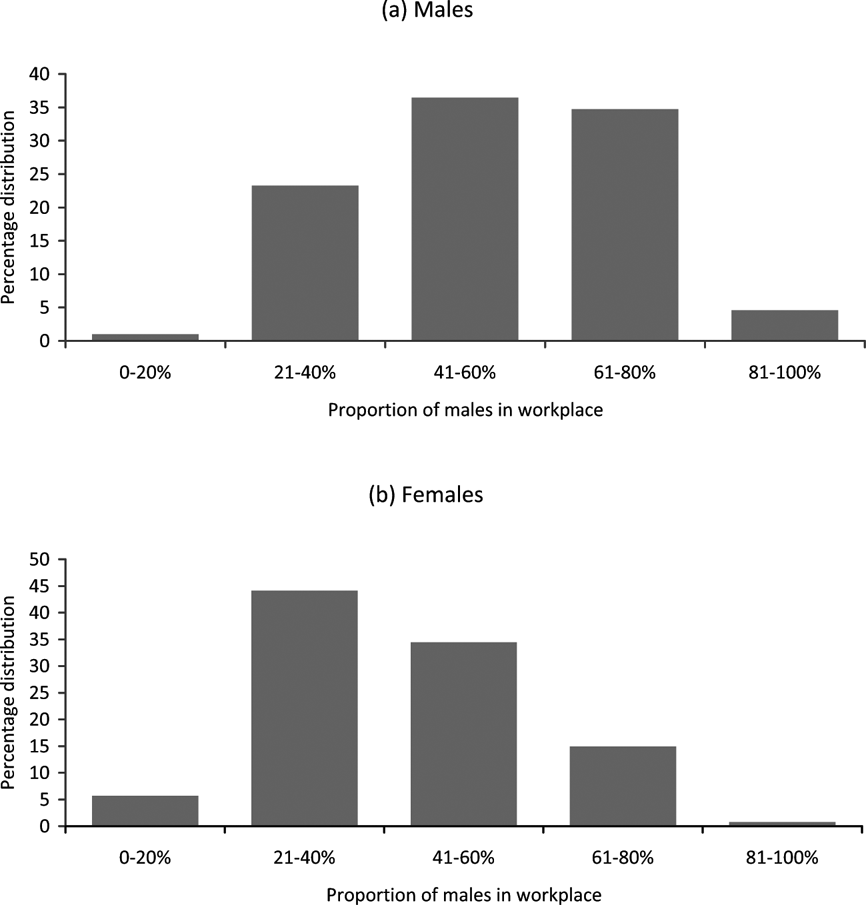
The proportion of males in the workplace was calculated by dividing the total number of males in each workplace by the total number of people in each civil service workplace. Thus, this measure falls on a scale of 0 to 100. The reported hazard ratios (HRs) therefore refer to the increased or decreased hazard associated with a 1% increase in the proportion of males in the workplace. The histograms in Fig. 1 show the percentage distribution of observations within five categories of the proportion of males in the workplace. They depict the distribution within the workplaces under analysis, not in Sweden as a whole. Analyses are conducted using both a linear and a categorical term for the proportion of males in the workplace, the categorical terms using the same groups as shown in Fig. 1.
Percentage distribution of male (a) and female (b) samples within workplaces, Swedish civil service, 1995 to 2007

Covariates
The following variables were drawn from, or calculated using, the STAR registers: age, family status, education, occupation, occupational segregation by sex, level of government, region by county (län), period, age structure of workplace, age structure of workplace by sex, occupational structure of workplace, modal educational level at workplace, total number of individuals.
To briefly comment on the other covariates, it should be noted that the legal age of retirement in Sweden was 65 for the period over which this analysis is being conducted (Palme & Svensson, Reference Palme, Svensson, Gruber and Wise1999), and this was enforced in the public sector. It follows that the sample for these analyses will consist of males and females of age 65 or younger. The family status categories (unmarried, married, divorced and widowed) include both opposite-sex and same-sex partnerships. During the study period the Swedish registers did not contain data on cohabitation. Thus the unmarried category includes both single individuals as well as unmarried individuals who cohabit and may or may not have a child with their partner. Cohabitation without marriage is very common in Sweden. For occupation, observations were classified according to the SSYK occupational codes (Statistics Sweden, 2011): SSYK-1: legislators, senior officials and managers; SSYK-2: professionals; SSYK-3: technicians and associate professionals; SSYK-4: clerks; SSYK-Other: all other occupations.
The variable ‘Occupation Segregation’ in the results tables below refers to the proportion of males within the occupation of a given individual in a given year, and this is a linear term. This was calculated using all the data available in the occupational registers, and is not a calculation within the Swedish civil service alone. A number of variables were calculated at the level of the workplace, and these include the structure of the workplace by age, age and sex, occupation, education and the total number of workers at the workplace.
Analysis
Piecewise constant survival models were used to estimate the impact of the proportion of males in the workplace upon mortality risk. The proportional hazards model λi(t|xi), where the hazard at time t for an individual with time-varying covariates xi, is assumed to be:
 $$\lambda_i (t | x_i) = \lambda_0 (t) \exp \{ x'_i \beta \}$$
The baseline hazard is indicated by λ 0(t), and exp{x′iβ} refers to the relative risk associated with the set of characteristics x i. The baseline hazard is age. The total period of 12 years over which the subjects are under observation were split into twelve yearly sub-periods, because the occupational data register is updated once each year, in November. These models were estimated using cluster-adjusted standard errors to account for any potential intra-group correlation (Primo et al., Reference Primo, Jacobsmeier and Milyo2007). The clusters in this study are the workplaces in which the individuals within the sample are employed.
Results
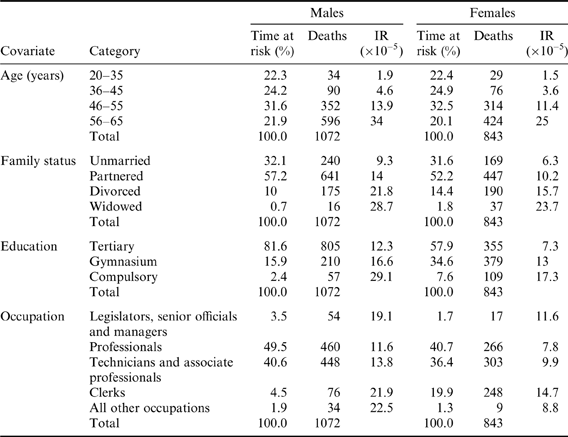
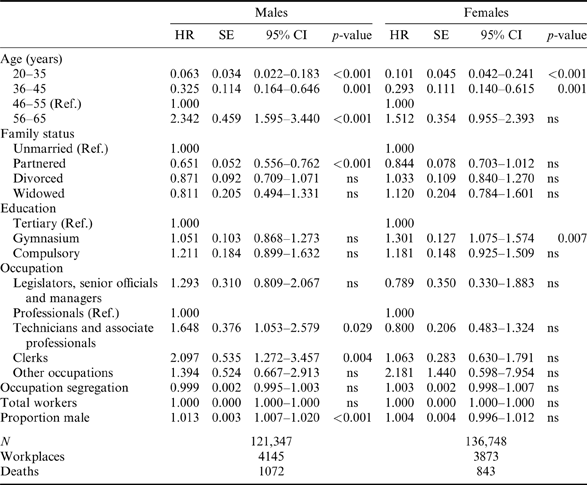
Descriptive statistics for the all-cause mortality analyses are given in Table 1. The incidence rate (IR) in Table 1 describes the number of new cases per population in a given time period. The time at risk for each category of each covariate refers to the percentage of the total person-years that each category contributes to the total exposure. As can be seen in Table 2, there is a positive and significant relationship between the proportion of males in the workplace and all-cause mortality risk for males, with a 1% increase in the proportion of males in the workplace associated with a 1.3% increase in the risk of mortality (HR 1.013, 95% CI 1.007–1.020, p<0.001). However, in contrast to males, the proportion of males in the workplace is not significantly associated with all-cause mortality risk for females at the p<0.05 level (HR 1.004, 95% CI 0.996–1.012, p=0.297).
Distribution of time at risk, deaths and incidence rates (IR) for males and females Swedish civil service, 1995 to 2007
Survival analysis for males and females: all-cause mortality, Swedish civil service, 1995 to 2007
Estimates not shown for level of government, period, region and structure of workplace in regard to age, age by sex, occupation and education.
Ref.: reference category.
Looking at some of the other results, the estimates for occupational segregation by gender for both males and females are consistent with earlier research, as past findings have suggested that the higher the proportion of one's own gender in a given occupation, the lower the associated health risks should be. These results suggest that males have a decreased mortality risk when working in occupations that are dominated by males, and females have an elevated mortality risk when working in occupations that are dominated by males. However, neither of these results was statistically significant. The hazard ratio associated with the proportion of males in the workplace when this variable for occupational segregation by gender was excluded was very similar for both males (HR 1.010, 95% CI 1.004–1.016, p=0.002) and females (HR 1.004, 95% CI 0.997–1.012, p=0.287). The full results from these analyses are available from the author upon request.
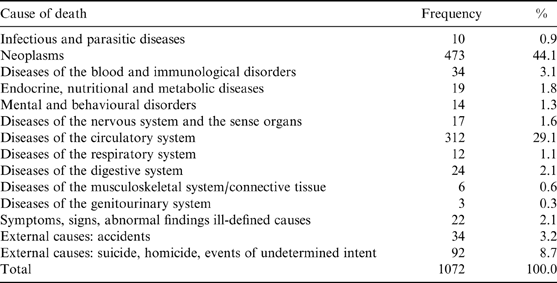
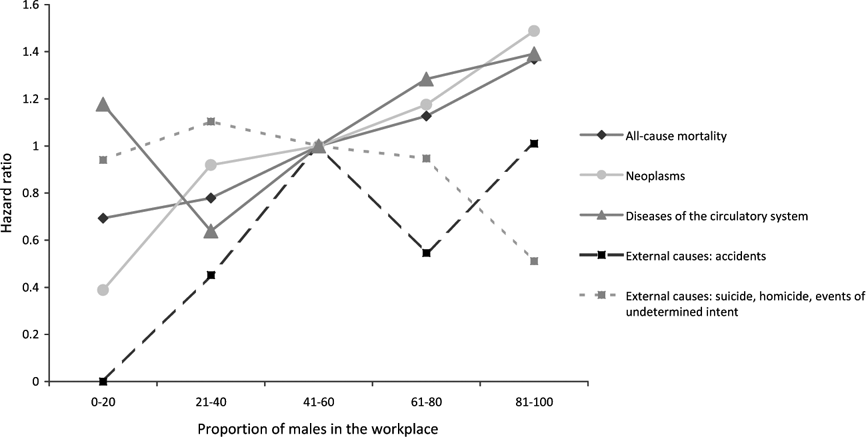
Table 3 is a frequency table for the major different sub-categories of causes of death amongst males, and shows that neoplasms and diseases of the circulatory system constituted the two largest causes of death amongst males in this sample. Additional analyses were conducted to investigate the relationship between the linear term for the proportion of males in the workplace and mortality risk for each of the sub-categories of cause of death, adjusting for the same variables as in the all-cause mortality model shown above. A statistically significant relationship was found between the linear term for the proportion of males in the workplace and the following causes of death: neoplasms (HR 1.012, 95% CI 1.002–1.021, p=0.020), diseases of the circulatory system (HR 1.015, 95% CI 1.002–1.028, p=0.019) and diseases of the respiratory system (HR 1.047, 95% CI 1.014–1.081, p=0.005). The result for mortality attributable to mental and behavioural disorders, which include alcohol abuse and drug dependence, approached statistical significance (HR 1.051, 95% CI 0.998–1.108, p=0.060). Following this, these analyses were repeated using a categorical term for the proportion of males in the workplace, with categories 0–20%, 21–40%, 41–60%, 61–80% and 81–100% males, again also conducting these analyses for the major sub-categories of causes of death, adjusting for the same variables. The results for these categorical analyses are shown in Fig. 2.
Frequency table for causes of death for males, Swedish civil service, 1995 to 2007
Relative risks of major causes of death for males, Swedish civil service, 1995 to 2007
Plots are included for all-cause mortality, as well as those sub-categories of causes of death that constitute 5% or more of the total number of deaths. This means that Fig. 2 shows plots for all-cause mortality, mortality related to neoplasms, diseases of the circulatory system and external cause deaths that resulted from suicide, homicide or events of undetermined intent. Furthermore, a plot is included for external causes of death due to accidents, so as to make clear that these deaths are not responsible for the observation of a spurious relationship between the proportion of males in the workplace and all-cause mortality. As can be seen, the trend for all-cause mortality is in fact remarkably linear, meaning that it is possible to have confidence in the significant hazard ratio estimated for the linear term of the proportion of males in the workplace.
The two largest sub-categories of cause of death are neoplasms and diseases of the circulatory system, and it is clear that these two causes of death are strongly driving the all-cause mortality trend. With a gendered-balanced workplace as the reference category, the association between the proportion of males in the workplace and death related to neoplasms is very much lower in workplaces with 0–20% males, and substantially elevated in workplaces where the proportion of males is higher than 61%. There is a similar trend for deaths related to diseases of the circulatory system. However, surprisingly, the relative risk of mortality within this category is also substantially elevated in workplaces with 0–20% males. The third largest contributor to the total number of mortalities is external causes related to suicide, homicide or events of undetermined intent. This trend is slightly less dramatic, but overall the relative risk of mortality can be seen to be decreasing as the proportion of males in the workplaces increases.
Finally, external causes of death due to accidents were lower in all workplaces relative to the reference category of gender-integrated workplaces, except for being very slightly elevated in workplaces where the proportion of males was greater than 80%. Given the relatively low number of deaths in this category (34), and the negative relationship between the proportion of males in the workplace and external causes of death due to suicide, homicide and events of undetermined intent, it is clear that external causes of death are not responsible for the association between the proportion of males in the workplace and all-cause mortality. Separate analyses were also conducted for the other causes of death shown in Table 3. The majority of these causes of death were positively associated with the proportion of males in the workplace. However, due to the small number of mortalities in some of the categories, and because of the sample distribution across workplaces in terms of the proportion of males, in several cases no mortalities occurred in either heavily male- or female-dominated workplaces where the proportion of males was 81–100% or 0–20%, respectively.
Given the high proportion of deaths attributable to neoplasms (44.1%), there was a concern that the proportion of males in the workplace might be related to differential rates of early retirement. If the proportion of males in the workplace could be related to patterns of sickness presenteeism, it seemed very possible that the proportion of males could also affect the likelihood that an individual would remain registered at his or her workplace after being diagnosed with a serious illness. In other words, if individuals were more likely to retire early when they became seriously ill in workplaces with a lower proportion of males, then this could account for the results observed in the previous analyses. To address this concern, further analyses were conducted for males and females to account for these selection effects. In these analyses, those who retired early were retained in the sample population, rather than being censored. Information regarding early retirement was accessed by using a variable for the early retirement pension available to the employees in the sample. Because those who retired early had missing values for the occupation- and workplace-related variables in the period after they had left their job, the values for these variables were held constant from the last year that they had been employed within the Swedish civil service before retiring.
Despite these concerns, the results were almost exactly the same. For males, the total number of deaths increased from 1072 to 1287, and for females the total number of deaths increased from 843 to 1055. As with the analysis without correcting for selection effects, a 1% increase in the proportion of males was associated with a 1.3% increase in the risk of mortality (HR 1.013, 95% CI 1.007–1.019, p<0.001). The results for females were not statistically significant (HR 1.003, 95% CI 0.996–1.010, p=0.434). These analyses also included a dummy variable for whether a given individual had retired early or not. As one would expect, those who retired early had a significantly greater mortality risk before the age of 65 than those who had not. For males the increased relative risk was 6.879 (RR=6.879, 95% CI 5.969–7.928, p<0.001), and for females the increased relative risk was 5.997 (RR=5.997, 95% CI 5.223–6.887, p<0.001). The full results from these analyses are available upon request from the author.
Discussion
To briefly sum up the results, a higher proportion of males in the workplace was associated with a higher risk of all-cause mortality for males, but no significant relationship was observed for females. For males, mortality attributable to diseases of the circulatory system, and neoplasms, followed the same pattern as the all-cause mortality results. In light of the proposed mechanisms outlined above, this result is not altogether surprising. It should perhaps be noted that a smaller, but still positive, relationship was observed between the proportion of males in the workplace and all-cause mortality risk for females, but this was not significant at the p<0.05 level. It is hoped that a clearer picture will emerge with further research. It might be added that even if the proposed mechanisms are plausible, the general trend that women engage in more positive health behaviours may mean that women are somewhat more resistant to peer effects promoting a less healthy lifestyle. Alternatively, it is possible that the observed pattern that females tend to have higher levels of sickness absenteeism (Mastekaasa, Reference Mastekaasa2005; Bryngelson et al., Reference Bryngelson, Hertzman and Fritzell2011) may have an ameliorative effect on health that counteracts other negative influences. Males are more likely to engage in risky health behaviours, and are less likely than females to be absent from work for sickness. Subsequently, they may also be more susceptible to a workplace culture that encourages a further exacerbation of these trends. Given that the male sample group under analysis was individuals under the age of 65, almost all of whom had medium to high occupational status and high levels of education, and who had stable jobs in the public sector, these results are likely to be conservative.
In this study it has not been possible to distinguish between the different potential mechanisms for the relationship between the sex composition of the workplace and all-cause mortality risk. It is possible that male-dominated workplaces are characterized by higher levels of aggression, competition and conflict, or it may be that when males are grouped together group polarization may lead to an increase in the prevalence of risky health behaviours such as smoking, and consuming unhealthy foods and alcohol. Mild support for this hypothesis is offered by the significant relationship between the proportion of males in the workplace and mortality attributable to diseases of the respiratory system. Alternatively, workplaces with a higher proportion of males may be characterized by a culture of sickness presenteeism, with males in these jobs less likely to take time off work for sickness even when that absence would be warranted. It is also possible that another unconsidered explanation could account for these results. The plots shown in Fig. 2 for neoplasms and diseases of the circulatory system mean that it is difficult to rule any of these explanations out, with all three mechanisms plausibly related to these outcomes.
Regarding the cause-specific mortality patterns, past research suggests reasons for expecting that psychosocial stress could be related to the incidence of both cardiovascular disease and neoplasms. A large body of research has demonstrated that psychosocial stress, whatever its origin, is related to an increased risk of cardiovascular health problems (Marmot et al., Reference Marmot, Davey-Smith, Stansfeld, Patel, North and Head1991; Sapolsky, Reference Sapolsky2004). Likewise, a recent review of the literature has suggested that environmental psychosocial stress factors are linked to higher incidence rates of cancer in healthy populations, and higher mortality rates amongst those already diagnosed with cancer (Chida et al., Reference Chida, Hamer, Wardle and Steptoe2008). Although psychosocial stress may play an important role in explaining these cardiovascular mortality patterns, they could also clearly be explained by an increase in risky health behaviours. It should be added, however, that research has also documented a causal relationship between both alcohol consumption and unhealthy dietary patterns and cancer (Boffetta et al., Reference Boffetta, Hashibe, La Vecchia, Zatonski and Rehm2006; Boffetta & Hashibe, Reference Boffetta and Hashibe2006; Benetou et al., Reference Benetou, Trichopoulou, Orfanos, Naska, Lagiou, Boffetta and Trichopoulos2008; Lucenteforte et al., Reference Lucenteforte, Scita, Bosetti, Bertuccio, Negri and La Vecchia2008; Chan et al., Reference Chan, Lau, Aune, Vieira, Greenwood, Kampman and Norat2011). Finally, any link between sickness presenteeism and increased mortality risk is likely to be weak, if any such relationship exists at all, but it seems plausible that refusing to take the opportunity to recuperate when it is necessary should have a general deleterious effect on the body. Of course it is possible that peer effects, sickness presenteeism and psychosocial stress play simultaneous roles in regards to the relationship between the sex composition of the workplace and mortality risk.
Potential extensions to this research include further investigating the relationship between the proportion of males in the workplace and morbidity by looking at sickness absenteeism, extending the work of Mastekaasa (Reference Mastekaasa2005), and by using non-fatal hospitalization data. It should be noted that the collection of evidence for the relationship between the proportion of males in the workplace and mortality risk is at a very early stage, and to the knowledge of the author, this study is the only one of its kind. Further verification of these results, particularly in other countries and contexts, would provide further support for an important finding, and one that has challenging implications for public health policy.
Acknowledgments
The author would like to thank the following people for comments and advice at various stages of the development of this study: Gunnar Andersson, Jens Rydgren, Nicholas Christakis, Jan Hoem, Sunnee Billingsley, Juho Härkönen, Martin Kolk, Sven Drefahl, Martin Hällsten, Sofi Ohlsson-Wijk, Maria Brandén, and Jonathan Mellon. He would also like to thank the audiences at presentations at the Centre for Economic Demography at Lund University, the Nordic Sociological Association Conference, Karolinska Institutet, the Stockholm University Demography Unit, and the Population Association of America Conference 2012. This study is supported by the Swedish Research Council (Vetenskapsrådet) via the Swedish Initiative for research on Microdata in the Social and Medical Sciences (SIMSAM).