1. Introduction
During the 1970s and early 1980s, the US economy experienced rates of inflation quite unlike those encountered either before or since. The annual average rate of inflation, which had been 3.1% for 1960–73, more than doubled to 7.1% during the period 1974–89, before falling back to 3.1% between 1990 and 2000. The current conventional wisdom is that this pattern of first low, then high, then low inflation during the post-war period is best explained by monetary policy shocks that created a ‘great inflation’ during the 1970s/1980s. These shocks are attributed either to deliberate policy interventions motivated by the desire to avoid recession in the real economy, or else some form of honest mistake, such as an inability to accurately estimate the natural rate of unemployment, or a failure to obey the ‘Taylor principle’ when adjusting nominal interest rates in response to changes in expected inflation.Footnote 1
Despite superficial differences, the common core of all variants of the conventional wisdom outlined above is that inflation is exclusively caused by excess aggregate demand in an economy characterized by a unique and stable supply-determined equilibrium rate of unemployment. The thesis advanced in this paper departs radically from this common core, positing that inflation is rooted in conflict over the distribution of income in a demand-determined economy that displays no propensity to gravitate towards any pre-determined (on the supply-side) equilibrium rate of unemployment. Nor is the economy understood to be structurally self-regulating. Specifically, it is held that capitalist economies do not automatically create the institutional structures necessary to permit reconciliation of low rates of inflation with low unemployment and high growth. Rather, at any point in time, the ‘fundamental’ properties of the inflation process rooted in conflict over the distribution of income are embedded in a historically specific institutional framework. Together, these constitute a macroeconomic regime that, at any point in time, will give rise to conditional equilibrium inflation outcomes. The latter are conditional in the specific sense that they depend on the reproduction over time of the particular institutional framework within which the ‘fundamentals’ of the inflation process are currently embedded. Since institutions are relatively inert and enduring, the conditional equilibrium inflation rates described above will also endure, becoming part of discrete, medium-run episodes of macroeconomic performance.Footnote 2
But institutions are not immutable – they can, and do, change over time. This change in the institutional structure of the economy will give rise to (inter alia) change in the conditional equilibrium rate of inflation. It is thus institutional change that this paper seeks to associate with the variations in the US inflation rate identified earlier. Specifically, the thesis advanced is that during the post-war period, the inflation experience of the US economy has reflected the rise, decline, and rise of successive incomes policies, where the latter are defined as formal and/or informal institutions that frame and mediate aggregate wage and price setting behaviour in such a way as to reduce conflict over income shares and better reconcile conflicting income claims.Footnote 3 Conventional wisdom would have it that incomes policies experienced only a brief – and unsuccessful – trial as an anti-inflation device during the early 1970s.Footnote 4 But the argument developed here is that the two low inflation episodes during recent US macroeconomic history correspond precisely to the operation of two successful (in terms of their capacity to reduce inflation) but structurally very different incomes policies, with the high inflation interlude during the 1970s and 1980s – including the period that conventional wisdom identifies with the brief and unsuccessful adoption of incomes policies – constituting an inter-regnum.
In order to develop this argument more fully, the remainder of the paper is organized as follows. Section 2 briefly discusses the methodology on which the paper is based. Section 3 then constructs a conflicting-claims model of inflation that is consistent with the ‘fundamentals’ of the inflation process identified in Section 2. In Section 4, the conflicting claims model is ‘calibrated’ on the basis of both quantitative and qualitative information about the successive (and different) institutional frameworks within which it has been embedded over the past half century. It is shown that the conditional equilibrium outcomes of the resulting model can be used to successfully explain the evolution of inflation and the wage share of income in the US over three successive episodes of macroeconomic performance (1960–73, 1974–89, and 1990–2000) and that this, in turn, substantiates the claim that the post-war US economy has been characterized by the rise, decline, and rise of successive incomes policies. Finally, Section 5 offers some conclusions.
2. Methodology
As suggested above, and following Setterfield and Cornwall (Reference Setterfield, Cornwall and Setterfield2002), the basic vision of the economy on which this paper rests involves certain ‘fundamental’ principles of the inflation process embedded in a historically specific institutional framework that impinges upon the process of aggregate wage and price setting. A fundamental refers to ‘a proposition that we take as basic to the functioning of capitalism, regardless of the precise . . . [inflation] episode that we are dealing with’ (Setterfield and Cornwall, Reference Setterfield, Cornwall and Setterfield2002: 70). In the current context, our fundamentals can be reduced to the following propositions:
(a) Conflict over the distribution of income is central to the process of inflation. Contrary to the view that inflation is exclusively the product of excess aggregate demand, we regard inflation as the result of the irreconcilable demands of different social groups on real output, inflation being what results when these conflicting claims are expressed in nominal terms, as in a money-using economy.
(b) Both the power of workers vis-à-vis the wage bargain and the power of firms vis-à-vis the goods market are incomplete. In other words, neither workers nor firms can fully index their expectations or aspirations into wages and prices.
(c) Workers and firms bargain over the determination of the nominal wage, following which firms set prices (and hence the value of the real wage). This is consistent with the first principles of a money-using economy as articulated by Keynes (1936: ch. 2), and rules out the idea that workers and firms enter into direct negotiations concerning the size of the real wage (as in a barter system).
These fundamentals, together with the institutional framework within which they are embedded, allow us to identify three ‘regimes’ on which the analysis of inflation can then be based. The wage and price regimes identify the determinants of the rate of growth of nominal wages and prices, respectively, in a manner consistent with the fundamentals of the inflation process identified above. As will become clear in the following section, these regimes can be summarized in terms of a conflicting claims model of inflation.Footnote 5 Finally, the institutional regime is:
a relatively enduring macro-institutional structure within which economic behaviour takes place. It constitutes the ‘operating system’ that provides the social infrastructure necessary, in an environment of uncertainty and conflict, to create stability, undergird the state of long run expectations, [define and] reconcile competing distributional demands, and hence facilitate economic activity amongst decentralized decision makers.Footnote 6
(Setterfield and Cornwall, Reference Setterfield, Cornwall and Setterfield2002: 71)
In other words, the institutional regime creates ‘conditional closure’ in an otherwise open economic system (Setterfield, Reference Setterfield and Downward2003).Footnote 7 Closure is again conditional in the specific sense that it depends on the reproduction over time of a set of relatively enduring – but ultimately transmutable – institutions. Like the institutions from which it derives, of course, conditional closures are also relatively enduring. Hence combination of the wage, price and institutional regimes – which together comprise the macroeconomic regime alluded to earlier – permits identification of actual inflation outcomes, which emerge as relatively enduring, conditional equilibrium values characteristic of a discrete episode of macroeconomic performance.Footnote 8 Once again, the conditionality of these equilibrium values stems from the fact that they are contingent on the reproduction over time of a relatively enduring – but ultimately transmutable – institutional regime.Footnote 9
In what lies ahead, we first develop a conflicting claims model of inflation to represent the wage and price regimes described above. We then identify three distinct institutional regimes in the post-war US economy, and show how the use of these institutional regimes to ‘calibrate’ the wage and price regimes explains the inflation experience of the US economy described in the introduction as three distinct episodes of macroeconomic performance associated with the rise, decline, and rise of successive incomes policies.
3. Modelling the wage and price regimes: a conflicting-claims model of inflation
The wage and price regimes described in the previous section are captured by the following equations, which together comprise the basis of a conflicting-claims model of inflation


where w denotes the rate of growth of nominal wages, ωW is the target wage share of workers, ω is the actual wage share, q is labour productivity growth, pe and p denote the expected and actual rates of inflation, respectively, and ωF is the target wage share of firms, where ωW > ωF by assumption. Equation (1) represents the wage regime, describing the rate of growth of nominal wages as a function of the difference between workers’ target wage share and the actual wage share (the former representing their distributional aspirations), the rate of productivity growth, and expected inflation (both of which, ceteris paribus, will affect the wage share unless the nominal wage is adjusted in compensating fashion).Footnote 10 The parameters μi are determined by the relative power of workers vis-à-vis firms in the wage bargain. We need not always observe μi = μj, however, since, for any given degree of bargaining power, workers may expend more or less effort on, for example, ensuring that w responds to pe as opposed to other variables in (1).Footnote 11 Nevertheless, for the sake of simplicity we will assume that μi = μj for all i, j in what follows, so that we can write the wage regime as

Note also that

and

where U denotes the rate of unemployment, S denotes institutional features of the labour market and industrial relations system that diminish the ability and/or willingness of workers to press for nominal wage increases,Footnote 12 and Z is a vector of other variables that affects workers’ perceptions of a fair wage share (including, for example, historical experience). Equation (3) states that the extent to which workers index expected inflation, productivity growth, and disparities between their preferred wage share and the actual wage share into nominal wage growth varies inversely with the rate of unemployment and the institutional determinants of the ability and/or willingness of workers to press for nominal wage increases. Equation (4), meanwhile, is based on the work of Setterfield and Lovejoy (Reference Setterfield and Lovejoy2006) who, following Kahneman et al. (Reference Kahneman and Thaler1986), postulate that aspirations are influenced by multiple objective ‘reference points’ based on salient past and present events. In the case of ωW in Equation (4), these reference points include both U and S. Hence workers’ wage share aspirations are inversely related to the rate of unemployment on the basis of the hypothesis that a paucity of employment opportunities diminishes workers’ subjective sense of self-worth. At the same time, ωW is affected by the institutions that comprise S, although the sign of ωS is ambiguous. This is because the impact of S on worker aspirations will depend upon the character of the precise institutional regime within which the wage and price regimes above are embedded, and thus cannot be determined a priori.Footnote 13 The full significance of equations (3) and (4) will become more evident in Section 4 below.
Equation (2) captures the price regime, describing the rate of inflation as depending upon the rate of growth of unit labour costs (w − q) and the difference between the actual wage share and firms’ target wage share. The parameter ϕ is determined by the state of competition in product markets and the corresponding ability of firms to mark up prices in excess of the average costs of production.Footnote 14 Indeed, the price regime in Equation (2) is essentially a dynamic version of a standard mark-up pricing equation in which the mark up (and hence ωF) is determined by the target rate of return on firms’ assets.Footnote 15 To see this, note that by definition
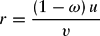
where r is the rate of profit, (1 − ω) is the profit share, u is the rate of capacity utilization, and v is the fixed capital–output ratio derived from the production technology. It follows that
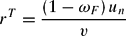
or
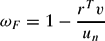
where rT denotes the target rate of return established by firms and un is the normal rate of capacity utilization at which this target rate of return is calculated.
It is worth remarking at this point on the fidelity of the wage and price regimes above to the fundamentals identified in the previous section. Hence note that distributional conflict is made central to the inflation process by the dependence of w and p on ωW and ωF, where ωW > ωF. Meanwhile, the assumptions that μ, ϕ < 1 are consistent with the claim that workers’ power vis-à-vis the wage bargain and firms’ power vis-à-vis the goods market is incomplete; neither workers nor firms are capable of fully indexing all of the determinants of w or p into nominal wage growth or price inflation, respectively. Finally, the principle that workers and firms bargain over the nominal wage, with the real wage determined only once prices have been set in the goods market, is captured by the facts that (1a) explicitly describes a nominal wage setting process and that despite the fact that nominal wage growth is influenced by productivity growth and expected inflation in (1a), the actual rate of growth of the real wage is always determined in (2) as

As discussed in the previous section, the specific conditional equilibrium outcomes that will emerge from the model under construction here cannot be identified unless we first specify the institutional regime within which the wage and price regimes are embedded and which, by determining the values of variables such as S, creates conditional closure within the model. Nevertheless, it is possible at this stage to identify certain general conditions necessary for any specific conditional equilibrium to emerge within this model, and to explore the consequences of these conditions for the wage and price regimes described above. These conditions include the realization of inflation expectations (p = pe) and constancy of the wage share over time (which, from the definition of the wage share, implies that p = w − q). Combining both of these general equilibrium conditions with (1a) yields
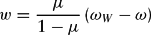
whilst combining the second with Equation (2) yields

We can now utilize the information in (5) and (6) to deduce certain general properties that will be characteristic of any specific conditional equilibrium values of w, p, and ω that we subsequently derive. Hence denoting an equilibrium value with an asterisk, it follows directly from (6) that

In other words, the equilibrium value of ω is ultimately determined in the goods market and by the aspirations of firms – independently of μ and ωW (the bargaining power and aspirations of workers) in the wage bargain.Footnote 16 Meanwhile, substituting (7) into (5) we arrive at
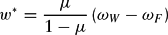
from which, given the general equilibrium condition p = w − q, it follows that

where q denotes the (assumed given) trend rate of productivity growth.Footnote 17 Equations (8) and (9) describe the equilibrium rates of growth of nominal wages and prices as functions of workers’ bargaining power and the ‘aspiration gap’ ωW − ωF (the difference between workers’ and firms’ wage share targets).
Two further key results emerge from equations (8) and (9). The first is that w* and p* are both increasing in μ. To see this, note that
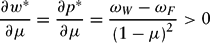
Other things being equal, the equilibrium rates of wage and price inflation will vary directly with the bargaining power of workers. Second, both w* and p* are increasing in the ‘aspiration gap’ ωW − ωF. Hence

Other things being equal, any increase in ωW or any decrease in ωF will raise the equilibrium rates of wage and price inflation, and vice versa.Footnote 18
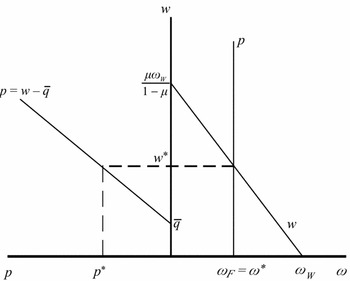
The wage and price regimes in equations (5) and (6) together with the general equilibrium condition p = w − q are illustrated in Figure 1, which depicts an imagined conditional equilibrium configuration corresponding to some (unspecified) institutional regime.Footnote 19
Conflicting-claims inflation

Having thus specified wage and price regimes consistent with the fundamentals identified in the previous section, and having identified certain general equilibrium properties of these regimes, we are now in a position to ‘calibrate’ the resulting model using information about institutions. This will enable us to show how changes in the institutional regime of the US economy over the past 50 years have resulted in the evolution of the US economy through several successive episodes of macroeconomic performance – an evolution that, in terms of its impact on the variables of interest here, can ultimately be interpreted in terms of the rise, decline, and rise of successive incomes policies. It is to this task that we now turn.
4. The rise, decline and rise of incomes policies in the US
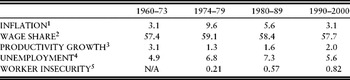
Table 1 presents the stylized facts of US macroeconomic performance over the past four decades. The first row of Table 1 clearly illustrates the ‘low–high–low’ evolution of inflation since 1960, two episodes of low inflation (1960–73 and 1990–2000) separated by the high inflation interlude of the 1974–89 period. Table 1 also reveals the extent to which this episodic behaviour of inflation has been accompanied by similarly episodic behaviour in other macroeconomic variables. Hence roughly comparable values of the wage share, rate of productivity growth, and unemployment rate during the periods 1960–73 and 1990–2000 are separated by a rise in the wage share, a marked decline in the rate of productivity growth and a marked increase in the unemployment rate 1974–89.Footnote 20 In this section, we will argue that the stylized facts in Table 1 can be understood as a series of episodic macroeconomic outcomes associated with three qualitatively different macroeconomic regimes, the defining feature of each of which has been the institutional regime within which the wage and price regimes outlined in Section 3 were embedded.
US macroeconomic performance since 1960

Notes: 1. Percentage rate of change of the CPI, all items, Economic Report of the President, 2004: 357.
2. Compensation of employees as a percentage of Gross Domestic Income, Bureau of Economic Analysis National and Income and Product Accounts, Table 1.11 (www.bea.doc.gov)
3. Percentage rate of change of output per hour of all persons, business sector, Economic Report of the President, 2004: 343.
4. Unemployed persons as a percentage of the civilian labour force, Economic Report of the President, 2004: 334.
5. Index of worker insecurity (Setterfield, Reference Setterfield and Setterfield2005).
A common theme in political economy identifies the post-war Golden Age (1948–73) with a historic compromise between capital and labour, as a result of which the distributional goals of workers and firms were (at least partially) reconciled (Bowles et al., Reference Bowles, Gordon and Weisskopf1990; Cornwall, Reference Cornwall1990; Glyn et al., Reference Glyn, Hughes, Singh, Marglin and Schor1990; Cornwall and Cornwall, Reference Cornwall and Cornwall2001). This ‘value sharing’ norm of distributive justice is understood to have been codified in the form of ‘social bargains’, under the terms of which firms retained the ‘right to manage’ in return for commitment to a high and stable wage share of income and annual growth in real earnings. The social bargains were not uniform across capitalist economies, being more highly developed in northern Europe and Japan than in the Anglo-Saxon economies (Cornwall, Reference Cornwall1990).Footnote 21 Hence the US achieved only a ‘limited capital-labour accord’ (Bowles et al., Reference Bowles, Gordon and Weisskopf1990) during the Golden Age. Nevertheless, by better reconciling the distributional conflict at the heart of the inflation process, social bargains – even in the limited form found in the US – had a beneficial impact on the unemployment and growth performances of the advanced capitalist economies (Bowles et al., Reference Bowles, Gordon and Weisskopf1990; Cornwall, Reference Cornwall1990; Glyn et al., Reference Glyn, Hughes, Singh, Marglin and Schor1990; Cornwall and Cornwall, Reference Cornwall and Cornwall2001; Setterfield and Cornwall, Reference Setterfield, Cornwall and Setterfield2002). In keeping with this theme, the position adopted here is that the limited capital–labour accord created an institutional regime that explains the precise constellation of macroeconomic outcomes in the first column of Table 1, as a discrete episode of US macroeconomic performance characterized by high growth, low unemployment, and low rates of inflation. More precisely, the limited capital–labour accord in the US constituted an incomes policy in the sense defined earlier, raising the value of S in Equation (3) by reducing the willingness of workers to press for nominal wage increases purely on the basis of the market power vested in them by a low rate of unemployment.Footnote 22 This alleviated the inflation constraint on the US economy (the need to sacrifice growth and employment by raising U in order to lower μ and ωW in equations (3) and (4), and hence reduce inflation in Equation (9)), facilitating, in turn, the reconciliation of rapid growth and low unemployment with low rates of inflation – precisely the triad observed in the first column of Table 1.
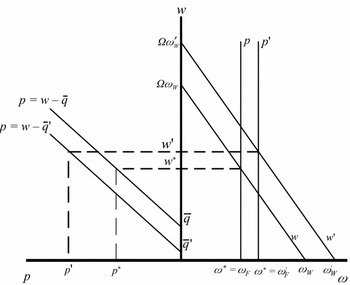
After 1968, however, the social bargains described above began to unravel and – along with the value-sharing norm of distributive justice on which they were based – had broken down altogether by 1973 (Bowles et al., Reference Bowles, Gordon and Weisskopf1990; Cornwall, Reference Cornwall1990; Cornwall and Cornwall, Reference Cornwall and Cornwall2001). Rather than being based on compromise and reconciliation, the early 1970s witnessed the emergence of a ‘market power’ approach to industrial relations, the embodiment of a ‘winner take all’ norm of distributive justice. These developments were associated in the first instance with ‘aspiration inflation’ on the part of labour, emanating both from materially secure workers who had grown accustomed to the experience of full employment and steadily rising real incomes during the Golden Age (Cornwall, Reference Cornwall1990), and from ‘new’ workers (including women and minorities) who had not benefitted from the spoils of the post-war social bargains (Bowles et al., Reference Bowles, Gordon and Weisskopf1990).Footnote 23, Footnote 24 These institutional changes – together with their implications for inflation – are illustrated in Figure 2. Replicating the configuration illustrated in Figure 1 and treating this as a stylized representation of the Golden Age macroeconomic regime, Figure 2 then shows an increase in the target wage share of workers (from ωW to ωW′) consistent with the aspiration inflation described above. Other things being equal, and in line with Equation (11), this worsened inflationary pressures resulting from conflict over the distribution of income. However, and again in a manner congruent with Equation (11), Figure 2 shows these inflationary pressures being moderated somewhat by a discrete increase in the target wage share of firms (from ωF to ωF′). The hypothesis here is that this development was related in the first instance to the increased international competition faced by US firms by the end of the 1960s, the most obvious manifestation of which was the disappearance by the early 1970s of the US trade surplus.Footnote 25 This resulted in a second important institutional change – a decrease in the value of ϕ (US firms ‘degree of monopoly’) in Equation (2). Recall that ϕ itself has no systematic impact on the equilibrium inflation or distributional outcomes in equations (7)–(9). However, the discretionary increase in firms’ target wage share depicted in Figure 2 is entertained here as being the result of particular historical circumstances – specifically, the combination of pressures on firms emanating from product markets (as captured by the diminution of their ‘degree of monopoly’, ϕ) resulting in a need to limit price increases, even as the rate of growth of unit labour costs was increasing as a result of workers’ rising aspirations and a slowdown in the trend rate of productivity growth.Footnote 26 As shown in Figure 2, the initial combined effect of the new ‘market power’ institutional regime that emerged from the breakdown of the post-war social bargains and the fundamentals embodied in the wage and price regimes was thus a higher wage share and a higher rate of inflation – the latter exacerbated by the post-1973 productivity slowdown. These outcomes are clearly evident in the data in the second column of Table 1.
The breakdown of social bargains Note: 

Although Figure 2 characterizes the 1970s as a conditional equilibrium resulting from the combination of a particular institutional regime with the wage and price regimes outlined in Section 3, it must be noted that this conditional equilibrium is not a ‘fully adjusted’ position. This is because, as a result of the specific historical conditions described above, it involves ω* = ωF′ > ωF, where the latter denotes the wage share that (other things being equal) is uniquely consistent with firms’ target rate of return, rT.Footnote 27 Firms thus have an incentive to seek further changes to the configuration of the economy depicted in Figure 2 in an effort to re-establish a wage share consistent with their target rate of return.
This brings us to the reaction of firms – and the state – to the aspiration inflation with which we commenced our discussion of the post-1973 period. One widely documented aspect of this response was that of the state, which initially took the form of restrictive macroeconomic policies (Bowles et al., Reference Bowles, Gordon and Weisskopf1990; Cornwall, Reference Cornwall1990; Cornwall and Cornwall, Reference Cornwall and Cornwall2001; Epstein and Schor, Reference Epstein, Schor, Marglin and Schor1990). This response was designed to raise the rate of unemployment and thus (per equations (3), (4), (10), and (11) diminish inflation by lowering the bargaining power and wage-share aspirations of workers. In view of what was said above about the conjunction of historical circumstances that gave rise to the increase in the target wage share of firms depicted in Figure 2, it is to be expected that these developments would have alleviated the pressure on firms to keep the target wage share as high as ωF′. The third column of Table 1 is consistent with the workings out of this policy response during the 1980s. In particular, it draws attention to the combination of rising unemployment (which actually began in the 1970s) coupled with falling inflation and a falling wage share of income. However, Table 1 suggests that the restrictive macroeconomic policies pursued during the 1970s and 1980s were only partially successful as a response to the post-1973 macroeconomic regime depicted in Figure 2. In the first case, it shows that the wage share remained high – above the 1960–73 value associated with a fully adjusted conditional equilibrium. Second, the pursuit of restrictive policies involved a macroeconomic trade-off, in which real macroeconomic performance was sacrificed in order to alleviate inflationary pressures and relieve the profit squeeze on US firms. Hence Table 1 reveals the costs of restrictive macroeconomic policies to have been a sharp increase in unemployment to almost 150% of its 1960–73 value during the 1980s.Footnote 28
This leads us to the second aspect of the corporate/state response to the macroeconomic regime of the 1970s, which is evident in the last row of Table 1: a series of initiatives designed to raise the value of S in equations (3) and (4) and thus reduce the willingness and ability of workers to press for nominal wage increases by increasing worker income and employment insecurity. This strategy has been corporate-led, and has involved changing the conventions of the employment relation in order to diminish both the bargaining power and the aspirations of workers.Footnote 29 It has included (inter alia) deunionization initiatives, increases in corporate downsizing exercises, plant relocation, and increases in the quantity of non-standard (part-time and temporary) work, in the pursuit of some of which corporations have been aided by changes in formal institutions brought about by the actions of the state. Hence changes in US labour law created a legal environment that made it easier for firms to engage in deunionization initiatives during the 1980s (Block et al., Reference Block, Beck and Kruger1996: 28–33), with the result that union membership in the US has since fallen steadily from over 25% of private-sector employees during the mid 1970s to barely 10% by the mid-1990s (Palley, Reference Palley1998: 32). At the same time, periodic downsizing exercises – which create a threat to workers’ employment and income security regardless of general economic performance – have become the norm. Osterman (Reference Osterman1999: 38–40) shows that by the mid-1990s, the number of layoffs in the US accounted for by ‘structural change’ surpassed the number due to poor firm performance. Similarly – as first discussed by Bluestone and Harrison (Reference Blueston and Harrison1982) – plant relocation has become an omnipresent threat. Between 1967 and 1991, the share of manufacturing employment in the ‘rust belt’ states of the US fell from 48.6% to 36.2%, the share of states in the South and West increasing from 37.0% to 50.2% over the same period (Crandall, Reference Crandall1993: 12). Apart from its contribution to the process of deunionization reported above, the extent of this relocation – coupled with its internationalization in the age of multinational corporations – has created a credible threat that both directly reduces the security of workers and indirectly reduces this security by diminishing the efficacy of strike activity and union organizing drives (Palley, Reference Palley1998: 34–35; Bronfenbrenner, Reference Bronfenbrenner2000).Footnote 30 Finally, increases in non-standard employment arrangements have reduced the employment security of those desirous of year round, full-time work, and who now face a reduced likelihood of obtaining such work in the event of dismissal from their current employment (Osterman, Reference Osterman1999: 54–60, 85–88). These developments are captured by the monotonic rise of the index of worker insecurity reported in the last row of Table 1.Footnote 31
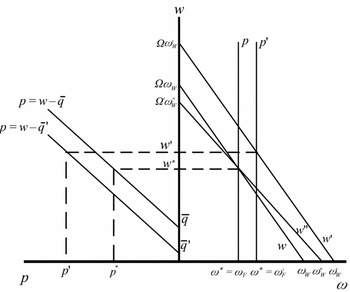
In short, in response to the macroeconomic regime prevalent in the US during the 1970s and 1980s, there has occurred a constellation of institutional changes that have diminished worker employment and income security independently of the performance of the aggregate labour market, as measured by the rate of unemployment. The consequences of this are illustrated in Figure 3 below, and are also evident in the data in the final column of Table 1. Figure 3 first shows a decline in both the bargaining power (from μ to μ′) and wage share aspirations (from ωW′ to ωW″) of workers as a result of the institutional changes detailed above, which are manifest in an increase in S in equations (3) and (4). Footnote 32 Consistent with equations (10) and (11), this will reduce inflationary pressures, at the same time alleviating the need for firms to maintain an elevated target wage share. This latter development is captured by the fall in firms’ target wage share from ωF′ to ωF in Figure 3, making the conditional equilibrium depicted in Figure 3 a fully adjusted position.Footnote 33 The result of these developments, as illustrated in Figure 3, is a fall in both the rate of wage inflation and the wage share of income, the former resulting in a decline in price inflation enhanced by the improvement of trend productivity growth to something like its value during the Golden Age. The upshot of all this is the restoration of a rate of inflation and distribution of income comparable to those achieved during the Golden Age, all without sacrificing employment. More precisely, the contention here is that by the 1990s, the institutional regime of the US economy again involved an incomes policy in the sense defined earlier, which operated by raising the value of S in equations (3) and (4) and thus reducing both the willingness and ability of workers to press for nominal wage increases, regardless of the market power seemingly vested in them by a low rate of unemployment. This incomes policy again alleviated the inflation constraint on the US economy – the need to sacrifice growth and employment in order to raise U, lower μ and ωW in equations (3) and (4), and hence reduce inflation in (9) – facilitating, in turn, the reconciliation of rapid growth and low unemployment with low rates of inflation and a distribution of income acceptable to firms. These are, of course, precisely the macroeconomic outcomes observed in the final column of Table 1.
An incomes policy based on fear Note:

5. Conclusion
According to the vision articulated in this paper, at any point in time we can conceive of the macroeconomic ‘data generating process’ as consisting of a set of fundamentals embedded in a relatively enduring institutional framework – the latter subject to discontinuous change over time, partly in response to the very conditional equilibrium macroeconomic outcomes to which it gives rise. This furnishes a conception of the long run as comprising an evolutionary sequence of discrete ‘episodes’ of macroeconomic performance (the defining structural characteristic of each episode being a specific institutional framework), rather than as a path-independent trend from which there are but temporary departures caused by independent and transitory shocks.
In this paper, the vision of macroeconomics described above has been used to create a model of inflation comprising wage and price regimes consistent with a conflicting claims view of the inflation process. This model is rendered conditionally closed (resulting in a conditional equilibrium solution) by the identification of the precise institutional regime within which, during some particular interval of historical time, the wage and price regimes are embedded. The result is a tripartite periodization of the US economy into three distinct ‘episodes’ of macroeconomic performance (1960–73, 1974–89, 1990–2000) based on three distinct institutional regimes. Crucial to the thesis advanced at the start of this paper, the first and third of these institutional regimes have been identified as featuring incomes policies – formal and/or informal institutions that frame and mediate aggregate wage and price setting behaviour in such a way as to reduce conflict over income shares and better reconcile conflicting income claims – that have given rise to similar macroeconomic outcomes and which, in conjunction with the institutional features of the intervening episode, help to explain the recent evolution of the US economy through successive episodes of low, high, and low inflation. The incomes policies that ‘bookend’ the past 50 years of US macroeconomic performance differ profoundly in their structural features. Hence, whilst the limited capital–labour accord was a model of cooperation and conciliation in which conflict was ameliorated through consensus building, the constellation of institutions identified with the most recent institutional regime comprise an ‘incomes policy based on fear’ (Cornwall, Reference Cornwall1990) – a model of domination in which conflict is ameliorated essentially by means of coercion and in which the costs of better reconciling distributional conflict and reducing inflationary pressures fall squarely on the shoulders of workers. Nevertheless, both achieve – albeit in radically different ways – the reduction of distributional conflict characteristic of incomes policies and it is because of this that the US economy can ultimately be said to have experienced the rise, decline, and rise of incomes policies over the past 50 years.