Cardiomyopathy is an important cause of cardiac morbidity and mortality in children. Inborn errors of metabolism may lead to reversible cardiomyopathy in children, and early diagnosis and appropriate therapy is essential to prevent permanent cardiac damage and death. Fatty acid beta oxidation is the major source of myocardial energy after birth. Defects in fatty acid metabolism may cause cardiac failure, pericardial effusion, ventricular arrhythmias, fatty liver, skeletal myopathy, and death. We present 2 cases of disorders of long chain fatty acid oxidation presenting with pericardial effusion and reversible cardiac failure in infancy.
Case reports
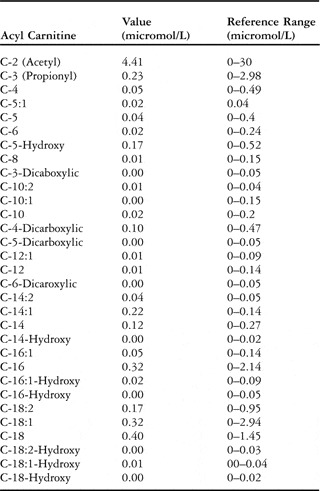
Baby R was born full term via caesarean section for failed progress of labour. He had transient neonatal hypoglycaemia for the first 4 days of life. At 2 months, he was hospitalized for severe respiratory distress, failure to thrive, hepatomegaly, and hypotonia. He rapidly deteriorated and had a cardiorespiratory arrest requiring resuscitation. Echocardiography initially demonstrated normal cardiac structural anatomy, left ventricular hypertrophy, and good contractility. Repeat echocardiography done 4 days later showed left ventricular dilation, global dysfunction, and pericardial effusion requiring repeated pericardiocentesis. Investigation for aetiology of infantile cardiac failure included viral studies and metabolic screening. The Acyl carnitine profile showed elevation of C 14:1 acyl carnitines and ratio of C 14:1 to C2, consistent with very long chain acyl coenzyme A dehydrogenase deficiency (Table 1). It was later enzymatically confirmed from skin fibroblast cultures. He had markedly elevated levels of creatinine phosphokinase. He was started on high dose carnitine, coenzyme Q, and portagen, the latter being a formula rich in medium chain triglycerides. He improved rapidly, and cardiac function returned to normal in a few weeks. He has been advised to avoid prolonged fasting and excessive physical activity to prevent rhabdomyolysis. Over the past 8 years, he has had several episodes of rhabdomyolysis with marked elevation of creatinine phosphokinase, with no significant reduction in cardiac function. His left ventricular size, however, has always remained above the 95th percentile for his age and body surface area, though systolic and diastolic function indexes have been within normal range.
Acyl carnitine profile in Baby R showing elevation of C 14:1 acyl carnitines and C 14:1/C2 ratio.

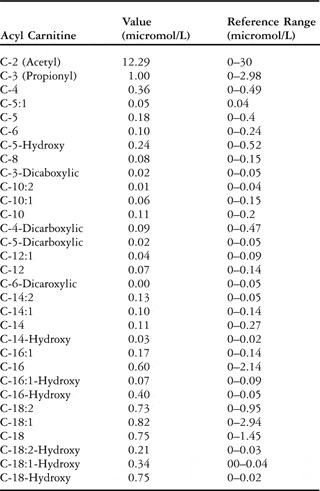
Baby boy A was born at term weighing 2.3 kilograms, and was admitted to the intensive care unit for temperature instability and poor feeding. He continued to be underweight despite multiple changes in formula. He presented at 4 months of age with cardiogenic shock and metabolic acidosis. Echocardiogram after resuscitation, showed a dilated heart, with Z scores for internal diameters of left ventricle at end diastole and end systole of 3.08, and 3.58, respectively, and poor left ventricular function, with shortening fraction of 17%, equating to a Z score of −8.7. Acyl carnitine profile showed elevated long-chain hydroxyacyl carnitines consistent with long chain 3-hydroxy acyl coenzyme A dehydrogenase deficiency (Table 2). His diagnosis was confirmed by mutation analysis. He is a compound heterozygote, with G1528C in one allele and a 1 bp deletion (delta A2059) in exon 19. Blood tests also revealed very high levels of creatinine phosphokinase at presentation. He was treated with carnitine and a formula rich in medium chain triglycerides for his metabolic disorder. He initially required inotropic support in the intensive care unit. On follow-up, 4 weeks later, he showed remarkable clinical improvement, and repeat echocardiogram done at 5 months of life showed normal cardiac size and function. Medications against cardiac failure could be discontinued by 1 year of age. He has since had several hospitalizations with rhabdomyolysis, and markedly elevated creatinine phosphokinase, and during some of these admissions, he demonstrated mild cardiac enlargement and transient mild systolic and diastolic dysfunction. At 4 years of age, his cardiac size and function remain normal, and he is on a semiannual cardiology follow-up schedule.
Acyl carnitine profile in Baby A showing elevated long-chain hydroxyacyl carnitines.

Discussion
Cardiomyopathy is an important cause of morbidity and mortality, with a prevalence of 1 in 10,000 children.Reference Ferencz and Neill1 Despite medical therapy and cardiac transplantation, cardiomyopathy remains one of the leading cardiac causes of death in children.Reference Lewis and Chabot2, Reference Mathur, Sims and Gopalakrishnan3 Mitochondrial beta oxidation of fatty acids is a major source of myocardial energy. Defects in transport, uptake, and beta oxidation of long chain fatty acids cause cardiomyopathy in infants and children. Mitochondrial beta oxidation requires active transport of long chain fatty acids and carnitine across the cardiomyocyte sarcolemma, activation by esterification to coenzyme A, and the mitochondrial inner membrane fatty acyl coenzyme A/carnitine shuttle to deliver fatty acids to the matrix. The mitochondrial fatty acid beta oxidation spiral involves 4 enzymatic steps, the first of which is catalyzed by four different acyl coenzyme A dehydrogenases, with overlapping substrate specificities. These are very long chain acyl coenzyme A dehydrogenase with substrate specificity for fatty acids of 14–20 carbons, long chain 3-hydroxy acyl coenzyme A dehydrogenase, medium chain acyl coenzyme A dehydrogenase and short chain acyl coenzyme A dehydrogenase. Very long chain acyl coenzyme A dehydrogenase and long chain 3-hydroxy acyl coenzyme A dehydrogenase deficiencies lead to impaired myocardial energy production and accumulation of toxic metabolites leading to cardiomyopathy.Reference Mathur, Sims and Gopalakrishnan3 Early detection of these disorders, and treatment with diets low in long chain fatty acids, can result in excellent outcomes, as was seen in our cases.Reference Brown-Harrison, Nada and Sprecher4, Reference Cox, Souri and Aoyama5 It is important to rule out fatty acid β-oxidation defect as an underlying aetiology, in an infant presenting with pericardial effusion and cardiomyopathy with rapid decompensation, after exclusion of infectious causes.Reference Spiekerkoetter, Tenenbaum, Heusch and Wendel6 All infants with severe ventricular dilation and dysfunction without any evidence of structural cardiac disease, therefore, should undergo routine screening for metabolic disorders. With the inclusion of plasma acyl carnitine levels by tandem mass spectrometry in the new born screening, cases of fatty acid oxidation disorders can be diagnosed at an earlier age, leading to early institution of specific diet.Reference Liebeg, Schymik and Mueller7 Both of our patients were born before inclusion of fatty acid oxidation disorders on the newborn screen, and hence the diagnosis was delayed. There are some pitfalls of neonatal screening for very long chain acyl coenzyme A dehydrogenase deficiency using tandem mass spectrometry, with some false positive and false negative results. An increased level of C14:1-carnitine can also occur in heterozygous individual, leading to false positive results.Reference Liebeg, Schymik and Mueller7 Further diagnostic evaluation, including enzyme and molecular analyses, is essential correctly to identify these disorders.Reference Liebeg, Schymik and Mueller7 Timing of blood sampling is important and samples drawn 72 hours after birth could be falsely negative based on anabolism.Reference Boneh, Andresen and Gregersen8
Disorders of fatty acid oxidation, therefore, are important causes of reversible cardiomyopathy in infancy. They should be suspected in any child presenting with cardiomyopathy and pericardial effusion with feeding difficulty and growth retardation during infancy. Early detection and prompt modification of diet can reverse the cardiotoxicity in these otherwise fatal cases. Recurrent, albeit reversible, cardiac dysfunction, as well as persistent cardiomegaly, as seen in our cases, highlights the need for regular and close cardiac follow-up.