Introduction
There are approximately 17 million people with dementia in East and Southeast (SE) Asia and by 2050, there will be 50 million in the region (Alzheimer's Disease International, 2015). According to Alzheimer's Disease International (ADI), long-term residential facilities commonly known as nursing homes established in countries such as China, Japan, South Korea, Malaysia, Singapore, Philippines, and Sri Lanka provide accommodation and nursing care for people living with dementia (ADI, 2014). Studies show that nursing homes in Asia are characterized by social isolation, inferior quality of care, and low quality of life (Zulkifli and Khan, Reference Zulkifli and Khan2014; Huang et al., Reference Huang, Shyu, Chen, Huang, Kuo, Chen and Hsu2015; Wee et al., Reference Wee, Hu, Yong, Chong, Raman and Chan2015). People with dementia in the region are admitted into nursing homes when their care needs have become too high to be met within the community (Cheng et al., Reference Cheng, Rosenberg, Wang, Yang and Li2011; de Guzman et al., Reference de Guzman2012). The profile of nursing home residents includes people with dementia with no full-time caregivers, or who are destitute. The growth in the number of people with dementia and the disruption of traditional care provision brought about by industrialization is obliging most countries in East and SE Asia to consider how they can improve their service provision and infrastructure for the growing number of people living with dementia (Wu et al., Reference Wu, White, Cash and Foster2009; Cheng et al., Reference Cheng, Rosenberg, Wang, Yang and Li2011; de Guzman et al., Reference de Guzman2012).
The built environment is an essential component of long-term care facilities. When designed well, it contributes to the quality of the care delivered to the residents and the quality of life they enjoy (Fleming and Purandare, Reference Fleming and Purandare2010; ADI, 2015). A validated and reliable measure of the quality of the built environment can help translate knowledge derived from research into tangible supportive quality health outcomes for residents with dementia by guiding the development of dementia enabling environmental designs that are evidence based. The built environment can be described in relation to a set of underlying principles (Marshall et al., Reference Marshall, Judd and Phippen1998; Fleming and Purandare, Reference Fleming and Purandare2010; Fleming and Bennett, Reference Fleming and Bennett2015a). An understanding of these principles can guide the developmental design process resulting in a final product that can positively shape the user experience and help maintain the rights of people with dementia, their privacy, and their physical and cognitive well-being (Fleming and Bennett, Reference Fleming, Bennett, Nay, Garratt and Fetherstonhaugh2014). Designing nursing homes without the support of evidence-based, culturally appropriate guiding principles will result in a design that will perpetuate the current, unsatisfactory state of affairs.
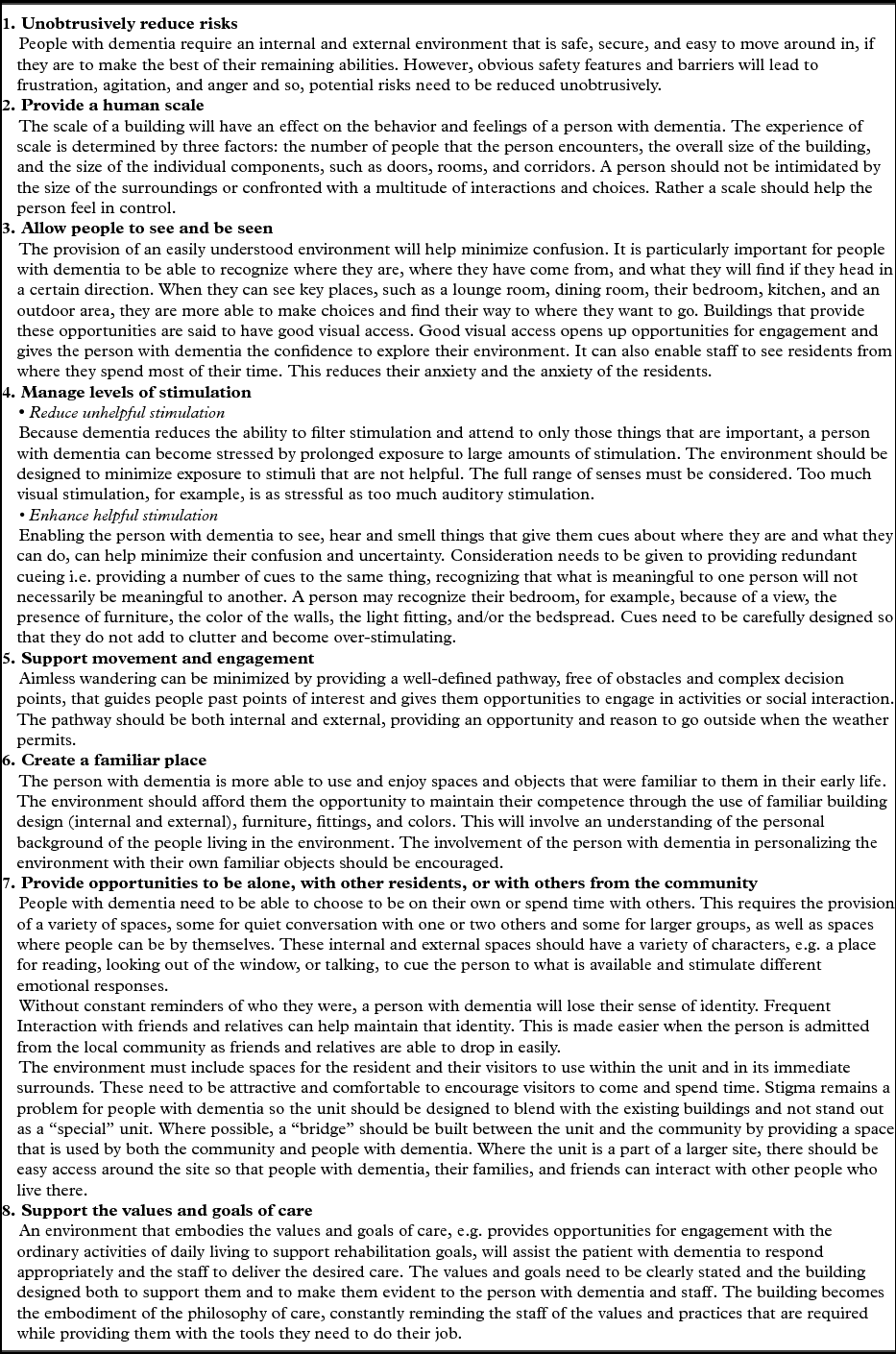
The World Health Organization (WHO, 2012) advocates for person-centered care to be provided to people living with dementia. A review of assessment tools for dementia enabling environments, such as the Multiphasic Environmental Assessment Procedure, Therapeutic Environment Screening Survey for Nursing Homes, Special Care Unit Environmental Quality Scale, reveals an institutional approach, which deviates from WHO recommended practices of person-centered care (Fleming, Reference Fleming2011). However, the Environmental Audit Tool (EAT), a tool that encompasses person-centered care utilizing a principle-based approach has been used in Australia for some years to assist health and aged care organizations understand the strengths and weaknesses of their existing buildings and plan refurbishments (Fleming and Bennett, Reference Fleming and Bennett2015a). The Environmental Audit Tool High-Care (EAT-HC) is based on principles that "closely reflect the needs of people with dementia cared for in high care units” (Fleming and Bennett, Reference Fleming and Bennett2015a, p. 193), and there is a close alignment between the aims of the EAT-HC, person centered care, and the high care needs of people with dementia that are living in nursing homes in Asia. The EAT-HC contains eight principles of design (Table 1) that guide the audit process (Fleming and Bennett, Reference Fleming and Bennett2015b). The review of the literature reported here did not reveal any Asian equivalent of the EAT-HC.
Key design principles (Fleming and Bennett, Reference Fleming and Bennett2015b, p. 3)

This scoping review aims to examine nursing homes in East and SE Asia through the lens of these eight principles of design, providing a view of the characteristics of the built environment used to provide accommodation and support to people with dementia in nursing homes in the region. It has been carried out in the context of the development of a Singaporean version of the EAT-HC. This work involves input from the major cultural groups of Singapore: the Malays, Chinese, and Indians, and is expected to result in the provision of versions of the EAT-HC that are relevant to these cultures.
Methodology
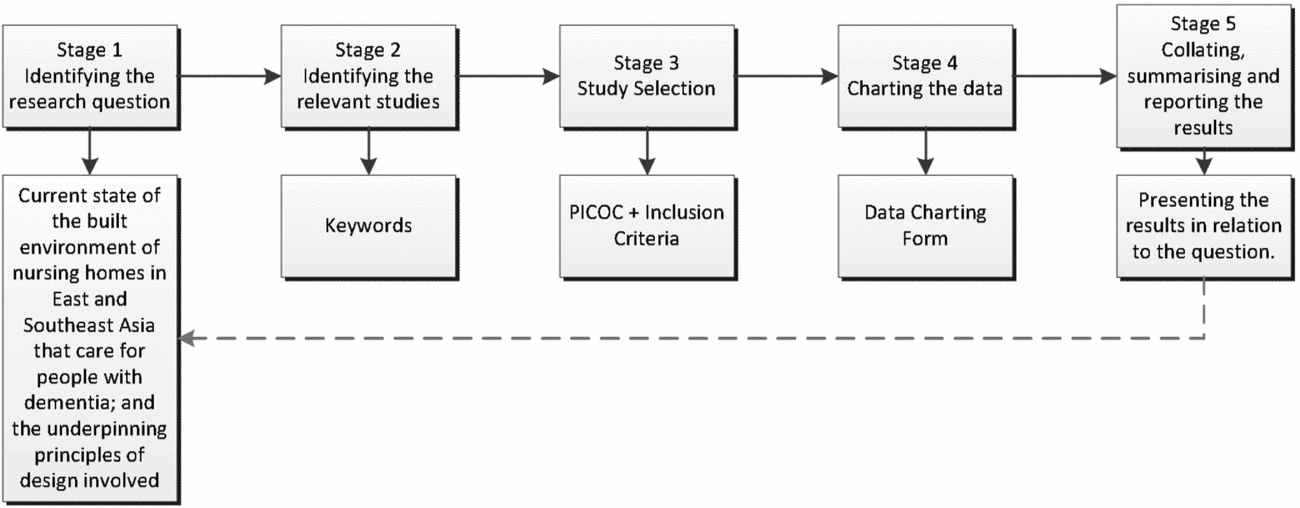
A scoping review was carried out to give a clear picture of the application of the principles in East and SE Asia nursing homes. With previous studies (ADI, 2015) indicating that there is little evidence available on dementia care in East and SE Asia, a scoping review is the best approach to explore the existing literature and critically analyze the available evidence (Cheng et al., Reference Cheng, Rosenberg, Wang, Yang and Li2011; Chang, Reference Chang2013). A scoping review is exploratory and has the ability to consolidate a diverse range of evidence, including grey literature, providing theoretical clarity to aid in the provision of a direction for future research (Arksey and O'Malley, Reference Arksey and O'Malley2005). However, a scoping review only provides clarity on the extent of the evidence and does not aim to conduct assessments on the quality of the evidence (Booth et al., Reference Booth, Papaioannou and Sutton2012). The scoping review was carried out in accordance with the Arksey and O'Malley (Reference Arksey and O'Malley2005) methodological framework (Figure 1), which consists of five steps: defining the research question (1), uncovering the evidence through a systematic search (2 and 3), selecting the evidence (4), executing a critical analysis and thematic synthesis of the findings to present a clear summary (5).
The Arksey and O'Malley (Reference Arksey and O'Malley2005) methodological framework utilized in the scoping review.

The scoping review was undertaken in March 2016. The list of East and SE Asian countries was drawn up and categorized as per the World Health Organization Global Burden of Disease world regions; this includes high-income Asia Pacific countries such as Brunei, Japan, Singapore, and South Korea (Global Burden of Disease Study 2013 Collaborators, 2015). Due to the complex range of dementia awareness in the long-term care industry in Asia, the study included publications that touch on long-term care environments that provide care for older adults without a specific focus on dementia on the assumption that such environments are similar to Australian facilities in accommodating a high proportion of people with dementia (AIHW, 2012). The publications are limited to English databases and grey literature from 2001 to 2015.
A systematic search strategy for identifying relevant studies from both research databases and credible sources of grey literature was designed in line with Arksey and O'Malley (Reference Arksey and O'Malley2005) methodological framework for scoping studies. The Preferred Reporting Items for Systematic Reviews and Meta-Analyses (PRISMA; Moher et al., Reference Moher, Liberati, Tetzlaff and Altman2009) statement was used to guide the design of the overarching structural framework for the reporting process of the systematic search strategy.
Six scientific databases were accessed: ScienceDirect, Cumulative Index of Nursing and Allied Health Literature (CINAHL), Scopus, Japan Science and Technology Information Aggregator Electronic (J-STAGE), Australia/New Zealand Reference Centre, and MEDLINE. A search was also carried out on reference lists to identify key journals, such as the Journal of Asian Architecture and Building Engineering, and publications from the Health Environments Research and Design Journal in accordance to their methodological framework (Arksey and O'Malley, Reference Arksey and O'Malley2005). Additional sources of grey literature included publications from advocacy groups, government, educational, and regulatory organizations. The initial search strategy included broad concepts which introduced the main concept of the “environment,” “dementia,” “older adults”; it was then supplemented with specific keywords to narrow down and increase the sensitivity of the search.
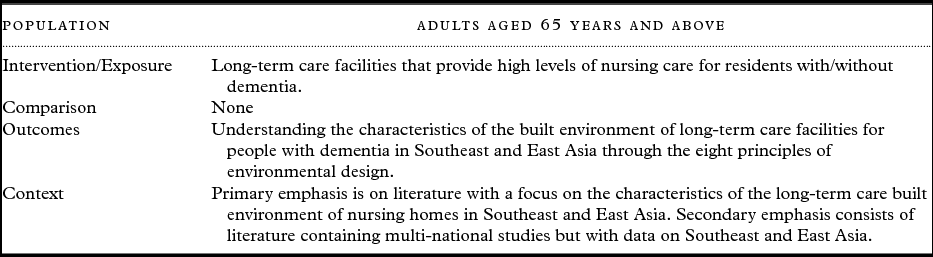
The study eligibility process utilized the Population, Intervention, Comparison, Outcomes, and Context (PICOC; Table 2) framework to define the scope of the review and provide focus on the research question identified (Petticrew and Roberts, Reference Petticrew and Roberts2006; Booth et al., Reference Booth, Papaioannou and Sutton2012). Delving deeper into the process, additional search terms had to be utilized due to the difference in the interpretations and terminology of older adults and long-term care facilities in Asia (Wu et al., Reference Wu, Mao and Xu2008; Srithamrongsawat et al., Reference Srithamrongsawat, Bundhamcharoen, Sasat, Odton and Ratkjaroenkhajorn2009; de Guzman et al., Reference de Guzman2012; Zulkifli and Khan, Reference Zulkifli and Khan2014). Addition terms such as “nursing home,” “institution,” “old folks,” “aged,” “elderly,” “senior” and “old age” contributed to the study selection process (Figure 2). A chronological age of 65 years and above was included in the selection process to ensure a focus on long-term care environments specifically for older adults.
PICOC model (Pettigre and Roberts, Reference Petticrew and Roberts2006)

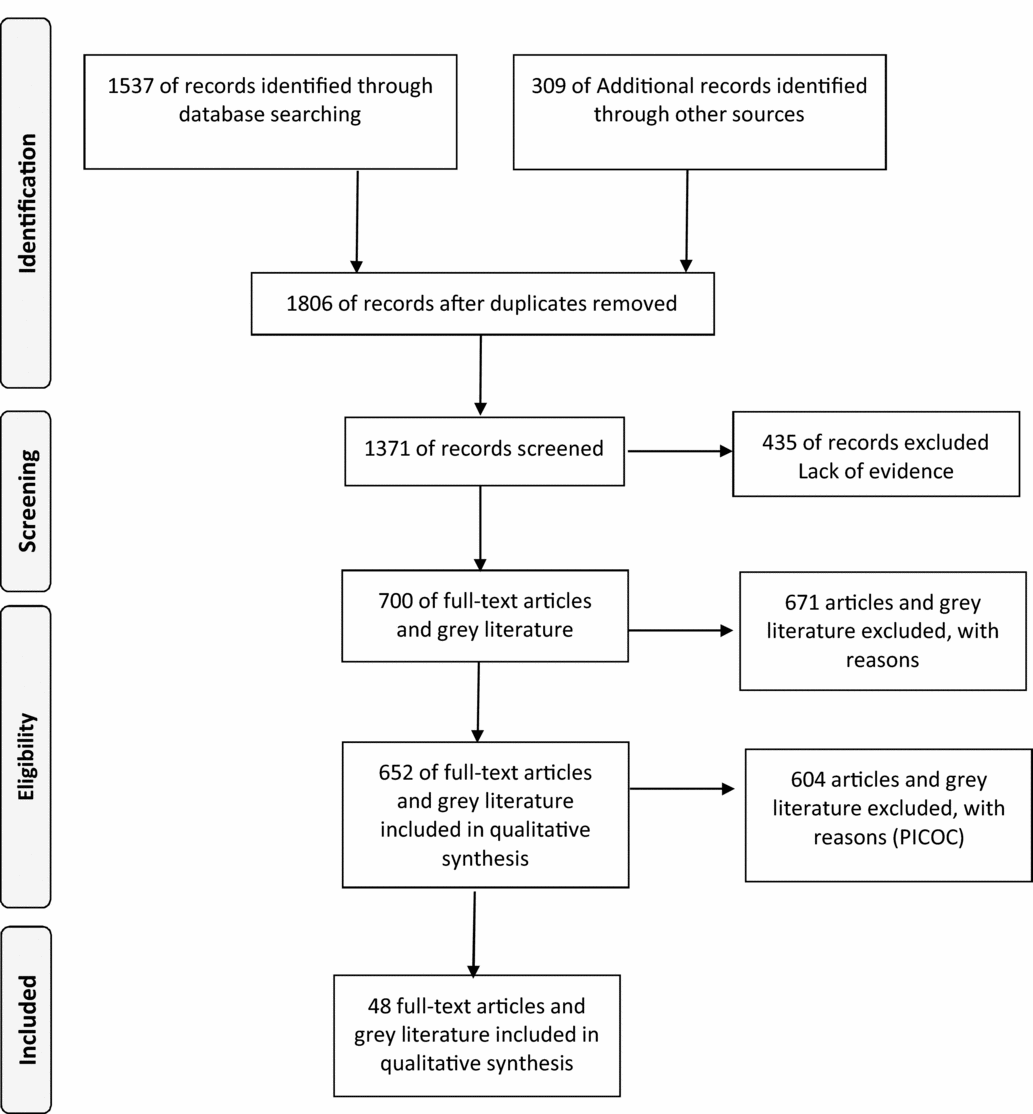
PRISMA flow diagram (Moher et al., Reference Moher, Liberati, Tetzlaff and Altman2009) illustrating an overview of the systematic search strategy executed in this scoping review.

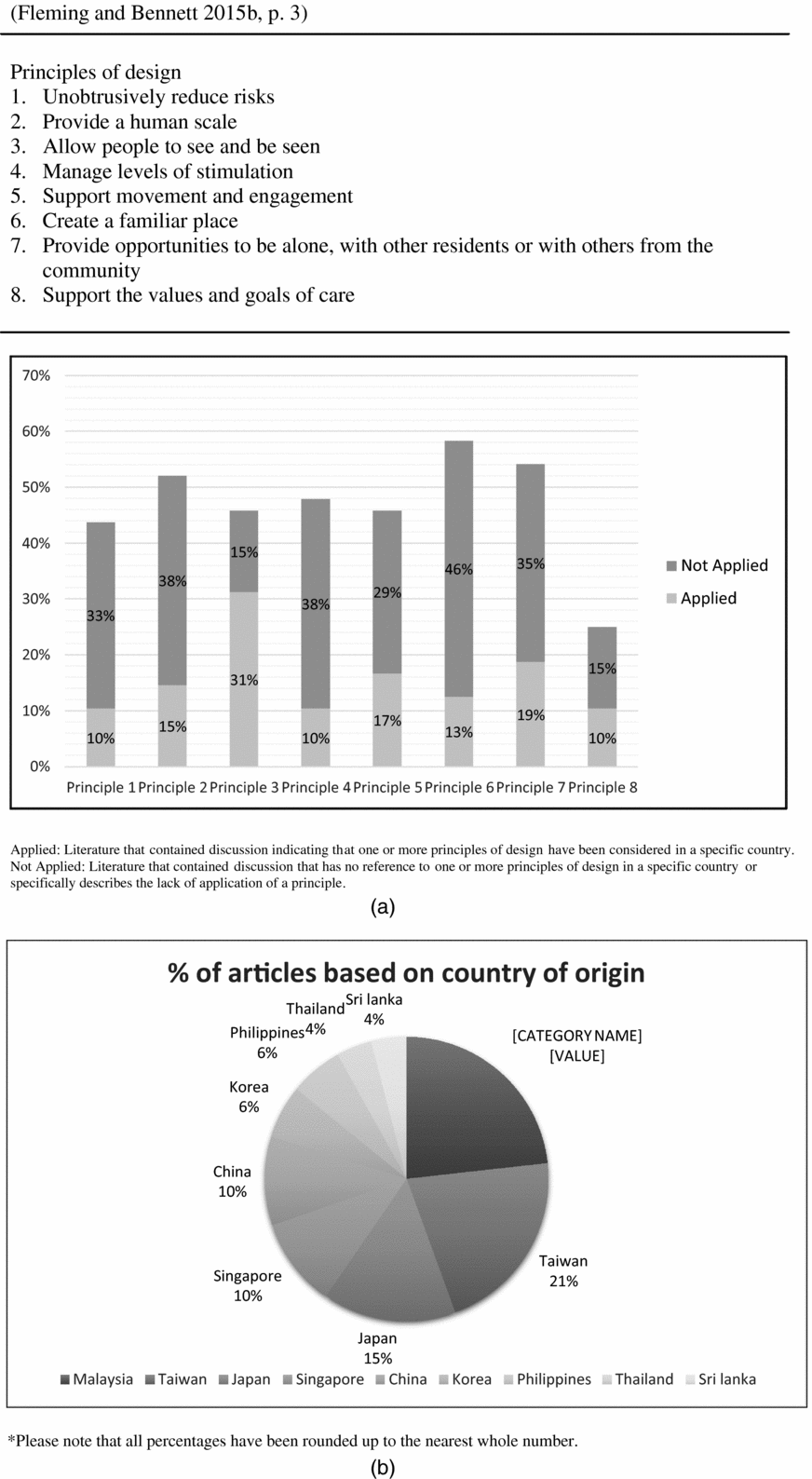
Following the application of the PICOC framework, the articles selected were processed in compliance with the fourth stage of the scoping review framework, and the evidence was contextualized and entered a data-charting form (Arksey and O'Malley, Reference Arksey and O'Malley2005). NVivo 2011 followed by Microsoft Excel 2016 were used to manage a comprehensive summary containing data extracted in the form of a narrative review for each of the articles. Types of study, frequencies of occurrences of data in each geographic location, and the reporting of the presence or absence of the application of the design principles are reported (Figure 3). Given that scoping studies are not designed to assess the quality of the studies, the literature analyzed was not selected or weighted on the quality of the evidence provided (Arksey and O'Malley, Reference Arksey and O'Malley2005). The process of developing the summary of the identified available research and gaps process concluded the fifth stage of the scoping review framework by Arksey and O'Malley (Reference Arksey and O'Malley2005).
(a) Evidence of application of the principles of design across the literature. Principles of design include the following (Fleming and Bennett, Reference Fleming and Bennett2015b, p. 3): (1) unobtrusively reduce risks; (2) provide a human scale; (3) allow people to see and be seen; (4) manage levels of stimulation; (5) support movement and engagement; (6) create a familiar place; (7) provide opportunities to be alone, with other residents, or with others from the community; and (8) support the values and goals of care. Applied: Literature that contained discussion indicating that one or more principles of design have been considered in a specific country. Not Applied: Literature that contained discussion that has no reference to one or more principles of design in a specific country or specifically describes the lack of application of a principle. (b) Evidence of application of the principles of design across the literature. Please note that all percentages have been rounded up to the nearest whole number.

Results
In the initial search process, 1,846 articles comprising of 1,537 peer-reviewed publications and 309 sources of grey literature were found (Figure 2). Screening for duplicates ensued, and 1,806 records remained. A review of the titles and abstracts of the documents obtained resulted in the removal of 435 records due to lack of relevance. A further screening of 1,371 records for the availability of full-text articles led to the exclusion of 671 publications. After extracting the records which contained full text, 700 remained in the database for the eligibility process. 652 publications contained all the search terms. However, when reviewed utilizing the PICOC, 604 of these publications fulfilled the population and intervention criteria but did not provide sufficient information on environmental characteristics, and hence did not fulfill the standards in the areas of context and outcome. Therefore, only 48 qualitative and quantitative articles remained for the scoping review, 65% (31) of the literature consisted of qualitative studies. 90% (43) were academic peer-reviewed publications, one dissertation was included, and the remaining four were sourced from "gray" literature found in regulatory bodies in Singapore, Malaysia, Thailand, and Hong Kong Special Administrative Region of the People's Republic of China. Malaysia (11 articles, 23%) and Taiwan (10 articles, 21%) were the top two countries mentioned in the publications producing 44% of the total literature that contributed to the results of the scoping review. This was followed by Japan (seven articles, 15%), China (five articles, 10.5%), Singapore (five articles, 10.5%), Philippines (three articles, 6%), South Korea (three articles, 6%), Thailand (two articles, 4%), and Sri Lanka (two article, 4%). No research articles on nursing home environments were found for Brunei, Cambodia, Indonesia, South Korea, Laos, Maldives, Timor-Leste, and Vietnam which was consistent with the findings in a study conducted on a search for English literature on healthcare across Asia (McCuskey-Shepley and Song, Reference McCuskey-Shepley and Song2014).
Only 15 articles (31.5%) originated from high-income countries (Global Burden of Disease Study 2013 Collaborators, 2015) such as Japan (15%), Singapore (10.5%), and South Korea (6%). Middle- to low-income non-English speaking countries contributed to 68.5% of the articles in English, suggesting that research in the area of aged care and the environment is not limited to high-income countries in East and SE Asia but is an issue that is relevant across the countries.
All 48 articles included in the analysis contained findings that indicated an awareness of a minimum of one principle of design and a maximum of all eight principles of design. The sixth principle of design “create a familiar place” was the most extensively discussed principle, and was present in 59% of the articles reviewed (Figure 3a). The same principle was also the most likely to be specifically described as not being applied in the current environmental design of nursing homes across East and SE Asia (46%). The third principle, “allow people to see and be seen,” was the most highly applied principle with 31% of the articles citing the application of the principle in nursing homes across the region.
Unobtrusively reduce risks
Findings surrounding the principle of “unobtrusively reduce risks” highlighted two issues: the lack of safety measures and the presence of obtrusive safety measures.
The items of the EAT-HC that describe the principle were evident in 43% of the literature with 33% indicating that the principle was not appropriately applied (Figure 3, Fleming and Bennett, Reference Fleming and Bennett2015b, p. 3). Research from South Korea, Malaysia, and Thailand stated that facilities contain environmental elements that are not designed to reduce risk. For instance, as a result of rain, some facilities have corridors and ramps that become slippery and wet posing a high risk of falls for residents (Othman and Fadzil, Reference Othman and Fadzil2015). Literature from Thailand indicates that safety regulations are not mandatory and in Malaysia, it was found that some facilities may contain staircases in communal areas, uneven flooring, and steep ramps which pose a risk to residents (Srithamrongsawat et al., Reference Srithamrongsawat, Bundhamcharoen, Sasat, Odton and Ratkjaroenkhajorn2009; Zulkifli and Khan, Reference Zulkifli and Khan2014; Othman and Fadzil, Reference Othman and Fadzil2015). In South Korea, the provision of standardized beds that do not cater to the individual needs of the residents have contributed to falls (Chang, Reference Chang2013).
Articles from China and Japan describe environments designed with the aim of obtrusively reducing risk. The literature touched on facilities that oppose any display of plants due to fear of infections and obstacles to mobile residents, and rooms that obtrusively bar residents within to prevent wandering (Wu et al., Reference Wu, Mao and Xu2008; Otsuka et al., Reference Otsuka, Hamahata, Komatsu, Suishu and Osuka2010). Despite the findings, some literature advocates for the need for environmental modifications that can help reduce risk unobtrusively (Ministry of Health Malaysia, 2009; Li and Khan, Reference Li and Khan2012).
Provide a human scale
53% of the articles contained discussions on the items from the EAT-HC that describe the second principle of design “provide a human scale”, and 38% of the literature found that the principle was not adequately applied (Figure 3; Fleming and Bennett, Reference Fleming and Bennett2015b, p. 3). Articles highlighted the issues of bedrooms containing occupancy rates as high as eight beds in a room indicating a significantly high number of personal encounters between residents (Hsieh et al., Reference Hsieh, Lin and Huang2012). There may be up to sixteen older adults of no relation sharing one shower and a toilet, which may prove to be a confronting experience for both people with and without dementia (Ministry of Health Singapore, 2002). Some examples of the scale of the buildings recommend that the size of the environment should ideally contain a minimum of 200 residents, sharing one multipurpose hall and residing in bedrooms providing a 1.2 meter gap between each bed (Ministry of Health Singapore, 2002). Though the facility is physically small, it does not align with the principle of providing a small-scale environment in that the number of people sharing common activity and dining space far exceeds the parameters set by the EAT-HC items. Facilities were reported to be prone to overcrowding and residents were commonly subjected to high-density living (Hsieh et al., Reference Hsieh, Lin and Huang2012; Normala et al., Reference Normala, Azlini, Nurul and Lukman2014). The scale of the building also impacts on the delivery of palliative care, respect, dignity, and privacy when the delivery of care is in an open ward setting, that is overcrowded and noisy (Koh, Reference Koh2004). The review of the literature found that residents, caregivers, staff, and researchers alike have identified the need for an enabling environment that reflects a culturally appropriate home, that is smaller in scale, to improve residents’ well-being and staff satisfaction (Chuang and Abbey, Reference Chuang and Abbey2009; Cheng et al., Reference Cheng, Rosenberg, Wang, Yang and Li2011, Chang, Reference Chang2013, Lee et al., Reference Lee, Choi, Lim and Kim2013).
Allow people to see and be seen
46% of the articles placed great emphasis on the items in the EAT-HC that describe the third principle “allow people to see and be seen” with 31% of the articles reporting the application of the principle (Figure 3; Fleming and Bennett, Reference Fleming and Bennett2015b, p. 3). The correct application of this principle enables residents to be able to find their way around by being able to see where they want to go. It also provides a benefit in terms of improving the opportunity staff has to monitor the residents. However, this secondary benefit can be overemphasized and the design of facilities described in the literature often appears to overwrite the privacy and care needs of residents (Chuang and Abbey, Reference Chuang and Abbey2009; Wu et al., Reference Wu, White, Cash and Foster2009; Wee et al., Reference Wee, Hu, Yong, Chong, Raman and Chan2015). While some have been applied, appropriately maintaining privacy for residents, the findings also resulted in residents reported to be “living in public spaces” with many residing in shared open concept bedrooms or wards with no partitioning between beds (Chuang and Abbey, Reference Chuang and Abbey2009, p. 1642). The open space design, coupled with the proximity and lack of partitioning between beds have resulted in feelings of distress and anxiety (Tsai and Tsai, Reference Tsai and Tsai2008; Chang, Reference Chang2013). Residents may also share the same room with residents requiring the end of life care or roommates in severe stages of dementia which leads to residents engaging in ruminating thoughts of death and misfortune creating anxiety and fear (Tsai and Tsai, Reference Tsai and Tsai2008; Chang, Reference Chang2013). The need to be able to see residents at all times by staff have resulted in the creation of environments that compromise the mental health of residents, by failing to create spaces that preserve the privacy, dignity, and respect of people with dementia.
Manage levels of stimulation
A total of 48% of the literature touched on the fourth principle of design, the use of managing levels of stimulation in the environment (Figure 3; Fleming and Bennett, Reference Fleming and Bennett2015b). Only 10% of the literature addressed designing to manage levels of stimulation in the environment, while 38% of the literature described environments designed without regard to enhancing positive or reducing negative stimulation. As a result of the lack of designs that contribute to the management of levels of stimulation, the literature reviewed provided numerous examples of adverse effects of excessive visual, auditory, and olfactory stimulation. Excessive noise and visual activity due to a multitude of individuals engaged in either movement, conversations, or verbal outburst in overcrowded spaces, audio and visual output from televisions, and the smell of waste are all highly distressing to residents (Chuang and Abbey, Reference Chuang and Abbey2009; Hsieh et al., Reference Hsieh, Lin and Huang2012; Chang, Reference Chang2013). Other articles provided a view of the effects of environments that lack stimulation, reporting that residents experience high levels of isolation, boredom, feelings of suffering, and losing the will to live resulting in a low quality of life (Yap et al., Reference Yap, Lau, Ang, Kwan, Ng and Jin2003; Hsieh et al., Reference Hsieh, Lin and Huang2012; Chang, Reference Chang2013; Chen and Li, Reference Chen and Li2014). Articles report either a high level of stimulation or contrastingly no stimulation, which are both detrimental to residents with dementia. There appears to be a gap in the understanding of the role that stimulation has in improving the care for residents with dementia with only 10% of the literature indicating that there are facilities capable of reducing negative and enhancing positive stimulation in the environment.
Support movement and engagement
46% of the articles highlighted the application of items from the EAT-HC that describe the fifth principle “support movement and engagement”, with 29% of the literature citing evidence of negative application (Fleming and Bennett, Reference Fleming and Bennett2015b). Examples consist of facilities that have pathways which contain clutter or obstacles and those that bar residents from venturing outdoors, discouraging movement and engagement (Komatsu et al., Reference Komatsu, Hamahata and Magilvy2007; Srithamrongsawat et al., Reference Srithamrongsawat, Bundhamcharoen, Sasat, Odton and Ratkjaroenkhajorn2009; Hwang et al., Reference Hwang, Hsieh and Wang2013; Zulkifli and Khan, Reference Zulkifli and Khan2014; Ibrahim and Dahlan, Reference Ibrahim and Dahlan2015; Othman and Fadzil, Reference Othman and Fadzil2015). These environments result in residents indicating an elevated level of discomfort as they remain disengaged and in bed during the day (Komatsu et al., Reference Komatsu, Hamahata and Magilvy2007). Improving environmental factors by raising awareness of and applying the fourth and fifth principles of design can help reduce disruptive and distressing behaviors while supporting residents to remain independent, engaged, and cognitively stimulated (Kasai et al., Reference Kasai, Meguro, Akanuma and Yamaguchi2015).
Create a familiar place
59% of the literature touched on the sixth principle, “create a familiar place” (Fleming and Bennett, Reference Fleming and Bennett2015b, p. 3). The available literature describes a wide variety of environmental designs for nursing homes in East and SE Asia, from small townhouses to large institutions. The designs from each country vary, reflecting the needs of the community, available resources, and the current cultural understanding of the care for people with dementia (Chuang and Abbey, Reference Chuang and Abbey2009). The terminology utilized in the literature suggested that residential aged care facilities are commonly seen as institutions (62.5%), and there was little mention of the design of positive enabling environments for people with dementia, the operational sustainability of the facility, or inclusion with the wider community. The descriptions of the environments indicate that they lack a familiar, home-like feel and do not have designs and artifacts that reflect the characteristics of the residents from specific Asian populations.
Provide opportunities to be alone, with other residents, or with others from the community
The seventh principle, “provide opportunities to be alone, with other residents, or with others from the community” was mentioned in 54% of the articles (Fleming and Bennett, Reference Fleming and Bennett2015b, p. 3). Up to 35% cited the lack of opportunities, for residents to be alone, with fellow residents, or engagement with the wider community. Residents have cited loneliness, and feelings of exile and suffering despite living in a communal environment, disclosing the lack of meaningful social engagement and segregation from the wider community as a result of safety concerns (Chuang and Abbey, Reference Chuang and Abbey2009; Chang, Reference Chang2013; Zulkifli and Khan, Reference Zulkifli and Khan2014; Ibrahim and Dahlan, Reference Ibrahim and Dahlan2015). Segregation from the community can be either exclusion via geographical isolation or through the lack of opportunities for occupation and meaningful community interaction (Wee et al., Reference Wee, Hu, Yong, Chong, Raman and Chan2015). Literature from Malaysia and Japan indicated that children are not permitted or encouraged to visit nursing homes (Otsuka et al., Reference Otsuka, Hamahata, Komatsu, Suishu and Osuka2010; Othman and Fadzil, Reference Othman and Fadzil2015). In 19% of the literature, there are examples of implementation of the principle. Facilities in China, Japan, Malaysia, and Sri Lanka encourage older adults to engage in activities that can be done in private or with fellow residents, the community. These activities include gardening, house chores, community and family engagement programs, religious activities, and charitable work with the greater community (Wu et al., Reference Wu, Mao and Xu2008; Traphagan and Nagasawa, Reference Traphagan and Nagasawa2008; Otsuka et al., Reference Otsuka, Hamahata, Komatsu, Suishu and Osuka2010; Risseeuw, Reference Risseeuw2012). Such activities provide occupation, meaning, and social engagement for residents, increasing motivation, coping skills, and acceptance of their new living environment (Komatsu et al., Reference Komatsu, Hamahata and Magilvy2007; Chen and Li, Reference Chen and Li2014; Otsuka et al., Reference Otsuka, Hamahata, Komatsu, Suishu and Osuka2010).
Support the values and goals of care
Awareness and application of the principle “support the values and goals of care” are very low (Fleming and Bennett, Reference Fleming and Bennett2015b, p. 3). Only 25% of all articles touched on the principle, out of which only 10% indicated an understanding of the application of the principle. In the thematic analysis, the institutionalized appearance of nursing homes described in the articles corresponds to a medical model of care with notions of temporary residence, provision of medical care, disease, and sickness (Tsai and Tsai, Reference Tsai and Tsai2008; Chuang and Abbey, Reference Chuang and Abbey2009; Othman and Fadzil, Reference Othman and Fadzil2015). The remaining 15% included discussions on the need for focus in and understanding of the goals and values of nursing homes in addition to the change in the environment to produce a positive outcome for residents living in the institutionalized nursing home environment (Chang, Reference Chang2013; Zulkifli and Khan, Reference Zulkifli and Khan2014).
Additional findings
The principles did not cover key factors such as religious spaces, palliative care spaces, cultural specificity, or the presence of assistive technology. 23% of the papers highlight the need for the acknowledgement and incorporation of culturally appropriate environmental features, 17% of the papers touched on the need for religious spaces to meet the religious and spiritual needs of residents (Kasai et al., Reference Kasai, Meguro, Akanuma and Yamaguchi2015), 4% of the papers also brought forward the notion of introducing technology to empower residents and aid staff in the activities of daily living, to unobtrusively reduce risk, manage levels of stimulations, and promote movement and engagement through a range of technological aids (Ministry of Health Malaysia, 2009; Long, Reference Long2012).
Discussion
The scoping review identified substantial weaknesses in the design of facilities for people with dementia in East and SE Asia when they are viewed through the lens of principles that have been successfully employed in countries such as the United Kingdom and Australia. It is tempting to suggest that the application of the eight principles of design would better address the needs of the people with dementia through the promotion of risk reduction, the provision of physical and cognitive engagement, familiarity, privacy, and the support of dignity.
However, it is premature to come to this conclusion. It is clear that there are great differences between the cultures, as exemplified by Australia and the United Kingdom, and those found in East and SE Asia. These differences may render the principles of design described here somewhat irrelevant to the design of aged care homes in these cultures. There may even be sufficient differences between the cultures found in East and SE Asia to make it necessary to understand the application of the principles, culture by culture. However, the fact that it has been found to be possible to analyze the existing literature using these principles as a framework suggests that they, at least, provide a starting point for a discussion on what is important in designing for people with dementia in East and SE Asian aged care homes. Such a discussion is taking place in the context of the project mentioned in the introduction, the development of a Singaporean version of the EAT-HC. It is anticipated that the process of developing the Singaporean version of the EAT-HC will throw considerable light on the relevance of these principles to East and SE Asia.
This study has shown that the eight principles are not sufficient to encompass all of the design features mentioned in the papers examined. Consideration needs to be given to spaces for palliation, technology, religious activities, and culturally appropriate features. The introduction of palliative care may not only contribute to an increase in the number of physical spaces for people with dementia to receive palliative care but it may have a direct impact on the level of awareness of palliation among the aged care work force and the family caregivers. The results also illustrate the need for physical spaces to be future proof. With the rampant growth of technology in aged care in the areas of communication, telehealth, surveillance, safety, and assistive technology, the ability of the built environment to support the use of technology enables the provision of technological interventions. Findings of the scoping review also suggested that the built environment can promote cultural and religion inclusion, further preserving the identity of the person with dementia through the introduction of culturally appropriate features and religious spaces. These topics may fit into the existing principles, or failing that, require the establishment of additional principles.
The results of this consideration will feed into future revisions of the Australian version of the EAT-HC with the intent of making it more relevant to a multi-cultural country where assistive technology is finding ever more significant roles in the care of people with dementia (Fleming and Sum, Reference Fleming and Sum2014; Chu, et al., Reference Chu, Khosla, Khaksar and Nguyen2017).
Conclusion
The evidence found in the literature may be interpreted as a lack of awareness of the knowledge base on environmental design for people with dementia in the provision of dementia specific services for older adults in East and SE Asia (Chung and Abbey, Reference Chuang and Abbey2009; Kong and Evans, Reference Kong and Evans2012). The absence of the application of principles of design that have been shown to be effective in providing high quality environments in the United Kingdom and Australia suggests that there is an opportunity to aid regulatory bodies and design professionals to minimize the persistence of the building of long-term care facilities in Asia that have been described as being unable to meet the needs of people with dementia (Chung and Abbey, Reference Chuang and Abbey2009; Wee et al., Reference Wee, Hu, Yong, Chong, Raman and Chan2015). However, this will need to be done with an awareness of the need for cultural sensitivity. At this stage, it appears that the use of the eight principles of design provides a lens that helps with the identification of the strengths and weaknesses of the existing designs but they require modification, or supplementation, to accommodate the extra features that have been identified in the Asian literature.
Conflict of interest
None.
Description of authors’ roles
JS designed the study, collected and analyzed the data and drafted the manuscript. RF edited and supervised in the design and development of the manuscript. Both authors have read and approved the manuscript.