Introduction
Time-lapse terrestrial photography is commonly used in polar and alpine regions to study the dynamics of glaciers or to follow the detachment of icebergs (Lenzano et al. Reference Lenzano, Lannutti, Toth, Lenzano and Lovecchio2014, Medrzycka et al. Reference Medrzycka, Benn, Box, Copland and Balog2016). Underwater time-lapse studies in coastal polar regions are uncommon due to the intrinsic limitations of scientific SCUBA diving at sub-zero temperatures, the logistical challenges linked to the deployment of large-size and heavy time-lapse arrays and the risk of loss of the photo/video systems that may be misplaced or destroyed by iceberg scouring.
The coupling of video/photo arrays to capture the behaviour of organisms via probes capable of recording seawater physical parameters is indispensable for understanding the effects of climate change on polar macrozoobenthos (Bae et al. Reference Bae, Ahn, Park, Song, Noh, Kim and Khim2021, Lombardi et al. Reference Lombardi, Kuklinski, Bordone, Spirandelli and Raiteri2021, Zwerschke et al. Reference Zwerschke, Morley, Peck and Barnes2021).
Schories (https://www.youtube.com/watch?v=xZOYY2v7Tcs) was the first to conduct time-lapse analysis of movements of the limpet Nacella concinna (Strebel) in the Antarctic Peninsula (King George Island). These images were captured every 30 s, covering a period of 2 h. More recently, Schories et al. (Reference Schories, Díaz, Garrido, Heran, Holtheuer and Kappes2019) conducted a study in the same area between 21 and 26 February 2011, with video recordings of 1 s, every 1 min, made between 12h30 and 18h30.
Further examples of the time-lapse approach are those carried out in the Ross Sea at McMurdo Sound. Here, in 1993–1994, Slattery et al. (Reference Slattery, Clintock and Bowser1997) recorded the feeding movements of the Antarctic soft corals Gersemia antarctica (Kükenthal) via a real-time underwater Charge-coupled device camera for 1–2 weeks. Kim et al. (Reference Kim, Thurber, Hammerstrom and Conlan2007) photographed for 72 h the movement of the sea star Odontaster validus Koehler, attracted by organic enrichment at 16–19 m depth, and McClintock et al. (Reference McClintock, Tackett and Bowser2010) recorded the valve clap frequency of the scallop Adamussium colbecki (E.A. Smith), filming for nearly 1 month at a depth of 25 m.
Dayton et al. (Reference Dayton, Robilliard, Paine and Dayton1974) and Dayton & Oliver (Reference Dayton and Oliver1978) outlined the importance of the establishment of permanent study sites that would enable the long-term monitoring and measurement of changes of benthic components in benthopelagic processes. To address this issue, during 2017–2019 the McMurdo Oceanographic Observatory (MOO) was positioned on the sea floor of McMurdo Sound. It consisted of a live-streaming high-definition video camera that could point and zoom in all directions, an underwater microphone and sensors that could measure temperature, salinity and tides (https://moo-antarctica.net/about).
Cummings et al. (Reference Cummings, Hewitt, Thrush, Marriott, Halliday and Norkko2018), upon comparing data on benthos and environmental characteristics collected by summer diving at eight sites from Ross Island to Tethys Bay, demonstrated the importance of environmental variable as drivers of the Antarctic coastal macrofauna community. The physicochemical characteristics of the first 30 m of sea water in Antarctica vary not only from site to site but also from offshore sea water (Cummings et al. Reference Cummings, Thrush, Norkko, Andrew, Hewitt, Funnel and Schwarz2006, Reference Cummings, Hewitt, Thrush, Marriott, Halliday and Norkko2018, Dayton et al. Reference Dayton, Jarrell, Kim, Parnell, Thrush, Hammerstrom and Leichter2019). The reduction or disappearance of some key species, such as bivalves and sponges, from Antarctic coastal bottoms may be linked either to physical causes, such as anchor ice and iceberg scouring, or to biological ones, such as predation and food scarcity. Thrush & Cummings (Reference Thrush and Cummings2011) demonstrated that the occurrence of three massive icebergs in the early 2000s at Cape Evans (south-western Ross Sea) influenced coastal hydrodynamics, directly impacting macro- and mega-faunal species. Dayton et al. (Reference Dayton, Jarrell, Kim, Parnell, Thrush, Hammerstrom and Leichter2019) observed drastic declines in density and/or disappearances of O. validus and Sterechinus neumayeri in McMurdo Sound. These patterns were related to increased ice cover or current changes that reduced food availability in terms of primary productivity and the size of the suspended particles.
Within the framework of Italian National Antarctic Programme (PNRA) research at Terra Nova Bay (Ross Sea, Antarctic), several studies have been published concerning the structure of benthic communities and the distribution of species (Cattaneo-Vietti et al. Reference Cattaneo-Vietti, Chiantore, Gambi, Albertelli, Cormaci, Di Geronimo, Faranda, Guglielmo and Ianora2000); however, only a few studies involved time series, and they were performed with destructive gear (i.e. dredge; Cantone et al. Reference Cantone, Castelli, Gambi, Faranda, Guglielmo and Ianora2000).
The Ice-Lapse Project (2013/AZ1.16) was planned to study the dynamics and seasonal changes of the Antarctic benthos in Tethys Bay (Terra Nova Bay) using non-destructive methods over long periods. During the XXXI PRNA expeditions in the summer of 2015–2016, three permanent monitoring stations composed of fixed transects were positioned near Mario Zucchelli Station (MZS) at 15–21 m depth (Piazza et al. Reference Piazza, Cummings, Lohrer, Marini, Marriott and Menna2018, Reference Piazza, Cummings, Guzzi, Hawes, Lohrer and Marini2019). Simultaneously, two time-lapse experiments were conducted to study the short-term (24–48 h; Peirano et al. Reference Peirano, Bordone, Marini, Piazza and Schiaparelli2016) and long-term (1 year; Marini et al. Reference Marini, Bonofiglio, Corgnati, Bordone, Schiaparelli and Peirano2022) behaviour of macrozoobenthos. A probe was deployed in the same location to measure temperature, salinity and light intensity (photosynthetically active radiation; PAR) to compare the behaviour of organisms with environmental variables on a yearly scale.
Here, we present an analysis of a long-term series of time-lapse images acquired using autonomous imaging devices (Marini et al. Reference Marini, Bonofiglio, Corgnati, Bordone, Schiaparelli and Peirano2022) to evaluate the yearly changes in the abundance and activity of the sea star O. validus and the sea urchin S. neumayeri. To elucidate the mechanisms underlying the differences in the seasonal behaviour of the two species, the results were compared with short-term studies and environmental parameters recorded at the site.
Methods
Study site
Among the variety of available sites for placing the long-time-lapse apparatus, we focused on ‘sponge fields’, a type of community among the most characteristic of Antarctica (Dayton et al. Reference Dayton, Robilliard, Paine and Dayton1974), which have seldom been considered in monitoring and conservation projects (Bell Reference Bell2008). The study site was in the Tethys Bay (74°41.410'S, 164°06.233′E) in front of a granite cliff facing north-west. Here, the sea bottom is characterized by a gentle rocky slope with scattered boulders. The time-lapse apparatus was positioned in late November 2015 at a depth of 20 m at the end of the slope, ~30 m from the rocky wall, just in front of one sponge of the species Mycale (Oxymycale) acerata Kirkpatrick, which was 28 cm high.
Seawater parameters
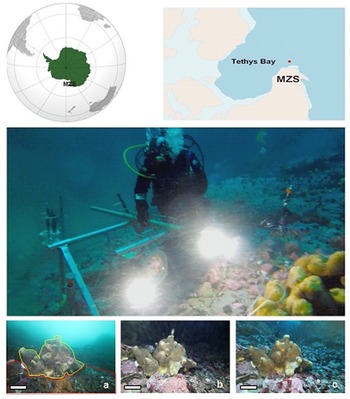
Three meters away from the time-lapse apparatus, a 1 m-high cage was fixed at the bottom. The cage contained an SBE 16 probe that recorded temperature, salinity and PAR (Biospherical Instruments QSP-2300 70597) every 30 min (Fig. 1). SBE 16 uses nine D-cell alkaline 1.5 V batteries with a nominal capacity of 14 Ah; the 30 min sampling time allowed the probe to collect data for more than 1 year in Antarctica.
Tethys Bay: the red dot indicates the site near the Italian Mario Zucchelli Station (MZS) where the time-lapse apparatus and the probe shown in the picture were positioned. The bottom images were taken in a. January, b. July and c. November 2017. In a., the area considered for the detection of organisms on the sponge is shown in yellow and that on the rocky substrata is shown in red.

Time-lapse apparatus
The imaging device consisted of one camera specifically designed for deployments that extend over time in extreme and remote marine environments (Corgnati et al. Reference Corgnati, Marini, Mazzei, Ottaviani, Aliani, Conversi and Griffa2016, Marini et al. Reference Marini, Bonofiglio, Corgnati, Bordone, Schiaparelli and Peirano2022). A transparent underwater case contained a Canon reflex camera whose internal firmware was modified to perform autonomous image acquisition. The field of view of the camera encompassed the sponge, the rocky area in front of the sponge (~930 cm2) and the background, including pack ice on the surface (Fig. 1a–c). The underwater case and lamps were fixed to an appropriately sized metallic frame for lowering through from the diving hole on the pack ice (Fig. 1).
The framing and lighting were adjusted by an underwater diver in late November 2015; this was done using an internal service display that was visible through the transparent underwater case and an internal control hardware component operated by the diver through a magnetic switch (Marini et al. Reference Marini, Bonofiglio, Corgnati, Bordone, Schiaparelli and Peirano2022). The lighting system was based on four high-efficiency LEDs that were switched on for 12 s during each image acquisition. The imaging device and lights were powered by the main battery pack comprising nine primary Tadiran SL-2700 Series batteries (3.6 V, 35.0 Ah, size DD). The main battery pack was coupled with a secondary rechargeable battery pack comprising four Samsung 18650 batteries (3.6 V, 3450 mAh, max discharge current 8 A). The main battery pack was used to provide the energy needed for the long-term monitoring, while the secondary battery pack was used to supply an impulse of power required for switching on the camera and the lighting system. The device was programmed to capture one image every 9 h continuously for at least 1.5 years. Each image had a resolution of 5207 × 3469 pixels, and these were saved in the Canon proprietary raw format CR2.
Image analysis
The yearly time-lapse sequence was divided into months. For each month, a first background light analysis was conducted for each image. The image background was not illuminated by the artificial lights of the time-lapse apparatus; this allowed for it to reveal the main seasonal changes in bottom illumination. The background analysis allowed the classification of the images into three main categories: photos captured without pack ice, photos captured with pack ice illuminated by the sun and photos captured during dark periods. The last set included both shots taken at night in the winter season and those taken in the summer season, during the dark periods of the daily cycle related to cliff- or ice-shadowing effects (Peirano et al. Reference Peirano, Bordone, Marini, Piazza and Schiaparelli2016, Marini et al. Reference Marini, Bonofiglio, Corgnati, Bordone, Schiaparelli and Peirano2022). The yearly sum of the monthly mean number of images for each category allowed us to calculate the monthly percentage of pack-ice presence/absence and dark/night periods.
The presence of benthos was recorded in two different areas framed by the camera (Fig. 1a): on the sponge and the rocky bottom in front of the camera lit up by the lamps (Marini et al. Reference Marini, Bonofiglio, Corgnati, Bordone, Schiaparelli and Peirano2022). Macrozoobenthos were identified in each image to the species level where possible. The number of individuals of each species recognized in each image was recorded; furthermore, the mean number of individuals per species (M) for each month was determined.
The 9 h intervals between two successive photos clearly showed broad-scale changes in the positions of each species; however, this interval was too long to track the movements of individuals. Hence, activity was recorded as a positive score (1) when the difference in the number of individuals of one species between two subsequent images was positive or negative (Peirano et al. Reference Peirano, Bordone, Marini, Piazza and Schiaparelli2016). When the same number of individuals of one species was present in two consecutive images but individuals were in different positions, a positive score was assigned if at least one individual had changed its position and the distance between the two recorded positions was greater than the width of the individual. The monthly percentage activity per species was calculated as the percentage ratio between the mean monthly and total yearly activities.
Differences in the monthly abundances and activity levels of the sea star and sea urchin were estimated using the Kruskal-Wallis non-parametric test (K-W) and multi-comparison test.
The monthly species abundances and percentage activity levels on the rock and sponge were compared with the monthly percentage of pack-ice presence/absence and dark periods. Relationships among monthly percentage abundances/activity levels of the species relative to light/dark periods were statistically investigated using Pearson's r correlation.
Results
Seawater parameters
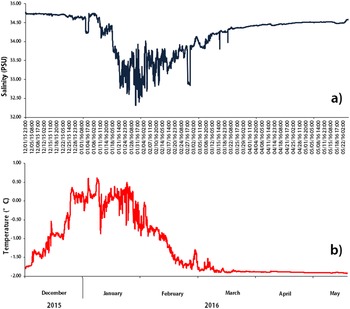
The SBE 16 probe recorded temperature and salinity for 6 months from 1 December 2015 to 24 May 2016; this recording ended when water flowed into one of the sensors and short-circuited the battery. From December to the end of January, seawater temperature increased from -1.7 to 0.5°C. This increase in temperature was followed by a salinity decrease from 34.7 practical salinity units (PSU) to a minimum of 32.3 PSU from 21 January to 4 February, coinciding with the melting of the pack ice (Fig. 2a,b).
Tethys Bay: a. salinity and b. temperature recordings from December 2015 to May 2016. PSU = practical salinity unit.

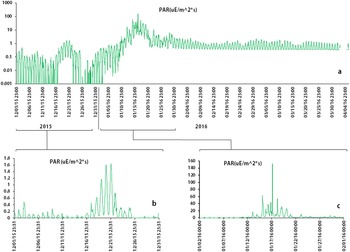
PAR measurements from 1 December 2015 to 6 April 2016 showed constant diurnal cycles with a duration of ~12 h (Fig. 3). In December, when the pack ice and the sub-ice platelet layer were 2.5 and 1.5–2.0 m thick, respectively, the maximum PAR was 1.5 μEm-2 s-1 (Fig. 3b). On 17 January, without pack ice, PAR reached a value of 152.6 μEm-2 s-1 (Fig. 3c); after 1 February, PAR ranged between 0.38 and 2.22 μEm-2 s-1.
Photosynthetically active radiation (PAR) measurements at Tethys Bay: a. log-transformed values recorded from December 2015 to April 2016; b. PAR peak in December 2015; c. PAR peak in January 2016.

Image analysis
During the first year, the time-lapse apparatus recorded macrozoobenthic activity from 4 to 17 December 2015, following which image acquisition discontinued owing to displacement of the camera, probably due to a seal impact. The camera was repositioned during the next year and recorded images from 24 January to 4 November 2017.
During the two recording periods, the camera captured a total of 784 images. The image background analysis showed that the period of total darkness reached its maximum in June–July; in December 2015, 50% of the images were photos with pack ice illuminated by the sun and the other 50% were photos taken in a dark environment. The photos taken at 9 h intervals under different light conditions (i.e. at night or in the absence of pack ice) showed that macrozoobenthos species were not influenced by the lighting system of the time-lapse apparatus. Only benthic fishes were attracted by the lamps. The presence of anchor ice on the sponge was recorded from 14 to 20 October 2017.
A total of 12 genera of macrozoobenthos were identified. Although most of the benthic species were found only occasionally and limited to one or two individuals, image analysis revealed patterns linked to other organisms. For example, schools of juveniles of the pelagic fish Pagothenia borchgrevinki (Boulenger) were observed from 24 January to 2 February 2017, and an aggregation episode of four/five individuals of the gastropod Neobuccinium eatoni (E.A. Smith) was observed on the rocky bottom in April 2017.
Only the sea star O. validus and the sea urchin S. neumayeri were noted as being abundant throughout the year in all of the time-lapse images; furthermore, these species occurred both on the sponge and on the rocky bottom. For this reason, the calculation of abundances and activity levels was limited to these two species.
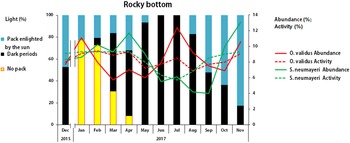
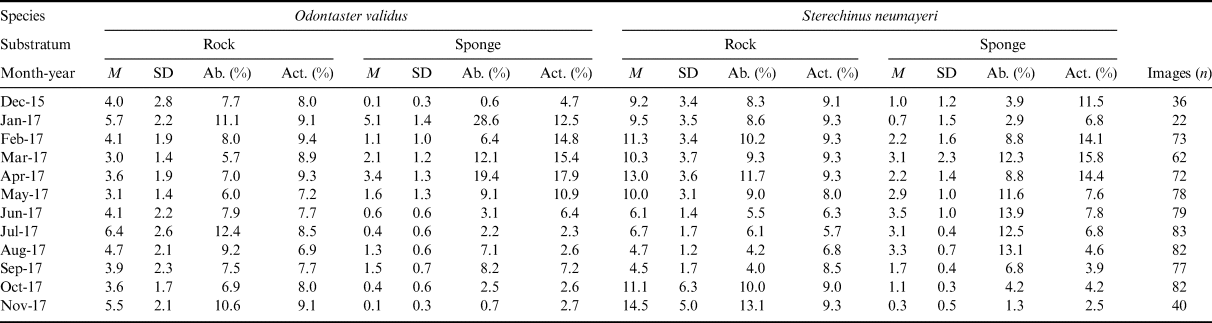
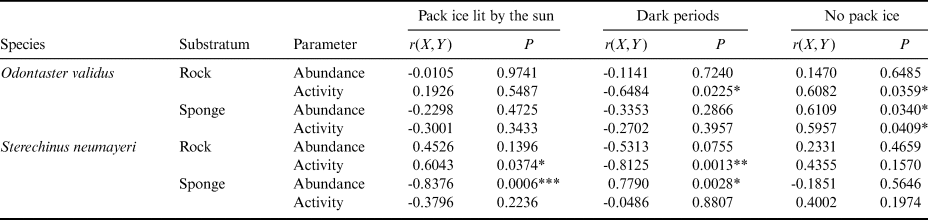
On the rocky bottom, the percentage abundance of O. validus did not vary among months (K-W test: P = 0.0001). Alternative peaks were found in 2017, specifically in January (11.1%; M = 5.7 ± 2.2), July (12.4%; M = 6.4 ± 2.6) and November (10.6%; M = 5.5 ± 2.1), with a minimum in March (5.8%; M = 3). The activity of the red sea star did not show differences among months (K-W test: P = 1); it showed a maximum in April 2017 (9.3%) and a minimum in August 2017 (6.9%; Fig. 4 & Table I). Furthermore, the activity of the red sea star was negatively correlated with dark periods (P = 0.0225) and positively correlated with periods with pack-ice absence (P = 0.0359; Table II).
Mean monthly abundance and percentage activity level of the red sea star Odontaster validus and the sea urchin Sterechinus neumayeri on the rocky bottom compared with monthly percentages of light and pack-ice presence/absence. The dark periods include the night winter season and dark periods of the daily cycle observed in summer.

Mean monthly percentage activity levels (Act.) and abundance (Ab.) of the red sea star Odontaster validus and the sea urchin Sterechinus neumayeri at Tethys Bay on the rocky substrata and on the sponge Mycale acerata from the time-lapse image analysis. Data reported in each row represent the number of samples or images analysed per month.

Tethys Bay: results of Pearson's r correlations among mean monthly percentage activity levels and abundances of Odontaster validus and Sterechinus neumayeri on the rocky substrata and on the sponge Mycale acerata vs monthly percentages of light and pack-ice presence/absence (see Table I for data). Dark periods include the night winter season and dark periods of the daily cycle observed in summer.

*0.05 ≥ P > 0.01; **0.01 ≥ P > 0.001; ***P ≤ 0.001.
S. neumayeri showed significant monthly differences for both abundance and activity on the rock (K-W test; P = 0.0001). The number of individuals in 2017 decreased from April (11.7%; M = 13 ± 3.6) to September (4.0%; M = 4.5 ± 1.7). The maximum activity level was recorded in summer from November 2017 (9.3%) to April 2017 (9.4%). Sea urchin activity was positively correlated with the pack ice being illuminated by the sun (P < 0.0374) and negatively correlated with dark periods (P = 0.0013; Table II).
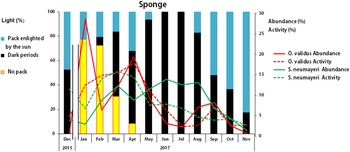
On the sponge, O. validus showed significant monthly variations in its abundance and activity (K-W test; P = 0.0001). Specifically, in 2017 its abundance showed three peaks in January (28.6%; M = 5.1 ± 1.4), April (19.4%; M = 3.4 ± 1.3) and September (8.2%; M = 1.5 ± 0.7). The minimum abundance was recorded in December 2015 (0.6%; M = 0.1 ± 0.3). The monthly percentage activity level of the red sea star increased in 2017 from January (12.5%) to April (17.9%) and then decreased to a minimum in July (2.3%). Both the abundance and activity on the sponge were positively correlated (P = 0.034 and 0.0409, respectively) with periods of no pack ice.
With respect to the mean monthly abundance of S. neumayeri on the sponge, differences were found between months (K-W test: P = 0.0001). Specifically, there was an increase in the number of individuals from January (2.9%, M = 0.7 ± 1.5) to June 2017 (13.9%; M = 3.5 ± 1.0), followed by a decrease in August, down to a minimum in November of 1.3% (M = 0.3 ± 1.3; Fig. 5 & Table I). The monthly percentage activity level showed differences between months (K-W test: P = 0.0001); activity increased in 2017 from January (6.8%) to March (15.8%) and then decreased to a minimum of 2.5% in November. Abundance showed a negative correlation (P = 0.0006) with periods of solar illumination and pack-ice presence and a positive correlation (P = 0.0028) with darkness and the winter period.
Mean monthly abundance and percentage activity level of the red sea star Odontaster validus and the sea urchin Sterechinus neumayeri on the sponge Mycale acerata compared with monthly percentages of light and pack-ice presence/absence. The dark periods include the night winter season and dark periods of the daily cycle observed in summer.

Discussion
Seawater parameters
Our observations on temperature and salinity in the coastal water of Tethys Bay demonstrated a temperature > 0°C at the end of December. Increasing daily irradiance during summer is the main factor determining the rise in temperature and subsequent melting of pack ice (Innamorati et al. Reference Innamorati, Mori, Massi, Lazzara, Nuccio, Faranda, Guglielmo and Ianora2000). In late January 2016, the temperature increase was followed by a decrease in seawater salinity and density, which determined the stratification of water and the stability of this stratification (Innamorati et al. Reference Innamorati, Mori, Massi, Lazzara, Nuccio, Faranda, Guglielmo and Ianora2000, Lombardi et al. Reference Lombardi, Kuklinski, Bordone, Spirandelli and Raiteri2021). The presence of anchor ice was observed on the sponge in photos captured in October 2017, confirming previous observations made by AP that were conducted in late November 2015 at a depth of 10–15 m; these observations were recorded during exploratory dives intended to locate the best area for deploying the time-lapse apparatus. Although anchor-ice formation is well known in the Ross Sea (Dayton et al. Reference Dayton, Robilliard and DeVries1969, Thrush et al. Reference Thrush, Dayton, Cattaneo-Vietti, Chiantore, Cummings and Andrew2006), it has not been frequently observed in Terra Nova Bay (Cattaneo-Vietti et al. Reference Cattaneo-Vietti, Chiantore, Gambi, Albertelli, Cormaci, Di Geronimo, Faranda, Guglielmo and Ianora2000, Thrush et al. Reference Thrush, Dayton, Cattaneo-Vietti, Chiantore, Cummings and Andrew2006). This finding may support the hypothesis that the reduction of the sponge community observed by Piazza et al. (Reference Piazza, Cummings, Lohrer, Marini, Marriott and Menna2018) in 2015–2017 could be related not only to predation, but also to episodes of anchor ice that caused the eradication or death of the sponges (Dayton Reference Dayton1989, Gutt Reference Gutt2002).
Dark periods in December 2015 were observed in time-lapse images by Peirano et al. (Reference Peirano, Bordone, Marini, Piazza and Schiaparelli2016) and Marini et al. (Reference Marini, Bonofiglio, Corgnati, Bordone, Schiaparelli and Peirano2022) and were maintained during the summer until winter. The PAR sensor recorded diurnal cycles with a duration of ~12 h, which were also found by Yuxin et al. (Reference Yuxin, Zhang, Yang, Lin and He2014) at Great Wall Bay (King George Island, Antarctic Peninsula) and Schwartz et al. (Reference Schwarz, Hawes, Andrew, Norkko, Cummings and Thrush2003) at Cape Evans (Ross Sea). These diurnal variations are in agreement with sea-level changes due to tidal diurnal oscillation that may reach amplitudes of ~80 cm in Tethys Bay (Byun & Hart Reference Byun and Hart2020). Hence, tidal oscillations are another factor that, together with pack ice, snow on top of the ice, platelet pack-ice thickness and floating icebergs, may limit PAR reaching the bottom, thereby reducing primary productivity in summer (Schwartz et al. Reference Schwarz, Hawes, Andrew, Norkko, Cummings and Thrush2003).
The PAR measured at a depth of 20 m in December 2015 reached its maximum of 1.5 μEm-2 s-1 when the pack ice was 2.5 m thick. In November 1999, Mangoni et al. (Reference Mangoni, Saggiomo, Modigh, Catalano, Zingone and Saggiomo2008) measured at the top of the pack ice a PAR range of 505–1487 μEm-2 s-1 with pack ice 2.5 m thick and 2–4 m of platelet pack ice. Lazzara et al. (Reference Lazzara, Nardello, Ermanni, Mangoni and Saggiomo2007), with the same pack-ice thickness, estimated that, on average, only 1.4% of PAR at the surface penetrated to the bottom ice and < 0.6% penetrated below the platelet ice. From these data, we can estimate that the amount of PAR reaching the bottom in December 2015 was 0.1–0.2% of the surface light, in accordance with measurements made by Cummings et al. (Reference Cummings, Hewitt, Thrush, Marriott, Halliday and Norkko2018) at Tethys Bay in November 2006. Odate et al. (Reference Odate, Hirawake and Fukuchi2004) reported PAR threshold values of 0.6–7.6 μEm-2 s-1 for algal photosynthesis and growth in the Canadian Arctic and Alaska. These values are generally considered as the limit for photosynthesis or as the bottom of the euphotic zone, and it is assumed that no algal growth occurs beneath sea ice if the pack-ice thickness becomes > 3 m (Odate et al. Reference Odate, Hirawake and Fukuchi2004). Hence, we can estimate from our data that photosynthetic activity at -20 m was possible at the bottom only during the first peak on 21 December 2015 (1.5 μEm-2 s-1) and from 1 January 2015 onward. Without pack-ice cover, the value of PAR reaching the bottom was 100 times greater. The peak observed in January 2015 (152 μEm-2 s-1) is similar to the maximum PAR recorded by Schwartz et al. (Reference Schwarz, Hawes, Andrew, Norkko, Cummings and Thrush2003) at Cape Evans (McMurdo Sound) in February 2002 at a depth of 15 m (120 μEm-2 s-1) and is in agreement with observations made by Yuxin et al. (Reference Yuxin, Zhang, Yang, Lin and He2014) in January 2011 at the same depth at Great Wall Bay (Fildes Peninsula, King George Island), although the PAR value in Tethys Bay was only 67% of the maximum recorded in the Antarctic Peninsula (~225 μEm-2 s-1) .
Image analysis
All fish and macrozoobenthos species recognized in the time-lapse series are known from Tethys Bay (Gambi et al. Reference Gambi, Lorenti, Russo and Scipione1994, Cantone et al. Reference Cantone, Castelli, Gambi, Faranda, Guglielmo and Ianora2000, Cattaneo-Vietti et al. Reference Cattaneo-Vietti, Chiantore, Gambi, Albertelli, Cormaci, Di Geronimo, Faranda, Guglielmo and Ianora2000, Vacchi et al. Reference Vacchi, La Mesa, Greco, Faranda, Guglielmo and Ianora2000). However, little could be said about the behaviour of most organisms observed on the time-lapse images owing to the small sample size that precluded evaluation of any species except the sea star and sea urchin. The underwater apparatus showed, for the first time, the benthopelagic behaviour of fish P. borchgrevinki, with juvenile schools being observed near the bottom at the end of January 2017. The presence of the benthic fish Trematomus bernachii Boulenger was confirmed at rocky inshore habitats (Williams, Reference Williams1988); however, its presence/absence from the time-lapse images cannot be attributed to behaviour changes, but instead to the attraction induced by the artificial light of the time-lapse apparatus, as noted by Peirano et al. (Reference Peirano, Bordone, Marini, Piazza and Schiaparelli2016). In contrast, artificial lights did not disturb the presence of other macrozoobenthos species, as shown by comparing their positions during the analysis of the photos taken in succession.
The gastropod N. eatoni showed an aggregation episode of four to five individuals in April 2017 that could be associated with a reproduction episode, in agreement with the observations of Hedley (Reference Hedley and Murray1911) on egg capsules collected in June.
The two more abundant taxa throughout the year were the sea star O. validus and the sea urchin S. neumayeri, confirming 2007 summer diving observations made by Cummings et al. (Reference Cummings, Hewitt, Thrush, Marriott, Halliday and Norkko2018) at Tethys Bay.
On the rocky bottom, the abundance of O. validus showed three peaks in January, July and November 2017, whereas both the abundance and activity of S. neumayeri declined during the winter season.
O. validus showed preferential activity during brighter periods, both on the sponge and on the rocky bottom, in agreement with 1–2 days of observations made by Peirano et al. (Reference Peirano, Bordone, Marini, Piazza and Schiaparelli2016) on the rocky bottom from November to December 2015.
On M. acerata, tissue ingestion by the red sea star can lead to the sponge's destruction owing to the further damage of S. neumayeri, which grazes the remaining sponge skeleton colonized by diatoms (Cerrano et al. Reference Cerrano, Bavestrello, Calcinai, Cattaneo-Vietti and Sarà2000). This sequence was confirmed by the activity of the red sea star on the sponge, which increased from December to April by more than threefold, followed by an increase in urchin activity from February to April. Overall, the activities of the two species are concentrated on the sponge when the pack ice melts and the associated increase in light allows phytoplankton to bloom (Innamorati et al. Reference Innamorati, Mori, Massi, Lazzara, Nuccio, Faranda, Guglielmo and Ianora2000, Nuccio et al. Reference Nuccio, Innamorati, Lazzara, Mori, Massi, Faranda, Guglielmo and Ianora2000, Lazzara et al. Reference Lazzara, Nardello, Ermanni, Mangoni and Saggiomo2007, Lombardi et al. Reference Lombardi, Kuklinski, Bordone, Spirandelli and Raiteri2021).
The sponge was not severely damaged by these two species from December 2015 to November 2017. Perhaps the limited damage to the sponge was related to the low number (maximum of six individuals) of O. validus observed actively feeding on it from January to May 2017. The number of consuming O. validus individuals seems to be crucial to the survival of the sponge and to the recovery of damaged tissue. This hypothesis is supported by the observations made in December 2015 by AP on a flat rocky bottom along a video transect 20 m away from the time-lapse apparatus. Here, tens of O. validus individuals completely consumed one M. acerata, leading to its disappearance in 2016 (Piazza et al. Reference Piazza, Cummings, Guzzi, Hawes, Lohrer and Marini2019).
Platelet ice melting observed by divers in Tethys Bay on 6 December 2015 is a fundamental event in maintaining coastal Antarctic benthic diversity and food web equilibrium. Sympagic algae derived from the pack-ice bottom are a basic food source for all benthic organisms. S. neumayeri and O. validus have very broad diets, ranging from macroalgal debris to seal faeces (Bray et al. Reference Brey, Pearse, Basch, McClintock and Slattery1995); however, they predominantly feed on benthic diatoms and large phytoplankton mats that drape the sea floor after spring blooms (Dayton et al. Reference Dayton, Jarrell, Kim, Parnell, Thrush, Hammerstrom and Leichter2019).
Caputi et al. (Reference Caputi, Careddu, Calizza, Fiorentino, Maccapan, Rossi and Costantini2020) analysed the food web in Tethys Bay from 14 November 2016 to 7 February 2017 before (b) and after (a) the ice break, which occurred on 18 December 2016. The nutritional value of the 60 benthic species was inferred through C and N stable isotope analysis and species trophic position (TP). They found that Odontaster meridionalis (TP = 3.2 b, 3.0 a) consumed materials mainly of animal origin, whereas S. neumayeri (TP = 2.5 b, 2.2 a) showed dependence on sympagic algae (TP = 1.0 b, 1.0 a) during both periods, although this dependence was more pronounced after the ice break. The TP data indicated that the sponge Mycale spp. (TP = 2.6 b, 2.2 a) could be an alternative food source for both the sea star and sea urchin, whereas the associated Polynoidae (TP = 3.2 b) found by Marini et al. (Reference Marini, Bonofiglio, Corgnati, Bordone, Schiaparelli and Peirano2022) on the sponge could be prey for the sea star.
The winter months are critical both for O. validus and S. neumayeri; while the red sea star maintains its pattern of activity on the rocky bottoms by foraging, the sea urchin reduces its activity, probably to survive a starvation period.
Conclusions
Despite the limitation in terms of the taxonomic recognition of species owing to the use of an imaging device, the data collected at Tethys Bay demonstrated the importance of positioning long-term observatories on coastal bottoms in Antarctica all year around and providing these observatories with probes for collecting physicochemical data.
The long-time-lapse approach showed its potential in studying macrozoobenthos occurrence and activity levels, and it could become an important tool for evaluating aspects of key macroinvertebrate foraging and behaviour patterns. Despite the technical difficulties in positioning and maintaining continuous observation systems, the data collected using automated devices will contribute to elucidating the roles of macrozoobenthos species in coastal habitats, helping us to predict the future of the Antarctic environment that is facing climate change and the impacts of warming and ocean acidification.
Author contributions
AP and SM conceived the pilot study; LPC and SM conceived the imaging device; AP, AB and SM prepared and tested the imaging device for the Antarctic long-term monitoring; AP and SM participated in the XXXI Antarctic expedition in Tethys Bay, where AP was the scientific diver. AP identified specimens from the images, analysed data and wrote the manuscript with the support of AB, LPC and SM.
Acknowledgements
The work was conducted within the Ice-Lapse Project 2013/AZ1.16 during the XXXI PNRA (Italian National Antarctic Programme) expedition. We thank the Italian Navy divers G. Tangari and T. Pischedda and the Army divers G. Oggero and R. Pini for their assistance in underwater work. We also thank G.B. Fasani (ENEA) and all of the members of the Italian Mario Zucchelli Station for the logistical support. Finally, we thank the editor and two anonymous referees whose suggestions greatly improved the manuscript. Editage (www.editage.com) contributed to the English-language editing. We also thank the anonymous reviewers for their comments.
Financial support
This work has been supported by funding from Italian National Antarctic Programme (PNRA) and by the ENDURUNS and JERICO Projects.