





Introduction
Although most people worldwide acknowledge anthropogenic climate change (ACC) as a significant threat, a persistent minority remains skeptical. In member states of the European Union, 8 to 20% of citizens either doubt that the climate is changing or reject human activity as its cause (e.g., Poortinga, Whitmarsh, Steg et al. Reference Poortinga, Whitmarsh, Steg, Böhm and Fisher2019). Understanding both public and political elites’ attitudes toward climate change is crucial, as accepting ACC is a prerequisite for supporting mitigation policies (Fielding, Head, Laffan et al. Reference Fielding, Head, Laffan, Western and Hoegh-Guldberg2012; Rapeli and Koskimaa Reference Rapeli and Koskimaa2022; Tranter Reference Tranter2011).
However, most studies focus on either the general population or party positions, with little attention given to political elites’ attitudes – particularly those that fall between outright denial and full acceptance of climate change and yet pose a significant hindrance for effective climate mitigation. While outright denial of ACC has gained increasing scholarly attention over the past five years (e.g., Huber Reference Huber2020; Poortinga, Whitmarsh, Steg et al. Reference Poortinga, Whitmarsh, Steg, Böhm and Fisher2019), the nuances of climate change skepticism remain understudied. Few surveys address what we term the ‘gray zone’ of skeptic attitudes, such as doubts about the scientific consensus or ‘climate nationalism’, where individuals or politicians deny or downplay their own country’s responsibility (for exceptions see Engels, Hüther, Schäfer et al. Reference Engels, Hüther, Schäfer and Held2013; Poortinga, Spence, Whitmarsh et al. Reference Poortinga, Spence, Whitmarsh, Capstick and Pidgeon2011; Vihma, Reischl, and Andersen Reference Vihma, Reischl and Andersen2021; Whitmarsh Reference Whitmarsh2011). These views, relatively widespread and highly compatible with the political mainstream, pose a significant challenge to effective climate change mitigation.
Against this background, our research interest is threefold. First, we ask how widespread climate change skepticism is among local political elites. Second, we examine which types of climate change skeptic attitudes can be distinguished within this elite group. Third, we analyze how these attitudes are distributed across and within political parties. Our study contributes to the growing literature on political elite attitudes toward climate change in several ways. We develop a theoretical framework that differentiates between distinct dimensions of climate skepticism. Building on this framework, we introduce a novel battery of survey items designed to capture a broader and more fine-grained spectrum of skeptical attitudes, allowing for a more nuanced empirical assessment of climate change skepticism among local political elites.
To understand why such nuanced forms of skepticism matter beyond the general population, it is essential to consider the specific role of local political elites in climate governance. Local political elites are particularly relevant because they can function as key veto players in climate policy implementation, especially in decisions concerning renewable energy siting, land-use planning, and infrastructure development. Their attitudes may therefore directly affect the feasibility, timing, and ambition of climate mitigation efforts. Accordingly, even partial or ambiguous forms of skepticism may translate into resistance, delay, or selective implementation of climate policies at the local level.
Against this background, we shift the focus to local political elites, who are directly involved in shaping and implementing climate-relevant policies. In addition, they serve as key opinion leaders for citizens and can influence broader public debates on climate change. Our study examines the views of council members in Saxony and Thuringia – two eastern German states characterized by ideologically competitive party systems and intense conflicts over Germany’s energy transition, reflecting broader trends in party system change.
While most research addressing climate change skepticism focuses on the far right, we use original web survey data and a robust battery of survey items to show that attitudes from the broader spectrum of climate change skeptic views extend into the political mainstream. Moreover, we demonstrate that local politics, traditionally less polarized and more consensus-orientated (e.g., Bogumil and Holtkamp Reference Bogumil and Holtkamp2016; Legner Reference Legner, Burmester and Pfaff2013), now exhibits significant ideological differentiation on climate issues. Our findings confirm a divide between the Greens and the far-right Alternative for Germany (AfD) observed in previous studies (e.g., Otteni and Weisskircher Reference Otteni and Weisskircher2022). However, our analysis also reveals significant attitudinal differences across most of the party spectrum. Second, our results reinforce the observation that parties are not monolithic entities but internally diverse organizations. Overall, our study highlights the importance of local-level attitudes in shaping the political feasibility of climate policies and addressing skepticism both within and across party lines.
Next, we present our theoretical framework, outlining the role of local political elites’ attitudes in shaping climate policies, as well as key concepts of climate skepticism. We also argue that the broader spectrum of partially skeptical attitudes can influence ideological inter-party and intra-party heterogeneity. We then describe our case selection, methodological approach, and data. Our empirical analysis examines climate-skeptic attitudes among German local councilors. Finally, we discuss our findings and highlight directions for future research.
Theoretical framework and hypotheses
The role of local political elites’ attitudes in climate policies
Since climate issues are seen as the most pressing concern in Europe (European Commission 2023), it is unsurprising that academic research on this topic is expanding. However, most existing studies focus on the supply side, analyzing party positions in election manifestos or specific climate policies (DIW Econ 2021; Ekardt and Sund Reference Ekardt and Sund2021; Schulze and Schoenefeld Reference Schulze and Schoenefeld2022) – often with a strong emphasis on the far-right party family (Schaller and Carius Reference Schaller and Carius2019; Weisskircher and Volk Reference Weisskircher and Volk2026). In contrast, our understanding of political elites’ attitudes toward climate change remains limited, particularly at the local level. Addressing this research gap is essential for at least two reasons.
First, local elites are crucial for implementing and communicating climate policy decisions, such as the construction of wind parks, power line extensions, large solar photovoltaic fields, and biomass power plants (Reusswig, Braun, Heger et al. Reference Reusswig, Braun, Heger, Ludewig, Eichenauer and Lass2016). Political elites – defined here as elected politicians or, more precisely, as ‘individuals and small, relatively cohesive, and stable groups with disproportionate power to affect national and supranational political outcomes on a continuing basis’ (Best and Higley Reference Best, Higley, Best and Higley2018: 3) – hold key positions in policy-making, including at the local level. Where they downplay the urgency of climate change or consider it politically secondary, they may obstruct implementation efforts on the ground. In Germany’s Rheinisches Revier, for instance, local elites prioritized coal-related economic interests, resisted transition projects, and delayed implementation while also influencing the national coal commission’s compromise (Sander, Siebenmorgen, and Becker Reference Sander, Siebenmorgen and Becker2020). By contrast, cities like Heidelberg and Jena pushed ahead with ambitious climate action plans and ‘climate emergency’ declarations, reinforcing climate goals and shaping national debates (Deutscher Bundestag 2019).
Second, political elites may play a crucial role in shaping public opinion on complex issues like climate change. Although most existing evidence refers to national political leaders, these studies suggest that elite cues also influence citizens’ climate attitudes more broadly. Their attitudes serve as key heuristics that citizens rely on, ‘trickling down’ into the general public (Cohen Reference Cohen2003). Politicians ‘also send a mixed message to citizens without strong political affiliations and undermine any emergent wider consensus about the issue in terms of what to believe and what actions to take’ (Fielding, Head, Laffan et al. Reference Fielding, Head, Laffan, Western and Hoegh-Guldberg2012: 716). Research by Sciarini, Bornstein, and Lanz (Reference Sciarini, Bornstein, Lanz and de Vreese2007) suggests that polarization among political leaders on environmental issues is often mirrored among partisans. Tranter (Reference Tranter2011: 89–90) goes even further, indicating that political leaders influence climate change attitudes across the political spectrum – sometimes even more than party identification itself. Local political elites are likely to play a similar role by communicating and interpreting party positions in local political arenas, thereby reinforcing climate-related debates and influencing policy implementation.
The limited research on political elites’ attitudes toward climate change – most of which examines national- or regional-level actors (e.g., Fielding, Head, Laffan et al. Reference Fielding, Head, Laffan, Western and Hoegh-Guldberg2012; Rapeli and Koskimaa Reference Rapeli and Koskimaa2022) – suggests that these attitudes extend beyond a simple acceptance-versus-denial divide. Although existing studies consistently identify a pronounced ideological divide in climate change attitudes, with skepticism being particularly prevalent among conservative and far-right actors, much less is known about the extent to which more nuanced forms of climate skepticism extend beyond outright denial and are present across the broader party spectrum. For example, Fielding, Head, Laffan et al. (Reference Fielding, Head, Laffan, Western and Hoegh-Guldberg2012), studying Australian politicians at the national and state levels, demonstrate that party affiliation and ideology strongly shape climate attitudes. Their survey found that politicians from the Labor and Green parties align more closely with the scientific consensus on climate change than their non-aligned or conservative counterparts.
Whether these patterns also apply to local political elites remains an open question. Local politics has traditionally been characterized as less ideological and more consensus-oriented than politics at higher levels of government (Bogumil and Holtkamp Reference Bogumil and Holtkamp2016). However, recent studies underline that local governments still make important political decisions, and local issues can produce stark partisan divides, for example, in areas such as culture, infrastructure, and housing (Heinze Reference Heinze2026). Consequently, while we expect local elites to reflect broader partisan divides on climate change, these divisions may be less pronounced and shaped by local implementation contexts. Examining local elites therefore provides an opportunity to assess the extent to which national patterns of ideological differentiation on climate change issues extend to the local level.
Moreover, these studies suggest that the issue of climate change goes well beyond the binary question of whether political elites believe in it or not. However, there is still a lack of a clear analytical framework to capture more nuanced perspectives that fall in the ‘gray zone’ between denial and acceptance. Therefore, in the following, we develop a theoretical framework to analyze climate change attitudes, incorporating a broader spectrum of (partially) skeptical views. These attitudes include, for example, downplaying one’s own country’s contribution to global CO2 levels or believing that the risks of climate are exaggerated.
Broader spectrum of climate skepticism
According to Rahmstorf (Reference Rahmstorf and Munich2004), one can distinguish between trend, attribution, and impact skeptics. Trend skeptics deny that global warming is occurring. Attribution skeptics acknowledge the warming trend but argue that human contributions are either non-existent or overstated compared to natural factors. Impact skeptics accept the occurrence of climate change but dispute its harmful effects or the need to take action. Van Rensburg (Reference Van Rensburg2015) later summarizes these three types under the label ‘evidence skepticism’, which constitutes the ‘core’ of climate change skeptic attitudes. This outright denial of scientific evidence is estimated to affect between 8 and 20% of the population (e.g., Poortinga, Whitmarsh, Steg et al., Reference Poortinga, Whitmarsh, Steg, Böhm and Fisher2019).
In view of the devastating effects of climate change becoming more apparent in the Global North, evidence skepticism may be declining. Even some previously skeptical parties, such as the Danish People’s Party, have moderated their positions (Vihma, Reischl, and Andersen Reference Vihma, Reischl and Andersen2021). Consequently, van Rensburg proposes two ‘weaker’ forms of skepticism: process and response skepticism. Process skepticism questions how evidence of man-made climate change is generated and communicated, whereas response skepticism refers to criticism of climate change mitigation policies (van Rensburg Reference Van Rensburg2015). In this paper, we adopt a different perspective. Rather than focusing on response skepticism, which we consider conceptually distinct from climate skepticism itself, we argue that there exists a ‘gray zone’ of partial skepticism situated between outright denial and full acceptance. These views constitute the ‘wider’ concept of climate change skepticismFootnote 1 and have been largely overlooked in current research (for exceptions see Engels, Hüther, Schäfer et al. Reference Engels, Hüther, Schäfer and Held2013; Poortinga, Spence, Whitmarsh et al. Reference Poortinga, Spence, Whitmarsh, Capstick and Pidgeon2011; Vihma, Reischl, and Andersen Reference Vihma, Reischl and Andersen2021).
Importantly, not all forms of gray zone skepticism are equally close to conventional climate skepticism (trend, attribution, or impact skepticism), which directly challenges the established scientific understandings of climate change or the severity of climate risks. One of the central motivations of the ‘gray zone’ is that these attitudes occupy a more ambiguous position than outright climate change denial. Following previous scholarship, including van Rensburg’s (Reference Van Rensburg2015) work on response skepticism, we adopt a broader understanding of skepticism as doubt regarding key elements of the dominant climate change narrative, such as the scientific consensus, the responsibilities of particular actors, or the appropriateness of proposed policy responses. A key contribution of this paper is the development of a new survey instrument that captures this broader spectrum of partially skeptical attitudes.
One such view is consensus skepticism, which questions the scientific consensus that 97 to 99.9% of climate scientists agree on the human causes of dangerous climate change (Anderegg, Prall, Harold et al. Reference Anderegg, Prall, Harold and Schneider2010; Cook et al. Reference Cook, Nuccitelli, Green, Richardson, Winkler, Painting, Way, Jacobs and Skuce2013; Powell Reference Powell2016; for a survey measuring this attitude, see Engels, Hüther, Schäfer et al. Reference Engels, Hüther, Schäfer and Held2013). While questioning the existence of a scientific consensus may appear closer to conventional forms of climate skepticism than some of the other attitudes considered here, it can also be understood as a more indirect challenge to climate science that does not necessarily entail outright denial of anthropogenic climate change. We therefore include it as part of the broader spectrum of gray zone skeptical attitudes.
Another common skeptic narrative, often employed by the far right, is the belief that the risks of climate change are greatly exaggerated – frequently dismissed as alarmism or hysteria (Forchtner and Lubarda Reference Forchtner and Lubarda2022; Küppers Reference Küppers2024). This form of skepticism – which is similar to van Rensburg’s (Reference Van Rensburg2015) process skepticism – goes beyond outright denial of scientific evidence and includes, for example, criticism of established parties for ‘being alarmist and using climate change as a political tool to pursue a hidden agenda’ (Küppers Reference Küppers2024: 16).
Additionally, we identify views that we chose to term climate nationalism. Climate nationalists prioritize national economic competitiveness and argue that domestic emission reduction efforts have little impact on global CO2 levels, shifting responsibility to major polluters like China and the U.S. This position is evident among far-right parties in the Nordic countries (Vihma, Reischl, and Andersen Reference Vihma, Reischl and Andersen2021; see also Schwörer and Fernández-García, Reference Schwörer and Fernández-García2024).
Finally, climate conservatives, as identified by Vihma, Reischl, and Andersen (Reference Vihma, Reischl and Andersen2021), aim to preserve existing economic structures, particularly the consumerist and fossil fuel-based way of life. They are concerned that climate change mitigation efforts may negatively affect the economy and disrupt established lifestyles. Often, climate conservatives advocate for market-based solutions, such as carbon pricing, which they believe can reduce emissions without harming the economy or requiring drastic lifestyle changes.
By downplaying the need to act on climate change, these four perspectives can be considered ‘partially skeptical’. In the following, we argue that these views from the wider spectrum of climate skepticism have the potential to contribute to ideological differentiation and intra-party heterogeneity in party systems – also at the local level.
Climate skepticism and inter-party heterogeneity
Previous studies suggest that climate change measures can drive ideological heterogeneity in both civil society and party systems. For example, Reusswig, Braun, Heger et al. (Reference Reusswig, Braun, Heger, Ludewig, Eichenauer and Lass2016) examine local conflicts over wind park construction, arguing that Germany’s energy transition is not only controversial in its implementation but also as a broader political project – especially when framed in economic terms. Similarly, Otteni and Weisskircher (Reference Otteni and Weisskircher2022) show that wind turbine construction fuels conflict between its key proponents and opponents, namely the Greens and the AfD, reinforcing party system polarization and shaping electoral success.
While these studies illuminate how environmental conflicts influence party competition, it remains unclear whether similar patterns of ideological differentiation exist among local political elites. In this context, we define ideological differentiation (rather than polarization in the strict sense) as the extent to which local elites adopt divergent positions on climate change. In line with Mehlhaff (Reference Mehlhaff2024), we understand polarization as a multidimensional concept that requires both inter-group divergence and intra-group homogeneity. This distinction is crucial, as high between-party differences can coexist with substantial within-party heterogeneity.
Importantly, policy disagreement is a normal and even healthy feature of democratic competition (Dahl Reference Dahl1971; Sartori Reference Sartori1976). However, ideological differentiation becomes normatively problematic when it hampers cross-party cooperation, reduces the scope for consensus, and obstructs effective policy implementation (Hetherington Reference Hetherington2009). These concerns are especially salient in the context of local climate governance, where pragmatic cooperation is often essential. Moreover, increasing partisan polarization can drive both policy and affective polarization (Hobolt, Lawall, and Tilley Reference Hobolt, Lawall and Tilley2024).
In the German context, local politics are often considered technical rather than ideological. Governance at this level is typically regarded as an administrative task – or, as is often remarked, ‘there is no Christian Democratic street lighting’ (Bogumil Reference Bogumil, Gehne and Spier2010: 38). However, climate policy debates may increasingly challenge this perception. Recent studies show growing ideological differentiation around climate change, driven by far-right activity (Falkenberg et al. Reference Falkenberg, Galeazzi, Torricelli, Di Marco, Larosa, Sas, Mekacher, Pearce, Zollo, Quattrociocchi and Baronchelli2022) and stark divisions in civil society (Zilles and Marg Reference Zilles and Marg2022).
Given that climate policies are primarily implemented at the local level, we expect that climate issues contribute to ideological differentiation among local elites as well, leading us to the following hypotheses:
H1: Climate change attitudes at the local level differ across the party spectrum.
H2: Local far-right and Green political elites will hold the most divergent attitudes towards climate change.
Climate skepticism and intra-party heterogeneity
At the same time, climate change beliefs could contribute to intra-party heterogeneity among political elites. Recent conceptual work emphasizes that intra-party heterogeneity constitutes an important analytical dimension in its own right, as substantial within-group variation may coexist with clear differences between political groups (Mehlhaff Reference Mehlhaff2024). Research has shown that parties are not monolithic entities but rather organizations of diverse social interests. This is particularly true for large parties, which tend to accommodate a broad range of policy preferences (Sieberer Reference Sieberer2006). For local political elites, this implies that individual positions are shaped by the need to balance local constituency preferences, personal policy beliefs, and party expectations, which may create incentives for either convergence or divergence within parties. These incentives also operate at the individual level, as local politicians face potential trade-offs between responsiveness to local voters and adherence to party positions, which may affect both their expressed attitudes and the degree of within-party variation.
Intra-party heterogeneity is also influenced by party ideology and issue salience. Mader and Steiner (Reference Mader and Steiner2019) find that parties tend to be more united on core ideological issues and more divided on secondary ones. In Germany, the Greens demonstrate the highest internal consensus on environmental issues (including the balance between climate change and the economy, environmental protection, and nuclear energy), while the AfD exhibits the lowest agreement (ibid.: 211). However, Berker and Pollex (Reference Berker and Pollex2021) highlight nuanced differences in how regional Green parties respond to climate activism and prioritize climate policies.
Building on this literature, we argue that climate-related attitudes are likely to be particularly homogeneous within parties for which climate change constitutes a core ideological issue. In such parties, climate policy positions are central to the party’s identity and programmatic profile, creating strong incentives for ideological cohesion among political elites. Conversely, parties for which climate change is a secondary or cross-cutting issue may accommodate a broader range of views, resulting in greater intra-party heterogeneity.
Moreover, climate change has become increasingly salient for the far right (Forchtner and Lubarda Reference Forchtner and Lubarda2022; Otteni and Weisskircher Reference Otteni and Weisskircher2022). Far-right parties have increasingly incorporated climate-related issues into their broader ideological projects, frequently combining climate skepticism with nationalist and anti-elitist narratives (Forchtner and Lubarda Reference Forchtner and Lubarda2022; Vihma, Reischl, and Andersen Reference Vihma, Reischl and Andersen2021). As a result, skeptical positions on climate change may become closely linked to the party’s ideological identity.
However, not all forms of climate skepticism are equally consequential for intra-party cohesion. Trend and attribution skepticism challenge fundamental elements of the scientific understanding of climate change and therefore constitute particularly strong ideological positions. In parties where such views are widespread, they may become part of the party’s ideological identity and thus resemble what Mader and Steiner (Reference Mader and Steiner2019) describe as constitutive issues. Research shows that parties tend to be especially cohesive on issues that are central to their identity and programmatic profile. Consequently, when trend and attribution skepticism become salient elements of a party’s self-understanding, party elites are expected to converge in their climate-related attitudes. Through processes of ideological self-selection and value infusion, climate-skeptic parties may therefore recruit and retain candidates holding similar views, resulting in lower levels of intra-party heterogeneity. At the same time, at the individual level, local elites are constrained by party signaling and career incentives within the party organization, which further reinforces alignment and limits attitudinal dispersion.
This leads us to the following hypotheses regarding climate change attitudes at the party level:
H3: Parties for which climate change is a core issue exhibit lower intra-party heterogeneity.
H4: Parties with higher levels of trend and attribution skepticism are expected to exhibit lower levels of intra-party heterogeneity in climate-related attitudes.
Research design, methods, and operationalization
To address these questions, we conducted a web survey of local councilors in two eastern German states. In the following, we provide a detailed explanation of our case selection and methodological approach.
Case selection
Our study examines the attitudes of local council members in Saxony and Thuringia – two eastern German states characterized by ideologically competitive party systems and intense conflicts over the energy transition, reflecting broader trends in party system change.
First, these cases represent typical eastern German states, particularly in the rise of the AfD, Germany’s most climate-skeptical party, which established early electoral strongholds there. Its success has shaped party competition, coalition dynamics, and policy-making. Initially about twice as strong in the east as in the west, the AfD’s appeal is partly rooted in the region’s socialist legacy, which continues to influence political attitudes and representation (Weisskircher Reference Weisskircher2020). To this day, the AfD achieves its strongest results at national, subnational, and local levels in eastern states. While there is still a cordon sanitaire, instances of local cooperation have emerged (Schroeder, Ziblatt, and Bochert Reference Schroeder, Ziblatt and Bochert2025) – primarily, though not exclusively, between the AfD and the Christian Democratic Union (CDU), which are ideologically the closest (Bräuninger, Debus, Müller et al. Reference Bräuninger, Debus, Müller and Stecker2020).
At the same time, the Greens remain significantly weaker in eastern Germany than in the west (Heinze, Jun, and Oppelland Reference Heinze, Jun and Oppelland2025). This disparity reflects historical and cultural differences as well: founded in western Germany, the party has struggled to establish deep roots in the east. Moreover, their progressive, environmentally focused agenda often conflicts with local economic concerns and more conservative values. However, in many regions, the AfD and the Greens now compete directly for political influence, intensifying polarization in a political landscape traditionally shaped by consensus (Bogumil and Holtkamp Reference Bogumil and Holtkamp2016; Legner Reference Legner, Burmester and Pfaff2013).
Second, Saxony and Thuringia are key battlegrounds in local conflicts over Germany’s energy transition, which could foster cooperation among those opposing center-left and progressive climate policies. Saxony’s Lusatia region is undergoing a transformation from coal mining to renewable energy, yet only 35% of citizens view coal mining as a major problem for the climate, compared to 50% nationwide (Rinscheid Reference Rinscheid2018). Meanwhile, Thuringia faces strong opposition to the expansion of wind power, particularly in forested areas, with some of these objections even leading to successful constitutional complaints at the Federal Constitutional Court (Bundesverfassungsgericht 2022). Those local conflicts, therefore, provide fertile ground for studying resistance to climate policies.
Although the eastern German states remain specific in terms of socioeconomic factors, historical legacies, and political culture (Mau Reference Mau2024), they increasingly reflect broader nationwide shifts in party systems – trends that are also evident in many other countries. In the 2025 federal election, the AfD made significant gains in several western German states (at times outpacing its growth in the east), sparking similar debates about party politics that had previously emerged in the east. At the same time, the Greens remain weaker in the east, though they lost comparatively less ground there. Therefore, the findings should be generalized with caution – for example, they may be less transferable to certain western German regions with strong Green representation.
Data
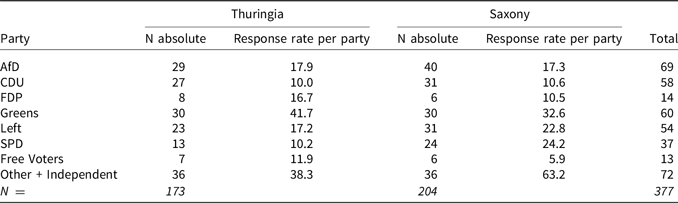
Our data come from two web surveys conducted in Thuringia and Saxony, each targeting the full population of approximately 1,000 local councilorsFootnote 2 (Thuringia: 968; Saxony: 1,066). We received 534 responses (Thuringia: 253; Saxony: 281), though some cases had entirely missing data (Thuringia: 40; Saxony: 35), resulting in a final response rate of 20.5% (Thuringia) and 22.1% (Saxony) – comparable to similar studies (Fielding, Head, Laffan et al. Reference Fielding, Head, Laffan, Western and Hoegh-Guldberg2012; Rapeli and Koskimaa Reference Rapeli and Koskimaa2022). Additionally, only 173 respondents in Thuringia and 204 in Saxony indicated their party affiliation (see Table 1), further reducing the number of cases in most analyses.Footnote 3
Distribution of respondents per party

Table 1. Long description
The table shows the distribution of respondents per party in Thuringia and Saxony. It has 9 rows and 5 columns. The columns are labeled Party, N absolute, Response rate per party for Thuringia, N absolute for Saxony, Response rate per party for Saxony, and Total. The rows list different parties: AfD, CDU, FDP, Greens, Left, SPD, Free Voters, Other + Independent, and a total row labeled N =. Row 1: AfD, 29, 17.9, 40, 17.3, 69. Row 2: CDU, 27, 10.0, 31, 10.6, 58. Row 3: FDP, 8, 16.7, 6, 10.5, 14. Row 4: Greens, 30, 41.7, 30, 32.6, 60. Row 5: Left, 23, 17.2, 31, 22.8, 54. Row 6: SPD, 13, 10.2, 24, 24.2, 37. Row 7: Free Voters, 7, 11.9, 6, 5.9, 13. Row 8: Other + Independent, 36, 38.3, 36, 63.2, 72. Row 9: N =, 173,, 204,, 377.
Participants were invited via email, but due to limited publicly available addresses, we also contacted local party headquarters, requesting them to forward the survey. In doing so, we addressed structural weaknesses in some eastern German parties (Niedermayer Reference Niedermayer2024). However, the absence of Social Democratic Party (SPD), Greens, and Free Democratic Party (FDP) branch offices in some districts hindered outreach. To boost responses, we sent a reminder email after approximately three weeks (personal email) or five weeks (party headquarters).
The survey was conducted from 19.01.2022 to 09.03.2022 (Thuringia) and from 17.11.2023 to 17.12.2023 (Saxony). These data collection periods were determined by organizational factors in the project. To avoid potential biases in the data, we ensured that no major political or social events (e.g., elections, crises, or significant climate policy events) occurred during these periods, which could have caused shifts in public opinion. However, the survey period in Thuringia overlapped with the onset of Russia’s invasion of Ukraine (February 24, 2022), a development that may have influenced attitudes toward energy and climate policy (particularly regarding energy dependence and support for fossil fuels). In contrast, it is less likely that the invasion significantly affected more general views on climate change (such as denial or acceptance).
Naturally, inviting political elites to participate in a survey on ‘climate change’ may introduce a self-selection bias. This could lead to an underrepresentation of local elites with climate-skeptic attitudes, as they may be less inclined to engage with a topic they fundamentally reject. However, the high response rate among local AfD councilors suggests that this is not the case in our data.
At the same time, the high response rates for both the AfD and the Greens may indicate a different type of bias. It seems plausible that individuals at both extremes of the climate change belief spectrum (i.e., those who deny ACC and those who are deeply concerned about its consequences) are overrepresented – as also indicated in the distribution of our dependent variables (see Figure S2 in the online Supplementary Material). However, the party-based response rate suggests that the issue holds particular significance for many other parties.
Operationalization of dependent variables
To analyze ideological differentiation, we measured both evidence-skeptic attitudes and a broader range of partially skeptic attitudesFootnote 4 using eight questions as our dependent variables.
First, to measure views from the ‘core’ of climate change skeptic attitudes (namely trend and attribution skepticism), our original variable was recoded into a binary variable for logistic regression analysis. The categories ‘mainly man-made’ and ‘caused in roughly equal parts by both human and natural factors’ were coded as ‘no skepticism’ (0); the categories ‘mainly caused by natural factors’, and ‘not happening at all’ were coded as ‘skepticism’ (1).
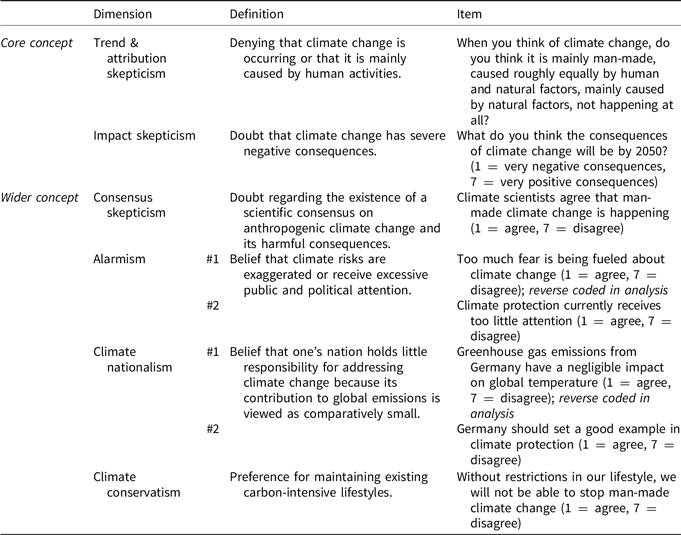
Impact skepticism, as well as views from the broader realm of climate skepticism, was originally measured on a 7-point scale. Due to the non-normal distribution of these variables (see Figure S2 in the Supplementary Material), we opted for logistic regression instead of ordinary least squares (OLS). Hence, all variables were recoded into dummies: a value of 5 or higher on the 7-point response scale was coded as ‘skepticism’ (1), and all values below it were coded as ‘no skepticism’ (0). The question wordings of the items assessing climate change beliefs and skepticism are displayed in Table 2.
Operationalization of climate change skeptic beliefs

Table 2. Long description
A table categorizing climate change skeptic beliefs with dimensions, definitions, and items. The table has three columns: Dimension, Definition, and Item. It is divided into sections: Core, Impact, Wider, and Climate. Each section lists specific beliefs and skepticisms related to climate change. For example, under Core, it lists ‘concept’ and ‘Denying that climate change is occurring or that it is mainly caused by human activities.’ Under Impact, it lists ‘skepticism’ and ‘Doubt that climate change has severe negative consequences.’ The Wider section includes ‘concept,’ ‘Alarmist,’ and ‘Climate nationalism,’ with corresponding definitions and items. The Climate section includes ‘conservatism’ and ‘Preference for maintaining existing carbon-intensive lifestyles.’ Each row provides specific questions or statements used to assess these beliefs.
We examine ideological differentiation across parties and intra-party heterogeneity at the individual and party levels, in line with existing studies (e.g., Carroll and Kubo Reference Carroll and Kubo2019; Mader and Steiner Reference Mader and Steiner2019; Steiner and Mader Reference Steiner and Mader2019). Following Mehlhaff (Reference Mehlhaff2024), we distinguish ideological differentiation from polarization, which in a strict sense requires both inter-group divergence and intra-group homogeneity. Our data and research design do not allow for the construction of a polarization measure, as we rely on cross-sectional individual-level survey data. Accordingly, we operationalize intra-party heterogeneity by calculating the standard deviation (SD) for each party and item (excluding trend and attribution skepticism). A lower SD suggests greater party homogeneity, while a higher SD indicates more intra-party heterogeneity.
Operationalization of independent variables
To measure party membership, we asked respondents to indicate the party they belong to. Given the increasing relevance of independent local lists (Angenendt Reference Angenendt2018), respondents could also select ‘independent’ as their affiliation or name an unlisted party, which was then coded as ‘other’.
The salience of climate change was operationalized through the question: ‘What part does climate policy play in your current political work?’ Responses ranged from ‘no share’ to ‘a very large share’ on a 7-point scale.
The share of trend and attribution skeptics within each party serves as our second primary independent variable for assessing heterogeneity. This was measured using the item displayed in Table 2.
In our models analyzing ideological differentiation, which are computed at the individual level, we control for the age, gender, and education level of local councilors.
Empirical results
Broader spectrum of climate skepticism (descriptive statistics)
As expected, we find varying degrees of climate skepticism, which have the potential to influence inter-party and intra-party heterogeneity. Figure 1 shows that trend skeptic attitudes are extremely rare and confined to only four groups of local councilors: next to the AfD (3.1%), the outright denial of global warming is even more prevalent among the ‘Free Voters’ (8.3%), independent local councilors (3.6%), and members of smaller parties (grouped under the ‘other’ label, 7.1%).
Evidence skepticism across parties.

In contrast, attribution skeptic attitudes are far more common. This form of skepticism acknowledges the warming trend but attributes it primarily to natural factors rather than human activity or downplays the role of human influence altogether (here, it is measured as that climate change is ‘mainly caused by natural factors’). Within the AfD (73.4%), this is the dominant stance – far exceeding levels in all other groups, none of which surpasses 30%. However, we also find remarkably high levels of attribution skepticism within the FDP (28.6%), independent councilors (23.6%), and the CDU (12.3%). This picture becomes even more pronounced when we broaden the focus to the ambiguous stance that climate change is ‘caused in roughly equal parts by both human and natural factors’. In this case, the share of individuals who can be labeled skeptic or partially skeptic exceeds 50% not only within the AfD but also among the CDU, FDP, Free Voters, and independent councilors (see Figure 1).
While skepticism is almost non-existent among Green councilors, both the Left and the SPD show more internal divisions. If we also take the ambiguous stance into account, attribution-skeptic attitudes are notably more prevalent among these two parties – standing in stark contrast to the positions they advocate in their national election manifestos, where climate change is recognized as a pressing issue.
As argued above, we can identify at least four additional forms of skepticism: consensus skepticism, alarmism, climate nationalism, and climate conservatism. As illustrated in Figure 2, the AfD stands out as the most skeptical party across all dimensions of the broader spectrum of skepticism – as well as impact skepticism, while the Greens have the least skeptical local councilors. This lends initial support for H2, which posits that the political elites of these two parties hold the most divergent views on climate change.
Dimensions of skepticism across parties (boxplots).

Figure 2. Long description
The image contains eight box plots arranged in a 2x4 grid, each representing different dimensions of skepticism across various political parties. Each box plot has a horizontal axis labeled with party names (AfD, CDU, FDP, Greens, Left, SPD, FW, Other, Indep.) and a vertical axis labeled from 1 to 7, indicating the level of skepticism (1 = non-skeptic, 7 = skeptic). Panel A: Impact skepticism. Panel B: Consensus skepticism. Panel C: Climate nationalism #1. Panel D: Climate nationalism #2. Panel E: Climate alarmism #1. Panel F: Climate alarmism #2. Panel G: Climate conservatism. Each box plot shows the distribution of skepticism levels for each party, with the median, quartiles, and any outliers clearly marked. The colors of the boxes and whiskers vary by party, providing a visual distinction between them. The plots illustrate the variation in skepticism levels across different parties and dimensions.
However, we again find surprisingly high levels of skepticism among local councilors from the CDU, FDP, and Free Voters, whose responses are clearly skewed towards the skeptic end of the continuum – particularly regarding one of the climate nationalism items as well as alarmism (see Figure 2). This could be viewed as initial evidence for an ideological differentiation across the party spectrum as hypothesized in H1.
A key difference lies in the varying degrees of intra-party heterogeneity. Comparing interquartile range (IQR) and range across parties, we observe that independent local members of parliament and those affiliated with ‘other’ parties show the highest heterogeneity across all items. Additionally, SPD, CDU, and often FDP elites demonstrate comparatively heterogeneous preferences beyond the evidence skeptic core. Conversely, the Greens, the Left, and AfD appear to be more homogeneous. Given that the Greens place the highest emphasis on climate issues across various operationalizations of salience, this indicates initial support for H3: parties that prioritize climate change as a core issue tend to exhibit low intra-party heterogeneity. At the same time, given that the AfD has the highest share of attribution-skeptic members (see Figure 1), this lends initial support to H4: parties that exhibit this form of skepticism also tend to show lower intra-party heterogeneity on the wider realm of (partially) climate change skeptic views.
Ideological differentiation in climate change attitudes
Given that climate-skeptic attitudes appear to be far more widespread than often assumed, it is worth considering their broader impact on ideological inter-party and intra-party heterogeneity.
Figure 3, displaying mean attitudes per party, reinforces our assumption of ideological differentiation at the local level, lending further support for H1. While the Greens, SPD, and Left align on one side of the spectrum, the AfD occupies the opposite extreme. On average, local AfD councilors consistently express views at the skeptical end of the response scale (>4), whereas their counterparts in the Greens, Left, and SPD fall on the non-skeptic side. Notably, the Greens hold significantly different positions on climate change compared to the CDU, FDP, and Free Voters. Consequently, forging policy agreements between these parties may prove more challenging than among the more closely aligned Greens, Left, and SPD.
Mean per party across items.

Figure 4, displaying mean attitudes per item for the different parties, further confirms that the AfD is the most skeptical party across all dimensions of partially climate-skeptic attitudes. As expected, AfD and Green local elites appear to be the most ideologically divergent in their climate change views, with one exception: the Left’s stance on climate conservatism. However, differences in attitudes among Green, Left, and SPD councilors are often minor. Interestingly, mean responses of CDU and FDP councilors fall on the skeptic side of the continuum for three and four, respectively, of our seven items.Footnote 5
Mean attitudes per item across parties.

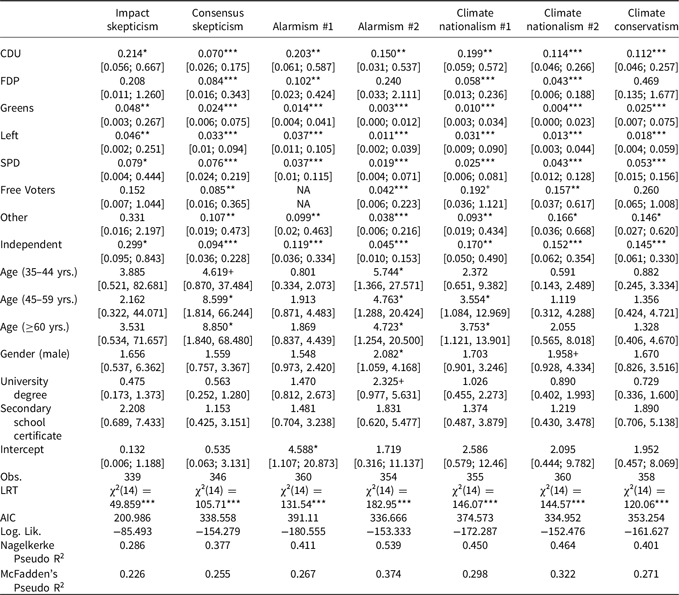
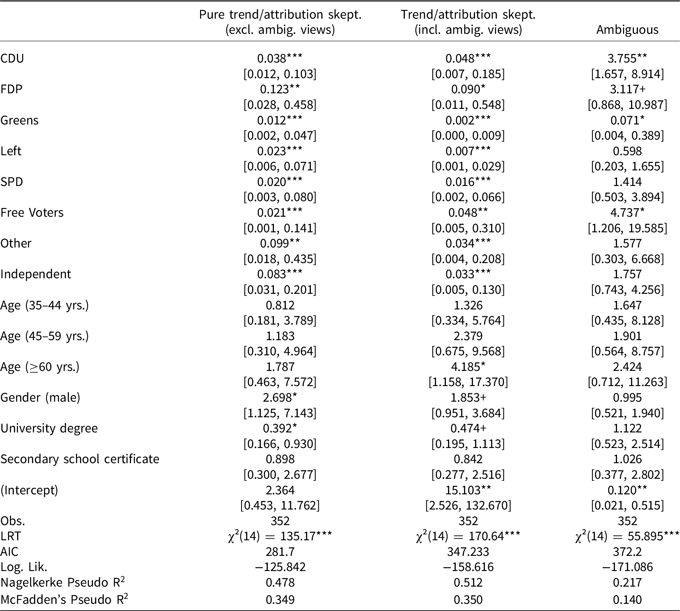
As expected, multivariate models confirm that local AfD and Green councilors always differ significantly – both on core evidence skeptic attitudes (see Table 3) as well as attitudes from the broader realm of skepticism (see Table 4). This highlights a clear divide between these two parties, supporting H2. However, the ideological differentiation is more complex than initially assumed. First, local elites from the Free Voters and the FDP sometimes do not differ significantly from the AfD when it comes to the ‘gray zone’ views (three items for the FDP and Free Voters each, see Table 4). Second, compared with AfD politicians, CDU, FDP, and Free Voter local councilors are substantially more likely to hold the ambiguous ‘equal parts’ position rather than either fully accepting the reality of man-made climate change or expressing outright denial (see Table 4). Third, the results suggest that climate change attitudes among local elites are not structured by a simple AfD-versus-Greens or AfD-versus-all-others divide. While AfD councilors exhibit the highest levels of outright skepticism, the results also reveal an intermediate group of CDU, FDP, and Free Voter politicians who are substantially less skeptical than AfD councilors but more likely to hold ambiguous views regarding the causes of climate change. This finding provides further support for our notion of a gray zone situated between outright skepticism and full acceptance.
Logistic regression model predicting trend/attribution skepticism (odds ratios)

Table 3. Long description
The table presents logistic regression models predicting trend/attribution skepticism, showing odds ratios for various political groups and demographic categories. It includes three main columns: Pure trend/attribution skeptic (excluding ambiguous views), Trend/attribution skeptic (including ambiguous views), and Ambiguous. The table has 16 rows, each representing different political parties, age groups, gender, education levels, and other demographic factors. Each row lists the odds ratios and confidence intervals for the respective categories. Notable entries include CDU, FDP, Greens, Left, SPD, Free Voters, Other, Independent, Age (35-44 yrs.), Age (45-59 yrs.), Age (>=60 yrs.), Gender (male), University degree, Secondary school certificate, and Intercept. The table also includes statistical information such as the number of observations, Likelihood Ratio Test (LRT), AIC, Log Likelihood, Nagelkerke Pseudo R^2, and McFadden’s Pseudo R^2.
Note: The AfD was used as the reference category; +p<0,1; *p<0.05; **p < 0.01; ***p < 0.001.
Logistic regression models predicting (partially) climate skeptic attitudes (odds ratios with 95% CI)Footnote 7

Table 4. Long description
The table presents logistic regression models predicting climate skeptic attitudes, showing odds ratios with 95% confidence intervals. It includes data for various political parties such as CDU, FDP, Greens, Left, SPD, Free Voters, and others, as well as demographic categories like age groups, gender, and education levels. The table has 15 rows and 8 columns, with column headers including Impact skepticism, Consensus skepticism, Alarmism #1, Alarmism #2, Climate nationalism #1, Climate nationalism #2, and Climate conservatism. Each row provides specific odds ratios and confidence intervals for the corresponding group or demographic. Notable trends include varying levels of skepticism and nationalism across different political groups and age demographics.
Note: The AfD was used as a reference category; +p < 0.1; *p < 0.05; **p < 0.01; ***p < 0.001. In the model Alarmism#1, the estimate for Free Voters is unreliable due to perfect separation (no observed cases in the ‘no skepticism’ category).
We also find partial support for H1: when using different parties as reference categories, the analysis reveals significant attitudinal differences across most of the party spectrum – for example, between the Greens and CDU, FDP, or Free Voters, as well as between the SPD or Left and the parties on the right. However, there are (almost) no significant differences within the ideological blocs – that is, among the Greens, SPD, and Left on the one side and among the FDP, CDU, and Free Voters on the center-right (regression tables can be found in the web-based output generated by the markdown script, as well as in the underlying markdown file. These are part of the replication material).
Intra-party heterogeneity
To better understand intra-party heterogeneity in climate change attitudes, our analytical framework and survey item battery once again proved useful. Figure 5 illustrates the heterogeneity of climate change attitudes across different political parties on an item basis. Items associated with the wider realm of skepticism exhibit higher heterogeneity. In contrast, impact skepticism – as part of the core concept of evidence skepticism – stands out for its relatively low heterogeneity across parties. This suggests that attitudes located closer to conventional climate skepticism are more consistently shared within parties. By contrast, gray zone attitudes often overlap with other ideological concerns, such as nationalism, economic attitudes, or views on individual freedoms. As a result, these attitudes may attract support from a broader and more heterogeneous set of local elites. While the AfD and the Greens appear the most internally homogeneous,Footnote 6 notable heterogeneity is observed within other parties, such as the SPD and the Free Voters.
SD per party across items.

Figure 6 visualizes heterogeneity per item and party, with the large colored dot representing the mean SD per party. As expected, the AfD and the Greens appear to be the most homogeneous parties, whereas those affiliated with no party or ‘other’ parties exhibit the highest intra-party heterogeneity across items. Notably, the SPD, Free Voters, and CDU also display considerable internal variance.
SD per item across parties.

While the visual inspection lends initial support for our hypotheses 3 and 4, a correlation analysis does not support our initial hypotheses. There is no significant association between the share of attribution skeptics within a party and the level of heterogeneity on climate-skeptic attitudes among their political elites (H4). Similarly, the bivariate analysis finds no significant relationship between the salience of climate change and heterogeneity in climate-skeptic attitudes among political elites (H3). Given the small sample size, these results should, however, be taken with caution.
The non-significant findings on H3 stand in contrast to existing literature (Mader and Steiner Reference Mader and Steiner2019; Steiner and Mader Reference Steiner and Mader2019). This discrepancy could be explained by two factors. First, it is possible that the self-reported item does not adequately capture the salience of climate issues for skeptics. Rather than measuring subjective issue salience alone, the question may reflect the role-related relevance of climate policy within respondents’ institutional responsibilities. Consequently, politicians may view climate change as a highly important issue while reporting low salience because it plays only a limited role in their day-to-day political work. Basing a measure of salience on manifestos for regional or local elections might yield different results. Yet, such data at the local level is scarce, as most local party branches outside larger cities do not draft full-scale manifestos (but see Gross and Jankowski Reference Gross and Jankowski2020).
A second interpretation is that climate change may be less central to far-right parties than expected, as their primary focus remains immigration. However, studies suggest that far-right parties have increasingly engaged with climate issues – particularly following the rise of Fridays for Future in 2019 (Schwörer and Fernández-García Reference Schwörer and Fernández-García2024) – underscoring the need for further investigation. Taken together, the absence of support for H3 should, therefore, be interpreted with caution. While it may indicate that climate change is less central to the far right than expected, it may also reflect limitations of our measure of issue salience. Future research employing alternative measures of climate policy salience will be necessary to distinguish between these explanations.
Discussion and conclusion
In this article, we contribute to the literature in two ways. Theoretically, we developed a framework to analyze the broader spectrum of climate skepticism, operationalizing four distinct forms of (partial) skepticism. Empirically, we applied this model to examine the climate change attitudes of political elites at the local level.
First, we proposed new and more fine-grained measures for capturing climate skepticism, building on existing research on climate skepticism and the far right. Our approach has proven to be a powerful tool for assessing the many ‘gray areas’ of climate skepticism. By going beyond the core concept of evidence skepticism to include other dimensions – such as climate nationalism – we identified nuanced and important variations in (partially) climate-skeptic attitudes both within and across political parties.
Using original data from a web survey conducted in Thuringia and Saxony – two eastern German states characterized by salient party competition and intense conflicts over the energy transition – we found that attribution skepticism (denying that climate change is man-made) is strongest within the AfD, whereas outright trend skepticism (denying that climate change is happening) is rare, even within their ranks. Crucially, our findings reveal that partially skeptical attitudes are far more prevalent outside the ranks of far-right parties than often assumed (but see Gruber Reference Gruber2024). For instance, climate nationalism (the belief that a country’s impact on global CO2 levels is negligible) and climate alarmism (the perception that excessive fear is being fueled about climate change) were markedly present among councilors from the CDU, FDP, and Free Voters. These attitudes were also evident – though to a much lesser extent – among the SPD and even the Left. This may be one reason why parties do not always prioritize or support climate policy measures, making long-term policy-making challenging – especially when new alliances form in opposition to climate policies.
Our study provides unique insights into key dynamics that have broader implications for party system change well beyond (eastern) Germany. First, while we observe patterns of ideological differentiation on climate change issues at the local level, this divide is not limited to a simple AfD-versus-Greens opposition. While there is clear between-party divergence between the AfD and (almost) all other parties, partially skeptical views are also present across most of the political spectrum – particularly among parties on the right. This may potentially complicate party competition and policy-making. Further, we find substantial intra-party heterogeneity in partially skeptic beliefs, reinforcing the need to view parties as internally diverse rather than monolithic entities. However, our findings do not fully explain intra-party heterogeneity based on our initial hypotheses (issue salience and the share of trend and attribution skeptics), highlighting the need for further research into additional factors, such as intra-party competition and candidate nomination rules (Carroll and Kubo Reference Carroll and Kubo2019; Mader and Steiner Reference Mader and Steiner2019).
Regarding the limitations of our study, first, the sample may be affected by self-selection bias, potentially resulting in an overrepresentation of local councilors at both ends of the climate change belief spectrum – those who deny climate change and those who are deeply concerned about it. Second, assessing the salience of climate change, based on a self-reported question regarding the role of climate policy in councilors’ political work, may be difficult to answer for climate change deniers, which could introduce measurement error. Lastly, our measure of impact skepticism – asking respondents to rate the consequences of climate change on a scale from very negative to very positive – does not include the option to indicate that climate change has no consequences, which may limit its validity. A further concern is that respondents who evaluate the future consequences of climate change relatively positively may do so not because they doubt its harmful impacts, but because they are optimistic about technological innovation. While this possibility cannot be ruled out with the present measure, the observed response patterns suggest that positive evaluations of climate change consequences are found almost exclusively among respondents who are also skeptical about its anthropogenic causes. This pattern lends support to our interpretation of the item as capturing impact skepticism.
Overall, our findings underscore the growing salience of climate issues, including at the local level. Future research should investigate how partially climate-skeptic attitudes shape policy-making and whether they facilitate cooperation between center-right parties and the far right. As climate issues become increasingly central to far-right politics, they may provide a new cleavage for mainstreaming far-right positions, posing one of the greatest challenges to liberal democracies.
Beyond the scope of the present study, a particularly promising avenue for future research concerns the question of how such patterns of ideological differentiation and intra-party heterogeneity translate into processes of political polarization. While our data do not allow for an analysis of polarization dynamics or intra-party conflict, future studies could examine whether and under which conditions heterogeneous belief structures within parties contribute to elite-level polarization, party competition, or intra-party coordination problems.
Although our analysis focuses on two eastern German states, the conceptual distinction between conventional climate skepticism and the broader gray zone of skepticism is likely relevant beyond this narrow geographical context. Future comparative research could examine whether the patterns identified here – particularly the broad prevalence of attitudes from the gray zone beyond parties traditionally associated with climate skepticism – also characterize local political elites in other German states or (Eastern) European countries.
In this context, comparative studies on national political elites – including candidate surveys with fine-grained items on climate change – could offer further insights. Given the increasing complexity of climate debates and their criticisms, it is essential to recognize the ‘many shades’ of climate skepticism.
Supplementary material
The supplementary material for this article can be found at https://doi.org/10.1017/S147567652610173X.
Data availability statement
All materials, datasets, and the R script are publicly available for replication purposes via https://osf.io/pafme.
Acknowledgements
We would like to express our sincere gratitude to the three anonymous reviewers for their constructive comments, as well as all the colleagues who provided valuable feedback at events organized by the German Political Science Association (DVPW), the European Consortium for Political Research (ECPR), and the REXKLIMA Research Group at TU Dresden. Moreover, we would like to thank Henning Sylla and Eric Steffes for their valuable research assistance.
Funding statement
Funding for data collection and research assistance was received from the University of Jena (ProChance Career grant) and the Volkswagen Foundation (NurtureDEMOS Project).
Competing interests
The author(s) declared no potential conflicts of interest with respect to the research, authorship, and/or publication of this article.
Ethical standards
The research was based solely on a voluntary and anonymized survey and did not include any experimental intervention. Therefore, formal ethics board approval was not required in accordance with institutional and ethical guidelines.




 Open access

