Introduction
Aphids (Hemiptera: Aphidoidea) are phloem-feeder insects present in a quarter of the plant species in temperate regions (Dixon et al., Reference Dixon, Kindlmann, Leps and Holman1987). Aphids can negatively affect trees via direct damage to leaves and flowers or via the indirect transmission of viruses (Ebeling, Reference Ebeling1959). Seven species of aphids have been found so far in the organic citrus orchard under study, the most abundant being Aphis spiraecola Patch and Aphis gossypii Glover (Piñol et al., Reference Piñol, Espadaler, Cañellas and Pérez2009a). These two species are in fact well known for being responsible for the worst direct damage to citrus trees (Barbagallo et al., Reference Barbagallo, Cocuzza, Cravedi, Komazaki, van Emden and Harrington2007; Urbaneja et al., Reference Belliure, Pérez, Marcos, Michelena, Hermoso de Mendoza, Jacas and Urbaneja2008). The cotton aphid, A. gossypii, is also the most efficient vector of the Citrus tristeza virus (Closteroviridae; genus Closterovirus) in the Mediterranean Basin (Belliure et al., Reference Belliure, Pérez, Marcos, Michelena, Hermoso de Mendoza, Jacas and Urbaneja2008), a pathogen that has affected the citrus industry worldwide (Moreno et al., Reference Moreno, Ambros, Albiach-Martí, Guerri and Pena2008).
In order to minimize aphid damage, their populations must be kept below an economic threshold (Irwin et al., Reference Irwin, Kampmeier, Weisser, van Emden and Harrington2007; Belliure et al., Reference Belliure, Pérez, Marcos, Michelena, Hermoso de Mendoza, Jacas and Urbaneja2008). Natural enemies such as predators may help regulate aphid populations in citrus orchards. There are several key aphid predators, including ladybird beetles, anthocorid and mirid bugs, lacewings, hoverflies and earwigs (Dixon, Reference Dixon1998; Solomon et al., Reference Solomon, Cross, Fitzgerald, Campbell, Jolly, Olszak, Niemczyk and Vogt2000). In this study, we focus on earwigs, in particular on the most common species, the European earwig Forficula auricularia Linnaeus (Dermaptera: Forficulidae). Even if earwigs have been reported to be active aphid predators in apple and citrus orchards (Mueller et al., Reference Mueller, Blommers and Mols1988; Nicholas et al., Reference Nicholas, Spooner-Hart and Vickers2005; Piñol et al., Reference Piñol, Espadaler, Cañellas and Pérez2009a; Dib et al., Reference Dib, Simon, Sauphanor and Capowiez2010), their predation rates have never been measured.
Different methods have been used to identify the prey remains in predators' guts, including dissection, radio-isotope labelling, stable isotopes, electrophoresis, chromatography, monoclonal antibodies and DNA-based analysis (reviewed in Symondson, Reference Symondson2002, and in Hardwood & Obrycki, Reference Hardwood and Obrycki2005). Nowadays, the DNA-based approach, using the polymerase chain reaction (PCR) amplification of the DNA of the prey remains, is the most common method (King et al., Reference King, Moreno-Ripoll, Agustí, Shayler, Bell, Bohan and Symondson2011). Several single and multiple-copy DNA regions from nuclear and mitochondrial genes have been targeted and sequenced in insects, and many group- and species-specific primers have already been designed (King et al., Reference King, Read, Traugott and Symondson2008; Kuusk & Agustí, Reference Kuusk and Agustí2008) and used to study invertebrate prey-predator interactions in the field (Agustí et al., Reference Agustí, Shayler, Harwood, Vaughan, Sunderland and Symondson2003a; Harper et al., Reference Harper, King, Dodd, Hardwood, Glen, Bruford and Symondson2005; Ma et al., Reference Ma, Li, Keller, Schmidt and Feng2005; Read et al., Reference Read, Sheppard, Bruford, Glen and Symondson2006; Hardwood et al., Reference Hardwood, Desneux, Yoo, Rowley, Greenstone, Obrycki and O'Neil2007; Juen & Traugott, Reference Juen and Traugott2007; Zhang et al., Reference Zhang, Lü and Wan2007; Monzó et al., Reference Monzó, Sabater Muñoz, Urbaneja and Castañera2010; Moreno-Ripoll et al., in press).
To correctly interpret DNA-based outcomes of predation, it is necessary to know the time during which prey remains can be detected in the guts of predators (Greenstone et al., Reference Greenstone, Rowley, Weber, Payton and Hawthorne2007). Predators with long detection periods might appear to predate more than they actually do if the data are not weighted according to the decay in detectability (Chen et al., Reference Chen, Giles, Payton and Greenstone2000; Greenstone et al., Reference Greenstone, Rowley, Weber, Payton and Hawthorne2007). The detectability half-life is a measure of the decay in detectability and is defined as the time needed to reduce the number of predators that test positive for prey DNA to 50% (Greenstone et al., Reference Greenstone, Rowley, Weber, Payton and Hawthorne2007). The detectability half-life is used to standardize predation rates when different predator taxa are compared (King et al., Reference King, Read, Traugott and Symondson2008). Detectability half-lives have been obtained for many arthropod predators, such as spiders, beetles, heteropterans, neuropterans, mites and collembolans, but never for earwigs.
In short, our objectives were: (i) to develop group-specific PCR primers for aphids, capable of detecting the most common aphid species in citrus orchards, (ii) to measure the detectability half-life of aphid DNA in earwigs by laboratory feeding trials, and (iii) to track aphid predation rates by the European earwig under natural field conditions in Mediterranean organic citrus trees. To our knowledge, this is the first time DNA-based approaches have been used to study earwig predation in the field.
Materials and methods
Primer design and species specificity
The mitochondrial cytochrome c oxidase subunit I (COI) region was used for the design of a pair of aphid-specific primers. The following GenBank aphid and earwig sequences were used: EU701503 (Aphis spiraecola), EU701399 (Aphis gossypii), EU701935 (Toxoptera aurantii (Boyer de Fonscolombe)), EU701804 (Myzus persicae (Sulzer)), EU701313 (Aphis craccivora (Koch)), EU701729 (Macrosiphum euphorbiae (Thomas)), EU701935 (Aulacorthum solani (Kaltenabach)), EU701813 (Nasonovia ribisnigri (Mosley)) and AF015230 (F. auricularia). Sequences were aligned using CLUSTALW2 (www.ebi.ac.uk/Tools/msa/clustalw2: Larkin et al., Reference Larkin, Blackshields, Brown, Chenna, McGettigan, McWilliam, Valentin, Wallace, Wilm, Lopez, Thompson, Gibson and Higgins2007), while primers were designed as described in Agustí et al. (Reference Agustí, Shayler, Harwood, Vaughan, Sunderland and Symondson2003a), following the guidelines of Innis & Gelfand (Reference Innis, Gelfand, Innis, Gelfand, Sninsky and White1990) and Saiki (Reference Saiki, Innis, Gelfand, Sninsky and White1990).
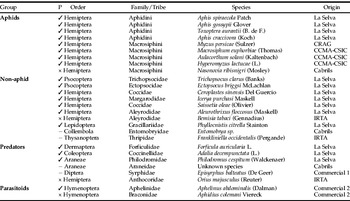
Primer specificity was tested by attempting to amplify DNA from several aphid species, as well as from earwigs and other potential prey, predators and parasitoids (table 1). All seven aphid species present in the study site were tested, as well as the most common non-aphid species susceptible to be predated by earwigs. Three to five individuals from each species were tested, most of them collected at the study site (see below).
Aphids, non-aphid prey, predators and parasitoids tested for primer specificity. All aphids belong to the family Aphididae (tribe is indicated). The column ‘P’ indicates presence (✓), absence (X), or unknown presence (−) of the species in the study site. The source of sampled individuals was: La Selva=Experimental citrus orchard, La Selva del Camp, Tarragona; CRAG=Laboratory colonies at the Center for Research in Agricultural Genomics, Barcelona; CCMA-CSIC=Laboratory colonies at the Center for Environmental Sciences, Madrid; Cabrils=Experimental lettuce fields, Cabrils, Barcelona; IRTA=Laboratory colonies at IRTA, Cabrils, Barcelona; Commercial 1=Koppert Biological Systems S.L., Almería; Commercial 2=Biobest Biological Systems S.L., Águilas.

DNA extraction and PCR analysis
DNA was extracted using the DNeasy Tissue Kit (QIAGEN, Hilden, Germany) according to the protocol for insects included in the manufacturer's instructions. The whole body was used for all insects except for earwigs, in which only the abdomen was used for DNA extraction, in keeping with reports that most of the digestive system of earwigs is located in their abdomen (Albouy & Caussanel, Reference Albouy and Caussanel1990). Total DNA was eluted in 100 μl of AE buffer and stored at −20°C. DNA amplifications were performed in 25 μl reaction volumes containing 1 μl of resuspended DNA, 0.2 mM of dNTPs (Promega Corporation, WI, USA), 2 mM of MgCl2, 0.2 μM of each primer and 0.6 U Taq DNA polymerase (Invitrogen Corporation, CA, USA) in 10× manufacturer's buffer. Samples were amplified in a 2720 thermal cycler (Applied Biosystems, CA, USA) for 35 cycles at 94°C for 20 s, 54°C for 30 s and 72°C for 45 s. An initial denaturation step was carried out at 94°C for 2 min, and a final extension step was performed at 72°C for 2 min. Target DNA and water were always included as positive and negative controls, respectively. PCR products were separated by electrophoresis in 1.5% agarose gels stained with ethidium bromide and visualized under UV light. Each extracted sample was tested up to three times and considered positive if aphid DNA was detected in one of them.
Feeding trials
Forficula auricularia feeding trials were performed to determine aphid detection decay rates in earwig gut. After 11 days of starvation at room temperature, earwigs collected at the study site (see below) were individually placed in plastic containers (5 cm diameter) with a humidity source (cotton soaked in water). They were allowed to consume five frozen A. spiraecola for a maximum of two hours. This was the aphid species most abundant at the study site (Piñol et al., Reference Piñol, Espadaler, Cañellas and Pérez2009a). Only those earwigs that had been observed to feed on three to five aphids were immediately frozen (t=0) at −20°C or maintained for 3, 6, 14, 24, 48 and 72 h at 25±1°C, 70±10% RH and L16:D8 photoperiod and then frozen. Ten individuals were tested for each time period (males and females). The half-life of aphid DNA in earwigs (50% of earwigs testing positive) was obtained from an exponential function fitted between the percentage of aphid detection in earwigs and time. We estimated the function parameters by least squares using SigmaPlot 8.0 (SPSS Inc. Chicago, IL, USA).
Field analysis of predation
The field site is an organic citrus orchard located in La Selva del Camp (Tarragona, NE Spain; 41°13′7″N, 1°8′35″E). The orchard consisted of ca. 300 Clementine trees grafted on the hybrid rootstock Carrizo citrange (Poncirus trifoliata (L.) Raf.×Citrus sinensis (L.) Osb.). An artificial refuge was placed on two branches of 15 trees. These refuges, similar to those described by Suckling et al. (Reference Suckling, Burnip, Hackett and Daly2006), consisted of plastic shell vials (7.6 cm length; 1.2 cm diameter) covered with garden hosing with caps on top to create darkness. The refuges were tied to branches with tape and were checked once a month (from April to August) for earwig presence. Earwigs were collected in the morning and preserved at −80°C for subsequent molecular analysis. Twenty earwigs (ten males and ten females) were tested every month using the designed primers, except in April, when only 16 earwigs were obtained from the refuges (five males and 11 females). The aphid detection percentages obtained from males and females were compared using the Pearson chi-square test, gathering all month's results in a unique analysis. The software used was SPSS 15.0 (SPSS Inc. Chicago, IL, USA).
The abundance of aphids in the canopy was calculated in nine different trees from the same orchard. These trees were randomly chosen at the beginning of the experiment and periodically sampled on the same day that earwigs were collected. Aphids were sampled using beating trays (three vigorous blows to the tree canopy in opposite directions), captured with entomological aspirators, and immediately preserved in 70% ethanol. The total number of aphids found in each sample was counted.
Results
Primers
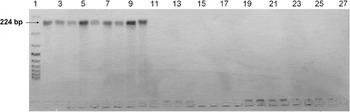
A pair of aphid-specific primers was successfully designed from the COI region. Primer sequences were: 5′-ATTTGGTATTTGATCAGG-3′ (AphF1) and 5′-CGTGGAAAAGATATATCTGGAC-3′ (AphR3). They amplified a fragment of 224 bp for all the aphid species tested without amplifying the DNA of other potential prey species, such as two Psocoptera, five non-aphid Hemiptera, one Lepidoptera, one Collembola and one Thysanoptera (fig. 1). Predators, such as earwigs, ladybird beetles, spiders, anthocorid bugs and hoverflies, also tested negative, as did two aphid parasitoids (Hymenoptera: Aphelinidae, Braconidae). Even though throughout the manuscript we refer to aphid-specific primers, they have been only tested on species belonging to the Aphididae family.
Agarose gel electrophoresis of PCR-amplified DNA using the aphid-specific COI primers AphF1/AphR3 (224 bp). Lane 1, 100 bp molecular-size marker; lane 2, Aphis spiraecola; lane 3, Aphis gossypii; lane 4, Toxoptera aurantii; lane 5, Myzus persicae; lane 6, Aphis craccivora; lane 7, Nasonovia ribisnigri; lane 8, Macrosiphum euphorbiae; lane 9, Aulacorthum solani; lane 10, Hyperomyzus lactucae; lane 11, Trichopsocus clarus; lane 12, Ectopsocus briggsi; lane 13, Ceroplastes sinensis; lane 14, Icerya purchasi; lane 15, Saissetia oleae; lane 16, Aleurothrixus floccosus; lane 17, Phyllocnistis citrella; lane 18, Bemisia tabaci; lane 19, Entomobrya sp.; lane 20, Frankliniella occidentalis; lane 21, Forficula auricularia; lane 22, Adalia decempunctata; lane 23, Philodromus cespitum; lane 24, Orius majusculus; lane 25, Episyrphus balteatus; lane 26, Araneidae; lane 27, negative control.

Aphid DNA detection
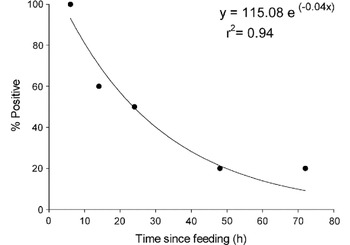
Aphid DNA was detected in 70% of earwigs immediately after feeding (t=0). At t=3 h and t=6 h aphid detection increased to 100%, before dropping to 20% at 72 h after ingestion (fig. 2). The low percentage of detection at t=0 (70%) was considered to be an artifact, as DNA was extracted only from earwig abdomens. The length of earwigs (males 14–21 mm; females 13–18 mm: Albouy & Caussanel, Reference Albouy and Caussanel1990) makes it likely that some prey had not yet reached the abdomen immediately after feeding. Thus, this value (70% at t=0) was not used to draw the function of decay in detectability. The detection of aphid DNA in earwigs was better fitted to an exponential decay with a half-life of 23.8 h.
Detection of Aphis spiraecola DNA in Forficula auricularia at different times after ingestion in a laboratory feeding trial performed at 25°C.

Field analysis of predation
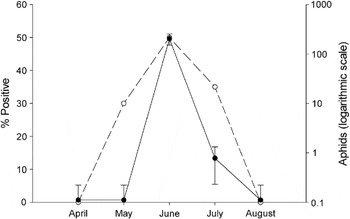
Aphids were scarce in the trees in April, May and August (mean±SE; 0.1±0.1 aphids per sample) (fig. 3). June was, by far, the month with the highest population of aphids in canopies (203±53 aphids per sample), followed by July, albeit with a much lower population (0.8±0.3 aphids per sample). In April and August, no earwig tested positive for aphid DNA presence. In the other months, earwigs contained aphid remains (30% in May, 50% in June and 35% in July). The aphid peak in the field occurred in June, and this was also the month with the highest percentage of earwigs screening positive for aphid DNA. No difference was found in the detection of aphid DNA between earwig males and females (n=60; χ2=0.64, P=0.43).
Percentage of Forficula auricularia screening positive by PCR using AphF1/AphR3 primers (dashed line) and mean abundance (±SE) of aphids captured per citrus canopy (solid line) in each tested month ( , % Positive;
 , Aphids).

Discussion
The group-specific primers that we designed successfully amplified a 224 bp fragment of the COI region of all the aphid species tested, which belong to two different tribes of the Aphididae family. They also made it possible to detect aphid remains in earwigs. Multiple-copy DNA regions (such as COI) and short amplified sequences (100–300 bp) have previously proved suitable for primer design in gut-content analyses (Agustí et al., Reference Agustí, Shayler, Harwood, Vaughan, Sunderland and Symondson2003a; King et al., Reference King, Read, Traugott and Symondson2008). The aphid-specific primers developed by Harper et al. (Reference Harper, King, Dodd, Hardwood, Glen, Bruford and Symondson2005) were inadequate for our purposes as they detected earwig DNA. On the contrary, the primers that we designed are aphid-specific in the context of this study, as tested negative when earwigs were screened and also when non-aphid prey, parasitoids and predators other than earwigs were tested. The designed primers could probably be of interest to study antagonistic interactions not only in citrus crops, but also in other agroecosystems as many of the insect species tested here are common in several agroecosystems. For instance, Nasonovia ribisnigri is a widespread aphid pest in lettuce fields (Reinink & Dieleman, Reference Reinink and Dieleman1993; Díaz et al., Reference Díaz, Legarrea, Marcos-García and Fereres2010), and the syrphid Episyrphus balteatus and the parasitoid Aphidius colemani Viereck are natural enemies of Myzus persicae on sweet-pepper plants (Pineda et al., Reference Pineda, Morales, Marcos-García and Fereres2007).
The detectability half-life of aphid remains in earwig guts was approximately one day. Spiders usually have longer detection periods (Agustí et al., Reference Agustí, Shayler, Harwood, Vaughan, Sunderland and Symondson2003a; Ma et al., Reference Ma, Li, Keller, Schmidt and Feng2005; Sheppard et al., Reference Sheppard, Bell, Sunderland, Fenlon, Skervin and Symondson2005; Greenstone et al., Reference Greenstone, Rowley, Weber, Payton and Hawthorne2007; Hosseini et al., Reference Hosseini, Schmidt and Keller2008; Monzó et al., Reference Monzó, Sabater Muñoz, Urbaneja and Castañera2010), whereas in other predators, such as beetles, heteropterans, neuropterans and mites, the detection periods are generally shorter (Chen et al., Reference Chen, Giles, Payton and Greenstone2000; Agustí et al., Reference Agustí, Unruh and Welter2003b; Ma et al., Reference Ma, Li, Keller, Schmidt and Feng2005; De León et al., Reference De León, Fournier, Hagler and Daane2006; Read et al., Reference Read, Sheppard, Bruford, Glen and Symondson2006; Hardwood et al., Reference Hardwood, Desneux, Yoo, Rowley, Greenstone, Obrycki and O'Neil2007; Juen & Traugott, Reference Juen and Traugott2007; Zhang et al., Reference Zhang, Lü and Wan2007; Hosseini et al., Reference Hosseini, Schmidt and Keller2008). However, there are exceptions to the above distinction between spiders and insects, i.e. the detectability half-life of aphids in lycosid spiders was much lower (t=3.7 h: Kuusk et al., Reference Kuusk, Cassel-Lundhagen, Kvarnheden and Ekbom2008) than that of aphids in carabids (t=28.9 h: Sheppard et al., Reference Sheppard, Bell, Sunderland, Fenlon, Skervin and Symondson2005). In fact, there are some factors that affect the detectability of prey DNA in predators that should be considered before comparing half-lives, such as the feeding mode and the digestive physiology of each specific predator (Greenstone et al., Reference Greenstone, Rowley, Weber, Payton and Hawthorne2007). Temperature also influences the detectability of prey DNA in the predator gut (Hoogendoorn & Heimpel, Reference Hoogendoorn and Heimpel2001; Hosseini et al., Reference Hosseini, Schmidt and Keller2008; von Berg et al., Reference von Berg, Traugott, Symondson and Scheu2008). In this study, earwigs were maintained at 25°C, close to summer field conditions in the study area. Even if higher temperatures usually imply lower detection rates (von Berg et al., Reference von Berg, Traugott, Symondson and Scheu2008), presumably as a result of an increased digestion rate (Hoogendoorn & Heimpel, Reference Hoogendoorn and Heimpel2001), in the case of earwigs detection, was still quite high at 25°C.
Aphid DNA was found in field-collected earwigs in three out of the five months. In May, before the severe aphid attack started, 30% of the earwigs tested positive for aphid DNA, while in June, during the pest outbreak, detection rose to 50%. In July, when aphid populations were declining, 35% of earwigs still tested positive. This means that earwigs fed on aphids before, during and after the aphid outbreak. The 50% of positives found in June is a high value, as, although higher percentages in detectability in other prey-predator associations have been found (Ma et al., 2005; Hardwood et al., Reference Hardwood, Desneux, Yoo, Rowley, Greenstone, Obrycki and O'Neil2007; Zhang et al., Reference Zhang, Lü and Wan2007; Moreno-Ripoll et al., in press), most studies usually report lower percentages, ranging from 0% to 40% (Agustí et al., Reference Agustí, Shayler, Harwood, Vaughan, Sunderland and Symondson2003a; Harper et al., Reference Harper, King, Dodd, Hardwood, Glen, Bruford and Symondson2005; Read et al., Reference Read, Sheppard, Bruford, Glen and Symondson2006; Hardwood et al., Reference Hardwood, Desneux, Yoo, Rowley, Greenstone, Obrycki and O'Neil2007; Juen & Traugott, Reference Juen and Traugott2007; Kuusk et al., Reference Kuusk, Cassel-Lundhagen, Kvarnheden and Ekbom2008; Kuusk & Ekbom, Reference Kuusk and Ekbom2010; Monzó et al., Reference Monzó, Sabater Muñoz, Urbaneja and Castañera2010; Moreno-Ripoll et al., in press). However, the predation on aphids in June, when aphid density was at its maximum, and in July, when the aphid population was already declining, probably had little effect on the overall aphid dynamics. What is really important for the dynamics of the aphid population is the 30% predation detected in May. Even though aphid outbreak still took place, probably because earwig abundance was below the threshold needed to eradicate aphid populations (Piñol et al., Reference Piñol, Espadaler, Pérez and Beven2009b), 30% predation in May most probably reduced the aphid outbreak extent. When aphid density is very low, predation can have a disproportionate effect on final aphid density because the per capita effect of each predation event on the aphid population is higher (Piñol et al., Reference Piñol, Espadaler, Pérez and Beven2009b). This would confirm the European earwig's important role as an aphid predator in citrus orchards as a consequence of its early seasonal pressure on this pest (Romeu-Dalmau et al., in press).
To conclude, molecular techniques have been successfully used to track aphid predation by earwigs, providing a new tool for estimating the earwig's role as a biological control agent. We showed that earwigs are important predators of aphids in citrus orchards, particularly as a result of their early pressure on this pest. The designed primers might also be useful in agroecosystems other than citrus orchards.
Acknowledgements
We are indebted to Thaïs Aznar for her technical support and to Xavier Espadaler for his assistance in the field. We also thank Núria Cañellas for granting access to her land and Nicolás Pérez for aphid identification. This work has been supported by grants from MICINN-FEDER (CGL2007-64080-C02-01/BOS, CGL2010-18182 and AGL2008-00546). The first author was funded by a FI-studentship from the Generalitat de Catalunya.