1. Introduction
1.1. cognitive architecture in williams syndrome
Williams syndrome (WS) is a neurodevelopmental disorder of genetic origin – micro-deletion on 7q11.23 – (Ewart et al., Reference Ewart, Morris, Atkinson, Jin, Sternes, Spallone and Keating1993), occurring in 1:7500 live births (Strømme, Bjørnstad, & Ramstad, Reference Strømme, Bjørnstad and Ramstad2002). Individuals with WS have intellectual disability and a cognitive profile traditionally characterized as uneven (Bellugi, Lichtenberger, Jones, Lai, & George, Reference Bellugi, Lichtenberger, Jones, Lai and George2000). Together with relatively good skills in language, face recognition, phonological memory, and music, severe deficits in spatial and numerical cognition, planning, and problem solving are observed (e.g., Bellugi et al., Reference Bellugi, Lichtenberger, Jones, Lai and George2000; Levitin et al., Reference Levitin, Cole, Chiles, Lai, Lincoln and Bellugi2004; Mervis & John, Reference Mervis and John2010).
WS has been proposed as a ground for investigating the separability of language and other cognitive functions (Bellugi, Marks, Bihrle, & Sabo, Reference Bellugi, Marks, Bihrle, Sabo, Bishop and Mogford1988). Early reports describing individuals with WS as having relatively intact linguistic skills despite their cognitive impairment and marked problems in spatial cognition (Bellugi et al., Reference Bellugi, Marks, Bihrle, Sabo, Bishop and Mogford1988) led to claims of WS as evidence of language modularity (Pinker, Reference Pinker1991). There is now a large body of research showing that the linguistic skills of individuals with WS are not preserved but rather present impairments, being in turn more complex than initially thought (for a review, see Stojanovik, Reference Stojanovik, Farran and Karmiloff-Smith2012). Far from the modular accounts, WS is now believed to show the interdependence of different cognitive domains (Mervis & Becerra, Reference Mervis and Becerra2007). For example, the difficulties individuals with WS exhibit when using spatial words are interpreted as evidence of shared processing mechanisms between language and spatial cognition, in clear contrast with the early views on the dissociation between the domains (Phillips, Jarrold, Baddeley, Grant, & Karmiloff-Smith, Reference Phillips, Jarrold, Baddeley, Grant and Karmiloff-Smith2004).
Another means of analyzing whether language shares processing mechanisms with other cognitive fields in WS involves considering the commonalities between language and music (Elsabbagh, Cohen, & Karmiloff-Smith, Reference Elsabbagh, Cohen and Karmiloff-Smith2010). Although there is hardly any study on the topic in WS (Don, Schellenberg, & Rourke, Reference Don, Schellenberg and Rourke1999; Martínez-Castilla & Sotillo, Reference Martínez-Castilla and Sotillo2014), a fruitful body of research has looked at this question among typically developing (TD) individuals.
1.2. evidence of shared processing mechanisms between language and music in typically developing individuals: the facilitating effect of musical training on linguistic prosody
The body of research on whether TD individuals process language and music through shared mechanisms has shown data both supporting and refuting this view; therefore, the debate on the matter remains open (for a review, see Patel, Reference Patel2008). However, there seems to be agreement that prosody and music share processing mechanisms. Even the strongest advocates of the modularity of music processing admit such overlap (Peretz & Coltheart, Reference Peretz and Coltheart2003).
Prosody refers to the melodic and temporal properties of speech and is often described as the ‘music of language’ (Glaser, Reference Glaser2000). As such, prosody is expressed through the same acoustic parameters as music, i.e., pitch, duration, intensity, and timber (Besson, Chobert, & Marie, Reference Besson, Chobert and Marie2011). It could therefore be considered that music and prosody are also processed through the same mechanisms. Evidence to support this view comes from studies on the effects of musical training on prosody perception through comparisons between the prosodic skills of musically trained and untrained individuals. Musically trained TD children and adults perform higher than musically untrained peers in detecting subtle pitch contour variations not only in music but also in the prosody of their native language (French or Portuguese) or a foreign language (Portuguese) (Magne, Schön, & Besson, Reference Magne, Schön and Besson2006; Marques, Moreno, Castro, & Besson, Reference Marques, Moreno, Castro and Besson2007; Moreno et al., Reference Moreno, Marques, Santos, Santos, Castro and Besson2009; Schön, Magne, & Besson, Reference Schön, Magne and Besson2004). Musically trained TD adults who are native speakers of a non-tonal language (English or French) also outperform musically untrained counterparts in Chinese lexical tone discrimination (Alexander, Wong, & Bradlow, Reference Alexander, Wong and Bradlow2005; Marie, Delogu, Lampis, Belardinelli, & Besson, Reference Marie, Delogu, Lampis, Belardinelli and Besson2011). Subcortical and cortical processing of pitch in language is also enhanced among musicians as compared to non-musicians who are native speakers of French or English (Bidelman, Gandour, & Krishnan, Reference Bidelman, Gandour and Krishnan2010; Magne et al., Reference Magne, Schön and Besson2006; Marie, Delogu et al., Reference Marie, Delogu, Lampis, Belardinelli and Besson2011; Marques et al., Reference Marques, Moreno, Castro and Besson2007; Schön et al., Reference Schön, Magne and Besson2004; Wong, Skoe, Russo, Dees, & Kraus, Reference Wong, Skoe, Russo, Dees and Kraus2007).
While the aforementioned studies focused on the parameter of pitch, similar results have been found when considering duration. Thus, musically trained TD children and adults discriminate durational cues of their native language (French or Japanese) or a foreign language (Japanese) better than musically untrained TD peers (Chobert, Marie, François, Schön, & Besson, Reference Chobert, Marie, François, Schön and Besson2011; Marie, Magne, & Besson, Reference Marie, Delogu, Lampis, Belardinelli and Besson2011; Sadakata & Sekiyama, Reference Sadakata and Sekiayama2011). Moreover, the cortical processing of these cues is enhanced in French-speaking TD individuals with musical training (Chobert et al., Reference Chobert, Marie, François, Schön and Besson2011; Marie, Magne et al., Reference Marie, Delogu, Lampis, Belardinelli and Besson2011).
Overall, the evidence found in different languages regarding the enhanced perception of both pitch and duration in speech presented by musically trained individuals as compared to musically untrained peers is interpreted as evidence of common processing mechanisms between music and prosody (Besson et al., Reference Besson, Chobert and Marie2011). Based upon this, it has been suggested that the awareness of pitch and duration provided by musical training facilitates the perception of these parameters in the domain of prosody (Besson et al., Reference Besson, Chobert and Marie2011; Kraus & Chandrasekaran, Reference Kraus and Chandrasekaran2010). Interestingly, not only would musical training enhance perception of acoustical parameters common in music and speech, but it could also facilitate the abstract linguistic representations linked to such parameters (Besson et al., Reference Besson, Chobert and Marie2011; Sadakata & Sekiyama, Reference Sadakata and Sekiayama2011).
Prosody plays an important role in communication. It is used both to express emotions and to convey linguistic functions (Kolinsky, Cuvelier, Goetry, Peretz, & Morais, Reference Kolinsky, Cuvelier, Goetry, Peretz and Morais2009; Plesa-Skwerer, Schofield, Verbalis, Faja, & Tager-Flusberg, Reference Plesa-Skwerer, Schofield, Verbalis, Faja and Tager-Flusberg2007). In different languages such as English, French, or Spanish, linguistic prosody helps to indicate a speaker’s epistemic stance about information, convey sentence type (e.g., differentiate questions from statements), segment the speech chain, express the focus of an utterance, and distinguish between different lexical items (Peppé, Reference Peppé2009).While the assessment of the possible effects of musical training on affective prosody identification has shown contradictory results (e.g., Lima & Castro, Reference Lima and Castro2011; Thompson, Schellenberg, & Husain, Reference Thompson, Schellenberg and Husain2004; Trimmer & Cuddy, Reference Trimmer and Cuddy2008), results on linguistic prosody seem to be solid, lexical function being the focus of most studies on the topic. Musically trained TD adults who are native speakers of English or French better identify lexical tone and lexical stress in a foreign language (Chinese and English, respectively) than musically untrained peers (Alexander et al., Reference Alexander, Wong and Bradlow2005; Kolinsky et al., Reference Kolinsky, Cuvelier, Goetry, Peretz and Morais2009). Building on the conclusions regarding common processing mechanisms of acoustic parameters for music and prosody, the enhanced performance of musically trained individuals on higher levels of speech processing (e.g., lexical tone or lexical stress identification) is taken as evidence of positive music-to-language transfer effects (Alexander et al., Reference Alexander, Wong and Bradlow2005; Besson et al., Reference Besson, Chobert and Marie2011; Bidelman et al., Reference Bidelman, Gandour and Krishnan2010).
It should be noted that the nature of most of the studies on the topic is correlational, and this precludes the possibility of drawing conclusions regarding causality. Due to the difficulties and cost of longitudinal studies with random assignment to musical training, the research conducted has been cross-sectional, i.e., has compared the prosodic performance of individuals who already had musical training with that of musically untrained peers. The few longitudinal studies carried out have shown a positive effect of musical training on prosody, therefore being evidence of causality from the former to the latter (Chobert, François, Velay, & Besson, Reference Chobert, François, Velay and Besson2014; Moreno et al., Reference Moreno, Marques, Santos, Santos, Castro and Besson2009).
From both correlational and causal studies, research on TD individuals has highlighted how the facilitating effect of musical training on prosody processing opens up the possibility of using music within intervention programs for improving the prosodic skills of individuals with atypical development (Kolinsky et al., Reference Kolinsky, Cuvelier, Goetry, Peretz and Morais2009; Moreno et al., Reference Moreno, Marques, Santos, Santos, Castro and Besson2009). However, prior to developing new music-based methods for individuals with disabilities, we should determine whether the processing relationships between prosody and music found in TD individuals also hold for the population to whom the intervention is addressed, such as those with WS.
1.3. studies on williams syndrome: linguistic prosody and music
Research has shown that individuals with WS present prosodic impairments over their lifespan. Early difficulties with using prosodic cues to segment the speech chain have been found in infants with WS (Nazzi, Paterson, & Karmiloff-Smith, Reference Nazzi, Paterson and Karmiloff-Smith2003). Children with WS perform lower than TD peers matched on chronological age (CA) on tasks tapping linguistic prosodic functions (Stojanovik, Setter, & van Ewijk, Reference Stojanovik, Setter and van Ewijk2007). Specifically, their ability to understand and produce questions vs. statements, complex noun phrases (i.e., utterance segmentation into prosodic phrases), and contrastive focus through prosodic means is impaired. A slower rate of development for these prosodic functions has also been found (Stojanovik, Reference Stojanovik2010). Compared to CA-matched TD peers, children with WS also have difficulty discriminating and reproducing the parameters involved in the former prosodic skills (Stojanovik et al., Reference Stojanovik, Setter and van Ewijk2007). Similar results have been found in adolescents and adults with WS (Martínez-Castilla, Sotillo, & Campos, Reference Martínez-Castilla, Sotillo and Campos2011) who, in turn, exhibit problems understanding lexical stress (Plesa-Skwerer et al., Reference Plesa-Skwerer, Schofield, Verbalis, Faja and Tager-Flusberg2007). In general, when mental age is taken into account, prosodic impairments are no longer apparent (Martínez-Castilla et al., Reference Martínez-Castilla, Sotillo and Campos2011; Plesa-Skwerer et al., Reference Plesa-Skwerer, Schofield, Verbalis, Faja and Tager-Flusberg2007; Stojanovik et al., Reference Stojanovik, Setter and van Ewijk2007). Still, even after controlling for cognitive impairment, adolescents and adults with WS have difficulties understanding and expressing the prosodic function of segmentation (e.g., problems for processing a phrase such as “fruit salad and juice”, in which the first two words can sound either like two different food items or only one; in the latter case, the item would refer to a salad made out of fruit) (Martínez-Castilla et al., Reference Martínez-Castilla, Sotillo and Campos2011). The same holds for the expression of contrastive focus (Martínez-Castilla et al., Reference Martínez-Castilla, Sotillo and Campos2011), even though some of the acoustic correlates produced by individuals with WS to express this function may be appropriate (Ito & Martens, Reference Ito and Martens2017). Despite their prosodic impairments, prosody may be an important means for individuals with WS to progress on their path towards language acquisition. Thus, compared to TD children matched on cognitive level, those with WS rely more on prosodic cues for grammar learning (Stojanovik et al., Reference Stojanovik, Zimmerer, Setter, Hudson, Poyraz-Bilgin and Saddy2018).
As far as we know, only one study has assessed the processing relationships between linguistic prosody and music in WS. Martínez-Castilla and Sotillo (Reference Martínez-Castilla and Sotillo2014) showed that the musical pitch discrimination skills of children with WS predict their abilities for discriminating pitch-based prosodic contours. This result was taken as evidence of common mechanisms for pitch processing in prosody and music in WS.
There has been controversy as to the level of music skills among individuals with WS. They were initially described as excellent and preserved (Lenhoff, Perales, & Hickok, Reference Lenhoff, Perales and Hickok2001; Levitin & Bellugi, Reference Levitin and Bellugi1998), though impairments were later reported (Martínez-Castilla & Sotillo, Reference Martínez-Castilla and Sotillo2008). Atypicalities have also been found in their music processing and music development (Deruelle, Schön, Rondan, & Mancini, Reference Deruelle, Schön, Rondan and Mancini2005; Elsabbagh et al., Reference Elsabbagh, Cohen and Karmiloff-Smith2010; Martínez-Castilla, Rodríguez, & Campos, Reference Martínez-Castilla, Rodríguez and Campos2016). Moreover, a higher rate of amusia (i.e., a deficit in musical pitch processing) has been reported in WS (Lense, Shivers, & Dykens, Reference Lense, Shivers and Dykens2013).
Regardless of the changes in the conceptualization of their musical skills, researchers have agreed on the interest and motivation for musical activities among individuals with WS (Levitin et al., Reference Levitin, Cole, Chiles, Lai, Lincoln and Bellugi2004). Moreover, they benefit from musical training, and their music performance improves with lessons (Lense & Dykens, Reference Lense and Dykens2013; Martínez-Castilla & Sotillo, Reference Martínez-Castilla and Sotillo2008). Through comparisons between musically trained and untrained individuals with WS, musical training has also been found to positively impact other cognitive fields, such as verbal memory (Dunning, Martens, & Jungers, Reference Dunning, Martens and Jungers2015; Martens, Jungers, & Steele, Reference Martens, Jungers and Steele2011). Engagement in musical activities may also be related to prosodic sensitivity in WS (Stojanovik et al., Reference Stojanovik, Zimmerer, Setter, Hudson, Poyraz-Bilgin and Saddy2018). However, no prior research has studied whether musical training is associated with enhanced prosodic performance in this population.
1.4. aims and hypothesis of the study
Considering the literature on the positive effects of musical training on linguistic prosody in TD individuals, this research aimed to study whether musical training is also associated with an enhancement of the prosodic perception skills of individuals with WS. It also sought to provide further data on the possible processing relationships between prosody and music in this population, and to study whether music-to-language transfer effects could take place. In typical development, positive effects of musical training have been mostly shown for the perception of prosodic acoustical parameters (Besson et al., Reference Besson, Chobert and Marie2011). Based on the extant evidence of shared processing mechanisms between linguistic prosody and music in individuals with WS (Martínez-Castilla & Sotillo, Reference Martínez-Castilla and Sotillo2014), we hypothesized the same effects in this group. TD individuals with musical training present enhanced comprehension of the lexical function of prosody (Alexander et al., Reference Alexander, Wong and Bradlow2005; Kolinsky et al., Reference Kolinsky, Cuvelier, Goetry, Peretz and Morais2009). This, together with the positive impact of musical training on other cognitive fields in WS (Dunning et al., Reference Dunning, Martens and Jungers2015), led us to also hypothesize enhanced comprehension of prosodic functions in musically trained individuals with WS.
2. Method
2.1. participants
Participants were a subset of those reported in the study of Martínez-Castilla et al. (Reference Martínez-Castilla, Sotillo and Campos2011). Specifically, musically trained participants and their CA-matched peers without musical training were included in this research. Thus, the sample was composed of 21 adolescents and young adults (13–32 years old) with WS, of whom 7 were musically trained and 14 untrained. Participants were recruited through the Williams Syndrome Association of Spain. According to figures provided by this Association, the total number of participants with WS represents approximately 10% of the individuals with WS in Spain; the group of musically trained participants represents more than 3%. These figures suggest that the groups of participants with WS were representative of the population with WS in the country where this study was carried out (Van Herwegen & Karmiloff-Smith, Reference Van Herwegen, Karmiloff-Smith, Cohen Kadosh and Dowker2015).
As previously mentioned, the two groups of participants with WS (with and without musical training) were matched on CA (p = .85). They were also matched on full-scale IQ (p = .69), verbal IQ (p = .91), and performance IQ (p = .64), as measured by the Wechsler Intelligence Scales: the Wechsler Intelligence Scale for Children-IV (Wechsler, Reference Wechsler2005) for participants aged between 13 and 16, and the Wechsler Intelligence Scale for Adults-III (Wechsler, Reference Wechsler2001) for the remaining participants. All participants with WS had both the clinical phenotype and genetic diagnosis of WS, as confirmed by Fluorescence In-Situ Hybridization (FISH) tests. As reported by parents, none had hearing problems or any other clinical diagnosis.
As mentioned in Section 1.3., individuals with WS present prosodic impairments in comparison with CA-matched TD peers (Stojanovik et al., Reference Stojanovik, Setter and van Ewijk2007). In order to test whether musical training could lead participants with WS to reach the level of TD counterparts of the same CA, a control group (CG) of TD participants matched on CA to participants with WS (p = .95) was also included in the study. The CG was formed by 42 TD individuals, of whom 14 were musically trained and 28 had no musical training. The number of control participants was twice the number of individuals with WS to increase the power of the study. As expected, full-scale IQ, verbal IQ, and performance IQ were higher in the TD participants than in the WS groups (p < .001 in all cases). As reported in prior research (Schellenberg, Reference Schellenberg2004), musically trained TD participants had higher full-scale IQ (p = .004), verbal IQ (p = .02), and performance IQ (p = .02) than their TD counterparts without musical training. However, the groups did not differ on CA (p = .79). Neither TD participants nor their parents reported any disorder or hearing impairment. They were recruited through education centers and other typical settings (work and neighbors). In both the WS and TD groups, all participants were native speakers of Iberian Spanish and all of them were monolingual. Descriptive characteristics of the WS and TD groups by musical training are shown in Table 1.
Descriptive characteristics of the Williams syndrome (WS) and typically developing (TD) groups by musical training

note: Values in parentheses represent standard deviations; CA: chronological age.
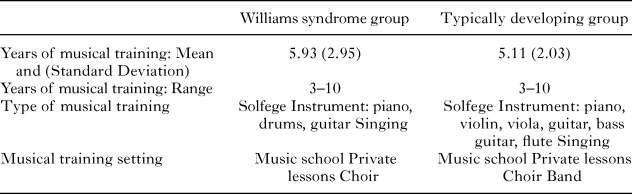
Data on participants’ musical training was obtained through a brief questionnaire administered to parents of participants with WS, parents of TD participants under 18 years of age, and TD adults. All participants had at least three years of musical training. Teaching music to individuals with WS requires specialized strategies (Stambaugh, Reference Stambaugh1996). For example, while music is taught to TD individuals by using the musical notation system, the visuospatial problems that individuals with WS present make it better for them to learn by ear and rote (Stambaugh, Reference Stambaugh1996). Because of this, an exact matching on musical training between the WS and TD groups was not possible. However, the musical training levels of the groups were intended to be relatively homogeneous. Table 2 shows the characteristics of participants’ musical training. The musical training of participants with WS was similar to that described in prior studies in which musical training was shown to have a positive effect on other cognitive skills in WS (Dunning et al., Reference Dunning, Martens and Jungers2015).
Characteristics of participants’ musical training

2.2. materials and procedure
Participants were administered with five tasks from the Profiling Elements of Prosody in Speech-Communication (PEPS-C) battery in Spanish (Martínez-Castilla & Peppé, Reference Martínez-Castilla and Peppé2008) (the native language of all participants). This battery was chosen because it is the only formal prosody assessment procedure available in Spanish (complete details about the battery can be found in Martínez-castilla & Peppé, Reference Martínez-Castilla and Peppé2008). In addition, it is suitable for the assessment of individuals with intellectual disabilities, such as those with WS. Thus, it has been successfully used in prior research with Spanish-speaking and English-speaking individuals with WS (Martínez-Castilla, Stojanovik, Setter, & Sotillo, Reference Martínez-Castilla, Stojanovik, Setter and Sotillo2012; Stojanovik et al., Reference Stojanovik, Setter and van Ewijk2007). The test allows for the assessment of different perception and production prosodic skills. As we have already seen, in TD individuals musical training is associated with enhanced perception of linguistic prosody. This study aimed to assess whether the same relationship holds for WS. Therefore, for this study, only the PEPS-C perception tasks of linguistic prosody were used; i.e., short-item discrimination, long-item discrimination, turn-end input, chunking input, and focus input. The first two tasks evaluate the perception of acoustic parameters involved in prosody; the others assess the comprehension of different prosodic functions (see below). All tasks follow the same structure: an auditory item is presented and participants have to choose which of two pictures shown on a screen represents the item heard. For this, participants could either click on the picture with a mouse or point to it with their fingers. In all cases, prosody is the sole disambiguator of the task. To ensure that participants understand the tasks, each includes two examples and two practice items. Sixteen experimental items are then administered, so that scores for each task range from 0 to 16.
The short-item and long-item discrimination tasks evaluate the skills for discriminating between pairs of prosodic contours. Specifically, the pairs of prosodic contours are the laryngograph recordings of minimal pairs of verbal items in which the meaning was distinguished only by prosody. Laryngograph recordings show the laryngeal signal of words. Thus, they do not include segmental information but maintain the original prosodic contours. In short-item discrimination, prosodic contrasts are based on pitch contour. For example, a minimal pair formed by the word ‘potatoes’ (patatas, in Spanish) with interrogative (rise contour) and with declarative (fall contour) intonation would constitute different items. In long-item discrimination, together with pitch cues, duration and intensity also distinguish the prosodic contours. For example, a minimal pair with the words ‘black and red and green socks’ (calcetines negros y rojos y verdes, in Spanish), where the aforementioned acoustic parameters distinguished whether the bi-colored socks are black and red, or red and green, would form an item. The length of the prosodic contours also distinguished these tasks. In the short-item discrimination task, within each pair, each stimulus was composed of single words of 1 to 4 syllables. In the long-item discrimination task, the stimuli were formed by groups of words of 7 to 10 syllables. In both tasks, participants have to decide whether the two sounds presented are the same or different.
Turn-end input assesses the understanding of questioning and declarative intonation by using single words which constitute conversational turns. Rising or falling intonation is used to express this contrast. Words of food items (e.g., ‘sandwich’) are presented, and participants have to decide whether the item has been ‘offered’ (rising intonation) or ‘named’ (falling intonation).
Chunking (segmentation or boundary) input evaluates the comprehension of syntactically ambiguous utterances that are disambiguated by prosody. Phrasal tone, lengthening, and pause are here involved to mark the word boundary. In this task, a pair of pictures that show two possible interpretations of the same lexical items is presented (e.g., /barco/ pirata/ y agua/ ‘/ship/ pirate/ and water/’ vs. /barco-pirata/ y agua/ ‘/pirate-ship/ and water/’). Participants have to choose the appropriate picture depending on what they hear.
Focus input assesses the comprehension of prefinal contrastive stress. Pitch accent is used to express this function. The task features a child who wanted two food items to eat but has been given just one. Participants are presented with pictures of the two food items and, from what they hear, have to decide which of the two foods the child is asking for (e.g., /Quería tomates y GUISANTES para comer/ ‘/I wanted tomatoes and PEAS to eat/’ vs. /Quería TOMATES y guisantes para comer/ ‘/I wanted TOMATOES and peas to eat/’).
The PEPS-C tasks were administered via the speakers of a laptop (Hewlett-Packard, Palo Alto, CA, USA; Intel Pentium M Processor 1.60 GHz 800 MHz, SoundMAX Integrated Digital Audio sound card) at a comfortable listening level. All of the participants were individually assessed. Participants with WS were assessed in a quiet room of their residences. TD participants were evaluated in a quiet room in their places of residence or education centers. Specific instructions for each PEPS-C task are provided as supplementary materials (available at: http://doi.org/10.1017/langcog.2019.27). Written informed consent for participation in the study was obtained from parents of participants with WS, parents of TD participants under 18 years, and TD adults. This research was carried out in agreement with the ethical principles of the Declaration of Helsinki and was approved by the Universidad Autónoma de Madrid.
3. Results
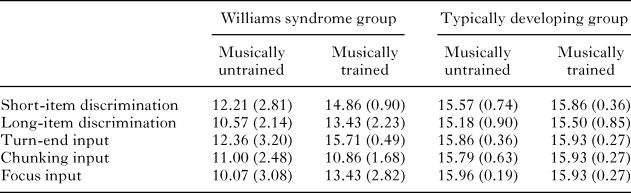
The results obtained for the different groups of the study are shown in Table 3. Although heterogeneity is associated with WS (Porter & Coltheart, Reference Porter and Coltheart2005), no outliers were found. Frequency distributions of scores for the groups with WS are provided as supplementary materials.
Results of the Williams syndrome and typically developing groups by musical training

note: Valuess in parentheses represent standard deviations.
In order to test whether participants’ performance was above chance level, separate one-way t-tests were run for each group in each task. Both the musically untrained and musically trained WS groups and their correspondent control groups performed above chance level in all of the tasks (musically untrained participants with WS: p < .001 for short-item discrimination and turn-end input, p = .001 for long-item discrimination and chunking input, p = .026 for focus input; musically trained participants with WS: p < .001 for short-item discrimination and turn-end input, p = .001 for long-item discrimination, p = 004 for chunking input, p = .002 for focus input; musically untrained and musically trained TD participants: p < .001 for all tasks).
A 2 × 2 ANCOVA with diagnosis group (WS and TD) and musical training (with and without) as between-subject factors was conducted. CA was included as a covariate in the model to control for the possible effect of this variable on prosodic performance. When the interaction effect was significant, the results were analyzed by studying the simple effects, i.e., comparing the levels of one factor within the levels of the other factor (Pardo & Ruiz, Reference Pardo and Ruiz2002). Bonferroni correction was used to control for the error rate. The assumption of homogeneity of variance was not met. Because of this, a stringent α level (α = .01) was required (Tabachnick & Fidell, Reference Tabachnick and Fidell2007).
In the short-item discrimination task, the main effects of diagnosis group (F(1,58) = 43.57, p < .001, η 2 = .37) and musical training were significant (F(1,58) = 7.65, p = .008, η 2 = .07). The interaction was also found to be significant (F(1,58) = 8.14, p = .006, η 2 = .07). However, the effect of CA was not statistically significant (p = .78). Bonferroni pairwise comparisons showed a significantly lower performance of participants with WS as compared to their TD peers only in the groups without musical training (CI.95 = –4.31 (lower) –2.40 (upper), p < .001). Thus, no significant differences between the WS and TD groups were found when considering participants with musical training (CI.95 = –2.35 (lower) 0.35 (upper), p = .14). The effect of musical training was significant in the WS group in that musically trained participants outperformed their musically untrained counterparts (CI.95 = 1.30 (lower) 4.00 (upper), p < .001), but no effects of musical training were found in the TD participants (CI.95 = –1.25 (lower) 0.66 (upper), p = .54).
In the long-item discrimination task, diagnosis group, musical training, and the interaction between these two variables were significant (F(1,58) = 95.76, p < .001, η 2 = .55; F(1,58) = 9.03, p = .004, η 2 = .05; F(1,58) = 9.67, p = .003, η 2 = .06, respectively). However, CA was not found to be significant (p = .38). The analysis of the interaction showed that, regardless of musical training, individuals with WS performed lower than their TD peers (for musically trained participants: CI.95 = –3.40 (lower) –0.74 (upper), p = .003; for musically untrained participants: CI.95 = –5.55 (lower) –3.66 (upper), p < .001). Moreover, significant differences between musically trained and untrained participants were only found in the WS group, in favor of those with musical training (WS group: CI.95 = 1.51 (lower) 4.18 (upper), p < .001; TD group: CI.95 = –1.25 (lower) 0.63 (upper), p = .51).
Turn-end input threw significant effects of diagnosis group (F(1,58) = 33.76, p < .001, η 2 = .30), musical training (F(1,58) = 7.92, p = .007, η 2 = .07), and their interaction (F(1,58) = 14.01, p < .001, η 2 = .12), but no statistical significance for CA (p = .81). Bonferroni pairwise comparisons showed significant differences between the WS and TD groups, in favor of the latter, but only for participants without musical training (for musically trained participants: CI.95 = –1.65 (lower) 1.22 (upper), p = .77; for musically untrained participants: CI.95 = 2.49 (lower) 4.51 (upper), p < .001). Only in WS did musically trained participants outperform their musically untrained counterparts (WS group: CI.95 = 1.92 (lower) 4.79 (upper), p < .001; TD group: CI.95 = –1.09 (lower) 0.95 (upper), p = .89).
In chunking input, a significant main effect of diagnosis group was found in that TD participants outperformed participants with WS (F(1,58) = 178.28, p < .001, η 2 = .75). No other significant effects were found (CA: p = .89; musical training: p = .90; interaction: p = .71).
In focus input, the effect of diagnosis group was significant (F(1,58) = 109.50, p < .001, η 2 = .58). Musical training approached significance (F(1,58) = 5.53, p = .022, η 2 = .03). The interaction between diagnosis group and musical training was significant (F(1,58) = 12.36, p = .001, η 2 = .07). However, CA did not reach statistical significance (p = .14). The analysis of the interaction showed that, for both the musically trained (CI.95 = –4.07 (lower) –0.92 (upper), p = .002) and untrained groups (CI.95 = –7.00 (lower) –4.77 (upper), p < .001), participants with WS performed significantly lower than TD participants. In addition, a significantly higher performance of musically trained participants as compared to their musically untrained peers was found only in the WS group (WS group: CI.95 = 1.75 (lower) 4.91 (upper), p < .001; TD group: CI.95 = –1.06 (lower) 1.18 (upper), p = .91).
To test whether participants’ verbal level could account for the significant effects, analyses were conducted again with verbal IQ as a covariate. As in the previous analyses, the α level was established at .01.
In the short-item discrimination task, verbal IQ had a significant effect (F(1,57) = 46.98, p < .001, η 2 = .39). The interaction between diagnosis group and musical training also reached statistical significance (F(1,57) = 9.82, p = .003, η 2 = .08). No other significant effects were found (CA: p = .78; diagnosis group: p = .81; musical training: p = .016). The analysis of the interaction showed a significant effect of musical training only in the WS group, in that musically trained participants outperformed their musically untrained peers (WS group: CI.95 = 1.33 (lower) 4.00 (upper), p < .001; TD group: CI.95 = –1.05 (lower) 0.95 (upper), p = .93). No significant differences were found between the WS and the TD groups for the musically trained (CI.95 = –2.05 (lower) 4.89 (upper), p = .42) or the musically untrained participants (CI.95 = –4.21 (lower) 1.82 (upper), p = .43).
Verbal IQ also reached significance in the long-term discrimination task (F(1,57) = 91.39, p < .001, η 2 = .53). Musical training and the interaction between diagnosis group and musical training were likewise significant (F(1,57) = 8.47, p = .005, η 2 = .05; F(1,57) = 9.84, p = .003, η 2 = .06, respectively). The effects of CA (p = .38) and diagnosis group (p = .06) were non-significant. Bonferroni pairwise comparisons showed a trend for a lower performance of the WS group as compared to the TD group only for the musically untrained participants (musically untrained participants: CI.95 = –6.84 (lower) –0.80 (upper), p = .014; musically trained participants: CI.95 = –4.67 (lower) 2.29 (upper), p = .50). In the WS group, musically trained participants outperformed their musically untrained peers (CI.95 = 1.51 (lower) 4.19 (upper), p < .001). Musical training did not throw significant differences in the TD group (CI.95 = –1.23 (lower) 0.78 (upper), p = .66).
In the turn-end input task, significant effects were found for verbal IQ (F(1,57) = 35.83, p < .001, η 2 = .31) and the interaction between diagnosis group and musical training (F(1,57) = 15.79, p < .001, η 2 = .14). No other significant effects were found (CA: p = .81; diagnosis group: p = .76; musical training: p = .012). The analysis of the interaction showed that musically untrained participants performed lower than their musically trained peers only in the WS group (WS group: CI.95 = –4.79 (lower) –1.94 (upper), p < .001; TD group: CI.95 = –0.9 (lower) 1.24 (upper), p = .75). No significant differences were found between the WS and TD groups either for the musically trained (CI.95 = –1.57 (lower) 5.83 (upper), p = .25) or untrained participants (CI.95 = –4.62 (lower) 1.80 (upper), p = .38).
In chunking input, verbal IQ was significant (F(1,57) = 167.53, p < .001, η 2 = .72). The main effect of diagnosis group was also found to be significant (F(1,57) = 8.75, p < .001, η 2 = .04) so that participants with WS performed significantly lower than their TD counterparts. No other significant effects were found (CA: p = .89; musical training: p = .98; interaction: p = .80).
Finally, in the focus input task, the effects of verbal IQ (F(1,57) = 108.28, p < .001, η 2 = .57) and the interaction between diagnosis group and musical training (F(1,57) = 13.69, p < .001, η 2 = .07) were significant. CA (p = .14), diagnosis group (p = .08), and musical training (p = .035) were non-significant. Bonferroni pairwise comparisons showed a trend for significant differences between the WS and TD groups, in favor of the latter, only for musically untrained participants (musically untrained: CI.95 = 0.33 (lower) 7.41 (upper), p = .033; musically trained: CI.95 = –4.32 (lower) 3.84 (upper), p = .91). Moreover, only in the WS group did musically trained participants outperform their musically untrained peers (WS group: CI.95 = 1.77 (lower) 4.91 (upper), p < .001; TD group: CI.95 = –0.89 (lower) 1.47 (upper), p = .62).
In summary, significant effects of musical training were found only in participants with WS. Musically trained participants performed higher than their musically untrained peers on the short-item and long-item discrimination tasks, turn-end input and focus input. Furthermore, while prosodic performance was generally higher in the TD group than in the WS group, in the short-item discrimination and turn-end input tasks there were no significant differences between the musically trained participants with WS and their TD counterparts. In the chunking input task, musical training did not show any significant effect. When controlling for the effect of verbal IQ, all differences between the musically trained and untrained participants with WS remained significant. In addition, in the long-item discrimination and focus input tasks, the differences between the WS and TD groups for participants with musical training lost their statistical significance.
4. Discussion
The main aim of the study was to ascertain whether musical training is associated with an enhancement of the linguistic prosodic perception skills of individuals with WS. This was the case in four out of the five prosodic tasks included in this research. Thus, musically trained participants with WS outperformed their musically untrained peers with WS on the short-item and long-item discrimination, turn-end input, and focus input tasks.
As described in Section 2.2., the prosodic contrasts tested in the short-item and long-item discrimination tasks were expressed through pitch, duration, and intensity. These acoustic parameters are also involved in music perception (Besson et al., Reference Besson, Chobert and Marie2011). Therefore, the higher performance of musically trained individuals with WS as compared to musically untrained peers on the short-item and long-item discrimination tasks can be interpreted as evidence that, in WS, music and prosody share processing resources, as also claimed for typical development (Besson et al., Reference Besson, Chobert and Marie2011). Prior research showed evidence of common mechanisms for pitch processing in prosody and music in WS (Martínez-Castilla & Sotillo, Reference Martínez-Castilla and Sotillo2014). In the study presented here we provide data suggesting shared processing mechanisms not only for the parameter of pitch but also for duration and intensity.
In typical development, higher prosodic discrimination in musically trained individuals as compared to unmusically trained peers is also considered evidence of a facilitating effect from musical training to prosodic perception (Besson et al., Reference Besson, Chobert and Marie2011; Kraus & Chandrasekaran, Reference Kraus and Chandrasekaran2010). This effect is explained by the increased sensitivity to the acoustic parameters important for both music and prosody that results from musical practice (Besson et al., Reference Besson, Chobert and Marie2011; Strait & Kraus, Reference Strait and Kraus2011). The fact that the same pattern of results was found in this study for the participants with WS suggests that the same explanation may account for such results.
In WS, musical training was also associated with enhanced performance on turn-end input and focus input. Pitch contour and pitch accent are the forms responsible for the prosodic contrasts in these tasks, respectively. Therefore, changes in fundamental frequency are crucial for the prosodic contrasts tested. This acoustic parameter is also key in music. As previously suggested, increased sensitivity to pitch arising from musical training may thus contribute to accounting for the higher results of the musically trained individuals with WS as compared to their musically untrained peers. It should also be considered that the turn-end and focus tasks require not only pitch processing but also comprehension of two different linguistic prosody functions, namely, understanding of questions and statements, and contrastive stress, respectively. As mentioned in Section 1.2., in typical development the positive influence of musical training shown through comparisons between musically trained and untrained individuals on speech levels higher than acoustic processing is considered evidence of music-to-language transfer effects (Alexander et al., Reference Alexander, Wong and Bradlow2005; Besson et al., Reference Besson, Chobert and Marie2011; Bidelman et al., Reference Bidelman, Gandour and Krishnan2010). The results of this study on turn-end input and focus input in WS may be interpreted in the same way. In typical development, regarding linguistic prosody, possible music-to-language transfer effects have only been found for the function of lexical distinction (Alexander et al., Reference Alexander, Wong and Bradlow2005; Kolinsky et al., Reference Kolinsky, Cuvelier, Goetry, Peretz and Morais2009). Our results suggest that the transfer effect may occur in WS in two other prosodic functions. Interesting similarities can be drawn between such functions in prosody and music. Thus, while prosody can express questions and statements, musical melodies are organized in question–answer sequences, a characteristic of the organization of the Western tonal musical system (Abraham, Reference Abraham2002). In addition, the prosodic function of focus, which allows the speaker to emphasize particular syllables or words in an utterance depending on their communicative intentions (Zubizarreta, Reference Zubizarreta1998), has its musical parallel in interpretative accentuation, especially relevant for musical expression (Glaser, Reference Glaser2000).
Moreover, just as prosody contributes to segment the speech chain, musical phrasing plays a perceptually informative role, helping the listener identify structural features (Palmer, Jungers, & Jusczyk, Reference Palmer, Jungers and Jusczyk2001). One might hypothesize that, in WS, musical training would be associated to enhanced performance on such a prosodic function. However, we did not find this relationship in chunking input, which evaluates speech boundaries through prosodic means. Together with pause, pitch and duration (exponents of phrasal tone and lengthening) are important acoustic correlates of this function. The two latter parameters were involved in other prosodic tasks in which a significant effect of musical training was found in WS (e.g., short-item and long-item discrimination). It may then be suggested that the lack of significant differences between the musically trained and untrained participants with WS in chunking input was due to the role of pause in this task. However, this seems unlikely since, in this task, pause co-occurs with phrasal tone and lengthening. In addition, it could be argued that pause also plays a significant role in music (e.g., in rhythm perception), so there would be no reason to expect a lack of association between musical training and this parameter. Instead, we suggest that the severe deficits that individuals with WS present for understanding the prosodic function of segmentation would account for the results found. Thus, infants with WS show early impairments in this prosodic function (Nazzi et al., Reference Nazzi, Paterson and Karmiloff-Smith2003). A delayed rate of development is observed throughout childhood (Stojanovik, Reference Stojanovik2010) and, by adulthood, this prosodic deficit cannot be explained by the intellectual disability characteristic of WS (Martínez-Castilla et al., Reference Martínez-Castilla, Sotillo and Campos2011). The possible severity of this impairment may therefore explain why no significant effects of musical training were found on the chunking input task. In spite of the higher sensitivity that musically trained individuals with WS may have for pitch and duration (as suggested from the results obtained in the other prosody tasks), their deficits in understanding the prosodic function of segmentation would prevent music-to-language transfer effects from taking place.
Although prior studies have found that musical training is associated with enhanced prosodic performance in TD individuals (see, e.g., for a review, Besson et al., Reference Besson, Chobert and Marie2011), no such effect was found in this research. This is explained by considering that, at the age of the TD participants included in our study, the prosodic skills under evaluation have already been acquired (Martínez-Castilla & Peppé, Reference Martínez-Castilla and Peppé2008). In fact, not surprisingly, the TD participants performed at ceiling on the prosodic tasks.
It should be noted, though, that a TD CG matched to the WS group on CA was included in the study in order to test whether musically trained participants with WS could reach the prosodic level of their TD counterparts. Prior research has found that individuals with WS perform significantly lower than TD peers of the same CA on the prosodic tasks included in our study (Stojanovik et al., Reference Stojanovik, Setter and van Ewijk2007). Remarkably, in short-item discrimination and turn-end input, the musically trained participants with WS performed at the same level as the CG. Therefore, musical training may help individuals with WS to overcome some of their prosodic impairments. Yet, considering the ceiling effects found in the CG, the result should be taken with caution. It is therefore more conservative to conclude that our result means a clear improvement towards the performance expected by the CA of individuals with WS. Further research should assess whether musically trained individuals with WS reach the level of their CA-matched TD peers when using prosodic tasks that are more difficult for the CG. The challenge here lies in developing new prosodic tests that are sensitive enough for TD teenagers and adults while avoiding floor effects in individuals with WS.
In any case, musically trained participants with WS performed at the level of their TD peers in only two of the four prosodic tasks where musical training showed a significant effect in WS. Unlike in short-item discrimination and turn-end input, in long-item discrimination and focus input the musically trained participants with WS did not reach the level of their TD peers. In typical development, short-item discrimination and turn-end input are easier than long-item discrimination and focus input (Martínez-Castilla & Peppé, Reference Martínez-Castilla and Peppé2008). Therefore, differences in the difficulty levels of the prosodic tasks could explain the difference found in the extent of the effect of musical training. Despite these differences, it should be noted that, in long-item discrimination and focus input, when controlling for verbal IQ, the significant differences previously found between the WS and control groups were cancelled out for participants with musical training. This result, together with the fact that musically trained participants with WS outperformed their musically untrained peers with the syndrome, highlights the possible benefits of musical training for enhancing these prosodic skills in WS.
To conclude whether musical training may have an effect on any cognitive domain, it is crucial to ensure that the effect is not explained by differences in IQ between the participants with and without musical training (Schellenberg, Reference Schellenberg2008). The lack of this control has been strongly criticized in previous studies on this topic among TD individuals (Schellenberg, Reference Schellenberg2008). We assessed the IQ of all of the participants in our study. As previously found in the literature (Schellenberg, Reference Schellenberg2004), IQ measurements were significantly higher in the musically trained participants than in their musically untrained peers in the CG. However, and importantly for the aims of this study, no significant differences were found in IQ between the musically trained and untrained WS groups. Furthermore, the effect of musical training found in WS remained significant after controlling for differences in verbal IQ. Therefore, we can be certain that the effects of musical training found in the study cannot be attributed to IQ.
Although we found results suggesting facilitating effects of musical training on prosodic performance in WS, these results are correlational. Therefore, no causal relationships can be inferred from this study, an issue that is also present in the literature on the topic in typical development. Although a few longitudinal studies have shown the positive influence of musical training on prosodic skills (Moreno et al., Reference Moreno, Marques, Santos, Santos, Castro and Besson2009), most of the research is correlational, as previously mentioned. The possible confound here is that pre-existing differences relevant for prosody processing might affect the likelihood of enrolling in musical training (Patel & Iversen, Reference Patel and Iversen2007; Schellenberg, Reference Schellenberg2008). Still, it has been shown that there are no pre-existing neural, cognitive, motoric, or musical markers between TD individuals who do or do not choose to receive musical training (Norton et al., Reference Norton, Winner, Cronin, Over, Lee and Schlaug2005). In the case of individuals with WS, it is the stereotyped ideas about their high musical skills that lead parents to seek musical activities for their children (Dykens, Rosner, Ly, & Sagun, Reference Dykens, Rosner, Ly and Sagun2005; Fidler, Lawson, & Hodapp, Reference Fidler, Lawson and Hodapp2003). Therefore, it seems unlikely that pre-existing differences in prosody skills account for decisions about whether to receive musical training.
The positive association between musical training and the perception of linguistic prosody found in this study for the WS group was obtained with participants whose native language was Spanish. As mentioned in Section 1.2., the same association has been previously found in TD individuals who are native speakers of other languages such as English, French, Portuguese, and Japanese. This suggests that, in typical development, the positive effect of musical training on prosodic performance is not language-specific. Despite important differences in the use of prosody across languages, prosody is conveyed cross-linguistically through the same acoustic exponents; i.e., pitch, duration, and intensity (Fox, Reference Fox2000). These acoustic parameters seem to be processed through shared mechanisms in music and prosody, being sensitivity to such parameters enhanced by musical training (Besson et al., Reference Besson, Chobert and Marie2011; Strait & Kraus, Reference Strait and Kraus2011). Following on from this, a positive association between musical training and prosodic performance would be expected cross-linguistically. This would also hold for WS. Yet, as far as we know, there are no other studies on this topic on individuals with WS who speak a language other than Spanish. Therefore, further research should be conducted to clarify whether, in WS, the association between musical training and enhanced linguistic prosodic skills also applies for other languages. In addition, future studies should evaluate whether the processing of the acoustic parameters involved in both music and prosody (i.e., low-level auditory processing) is enhanced in musically trained individuals with WS.
In this study we have provided behavioral evidence on the positive association between musical training and the perception of linguistic prosody in WS. In typical development, together with behavioral results, neurophysiological data also support such an association (Besson et al., Reference Besson, Chobert and Marie2011). Future neurophysiological research should be conducted on this topic in WS.
As referred to in Section 2.1., the number of participants with WS in the study may be considered representative of the population with WS in the country where this research was conducted. Yet, the small sample size of the group of musically trained individuals with WS and the unbalanced group sample size limit the study. This was due to both the low incidence of the syndrome and the difficulties in finding a homogeneous group of individuals with WS who had received music lessons. This problem is common in the literature on studies on both prosody in groups or subgroups of participants with WS (Catterall, Howard, Stojanivik, Szczerbinski, & Wells, Reference Catterall, Howard, Stojanovik, Szczerbinski and Wells2006; Martínez-Castilla et al., Reference Martínez-Castilla, Stojanovik, Setter and Sotillo2012; Reilly, Klima, & Bellugi, Reference Reilly, Klima and Bellugi1990; Stojanovik et al., Reference Stojanovik, Zimmerer, Setter, Hudson, Poyraz-Bilgin and Saddy2018) and on research on musical training in this population (Lenhoff et al., Reference Lenhoff, Perales and Hickok2001; Martínez-Castilla, Sotillo, & Campos, Reference Martínez-Castilla, Sotillo and Campos2013). Even though, this limitation hinders the generalization of results. Therefore, our findings should be considered preliminary.
It should also be mentioned that differences in the type of musical training received may affect sensitivity to the parameters that are more relevant for the musical activity being carried out. For example, learning the violin enhances sensitivity to pitch due to the need of violinists to tune their instrument (Kraus & Chandrasekaran, Reference Kraus and Chandrasekaran2010). Consequently, different forms of musical training could also have different effects on prosodic performance (Alexander et al., Reference Alexander, Wong and Bradlow2005). Nevertheless, the possible differential effects of musical training on the prosodic skills of individuals with WS cannot be disentangled from our study, as the participants had received different types of musical training. Although many more studies have been conducted on TD individuals, diversity in the type of musical training has also been noticed and the same problem has thus been reported (Kraus & Chandrasekaran, Reference Kraus and Chandrasekaran2010). Further research should be conducted on this topic.
To conclude, we have shown in this study that musical training is associated with an enhancement of the prosodic skills of individuals with WS. This result may be relevant for clinical practice. Thus, as suggested for the short-item discrimination and turn-end input tasks, musical training may help individuals with WS overcome some of their prosodic impairments. Pending longitudinal studies, our results highlight the potential for musical training as a possible intervention tool on prosodic performance in WS. Yet, given the results found for chunking input, we would also conclude that musical training may not be an efficient intervention tool when the prosodic deficit is severe. In any case, and as has already been noted for other developmental disorders (Kraus & Chandrasekaran, Reference Kraus and Chandrasekaran2010), we consider that musical training should not replace traditional intervention methods (e.g., speech and language therapy). Instead, it could constitute a complementary tool that may have the added value of being enjoyable and pleasant (Kraus & Chandrasekaran, Reference Kraus and Chandrasekaran2010). This tool may be particularly useful in individuals with WS, as they are often interested in music (Levitin et al., Reference Levitin, Cole, Chiles, Lai, Lincoln and Bellugi2004).
Supplementary materials
For supplementary materials for this paper, please visit <http://doi.org/10.1017/langcog.2019.27>.