Introduction
Digeneans from the genus Lecithaster Lühe, 1901 (family Lecithasteridae Odhner, 1905, superfamily Hemiuroidea Looss, 1899) are globally distributed parasites of marine fish (Gibson, Reference Gibson, Gibson, Jones and Bray2002; WoRMS, 2022a). Lecithaster comprises 31 valid species, and in many of them maritae (sexual adults) are quite similar, with only morphometric analysis helping to tell them apart (Srivastava, Reference Srivastava1966; Martin & Multani, Reference Martin and Multani1970; Orecchia et al., Reference Orecchia, Paggi and Radujkovir1988; Besprozvannykh et al., Reference Besprozvannykh, Atopkin, Ngo, Ermolenko, Van Ha, Van Tang and Beloded2017). Intensive molecular genetic studies have been performed for the Lecithaster species from the Far East recently (Besprozvannykh et al., Reference Besprozvannykh, Atopkin, Ngo, Ermolenko, Van Ha, Van Tang and Beloded2017; Atopkin et al., Reference Atopkin, Nakao, Besprozvannykh, Ha, Nguyen and Sasaki2020), but relevant sequencing data on this genus from the European waters are surprisingly few (Olson et al., Reference Olson, Cribb, Tkach, Bray and Littlewood2003). Alongside molecules, characters that help with the species delineation are associated with the lifecycle pattern. Recently, several digenean species were shown to have the same morphology of marita, although the lifecycle stages from the intermediate hosts and the species range of these hosts differ (Gilardoni et al., Reference Gilardoni, Etchegoin, Cribb, Pina, Rodrigues, Diez and Cremonte2020; Gonchar & Galaktionov, Reference Gonchar and Galaktionov2021).
In the present article, we question the specific identity of the Lecithaster found in White Sea fishes. Previously, Lecithaster gibbosus (Rudolphi, 1802) Lühe, 1901 and Lecithaster confusus Odhner, 1905 had been recorded in this region (Shulman & Shulman-Albova, Reference Shulman and Shulman-Albova1953; Mitenev & Karasev, Reference Mitenev and Karasev2005). However, these species use Brachystomia eulimoides (Hanley, 1844) and Boonea trifida (Totten, 1834) (Heterobranchia: Pyramidellidae) as their first intermediate hosts, respectively (Hunninen & Cable, Reference Hunninen and Cable1943; Køie, Reference Køie1989). These gastropods have never been found in the White Sea (Golikov, Reference Golikov, Starobogatov and Naumov1987; Kantor & Sysoev, Reference Kantor and Sysoev2006). However, lecithasterid sporocysts and cystophorous cercariae, Cercaria saccocaudata Tschubrik, 1966, have been found in another gastropod, Cryptonatica affinis (Gmelin, 1791) (Caenogastropoda: Naticidae), in the White and Barents seas (Chubrik, Reference Chubrik1966; Timofeeva, Reference Timofeeva1976). We obtained Lecithaster maritae from various fish species, metacercariae from planktonic copepods and intramolluscan lifecycle stages from C. affinis, and compared them by 28S ribosomal DNA (rDNA) and internal transcribed spacer 2 (ITS2) sequencing to determine whether they are the stages of a single life cycle, and to define their species identity.
Material and methods
Sampling was performed at the Keret Archipelago, White Sea, in 2019–2021. We searched for the maritae of Lecithaster in 16 fish species. Three species of gastropods from the family Naticidae (C. affinis, N = 270; Euspira pallida (Broderip & G. B. Sowerby I, 1829), N = 24; Amauropsis islandica (Gmelin, 1791), N = 3) were dissected to find lecithasterid sporocysts and cercariae. Metacercariae were obtained from planktonic copepods.
Sporocysts, metacercariae and maritae were fixed in 96% ethanol for the whole mounts. All specimens of maritae were heat-killed before fixation. Worms were stained with acetocarmine (Sigma-Aldrich, Steinheim, Germany) followed by destaining in 0.1 M hydrogen chloride in 70% ethanol, dehydrated in a graded alcohol series, clarified in xylol and mounted in Canada balsam. Cercarial gross morphology was studied on temporary mounts of live specimens or some fixed in 2.5% glutaraldehyde in sea water. Whole mounts were observed under microscopes Leica DM 500 or DM 2500 (Leica Microsystems, Wetzlar, Germany); photos and videos were taken in bright field and with differential interference contrast using a Nikon DS Fi1 (Nikon, Tokyo, Japan) or with a smartphone camera. Measurements were made using Fiji software (Schindelin et al., Reference Schindelin, Arganda-Carreras and Frise2012). All the measurements are in micrometres.
For scanning electron microscopy (SEM), 2.5% glutaraldehyde-fixed cercariae were rinsed in distilled water, dehydrated in ethanol and acetone, dried in a critical-point dryer, coated with platinum and examined with a Quanta 250 (FEI, Eindhoven, Netherlands) at 15 kV. Visualization of musculature and flame cells arrangement was performed by means of confocal laser scanning microscopy (CLSM). Specimens were fixed in 4% paraformaldehyde in 0.01 M phosphate-buffered saline and stained with TRITC-labelled phalloidin and DAPI (Sigma-Aldrich, Steinheim, Germany). The protocol was the same as described in Kremnev et al. (Reference Kremnev, Gonchar, Krapivin, Knyazeva and Krupenko2020).
Ethanol-fixed sporocysts, metacercariae and maritae were used for molecular studies. To extract DNA we took a fragment of metacercaria, marita (anterior part of the oral sucker or a piece from posterior body end) or sporocyst. The samples were taken from 96% ethanol and dried completely, incubated in 200 μl of 5% solution of Chelex® 100 resin (Bio-Rad, Hercules, California, USA) with 0.2 mg/ml of proteinase K (Evrogen, Moscow, Russia) at 56°C for 4 h, then kept for 8 min at 90°C and centrifuged for 10 min at 14,000 rpm. The supernatant was then transferred into a new tube and stored at −20°C.
Amplification of the 28S rDNA and ITS2 region was performed with primers digl2 (5′-AAGCATATCACTAAGCGG-3′) and 1500R (5′-GCTATCCTGAGGGAAACTTCG-3′) for 28S (domains D1–D3) (Tkach et al., Reference Tkach, Grabda-Kazubska, Pawlowski and Swiderski1999; Olson et al., Reference Olson, Cribb, Tkach, Bray and Littlewood2003), and with primers 3S (5′-GTACCGGTGGATCACGTGGCTAGTG-3′) and ITS2.2 (5′-CCTGGTTAGTTTCTTTTCCTCCGC-3′) for ITS2 (Morgan & Blair, Reference Morgan and Blair1995). The 20 μl reaction mixture contained 4 μl of ScreenMix-HS (Evrogen), 0.5 μl of forward and reverse primers (10 pmol/μL), 2 μl of the DNA and 13 μl of polymerase chain reaction (PCR)-grade water (Evrogen). PCRs were run on a T100 Thermal Cycler (Bio-Rad, USA) with the following conditions: 40 cycles of 30 s at 95°C, 30 s at 54°C and 60 s at 72°C for 28S, and 35 cycles of 30 s at 94°C, 30 s at 55°C and 60 s at 72°C for ITS2. In all reactions initial denaturation was at 95°C for 5 min and final extension was at 72°C for 10 min. PCR products were stained with ethidium bromide and visualized through electrophoresis on a 1% agarose gel. Sequencing was carried out with PCR primers on an ABI Prism 3500xl genetic analyser (Applied Biosystems, Foster City, California, USA). To analyse and edit chromatograms, and to build alignments we used Geneious Prime 2022.0.1 (https://www.geneious.com). The Basic Local Alignment Search Tool (BLAST) was used for preliminary assessment of newly generated sequences. Relevant data for alignments were obtained from GenBank. To annotate 28S and ITS2, we used the sequence of Aponurus sp. (HQ713442; Carreras-Aubets et al., Reference Carreras-Aubets, Repullés-Albelda, Kostadinova and Carrassón2011) as a reference. Pairwise genetic distances between species (as the number of base differences per site) were calculated in MEGA 7 (Kumar et al., Reference Kumar, Stecher and Tamura2016). The maximum likelihood (ML) analysis was conducted at the CIPRES Science Gateway (https://www.phylo.org) using RAxML (Stamatakis, Reference Stamatakis2014) with 1000 bootstrap iterations. The model of nucleotide substitution was estimated as GTR + G for the 28S dataset and TVM + I for the ITS2 dataset using jModelTest (Darriba et al., Reference Darriba, Taboada, Doallo and Posada2012) at the CIPRES Science Gateway.
Results
Maritae of the genus Lecithaster were found in nine fish species: Atlantic wolffish Anarhichas lupus Linnaeus, 1758; Pacific herring Clupea pallasii Valenciennes, 1847; European whitefish Coregonus lavaretus (Linnaeus, 1758); navaga Eleginus nawaga (Walbaum, 1792); Atlantic cod Gadus morhua Linnaeus, 1758; common dab Limanda limanda (Linnaeus, 1758); Shorthorn sculpin Myoxocephalus scorpius (Linnaeus, 1758); pink salmon Oncorhynchus gorbuscha (Walbaum, 1792); and rainbow smelt Osmerus mordax dentex Steindachner & Kner, 1870. Two specimens of Lecithaster metacercariae were obtained from the planktonic copepods Pseudocalanus sp. and Metridia longa (Lubbock, 1854). In the gastropods C. affinis we found lecithasterid sporocysts and cercariae consistent with those described as C. saccocaudata (Chubrik, Reference Chubrik1966; Timofeeva, Reference Timofeeva1976). Two other naticid gastropods, E. pallida and Amauropisis islandica, were free from lecithasterid infection.
Molecular analysis
For the molecular analysis we used 19 isolates (listed in table 1). We obtained 1068 bp-long fragments of 28S rDNA for 17 specimens from the definitive and intermediate hosts. The closest 24 BLAST hits were the members of the genus Lecithaster, and they were included into an alignment to estimate conspecificity. After trimming ends to fit the shortest sequence, the alignment was 980 bp long. According to the matrix of pairwise distances, our specimens grouped together (see supplementary table S1), though one substitution was present: three maritae (isolates A24.2, D3.2 and D6.1) differed from the rest in the position 368 (C/T). This variation was not consistent with the host species. Our specimens were close to L. gibbosus (AY222199, Olson et al., Reference Olson, Cribb, Tkach, Bray and Littlewood2003) and Lecithaster salmonis Yamaguti, Reference Yamaguti1934 (MH625979–81, Atopkin et al., Reference Atopkin, Nakao, Besprozvannykh, Ha, Nguyen and Sasaki2020), with pairwise distances below 0.0031 ± 0.0018 (1–3 substitutions). The maximal number of substitutions within previously sequenced species of Lecithaster was three – in Lecithaster confusus (MH628305–6, Sokolov et al., Reference Sokolov, Atopkin, Urabe and Gordeev2019). Pairwise distances between the sequences of different species of the Lecithaster (excluding L. gibbosus and L. salmonis) varied from 0.0115 ± 0.0040 to 0.1250 ± 0.0345 (12 to 113 substitutions).
Isolates, their origin and GenBank accession numbers for sequences.

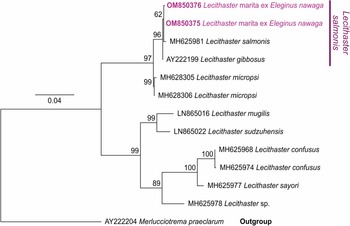
For the ML analysis we removed all the identical sequences; thus, the alignment included 12 specimens of Lecithaster. Merlucciotrema praeclarum (AY222204, Olson et al., Reference Olson, Cribb, Tkach, Bray and Littlewood2003) was added as an outgroup. The alignment was 980 bp long after trimming to the shortest sequence and removing gaps created by M. praeclarum. In the resulting tree, our sequences, together with those of L. gibbosus and L. salmonis, formed a well-supported branch (fig. 1). Within it interrelationships were unresolved.
Phylogenetic affinities of the White Sea Lecithaster maritae based on the 28S rDNA sequence data, inferred with the ML method. Newly generated sequences are indicated in bold and purple. Bootstrap values are printed in nodes. Scale bar shows the substitution rate. Identification of a group of sequences as Lecithaster salmonis is justified in Results and Discussion.

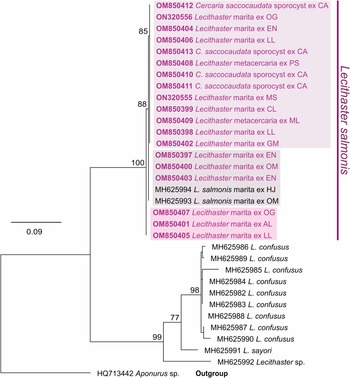
For 19 specimens we also obtained a 574–644 bp fragment including partial 5.8S rDNA (104–143 bp), complete ITS2 and the beginning of 28S (20–62 bp) (table 1). From GenBank, comparable data were available for only five species of Lecithaster: L. confusus (MH625982–90), L. sayori (MH625991), L. salmonis (MH625993–4), L. stellatus (AJ224749) and Lecithaster sp. (MH625992) (Anderson & Barker, Reference Anderson and Barker1998; Atopkin et al., Reference Atopkin, Nakao, Besprozvannykh, Ha, Nguyen and Sasaki2020). We excluded L. stellatus from the analysis as the sequence was much shorter at the 5’ end than the rest, and clearly differed from our sequences within the overlapping region in 173 positions. Aponurus sp. (HQ713442; Carreras-Aubets et al., Reference Carreras-Aubets, Repullés-Albelda, Kostadinova and Carrassón2011) was added as an outgroup; gaps created by Aponurus sp. were removed. Thus, the alignment consisted of 31 sequences and was 508 bp long, including gaps. Our specimens grouped together, though three variable positions were present among them, resulting in three groups with a maximal pairwise distance of 0.0061 ± 0.0046 (fig. 2; supplementary table S2). One of these groups differed from L. salmonis in one ambiguous position (distance = 0), and the others in 2–3 positions, including one ambiguity (maximal pairwise distance = 0.0040 ± 0.0037). The heterogeneity among our specimens was not consistent with host species. The highest intraspecific distance was in L. confusus: 0.0430 ± 0.0213 (18 positions). The minimal interspecific pairwise distance was 0.0590 ± 0.0275 (39 positions).
Phylogenetic affinities of the White Sea Lecithaster lifecycle stages based on the ITS2 sequence data, inferred with the ML method. Newly generated sequences are indicated in bold and purple. Bootstrap values are printed in nodes. Scale bar shows the substitution rate. Identification of a group of sequences as Lecithaster salmonis is justified in Results and Discussion. Abbreviations: AL, Anarhichas lupus; CA, Cryptonatica affinis; CL, Coregonus lavaretus; EN, Eleginus nawaga; GM, Gadus morhua; HJ, Hypomesus japonicus; LL, Limanda limanda; ML, Metridia longa; OG, Oncorhynchus gorbuscha; OM, Osmerus mordax dentex; PS, Pseudocalanus sp.

Descriptions
Maritae
Locality. White Sea, Keret Archipelago, Vichennaya Luda Island, Malyi Gorelyi Island, Matryonin Island.
Hosts and infection rates. Anarhichas lupus (prevalence 11%, N = 27; mean intensity (MI) = 3.7); C. pallasii (14%, N = 37; MI = 1); C. lavaretus (25%, N = 4; MI = 2); E. nawaga (8%, N = 24; MI = 5.5); G. morhua (8%, N = 125; MI = 8.4); L. limanda (4%, N = 115; MI = 3.8); M. scorpius (5%, N = 91; MI = 2.2); O. gorbuscha (100%, N = 3; MI = 85.7); O. mordax dentex (30%, N = 20; MI = 4.7).
Sites. Midgut, pyloric ceca, hindgut, stomach.
The measurements and principal morphological characteristics of the hologenophores are given in table 2. As pieces of the maritae were taken for DNA extraction, not all of the specimens contributed a data point to all metrical variables. Considering heterogeneity in the sequenced ITS2 and 28S rDNA fragments, we give characteristics of three groups of genetically different maritae separately. Immature specimens (without eggs in the uterus) were not considered.
Measurements of maritae. Specimens are grouped according to their genetic heterogeneity in ITS2. All the specimens are Lecithaster salmonis (see Results and Discussion).

a Data based on one specimen. Abbreviations: AL, Anarhichas lupus; CL, Coregonus lavaretus; EN, Eleginus nawaga; GM, Gadus morhua; LL, Limanda limanda; MS, Myoxocephalus scorpius; OG, Oncorhynchus gorbuscha.
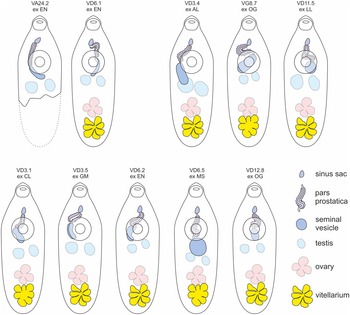
There were no clear morphological differences consistent with the genetic heterogeneity in our specimens. Schemes of the hologenophores (fig. 3) are given to illustrate the position and size of pars prostatica and seminal vesicle and the shape of vitellarium lobes – the three most variable characteristics among the studied maritae. Our specimens were most similar to descriptions of L. salmonis, L. confusus and L. gibbosus, on the basis of pars prostatica length, the position of the seminal vesicle and the shape of vitellarium lobes. However, they were apparently different from L. gibbosus and L. confusus in egg size: 19–22 × 12–15 (our data) vs. 21–36 × 13–18 in L. gibbosus (Odhner, Reference Odhner1905; Manter, Reference Manter1926; Linton, Reference Linton1940; Zhukov, Reference Zhukov1960; Shimazu, Reference Shimazu2018) and 12–20 × 7–13 in L. confusus (Odhner, Reference Odhner1905; Linton, Reference Linton1940).
Main morphological characters of the hologenophores of Lecithaster maritae from the White Sea. Specimens are grouped according to their genetic heterogeneity in ITS2. Abbreviations: AL, Anarhichas lupus; CL, Coregonus lavaretus; EN, Eleginus nawaga; GM, Gadus morhua; LL, Limanda limanda; MS, Myoxocephalus scorpius; OG, Oncorhynchus gorbuscha.

Taking into account both molecular and morphological data, we consider that all the maritae studied here pertain to L. salmonis.
Metacercaria
Based on one hologenophore
Host. Pseudocalanus sp.
Locality. White Sea, Keret Archipelago, Vichennaya Luda Island.
Body 568 × 226; forebody 150 (26% of body length); post-vitelline region 103 (18% of body length); post-caecal region 40 (7% of body length); oral sucker 63 × 75, ventral sucker 136 × 147, sucker length ratio 1:2.16; genital pore at middle of forebody, median; sinus sac 41 × 34; pars prostatica 118 (21% of body length), reaching middle of ventral sucker; seminal vesicle 152 × 63, extending posterior to ventral sucker; testes entire, left 68 × 70, right 46 × 63; ovary four-lobed 106 × 181; vitellarium postovarian, with seven oval lobes, 129 × 166.
Intramolluscan stages
Host. Cryptonatica affinis.
Locality. White Sea, Keret Archipelago, Vichennaya Luda Island, Matryonin Island.
Prevalence. 14.8% (N = 270).
Sites. Reproductive and digestive glands.
Sporocysts measurements based on six ethanol-fixed specimens. Sporocysts very long, 4312 (3101–5583) × 111 (90–122). Body with several constrictions. Birth pore terminal at anterior body end.
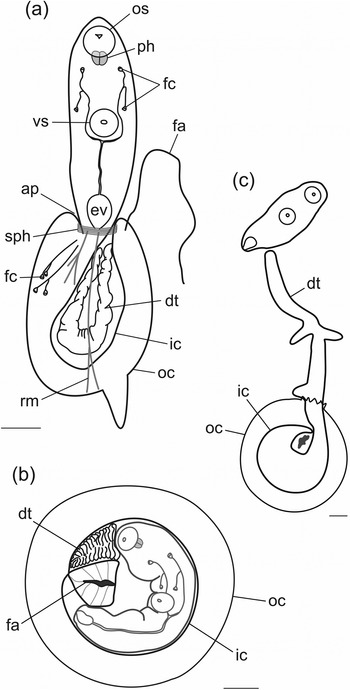
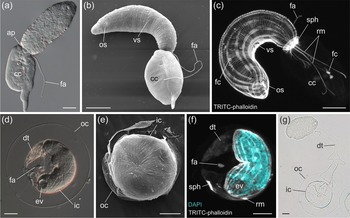
Cercariae measurements based on 24 infective and 22 pre-infective glutaraldehyde-fixed specimens. Cercariae of cystophorous type, with tail transformed into two-layered caudal cyst (figs 4 and 5). Cyst with delivery tube providing infection of second intermediate host and filamentose appendage 80 (64–97) long. In pre-infective cercaria caudal cyst oval, 78 (68–88) × 54 (43–67); outer cyst layer folded, often forming triangular projection; delivery tube withdrawn inside cavity, filamentose appendage and body outside. Body 108 (89–133) × 33 (29–37), oral sucker 16 (14–19) × 18 (16–20), pharynx 7 (6–8) × 9 (7–10), ventral sucker 13 (11–15) × 16 (12–18). Excretory vesicle Y-shaped, wider distal part 15 (13–17) × 9 (7–10). Two pairs of flame cells present within the body. Two excretory ducts inside caudal cyst, each with pair of flame cells (figs 4a and 5c). When getting into seawater cercariae become infective: body pulls into cyst through aperture by retractor muscles; aperture closes by sphincter muscle (figs 4a and 5c, e); filamentous appendage slowly withdraws into cyst, outer cyst layer inflates (figs 4b and 5d–f). Infective cercariae immobile, outer cyst 113 (109–120) in diameter, 60 (54–64) thick, inner cyst crescent-shaped, 77 (73–82) in diameter, 41 (38–43) thick. Flame cells within caudal cyst absent. Delivery tube measured in live specimens when everted under cover glass pressure (N = 7) 218 (201–225) long, with three lateral projections near base (figs 4c and 5g). Width between first and second projections 20 (17–22).
Schemes illustrating structure of the cercariae, pre-infective (a), infective (b) and with delivery tube everted (c). Scale bars: 20 μm. Abbreviations: ap, caudal cyst aperture; dt, delivery tube; ev, excretory vesicle; fa, filamentous appendage; fc, flame cell; ic, inner cyst layer; oc, outer cyst layer; os, oral sucker; ph, pharynx; rm, retractor muscles; sph, sphincter; vs, ventral sucker.

Structure of the cercariae. (a–c) Pre-infective cercariae, differential interference contrast (a), SEM (b) and TRITC-phalloidin staining, CLSM (c). (d–f) Infective cercaria, differential interference contrast (d), SEM with outer cyst layer partially torn (e), TRITC-phalloidin and DAPI staining, CLSM (f). (g) Cercariae with delivery tube everted, bright field. Scale bars: 20 μm. Abbreviations: ap, caudal cyst aperture; cc, caudal cyst; dt, delivery tube; ev, excretory vesicle; fa, filamentous appendage; fc, flame cell; ic, inner cyst layer; oc, outer cyst layer; os, oral sucker; ph, pharynx; rm, retractor muscles; sph, sphincter; vs, ventral sucker.

Discussion
Previously, two species of the genus Lecithaster have been recorded from the White Sea: L. gibbosus and L. confusus (Shulman & Shulman-Albova, Reference Shulman and Shulman-Albova1953; Mitenev & Karasev, Reference Mitenev and Karasev2005). Molecular data showed that all the maritae of Lecithaster which we found in the White Sea fish likely belong to a single species, despite some variation in 28S rDNA and ITS2. Genetically, this species matched isolates of L. salmonis from the Far East (Atopkin et al., Reference Atopkin, Nakao, Besprozvannykh, Ha, Nguyen and Sasaki2020) and one isolate of L. gibbosus from the northern Atlantic (Olson et al., Reference Olson, Cribb, Tkach, Bray and Littlewood2003). At the same time, the difference between our specimens and L. confusus from the Far East (Atopkin et al., Reference Atopkin, Nakao, Besprozvannykh, Ha, Nguyen and Sasaki2020) was extremely high.
The morphological characteristics are variable among our isolates. They demonstrate certain similarities with L. salmonis, L. gibbosus and L. confusus in vitellaria shape, length and position of the pars prostatica and seminal vesicle. Additionally, the morphological variability of our specimens is consistent neither with their genetic heterogeneity, nor with host species. Among the metrical characteristics, we consider the egg size to be the most reliable as it does not depend on fixation procedure, which had not been standardized until recently. The eggs in our specimens are longer than ones of L. confusus: 19–22 (our data) vs. 15–17 (Odhner, Reference Odhner1905), 12–20 (Linton, Reference Linton1940). They are slightly smaller or similar to the eggs of L. salmonis: 22–24 (Yamaguti, Reference Yamaguti1934, Reference Yamaguti1940), 19–24 (Atopkin et al., Reference Atopkin, Nakao, Besprozvannykh, Ha, Nguyen and Sasaki2020). Finally, L. gibbosus has a clearly bigger egg size: 25–27 (Odhner, Reference Odhner1905), 23–26 (Manter, 1926), 24–36 (Linton, Reference Linton1940), 21–27 (Shimazu, Reference Shimazu2018).
Considering both molecular and morphological data, we conclude that the White Sea Lecithaster is probably L. salmonis, which appears to be remarkably variable in several important characteristics commonly used to define species of Lecithaster. We suppose that the sequence AY222204 (Olson et al., Reference Olson, Cribb, Tkach, Bray and Littlewood2003) from the Atlantic was attributed to L. gibbosus erroneously due to this morphological variability, and the egg size might not have been considered.
Lifecycle data are also informative for species recognition. We have discovered intermediate hosts of L. salmonis by matching rDNA sequences of maritae to those of the larval lecithasterids. These were sporocysts and cercariae (previously called C. saccocaudata) from the gastropod C. affinis (Caenogastropoda) and metacercariae from the copepods Pseudocalanus sp. and M. longa. Cryptonatica affinis is present in Japanese waters (Chen & Nomaki, Reference Chen and Nomaki2021), the type locality of L. salmonis, further supporting the identification of this species. On the contrary, the first intermediate hosts of L. confusus and L. gibbosus are heterobranch gastropods from the family Pyramidellidae (Hunninen & Cable, Reference Hunninen and Cable1943; Køie, Reference Køie1989), which are absent in the White Sea. Thus, we consider the records of L. confusus and L. gibbosus from the White Sea to be erroneous. Lecithaster maritae recovered from this region in previous studies (Shulman & Shulman-Albova, Reference Shulman and Shulman-Albova1953; Mitenev & Karasev, Reference Mitenev and Karasev2005) probably belong to the species L. salmonis.
We found L. salmonis maritae in nine fish species, and Shulman & Shulman-Albova (Reference Shulman and Shulman-Albova1953) recorded it from seven more. The host range covers distant taxonomic groups of teleosts and even one lamprey species (Arctic lamprey Lethenteron camtschaticum (Tilesius, 1811)). However, among them, Atlantic salmon Salmo salar Linnaeus, 1758 seems to be the most successfully colonized, with documented intensity of up to several thousands (Shulman & Shulman-Albova, Reference Shulman and Shulman-Albova1953; Mitenev & Karasev, Reference Mitenev and Karasev2005). Pink salmon O. gorbuscha is also highly infected, though the intensity is lower than in S. salar (Barskaya et al., Reference Barskaya, Ieshko, Novokhatskaya, Alimov, Berger, Ieshko and Nemova2005; our data). The type host of L. salmonis is also a representative of the subfamily Salmoninae Jarocki or Schinz, 1822, chum salmon Oncorhynchus keta (Walbaum, 1792) (Yamaguti, Reference Yamaguti1934). Infection data are not available for this host species.
As planktonic copepods act as the second intermediate hosts of L. salmonis, feeding on microplankton is expected to enhance the prevalence and intensity. However, the facts say otherwise: infection rates in fishes besides the Salmoninae do not differ substantially between plankton feeders (e.g. Pacific herring, rainbow smelt), benthic feeders (e.g. Atlantic wolffish, Shorthorn sculpin) and piscivorous fish (e.g. Atlantic cod) (Shulman & Shulman-Albova, Reference Shulman and Shulman-Albova1953; our data). Thus, higher rates of L. salmonis infection in the Salmoninae probably result from better host compatibility, approving its specific name. Specificity towards the first intermediate host, C. affinis, must be high: similar cercariae have never been found in any other gastropods in the White and Barents seas (Chubrik, Reference Chubrik1966; our observations). On the contrary, the range of copepods that may act as second intermediate hosts must be wide, judging from our data and lifecycle studies on the hemiuroid digeneans (Køie, Reference Køie1979, Reference Køie1989).
The geographical range of L. salmonis known to date includes the boreal Pacific region, the European subarctic (White Sea) and the boreal north-east Atlantic, so it is interrupted. We lack data on a variable DNA marker (e.g. cox1 gene) that could reveal the expansion route of this species, but some speculations are possible considering the distribution of its hosts. First, the dispersal abilities of parasites largely depend on their most vagile host (Esch et al., Reference Esch, Kennedy, Bush and Aho1988; Blasco-Costa & Poulin, Reference Blasco-Costa and Poulin2013), and that is fish in the case of L. salmonis. Second, the expansion must have proceeded through the marine environment, and specifically through the Arctic Ocean considering the distribution of the first intermediate host, C. affinis (WoRMS, 2022b). The simplest scenario of trans-Arctic transfer would involve some anadromous Arctic Salmoninae with a geographic range overlapping that of salmon in the Pacific and Atlantic. A good candidate is Arctic charr Salvelinus alpinus (Linnaeus, 1758), which has circumpolar distribution (Klemetsen et al., Reference Klemetsen, Amundsen, Dempson, Jonsson, Jonsson, O'Connell and Mortensen2003). With this host the expansion of L. salmonis could go both east to west and vice versa. Direct transfer of this parasite from Oncorhynchus (Pacific) to Salmo (Atlantic) is unlikely, because the former was introduced into the European sector of the Arctic quite recently, in the 1950s (Crawford & Muir, Reference Crawford and Muir2008). Noteworthy, only the eggs were translocated; thus, Oncorhynchus spp. could not bring parasites of their own, and were colonized by the local ones (Alekseev et al., Reference Alekseev, Tkachenko, Zubchenko, Shkatelov and Nikolaev2019). More opportunities for trans-Arctic dispersal could be provided by the other definitive hosts of L. salmonis, which migrated from the Pacific towards the Atlantic during the postglacial period: Pacific herring, rainbow smelt and Arctic lamprey (Makhrov & Lajus, Reference Makhrov and Lajus2018).
To summarize our data, the digenean trematode L. salmonis was found in the White Sea, though it had previously been known only from the Pacific. Maritae of L. salmonis are highly variable in morphology and can be easily misidentified as other species of Lecithaster. In the White Sea, they have previously been recorded as L. confusus and L. gibbosus. The morphological variability of L. salmonis makes us doubt the principles of species delineation in the genus Lecithaster. Thus, it is necessary to study other Lecithaster species from their type localities and type hosts using molecular genetic methods. Also, intriguing questions to explore in the future refer to the expansion of L. salmonis through the Pacific, Arctic and Atlantic. To test if the geographic range of L. salmonis is truly interrupted, intense sampling throughout the Arctic is needed, accompanied by the molecular analysis of cox1 or another variable gene sufficient for the elucidation of intraspecific genetic structure.
Supplementary material
To view supplementary material for this article, please visit https://doi.org/10.1017/S0022149X22000281
Acknowledgements
This research was carried out using the resources and with the help of staff of the Educational and Research Station ‘Belomorskaia’ of St Petersburg University (SPbU) and the White Sea Biological Station (WSBS) ‘Kartesh’ of the Zoological Institute of the Russian Academy of Sciences (ZIN RAS). Work at the WSBS ‘Kartesh’ was supported by a research program of ZIN RAS (project number 1021051402849-1). We thank all of our colleagues who helped with sampling, especially Olga Knyazeva, Vladimir Krapivin and Prof. George Slyusarev. We are also grateful to Dr Nataliya Polyakova for copepod identification. The molecular studies were carried out in the research resource centre ‘Molecular and Cell Technologies’ of SPbU, the SEM studies in the ‘Taxon’ research resource centre (http://www.ckp-rf.ru/ckp/3038/) (ZIN RAS) and the CLSM studies in the Resource Center for Microscopy and Microanalysis of SPbU.
Financial support
This study was supported by the Russian Science Foundation (project number 19-74-10029).
Conflicts of interest
None.
Ethical standards
This study was conducted in compliance with all institutional, national and international guidelines on the care and use of animals.