1. Introduction
Oceanic anoxic events (OAEs) are attracting much attention due to their impact on the development of life, and the burial of organic carbon in marine sediments leading to the formation of black to organic-rich shales of high economical value. During the last decades, numerous studies of OAEs across the world have revealed some of their distinctive features. OAEs were widely distributed across both oceanic and shelf basins, and were associated with perturbations of the global carbon cycle (Jenkyns, Reference Jenkyns2010). They are generally of short duration, lasting some tens to hundreds of thousand years. The onset of typical OAEs is nearly synchronous across different basins, and associated excursions in carbon isotope values can also be traced in non-marine successions. OAEs are also associated with elevated global temperatures, as well as significant faunal turnovers and sometimes extinctions (Jenkyns, Reference Jenkyns1999).
In addition to typical OAEs, other intervals characterized by widespread black shale distribution are known of. In particular, the Upper Jurassic – lowermost Cretaceous interval stands out as one of the most important. It can be traced across multiple middle- to high-latitude basins and sub-basins from NW Europe to the Polish Lowlands and the European part of Russia, and from the North Sea and East Greenland to Western and Northern Siberia, Alaska and Arctic Canada. Significant differences from typical OAEs preclude this period from being identified as a Late Jurassic anoxic event (Nozaki et al. Reference Nozaki, Kato and Suzuki2013; Arora et al. Reference Arora, Banerjee and Dutta2015; Carmeille et al. Reference Carmeille, Bourillot, Pellenard, Dupias, Schnyder, Riquier, Mathieu, Brunet, Enay, Grossi and Gaborieau2020) or an Oxfordian–Kimmeridgian OAE (Trabucho-Alexandre et al. Reference Trabucho-Alexandre, Hay and De Boer2012; Martinez & Dera, Reference Martinez and Dera2015). Here we propose to recognize the Late Jurassic – earliest Cretaceous shelf dysoxic–anoxic event (SDAE), named in such a manner because it influenced shelf environments, mainly in high latitudes. It is characterized by the following set of key features.
(1) Latest Jurassic – earliest Cretaceous black shales are very rare in low-latitude areas and oceanic sites, but very widely distributed in Boreal shelves (and also known from the high-latitude sites of the Southern Hemisphere).
(2) The onset and termination of this SDAE were strongly diachronous within laterally different palaeobasins and sometimes inside the same basin.
(3) The deposition of finely laminated organic-carbon-rich sediments and, accordingly, the existence of associated dysoxic–anoxic environments lasted for several million years (up to c. 20 Ma; see Georgiev et al. Reference Georgiev, Stein, Hannah, Xu, Bingen and Weiss2017).
(4) There is no evidence for any significant perturbations in the global carbon cycle during the SDAE.
(5) The long-term development of dysoxic–anoxic conditions near the sediment–water interface strongly affected benthic faunas, but did not lead to any remarkable extinction events.
This paper is focused on an analysis of the distribution of black shales near the Jurassic–Cretaceous (J/K) boundary. The term ‘black shales’ follows the definition by Tyson (Reference Tyson, Brooks and Fleet1987): “dark-coloured, fine grained mudrocks having the sedimentological, palaeoecological and geochemical characteristics associated with deposition under oxygen-deficient or oxygen-free bottom waters”. Additionally, Tyson (Reference Tyson, Brooks and Fleet1987) emphasized the high content of total organic carbon (TOC usually more than 1%; see also Arthur & Sageman, Reference Arthur and Sageman1994), and a predominantly marine origin of the organic matter (OM). Black shales are usually well-laminated due to a general lack of bioturbation (Savrda & Bottjer, Reference Savrda and Bottjer1986).
An additional comment should be made concerning the stage names used in this paper and Boreal–Tethyan correlation (Fig. 1). Significant faunal provincialism near to the J/K boundary (Enay, Reference Enay1972; Rawson, Reference Rawson1973; Remane, Reference Remane1991; Cecca, Reference Cecca1999; Zakharov & Rogov, Reference Zakharov and Rogov2003; Wimbledon, Reference Wimbledon2008) has led to continuous use of independent stages for Tethyan (internationally accepted Tithonian and Berriasian stages) and Boreal (Volgian and Ryazanian stages) regions. Although the base of the Volgian stage is coinciding with the base of the Tithonian stage (Rogov, Reference Rogov2004, Reference Rogov2010) and top of the Ryazanian stage lies close to the top of the Berriasian stage (Baraboshkin, Reference Baraboshkin2004), the Volgian–Ryazanian boundary corresponds to a level somewhere within the lower Berriasian stage (Houša et al. Reference Houša, Pruner, Zakharov, Kostak, Chadima, Rogov, Šlechta and Mazuch2007; Bragin et al. Reference Bragin, Dzyuba, Kazansky and Shurygin2013). It should also be noted that although the Volgian and Tithonian ammonite zones can be correlated (Rogov, Reference Rogov2014), the use of the Volgian and Ryazanian stages is preferred for the Boreal regions in this paper as all boundaries of these stages are clearly traced across the Boreal areas (Baraboshkin, Reference Baraboshkin2004; Rogov & Zakharov, Reference Rogov and Zakharov2009), while substages of the Tithonian and Berriasian stages cannot be recognized here.
Correlation of the regional ammonite biostratigraphic scales for the Oxfordian–Berriasian period. Boreal zonal successions are provided for 3 regions: (1) the Russian Platform; (2) England and (3) Northern Siberia. Correlation of the Volgian part of the succession is after Rogov & Zakharov (Reference Rogov and Zakharov2009), with minor corrections.

2. Late Jurassic – earliest Cretaceous black shales in space and time
The wide distribution of Late Jurassic – earliest Cretaceous black shales in temperate- and high-latitude areas of the Northern Hemisphere is well-known, especially due to the high source-rock potential of these rocks. However, there exist relatively few papers summarizing the occurrences of these black shales (cf. Braduchan et al. Reference Braduchan, Zakharov, Mesezhnikov and Sokolov1989; Wignall, Reference Wignall1990; Leith et al. Reference Leith, Weiss, Mørk, Elvebakk, Embry, Brooks, Stewart, Pchelina, Bro, Verba and Danyushevskaya1992); we therefore provide a brief review of black shale occurrences. We also consider low-latitude Subboreal black shales (such as those from England and northern France), as both the mode of occurrence and faunal contents of these black shales show similarities with those of northern high-latitudes.
Two different patterns of black shale deposition during the Late Jurassic – earliest Cretaceous SDAE can be recognized. (a) Type 1 are Subboreal (Kimmeridge Clay Formation) and are characterized by intercalations of black shales and typical shallow-water mudstones, marlstones, sandstones, etc; the sands, marls and muds were deposited in well-oxygenated environments. This type of black shale is mainly restricted to relatively low latitudes (35–50° N). (b) Type 2 are Boreal (Bazhenovo Formation of the Western Siberia) and characterized by thick, monotonous black shale units of variable thickness that were deposited in anoxic–dysoxic environments of long duration. Type 2 black shales are more typical of high palaeolatitudes (Fig. 2; online Supplementary Table S1, available at http://journals.cambridge.org/geo).
Black shale distribution across the J/K boundary in the Boreal areas of the Northern Hemisphere. N – North; Norw – Norway; Norweg – Norwegian; Greenl – Greenland; North – Northern; Boulonn – Boulonnais; Form – Formation; Novik – Novikovka; Podm – Podmoskovie; Trazovs – Trazovskaya; Promzin – Promzinskaya; for data source see text.

Type 1 black shales of the Subboreal type are especially well-studied in the type area of the famous Kimmeridge Clay Formation (Figs 2, 3a). These black shales span the upper Kimmeridgian – lowermost middle Volgian interval (Cope, Reference Cope1967, Reference Cope1978; Callomon & Cope, Reference Callomon and Cope1971; Morgans-Bell et al. Reference Morgans-Bell, Coe, Hesselbo, Jenkyns, Weedon, Marshall, Tyson and Williams2001; Gallois, Reference Gallois2004, Reference Gallois2011). Numerous black shale bands are exposed along the Dorset and Yorkshire coasts, penetrated by many exploration or scientific boreholes, and further expanded offshore to the North Sea (Gallois, Reference Gallois2004). These black shales, characterized by specific dysoxic–anoxic benthic assemblages (Wignall, Reference Wignall1990; Oschmann, Reference Oschmann1994), are intercalated with mudstone–marlstone beds indicating well-oxygenated near-bottom conditions. It should be noted, however, that not all black shale bands are clearly associated with prominent anoxia, but additional factors controlling black shale deposition (enhanced bioproductivity, high sediment accumulation rates and rapid burial) are also important (Tribovillard et al. Reference Tribovillard, Ramdani and Trentesaux2005). Fossil assemblages of the Kimmeridge Clay Formation (including black shale bands) are especially diverse and include some unique records of both invertebrates and vertebrates (Etches & Clarke, Reference Etches and Clarke1999; Gallois, Reference Gallois2004). The oxygen-depleted environments clearly favoured preservation of organic material. Total pyrolysed and residual organic carbon (TOC, %) values in the black shales vary from 2–4% to 10–12%, sometimes reaching 13–15% or 28–32% (Scotchman, Reference Scotchman1991; Sælen et al. Reference Sælen, Tyson, Telnæs and Talbot2000; Morgans-Bell et al. Reference Morgans-Bell, Coe, Hesselbo, Jenkyns, Weedon, Marshall, Tyson and Williams2001). RockEval Pyrolysis data and the distribution of the hydrogen index of kerogen (HI = S2/TOC, where S2: the amount of hydrocarbons from the thermal cracking of insoluble OM, measured in mg HC g–1) with the temperature of the maximum rate of hydrocarbon generation occurring in a kerogen sample during pyrolysis (measured at the top of the S2 peak; T max) (Fig. 4a) determine mainly ‘immature’ kerogen of Type II and III, which indicates a mixture of marine and terrestrial OM present in variable proportions (Scotchman, Reference Scotchman1991; Sælen et al. Reference Sælen, Tyson, Telnæs and Talbot2000). Increased TOC values in the black shales typically coincide with elevated HI (Fig. 4a), indicating an increase in the marine OM contribution to the kerogen composition. In northern Scotland (Isle of Skye) the deposition of black shales began earlier, and here black shales of the Subboreal type are known from the Oxfordian – lower Kimmeridgian Staffin Shale Formation (Nunn et al. Reference Nunn, Price, Hart, Page and Leng2009). TOC values here range from 0.2 to 9.2 wt% with values increasing up the sequence, although highest values were reported from the lower Oxfordian substage. RockEval pyrolysis indicated mainly Type III kerogen, while c. 10% of samples indicated Type II kerogen (Fig. 2).
Typical lithological logs, TOC values, thickness and stratigraphic distribution of black shales belonging to SDAE (western Europe). (a) Swanworth Quarry 1 borehole, England (Morgans-Bell et al. Reference Morgans-Bell, Coe, Hesselbo, Jenkyns, Weedon, Marshall, Tyson and Williams2001); (b) Blokelv-1 borehole, Jameson Land, East Greenland (Bojesen-Koefoed et al. Reference Bojesen-Koefoed, Bjerager, Nytoft, Petersen, Piasecki and Pilgaard2018; age after Alsen & Piasecki, Reference Alsen and Piasecki2018); and (c) DH2 and DH5R boreholes, Spitsbergen (Koevoets et al. Reference Koevoets, Abay, Hammer and Olaussen2016, Reference Koevoets, Hammer and Little2019; age after Rogov, unpubl. data). Abbreviations: ba. – bayi; Bath. – Bathonian; Call. – Callovian; cymod. – cymodoce; dc. – decipiens; eleg. – elegans; exot – exoticus; I – iatriensis; Km., Kimmer. – Kimmeridgian; L., Low. – Lower; lamb. – lambecki; L.Volg. – Lower Volgian; max. – maximus; Mid. – Middle; mt. – mutabilis; okens. – okensis; Oxford. – Oxfordian; ru. – Rugosa; U. – Upper; U. V. – Upper Volgian; Volg. – Volgian; whea. – wheatleyensis.

(a–d) Hydrogen index (HI) versus pyrolysis T max diagrams, showing kerogen type and thermal maturity (after Delvaux et al. Reference Delvaux, Martin, Leplat and Paulet1990; Tyson, Reference Tyson1995) of Subboreal and Boreal black shales of Europe. Dashed curve distinguishes kerogen of Type II (marine) and mixed Type II–III (marine and terrestrial). Dotted vertical line (T max = 430°C) subdivides immature and mature kerogen. R0, vitrinite reflectance.

Similar occurrences and stratigraphic ranges of black shales are known from the opposite coast of the English Channel, that is, in northern France (Herbin et al. Reference Herbin, Fernandez-Martinez, Geyssant, Albani, Deconinck, Proust, Colbeaux and Vidier1995; Proust et al. Reference Proust, Deconinck, Geyssant, Herbin and Vidier1995; Samson et al. Reference Samson, Lepage, Hantzpergue, Guyader, Saint-Germès, Baudin and Bignot1996; Gallois, Reference Gallois2005). However, the duration of black shale deposition is reduced and the number of elementary black shale bands here are fewer when compared with coeval strata in Dorset (Fig. 2). Black shale bands in this region, although bounded by TOC-depleted beds, are sometimes relatively thick (Geyssant et al. Reference Geyssant, Vidier, Herbin, Proust and Deconinck1993). According to Tribovillard et al. (Reference Tribovillard, Bialkowski, Tyson, Lallier-Vergès and Deconinck2001) and Hatem et al. (Reference Hatem, Tribovillard, Averbuch, Bout-Roumazeilles, Trentesaux, Deconinck, Baudin and Adatte2018), the TOC values in the black shales falls in the range 2–7% and sometimes 9%. Type II–III kerogen is represented mainly by amorphous OM interpreted as marine biomass degraded as a result of selective oxidation of metabolizable components, and partly by incorporation of reduced inorganic sulphur into lipids (Hatem et al. Reference Hatem, Tribovillard, Averbuch, Bout-Roumazeilles, Trentesaux, Deconinck, Baudin and Adatte2018).
Black shales belonging to the Subboreal type can also be found in the Polish Lowlands. Both lithologies and fossil contents of the Kimmeridgian and lower Volgian deposits here are very close to those of the Volga Basin (Rogov, Reference Rogov2010), and the measured TOC concentrations (0.2–9.2 wt%) from the central–eastern part of the Łódź Synclinorium are comparable to those of the Kimmeridge Clay facies of NW Europe (Wierzbowski & Wierzbowski, Reference Wierzbowski and Wierzbowski2019). The geochemical studies of the Upper Jurassic deposits in Central Poland (Socha & Makos, Reference Socha and Makos2016; Więcław, Reference Więcław2016; Wierzbowski & Wierzbowski, Reference Wierzbowski and Wierzbowski2019) indicate high potential for hydrocarbon generation in the dark-grey shaly calcareous claystones, interlayered with light-grey mudstones, marls or marly limestones of the upper Kimeridgian – middle Volgian Pałuki Formation (100–125 m in thickness). Dark shaly claystones with TOC values of c. 3–6% on average, sometimes reaching 9–11%, contain mainly Type II kerogen, sometimes with HI reaching 500–700 (Socha & Makos, Reference Socha and Makos2016; Więcław, Reference Więcław2016; Wierzbowski & Wierzbowski, Reference Wierzbowski and Wierzbowski2019). However, the T max values (423–439°C) indicate the low thermal maturity of the rocks in the Pałuki Formation (Wierzbowski & Wierzbowski, Reference Wierzbowski and Wierzbowski2019).
Black shales are especially widely distributed on the Russian Platform (Braduchan et al. Reference Braduchan, Zakharov, Mesezhnikov and Sokolov1989; Zakharov et al. Reference Zakharov, Rogov, Shchepetova, Zakharov, Rogov and Shchepetova2017) but can be subdivided into three parts based on their stratigraphic ranges (Figs 2, 5a, b).
Typical lithological logs, TOC values, thickness and stratigraphic distribution of black shales belonging to SDAE (eastern Europe and Siberia). (a) Gorodischi, Memei and Kashpir, composite, Volga area, Central Russia (Hantzpergue et al. Reference Hantzpergue, Baudin, Mitta, Olferiev and Zakharov1998; Rogov, Reference Rogov2010, Reference Rogov2013; Gavrilov et al. Reference Gavrilov, Shchepetova and Shcherbinina2014); (b) borehole 559, Samara region, Central Russia (Kulyova et al. Reference Kulyova, Yanochkina, Bukina, Ivanov, Baryshnikova, Troitskaya and Eryomin2004); (c) Cape Urdyuk-Khaya, Nordvik peninsula, Northern Siberia (Kashirtsev et al. Reference Kashirtsev, Nikitenko, Peshchevitskaya and Fursenko2018); and (d) borehole no. 6, Western Siberia (Panchenko et al. Reference Panchenko, Balushkina, Baraboshkin, Vishnevskaya, Kalmikov and Shurekova2015, Reference Panchenko, Nemova, Smirnova and Ilyina2016). autissiod. – autissiodorensis; Kimm. – Kimmeridgian; L., Low. – Lower; LV, L.V. – Lower Volgian; Mid. – Middle; mt. – mutabilis; Oxford. – Oxfordian; U. – Upper; UV – Upper Volgian. For legend see Figure 3.

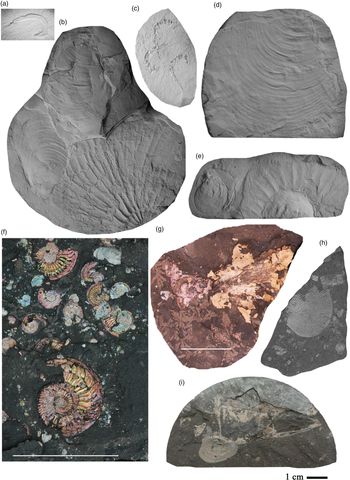
(1) The lower interval corresponds to the uppermost middle Oxfordian – uppermost lower Volgian deposits and is characterized by very few black shale bands, with TOC values varying from 4–6% to 16–17%. These black shales can be traced over distances from a few kilometres to c. 1000 km. Black shales are highly enriched in amorphous OM and commonly contain fine plant detritus (Bushnev et al. Reference Bushnev, Shchepetova and Lyyurov2006; Gavrilov et al. Reference Gavrilov, Shchepetova and Shcherbinina2014). RockEval parameters HI and T max (Hantzpergue et al. Reference Hantzpergue, Baudin, Mitta, Olferiev and Zakharov1998; Shchepetova & Rogov, Reference Shchepetova and Rogov2013, Reference Shchepetova and Rogov2016; Gavrilov et al. Reference Gavrilov, Shchepetova and Shcherbinina2014; Ilyasov et al. Reference Ilyasov, Staroverov and Vorobyeva2018) indicate that the Type II and III kerogen is of low thermal maturity (Fig. 4b), originating largely from marine microplankton with an admixture of terrestrial plant components. Fossil contents of these black shales are very different from one band to another. For example, black shale bands in the basal part of the upper Oxfordian substage (i.e. Głowniak et al. Reference Głowniak, Kiselev, Rogov, Wierzbowski and Wright2010) are characterized by relatively diverse ammonites, coleoids and benthonic fossils, which are usually overcrowding bedding planes (Fig. 6f–g). On the other hand, black shale bands in the upper Kimmeridgian Mutabilis Zone typically contain very few ammonites and sometimes bivalve (Aulacomyella) and gastropod accumulations (Fig. 6h).
Typical fossils encountered in Upper Jurassic black shales in Russia. (a, c) Megaonychites, coleoid hooks from the Volgian Stage of Western Siberia; (b, e) Ammonites associated with Buchia bivalves and oyster; (e) in the ammonite umbilical region, Volgian Stage of Western Siberia; (d) Inoceramus from the Bazhenovo Formation of Western Siberia; (f) Upper Oxfordian black shales showing typical accumulation of juvenile and mature ammonite shells, occasional bivalves and shell debris; Mikhalenino section, Kostroma region, Russia; (g) Fossilized soft tissue remains of the fin and part of the body of coleoid mollusc (age and locality as for (f)); (h) Numerous complete and disarticulated shells of planktonic bivalve Aulacomyella, Upper Kimmeridgian, Memei section, Middle Volga area, Russia; (i) Coleoid Acanthoteuthis (in the central part of the figure), piece of big-sized inoceramid bivalve (in the top), shell debris and limped gastropod (below coleoid), Middle Volgian of well 559, Samara region, Russia. Scale bar for (f, g) 5 cm; scale bar for other specimens is 1 cm (see lower right corner of the figure).

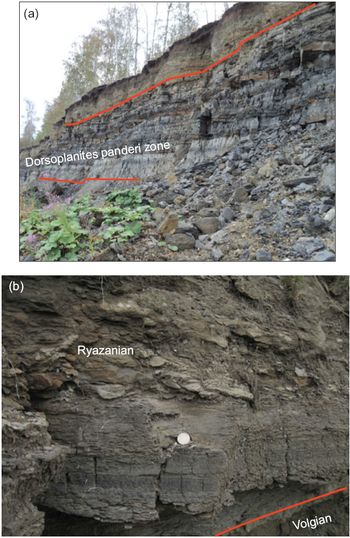
(2) The middle interval belongs to the middle Volgian Dorsoplanites panderi Zone (Rogov, Reference Rogov2013). It is characterized by a succession with well-defined decimetre- to metre-scale cyclicity, formed by alternations of black shales (ТОС up to 25%) and calcareous clays or mudstones. Volgian black shale (so-called Kashpir Oil Shale, according to Riboulleau et al. Reference Riboulleau, Derenne, Largeau and Baudin2001) developed in a wide area extending from the Caspian to Pechora seas. Although the thickness of this sequence varies from a few metres on the midlands of Russia to a hundred metres in the northern slope of the Caspian depression (Fig. 5a, b), and the thickness of individual black shale bands changes from one site to other, the general cyclic structure of this black shale unit remains nearly constant throughout the whole Russian Platform area (Strachoff, Reference Strachoff1934; Shchepetova, Reference Shchepetova2009; see Figs 5a, b, 7a). Kerogen in the Volgian black shales shows a low degree of thermal evolution, as determined by the range of T max < 435°C derived from RockEval Pyrolysis (Fig. 4b). Most of these shales are characterized by TOC values > 10%; a high hydrogen index (HI) corresponds mainly to a Type II kerogen, indicating predominance of marine OM, and sometimes to a Type I kerogen, resulting from the accumulation of the most resistant organic components. The middle Volgian black shales are especially rich in ammonites, and can be easily observed in borehole sections, as well as a diverse bivalve fauna dominated by common Buchia or Inoceramus, gastropods, brachiopods, echinoderms and diverse marine vertebrates. In contrast to many other examples of the SDAE black shales, these beds are also characterized by relatively diverse and abundant benthic fossils (i.e. Strachoff, Reference Strachoff1934; Vischnevskaya et al. Reference Vishnevskaya, de Wever, Baraboshkin, Bogdanov, Bragin, Bragina, Kostyuchenko, Lambert, Malinovsky, Sedaeva and Zukova1999; Fig. 6i). Benthic taxa are usually represented by numerous juveniles in death assemblages related to anoxic events (Vischnevskaya et al. Reference Vishnevskaya, de Wever, Baraboshkin, Bogdanov, Bragin, Bragina, Kostyuchenko, Lambert, Malinovsky, Sedaeva and Zukova1999; Turov, Reference Turov2000). Northwards from the middle Volga basin benthic faunal diversity in these black shales drastically decrease, and only Buchia and Inoceramus usually occur within black shale beds. Remains of coleoid molluscs (i.e. Rogov & Bizikov, Reference Rogov and Bizikov2006) and marine reptiles, especially ichthyosaurs (Zverkov & Efimov, Reference Zverkov and Efimov2019), are also very typical here.
Black shales of the Subboreal type. (a) Middle Volgian black shales in the Gorodischi section (middle Volga area, Russia). Thickness of black shale member is c. 6 m (photograph by MA Rogov). (b) Ryazanian black shales of the Subboreal type embedded between two sandy units in the Kashpir section (middle Volga area, Russia). Diameter of a coin c. 2 cm (photograph by SV Maleonkina).

(3) The upper interval is represented by two occurrences of black shale beds corresponding to the upper middle Volgian and lower Ryazanian substages, each known from only a single locality in Central Russia. Very thin (decimetre-scale) black shale horizons, highly enriched in marine organic carbon (TOC up to 16–40%, HI up to 278–444; Fig. 4b) are present within the sandy shallow-water upper middle Volgian – Ryazanian succession (6–7 m) (Rogov et al. Reference Rogov, Baraboshkin, Guzhikov, Efimov, Kiselev, Morov and Gusev2015). The upper middle Volgian black shale is characterized by ammonites, indicating the Epivirgatites nikitini Zone. In contrast, the Ryazanian shales are nearly barren of macrofossils and their age assignments are based on their relative stratigraphic position and a single ammonite record (Rogov et al. Reference Rogov, Baraboshkin, Guzhikov, Efimov, Kiselev, Morov and Gusev2015). Black shales belonging to the third interval are characterized by being bounded by sandstone units, not by mudstones (Fig. 7b).
Further eastwards, black shales of the Subboreal type are known from the eastern slope of the Subpolar Urals (Fig. 2). Here, a single band of marine black shale with TOC 12–13%, HI 278–446 and T max 408–420°C is recorded in the upper Kimmeridgian substage (Zakharov et al. Reference Zakharov, Baudin, Dzyuba, Daux, Zverev and Renard2005). It is characterized by a low-diversity molluscan assemblage consisting of cardioceratid ammonites and numerous Meleagrinella bivalves (Zakharov et al. Reference Zakharov, Baudin, Dzyuba, Daux, Zverev and Renard2005). This black shale band was previously ascribed to the Mutabilis Zone (Zakharov et al. Reference Zakharov, Baudin, Dzyuba, Daux, Zverev and Renard2005) but, because of the presence of Aulacostephanus species (indicative of the Eudoxus Zone in the underlying bed), these black shales were ascribed here to the lower Eudoxus Zone.
All aforementioned black shale occurrences of the Subboreal type are characterized by variable vertical TOC profiles, caused by alternation of the black shales with clayey or sandy beds characterized by very low TOC values (Figs 2, 3a, 5a, c). All basins and sub-basins show strongly diachronous onset and termination of the black shale deposition. The occurrences of individual black shale beds or members have significantly changed in space and time: some of the black shale bands are known from a single locality only, while others cover millions of square kilometres. Irrespective of such patchy distribution, individual black shale beds are sometimes characterized by very high TOC values, up to c. 30–40% (Fig. 2). Taking into account strongly irregular black shale records, it is not surprising that their occurrences are not associated with any carbon isotope excursions or faunal turnovers (except local turnovers influenced by local environmental perturbations). Cyclicity in the Subboreal black shale could be caused by short-term climate oscillations associated with Milankovich cycles. A very similar type of cyclicity was described in the Lower Cretaceous strata of England and northern Germany (Mutterlose & Ruffell, Reference Mutterlose and Ruffell1999). Here, the numerous thin pale beds of mudstone with Tethyan fauna, likely indicating surface waters depleted in nutrients, were formed during periods with warm arid climate while the dark mudstone layers, with a dominantly Boreal fauna, were deposited under cooler-water conditions, rich in nutrients. Although calcareous nannofossils are poorly preserved in black shales due to diagenetic overprint (e.g. in the middle Volgian black shales of the Volga area; see Ruffell et al. Reference Ruffell, Price, Mutterlose, Kessels, Baraboshkin and Gröcke2002), ammonite data at least partially support cooler environments during deposition of the dark shale beds. The well-traced black-shale-bearing interval near the top of the Kimmeridgian Eudoxus Zone is commonly overcrowded by Boreal cardioceratids Nannocardioceras, while the overlying grey mudstone beds of the base of the Autissiodorensis Zone are usually characterized by numerous Tethyan aspidoceratids both on the Russian Platform and in England (Rogov, Reference Rogov2010). However, the changes in ammonite assemblages of the middle Volgian Panderi zone rather show a gradual warming through time, with increasing Subboreal and/or Boreal ammonite ratios within both the black shales and grey clays (Rogov, Reference Rogov2013).
High-latitude black shale deposits, referred to here as Boreal type (Fig. 2), have been the focus of numerous integrated studies over the past decades. Black shales of the Boreal type are very common in the Arctic, ranging from the North Sea (Vollset & Doré, Reference Vollset and Doré1984; Cornford, Reference Cornford and Glennie1998), East Greenland (Stemmerik et al. Reference Stemmerik, Dam, Noe-Nygaard, Piasecki and Surlyk1998; Alsgaard et al. Reference Alsgaard, Felt, Vosgerau and Surlyk2003; Bojesen-Koefoed et al. Reference Bojesen-Koefoed, Bjerager, Nytoft, Petersen, Piasecki and Pilgaard2018) through Norwegian and Barents sea basins (Dalland et al. Reference Dalland, Worsley and Ofstad1988; Mutterlose et al. Reference Mutterlose, Brumsack, Flögel, Hay, Klein, Langrock, Lipinski, Ricken, Söding, Stein and Swientek2003; Langrock & Stein, Reference Langrock and Stein2004; Georgiev et al. Reference Georgiev, Stein, Hannah, Xu, Bingen and Weiss2017) to Spitsbergen (Dypvik, Reference Dypvik1985; Koevoets et al. Reference Koevoets, Hammer, Olaussen, Senger and Smelror2018a, b), and further E-wards via the Russian part of the Barents Sea shelf, South Kara basin and the Western Siberian depression (Braduchan et al. Reference Braduchan, Gurari, Zakharov, Bulynnikova, Vyachkileva, Golbert, Klimova, Kozlova, Lebedev, Mesezhnikov, Nalnyaeva and Turbina1986; Ryzhkova et al. Reference Ryzhkova, Burshtein, Ershov, Kazanenkov, Kontorovich, Kontorovich, Nekhaev, Nikitenko, Fomin, Shurygin, Beizel, Borisov, Zolotova, Kalinina and Ponomareva2018) to the Yenissei–Khatanga depression (Zakharov et al. Reference Zakharov, Rogov, Dzyuba, Žák, Košt’ák, Pruner, Skupien, Chadima, Mazuch and Nikitenko2014; Kashirtsev et al. Reference Kashirtsev, Nikitenko, Peshchevitskaya and Fursenko2018) and the Lena River lower reaches in the north (Rogov et al. Reference Rogov, Zakharov and Ershova2011). Eastwards from the Lena River basin, Upper Jurassic successions (sometimes extremely thick, up to 5–6 km thickness) are characterized by the common presence of volcanic rocks, including tuffs and lava flows. Upper Jurassic – lowermost Cretaceous black shales appear in Alaska and the Arctic Canada (Leith et al. Reference Leith, Weiss, Mørk, Elvebakk, Embry, Brooks, Stewart, Pchelina, Bro, Verba and Danyushevskaya1992).
Black shales are inherent constituents of the Late Jurassic – Early Cretaceous formations of the North Sea Graben Province. Thick accumulations of moderately organic carbon-rich shale commonly include extended intervals (from tens to several hundred metres) represented by dark-olive-grey fissile shales, enriched in marine organic carbon up to 5–6% in average, in some cases to 8 to 12–15% (Miller, Reference Miller1990; Cornford, Reference Cornford, Magoon and Dow1994, Reference Cornford and Glennie1998). They are also known as ‘hot shale’ due to the strong natural gamma-ray response (Miller, Reference Miller1990; Clark et al. Reference Clark, Riley and Ainsworth1993; Cornford, Reference Cornford, Magoon and Dow1994, Reference Cornford and Glennie1998; Underhill, Reference Underhill and Glennie1998; Gautier, Reference Gautier2005). The stratigraphic range of the ‘hot shales’ in the Central Graben (unit B of the Upper Kimmeridge Clay Formation, Mandal and Farsund Formations) and in the Viking Graben (Draupne Formation) is Volgian–Ryazanian (Vollset & Doré, Reference Vollset and Doré1984; Clark et al. Reference Clark, Riley and Ainsworth1993, Cornford, Reference Cornford, Magoon and Dow1994; Ineson et al. Reference Ineson, Bojesen-Koefoed, Dybkjær and Nielsen2003; Badics et al. Reference Badics, Avu and Mackie2015; Ziegs et al. Reference Ziegs, Horsfield, Skeie and Rinna2017), comparable to the Bazhenovo Formation in Western Siberia. In some cases the ‘hot shale’ is overlain by upper Ryazanian black shales, which are less rich in organic carbon (Lott et al. Reference Lott, Thomas, Riding, Davey and Butler1989). The lithostratigraphy and gamma-ray log patterns of the core sections (Vollset & Doré, Reference Vollset and Doré1984; Clark et al. Reference Clark, Riley and Ainsworth1993; Ineson et al. Reference Ineson, Bojesen-Koefoed, Dybkjær and Nielsen2003) when using calibrated relationships between gamma-log response and TOC values (Cornford, Reference Cornford and Glennie1998) suggest an almost uniform distribution of the elevated TOC values within the ‘hot shale’ units, thus also revealing its resemblance to the Bazhenovo Formation. Kerogen in the ‘hot shales’ is of Type II, originating from a mixture of degraded terrestrial and planktonic marine OM, resulting in the high hydrogen index values of 350–650 (Cornford, Reference Cornford, Magoon and Dow1994, Reference Cornford and Glennie1998; Gautier, Reference Gautier2005; Ponsaing et al. Reference Ponsaing, Mathiesen, Petersen, Bojesen-Koefoed, Schovsbo, Nytoft and Stemmerik2020; see Fig. 4c). The lower interval (upper Kimmeridgian – lower Volgian) of the black shale (TOC, 2–6 wt%) with lower gamma-ray values is present in the Moray Firth, Viking Graben and Norwegian–Danish Basin (Miller, Reference Miller1990).
In Greenland, the Upper Jurassic – lowermost Cretaceous black shales are well-known but have only been studied in detail in Jameson Land. Here, upper Oxfordian – lower Volgian black shales of the Hareelv Formation, with TOC values of 5–10% and kerogen Type III or Type II–III, seem to be degraded as a result of their pre-oil-window maturity (Bojesen-Koefoed et al. Reference Bojesen-Koefoed, Bjerager, Nytoft, Petersen, Piasecki and Pilgaard2018; Figs 2, 3b, 4d). Macrofossils recovered from black shale of the Blokelv-1 borehole are represented by ammonites, belemnites, onychites, bivalves and vertebrates, belonging to typical Boreal and Subboreal taxa (Alsen & Piasecki, Reference Alsen and Piasecki2018). Coeval strata of the Kuhn Ø belonging to the upper Oxfordian – lowermost Ryazanian Bernbjerg Formation, are dominated by dark-grey to black mudstones with TOC values of 2.8–5.4% (TOC data for the Volgian part of the succession remain unpublished); these rocks are also rich in ammonites, belemnites and buchiid bivalves (Alsgaard et al. Reference Alsgaard, Felt, Vosgerau and Surlyk2003; Pauly et al. Reference Pauly, Mutterlose and Alsen2013; Kelly et al. Reference Kelly, Gregory, Braham, Strogen and Whitham2015). The presence of black shale facies was also reported from North Greenland, where black shales of the Ladegardsaen Formation (Kimmeridgian–Volgian) are known from Peary Land (Håkansson et al. Reference Håkansson, Birkelund, Piasecki and Zakharov1981), while in Kilen black shales of the Dromledome Formation are Ryazanian – ?Hauterivian in age (Hovikoski et al. Reference Hovikoski, Pedersen, Alsen, Lauridsen, Svennevig, Nøhr-Hansen, Sheldon, Dybkjær, Bojesen-Koefoed, Piasecki, Bjerager and Ineson2018). No TOC data have been published from north Greenland.
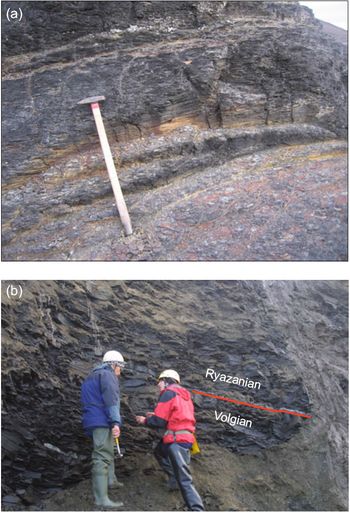
Black shales of the Late Jurassic – earliest Cretaceous age are well-represented in Svalbard (Figs 2, 3c, 8a). In contrast to aforementioned examples, in some cases the oldest black shale occurrences (with TOC contents up to 12%) are of Callovian age (Dypvik, Reference Dypvik1985). However, mass deposition of black shales in this area generally began during late Oxfordian time and ended during late Volgian or early Ryazanian time (Koevoets et al. Reference Koevoets, Abay, Hammer and Olaussen2016, Reference Koevoets, Hammer and Little2019). Two peaks of TOC values are recorded in the black paper shale, traced in both near-shore and offshore areas (Nagy et al. Reference Nagy, Løfaldli and Bäckström1988; Koevoets et al. Reference Koevoets, Hammer, Olaussen, Senger and Smelror2018a): upper Oxfordian – lower Kimmeridgian (ТOC up to 6–11%); and uppermost middle – upper Volgian (ТОС up to c. 12–14%) (Fig. 2), with background values oscillating around 1–3%. According to Koevoets et al. (Reference Koevoets, Hammer, Olaussen, Senger and Smelror2018a), the low HI values (50–200) in the black shales result from extensive thermal degradation, as indicated by T max values of 448–476°C (Fig. 4d). These suggest a higher initial quality of kerogen (Type II), which is most likely marine in origin. Black shales belong to the upper part of the Agardhfjellet Formation (Fig. 8a), which is well-exposed in Spitsbergen, and its fossil assemblages have attracted much attention during the last decade (Hammer et al. Reference Hammer, Hryniewicz, Hurum, Høyberget, Knutsen and Nakrem2013; Delsett et al. Reference Delsett, Novis, Roberts, Koevoets, Hammer, Druckenmiller, Hurum, Moody, Buffetaut, Naish and Martill2016; Koevoets et al. Reference Koevoets, Abay, Hammer and Olaussen2016, Reference Koevoets, Hammer, Olaussen, Senger and Smelror2018a, b, Reference Koevoets, Hammer and Little2019). Ammonites and Buchia bivalves are the most typical fossils, but sometimes other bivalves and gastropods as well as belemnites, onychites and echinoderms are also abundant (Hammer et al. Reference Hammer, Hryniewicz, Hurum, Høyberget, Knutsen and Nakrem2013; Koevoets et al. Reference Koevoets, Hammer, Olaussen, Senger and Smelror2018a). Vertebrate remains, including skeletons of diverse marine reptiles (Delsett et al. Reference Delsett, Novis, Roberts, Koevoets, Hammer, Druckenmiller, Hurum, Moody, Buffetaut, Naish and Martill2016) as well as fish bones and scales, are also very typical components of the black shale fossil assemblage (Koevoets et al. Reference Koevoets, Hurum and Hammer2018b).
Black shales of the Boreal type. (a) Kimmeridgian black shales at Myklegardfjellet, Spitsbergen (photograph by DS Zykov). (b) Volgian–Ryazanian boundary beds at Nordvik, northern Siberia (photograph by M Mazuch).

Black shales from the southern part of the Norwegian Sea belong to the Spekk Formation, ranging in age from Oxfordian to Ryazanian (Dalland et al. Reference Dalland, Worsley and Ofstad1988). Sometimes the Spekk Formation is referred to the Volgian–Ryazanian interval only, underlain by the Oxfordian–Kimmeridgian siltstones of the Rogn Formation. The high TOC values (from 4–5% to 10–13%) and mixed Type II and III kerogens were identified for the Spekk Formation of the Haltenbanken area (Cornford, Reference Cornford and Glennie1998). In the near-shore part of the basin (core 6307/07-U-02) highest TOC values (up to 7%) are reported from the Volgian stage (especially the lower Volgian substage), and show a gradual decline towards the Ryazanian stage (with TOC values up to 4%) (Langrock & Stein, Reference Langrock and Stein2004). Black shales in the northern part of the Norwegian Sea shelf (Hekkingen Formation) are of late Oxfordian – Ryazanian age. These rocks are represented by dark silty claystone, which is characterized by the uniformly elevated (2–7%) level of total organic carbon, with a peak in the approximate upper Volgian substage (Smelror et al. Reference Smelror, Mørk, Mørk, Weiss and Løseth2001; Mutterlose et al. Reference Mutterlose, Brumsack, Flögel, Hay, Klein, Langrock, Lipinski, Ricken, Söding, Stein and Swientek2003; Fig. 2). As at other Boreal sites, macrofossils here are dominantly represented by ammonites and Buchia bivalves, as revealed from the borehole 6814/04-U-02 (Smelror et al. Reference Smelror, Mørk, Mørk, Weiss and Løseth2001). Very similar patterns of black shale occurrences are reported from the Norwegian sector of the Barents Sea shelf (Langrock et al. Reference Langrock, Stein, Lipinski and Brumsack2003; Langrock & Stein, Reference Langrock and Stein2004; Georgiev et al. Reference Georgiev, Stein, Hannah, Xu, Bingen and Weiss2017). Here, these rocks are also of late Oxfordian – late Ryazanian age (Fig. 2). In the southwestern part of the Barents Sea, the maximum TOC (15.4%) and HI (300–430) values and the highest hydrocarbon generation potential (Fig. 4b) have been estimated within the upper Oxfordian – Kimmeridgian Alge Member of the Hekkingen Formation (Helleren, Reference Helleren2019). However, macrofaunas of these black shales are insufficiently known. Only Oxfordian – Kimmeridgian ammonites are well-studied (Wierzbowski et al. Reference Wierzbowski, Smelror and Mørk2002; Wierzbowski & Smelror, Reference Wierzbowski and Smelror2020), and very few Ryazanian Buchia bivalves and ammonites were mentioned and/or figured from this region (Wierzbowski et al. Reference Wierzbowski, Hryniewicz, Hammer, Nakrem and Little2011). Information concerning the black shales of the Russian sector of the Barents Sea is very limited, as all boreholes drilled here are poorly sampled, and characteristics of rocks were mainly based on an analysis of geophysical data and cuttings. The range of the black shale facies here can be roughly estimated as Kimmeridgian–Ryazanian. TOC values of these black shales lie mainly between 2 and 23%, but fluctuations of TOC distribution through the succession remains unclear (Basov et al. Reference Basov, Nikitenko and Kupriyanova2009). Fossils recovered from these black shales mainly belong to ammonites and Buchia; in addition to these groups, lingulid brachiopods, coleoid hooks and onychites (including big-sized megaonychites) were reported from the Volgian interval of black shales.
Black shales enriched by organic carbon were also reported from the upper Oxfordian – Ryazanian Hofer Formation of Franz-Josef Land (Kosteva, Reference Kosteva2005), but information concerning TOC remains unpublished. Leith et al. (Reference Leith, Weiss, Mørk, Elvebakk, Embry, Brooks, Stewart, Pchelina, Bro, Verba and Danyushevskaya1992) indicated that Upper Jurassic samples from this area have organic carbon contents of only 1–3%.
Upper Jurassic – Lower Cretaceous black shales are especially well-known in Western Siberia. Although the black shale lithofacies ranges from the upper Oxfordian to the Hauterivian (Braduchan et al. Reference Braduchan, Zakharov, Mesezhnikov and Sokolov1989), the Volgian–Ryazanian black shales of the famous Bazhenovo Formation (Braduchan et al. Reference Braduchan, Gurari, Zakharov, Bulynnikova, Vyachkileva, Golbert, Klimova, Kozlova, Lebedev, Mesezhnikov, Nalnyaeva and Turbina1986; Panchenko et al. Reference Panchenko, Balushkina, Baraboshkin, Vishnevskaya, Kalmikov and Shurekova2015; Ryzhkova et al. Reference Ryzhkova, Burshtein, Ershov, Kazanenkov, Kontorovich, Kontorovich, Nekhaev, Nikitenko, Fomin, Shurygin, Beizel, Borisov, Zolotova, Kalinina and Ponomareva2018) and its time equivalents are more widely distributed across Siberia. Upper Oxfordian – Kimmeridgian black shale facies here are restricted by the NE part of Western Siberia. These black shales belong to the Yanov Stan Formation (upper Oxfordian – Ryazanian, up to 300 m), and show relatively low TOC values (2.8% average) with a general trend to gradual TOC rise upsection, with maximum values up to c. 8%. As follows from the RockEval data, Type II kerogen and Type III kerogen occurred here in nearly equal quantities (Afanasenkov et al. Reference Afanasenkov, Petrov and Grayzer2018). Several members of the Bazhenovo Formation characterized by different dominant micro- and macrofossil groups can be recognized within the Bazhenovo Formation (Panchenko et al. Reference Panchenko, Balushkina, Baraboshkin, Vishnevskaya, Kalmikov and Shurekova2015, Reference Panchenko, Nemova, Smirnova and Ilyina2016). In the central regions of Western Siberia (Khanty-Mansiysk–Tyumen), the Bazhenovo Formation as well as its time analogue in the west of this area (lower Tutleim Member) can be subdivided into the lower (lower–middle Volgian) and upper (upper Volgian – Valanginian) members. The lower member (15–20 m) is composed mainly of dark-brown laminated siliceous shales rich in radiolarians, with low (30–40%) clay content and high (5–10%) organic carbon enrichment. Almost pure, devoid of clay, structureless dark chalcedonite with thin radiolarite intercalations prevail near the top (2–5 m) of the lower member. The upper member of Bazhenovo Formation (15–25 m) starts with very dark-brown clayey silicite (2–6 m) abundant in bivalve shells. This thin, but laterally traceable clayey unit corresponds to the upper Volgian substage. It is overlain by thinly laminated black shale with abundant calcareous nannoplankton of Ryazanian age, which is highly enriched in organic carbon (up to 20% and more). Within the upper Valanginian interval, the black shales are gradually followed by terrigenous clays with decreasing TOC, suggesting an increase in sedimentation rates. In the eastern part of Western Siberia (Tomsk region) the lower member, rich in radiolaria, is reduced, and the overlying black shale unit within the upper member, which is highly enriched in organic carbon and calcareous nannoplankton remnants, declines or disappears, while the clayey unit is much thicker. Such a dilution results in lower ТOC values (5–7%) on average and a displacement of TOC maxima in the lower member of the Bazhenovo Formation. It is noteworthy that in spite of non-uniformities in the organic carbon distribution in core sections from two different parts of Western Siberia, the numerous RockEval data show mainly Type II kerogen of marine origin (Lopatin & Yemets, Reference Lopatin and Yemets1987; Peters et al. Reference Peters, Kontorovich, Moldowan, Andrusevich, Huizinga, Demaison and Stasova1993; Ulmishek, Reference Ulmishek1993; Kozlova et al. Reference Kozlova, Fadeeva, Kalmykov, Balushkina, Pronina, Poludetkina, Kostenko, Yurchenko, Borisov, Bychkov and Kalmykov2015; see Fig. 9c), and the general trend is characterized by a gradual increase in TOC values during Volgian time. This is followed by a gradual decrease during Ryazanian time, although some levels are characterized by extremely high TOC values (Panchenko et al. Reference Panchenko, Nemova, Smirnova and Ilyina2016; Fig. 2; Fig. 5d). Highest average values of TOC are reached in the black shales of the central and southwestern regions of Western Siberia (Ponomareva et al. Reference Ponomareva, Burshtein, Kontorovich and Kostyreva2018). Ammonites (Fig. 6b, e), oysters, Inoceramus and Buchia bivalves (Fig. 6b, d), fish remains and onychites (Fig. 6a, c) are among the most common fossils of the Bazhenovo Formation (Braduchan et al. Reference Braduchan, Gurari, Zakharov, Bulynnikova, Vyachkileva, Golbert, Klimova, Kozlova, Lebedev, Mesezhnikov, Nalnyaeva and Turbina1986; Panchenko et al. Reference Panchenko, Balushkina, Baraboshkin, Vishnevskaya, Kalmikov and Shurekova2015). Surprisingly, large-sized fossil reptiles are extremely rare in this area: only one occurrence of ichthyosaur bones is known to date from the Bazhenovo Formation. This is consistent with the lithofacies characteristics and usually interpreted as resulting from deposition in restricted deep-marine environment persistently prone to anoxic conditions (Zakharov, Reference Zakharov, Leonova, Lopatin, Rozhnov, Ushatinskaya and Shevyrev2006; Grishkevich, Reference Grishkevich2018).
(a–d) Hydrogen index (HI) versus pyrolysis T max diagram, showing kerogen type and thermal maturity (after Delvaux et al. Reference Delvaux, Martin, Leplat and Paulet1990; Tyson, Reference Tyson1995) of Subboreal and Boreal black shales of the Barents Sea region and Siberia. Dashed curve distinguishes kerogen of Type II (marine) and mixed Type II–III (marine and terrestrial). Dotted vertical line (T max = 430°C) subdivides immature and mature kerogen; R0, vitrinite reflectance.

Eastwards from Western Siberia, in the Yenissei–Khatanga depression, Upper Jurassic and Lower Cretaceous rocks are mainly represented by shallow-water deposits with low organic carbon contents (cf. Shurygin & Dzyuba, Reference Shurygin and Dzyuba2015). However, in the north of Central Siberia, from the Khatanga Bay in the west to the Lena River lower reaches in the east, Upper Oxfordian – Ryazanian black shales become the dominant rock type. Only the well-known Nordvik section (Fig. 8b), which is the most thoroughly studied Boreal section across the J/K boundary (Zakharov et al. Reference Zakharov, Nalnyaeva and Shulgina1983, Reference Zakharov, Rogov, Dzyuba, Žák, Košt’ák, Pruner, Skupien, Chadima, Mazuch and Nikitenko2014; Houša et al. Reference Houša, Pruner, Zakharov, Kostak, Chadima, Rogov, Šlechta and Mazuch2007; Nikitenko et al. Reference Nikitenko, Pestchevitskaya, Lebedeva and Ilyina2008, Reference Nikitenko, Knyazev, Peshchevitskaya and Glinskikh2015; Kashirtsev et al. Reference Kashirtsev, Nikitenko, Peshchevitskaya and Fursenko2018), provides information concerning the organic geochemistry of these black shales. As has been revealed by Zakharov & Yudovny (Reference Zakharov and Yudovny1974) and recently approved by Kashirtsev et al. (Reference Kashirtsev, Nikitenko, Peshchevitskaya and Fursenko2018), typical black shales with elevated TOC values here are mainly restricted to the upper Oxfordian and middle Volgian – Ryazanian substages (Figs 2, 5c). However, their hydrogen index values indicate only kerogen of Type III, with a low contribution of marine OM, probably due to high sedimentation rates and dilution with terrigenous components (Fig. 9d). Fossil assemblages of these black shales are dominated by ammonites, belemnites, onychites and Buchia bivalves (Zakharov et al. Reference Zakharov, Nalnyaeva and Shulgina1983, Reference Zakharov, Rogov, Dzyuba, Žák, Košt’ák, Pruner, Skupien, Chadima, Mazuch and Nikitenko2014).
Black shales in Arctic Canada still remain insufficiently studied in terms of high-resolution biostratigraphy and geochemistry. Generally they are restricted to the Kimmeridgian–Ryazanian interval, although locally a first occurrence of black shales could be dated as Oxfordian (Leith et al. Reference Leith, Weiss, Mørk, Elvebakk, Embry, Brooks, Stewart, Pchelina, Bro, Verba and Danyushevskaya1992). Highest TOC values are reported from the Kimmeridgian part of the succession (Gentzis et al. Reference Gentzis, Goodarzi and Embry1996), while the Volgian–Ryazanian interval is characterized by less than 5% of TOC. Recent data by Galloway et al. (Reference Galloway, Vickers, Price, Poulton, Grasby, Hadlari, Beauchamp and Sulphur2019) have revealed that the Deer Bay Formation of the Axel Heiberg island is generally characterized by low TOC values throughout the succession. Their two measured sections show median values of TOC 1.6%, with range 0.9–4.6% (Buchanan Lake section) and TOC 1.8%, with range 0.8–5.7% (Geodetic Hills section). Highest TOC values in both sections are recorded near the top of the formation in the upper Valanginian substage. Organic matter is represented either by Type III kerogen (at Buchanan Lake) or by a mixture of Type II and III kerogen (at Geodetic Hills). As well as in other Boreal shaly facies, ammonites and Buchia strongly dominate in faunal assemblages of these rocks of Arctic Canada (Jeletzky, Reference Jeletzky1984).
Rocks that resemble black shales in Northern Alaska belong to the Oxfordian–Valanginian Kingak Shale Formation (Bird & Molenaar, Reference Bird, Molenaar, Bird and Magoon1987). TOC values reported from these shales are relatively few (mainly less than 2%, see Magoon et al. Reference Magoon, Woodward, Banet, Griscom, Daws, Bird and Magoon1987; Bayliss & Magoon, Reference Bayliss and Magoon1988). Imlay (Reference Imlay1981) reported ammonites and Buchia from Kingak Shale, indicating an early Oxfordian – earliest Ryazanian age of this formation.
3. High-latitude Late Jurassic – earliest Cretaceous black shale occurrences in the Southern Hemisphere
Black shale facies, mainly represented by ‘massive’ black shale members or formations that resemble black shales of the Boreal type, are common in the high-latitude areas of the Southern Hemisphere (Figs 10, 11). These are the Tithonian – lower Valanginian Vaca Muerta Formation of the Neuquen Basin (Argentina, see Kietzmann et al. Reference Kietzmann, Ambrosio, Suriano, Alonso, Tomassini, Depine and Repol2016); upper Callovian – Berriasian Spiti Shale Formation of Nepal (Cariou et al. Reference Cariou, Enay, Bassoullet and Colchen1994; Enay, Reference Enay2009); Tithonian black shales of the Suowa Formation, Tibet (Chen et al. Reference Chen, Tien-Shun Lin, Da, Yi, Tsai and Xu2012; Yang et al. Reference Yang, Cao, Hu, Bian, Hu and Fu2017); Kimmeridgian–Tithonian black shales of the Jhuran Formation in Kutch (Arora et al. Reference Arora, Banerjee and Dutta2015); and Kimmeridgian–Berriasian black shales of the Nordenskjöld Formation, Graham Land, Antarctic (Doyle & Whitham, Reference Doyle, Whitham, Tyson and PEarson1991). Oxfordian–Tithonian black shales of the Falkland Plateau (Deroo et al. Reference Deroo, Herbin and Roucaché1983) are the only Upper Jurassic black shales recorded during the Deep Sea Drilling Program. Macrofossil assemblages of these black shales mainly includes ammonites, vertebrates and, in some cases, Buchia homoeomorphs ascribed to Australobuchia (Doyle & Whitham, Reference Doyle, Whitham, Tyson and PEarson1991).
Oxfordian and Kimmeridgian palaeogeography (after Rees et al. Reference Rees, Ziegler, Valdes, Huber, MacLeod and Wing2000, with minor changes) and worldwide distribution of black shales.

Volgian and Ryazanian palaeogeography and worldwide black shale distribution.

All aforementioned high-latitude black shales of the Southern Hemisphere shared many common features with Boreal black shales discussed in the previous section. These are relatively thick black shale units characterized by elevated TOC values. They were deposited in anoxic–dysoxic environments, and characterized by low-diversity benthonic faunas represented by taxa tolerant to low-oxygen contents.
4. Low-latitude Late Jurassic – earliest Cretaceous black shales
The ‘Late Jurassic ocean anoxic event’ (Nozaki et al. Reference Nozaki, Kato and Suzuki2013; Arora et al. Reference Arora, Banerjee and Dutta2015) or ‘Oxfordian–Kimmeridgian anoxic event’ earlier suggested by (Trabucho-Alexandre et al. Reference Trabucho-Alexandre, Hay and De Boer2012) is not global in the strict sense because low-latitude occurrences of Upper Jurassic – lowermost Cretaceous black shales are scarce and known from only a few areas (Figs 10, 11). These are the upper Oxfordian – Kimmeridgian Haynesville Shale Formation in east Texas and Louisiana (Hammes et al. Reference Hammes, Hamlin and Ewing2011) and the upper Oxfordian – Tithonian black shales of Mexico (La Casita Formation, La Caja Formation, Pimienta Shale Formation; see Goldhammer & Johnson, Reference Goldhammer, Johnson, Bartolini, Buffler and Cantú-Chapa2002 for details). Middle Oxfordian black shales showing elevated TOC values (up to 6%) are known in the Khodjaipak Formation, Uzbekistan (Carmeille et al. Reference Carmeille, Bourillot, Pellenard, Dupias, Schnyder, Riquier, Mathieu, Brunet, Enay, Grossi and Gaborieau2020), while Kimmeridgian black marlstones of the Akkuyu Formation (SW Turkey) show very high TOC values (up to 30%, see Baudin et al. Reference Baudin, Tribovillard, Laggoun-Défarge, Lichtfouse, Monod and Gardin1999), comparable with those of Boreal regions. Oxfordian–Kimmeridgian black shales intercalated with limestones were also reported from the Antalo Limestone Formation in Ethiopia (Mohammedyasin et al. Reference Mohammedyasin, Wudie, Anteneh and Bawoke2019) and Oxfordian black shales are known of in Morocco (Davison, Reference Davison2005). Upper Jurassic black shale occurrences are also known from Yemen (Hakimi & Ahmed, Reference Hakimi and Ahmed2016, restricted to Kimmeridgian Madbi Formation) and northern Iraq (Tithonian–Berriasian Chia Gara Formation; see Tobia et al. Reference Tobia, Al-Jaleel and Ahmad2019). In all aforementioned examples, low-latitude black shales occur in restricted basins (Figs 10, 11). In contrast to high-latitude black shales, these beds are frequently intercalated with limestones and marls and their deposition seems to be influenced mainly by local environmental factors.
5. Key features of the Late Jurassic – earliest Cretaceous high-latitude shelf dysoxic–anoxic event
As emphasized in Section 1, in contrast to OAEs, the onset and offset of the SDAE are strongly diachronous in different basins and sub-basins. In all cases, however, the duration of black shale deposition was very long compared with those of OAE-related black shales, indicating nearly constant presence of anoxic–dysoxic near-bottom depositional conditions over periods of 10–20 Ma. The very widespread geographic distribution of these black shale facies in high latitudes excludes any significant influence of local factors on their deposition, while the traceability of individual black shale beds and their relationship with overlying and underlying units were controlled by local environmental conditions. Although different regions are characterized by different patterns of TOC values through time, at least for black shales of the Boreal type, maximum TOC contents were reported for the upper Volgian, that is, for the Jurassic–Cretaceous transitional strata. Although some attempts at chemostratigraphic correlation of these rocks were undertaken recently (Turner et al. Reference Turner, Batenburg, Gale and Gradstein2019), deposition of high-latitude Upper Jurassic – lowermost Cretaceous black shales are not associated with any significant carbon isotope excursions. The only carbon isotope excursion during middle Volgian time, the so-called VOICE (Volgian Isotopic Carbon Excursion), can be recognized in some Boreal areas (Hammer et al. Reference Hammer, Collignon and Nakrem2012; Koevoets et al. Reference Koevoets, Abay, Hammer and Olaussen2016; Galloway et al. Reference Galloway, Vickers, Price, Poulton, Grasby, Hadlari, Beauchamp and Sulphur2019); in contrast to excursions related to the typical OAEs it is relatively long, spanning nearly the whole middle Volgian age, and showing some diachroneity between the basins. The onset of black shale deposition was strongly asynchronous in the different basins and even different sub-basins, and the same is also true for the termination of black shale deposition with the end of the SDAE.
By comparison with coeval units deposited in the well-oxygenated environments, these black shales are characterized by a very low diversity of benthic organisms represented by a few dominant genera tolerant of low oxygen contents, especially by burrowing suspension-feeding bivalves (Oschmann, Reference Oschmann1988, Reference Oschmann1994) as well as by nektonic and planktonic animals. In black shales of the Boreal type, benthic fossils usually only occur in thin intervals, which indicate short-time increases in oxygen contents near the sea floor, while other parts of the successions are typically barren of benthic macrofossils. Nevertheless, these long-lasting anoxic conditions did not cause significant faunal turnover or extinction.
6. Possible causes of the Late Jurassic – earliest Cretaceous shelf dysoxic–anoxic events
Rising temperatures accompanied by increased productivity, together with slow ocean circulation, are considered among the factors responsible for prolonged black shale deposition in the Arctic (Georgiev et al. Reference Georgiev, Stein, Hannah, Xu, Bingen and Weiss2017). Indeed, gradual warming during the Late Jurassic epoch in the Boreal areas is supported by palynology (Dzyuba et al. Reference Dzyuba, Pestchevitskaya, Urman, Shurygin, Alifirov, Igolnikov and Kosenko2018), clay mineralogy (Ruffell et al. Reference Ruffell, Price, Mutterlose, Kessels, Baraboshkin and Gröcke2002) and oxygen stable isotope data (Price & Rogov, Reference Price and Rogov2009; Zakharov et al. Reference Zakharov, Rogov, Dzyuba, Žák, Košt’ák, Pruner, Skupien, Chadima, Mazuch and Nikitenko2014; Dzyuba et al. Reference Dzyuba, Pestchevitskaya, Urman, Shurygin, Alifirov, Igolnikov and Kosenko2018). Cold-water glendonite pseudomorphs are common in the Middle Jurassic deposits of Siberia (Morales et al. Reference Morales, Rogov, Wierzbowski, Ershova, Suan, Adatte, Föllmi, Tegelaar, Reichart, de Lange and Middelburg2017), but they rarely occur in the Upper Jurassic deposits. Glendonites are absent from the upper Kimmeridgian – lower Ryazanian interval of Siberia (Fig. 12). However, additional factors can be invoked to explain such unique SDAE, because other Mesozoic warming events are not associated with such long-time black shale deposition. It is very possible that, in tandem with warming and changes in oceanic circulation caused by Pangaea break-up, significant changes in the plankton ecosystems could be responsible for long-lasting high productivity. Relatively higher humidity in the Subboreal and Boreal realms compared with low-latitude territories caused more precipitation and more intensive land drainage; the chemical weathering therefore prevailed, at least periodically (or seasonally). Hypopycnal plumes of muddy fresh-water could have supplied high amounts of dissolved nutrients to the basins. This led to unfavourable conditions for accustomed marine plankton in the surface waters because of their opacity, abnormal salinity or ‘nutrient oversaturation’; their high buoyancy prevented mixing and contributed to stratification. Such conditions in the upper photic zone could cause rapid growth of new, more tolerant, planktonic communities. Periodical (or seasonal) restoration of such conditions was important for long-lasting changes of planktonic communities, resulting in black shale deposition directly or indirectly. In our opinion, immigration of calcareous nannoplankton to high latitudes is an indicator of such a new but very widespread ecological condition in the Subboreal and Boreal seas.
Climate indicators and black shale distribution in Western and north of Eastern Siberia. Blue bars showing amount of glendonite-bearing sites (Rogov et al. Reference Rogov, Zverkov, Zakharov and Arkhangelsky2019, with minor changes), while orange and red lines showing Classopollis pollen abundance (based on Vakhrameyev, Reference Vakhrameyev1982, with some additions from Ilyina, Reference Ilyina1985; Nikitenko et al. Reference Nikitenko, Knyazev, Peshchevitskaya and Glinskikh2015).

Enhanced productivity of high-latitude basins may have had a significant influence on black shale deposition. Some intervals of the Bazhenovo Formation are so enriched by radiolarians (Khotylev et al. Reference Khotylev, Balushkina, Vishnevskaya, Korobova, Kalmykov and Roslyakova2019) that they are considered here as rock-building, while other intervals consist mainly of calcareous nannoplankton (Zanin et al. Reference Zanin, Zamirailova and Eder2012). However, silicites, typical of the Bazhenovo Formation, rarely occur outside of Western Siberia.
In our opinion, immigration of calcareous nannoplankton to high latitudes is especially important for long-lasting changes of plankton communities and the resulting black shale deposition. It should be noted that coccolithophores, which originated during the Triassic Period (Mutterlose et al. Reference Mutterlose, Bornemann and Herrle2005), are now responsible for much of the primary oceanic productivity (Malone, Reference Malone1971; Rost & Riebesell, Reference Rost, Riebesell, Thierstein and Young2004). During the Late Jurassic epoch, calcareous nannoplankton shows a significant growth in diversity (Bown et al. Reference Bown, Lees, Young, Thierstein and Young2004; Suchéras-Marx et al. Reference Suchéras-Marx, Mattioli, Allemand, Giraud, Pittet, Plancq and Escarguel2019), but in high-latitude Arctic it is only recognized near the Jurassic–Cretaceous transition (Smelror et al. Reference Smelror, Mørk, Monteil, Rutledge and Leereveld1998; Mutterlose et al. Reference Mutterlose, Brumsack, Flögel, Hay, Klein, Langrock, Lipinski, Ricken, Söding, Stein and Swientek2003; Zanin et al. Reference Zanin, Zamirailova and Eder2012; Pauly et al. Reference Pauly, Mutterlose and Alsen2013; Rogov & Ustinova, Reference Rogov and Ustinova2018). Calcareous nannoplankton taxa have therefore controlled an increase in primary productivity, and an ecosystem disturbance seems to be one of the causes of Late Jurassic – earliest Cretaceous high-latitude SDAE. This hypothesis should be investigated in future studies. It should be noted that the onset of the studied interval of black-shale deposition across the Jurassic–Cretaceous boundary coincides with a shift from abiotic to biotic control on evolution of calcareous plankton (Eichenseer et al. Reference Eichenseer, Balthasar, Smart, Stander, Haaga and Kiessling2019). Among the other biotic factors, radiolarian blooms should also be considered as regionally responsible for black-shale deposition, that is, for the Bazhenov Formation of the Western Siberia (Khotylev et al. Reference Khotylev, Balushkina, Vishnevskaya, Korobova, Kalmykov and Roslyakova2019). Moreover, mass occurrences of radiolarians were also considered as very important for deposition of the Late Devonian black shales in European Russia (Afanasieva & Mikhailova, Reference Afanasieva and Mikhailova2001) However, among the studied Upper Jurassic – lowermost Cretaceous successions with black shale abundance, there are very few showing mass occurrence of radiolarians. In these cases, radiolarians are easily visible in thin-sections, and these microfossils became rock-forming.
Reduced salinity can also be favourable for black shale deposition. For example, recent studies of the Toarcian strata of the Cleveland Basin have revealed a significant salinity drop during the black shale interval associated with the Toarcian OAE, in spite of the common occurrence of ammonites that sharing a low tolerance to salinity decrease with other cephalopods (Remírez & Algeo, Reference Remírez and Algeo2020). However, the gradual decrease of salinity in the Middle Russian Sea during Oxfordian–Kimmeridgian time, recognized through clumped isotope studies (Wierzbowski et al. Reference Wierzbowski, Bajnai, Wacker, Rogov, Fiebig and Tesakova2018), shows no correlation with the prominent black shale horizons that occurred mainly in two very short intervals (at the beginning of the late Oxfordian and middle part of the late Kimmeridgian Mutabilis Chron). Although reduced salinity of the Arctic area was suggested as the one of the factors controlling regional distribution of faunas by Hallam (Reference Hallam1969), any evidence of a long-term drop in salinity in high-latitude areas during Late Jurassic – earliest Cretaceous time is missing. During the period considered here, both planktonic and nektonic faunas in high latitudes were nearly of the same type as before or after the SDAE, and were represented by the same taxa (at least at the family level).
7. Conclusions
The Late Jurassic – earliest Cretaceous episode of prolonged (10–20 Ma) black shale deposition in extra-tropical latitude areas is identified as a shelf dysoxic–anoxic event (SDAE). This specific type of anoxic event differs from typical OAEs. During the Late Jurassic – earliest Cretaceous time interval, OM-rich sediment accumulated mainly in the high latitudes. The onset and termination of SDAE was diachronous in separate palaeobasins. Subboreal and Boreal patterns of black shale deposition, caused by variations in the stability of oxygen-depleted environments, has been recognized. Among the main drivers of the SDAE, global climatic warming led to significant palaeo-oceanographic changes favouring a sluggish stratification-prone circulation pattern, driving the advancement of widespread dysoxia–anoxia-prone environments onto shallow shelves. These could have led to a disturbance in planktonic ecosystems and to an invasion of calcareous, siliceous and organic-walled nannoplankton to high-latitude palaeobasins, providing huge reserves for warmer and more transparent water masses during the considered period.
Acknowledgements
This study was supported by RSF grant 17-17-01171. The authors thank IV Panchenko (JSC MiMGO, Moscow) and YuA Gatovsky (Moscow State University, Moscow) for providing fossil specimens from western Siberia figured in this article. Two anonymous reviewers are kindly acknowledged for their valuable comments. We are especially grateful to Bas van de Schootbrugge for his work on improvement of the English language.