Introduction
The silvery blue, Glaucopsyche lygdamus (Doubleday) (Lepidoptera: Lycaenidae), is a widespread native North American butterfly species. Geographic variation in habitat, host plant use, and phenotype is considerable across its vast range, with the most recent assessment recognising 17 valid subspecies (Pelham Reference Pelham2008). The silvery blue has undergone a dramatic range expansion in the east in historical times by using weedy, non-native legumes as larval host plants (Layberry et al. Reference Layberry, Lafontaine and Hall1982, Reference Layberry, Hall and Lafontaine1998; Dirig and Cryan Reference Dirig and Cryan1991). It is well known among older observers of butterflies in southern Ontario, Canada that the silvery blue, G. lygdamus (Doubleday), has moved to the south from the north over the last 60 years. A more recent episode of this movement involving southwesterly expansion can be seen in the Ontario Butterfly Atlas (www.ontarioinsects.org/atlas_online.htm) where pre-1991 and post-1991 can be compared. However, there is also evidence that silvery blues may have been long established in southern Ontario and present before settlement by European people, but rare and confined to certain very restricted habitats, such as alvar and savannah where native plants of the Fabaceae family occurred in sufficient quantity for development of larvae (Catling and Layberry Reference Catling and Layberry2013). Here we document the historical occurrence of silvery blues in southern Ontario, so as to determine more specifically the timing of the southward and southwestward expansion and to evaluate the evidence for isolated occurrences before widespread expansion.
With regard to names, the northern silvery blue, which has a transcontinental distribution and expanded southward, is subspecies G. lygdamus couperi Grote. The Appalachian and eastern “southern silvery blue,” reaching its northern limit in New York State, United States of America has been considered the nominate subspecies G. lygdamus lygdamus (Miller and Brown Reference Miller and Brown1981; Dirig and Cryan Reference Dirig and Cryan1991; Layberry et al. Reference Layberry, Hall and Lafontaine1998).
Methods
Three databases were used to produce distribution maps prepared to help assess changes:
Biota of Canada Information Network – A database associated with the book “Butterflies of Canada” (Layberry et al. Reference Layberry, Hall and Lafontaine1998) and the biota of Canada Information Network (see The Biota of Canada Information Network: Documenting and Analysing Canada’s Living Capital for Science and Society. Final report on the inaugural workshop of the 5NR Biota of Canada Information Network project, Ottawa 2–3 March 2000). The sources of the data include all major Canadian institutional collections as well as some private collections. For the period up to 1950 most of the specimens plotted are from institutional collections. This database includes the oldest collections. For more information see:
http://www.cbif.gc.ca/spp_pages/butterflies/index_e.php.
Toronto Entomologists Association database – This is the database of published records of the Toronto Entomologists Association (TEA) (see http://www.ontarioinsects.org). The records here begin in 1969 and go to 2011. All the data is available at http://www.ontarioinsects.org/lep_sum.htm. An update of 2012 records not yet available online was added to make this fully current.
CBIF database – This is a source for dates and locations from Québec, Canada obtained from the Canadian Biodiversity Information Partnership programme, http://www.cbif.gc.ca/home_e.php. The coverage includes specimens in major museum collections across Canada and is derived from data gathered at museums by R.A.L. between 1998 and 2000.
Addressing collecting bias
Up to 1950 what is known of the occurrence of butterflies in southern Ontario (and elsewhere) is based largely on collections. Using collections to represent distributions, especially of invading species, is only an approximation, but it is also an indication of what is definitely known with a background of proof. Arrival in a particular region of an invading species may have been in advance of the date of the first collection, and at any particular time an invading species may be more widespread at the time than collections indicate.
Variation in sampling effort over time can lead to biases in interpreting periods of invasiveness. These biases can be overcome to some extent by a comparison with the spatial and temporal pattern and rate at which similar native taxa have been collected. Here we compare the distribution up to 1940 in southern Ontario of the native spring azure, Celastrina lucia (Kirby) (Lepidoptera: Lycaenidae), a small blue butterfly similar in appearance and seasonality to G. lygdamus. This provided an indication of a general distribution of search effort for small blue butterflies up to 1940 against which the distribution of G. lygdamus can be evaluated. The taxonomy of the C. lucia complex has been controversial, and Ontario populations have been variously reported as C. ladon (Cramer) (Layberry et al. Reference Layberry, Hall and Lafontaine1998) or even C. argiolus (Linnaeus) in the older literature. For the purposes of this study, we combined records of both the widespread C. lucia and spring records of what may be a separate, more southern, bivoltine species, C. ladon (see e.g., Pavulaan and Wright Reference Pavulaan and Wright2005).
Mapping
Distribution maps were prepared for consecutive 10-year intervals beginning in 1940. These were reduced to four maps for the present discussion: to 1940, to 1960, to 1980, and to 2012 (Figs. 1–2). In addition a map of the probable distribution of G. lygdamus in southern Ontario in pre-settlement times (Table 1, Fig. 3) was produced based on early records, recent food plant observations and known habitat availability.
Early records of Glaucopsyche lygdamus and Celastrina lucia in Ontario, Canada, up to 1940 (upper), and G. lygdamus only, up to 1960 (lower). Question mark in upper map indicates unknown locality in Bruce County from 1905 (Table 1).

Later records of Glaucopsyche lygdamus in Ontario, Canada, up to 1980 (upper) and up to 2011 (lower).
Probable distribution of Glaucopsyche lygdamus in southern Ontario, Canada in pre-settlement times based on early records, recent foodplant observations and habitat availability. Solid circles refer to an undetermined subspecies on the Norfolk Sand Plain, half-circles probable G. lygdamus couperi in eastern Ontario alvar woodlands.
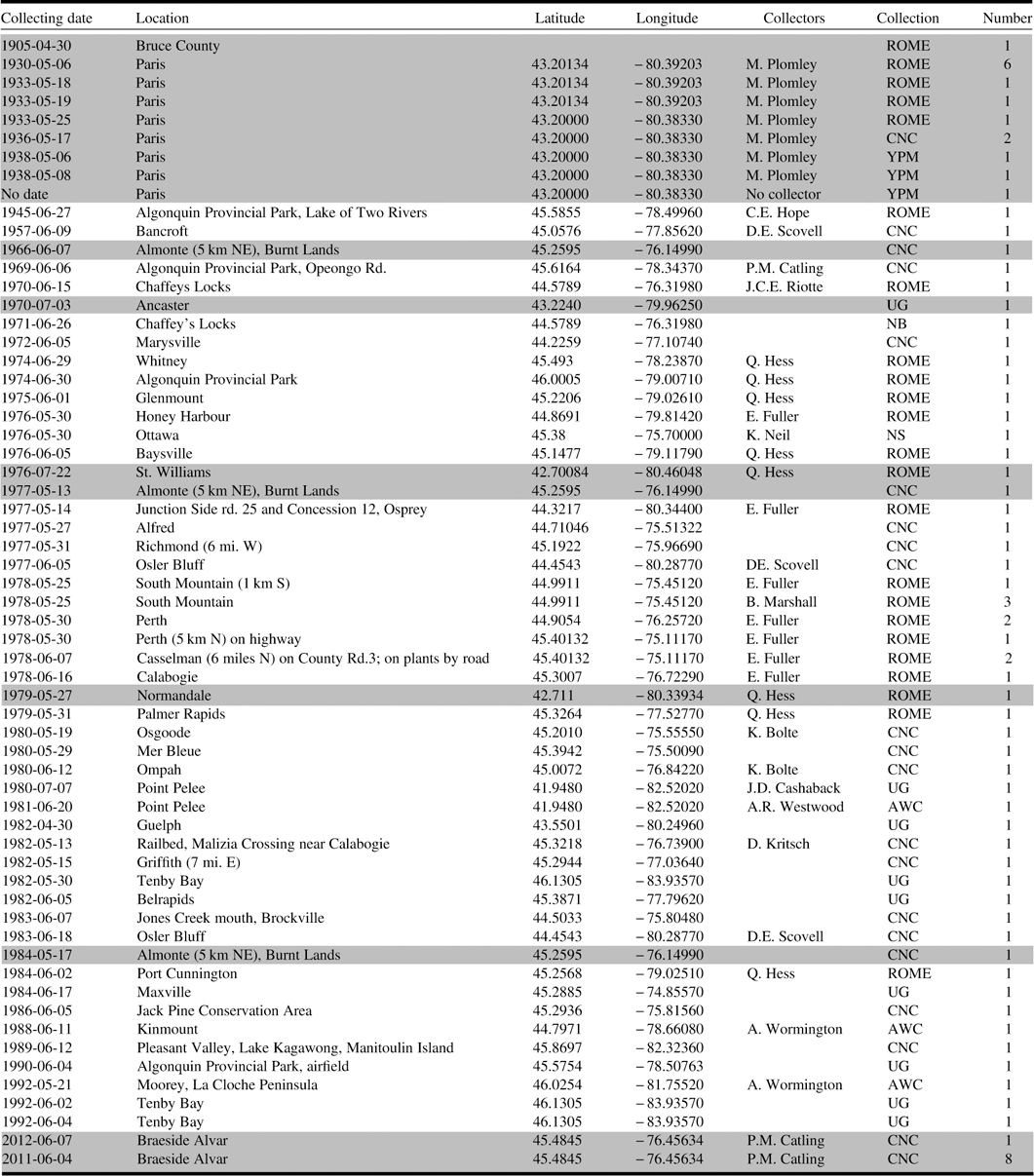
Collections of Glaucopsyche lygdamus from southern Ontario, Canada in the biota of Canada Information Network database, as well as the early record of Bethune.
Note: The shaded rows indicate potential occurrences before expansion.
CNC, Canadian National Collection at Agriculture Canada, Ottawa, Ontario, Canada; AWC, private collection of A.W. Wormington, Leamington, Ontario, Canada; NB, New Brunswick Museum, Saint John, New Brunswick, Canada; NS, Nova Scotia Museum, Halifax, Nova Scotia, Canada; ROME, Royal Ontario Museum, Toronto, Ontario, Canada; UG, University of Guelph, Guelph, Ontario, Canada; YPM, Yale University, New Haven, Connecticut, United States of America.
Subspecies identification
To determine whether the populations present in two potential refugial areas (savannah and alvar) were different from the invading subspecies, and to which subspecies they likely belonged, we measured wing pattern characters for four groups of male specimens (males being more frequent in collections and use of just males would exclude sexual variation): (1) individuals from populations in southern Ontario associated with introduced legumes (populations that had presumably invaded from the north recently and referable to subspecies G. lygdamus couperi, n=35); (2) populations from the eastern United States of America generally referred to subspecies G. lygdamus lygdamus (n=12); (3) a population from Braeside Alvar in the Ottawa Valley (n=6); and a population from Paris on the Norfolk Sand Plain, Ontario based on Plomley’s collections in the 1930s (n=9). Associated data for measured specimens are given Table 1.
Wing pattern characters consisted of (1) costal length: forewing length from wing base to apex; (2) anal length: forewing length from base to terminus of anal vein; (3) base to M2/M3: forewing length from base to distal wing margin between veins M2 and M3; (4) base to macule 3 (third subterminal macule from costa): forewing base to distal side of black portion of macule; (5) macule 3 width: maximum width of black portion of macule; (6) hindwing length: maximum distance from base to distal margin of hindwing; (7) hindwing width: distance from anal margin to vein A1+2. Measurements were made using a Nikon SMZ-U dissecting scope (Mississauga, Ontario, Canada) at 4.5× magnification, accurate to the nearest 0.2 mm; macule width was measured at 40× magnification with 0.03 mm accuracy.
Discriminant functions analysis (Statpoint Inc. 2005) was used to evaluate the groups. The axes were compared with eigenvalues with regard to explaining overall variation and the F-statistics from analysis of variance were employed to elucidate the relative value of characters.
Results
Before 1940
The paucity of records of G. lygdamus from southern Ontario before 1940, as compared with C. lucia, suggests a true absence of the former (Fig. 1, upper). The distribution of C. lucia provides an indication of the extent of “search effort” for a small blue butterfly up to that time. The only specific sites for G. lygdamus in southern Ontario are Paris and nearby Brantford (Table 1), and insect collectors had clearly covered a broad area by 1940. The occurrence of G. lygdamus at Paris is well established by 14 specimens collected in three different years (Table 1) and the occurrence at Brantford is based on a reliable report by Bethune (Reference Bethune1894). There is no reason to doubt the early record of G. lygdamus from Bruce County in 1905, although it lacks detailed collection data and cannot be plotted precisely.
1940–1960
The next three collections in southern Ontario were from Algonquin Park in 1945, Bancroft in 1957, and South Baymouth on Manitoulin Island in 1954 (Fig. 1, lower). Over this period there were many collections throughout northern Ontario (Basswood Lake, Favourable Lake, Fort Albany, Fort Severn, Hawk Lake, Kapuskasing, Latchford, Malachi, Moose Factory, Ogoki, Sioux Lookout, Smoky Falls, and Moosonee (Table 1, Riotte Reference Riotte1959), and G. lygdamus was widely established in the northern part of the province. The earlier presence of G. lygdamus on the cooler Algonquin dome was not unexpected for a more northern butterfly moving south into an area where the lumber industry had brought roads and openings into a forested landscape, as well as horses and presumably introduced forage including legumes in the 1800s. During the period between 1940 and 1960 there were also records for the Laurentide region of southern Québec (Fig. 1, lower).
1960–1980
Between 1960 and 1980 there was a large increase in the number of records of G. lygdamus in southern Ontario (Fig. 2, upper). The first of these was from the Burnt Lands near Almonte in 1966, followed by another record from Algonquin Park in 1969 (Table 1). In the 1970s a large increase in records was due to sight records accumulated and published by the Toronto Entomological Association. Although the increase in records was substantial, they were still confined to southern Ontario north of 44° and to a restricted, disjunct region south of that including Ancaster, Paris, and St. Williams on the Norfolk Sand Plain (Fig. 2, lower). There is also a site indicated for Point Pelee where single specimens were collected in 1980 and 1981. The Ancaster record is based on a 1970 collection (Table 1). The St. Williams record was based on a 1976 collection when G. lygdamus was found with Lycaeides melissa samuelis Nabokov (now Lycaeides samuelis; Forister et al. Reference Forister, Gompert, Fordyce and Nice2011) and Callophrys irus irus (Godart) (Lepidoptera: Lycaenidae), both now extirpated, on remnants of the dwarf oak scrub plains near St. Williams (P.M.C., personal observation). The huge increase in occurrences in the Ottawa area is notable, as is the absence from the Toronto area.
Before 2011
The big change in distribution after 1980 was a closing of the gap between the northern and southern regions of occurrence. More than anything else this was exemplified by many new occurrences in the region of Toronto (compare Fig. 2 upper and lower). The first records from this region were in the 1990s. The first records further to the west from the Halton region were in 2005, with several after that. Isolated occurrences near Niagara Falls in 2010 and in Perth County in 2005 were also significant extensions to the southwest.
Pre-expansion sites in Ontario
To summarise some of these results, the pre-expansion sites in Ontario that are supported by dates and/or isolation and/or larger numbers of collections are shown in Fig. 3. There are two groups, the Norfolk Sand Plain group and the alvar woodlands group. The Braeside collection is a part of the latter, while Plomley’s Paris material is the most reliable part of the former due to its early collection. These two are included in the analysis of four groups, which gave the results described below.
Subspecies identification
In the discriminant analysis (Fig. 4), populations from the eastern United States of America generally referred to subspecies G. lygdamus lygdamus formed a discrete group on the right side of the plot. The specimens from the alvar woodland feeding on a native legume grouped with the southern Ontario specimens referred to subspecies G. lygdamus couperi, most if not all of which, had expanded southward using introduced legumes. The Paris population is mostly within the G. lygdamus couperi group on the first axis, which accounts for most of the variation (Fig. 4), but four of nine specimens are nearer the subspecies G. lygdamus lygdamus group. Although the Paris group cannot be said to be “intermediate”, some Paris specimens were transitional between the subspecies G. lygdamus lygdamus and G. lygdamus couperi groups, while others showed some separation on the second axis from the remaining groups.
Discriminant function analysis of wing pattern characters in four groups of male Glaucopsyche lygdamus representing: (1) G. lygdamus lygdamus from the eastern United States of America (squares); (2) G. lygdamus couperi from southern Ontario, Canada (triangles); (3) specimens from alvar woodland at Braeside in the Ottawa Valley (asterisks); and specimens from Paris on the Norfolk Sand Plain collected in the 1930s (circles).
Discussion
Support for an early occurrence
The general absence of G. lygdamus in southern Ontario before 1940 outside of a single well-documented site is well supported by the distribution of entomologists collecting C. lucia but not finding G. lygdamus. Literature is also supportive. For example Bethune (Reference Bethune1894) lists only one location of G. lygdamus in southern Ontario, that being Brantford, but he lists three locations for the now extirpated Karner blue (Lycaeides samuelis), which was only ever known from five locations (Catling and Brownell Reference Catling and Brownell1999). His reference to Brantford is of particular interest because it precedes Plomley’s well documented Paris site (1930–1936) by 36 years and is only 10 km southeast. The evidence for an isolated population of G. lygdamus in this region is thus very strong.
Support for an invading race
The large number of records from the Ottawa area between 1960 and 1980 (see Figs. 1 lower and 2 upper) very strongly suggests a relatively sudden appearance because this region was well populated with professional entomologists (a few dozen) and naturalists (a large club) studying butterflies before 1960. Consequently Ottawa is a major benchmark for the apparent spread, which evidently reached the Ottawa area in the 1960s, with numerous records from the 1970s on. Although there were no records for Ottawa in 1960, it was present in 1961 (J.D. Lafontaine, Canadian National Collection of Insects, Ottawa, Ontario, Canada, personal communication), and was abundant there by 1968 (Lafontaine Reference Lafontaine1968); in 1982 it was the “commonest blue found in the Ottawa district and the commonest lycaenid” (Layberry et al. Reference Layberry, Lafontaine and Hall1982).
The region of Toronto is situated between the northern and southern occurrences. This has always been a hub of entomologists, and was (and is) home base for the very active Toronto Entomological Association, which has a strong focus on butterflies. The lack of records from this region between 1960 and 1980 compared with Ottawa, suggests that G. lygdamus was absent from the area, and the north-south gap at this time was real.
It is of interest that a southward expansion of G. lygdamus occurred in New England, United States of America about the same time that it did in Ontario (outlined by Dirig and Cryan Reference Dirig and Cryan1991), and that the species had just become well established in northeastern New York State, United States of America in the early 1980s when it had only recently become abundant in eastern Ontario. By 1988 it occurred south of Lakes Ontario and Champlain in New York State (Dirig and Cryan Reference Dirig and Cryan1991).
The Paris colony and Brantford and St. Williams
The early occurrence of G. lygdamus at Paris and Brantford, and more recently (but before expansion) at St. Williams, suggests that G. lygdamus may have existed in pre-settlement time and have been long established before that. All of the aforementioned settlements are on the Norfolk Sand Plain, which extends from Ancaster to Brantford and Paris, then broadly south through Simcoe and Aylmer to the shores of Lake Erie (Chapman and Putnam Reference Chapman and Putnam1984). Interestingly this area was open “plains” and “oak plains” in 1816 (Wood Reference Wood1961; Ball Reference Ball1981; Szeicz and MacDonald Reference Szeicz and MacDonald1991; Kurczewski Reference Kurczewski2000). These were the “beautiful plains” of Muir (Reference Muir1913), “an open country, dotted here and there with groves of … Black Oak, … but mostly covered with short grass and bushes”. The isolated relict distribution of Quercus ellipsoidalis Hill (Fagaceae) (Ball Reference Ball1981) and Bouteloua curtipendula (Michaux) Torrey (Poaceae) (Dore and McNeill Reference Dore and McNeill1980) and other flora and fauna are remnants of this open habitat that likely had diverse, abundant, native legumes. It was likely a remnant of the Plains of Burford where Bethune’s record of G. lygdamus originated, or a remnant of the Paris Plains where Plomley’s series of 14 G. lygdamus were collected near Paris between 1930 and 1936 (Table 1). Based on existing remnants of oak savannas of the Norfolk Sand Plain, there were a remarkable number of native legumes (Fabaceae) available as larval foodplants including Astragalus neglectus (Torrey and Gray) Sheldon, two species of Baptisia Ventenat, eight species of Desmodium Desvaux, Lathyrus ochroleucus Hooker, three species of Lespedeza Michaux, Lupinus perennis Linnaeus, Tephrosia virginiana (Linnaeus) Persoon, and Vicia caroliniana Walter (Cruise Reference Cruise1969; P.M.C., personal observation). Some of these are still quite frequent in small relicts. Thus the early occurrence on the Norfolk Sand Plain can be understood in terms of dry, open habitat and a diversity of potential foodplants. Vicia caroliniana was reported as a larval foodplant of G. lygdamus lygdamus in New York (Dirig and Cryan Reference Dirig and Cryan1991), and both V. caroliniana and Lathyrus ochroleucus were reported as foodplants in a colony from near Chicago, Illinois, United States of America where G. lygdamus was local at the time (Bower Reference Bower1911).
Based on its southern location, it is not surprising that the group from Paris exhibits some wing pattern characters that are transitional between subspecies G. lygdamus couperi and G. lygdamus lygdamus. Individuals from this group correspond to either G. lygdamus lygdamus, G. lygdamus couperi, or an entity slightly different from both. Phenotypic variability is probably a reason why distribution, ecology (including foodplants), and behaviour as well as phenotypic characters of a group are the best way to characterise subspecies. These factors should be kept in mind when assessing the apparently transitional nature of the Norfolk Sand Plain population.
The early occurrence at Almonte on the Burnt Lands Alvar
An early site on the Burnt Lands alvar at Almonte only preceded abundance in that region by a few years (Table 1), so cannot be definitely regarded an indication of a long established population. It is however, one of two sites in the region where G. lygdamus occurs in semi-open woodland and is associated with native larval foodplants (Catling and Layberry Reference Catling and Layberry2013). At the other site (Braeside Alvar), the butterflies oviposit on the native A. neglectus. Since specimens from these alvar woodlands grouped with those from human-made sites in the Ottawa Valley where the larval foodplants are introduced legumes, they are best referred to G. lygdamus couperi but may still be a distinct race based on foodplant and behaviour (Catling and Layberry Reference Catling and Layberry2013).
Other pre-expansion sites in Ontario
The earliest collection from southern Ontario from Bruce County (Table 1) suggests the possibility of one or more pre-expansion sites in that region. Here, and on nearby Manitoulin Island, pre-expansion sites may have been associated with either A. neglectus in semi-open alvar woodland (Catling and Layberry Reference Catling and Layberry2013) or with Lathyrus japonicus on shoreline dunes, as are some Canadian Maritime populations (Chermock Reference Chermock1945; Layberry et al. Reference Layberry, Hall and Lafontaine1998).
Although the location at Point Pelee may also be associated with a dune habitat, the fact that the only collections are of single individuals in recent years (1980, 1981 – Table 1) in a well-surveyed region suggests that these records represent strays from larger populations, such as the expansion populations to the northwest. These specimens were initially reported as G. lygdamus lygdamus (Wormington Reference Wormington1983) but later changed to G. lygdamus couperi (Layberry et al. Reference Layberry, Hall and Lafontaine1998). Numerous G. lygdamus records are mapped from southeastern Michigan, United States of America by Dirig and Cryan (Reference Dirig and Cryan1991), so an immigrant arriving at Point Pelee is not remarkable.
Rare pre-European settlement occurrences as well as an expanding race from the north
In summation the preceding discussion suggests that G. lygdamus moved southward into southern Ontario from northern Ontario beginning in the 1940s and was at first only on the cooler region of the Algonquin Dome. It had spread to much of the eastern part of southern Ontario by 1980 and continued to spread southwest, and by 2012 had reached a pre-1940 region of occurrence (Fig. 2 below) that was probably associated with relicts of the pre-settlement scrublands and savannah south of Paris and Brantford on the Norfolk Sand Plain. This apparently transitional southern Ontario savannah population (Fig. 3) may not be G. lygdamus couperi nor G. lygdamus lygdamus, but study of additional specimens is needed. Habitat and hostplant requirements for these populations should also be studied, as it appears that they were not able to switch to novel, introduced legumes that are used by G. lygdamus couperi. The savannah populations may have existed in pre-settlement times, and even for thousands of years. The origin of these populations warrants further study; two plausible scenarios would be from (1) a northwestward expansion of Appalachian populations (supported by phenotypic similarity between the two populations and use of V. caroliniana as a larval host), and/or (2) eastward expansion of a Great Plains population (supported by biogeography of other Great Plains prairie species that are relictual in eastern North America). There is also a possibility of pre-expansion populations probably best placed with G. lygdamus couperi that occurred very locally in alvar woodlands and on sand dune habitats in southern Ontario and the likeliest of these is in the Ottawa Valley alvars (Fig. 3). Remnants of the transitional subspecies and local races may be susceptible to a loss of distinctiveness due to genetic mixing with the expanding race and/or to the effect of increased mortality due to novel parasitoids from the expanding race. Although it is currently difficult to define a taxon at risk, the genetic diversity of silvery blue in southern Ontario may be declining.
Acknowledgements
Don Lafontaine of Agriculture and Agri-Food Canada provided valuable advice. Antonia Guidotti at the Royal Ontario Museum provided information on specimens in the Royal Ontario Museum collection including the series collected in the 1930s from Paris Ontario by Plomley. We thank Bob Robbins and an anonymous reviewer for helpful comments and suggestions that improved this manuscript.