





1 Introduction
We prove new bounds on the h-vectors of doubly Cohen–Macaulay simplicial complexes by calculating the Hilbert function of a certain quotient of the Stanley–Reisner ring of the complex. Our techniques can control the Hilbert function of certain quotients of the Stanley–Reisner rings of arbitrary simplicial complexes, and we work in that level of generality.
Let
$\Delta $
 be a simplicial complex of dimension
$d-1$
 with vertex set
$V = \{ 1,\ldots , n \}$
 . Throughout the paper, we fix a field k of characteristic
$2$
 and consider a purely transcendental field extension
$K = k(a_{i,j})_{1 \le i \le d, \, 1 \le j \le n}$
 . Let
$K[\Delta ]$
 be the Stanley–Reisner ring of
$\Delta $
 , and let
$\theta _i = \sum _{j} a_{i,j} x_j$
 for
$i \in \{1, \dotsc , d\}$
 . Then
$\theta _1, \dotsc , \theta _d$
 is a linear system of parameters for
$K[\Delta ]$
 , and the corresponding quotient
$H(\Delta ) := K[\Delta ]/(\theta _1, \dotsc , \theta _d)$
 is the generic artinian reduction of
$K[\Delta ]$
 . Assume that
$H^d(\Delta )$
 is nonzero. Then the level quotient
$\overline {H}(\Delta )$
 of
$H(\Delta )$
 is the quotient of
$H(\Delta )$
 by the homogeneous ideal whose degree q component is
$\{ y \in H^q(\Delta ) : y \cdot z = 0 \textrm { for all } z \in H^{d - q}(\Delta ) \}$
 . By construction,
$\overline {H}(\Delta )$
 is a level algebra, that is, for any nonzero
$y \in \overline {H}^q(\Delta )$
 , there is
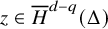
$z \in \overline {H}^{d-q}(\Delta )$
 with
$y \cdot z$
 nonzero. We are interested in bounding the following vector.
Definition 1.1. The
$\overline {h}$
 -vector
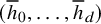
$(\overline {h}_0, \ldots , \overline {h}_d)$
 of
$\Delta $
 is the Hilbert function of
$\overline {H}(\Delta )$
 , that is,
$\overline {h}_q := \dim \overline {H}^q(\Delta )$
 for
$0 \le q \le d$
 .
We also consider the
$\overline {g}$
 -vector
$\overline {g}(\Delta ) = (\overline {g}_0, \ldots , \overline {g}_{\lfloor d/2 \rfloor })$
 , where
$\overline {g}_0 = \overline {h}_0 = 1$
 and
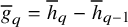
$\overline {g}_q = \overline {h}_q - \overline {h}_{q - 1}$
 for
$0 < q \le d/2$
 , which is an alternative encoding of the first half of
$\overline {h}$
 . The
$\overline {h}$
 -vector of
$\Delta $
 is independent of the choice of characteristic
$2$
 field k (see Proposition 2.2), and it is difficult to compute in general.
Before stating our results, we recall some interesting special cases. Let
$h(\Delta ) = (h_0,\ldots ,h_d)$
 be the usual h-vector of
$\Delta $
 , which is an encoding of the number of faces of
$\Delta $
 with q elements for each q. By [Reference StanleySta91, Corollary 3.2],
$\Delta $
 is Cohen–Macaulay (over k) if and only if
$h(\Delta )$
 is the Hilbert function of
$H(\Delta )$
 . Recall that
$\Delta $
 is doubly Cohen–Macaulay (over k) if it is Cohen–Macaulay, and, for every vertex v, the deletion
$\Delta \smallsetminus \{ v \}$
 is Cohen–Macaulay of dimension
$d-1$
 . Easy examples of doubly Cohen–Macaulay, which were introduced by Baclawski, include triangulations of spheres and
$2$
 -connected graphs. Being doubly Cohen–Macaulay is a topological property, that is, whether
$\Delta $
 is doubly Cohen–Macaulay (over k) depends only on the topological space of the geometric realization of
$\Delta $
 [Reference StanleySta96, Proposition III.3.7]. If
$h_d \not =0$
 and
$\Delta $
 is Cohen–Macaulay, then
$\Delta $
 is doubly Cohen–Macaulay if and only if
$H(\Delta )$
 is level, that is,
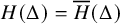
$H(\Delta ) = \overline {H}(\Delta )$
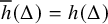
 [Reference StanleySta96, p. 94], which holds if and only if
$\overline {h}(\Delta ) = h(\Delta )$
 .
There are many examples of doubly Cohen–Macaulay complexes coming from complexes with a convex ear decomposition in the sense of Chari [Reference ChariCha97, Section 3.2]. Explicitly,
$\Delta $
 admits a convex ear decomposition if it contains a sequence of subcomplexes
$\Sigma _1,\ldots ,\Sigma _m$
 , where each
$\Sigma _p$
 is the boundary of a d-dimensional simplicial polytope,
$\Delta = \cup _p \Sigma _p$
 , and
$\Sigma _q \cap (\cup _{p < q} \Sigma _p)$
 is a
$(d- 1)$
 -dimensional ball for all
$1 < q \le m$
 (see [Reference Athanasiadis and FerroniAF26, Remark 2.3]). Swartz proved that if
$\Delta $
 admits a convex ear decomposition, then it is doubly Cohen–Macaulay [Reference SwartzSwa06, Theorem 4.1]. He observed that the proof works if one replaces each
$\Sigma _j$
 above with a
$(d - 1)$
 -dimensional k-homology sphere and requires each
$\Sigma _q \cap (\cup _{p < q} \Sigma _p)$
 to be a
$(d - 1)$
 -dimensional k-homology ball. Examples of simplicial complexes admitting convex ear decompositions (and hence of doubly Cohen–Macaulay complexes) include the independence complex of a coloop-free matroid [Reference ChariCha97, Theorems 2-3], the Bergman complex of a matroid [Reference Nyman and SwartzNS04, Section 4], and the augmented Bergman complex of a matroid [Reference Athanasiadis and FerroniAF26, Theorem 1.2]. See [Reference SwartzSwa06, Reference SchweigSch09, Reference SchweigSch11] for further examples.
More generally, Athanasiadis and Welker introduced the notion of a Buchsbaum* complex (over k) in [Reference Athanasiadis and WelkerAW12, Definition 1.2]. All oriented simplicial k-homology manifolds are Buchsbaum* [Reference Athanasiadis and WelkerAW12, Proposition 2.7], the Buchsbaum* complexes that are Cohen–Macaulay are precisely the doubly Cohen–Macaulay complexes [Reference Athanasiadis and WelkerAW12, Proposition 2.5], and there is a generalization of convex ear decompositions that constructs Buchsbaum* complexes [Reference Athanasiadis and WelkerAW12, Theorem 3.10]. Generalizing a result of Novik and Swartz for oriented simplicial k-homology manifolds [Reference Novik and SwartzNS09], Nagel [Reference NagelNag11, Corollary 4.1] proved that if
$\Delta $
 is a Buchsbaum* complex, then

where
$\beta _p = \dim \tilde {H}_p(|\Delta |;k)$
 is the pth reduced Betti number of the geometric realization
$|\Delta |$
 of
$\Delta $
 over k.
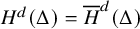
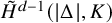
There is a natural identification of
$H^d(\Delta ) = \overline {H}^d(\Delta )$
 with the reduced cohomology group
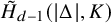
$\tilde {H}^{d-1}(|\Delta |, K)$
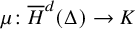
 , so linear maps
$\mu \colon \overline {H}^d(\Delta ) \to K$
 can be identified with the reduced homology group
$\tilde {H}_{d-1}(|\Delta |, K)$
 . See Section 2 for details. Let
$k'$
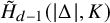
 be a subfield of K. By the universal coefficient theorem, the natural map from
$\tilde {H}_{d-1}(|\Delta |, k') \otimes _{k'} K$
 to
$\tilde {H}_{d-1}(|\Delta |, K)$
 is an isomorphism. We say that a map
$\mu \colon \overline {H}^d(\Delta ) \to K$
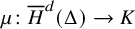 is defined over
$k'$
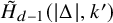
 if it can be expressed as
$\tilde {\mu } \otimes 1$
 , where
$\tilde {\mu }$
 corresponds to an element of
$\tilde {H}_{d-1}(|\Delta |, k')$
 .
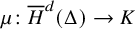
For each nonzero map
$\mu \colon \overline {H}^d(\Delta ) \to K$
 , let
$\overline {H}(\Delta , \mu )$
 be the Gorenstein quotient of
$\overline {H}(\Delta )$
 , that is, the quotient of
$\overline {H}(\Delta )$
 by the homogeneous ideal whose degree q component is
$\{y \in \overline {H}^q(\Delta ) : \mu (y \cdot z) = 0 \text { for all }z \in \overline {H}^{d-q}(\Delta )\}$
 . By construction,
$\overline {H}(\Delta , \mu )$
 is equipped with an isomorphism
$\mu \colon \overline {H}^{d}(\Delta , \mu ) \to K$
 , and the pairing
$\overline {H}^q(\Delta , \mu ) \times \overline {H}^{d-q}(\Delta , \mu ) \to K$
 given by
$(y, z) \mapsto \mu (y \cdot z)$
 is nondegenerate. The following result, which follows easily from [Reference Adiprasito, Papadakis and PetrotouAPP21, Theorem I] (see also Proposition 2.1), significantly restricts the possible
$\overline {h}$
 -vectors of simplicial complexes with nonzero
$\beta _{d-1}$
 .
Theorem 1.2. Let
$\Delta $
 be a simplicial complex of dimension
$d-1$
 , and let
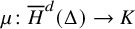
$\mu \colon \overline {H}^d(\Delta ) \to K$
 be a nonzero map that is defined over
$\mathbb {F}_2$
 . Let
$\ell = x_1 + \dotsb + x_n$
 . For each
$q \le d/2$
 , multiplication by
$\ell ^{d - 2q}$
 induces an isomorphism from
$\overline {H}^q(\Delta , \mu )$
 to
$\overline {H}^{d-q}(\Delta , \mu )$
 .
Choosing a basis
$\mu _1, \dotsc , \mu _s$
 for the dual of
$\overline {H}^d(\Delta )$
 , we have an injective ring homomorphism

We can choose each
$\mu _p$
 to be defined over
$\mathbb {F}_2$
 , so multiplication by
$\ell ^{d-2q}$
 induces an isomorphism from the degree q part of the right-hand side to the degree
$d - q$
 part of the right-hand side, giving the following corollary.
Corollary 1.3 [Reference Adiprasito, Papadakis and PetrotouAPP21, Corollary 3.1].
Let
$\Delta $
 be a simplicial complex of dimension
$d-1$
 with
$\beta _{d - 1} \neq 0$
 . Let
$\ell = x_1 + \dotsb + x_n$
 . For each
$q \le d/2$
 , multiplication by
$\ell ^{d - 2q}$
 induces an injection from
$\overline {H}^q(\Delta )$
 to
$\overline {H}^{d-q}(\Delta )$
 .
An M-vector (or O-sequence) is the Hilbert function of a finite-dimensional standard graded K-algebra, that is, a finite-dimensional graded K-algebra H that has
$H^0 = K$
 and that is generated by
$H^1$
 . Macaulay gave explicit inequalities classifying M-vectors; see Proposition 4.1. As
$\overline {H}(\Delta )/(\ell )$
 is generated in degree
$1$
 and its Hilbert function begins
$(\overline {h}_0, \overline {h}_1 - \overline {h}_0, \dotsc , \overline {h}_{\lfloor d/2 \rfloor } - \overline {h}_{\lfloor d/2 \rfloor - 1}, \dotsc )$
 , we have the following corollary.
Corollary 1.4. Let
$\Delta $
 be a simplicial complex of dimension
$d-1$
 with
$\beta _{d - 1} \neq 0$
 . Then
$\overline {h}(\Delta )$
 satisfies the following properties:
-
(1) $\overline {h}_q \le \overline {h}_{d - q}$
 for each
$q \le d/2$
,
-
(2) $\overline {g}(\Delta )$
is an M-vector.


Moreover, for every M-vector
$a = (a_0,\ldots ,a_{\lfloor d/2 \rfloor })$
 , there is a
$(d - 1)$
 -dimensional simplicial complex
$\Delta $
 that is the boundary of a d-dimensional simplicial polytope with
$a = \overline {g}(\Delta )$
 [Reference Billera and LeeBL81], so Corollary 1.4 is a complete classification of the
$\overline {g}$
 -vectors of simplicial complexes with nonvanishing
$\beta _{d-1}$
 .
Properties (1) and (2) in Corollary 1.4 were proved by Swartz in the special case when
$\Delta $
 admits a convex ear decomposition [Reference SwartzSwa06, Theorem 3.9], and they were conjectured by Björner and Swartz when
$\Delta $
 is doubly Cohen–Macaulay [Reference SwartzSwa06, Problem 4.2] and by Athanasiadis and Welker when
$\Delta $
 is Buchsbaum* [Reference Athanasiadis and WelkerAW12, Question 5.7].
We prove a strengthening of Corollary 1.3 that gives further numerical consequences for
$\overline {h}$
 -vectors. In light of the classification of possible
$\overline {g}$
 -vectors in Corollary 1.4, it is natural to consider the following vector.
Definition 1.5. The complementary vector of
$\Delta $
 is
$\overline {c}(\Delta ) = (\overline {c}_0, \ldots , \overline {c}_{\lfloor (d - 1)/2 \rfloor })$
 , where
$\overline {c}_q = \overline {h}_{d - q} - \overline {h}_{q}$
 for each
$q \le (d - 1)/2$
 .
When
$\Delta $
 is doubly Cohen–Macaulay,
$\overline {c}_q = h_{d - q} - h_q$
 for all q, and the vector
$\overline {c}(\Delta )$
 was studied by Swartz [Reference SwartzSwa06], who called it the complementary h-vector of
$\Delta $
 . We will classify the possible complementary vectors of simplicial complexes using the following algebraic result.
Theorem 1.6. Let
$\Delta $
 be a simplicial complex of dimension
$d-1$
 . Let k be a field of characteristic
$2$
 , and assume that
$\beta _{d - 1} \neq 0$
 . Then there is a map
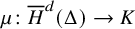
$\mu \colon \overline {H}^d(\Delta ) \to K$
 such that, for each
$q \le d/2$
 ,
$\dim \overline {H}^q(\Delta , \mu ) = \overline {h}_q$
 and multiplication by
$\ell ^{d-2q}$
 induces an isomorphism from
$\overline {H}^q(\Delta , \mu )$
 to
$\overline {H}^{d-q}(\Delta , \mu )$
 . If k is infinite, then
$\mu $
 can be chosen to be defined over k.
This is indeed a strengthening of Corollary 1.3, as the isomorphism from
$\overline {H}^q(\Delta ) = \overline {H}^q(\Delta , \mu )$
 to
$\overline {H}^{d-q}(\Delta , \mu )$
 given by multiplication by
$\ell ^{d - 2q}$
 factors through
$\overline {H}^{d-q}(\Delta )$
 .
If
$\Delta $
 admits a convex ear decomposition, then Swartz proved that
$\overline {c}(\Delta )$
 is a sum of M-vectors [Reference SwartzSwa06, Proposition 4.4], and he asked if the same result holds more generally when
$\Delta $
 is doubly Cohen–Macaulay [Reference SwartzSwa06, Problem 4.8]. Using Theorem 1.6, we give the following classification of the possible complementary vectors of simplicial complexes, affirmatively answering Swartz’s question.
Corollary 1.7. Let
$\Delta $
 be a simplicial complex of dimension
$d-1$
 . Let k be a field of characteristic
$2$
 , and assume that
$\beta _{d - 1} \neq 0$
 . Then the complementary vector
$\overline {c}(\Delta )$
 is a sum of M-vectors. Moreover, suppose that a sequence
$a = (a_0,\ldots ,a_{\lfloor (d - 1)/2 \rfloor })$
 is a sum of M-vectors. Then there is a
$(d - 1)$
 -dimensional simplicial complex
$\Delta $
 that admits a convex ear decomposition such that
$a = \overline {c}(\Delta )$
 .
A sequence of nonnegative integers
$(a_0, a_1, \dotsc , a_m)$
 is a sum of M-vectors if and only if there is a graded module
$M = M^0 \oplus M^1 \oplus \dotsb $
 over a polynomial ring in finitely many variables which is generated as a module in degree
$0$
 and has
$\dim M^q = a_q$
 for all q. We show that
$(a_0, a_1, \dotsc , a_m)$
 is a sum of M-vectors if and only if it is identically
$0$
 , or if
$a_0> 0$
 and
$(1, a_1, \dotsc , a_m)$
 is an M-vector. See Proposition 4.3. In particular, Macaulay’s inequalities classifying M-vectors immediately imply a numerical classification of all sums of M-vectors.
Proof of Corollary 1.7.
By Theorem 1.6, there is a linear map
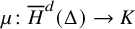
$\mu \colon \overline {H}^d(\Delta ) \to K$
 such that
$\dim \overline {H}^q(\Delta , \mu ) = \overline {h}_q$
 for each
$q \le d/2$
 . Let M be the kernel of the quotient map
$\overline {H}(\Delta ) \to \overline {H}(\Delta , \mu )$
 . We have
$\dim M^q = \overline {h}_{q} - \dim \overline {H}^q(\Delta , \mu ) = \overline {h}_{q} - \dim \overline {H}^{d - q}(\Delta , \mu )$
 for all q. In particular, our assumption implies that
$\dim M^q = 0$
 for
$q \le d/2$
 and that
$\dim M^q = \overline {h}_{q} - \overline {h}_{d - q}$
 for
$q> d/2$
 . Let
$M^*$
 be the graded dual of M, that is, the degree q component of
$M^*$
 is the dual of the vector space
$M^{d-q}$
 . This is a module over
$\overline {H}(\Delta )$
 , with
$y \in \overline {H}(\Delta )$
 acting on
$f \in M^*$
 via
$(y \cdot f)(z) = f(y \cdot z)$
 for each
$z \in M$
 . See, for example, [Reference EisenbudEis95, Section 21.1]. The Hilbert function of
$M^*$
 is
$\overline {c}(\Delta )$
 .
It suffices to show that
$M^*$
 is generated in degree
$0$
 as a module over
$\overline {H}(\Delta )$
 , as
$\overline {H}(\Delta )$
 is generated in degree
$1$
 and so is a quotient of a polynomial ring in finitely many variables. The perfect pairing between M and
$M^*$
 induces a perfect pairing between
$M^*/\overline {H}^{>0} \cdot M^*$
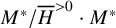 and
$ {\mathrm {Soc}}(M) := \{y \in M : y \cdot z = 0 \text { for all }z \in \overline {H}^{>0}(\Delta )\}$
 . As M is an ideal in the level algebra
$\overline {H}(\Delta )$
 ,
$ {\mathrm {Soc}}(M)$
 is concentrated in degree d, so
$M^*/\overline {H}^{>0} \cdot M^*$
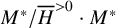 is concentrated in degree
$0$
 . Then
$M^*$
 is generated in degree
$0$
 by the graded version of Nakayama’s lemma.
The construction of all sums of M-vectors as complementary vectors of simplicial complexes with convex ear decompositions is carried out in Proposition 4.8.
Using this classification of complementary vectors, we give a negative answer to [Reference Athanasiadis and TzanakiAT21, Question 7.2]; see Example 4.9.
Corollary 1.4 and Corollary 1.7 are still far from classifying the possible
$\overline {h}$
 -vectors of simplicial complexes, as they do not account for the interactions between
$\overline {g}(\Delta )$
 and
$\overline {c}(\Delta )$
 . We have the following further result in this direction. Our proof of Corollary 1.7 shows that
$\overline {c}(\Delta )$
 is the Hilbert function of a graded module over the standard graded algebra
$\overline {H}(\Delta )$
 that is generated in degree
$0$
 . A generalization of Macaulay’s inequalities for M-vectors to modules proved in [Reference HulettHul95, Reference Blancafort and EliasBE00] then provides additional inequalities satisfied by
$\overline {c}(\Delta )$
 that depend on
$\overline {h}_1$
 ; see Corollary 4.5. These inequalities are new even when
$\Delta $
 admits a convex ear decomposition. For example, they provide new inequalities for the h-vector of the independence complex of a coloop-free matroid.
The Hilbert functions of standard graded level algebras, such as
$\overline {h}$
 -vectors of simplicial complexes, have been extensively studied. A full collection of references is too vast to list; for a survey of results up to 2003, see [Reference Geramita, Harima, Migliore and ShinGHMS07], and for some newer results, see [Reference Ahn and ShinAS17, Reference Masuti and TozzoMT18, Reference Park, Stanley and ZanelloPSZ19, Reference ZanelloZan24, Reference IarrobinoIar24, Reference Bezerra, Gondim, Ilardi and ZappalàBGIZ24]. In that more general setting, the conclusions of Corollary 1.4 and Corollary 1.7 can fail: if
$(a_0, \dotsc , a_d)$
 is the Hilbert function of a level algebra, then the complementary vector
$(a_d - a_0, a_{d-1} -a_1, \dotsc )$
 can have negative entries; for example,
$(1,13,12,13)$
 is the Hilbert function of a level algebra by [Reference StanleySta78, Example 4.3]. Even the Hilbert function of a level algebra that satisfies the conclusion of Corollary 1.4 need not satisfy the conclusion of Corollary 1.7; see Example 4.10. A level algebra may satisfy the conclusion of Corollary 1.3, but not the conclusion of Theorem 1.6; see Example 4.11.
The closest generalization of the results of this paper to Hilbert functions of arbitrary standard graded level algebras is [Reference Geramita, Harima, Migliore and ShinGHMS07, Corollary 2.11], which states that
$(a_d, \dotsc , a_0)$
 can be written as the Hilbert function of a standard graded Gorenstein algebra plus a sum of M-vectors. Our deduction of Corollary 1.7 from Theorem 1.6 is similar to the proof of [Reference Geramita, Harima, Migliore and ShinGHMS07, Corollary 2.11].
On the other hand, we present generalizations of our results to fields of arbitrary characteristic in Section 5.1 and to balanced simplicial complexes in Section 5.2. We also prove an analogue of Corollary 1.7 for pure O-sequences (see Theorem 5.8).
Our proof of Theorem 1.6 is based on the anisotropy of the Hodge–Riemann forms on
$\overline {H}(\Delta , \mu )$
 ; see Proposition 2.1. This follows from the differential operators technique, a technique that was introduced by Papadakis and Petrotou [Reference Papadakis and PetrotouPP20] to give a proof of the algebraic g-conjecture for simplicial spheres, which is a special case of Theorem 1.2. The differential operators technique has subsequently been extended to more general simplicial complexes [Reference Adiprasito, Papadakis and PetrotouAPP21, Reference Karu and XiaoKX23].
2 Cycles and Lefschetz
In this section, we establish some properties of
$\overline {H}(\Delta )$
 . Although the results in this section follow from standard techniques, they are not available in the precise form that we need, so we sketch the proofs. Throughout, we continue with the setup and notation of the introduction. In particular,
$\Delta $
 is a simplicial complex of dimension
$d-1$
 with vertex set
$V = \{ 1,\ldots , n \}$
 , k is a field of characteristic
$2$
 , and
$K = k(a_{i,j})_{1 \le i \le d, \, 1 \le j \le n}$
 . We continue to assume that
$H^d(\Delta )$
 is nonzero.
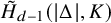
We first recall how to identify
${H}^d(\Delta ) = \overline {H}^d(\Delta )$
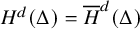 with the reduced cohomology
$\tilde {H}^{d-1}(|\Delta |, K)$
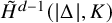 , or, equivalently, how to identify the dual vector space
$\mathrm {Hom}(H^d(\Delta ), K)$
 with
$\tilde {H}_{d-1}(|\Delta |, K)$
 .
Let
$x_1, \dotsc , x_n \in H^1(\Delta )$
 be the classes corresponding to vertices of
$\Delta $
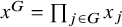
 . For a face G of
$\Delta $
 , let
$x^G = \prod _{j \in G} x_j$
 . Each
$H^s(\Delta )$
 is spanned by
$\{x^G : G \text { a face of }\Delta , \, |G| = s\}$
 [Reference LeeLee96, Theorem 9].
Suppose that
$F_1, \dotsc , F_t$
 are the facets of
$\Delta $
 of size d. For each facet
$F = \{j_1, \dotsc , j_d\}$
 of size d, let
$[F]$
 be the determinant of the
$d \times d$
 matrix whose
$(i,p)$
 th entry is
$a_{i,j_p}$
 . Using simplicial homology, we can identify
$\tilde {H}_{d-1}(|\Delta |, K)$
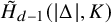 with a subspace of
$K^t$
 . Then each
$y = (c_1, \dotsc , c_t) \in \tilde {H}_{d-1}(|\Delta |, K)$
 defines a map

where
$e_p$
 is the pth standard basis vector. As
$H^{d}(\Delta )$
 is spanned by monomials corresponding to facets of size d,
$H^d(\Delta )$
 can be identified with a quotient of
$K^t$
 . The condition that y lies in
$\tilde {H}_{d-1}(|\Delta |, K)$
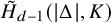 is exactly the condition that
$\mu _y$
 factors through
$H^d(\Delta )$
 [Reference LeeLee96, Theorem 10]. Therefore, a map
$\mu \colon H^d(\Delta ) \to K$
 is defined over a subfield
$k'$
 of K if and only if
$\mu (x^F) \cdot [F]$
 lies in
$k'$
 for each facet F of size d.
We say that a symmetric bilinear form B on a vector space V is anisotropic if, for all nonzero
$x \in V$
 ,
$B(x,x)$
 is nonzero. The following result is a strengthening of Theorem 1.2. It is a minor modification of [Reference Adiprasito, Papadakis and PetrotouAPP21, Theorem III] or [Reference Karu and XiaoKX23, Theorem 4.4], and it is essentially the same as [Reference ObaOba25, Theorem 7.6].
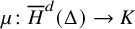
Proposition 2.1. Let
$\mu \colon \overline {H}^d(\Delta ) \to K$
 be a nonzero map that is defined over
$\mathbb {F}_2$
 , and let
$\overline {H}(\Delta , \mu )$
 be the corresponding Gorenstein quotient. Let
$\ell = x_1 + \dotsb + x_n \in \overline {H}^1(\Delta , \mu )$
 . For each
$q \le d/2$
 , the symmetric bilinear form
$\overline {H}^q(\Delta , \mu ) \times \overline {H}^q(\Delta , \mu ) \to K$
 given by
$(x, y) \mapsto \mu (x \cdot y \cdot \ell ^{d - 2q})$
 is anisotropic.
Proof. If one can verify that the analogue of [Reference Karu and XiaoKX23, Theorem 4.1] holds in
$\overline {H}(\Delta , \mu )$
 , then one can prove the result in exactly the same way as [Reference Karu and XiaoKX23, Theorem 4.4] is proved. As in [Reference Karu and XiaoKX23, Section 2.6], by introducing an additional cone vertex, the map from the degree d part of
$K[x_1, \dotsc , x_n]$
 to K induced by
$\mu $
 can be written as an
$\mathbb {F}_2$
 -linear combination of maps that are boundaries of simplices. The argument in [Reference Karu and XiaoKX23, Lemma 4.5] then reduces the desired statement to the case of the boundary of a simplex, which is treated in [Reference Karu and XiaoKX23, Theorem 4.6].
Finally, we prove that the
$\overline {h}$
 -vector does not depend on the choice of field k of characteristic
$2$
 .
Proposition 2.2. The dimension of
$\overline {H}^q(\Delta )$
 is independent of the choice of field k of characteristic
$2$
 .
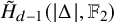
Proof. Choose a basis
$\mu _1, \dotsc , \mu _s$
 for
$\tilde {H}_{d-1}(|\Delta |, \mathbb {F}_2)$
 . As
$\tilde {H}_{d-1}(|\Delta |, K)$
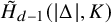 is identified with
$\tilde {H}_{d-1}(|\Delta |, \mathbb {F}_2) \otimes _{\mathbb {F}_2} K$
 , this induces a basis for
$\mathrm {Hom}(H^d(\Delta ), K)$
 . The kernel of
$H^q(\Delta ) \to \overline {H}^q(\Delta )$
 can be written as an intersection of subspaces indexed by some element
$\mu _t$
 in our chosen basis and a monomial
$x^J$
 in
$K[\Delta ]$
 of degree
$d - q$
 , where the subspace corresponding to
$\mu _t$
 and
$x^J$
 is the kernel of the map
$H^q(\Delta ) \to K$
 given by
$y \mapsto \mu _t(y \cdot x^J)$
 . As these subspaces are all defined over
$\mathbb {F}_2(a_{i,j})_{1 \le i \le d, \, 1 \le j \le n}$
 , this implies that the dimension of
$\overline {H}^q(\Delta )$
 is the same as the dimension of the level quotient of the generic artinian reduction over
$\mathbb {F}_2$
 .
Question 2.3. Let
$\Delta $
 be a simplicial complex of dimension
$d-1$
 . Throughout this paper, we assume that
$\beta _{d - 1} = \dim H^d(\Delta )$
 is nonzero. Can any of the results of this paper be extended to the case when
$\beta _{d - 1} = 0$
 ? In this case, if
$m = \max \{ q : H^q(\Delta ) \neq 0 \}$
 , then the level quotient
$\overline {H}(\Delta )$
 of
$H(\Delta )$
 is the quotient of
$H(\Delta )$
 by the homogeneous ideal whose degree q component is
$\{ y \in H^q(\Delta ) : y \cdot z = 0 \textrm { for all } z \in H^{m - q}(\Delta ) \}$
 . For example, if
$\hat {\Delta }$
 is the join of
$\Delta $
 with an
$(r - 1)$
 -dimensional simplex, then
$\dim \hat {\Delta } = d + r - 1$
 ,
$H(\hat {\Delta }) \cong H(\Delta )$
 , and
$\overline {H}(\hat {\Delta }) \cong \overline {H}(\Delta )$
 (after possibly extending the underlying field K). In particular, is there an analogue of Proposition 2.1?
3 Generic cycles
In this section, we prove Theorem 1.6. We will deduce it as a formal algebraic consequence of Proposition 2.1. For this, we will use Adiprasito’s ‘perturbation lemma.’ To make the article self-contained, we include a short and elementary proof.
Lemma 3.1 [Reference AdiprasitoAdi18, Lemma 6.1].
Let
$V,W$
 be finite-dimensional vector spaces over a field k. Let
$\alpha ,\beta \colon V \to W$
 be linear maps such that
$\beta (\ker (\alpha )) \cap {\mathrm {im}}(\alpha ) = \{ 0 \}$
 . Then for all but finitely many
$\lambda \in k$
 ,
$\ker (\alpha + \lambda \beta ) = \ker (\alpha ) \cap \ker (\beta )$
 .
Proof. Let
$s = {\mathrm {codim}} \ker (\alpha )$
 . Choose a splitting
$V = A \oplus \ker (\alpha )$
 , so A is some subspace with
$\dim A = s$
 . Choose a splitting
$W = {\mathrm {im}}(\alpha ) \oplus B$
 , so
$\dim B = \dim W - s$
 . By assumption,
$\beta (\ker (\alpha )) \cap {\mathrm {im}}(\alpha ) = \{ 0 \}$
 , and so we may assume that
$\beta (\ker (\alpha )) \subset B$
 . After choosing bases for the above subspaces, the matrix corresponding to
$\alpha $
 has the form

for some invertible
$s \times s$
 matrix M. The matrix corresponding to
$\beta $
 has the form

for some
$s \times s$
 matrix N, some
$(\dim W - s) \times s$
 matrix
$N'$
 , and some
$(\dim W - s) \times (\dim V - s)$
 matrix
$N"$
 . Observe that, if
$\lambda \not = 0$
 , then
$M + \lambda N$
 is invertible if and only if
$\lambda ^{-1}I + M^{-1} N$
 is invertible. This happens if and only if
$-\lambda ^{-1}$
 is not one of the (finitely many) eigenvalues of
$M^{-1} N$
 . Finally, if
$M + \lambda N$
 is invertible, then
$\ker (\alpha + \lambda \beta ) = 0_A \oplus \ker (N") = \ker (\alpha ) \cap \ker (\beta )$
 , where
$0_A$
 denotes the origin in A.
We say that
$\overline {H}(\Delta , \mu )$
 has the strong Lefschetz property if, for each
$q \le d/2$
 , multiplication by
$\ell ^{d - 2q}$
 induces an isomorphism from
$\overline {H}^q(\Delta , \mu )$
 to
$\overline {H}^{d-q}(\Delta , \mu )$
 . For example, Theorem 1.2 states that
$\overline {H}(\Delta , \mu )$
 has the strong Lefschetz property if
$\mu $
 is defined over
$\mathbb {F}_2$
 . Using the argument in [Reference Larson, Stapledon and NovikLSN24, Lemma 5.1], it can be shown that this is equivalent to the usual definition of the strong Lefschetz property.
Proof of Theorem 1.6.
Choose a basis
$\mu _1, \dotsc , \mu _s$
 of
$\mathrm {Hom}(H^d(\Delta ), K) = \tilde {H}_{d-1}(|\Delta |, K)$
 which is defined over
$\mathbb {F}_2$
 . We show by induction on t that there are
$(\lambda _1, \dotsc , \lambda _t) \in K^t$
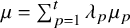
 such that, if we set
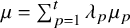
$\mu = \sum _{p=1}^{t} \lambda _p \mu _p$
 , then for each
$q \le d/2$
 , the kernel of
$\overline {H}^q(\Delta ) \to \overline {H}^q(\Delta , \mu )$
 is the same as the kernel of
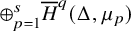
$\overline {H}^q(\Delta ) \to \oplus _{p=1}^{t} \overline {H}^q(\Delta , \mu _p)$
 and
$\overline {H}(\Delta , \mu )$
 has the strong Lefschetz property. As
$\overline {H}^q(\Delta )$
 injects into
$\oplus _{p=1}^{s} \overline {H}^q(\Delta , \mu _p)$
 , this implies the result.
The case
$t = 1$
 holds by setting
$\lambda _1 = 1$
 . For the inductive step, suppose that
$t < s$
 and, for each
$q \le d/2$
 ,
$\mu = \sum _{p=1}^{t} \lambda _p \mu _p$
 has the property that the kernel of
$\overline {H}^q(\Delta ) \to \overline {H}^q(\Delta , \mu )$
 is the same as the kernel of
$\overline {H}^q(\Delta ) \to \oplus _{p=1}^{t} \overline {H}^q(\Delta , \mu _p)$
 and
$\overline {H}(\Delta , \mu )$
 has the strong Lefschetz property. For
$\nu \in \mathrm {Hom}(\overline {H}^d(\Delta ), K)$
 and some
$q \le d/2$
 , let
$\phi _{\nu } \colon \overline {H}^q(\Delta ) \to \mathrm {Hom}(\overline {H}^q(\Delta ), K)$
 be the map given by
$\phi _{\nu }(x) = (y \mapsto \nu (x \cdot y \cdot \ell ^{d - 2q}))$
 . The map that sends
$\nu \in \mathrm {Hom}(\overline {H}^d(\Delta ), K)$
 to
$\phi _{\nu }$
 is K-linear.
Note that
$\overline {H}(\Delta , \nu )$
 has the strong Lefschetz property if and only if
$\ker (\phi _{\nu }) = \{x \in \overline {H}^q(\Delta ) : \nu (x \cdot y \cdot \ell ^{d - 2q}) = 0 \text { for all }y \in \overline {H}^q(\Delta )\}$
 coincides with the kernel of the map
$\overline {H}^q(\Delta ) \to \overline {H}^q(\Delta , \nu )$
 . By the induction hypothesis, the kernel of
$\phi _{\mu }$
 coincides with the kernel of
$\overline {H}^q(\Delta ) \to \oplus _{p=1}^{t} \overline {H}^q(\Delta , \mu _p)$
 . We claim that

Assuming this claim, we apply Lemma 3.1 with
$\alpha = \phi _\mu $
 and
$\beta = \phi _{\mu _{t+1}}$
 to deduce that, for all but finitely many
$\lambda \in K$
 , we have

We can find a
$\lambda $
 satisfying this condition because K is infinite. For any such
$\lambda $
 , the kernel of
$\phi _{\mu } + \lambda \phi _{\mu _{t+1}}$
 is the same as the kernel of
$\overline {H}^q(\Delta ) \to \oplus _{p=1}^{t+1} \overline {H}^q(\Delta , \mu _p)$
 . This implies that the inclusions

must be equalities, so
$\overline {H}(\Delta , \mu + \lambda \mu _{t+1})$
 has the strong Lefschetz property.
It remains to prove equation (1). Let x be a class in
$\ker (\phi _{\mu })$
 such that there is some
$y \in \overline {H}^q(\Delta )$
 with
$\phi _{\mu _{t+1}}(x) = \phi _{\mu }(y)$
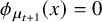
 . We need to show that
$\phi _{\mu _{t+1}}(x) = 0$
 . By definition, for any
$z \in \overline {H}^q(\Delta )$
 , we have

Set
$z = x$
 in the above equation. As
$x \in \ker (\phi _{\mu })$
 , we have
$\mu (y \cdot x \cdot \ell ^{d - 2q}) = 0$
 . Therefore
$\mu _{t+1}(x \cdot x \cdot \ell ^{d - 2q}) = 0$
 . As
$\mu _{t+1}$
 is defined over
$\mathbb {F}_2$
 , Proposition 2.1 then implies that x lies in the kernel of
$\overline {H}^q(\Delta ) \to \overline {H}^q(\Delta , \mu _{t+1})$
 , which is the kernel of
$\phi _{\mu _{t+1}}$
 .
Finally, if k is infinite, then at each step we can choose
$\lambda _t$
 to lie in k, so
$\mu $
 will be defined over k.
The proof of Theorem 1.6 relies on Lemma 3.1, whose hypothesis is difficult to verify with weaker assumptions. The following example shows that the conclusion of Theorem 1.6 can fail if one uses a nongeneric artinian reduction.
Example 3.2. Let
$\Delta $
 be the
$1$
 -dimensional complex on the left of Figure 1, which is doubly Cohen–Macaulay and has h-vector
$(1, 3, 2)$
 . Set
$\theta _1^N = a_{1,1} x_1 + a_{1,3} x_3 + a_{1,5} x_5$
 and
$\theta _2 = a_{2,1} x_1 + a_{2,2} x_2 + a_{2,3} x_3 + a_{2,4} x_4 + a_{2,5} x_5$
 . Let
$H_N(\Delta ) = K[\Delta ]/(\theta _1^N, \theta _2)$
 , which is level and has Hilbert function
$(1, 3, 2)$
 . A basis of
$\tilde {H}_1(|\Delta |, K)$
 is given by the classes of the induced subcomplexes with vertex sets
$\{1, 2, 4, 5\}$
 and
$\{2, 3, 4, 5\}$
 , respectively. Call these cycles
$\mu _1$
 and
$\mu _2$
 . Let
$\mu = \alpha \mu _1 + \beta \mu _2$
 be a nonzero cycle. If
$\alpha $
 and
$\beta $
 are both nonzero, then
$a_{1,1} \alpha ^{-1} x_1 + a_{1,3} \beta ^{-1} x_3$
 is in the kernel of
$H_N(\Delta ) \to \overline {H}_N(\Delta , \mu )$
 . If
$\alpha = 0$
 or
$\beta = 0$
 , then
$\mu $
 is supported on a subcomplex with h-vector
$(1, 2, 1)$
 . Therefore there is no Gorenstein quotient of
$H_N(\Delta )$
 with Hilbert function
$(1, 3, 1)$
 .
Some counterexamples to possible extensions of Theorem 1.6.

If
$\Delta $
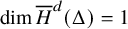
 is a simplicial manifold, then
$\dim \overline {H}^d(\Delta ) = 1$
 , and there is a canonical isomorphism
$\deg \colon H^d(\Delta ) \to K$
 given by
$\deg (x^F) = 1/[F]$
 for each facet F. For an odd-dimensional simplicial manifold, the determinant
$D_{d/2}$
 of the symmetric bilinear form
$\overline {H}^{d/2}(\Delta ) \times \overline {H}^{d/2}(\Delta ) \to K$
 is a well-defined element in
$K^{\times }/(K^{\times })^2$
 . In [Reference Larson, Stapledon and NovikLSN24, Theorem 1.1], the authors proved that
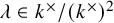
$D_{d/2} = \lambda \prod _{F \text { facet of }\Delta } [F] \in K^{\times }/(K^{\times })^2$
 for some
$\lambda \in k^{\times }/(k^{\times })^2$
 . Example 3.2 shows that the proof strategy does not extend to doubly Cohen–Macaulay complexes, and the following example shows that the natural generalization of [Reference Larson, Stapledon and NovikLSN24, Theorem 1.1] is false.
Example 3.3. Let
$\Delta $
 be the
$1$
 -dimensional complex on the right of Figure 1, which is doubly Cohen–Macaulay and has h-vector
$(1, 2, 2)$
 . There is no nonzero cycle
$\mu \in \tilde {H}_1(|\Delta |, k)$
 such that the determinant
$D_{d/2,\mu } \in K^{\times }/(K^{\times })^2$
 of the symmetric bilinear form on
$\overline {H}(\Delta , \mu )$
 is divisible by
$[\{i,j\}]$
 for every edge
$\{i, j\}$
 of
$\Delta $
 .
Explicitly, a basis of
$\tilde {H}_1(|\Delta |, K)$
 is given by the classes of the induced subcomplexes with vertex sets
$\{1, 2, 4 \}$
 and
$\{2, 3, 4 \}$
 , respectively. Call these cycles
$\mu _1$
 and
$\mu _2$
 . Let
$\mu = \alpha \mu _1 + \beta \mu _2$
 be a nonzero cycle. Then

4 Constructions and M-vectors
In this section, we discuss M-vectors and Hilbert functions of modules. We give a strengthening of the bounds in Corollary 1.7. We also give a construction which shows that every sum of M-vectors occurs as the complementary vector of a complex with a convex ear decomposition, completing the proof of Corollary 1.7.
Recall that an M-vector is the Hilbert function of a finite-dimensional standard graded algebra. There are explicit inequalities which characterize M-vectors that were proved essentially by Macaulay (see [Reference StanleySta96, p. 56]), which we now recall.
Given positive integers b and i, there is a unique expression

We define
$b^{\langle i \rangle } = \binom {n_i + 1}{i + 1} + \binom {n_{i-1} + 1}{i} + \dotsb + \binom {n_j + 1}{j + 1}$
 . We set
$0^{\langle i \rangle } = 0$
 . Then we have the following result.
Proposition 4.1 [Reference MacaulayMac27].
A sequence of nonnegative integers
$(a_0, \dotsc , a_m)$
 is an M-vector if and only if
$a_0 = 1$
 and
$a_{i+1} \le a_i^{\langle i \rangle }$
 for
$1 \le i \le m - 1$
 .
We will need a generalization of Proposition 4.1 that classifies the Hilbert functions of modules that are generated in degree
$0$
 over a polynomial ring in finitely many variables. This was proved by Hulett [Reference HulettHul95] in characteristic
$0$
 and by Blancafort and Elias [Reference Blancafort and EliasBE00] in arbitrary characteristic.
Proposition 4.2 [Reference Blancafort and EliasBE00, Theorem 3.2].
A sequence of nonnegative integers
$(a_0, \dotsc , a_m)$
 is the Hilbert function of a graded module that is generated in degree
$0$
 over a polynomial ring with s generators if and only if
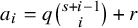
$a_{i+1} \le q \binom {s + i}{i + 1} + r^{\langle i \rangle }$
 for all
$0 \le i \le m - 1$
 , where q and r are the unique nonnegative integers with
$a_{i} = q \binom {s + i -1}{i} + r$
 and
$r < \binom {s + i - 1}{i}$
 .
We use Proposition 4.2 to give a description of the inequalities satisfied by sums of M-vectors.
Proposition 4.3. For a sequence
$(a_0, \dotsc , a_m)$
 of nonnegative integers, the following are equivalent:
-
(1) $(a_0, \ldots , a_m)$
is a sum of M-vectors. -
(2) Either the sequence is identically $0$
, or
$a_0> 0$
and
$(1,a_1, \ldots , a_m)$
is an M-vector. -
(3) $(a_0, \ldots , a_m)$
is the Hilbert function of a graded module that is generated in degree
$0$
over a polynomial ring in finitely many variables.






Proof. (1) implies (3): A standard graded algebra A is a module over the polynomial ring
$\mathrm {Sym} A^1$
 which is generated in degree
$0$
 , and so an M-vector is the Hilbert function of a module which is generated in degree
$0$
 . We realize a sum of M-vectors as the Hilbert function of a module which is generated in degree
$0$
 by taking the direct sum of these modules.
(3) implies (2): If N is a module that is generated in degree
$0$
 over a polynomial ring with s generators, then it is also a module that is generated in degree
$0$
 over a polynomial ring with t generators for any
$t \ge s$
 , with the extra generators acting by
$0$
 . For t sufficiently large, the inequalities in Proposition 4.2 become the inequalities in (2).
(2) implies (1): We can write
$(a_0, \dotsc , a_m) = (1, a_1, \dotsc , a_m) + \sum _{i=1}^{a_0 - 1} (1, 0, \dotsc , 0)$
 if
$a_0> 0$
 , and the sequence is the empty sum of M-vectors if it is identically
$0$
 .
Remark 4.4. A sum of M-vectors
$(a_0,\ldots ,a_m)$
 has no internal zeros in the sense that if
$a_i> 0$
 for some
$i> 0$
 , then
$a_{i - 1}> 0$
 .
The proof of Corollary 1.7 shows that the complementary vector of
$\Delta $
 is the Hilbert function of a graded module that is generated in degree
$0$
 over
$\overline {H}(\Delta )$
 . Because
$\overline {H}(\Delta )$
 is a quotient of a polynomial ring with
$\overline {h}_1$
 generators, Proposition 4.2 gives a sharper bound on
$\overline {c}(\Delta )$
 in terms of
$\overline {h}_1$
 .
Corollary 4.5. Let
$\Delta $
 be a simplicial complex of dimension
$d-1$
 . Let k be a field of characteristic
$2$
 , and assume that
$\beta _{d - 1} \neq 0$
 . We have
$\overline {c}_{i+1} \le q_i \binom {\overline {h}_1 + i}{i + 1} + r^{\langle i \rangle }_i$
 for all
$0 \le i \le (d - 3)/2$
 , where
$q_i$
 and
$r_i$
 are the unique nonnegative integers with
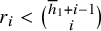
$\overline {c}_{i} = q_i \binom {\overline {h}_1 + i -1}{i} + r_i$
 and
$r_i < \binom {\overline {h}_1 + i - 1}{i}$
 .
Because the independence complex of a coloop-free matroid is doubly Cohen–Macaulay [Reference StanleySta96, p. 94], Corollary 4.5 gives new inequalities for the h-vectors of independence complexes of coloop-free matroids. There has been great interest in proving inequalities for h-vectors of independence complexes of matroids. For example, the authors of [Reference Ardila, Denham and HuhADH23] and [Reference Berget, Spink and TsengBST23] independently proved that the h-vector of the independence complex
$(h_0, \dotsc , h_d)$
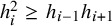
 is log-concave, that is,
$h_i^2 \ge h_{i-1}h_{i+1}$
 for
$1 \le i \le d-1$
 . In [Reference BrylawskiBry82, Section 6.10], Brylawski conjectures that the h-vector of the broken circuit complex of a matroid is ultra log-concave, that is, it remains log-concave after dividing by an appropriate binomial coefficient. The independence complex of a matroid is the broken circuit complex of the free coextension of that matroid, so this conjecture also predicts inequalities for independence complexes of matroids. Luis Ferroni pointed out to us that there are small counterexamples to this conjecture.
Example 4.6. There is a matroid of rank
$4$
 on
$6$
 elements for which the h-vector of the independence complex is
$(1, 2, 2, 2, 2)$
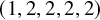 , which is not ultra log-concave and so gives a counterexample to Brylawski’s conjecture.
We next turn our attention to constructing examples. We will use the following lemma of Chari. If
$h(\Delta ) = (h_0,\ldots ,h_d)$
 is the h-vector of a
$(d-1)$
 -dimensional simplicial complex, then we write
$h(\Delta ;t) = \sum _{i = 0}^d h_i t^i$
 .
Lemma 4.7. [Reference ChariCha97, Lemma 3] Let
$\Delta $
 be a
$(d-1)$
 -dimensional simplicial complex that admits a convex ear decomposition, that is, it contains a sequence of subcomplexes
$\Sigma _1,\ldots ,\Sigma _m$
 , where each
$\Sigma _p$
 is the boundary of a d-dimensional simplicial polytope,
$\Delta = \cup _p \Sigma _p$
 , and
$\Sigma _q \cap (\cup _{p < q} \Sigma _p)$
 is a
$(d- 1)$
 -dimensional ball for all
$1 < q \le m$
 . Then

where
$B_q$
 is the closure of
$\Sigma _q \smallsetminus (\Sigma _q \cap (\cup _{p < q} \Sigma _p))$
 .
The following proposition completes the proof of Corollary 1.7.
Proposition 4.8. Suppose that a sequence of nonnegative integers
$a = (a_0,\ldots ,a_{\lfloor (d - 1)/2 \rfloor })$
 is a sum of M-vectors. Then there is a
$(d - 1)$
 -dimensional simplicial complex
$\Delta $
 that admits a convex ear decomposition such that
$a = \overline {c}(\Delta )$
 .
Proof. The zero vector is the complementary vector of any
$(d - 1)$
 -dimensional simplicial complex
$\Delta $
 with
$\beta _{d - 1} = 1$
 , for example, the boundary of a d-dimensional simplicial polytope. Assume that
$a = (a_0,\ldots ,a_{\lfloor (d - 1)/2 \rfloor })$
 is nonzero. Let
$\hat {a} = (1,a_1, \ldots , a_{\lfloor (d - 1)/2 \rfloor })$
 . Then
$a_0> 0$
 and
$\hat {a}$
 is an M-vector by Proposition 4.3. There is a
$(d - 2)$
 -dimensional simplicial complex Q that is the boundary of a
$(d - 1)$
 -dimensional simplicial polytope with
$\hat {a} = \overline {g}(Q)$
 [Reference Billera and LeeBL81]. Recall also that
$h(Q;t) = t^{d - 1}h(Q;t^{-1})$
 . Let
$S^0 = \{ x, x' \}$
 be the
$0$
 -dimensional sphere with two points. Then the join
$Q * S^0$
 is a
$(d - 1)$
 -dimensional simplicial sphere with
$h(Q * S^0;t) = h(Q;t)(1 + t)$
 . The subcomplexes B and
$B'$
 given by the joins
$Q * \{ x \}$
 and
$Q * \{ x' \}$
 , respectively, are
$(d- 1)$
 -dimensional balls with h-vectors
$h(B;t) = h(B';t) = h(Q;t)$
 . Let
$\Delta '$
 be obtained by gluing two copies of
$Q * S^0$
 along B. Equivalently,
$\Delta '$
 is obtained by gluing a copy of
$B'$
 to
$Q * S^0$
 along Q. Then
$\Delta '$
 admits a convex ear decomposition by construction. By Lemma 4.7,
$h(\Delta ';t) = h(Q * S^0;t) + t^d h(B';t^{-1}) = h(Q;t)(1 + 2t)$
 . It follows that
$t^d h(\Delta ';t^{-1}) - h(\Delta ';t) = h(Q;t)(1 - t)$
 , and hence
$\overline {c}(\Delta ') = \overline {g}(Q) = \hat {a}$
 .
Fix a facet F of
$\Delta '$
 . Let
$\Delta $
 be obtained by gluing
$a_0$
 copies of
$\Delta '$
 along the complement of the interior of F. Equivalently,
$\Delta $
 is obtained from
$\Delta '$
 by successively gluing
$a_0 - 1$
 copies of F along the boundary of F. Then
$\Delta $
 admits a convex ear decomposition by construction. Since
$h(F;t) = 1$
 , Lemma 4.7 implies that
$h(\Delta ;t) = h(\Delta ';t) + (a_0 - 1) t^d$
 . Hence
$\overline {c}(\Delta ) = \overline {c}(\Delta ') + (a_0 - 1, 0,\ldots , 0) = a$
 .
In [Reference Athanasiadis and TzanakiAT21, Question 7.2], Athanasiadis and Tzanaki asked if the following inequalities hold: if
$\Delta $
 is a
$(d - 1)$
 -dimensional doubly Cohen–Macaulay complex and
$h(\Delta ) = (h_0(\Delta ), \ldots , h_d(\Delta ))$
 , then

As in the proof of Proposition 4.8, let Q be the boundary of a
$(d - 1)$
 -dimensional simplicial polytope with symmetric h-vector
$h(Q) = (h_0(Q), \ldots , h_{d-1}(Q))$
 . Let
$S^0 = \{ x, x' \}$
 be the
$0$
 -dimensional sphere. Let
$\Delta $
 be the
$(d - 1)$
 -dimensional doubly Cohen–Macaulay complex obtained by gluing two copies of the suspension
$Q * S^0$
 of Q along
$Q * \{ x \}$
 . Then we have seen that
$h(\Delta ;t) = h(Q;t)(1 + 2t)$
 . Then one computes that equation (2) is equivalent to the condition that
$h_{i - 1}(Q)h_{i + 1}(Q) \le h_i(Q)^2$
 for all
$i \ge 0$
 , that is,
$h(Q)$
 is a log-concave sequence. The latter condition does not hold in general. We give a concrete example below.
Example 4.9. With the notation above, let Q be the boundary of a
$6$
 -dimensional simplicial polytope with
$h(Q) = (1,10,13,17,13,10,1)$
 , which exists by [Reference Billera and LeeBL81]. Note that
$h(Q)$
 is not log-concave since
$10 \cdot 17 = 170> 13^2 = 169$
 . Recall that
$S^0 = \{ x, x' \}$
 is the
$0$
 -dimensional sphere. Let
$\Delta $
 be the
$6$
 -dimensional doubly Cohen–Macaulay complex obtained by gluing two copies of the suspension
$Q * S^0$
 along
$Q * \{ x \}$
 . Then
$h(\Delta ) = (1,12,33,43,47,36,21,2)$
 and
$\overline {c}(\Delta ) = \overline {g}(Q) = (1,9,3,4)$
 . We have
$\frac {h_2(\Delta )}{h_{5}(\Delta )} = \frac {33}{36}> \frac {h_3(\Delta )}{h_{4}(\Delta )} = \frac {43}{47}$
 , and so
$\Delta $
 does not satisfy equation (2) .
The following example, which is due to Fabrizio Zanello, shows that the conclusion of Corollary 1.7 need not hold for the Hilbert functions of finite-dimensional standard graded level algebras satisfying the conclusions of Corollary 1.4.
Example 4.10. We claim that there is a finite-dimensional standard graded level algebra with Hilbert function
$(1, 19, 19, 20, 19, 19)$
 . Assuming this claim, the conclusion of Corollary 1.4 holds, that is, top-heaviness holds and the corresponding g-vector
$(1,18,0)$
 is an M-vector. On the other hand, the corresponding complementary vector is
$(18,0,1)$
 , which is not a sum of M-vectors by Remark 4.4, so the conclusion of Corollary 1.7 fails.
It remains to establish the claim. We first recall the notion of a trivial extension due to Stanley [Reference StanleySta78]. Let A be a finite-dimensional standard graded level algebra over a field k with Hilbert function
$(a_0,\ldots ,a_d)$
 , with
$a_d \neq 0$
 . Let
$\omega _A$
 be the graded dual of A, also known as the canonical module; cf. the proof of Corollary 1.7. The degree q component of
$\omega _A$
 is the dual of the vector space
$A^{d-q}$
 . The trivial extension is
$B = A \oplus \omega _A[1]$
 . We regard B as a graded k-algebra with multiplication defined by
$(a,f) \cdot (a',f') = (a a', a \cdot f' + a' \cdot f)$
 for all
$a,a' \in A$
 and
$f,f' \in \omega _A[1]$
 . The hypothesis that A is level is equivalent to the condition that
$\omega _A$
 is generated in degree
$0$
 as an A-module, which implies that B is standard graded. Moreover, multiplication induces a nondegenerate pairing
$B^q \times B^{d + 1 - q} \to B^{d + 1} = \omega _A^{d}$
 , and hence B is Gorenstein. In particular, B is level. Note that B has Hilbert function
$(a_0,\ldots ,a_d,0) + (0,a_d,\ldots ,a_0)$
 .
For a positive integer m, the truncation of a standard graded algebra to degree m is the algebra obtained by quotienting by the ideal generated by the elements of degree at least
$m+1$
 . The truncation of a standard graded level algebra to any fixed degree is still a standard graded level algebra.
Let A be the truncation of
$k[x,y,z]/(yz^3,z^4)$
 to degree
$5$
 . Then A is a standard graded level algebra with Hilbert function
$(1, 3, 6, 10, 13, 16)$
 . Let B be the trivial extension of A with Hilbert function
$(1, 3, 6, 10, 13, 16, 0) + (0, 16, 13, 10, 6, 3, 1) = (1, 19, 19, 20, 19, 19, 1)$
 . Then the truncation of B to degree
$5$
 is a standard graded level algebra with Hilbert function
$(1, 19, 19, 20, 19, 19)$
 .
We now give two examples of level algebras for which the conclusion of Corollary 1.3 holds, but the conclusion of Theorem 1.6 may or may not hold. These algebras are level monomial algebras, and Hausel showed that the conclusion of Corollary 1.3 holds for any level monomial algebra over a field of characteristic
$0$
 [Reference HauselHau05, Theorem 6.3]. See Section 5.3 for further discussion.
Example 4.11. Let k be a field and let
$A = k[x,y,z]/(x^3, x^2y, x^2z,yz,y^2,z^2)$
 . This is a standard graded level algebra with Hilbert function
$(1,3,3)$
 and degree
$2$
 graded piece
$A^2 = k x^2 \oplus k xy \oplus k xz$
 . If
$\ell = x + y + z$
 , then multiplication by
$\ell ^2 = x^2 + 2xy + 2 xz$
 induces an injection from
$A^0$
 to
$A^2$
 . However, we claim that A does not admit a Gorenstein quotient with Hilbert function
$(1,3,1)$
 .
To establish the claim, let
$\mu \colon A^2 \to k$
 be a nonzero linear map, and assume that the corresponding Gorenstein quotient
$A(\mu )$
 has Hilbert function
$(1,3,1)$
 . Then the projection map
$\pi \colon A \to A(\mu )$
 is an isomorphism in degree
$1$
 . On the other hand,
$\mu (xy)z - \mu (xz)y \in \ker (\pi )$
 , and hence
$\mu (xy) = \mu (xz) = 0$
 . Then y and z lie in the kernel of
$\pi $
 , a contradiction.
Example 4.12. Let k be a field, and let
$A = k[x,y,z]/(x^3,x^2y,xy^2,xz,y^2,z^2)$
 . This is a standard graded level algebra with Hilbert function
$(1,3,3)$
 and degree
$2$
 graded piece
$A^2 = k x^2 \oplus k xy \oplus k yz$
 . Let
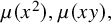
$\mu \colon A^2 \to k$
 be a linear map such that
$\mu (x^2),\mu (xy),$
 and
$\mu (yz)$
 are all nonzero. We claim that the corresponding Gorenstein quotient has Hilbert function
$(1,3,1)$
 .
To prove the claim, suppose that
$ax + by + cz$
 lies in the kernel of the map to the Gorenstein quotient, for some
$a, b$
 , and c in k. Then
$\mu (z \cdot (ax + by + cz)) = b \mu (yz) = 0$
 , so
$b = 0$
 . Also,
$\mu (x \cdot (ax + by + cz)) = a \mu (x^2) + b \mu (xy) = 0$
 , so
$a = 0$
 . Finally,
$\mu (y \cdot (ax + by + cz)) = a \mu (xy) + c \mu (yz) = 0$
 , so
$c = 0$
 .
5 Generalizations and further questions
In this section, we discuss various generalizations of our results, as well as questions for future research.
5.1 Arbitrary characteristic
Fix a field k. In this section, we do not assume that k has characteristic
$2$
 . We let
$\beta _{k,q} = \dim \tilde {H}_q(|\Delta |;k)$
 , and we assume that
$\beta _{k,d - 1} \neq 0$
 . Let
$\overline {H}_k(\Delta )$
 be the level quotient of the generic artinian reduction of the Stanley–Reisner ring of
$\Delta $
 over k, and similarly define
$\overline {H}_k(\Delta , \mu )$
 for
$\mu \in \tilde {H}_{d-1}(|\Delta |, k)$
 . Define the
$\overline {h}_k$
 -vector
$(\overline {h}_{k,0}, \ldots , \overline {h}_{k,d})$
 to be the Hilbert function of
$\overline {H}_k(\Delta )$
 , that is,
$\overline {h}_{k,q} := \dim \overline {H}_k^q(\Delta )$
 for
${0 \le q \le d}$
 . The proof of Proposition 2.2 implies that the
$\overline {h}_k$
 -vector depends only on the characteristic of k.
The differential operators technique has been extended to the case when k has any positive characteristic [Reference Karu, Larson and StapledonKLS24, AHK
${}^{+}$
 25], and this allows one to prove the following analogue of Theorem 1.6 in other positive characteristics.
Theorem 5.1. Let
$\Delta $
 be a simplicial complex of dimension
$d-1$
 . Let k be a field of characteristic
$p> 0$
 , and assume that
$\beta _{k,d - 1} \neq 0$
 . Then there is a map
$\mu \colon \overline {H}^d_k(\Delta ) \to K$
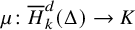 such that, for each
$q \le d/p$
 ,
$\dim \overline {H}^q_k(\Delta , \mu ) = \overline {h}_{k,q}$
 and multiplication by
$\ell ^{d - pq}$
 induces an injection from
$\overline {H}^q_k(\Delta , \mu )$
 to
$\overline {H}^{d - (p-1)q}_k(\Delta , \mu )$
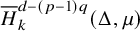 . If k is infinite, then
$\mu $
 can be chosen to be defined over k.
One can then use the techniques of the paper to deduce properties of complementary vectors, but only for the first
$\lfloor d/p \rfloor + 1$
 entries.
On the other hand, the anisotropy of the Hodge–Riemann forms on
$\overline {H}(\Delta , \mu )$
 is not known to hold if k does not have characteristic
$2$
 . If the anisotropy of Hodge–Riemann forms were known over fields of characteristic p, then the techniques of this paper would show that the bound
$q \le d/p$
 in Theorem 5.1 could be replaced by
$q \le d/2$
 . This would allow one to extend our results on complementary vectors. For example, we would conclude that the complementary vectors of complexes that are doubly Cohen–Macaulay in characteristic p are sums of M-vectors.
We outline the proof of Theorem 5.1. We use the following generalization of Proposition 2.1. It is a minor modification of [Reference Karu, Larson and StapledonKLS24, Theorem 1.3], obtained just as in the proof of Proposition 2.1.
Proposition 5.2. Let k be a field of characteristic
$p> 0$
 . Let
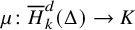
$\mu \colon \overline {H}^d_k(\Delta ) \to K$
 be a nonzero map that is defined over
$\mathbb {F}_p$
 , and let
$\overline {H}_k(\Delta , \mu )$
 be the corresponding Gorenstein quotient. Let
$\ell = x_1 + \dotsb + x_n \in \overline {H}^1_k(\Delta , \mu )$
 . For each
$q \le d/p$
 and any nonzero
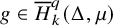
$g \in \overline {H}^q_k(\Delta , \mu )$
 ,
$\ell ^{d - pq} \cdot g^p$
 is nonzero.
Proof of Theorem 5.1.
The proof of Theorem 1.6 extends to a proof of Theorem 5.1, with two modifications.
Firstly, for some
$q \le d/p$
 , we let
$V = \overline {H}^q_k(\Delta )$
 and let W be the K-vector space of
$(p - 1)$
 -multilinear maps from V to K, that is, the tensor product of
$\mathrm {Hom}(\overline {H}^q_k(\Delta ), K)$
 with itself
$p - 1$
 times. For
$\nu \in \mathrm {Hom}(\overline {H}^d_k(\Delta ), K)$
 , define
$\phi _{\nu } \colon V \to W$
 to be the map given by
$\phi _{\nu }(x) = ((y_1,\ldots ,y_{p - 1}) \mapsto \nu (x \cdot y_1 \cdots y_{p - 1} \cdot \ell ^{d - pq}))$
 . Multiplication by
$\ell ^{d - pq}$
 induces an injection from
$\overline {H}^q_k(\Delta , \nu )$
 to
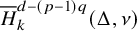
$\overline {H}^{d - (p-1)q}_k(\Delta , \nu )$
 if and only if
$\ker (\phi _{\nu })$
 , which is
$\{x \in \overline {H}^q_k(\Delta ) : \nu (x \cdot y_1 \cdots y_{p - 1} \cdot \ell ^{d - pq}) = 0 \text { for all } y_1, \ldots , y_{p - 1} \in \overline {H}^q_k(\Delta )\}$
 , coincides with the kernel of the map
$\overline {H}^q_k(\Delta ) \to \overline {H}^q_k(\Delta , \nu )$
 .
Secondly, the proof of equation (1) is modified as follows: let x be a class in
$\ker (\phi _{\mu })$
 such that there is some
$y \in \overline {H}^q_k(\Delta )$
 with
$\phi _{\mu _{t+1}}(x) = \phi _{\mu }(y)$
 . For any
$z_1,\ldots ,z_{p - 1} \in \overline {H}^q_k(\Delta )$
 , we have

Set
$z_1 = \cdots = z_{p - 1} = x$
 in the above equation. As
$x \in \ker (\phi _{\mu })$
 , we have
$\mu (y \cdot x^{p - 1} \cdot \ell ^{d - pq}) = 0$
 . Therefore
$\mu _{t+1}(x^p \cdot \ell ^{d - pq}) = 0$
 . Proposition 5.2 then implies that x lies in the kernel of
$\overline {H}^q_k(\Delta ) \to \overline {H}^q_k(\Delta , \mu _{t+1})$
 , which is the kernel of
$\phi _{\mu _{t+1}}$
 .
In some cases, we can deduce an analogue of Theorem 1.6 when k has characteristic
$0$
 . The hypothesis of the following theorem holds, for example, when
$\Delta $
 is doubly Cohen–Macaulay over a field of characteristic
$2$
 , which implies that it is doubly Cohen–Macaulay over k.
Theorem 5.3. Let
$\Delta $
 be a simplicial complex of dimension
$d-1$
 . Let k be a field of characteristic
$0$
 , and assume that
$\beta _{k,d - 1} \neq 0$
 and that
$\dim \overline {H}^q_{k}(\Delta ) = \dim \overline {H}^q_{{\mathbb {F}_2}}(\Delta )$
 for all q. Then there is a map
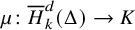
$\mu \colon \overline {H}^d_k(\Delta ) \to K$
 which is defined over k such that
$\dim \overline {H}^q_k(\Delta , \mu ) = \overline {h}_{k,q}$
 for each
$q \le d/2$
 .
Proof. Choose a basis
$\mu _1, \dotsc , \mu _t$
 for
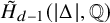
$\tilde {H}_{d-1}(|\Delta |, \mathbb {Q})$
 . Then for
$a_1, \dotsc , a_t \in \mathbb {Q}$
 , the dimension of
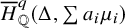
$\overline {H}^{q}_{\mathbb {Q}}(\Delta , \sum a_i \mu _i)$
 is the rank of a certain matrix computing the pairing between monomials of degree q and
$d - q$
 . The entries of this matrix are polynomials in
$a_1, \dotsc , a_t$
 with rational coefficients, and so if there is some field k of characteristic
$0$
 for which the conclusion of the theorem holds, then it holds for every field of characteristic
$0$
 .
The assumption that
$\dim \overline {H}^d_{k}(\Delta ) = \dim \overline {H}^d_{{\mathbb {F}_2}}(\Delta )$
 and the universal coefficient theorem for homology imply that
$\dim \tilde {H}_{d-1}(|\Delta |, \mathbb {Q}) = \dim \tilde {H}_{d-1}(|\Delta |, \mathbb {F}_2)$
 . By Theorem 1.6, we can find a cycle
$\overline {\mu } \in \tilde {H}_{d-1}(|\Delta |, \bar {\mathbb {F}}_2)$
 for which the Hilbert function of the corresponding Gorenstein quotient agrees with
$\dim \overline {H}^q_k(\Delta )$
 for
$q \le d/2$
 . Here
$\bar {\mathbb {F}}_2$
 denotes the algebraic closure of
$\mathbb {F}_2$
 . As
$\bar {\mathbb {F}}_2$
 is a union of finite fields,
$\overline {\mu }$
 is defined over
$\mathbb {F}_{2^n}$
 for some n.
Let k be a number field whose ring of integers
$\mathcal {O}_k$
 has
$\mathbb {F}_{2^n}$
 as a residue field. Then there is a cycle
$\mu \in \tilde {H}_{d-1}(|\Delta |, \mathcal {O}_k)$
 that specializes to
$\overline {\mu }$
 . This implies that the rank of the matrix that computes the pairing between monomials of degree q and
$d-q$
 using
$\mu $
 is
$\dim \overline {H}^q_k(\Delta )$
 , as the matrix has this rank after reducing to
$\mathbb {F}_{2^n}$
 . That is also the rank of this matrix over k, so
$\dim \overline {H}^q_k(\Delta , \mu ) = \dim \overline {H}^q_{\mathbb {F}_{2^n}}(\Delta , \mu ) = \dim \overline {H}^q_k(\Delta )$
 , as desired.
Remark 5.4. In the statement of Theorem 5.3, a standard argument can be used to show that
$\mu $
 may be chosen so that
$\overline {H}_k(\Delta , \mu )$
 satisfies the strong Lefschetz property; see, for example, [Reference Larson, Stapledon and NovikLSN24, Proof of Theorem 1.4].
5.2 Balanced complexes
In [Reference ObaOba25, Theorem 7.6], Oba generalized Proposition 2.1 to the case of balanced complexes. We explain how this result can be used to extend the results of the paper to the setting of balanced complexes.
Let
$\Delta $
 be a simplicial complex of dimension
$d-1$
 with vertex set
$V = \{ 1,\ldots , n \}$
 . Let
$\textbf {a} = (a_1,\ldots ,a_m)$
 be a sequence of positive integers with
$\sum _q a_q = d$
 . Recall that an m-coloring of the vertices of
$\Delta $
 is a function
$\kappa \colon V \to \{ 1,\ldots , m\}$
 such that
$\kappa (v) \neq \kappa (w)$
 for any edge
$\{ v,w \}$
 in
$\Delta $
 . An
$\boldsymbol {a}$
 -balanced complex is a pair
$(\Delta , \kappa )$
 , where
$\kappa \colon V \to \{ 1,\ldots , m\}$
 is a coloring of the vertices of
$\Delta $
 , and, for each face F of
$\Delta $
 , we have
$|F \cap \kappa ^{-1}(q)| \le a_q$
 for
$1 \le q \le m$
 .
Define a function
$\psi \colon \{ 1,\ldots , d \} \to \{ 1,\ldots , m \}$
 by setting
$\psi (i) = q $
 for
$i \in \{\sum _{l < q} a_l + 1, \ldots , \sum _{l < q} a_l + a_q\}$
 . Let k be a field of characteristic
$2$
 , and consider a purely transcendental field extension
$K = k(a_{i,j})$
 , where the indices
$(i,j)$
 run over all
$1 \le i \le d$
 and
$1 \le j \le n$
 such that
$\psi (i) = \kappa (j)$
 . Recall that
$K[\Delta ]$
 denotes the Stanley–Reisner ring of
$\Delta $
 . Let
$\theta _i = \sum _{\psi (i) = \kappa (j)} a_{i,j} x_j$
 for
$i \in \{1, \dotsc , d\}$
 , and define
$H(\Delta , \kappa ) := K[\Delta ]/(\theta _1, \dotsc , \theta _d)$
 . Then
$H(\Delta , \kappa ) = \oplus _{\textbf {b} \le \textbf {a}} H^{\textbf {b}}(\Delta , \kappa )$
 naturally inherits an
$\mathbb {N}^m$
 -grading that refines the usual
$\mathbb {N}$
 -grading. Here
$\textbf {b} = (b_1, \ldots , b_m) \in \mathbb {N}^m$
 , and we write
$\textbf {b} \le \textbf {a}$
 if
$b_q \le a_q$
 for
$1 \le q \le m$
 . We assume that
$H^d(\Delta , \kappa ) = H^{\textbf {a}}(\Delta , \kappa )$
 is nonzero. There is a natural identification of
$H^{\textbf {a}}(\Delta , \kappa )$
 with
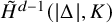
$\tilde {H}^{d-1}(|\Delta |, K)$
 . We may consider the
$\mathbb {N}^m$
 -graded level quotient
$\overline {H}(\Delta , \kappa )$
 , and, for each nonzero map
$\mu \colon \overline {H}^d(\Delta , \kappa ) \to K$
 , the
$\mathbb {N}^m$
 -graded Gorenstein quotient
$\overline {H}(\Delta , \kappa , \mu )$
 . Let
$\ell _q = \sum _{\kappa (j) = q} x_j \in \overline {H}^{e_q}(\Delta , \kappa )$
 for
$1 \le q \le m$
 , where
$e_q \in \mathbb {N}^m$
 denotes the qth standard basis vector. Define
$\boldsymbol {\ell }^{\textbf {b}}:= \prod _q \ell _q^{b_q} \in \overline {H}^{\textbf {b}}(\Delta , \kappa )$
 . Then the following result is essentially the same as [Reference ObaOba25, Theorem 7.6].
Proposition 5.5. Let
$(\Delta , \kappa )$
 be a balanced complex with
$\dim \Delta = d - 1$
 . Let k be a field of characteristic
$2$
 , and let
$\mu \colon \overline {H}^d(\Delta , \kappa ) \to K$
 be a nonzero map that is defined over
$\mathbb {F}_2$
 . Then for any
$\textbf {b} \in \mathbb {N}^m$
 with
$2\textbf {b} \le \textbf {a}$
 , the symmetric bilinear form
$\overline {H}^{\textbf {b}}(\Delta , \kappa , \mu ) \times \overline {H}^{\textbf {b}}(\Delta , \kappa , \mu ) \to K$
 given by
$(x, y) \mapsto \mu (x \cdot y \cdot \boldsymbol {\ell }^{\textbf {a} - 2\textbf {b}})$
 is anisotropic.
Define the
$\overline {h}$
 -vector of
$(\Delta ,\kappa )$
 by
$\overline {h}_{\textbf {b}} := \dim \overline {H}^{\textbf {b}}(\Delta , \kappa )$
 for
$\textbf {b} \le \textbf {a}$
 . As in Proposition 2.2, this is independent of the choice of characteristic
$2$
 field k. A minor modification of the proof of Theorem 1.6 implies the following result.
Theorem 5.6. Let
$(\Delta , \kappa )$
 be a balanced complex with
$\dim \Delta = d - 1$
 . Let k be a field of characteristic
$2$
 , and assume that
$\beta _{d - 1} \neq 0$
 . Then there is a map
$\mu \colon \overline {H}^d(\Delta , \kappa ) \to K$
 such that, for each
$\textbf {b} \in \mathbb {N}^m$
 with
$2\textbf {b} \le \textbf {a}$
 ,
$\dim \overline {H}^{\textbf {b}}(\Delta , \kappa ,\mu ) = \overline {h}_{\textbf {b}}$
 and multiplication by
$\boldsymbol {\ell }^{\textbf {a} - 2\textbf {b}}$
 induces an isomorphism from
$\overline {H}^{\textbf {b}}(\Delta , \kappa ,\mu )$
 to
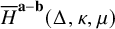
$\overline {H}^{\textbf {a} - \textbf {b}}(\Delta , \kappa ,\mu )$
 . If k is infinite, then
$\mu $
 can be chosen to be defined over k.
Define the complementary vector of
$(\Delta ,\kappa )$
 by
$\overline {c}_{\textbf {b}} := \overline {h}_{\textbf {a} - \textbf {b}} - \overline {h}_{\textbf {b}} $
 for
$\textbf {b}$
 with
$2\textbf {b} < \textbf {a}$
 . We now proceed as in the proof of Corollary 1.7. Theorem 5.6 implies that there exists a linear map
$\mu \colon \overline {H}^d(\Delta ,\kappa ) \to K$
 such that
$\dim \overline {H}^{\textbf {b}}(\Delta , \kappa ,\mu ) = \overline {h}_{\textbf {b}}$
 for each
$\textbf {b} \in \mathbb {N}^m$
 with
$2\textbf {b} \le \textbf {a}$
 . Let M be the kernel of the quotient map
$\overline {H}(\Delta , \kappa ) \to \overline {H}(\Delta , \kappa , \mu )$
 , and let
$M^*$
 be the graded dual of M. Both M and
$M^*$
 admit
$\mathbb {N}^m$
 -gradings that are compatible with their perfect pairing. The Hilbert function of
$M^*$
 (with respect to the
$\mathbb {N}^m$
 -grading) is precisely the complementary vector of
$(\Delta ,\kappa )$
 . Using the standard
$\mathbb {N}$
 -grading, the socle of M is concentrated in degree d, and it follows that
$M^*$
 is generated in degree
$0$
 . We conclude that we have the following analogue of Corollary 1.7.
Corollary 5.7. Let
$(\Delta , \kappa )$
 be a balanced complex with
$\dim \Delta = d - 1$
 . Let k be a field of characteristic
$2$
 , and assume that
$\beta _{d - 1} \neq 0$
 . Then the complementary vector of
$(\Delta , \kappa )$
 is the Hilbert function of an
$\mathbb {N}^m$
 -graded module over an
$\mathbb {N}^m$
 -graded polynomial ring in finitely many variables which is generated as a module in degree
$0$
 .
It would be interesting to further explore the numerical consequences of this result.
5.3 Pure O-sequences
Recall that an M-vector (or O-sequence) is the Hilbert function of a finite-dimensional standard graded K-algebra. In fact, it follows from Macaulay’s work [Reference MacaulayMac27] that an O-sequence may alternatively be defined as the Hilbert function of a finite-dimensional monomial algebra, that is, the quotient of a polynomial ring by a monomial ideal. A pure O-sequence is the Hilbert function of a finite-dimensional monomial algebra that is level, that is, the socle is concentrated in the top degree. A long-standing conjecture of Stanley asserts that the h-vector of the independence complex of a matroid is a pure O-sequence [Reference StanleySta77].
Working over
$k = \mathbb {C}$
 , Hausel [Reference HauselHau05, Theorem 6.3] proved that finite-dimensional level monomial algebras satisfy a natural analogue of Corollary 1.3, and so pure O-sequences satisfy the inequalities in Corollary 1.4. Given a pure O-sequence
$(a_0,\ldots ,a_d)$
 with
$a_d \neq 0$
 , define the corresponding complementary vector as
$(c_0, \ldots , c_{\lfloor (d - 1)/2 \rfloor })$
 , where
$c_q = a_{d - q} - a_{q}$
 for each
$q \le (d - 1)/2$
 . Then Hausel’s theorem implies that the complementary vector has nonnegative entries. We prove the following analogue of part of Corollary 1.7.
Theorem 5.8. The complementary vector of a pure O-sequence is a sum of M-vectors.
Note that Example 4.11 and Example 4.12 show that the analogue of Theorem 1.6 may or may not hold, that is, a finite-dimensional level monomial algebra may or may not admit a Gorenstein quotient whose Hilbert function is the same up to half of the socle degree.
We prove Theorem 5.8 by reducing it to a theorem of Murai. Let k be a field and let M be the set of monomials in
$k[x_1,\ldots ,x_n]$
 . For
$u,v \in M$
 , write
$u \mid v$
 if u divides v. A nonempty finite subset
$S \subset M$
 is a multicomplex if whenever
$u \mid v$
 and
$v \in S$
 , then
$u \in S$
 . Equivalently, the elements of S form a basis of a quotient of
$k[x_1,\ldots ,x_n]$
 by a monomial ideal. Write
$h_q(S)$
 for the number of elements of S of degree q.
Example 5.9. If
$\hat {m} \in M$
 is a monomial of degree d, then
$S = \{ u \in M : u \mid \hat {m} \}$
 is the basis of a Gorenstein monomial algebra with socle degree d and
$h_q(S) = h_{d - q}(S)$
 for all q. Moreover, the function
$u \mapsto \hat {m}/u$
 defines an involution on S sending elements of degree q to elements of degree
$d - q$
 .
Theorem 5.10 [Reference MuraiMur11, Theorem 1.14].
Fix a monomial
$\hat {m} \in M$
 of degree d, and let S be a multicomplex that is a proper subcomplex of
$\{ u \in M : u \mid \hat {m} \}$
 . Consider the sequence
$g(S) = (g_0(S),\ldots ,g_{\lfloor (d - 1)/2 \rfloor }(S))$
 , where
$g_q(S) = h_q(S) - h_{d - q}(S)$
 . Then
$g(S)$
 is the g-vector of a simplicial sphere and, in particular, is an M-vector.
Proof of Theorem 5.8.
With the notation above, let
$m_1,\ldots ,m_s \in M$
 be a sequence of distinct monomials of degree d for some positive integer s, and let
$A = \{ u \in M : u \mid m_q \textrm { for some } 1 \le q \le s\}$
 . Then any pure O-sequence has the form
$(h_0(A),\ldots ,h_d(A))$
 for some such multicomplex A. Consider the complementary vector
$c(A) = (c_0(A),\ldots ,c_{\lfloor (d - 1)/2 \rfloor }(A))$
 , where
$c_q(A) = h_{d - q}(A) - h_q(A)$
 . We argue by induction on s. When
$s = 1$
 , the complementary vector is identically
$0$
 by Example 5.9, and the result holds. Assume that
$s> 1$
 and consider the multicomplexes

Consider the multicomplex
$S = A' \cap A_s$
 . Since
$m_s \in A_s \smallsetminus A'$
 , we have
$S \neq A_s$
 . Consider the sequence
$g(S) = (g_0(S),\ldots ,g_{\lfloor (d - 1)/2 \rfloor }(S))$
 , where
$g_q(S) = h_q(S) - h_{d - q}(S)$
 . By Theorem 5.10,
$g(S)$
 is an M-vector. We claim that for
$0 \le q \le (d - 1)/2$
 ,

Assuming this claim, the result follows immediately by induction. It remains to prove the claim. Observe that
$A_s \smallsetminus S = A \smallsetminus A'$
 . Hence

Recall from Example 5.9 that
$A_s$
 admits an involution
$\phi : A_s \to A_s$
 ,
$\phi (u) = m_s/u$
 , taking elements of degree q to elements of degree
$d - q$
 . Write
$A_s \smallsetminus S$
 as the disjoint union of
$B = \{ u \in A_s \smallsetminus S : \phi (u) \in S \}$
 and
$B' = \{ u \in A_s \smallsetminus S : \phi (u) \notin S \}$
 . Since
$B'$
 is closed under
$\phi $
 , we have
$h(B')_q = h(B')_{d - q}$
 for all q. Hence

We have
$\phi (B) = \{ u \in S : \phi (u) \notin S \}$
 . Observe that S is the disjoint union of
$\phi (B)$
 and
$C = \{ u \in S : \phi (u) \in S \}$
 . Since C is closed under
$\phi $
 , we have
$h(C)_q = h(C)_{d - q}$
 for all q. We deduce that

This completes the proof of the claim and hence the theorem.
Acknowledgements
We thank Christos Athanasiadis, Luis Ferroni, Anthony Iarrobino, Kalle Karu, Juan Migliore, and Fabrizio Zanello for useful conversations. In particular, we thank Luis Ferroni for Example 4.6, and we thank Fabrizio Zanello for Example 4.10. We thank the referee for their helpful comments. This paper was proofread using Claude Opus 4.8.
Conflict of interest
The authors have no conflicts of interest to declare.
Financial support
This work was mostly conducted while the authors were at the Institute for Advanced Study, where the second author received support from the Charles Simonyi endowment.


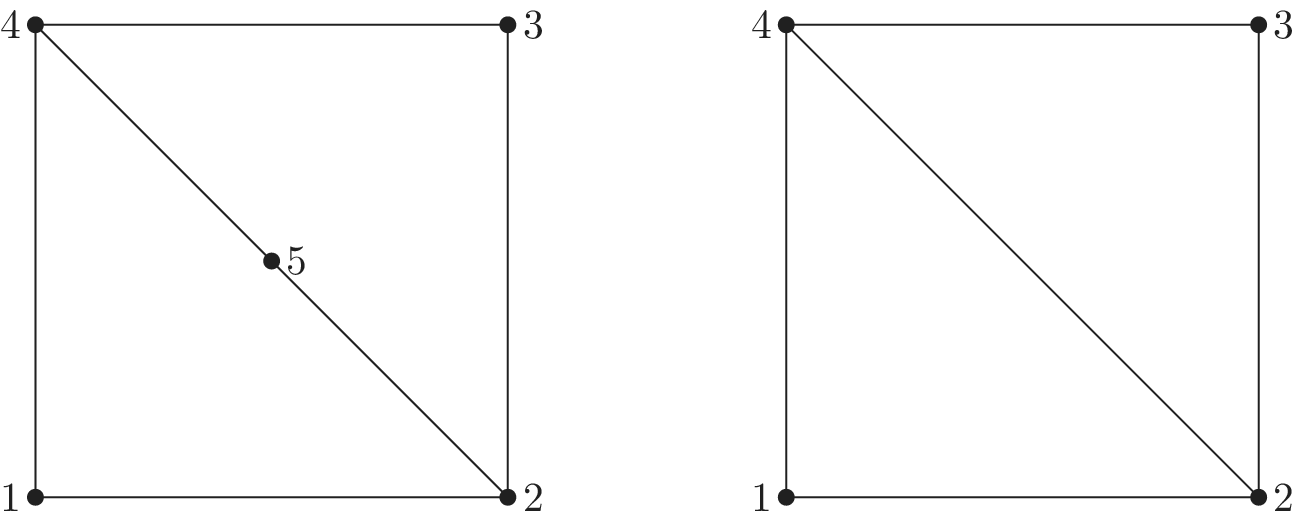

 Open access

