Introduction
Pre-Pleistocene fossil vertebrates are poorly known from Central America. In particular, no fossil birds of Tertiary age have been reported from this region (Panama through Guatemala and Belize), including Panama. To the north of Panama, the nearest Tertiary avian fossils are from central Mexico (Steadman and Carranzo-Castañeda, Reference Steadman and Carranza-Castañeda2006). Thus, it is noteworthy to report the first Miocene bird fossil from Panama. The specimen is a pedal ungual phalanx (claw). Pedal phalanges are surprisingly diagnostic at the generic level in hawks and eagles (Accipitridae; Olson, Reference Olson1982) as well as in a number of other families of birds such as the Anatidae (Steadman, Reference Steadman1991) and Rallidae (Steadman, Reference Steadman1988). The Panamanian fossil is the ungual of the middle toe (pedal digit III, phalanx 4), which is an integral part of grasping prey. Pedal digit III is the longest of the three front toes, and possesses an ungual that is second in size only to that of the opposing hind toe (pedal digit I). A distinctive feature of pedal digit III, phalanx 4 is that it is markedly bilaterally asymmetrical, and therefore readily distinguished from other unguals.
The purpose of this report is to document the early Miocene eagle fossil from Panama and to discuss its biogeographic affinities and significance.
Geologic setting
The fossil described here, UF 281480, was discovered by Dr. John Turner from outcrops of the Cucaracha Formation along the west side of the Panama Canal on New Year’s Day 1962. Dr. Turner, now of Hattiesburg, Mississippi, grew up in the Canal Zone and made fossil collections in this region during the 1950s and early 1960s. He donated a portion of his collection, which included this fossil, to the Florida Museum of Natural History (UF) Vertebrate Paleontology Collection in 2014 (MacFadden et al., Reference MacFadden, Morgan, Jones and Rincon2015). UF 281480 was contained within a box of other fossil vertebrates, all of which are from what is now termed the Centenario Fauna (MacFadden et al., Reference MacFadden, Kirby, Rincon, Montes, Moran, Strong and Jaramillo2010), including the most common taxon, i.e., the protoceratid Paratoceras. No other fossils from other localities were contained in this box, so it is safe to assume that this collection is from the same locality.
With regard to fossil vertebrates from Panama, over the past 50 years various reports have described early Miocene mammals (e.g., Whitmore and Stewart, Reference Whitmore and Stewart1965; MacFadden, Reference MacFadden2006; MacFadden et al., Reference MacFadden, Bloch, Evans, Foster, Morgan, Rincon and Wood2014), turtles (Cadena et al., Reference Cadena, Bourque, Rincon, Bloch, Jaramillo and MacFadden2012), the boid snake Boa (Head et al., Reference Head, Rincon, Suarez, Montes and Jaramillo2012), and crocodilians (Hastings et al., Reference Hastings, Bloch, Jaramillo, Rincón and MacFadden2013) from relevant outcrops along the Canal. These occurrences are from the Centenario Fauna, which includes the uppermost part of the Culebra Formation and most of the overlying Cucaracha Formation (MacFadden et al., Reference MacFadden, Kirby, Rincon, Montes, Moran, Strong and Jaramillo2010).
Exposures of the Cucaracha Formation crop out on the east and west sides of the Panama Canal along the Gaillard Cut (Stewart et al., Reference Stewart, Stewart and Woodring1980). This formation is moderately fossiliferous in places and the primary collecting localities are well documented (MacFadden, Reference MacFadden2006; MacFadden et al., Reference MacFadden, Bloch, Evans, Foster, Morgan, Rincon and Wood2014). The distinctive mode of preservation of the bird fossil (jet black within a matrix of off-white indurated silt) is similar to that of other vertebrates collected from these outcrops (contained in both the UF and Smithsonian collections; e.g., Whitmore and Stewart, Reference Whitmore and Stewart1965; MacFadden, Reference MacFadden2006). UF 281480 was collected from outcrops of the Cucaracha Formation north of the current location of the Centenario Bridge and south of Contractors Hill (J. Turner, personal communication; Supplementary Document 1) at approximate 9.035oN, 79.641oW (UF VP Locality YPA 002). From what is known about these exposures, UF 281480 was found within the middle third of the stratigraphic extent of the Centenario Fauna. Given the constraints of mode of preservation, the unambiguous documentation provided by the collector, and the lateral and stratigraphic extent of the Centenario Fauna, we are confident of the Cucaracha Formation provenience of UF 281480.
In addition to the spatial and temporal constraints provided here, based on paleomagnetic, geochronological, and biochronological evidence, fossils from the Centenario Fauna are constrained in Chron C5Er between 19.05 and 18.78 Ma during the early Miocene (MacFadden et al., Reference MacFadden, Bloch, Evans, Foster, Morgan, Rincon and Wood2014). The fossil mammals, including the diagnostic rhinoceros Floridaceras, indicate that the Centenario Fauna is early Hemingfordian (He1) age, which is the North American Land Mammal Age (NALMA) otherwise known in higher-latitude North America. In many of its faunal characteristics, the Centenario Fauna compares favorably with the slightly younger (ca. 18 to 17 Ma) Thomas Farm Local Fauna of Florida (e.g., Tedford et al., Reference Tedford, Albright, Barnosky, Ferrusquía-Villafranca, Hunt, Storer, Swisher, Voorhies, Webb and Whistler2004).
Materials and methods
To identify osteological characters, we compared the fossil with the following comparative specimens from the University of Florida (UF) Ornithology Collection. Pandionidae—Pandion haliaetus, UF 48491. Accipitridae—Accipiter gentilis, UF 41963; Buteogallus anthracinus, UF 33744; Buteogallus urubitinga, UF 33554; Buteogallus meridionalis, UF 38903; Geranoetus melanoleucus, UF 38062; Parabuteo unicinctus, UF 33745; Buteo jamaicensis, UF 42233; Haliaeetus leucocephalus, UF 33743; Aquila chrysaetos, UF 23962; Harpia harpyja, UF 38871; Circaetus gallicus, UF 38888; Hieraeetus spilogaster, UF 38898; Polemaetus bellicosus, UF 38904; Stephanoetus coronatus, UF 38905; Falconidae—Caracara cheriway, UF 42180. Tytonidae—Tyto alba, UF 41181. Strigidae—Strix varia, UF 26521; Bubo virginianus, UF 44040.
Systematic paleontology
Class Aves Linnaeus, 1758
Order Accipitriformes Vieillot, 1816
Family Accipitridae Vieillot, 1816
Genus indeterminate
Material
Complete pedal digit III, phalanx 4 (ungual), UF 281480.
Occurrence
Centenario Fauna, UF VP locality YPA 002, early Miocene, early Hemingfordian (He 1) NALMA, Panama Canal, Panama.
Comparative osteology
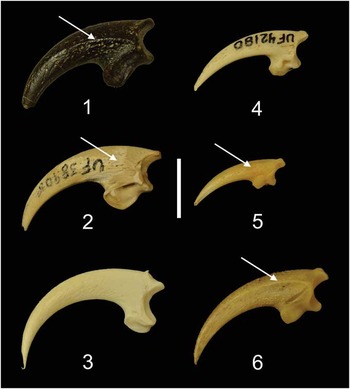
Osteological nomenclature follows that in Boev (Reference Boev2001) and Gala and Lenoble (Reference Gala and Lenoble2015). UF 281480 is referred to the Accipitridae rather than to the other families of birds with “raptorial” ungual phalanges (Pandionidae, Falconidae, Tytonidae, Strigidae) because of these characters (Fig. 1): medial side of corpus phalangis with prominent ridge (see arrows in Figs. 1, 2) originating at the juncture of cotyla articularis (the articulation for phalanx 3) with tuberculum flexorium (the underlying or plantar facet for attachment of flexor tendon III) (except in Strigidae); juncture of lateral and plantar sides of corpus phalangis defined by a sharp ridge (rounded in Pandionidae, Strigidae); in proximal aspect, cotyla articularis higher than wide (wider than high in Strigidae); in plantar aspect, tuberculum flexorium nearly bilaterally symmetrical (medial side much larger than lateral side in Falconidae, Tytonidae); in plantar aspect, tuberculum flexorium longer than wide (wider than long in Falconidae, Tytonidae, and Strigidae); in plantar aspect, the paired foramina for tuberculum flexorium relatively smaller than in Pandionidae, Falconidae, and Strigidae.
Digit III, phalanx 4 in medial aspect. (1) Accipitridae sp., fossil, UF 281480, Panama. (2) Stephanoetus coronatus, UF 38905, Zimbabwe. (3) Pandion haliaetus, UF 48491, Florida. (4) Caracara cheriway, UF 42180, Florida. (5) Tyto alba, UF 41181, Bahamas. (6) Bubo virginianus, UF 44040, Florida. White arrows point to the prominent ridge of the medial side of corpus phalangis. Scale bar represents 10 mm.

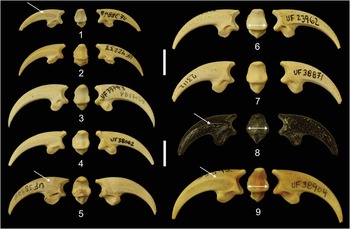
Digit III, phalanx 4 of Accipitridae in medial (left column), lateral (middle column), and proximal (right column) aspects. (1) Hieraaetus spilogaster, UF 38898 (mirror image), Botswana. (2) Buteo jamaicensis, UF 42233, Florida. (3) Haliaeetus leucocephalus, UF 33743, Florida. (4) Geranoetus melanoleucus, UF 38062, Argentina. (5) Stephanoetus coronatus, UF 38905, Zimbabwe. (6) Aquila chrysaetos, UF 23962, Texas. (7) Harpya harpyja, UF 38871, Costa Rica. (8) Accipitridae sp., fossil, UF 281480, Panama. (9) Polemaetus bellicosus, UF 38904, South Africa. White arrows point to the prominent ridge of the medial side of corpus phalangis. White 2-pointed arrows disclose the wide cotyla articularis in three species. Scale bar represents 10 mm.

Within the Accipitridae, UF 281480 is approximately the size of digit III, phalanx 4 in the largest, most powerful living species of hawks and eagles such as Harpya harpyja and Polemaetus bellicosus (Table 1, Fig. 2). Compared to any of the living species, UF 281480 has a wider cotyla articularis (ratio of measurements 1 vs. 2 in Table 1), being most closely approached by the Holarctic Aquila chrysaetos and African Stephanoetus coronatus (see the double-pointed arrows in Fig. 2.6, 2.8, and 2.9.) In its relative length of tuberculum flexorium (ratio of measurements 4 vs. 2 in Table 1), UF 281480 is roughly equivalent to the condition in the North American Buteo jamaicensis, and in three African species (Hieraaetus spilogaster, Stephanoetus coronatus, Polemaetus bellicosus).
Measurements (in mm) of Digit III, phalanx 4, in selected species of Accipitridae. Based on same specimens as in Figure 2. Cot art = cotyla articularis; Tub flex = tuberculum flexorium; Prox end = entire proximal end (Cot art + Tub flex).

UF 281480 agrees with the three African genera and disagrees with other accipitrids examined in having a sharp ridge running along the midline of the tuberculum flexorium (Fig. 2.1, 2.5, 2.7, 2.9). This ridge increases the surface area for tendinal attachment, probably resulting in a slight terminal bifurcation of flexor tendon III. This character is especially well developed in the fossil and in Stephanoetus coronatus.
Discussion
Biogeographic significance
Whereas most Neogene North American bird fossils represent taxa of Neotropical and Nearctic affinities, the possible African relationship of the early Miocene accipitrid fossil from Panama is not without precedent. The abundant dove Arenicolumba prattae (Columbidae) from the early Miocene Thomas Farm Local Fauna (Florida; Hemingfordian NALMA) represents an extinct genus with closer affinities to the living African endemic genera Oena and Turtur than to any living or extinct New World columbid genus (Steadman, Reference Steadman2008). Moreover, younger Neogene (middle Miocene through Pliocene) North American birds with African affinities include the anatids Tadorna s.l. and Nettapus, as well as the crane Balearica (Olson, Reference Olson1985, p. 164; Becker, Reference Becker1987, p. 38, 51, 58, 65; Steadman and Carranza-Castañeda, Reference Steadman and Carranza-Castañeda2006). To the south of Panama, we note that the middle Miocene avifauna from La Venta, Colombia (7–8 Myr younger than the Centenario Fauna) lacks evidence of accipitrid fossils or of any avian taxa with African affinities (Rasmussen, Reference Rasmussen1997).
The fossil mammals from the Centenario Fauna represent North American taxa, including considerable overlap at the generic level with those from Thomas Farm (e.g., Whitmore and Stewart, Reference Whitmore and Stewart1965; MacFadden, Reference MacFadden2006; MacFadden et al., Reference MacFadden, Bloch, Evans, Foster, Morgan, Rincon and Wood2014). The fossil reptiles from the Centenario Fauna are of mixed geographic affinities, although none shows a relationship with African taxa. Among the crocodylians, some have nearest relatives in North America and others in South America (Hastings et al., Reference Hastings, Bloch, Jaramillo, Rincón and MacFadden2013). The fossil turtles are primarily North American, although a fragmentary pleurodire has South American affinities, as does the fossil Boa (Cadena et al., Reference Cadena, Bourque, Rincon, Bloch, Jaramillo and MacFadden2012; Head et al., Reference Head, Rincon, Suarez, Montes and Jaramillo2012). The early Miocene pollen flora of Panama is predominantly of “Gondwana Amazonian” affinities (Jaramillo et al., Reference Jaramillo, Moreno, Ramírez, da Silva, Barrera, Barrera, Sánchez, Morón, Herrera, Escobar, Koll, Manchester and Hoyos2014).
Paleoecology
In its stout, powerful proportions, the Panamanian fossil most closely resembles the ungual phalanx of the large African eagles Stephanoetus coronatus and Polemaetus bellicosus. The former, known as the Crowned Hawk-eagle, is said to feed on “Mainly mammals, especially monkeys and small antelopes in lowland rain forest, or hyraxes and viverrids in drier forests.” (Thiollay, Reference Thiollay1994, p. 205). The Martial Eagle (P. bellicosus) feeds on “Mainly vertebrates weighing 1–5 kg, with large birds (e.g., gamebirds and waterfowl), monitor lizards, or mammals (e.g., hares, hyraxes, mongooses, and small antelopes) predominating …” (Thiollay, Reference Thiollay1994, p. 200). Although the estimated body sizes of the mammals from the Centenario Fauna have not yet been reported, there are several possible prey species in the 1–5 kg size range, including rodents, a procyonid carnivoran, and the small moschid artiodactyls.
Acknowledgments
We thank J. Turner of Hattiesburg, Mississippi for donating the collection that includes UF 281480 to the Florida Museum of Natural History and providing a description of the circumstances of its discovery. S. Moran took the photos, which were arranged in Figures 1 and 2 by H. Singleton. This research was supported by the PCP PIRE NSF award 0966884 (OISE, EAR, DRL). This is University of Florida Contribution to Paleobiology 764.
Accessibility of Supplemental Data
Data available from the Dryad Digital Repository: http://dx.doi.org/10.5061/dryad.v1r28.