Smoking is the most significant avoidable cause of morbidity and premature mortality in the European Union (European Commission, 2010), and in countries such as the United States (U. S. Department of Health and Human Services, 2010) or Spain (Ministerio de Sanidad y Política Social, 2010). However, the health risks associated with smoking can be considerably attenuated after the achievement of abstinence (Montes, Pérez, & Gestal, Reference Montes, Pérez and Gestal2004; Mulder, Hoogenveen, Smith, & Bueno de Mesiqua, 2004; U. S. Department of Health and Human Services, 2010).
Despite the serious health consequences of smoking, and the fact that the majority of smokers know the risks, many of them are incapable of maintaining abstinence, and relapse quite soon after giving up (Hughes, Keely, & Naud, Reference Hughes, Keely and Naud2004; Míguez & Becoña, Reference Míguez and Becoña2008; Piasecki, Reference Piasecki2006), as also occurs with other addictive behavior (Marlatt & Donovan, Reference Marlatt and Donovan2005).
Thus, relapse is the most common and most probable process within the smoking cessation process (Brandon, Vidrine, & Litvin, Reference Brandon, Vidrine and Litvin2007; Fiore et al., Reference Fiore, Jaén, Baker, Bailey, Benowitz, Curry and Wewers2008; Piasecki, Reference Piasecki2006; Piasecki, Fiore, McCarthy, & Baker, Reference Piasecki, Fiore, McCarthy and Baker2002). Continuous abstinence is still difficult to achieve for the majority of those who try to give up the habit (Conklin et al., Reference Conklin, Perkins, Sheidow, Jones, Levine and Marcus2005). Some studies have found that as many as 70–75% of smokers who achieve 4 weeks of abstinence relapse within the first year (Etter & Stapleton, Reference Etter and Stapleton2006; Ferguson, Bauld, Chesterman, & Judge, Reference Ferguson, Bauld, Chesterman and Judge2005; Hughes et al., Reference Hughes, Keely and Naud2004), and of those that are still abstinent at 1 year, more than 30% relapse later (Etter & Stapleton, Reference Etter and Stapleton2006).
Knowledge about the relapse process is of great importance, not only so as to aid our understanding of the process itself, but also to be able to implement appropriate strategies for reducing relapse rates, or for training smokers how to stay abstinent (Carroll, Reference Carroll1996; Ferguson & Shiffman, Reference Ferguson and Shiffman2010).
The most important model that has been used for assessing the relapse process is Marlatt’s cognitive-behavior model (Cummings, Gordon, & Marlatt, Reference Cummings, Gordon, Marlatt and Miller1980; Marlatt & Gordon, Reference Marlatt and Gordon1985), which has been updated since its original publication (Marlatt, Reference Marlatt1996; Marlatt & Donovan, Reference Marlatt and Donovan2005; Witkiewitz & Marlatt, Reference Witkiewitz and Marlatt2004). It is the most influential and widely used model in addictive behavior, both for analysis of the relapse situations and for the development of preventive initiatives based on it (Longabaugh, Rubin, Scout, Zywiak, & Lowman, Reference Longabaugh, Rubin, Scout, Zywiak and Lowman1996). The focus of the model has been on seeking the most immediate situational determinants of relapse –also called high-risk situations– (Curry & McBride, Reference Curry and McBride1994). One of its most important components is the assessment of individual or contextual characteristics, which would permit the classification of the relapse episode after a period of abstinence. The advantage of this model is that the relapse situations are clearly operationalized in a taxonomy. Thus, it provides those studies which use it with empirical knowledge about the different of relapse situations, so that different studies can be compared with one another.
The taxonomy of relapse is a hierarchical system with three levels (see Table 3). The first, highest level distinguishes two categories as precipitants of relapse: intrapersonal-environmental situations and interpersonal situations. The second level includes 8 subdivisions of the first level: five in the intrapersonal-environmental category (coping with negative emotional states, coping with physical-physiological negative states, enhancement of positive emotional states, testing personal control and giving in to temptations or urges to smoke) and three in the interpersonal category (coping with interpersonal conflict, social pressure and enhancement of positive emotional states). Finally, the third level of differentiation, which would involve the most detailed information, identifies variations in 5 of the 8 subcategories. In the subcategory coping with negative emotional states it differentiates between coping with frustration and/or anger, with depression, with anxiety and with other negative emotional states; in the subcategory coping with physical-physiological negative states it distinguishes between coping with physical states associated with prior smoking and coping with other negative physical states; in the subcategory giving in to temptations or urges it differentiates between relapse “ in the presence of substance cues” and “in the absence of substance cues”; in the subcategory coping with interpersonal conflict it distinguishes between coping with frustration and/or anger, with depression, with anxiety and with other negative emotional states; and in the social pressure subcategory it differentiates between direct and indirect social pressure. Marlatt’s relapse taxonomy is mutually exclusive, admitting the identification of just one relapse precipitant, specifically that which is closest in time to the relapse.
The majority of relapses studied with the Marlatt codification system are attributed to coping with negative emotional states and to social pressure (Cummings et al., Reference Cummings, Gordon, Marlatt and Miller1980; Hodgins, el-Guebaly, & Armstrong, 1995; Lowman, Allen, Stout, & The Relapse Research Group, 1996; Marlatt, Reference Marlatt1996; Marlatt & Gordon, Reference Marlatt and Gordon1985; O’Connell & Martin, 1987). Thus, for example, in the studies by Cummings et al. (Reference Cummings, Gordon, Marlatt and Miller1980) and by O’Connell and Martin (1987), with samples of 64 and 511 smokers, respectively, the high-risk situations for relapse in which the highest numbers of relapses occurred were, within intrapersonal determinants, those of negative emotional states (37% and 30%, respectively), and within interpersonal determinants, those of social pressure (32% and 28%, respectively).
Given that relapses among ex-smokers are common, despite their participation in a formal treatment program for smoking cessation, it is important and necessary to know and assess the relapse situations so as measures can be taken to try and avoid them (Brandon et al., Reference Brandon, Vidrine and Litvin2007; Coleman et al., Reference Coleman, Agboola, Leonardi-Bee, Taylor, McEwen and McNeill2010; Marlatt & Gordon, Reference Marlatt and Gordon1985; Shiffman, Reference Shiffman2006). In Spain there has to date been no research with large samples on this issue, and only exploratory studies are available (e.g., Becoña & Míguez, Reference Becoña and Míguez1995). In view of the above, we considered carrying out this research because having a wider knowledge of relapse situations is critical in order to help smokers coping with these situations and avoiding relapses over time. Therefore, the aim of the present study is to identify the relapse situations, according to Marlatt’s relapse taxonomy, in a sample of smokers participating in a cognitive-behavior psychological treatment for smoking cessation, who were followed up over 12 months.
Method
Participants
The sample was made up of 428 smokers (43.9% men and 56.1% women) aged 18 or over who sought treatment for giving up smoking at the Smoking Cessation Unit of the Faculty of Psychology at the University of Santiago de Compostela. Mean age of the smokers was 42.51 years (SD = 10.68), with a range of 20 to 86. Mean number of cigarettes smoked per day prior to the treatment was 23.19 (SD = 9.40, range of 10 to 70), whilst mean lifetime maximum number of cigarettes per day was 36.75 (SD = 12.50), with a range of 10 to 80 cigarettes (see Table 1). Recruitment of the smokers was by means of advertisements in the media (radio, press and television), through other smokers who had previously sought treatment, or through referral from GPs. Selection of participants was made according to the following inclusion criteria: age 18 or over, voluntary decision to take the treatment, minimum of 10 cigarettes smoked prior to entering the treatment program, and correctly filling out all the questionnaires in the pre-treatment assessment. Exclusion criteria were: presence of a diagnosed severe mental disorder (bipolar, psychotic, etc.), concurrent cocaine or heroin dependence, having participated in the same treatment program in the last year, having received other effective smoking cessation treatment (nicotine gum, nicotine patches, bupropion or varenicline) in the last year, and presence of any pathology that implies high risk to the participant’s life (e.g., recent acute myocardial infarction, pneumothorax, etc.), which would require immediate treatment. The study was approved by the Bioethics Committee of the University of Santiago de Compostela.
Measures
Pre-treatment assessment of smokers was made by means of the following questionnaires.
-
- Questionnaire on the Smoking Behavior (Becoña, Reference Becoña and Graña1994). Obtains information on sociodemographic variables (e.g., gender, age, marital status, educational level) and aspects related to smoking and smoking history (e.g., number of cigarettes smoked per day, age at first cigarette, previous attempts to quit smoking, number of years smoking, etc.).
-
- Nicotine Dependence Syndrome Scale (NDSS, Shiffman, Waters, & Hickcox, 2004; Spanish version by Becoña, Fernández del Río, López, & Míguez, 2009; Becoña, López, Fernández del Río, Míguez, & Castro, 2010; Becoña, Nogueiras, Flórez, Álvarez, & Vázquez, Reference Becoña, López, Fernández del Río, Míguez and Castro2010) evaluates nicotine dependence. Consists of 19 items and permits the assessment of a general factor of nicotine dependence and various factors derived from it. Each item is scored using a Likert-type scale ranging from 1 = “Not true” to 5 = “Completely true”. Reliability for the total scale is .78.
-
- Questionnaire for the Assessment of Relapse in Smokers (Becoña & Míguez, Reference Becoña and Míguez1995). This instrument is applied in the follow-ups at 1, 2, 3, 6 and 12 months after the end of the treatment. It analyzes the following aspects: smoker/non-smoker status at the end of the treatment, time spent abstinent after the treatment, current smoking (number of cigarettes/day and brand smoked), relapse situations, attempts to quit since end of the treatment and duration (in days) of those attempts, time spent abstinent, date of last cigarette, support received from people around them, intention to not smoke in the coming months, etc. With specific reference to relapse, it obtains information on the relapse situations, on the basis of Marlatt’s model (Marlatt, Reference Marlatt1996; Marlatt & Gordon, Reference Marlatt and Gordon1985). The questionnaire is completed face-to-face with the smoker (“on-site”) when he or she attends follow-up, or by telephone or post. It combines open and closed questions, with the aim of obtaining as much and as accurate information as possible so as to identify the principal relapse situation. Examples of items referring to the relapse process are: “How did the relapse occur?”; “Where were you?”; “What were you doing?”; “Who was present?”; and “Did you have cigarettes to hand?”.
-
- Micro IV Smokerlyser (Bedfont Technical Instruments Ltd, Sittingbourne, Kent, United Kingdom) for the assessment of carbon monoxide (CO) levels in expired air as an objective measure of smoking or not smoking (cut-off point of < 10 ppm to be considered a non-smoker).
Procedure
Participant assessment was carried out in a single session in which all the questionnaires described were administered. All participants gave their informed consent to take part in the study.
Treatment
Smokers received the “Programa para Dejar de Fumar” (Smoking Cessation Program) (Becoña, Reference Becoña2007). This is a cognitive-behavior psychological treatment applied in six weekly sessions and in group format. Each session lasts around 1 hour. It consists of the following elements: therapeutic contract, self-reports, graphic representation of cigarette-smoking rate, general information on tobacco, nicotine fading, stimulus control, strategies for avoiding nicotine withdrawal syndrome, physiological feedback on cigarette consumption (assessment of CO in expired air), training in relapse prevention strategies (training in assertiveness, relaxation, problem-solving, changing mistaken beliefs, management of anxiety and anger, physical exercise, weight control and self-reinforcement) and training in the maintenance of abstinence. The treatment was administered by psychologists trained in its application.
Follow-ups
Once the treatment was over, on-site follow-ups (with participants required to attend in person) were carried out at 1, 2, 3, 6 and 12 months. In each one of them participants were required to fill out the Follow-up questionnaire (abstinence/relapse) corresponding to their case (smoker/non-smoker), and their level of CO in expired air was measured. A participant was considered abstinent at the end of the treatment if he or she had not smoked in the 24 hours immediately prior to the last treatment session, and was considered abstinent at the follow-ups if he or she had not smoked in the 7 days prior to the date of the 1–, 2–, 3– and 6-month follow-ups and 30 days prior to the 12-month follow-up (Velicer, Prochaska, Rossi, & Snow, Reference Velicer, Prochaska, Rossi and Snow1992), and as long as the CO value was under 10 ppm (West, Hajek, Stead, & Stapleton, Reference West, Hajek, Stead and Stapleton2005). In cases in which no verification of CO level in expired air was possible, the participant was considered to be a smoker, at the same level (in number of cigarettes and nicotine content) as that of the pre-treatment assessment. Likewise, in those cases in which it was not possible to locate the participant, he or she was considered as a smoker at the same level (in number of cigarettes and nicotine content) as that of baseline (pre-treatment).
Codification of relapses
For the codification of relapse episodes we followed the relapse taxonomy and classification developed by Marlatt (Marlatt, Reference Marlatt1996; Marlatt & Gordon, Reference Marlatt and Gordon1985). To this end we drew up a codification sheet, relapse being classified by three assessors, all psychologists with experience in the treatment of smokers, with the appropriate training and who were familiar with Marlatt’s relapse model. Each assessor codified separately (independently and “blind”) smoker’s relapse episodes in one of the categories of the model.
It is essential to the codification process for assessors to be familiar with two rules (Marlatt, Reference Marlatt1996; Marlatt & Gordon, Reference Marlatt and Gordon1985). First, that the categories are conceptualized as mutually exclusive, that is, for each relapse episode there can be only one category. In cases in which multiple categories can be applied for a relapse episode, the event closest in time to the relapse should be chosen. The second rule refers to situations in which it is not possible to choose between two categories, in which case a hierarchy is applied (for example, the intrapersonal category takes precedence over the interpersonal category, the coping with negative emotional states subcategory takes precedence over the coping with negative physical-physiological states and other subcategories, etc.). Therefore, the taxonomy gives more priority to negative emotional states of intrapersonal-environmental determinants, so that this category is the most common precipitant of relapse (Cummings et al., Reference Cummings, Gordon, Marlatt and Miller1980; Lowman et al., Reference Lowman, Allen, Stout and Relapse1996; Marlatt & Gordon, Reference Marlatt and Gordon1985; O’Connell & Martin, 1987).
Statistical analysis
A distribution of frequencies was made in order to analyze the sociodemographic characteristics and cigarette consumption characteristics in relation to the different variables assessed. A Student t test was carried out to analyze the differences between groups (abstinent and smokers at the end of the treatment) with regard to mean scores on the scales. For the categorical variables we drew up contingency tables and applied the χ2 statistic with Bonferroni correction. Statistical significance level was set at p < .05 (p < .016 or p < .012 for χ2 with Bonferroni correction). For measuring degree of agreement between assessors we used the kappa index (Cohen, Reference Cohen1960). Kappa values of between .40 and .75 indicate good levels of agreement (Landis & Koch, Reference Landis and Koch1977). Finally, we used a one-factor ANOVA for comparing the means of the three groups (abstainers, relapsers, and smokers) and Scheffé’s post hoc test to identify the source of the differences.
Results
Participant characteristics
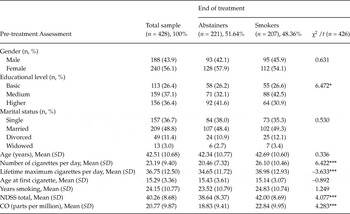
Of the 428 smokers that participated in the smoking cessation treatment, 221 were abstinent at the end of the treatment (51.64%) and 207 (48.36%) were still smoking.
Sociodemographic and cigarette consumption characteristics are shown in Table 1. Between the participants who were abstinent at the end of the treatment and those still smoking there were statistically significant differences in number of cigarettes smoked per day prior to the treatment, in lifetime maximum cigarettes smoked per day, in dependence scale (NDSS) score and in pre-treatment CO level. Those still smoking at the end of the treatment had significantly higher levels of dependence measured with the NDSS, t(426) = 4.077, p < .001, smoked a significantly higher mean number of cigarettes per day prior to the treatment, t(426) = 6.422, p < .001, had a significantly higher lifetime maximum cigarettes per day, t(426) = –3.633, p < .001, and presented a significantly higher mean CO level at the start of the treatment, t(426) = 4.283, p < .001. Moreover, statistically significant differences were found in educational level between participants who were abstinent at the end of the treatment and those who were still smoking, χ2 (1, N = 428) = 6.472, p < .05. However, after application of the Bonferroni correction between the different categories, this result was not statistically significant.
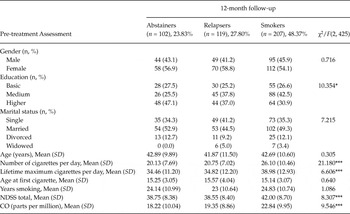
Taking as a reference the number of participants who were abstinent at the end of the treatment (n = 221), there were 119 relapses (53.85%) over the 12 months of follow-up, while the total number of participants remaining abstinent from the end of the treatment and throughout the follow-ups was 102 (46.15%). Sociodemographic and cigarette consumption characteristics of the three groups (abstinent, relapses, smokers) can be seen in Table 2.
Various statistically significant differences were found at the 12-month follow-up between participants still smoking at the end of the treatment, those who relapsed and those who remained abstinent. Those who were still smoking at the end of the treatment had significantly higher levels of dependence measured by the NDSS, F(2, 425) = 8.307, p < .001, smoked a significantly higher mean number of cigarettes per day prior to the treatment, F(2, 425) = 21.180, p < .001, had a significantly higher mean lifetime maximum number of cigarettes per day, F(2, 425) = 6.606, p < .001, and presented a significantly higher mean CO level at the beginning of the treatment, F(2, 425) = 9.546, p < .001. The Scheffé post hoc test revealed statistically significant differences between, on the one hand, participants still smoking at the end of the treatment, and on the other, those who relapsed and the abstainers (p < .05), in the above-mentioned variables. However, no significant differences were found between those who relapsed and those who remained abstinent. Moreover, statistically significant differences were observed between the three groups at the 12-month follow-up in educational level, χ2 (1, N = 428) = 10.354, p < .05. Nevertheless, after application of the Bonferroni correction between the groups, this result was not statistically significant.
Sociodemographic and cigarette consumption characteristics of participants

Note:
CO = Carbon monoxide; NDSS = Nicotine Dependence Syndrome Scale.
* p < .05; ***p <. 001.
Characteristics of the three groups (abstainers, relapsers, and smokers) at the 12-month follow-up

Note:
CO = Carbon monoxide; NDSS = Nicotine Dependence Syndrome Scale.
* p < .05; ***p < .001.
As far as the relapses are concerned (n = 119), 49 (41.2%) were in men and 70 (58.8%) were in women. On comparing relapses by gender, statistically significant differences emerged in marital status, number of cigarettes smoked per day prior to the treatment, age at first cigarette and dependence (NDSS). As regards marital status, χ2 (1, N = 119) = 11.020, p < .05, (Bonferroni correction p < .012), it was observed that among women who relapsed there was a significantly higher percentage of divorcees than among men (2.0% male vs. 14.3% female) and of widows than of widowers (0% male vs. 8.6% female), and a significantly lower percentage of married women than of married men (55.1% male vs. 37.1% female). With regard to number of cigarettes smoked per day prior to the treatment, it was found that women smoked a significantly lower mean number compared to men (23.04 male vs. 19.14 female), t(117) = 2.959, p < .01, that mean age at first cigarette was significantly higher than in men (14.69 male vs. 16.19 female), t(117) = –2.007, p < .05, and that their mean level of dependence was significantly higher (NDSS) than that of men (36.73 male vs. 39.81 female), t(117) = –1.994, p < .05.
Time point at which relapse occurred
Over the 12 months of follow-up, the highest percentage of relapses occurred in the first month (41.17%), followed by the first 3 months (28.57%), whilst the figures for 6 months and 12 months (14.29% and 15.97%, respectively) were much lower (relapses were fewer).
Degree of agreement between assessors in the classification of relapse episodes
Total level of agreement in the classification of 119 relapses among the three assessors, according to Marlatt’s relapse taxonomy, was 62.18%. However, the degree of agreement increased considerably on comparing the assessors two by two. Thus, for example, the degree of agreement between assessor 1 and assessor 2 was 70.59% (κ = .67), between 1 and 3, 72.27% (κ = .69), and between 2 and 3, 78.15% (κ = .75). It is important to note that when there were discrepancies between assessors, the majority were within the third-level subcategories, so that the categorization was made following the scoring rules and the hierarchies and priorities of the categories. In four cases (3.36%) there were discrepancies between the three assessors. In order to reach agreement there was a fourth assessor (expert in this area), who resolved the discrepancies between the three assessors by selecting the agreement between two of them or obtaining a consensus on the classifications made by the three assessors following the scoring rules of the taxonomy.
Categorization of relapse episodes by time points
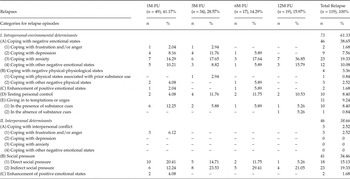
Of the 119 relapses, a total of 49 occurred in the first month (41.17%), of which 23.53% were attributed to intrapersonal-environmental determinants, whilst 17.65% were attributed to interpersonal determinants. Within the intrapersonal-environmental determinants, coping with negative emotional states was the first relapse situation (14.29%), followed by giving in to temptations or urges (5.04%), testing personal control (1.68%), coping with negative physical-physiological states (1.68%), and finally, enhancement of positive emotional states (.84%). Within the interpersonal determinants, social pressure occupied first place as the relapse situation (13.45%), followed by coping with interpersonal conflict (2.52%) and enhancement of positive emotional states (1.68%).
In the follow-up at 3 months there were 34 relapses (28.57%). As occurred in the 1-month follow-up, intrapersonal-environmental determinants emerged as the principal relapse situations, with 17.65%, as against 10.92% attributed to interpersonal determinants. Within the intrapersonal-environmental determinants, coping with negative emotional states was the first relapse situation (11.6%). This was followed by testing personal control (3.36%), giving in to temptations or urges (1.68%) and coping with negative physical-physiological states (.84%). Within the interpersonal determinants, social pressure was the only relapse situation found (10.92%).
At 6 months there were 17 relapses (14.29%), 8.40% of which were attributed to intrapersonal-environmental determinants and 5.88% to interpersonal determinants. Within the intrapersonal-environmental determinants, coping with negative emotional states was the first relapse situation (4.20%), followed by testing personal control (1.68%). These were followed by – all with the same percentage (.84%) – giving in to temptations or urges, coping with negative physical-physiological states and enhancement of positive emotional states. Within the interpersonal determinants, social pressure emerged as the only relapse situation (5.88%), as was the case in the 3-month follow-up.
Finally, in the follow-up at 12 months, there were 19 relapses (15.97%), the highest percentage of which – as occurred in the earlier follow-ups – were attributed to intrapersonal-environmental determinants (11.76%), with 4.20% attributed to interpersonal determinants. Within the intrapersonal-environmental determinants, coping with negative emotional states, as in the earlier follow-ups, was the primary relapse situation (8.40%), followed by testing personal control and giving in to temptations or urges (1.68% for each of them). Within the interpersonal determinants, social pressure was the only relapse situation (4.20%).
In the categorization of all 119 relapses according to Marlatt’s taxonomy (see Table 3), it was observed that intrapersonal-environmental determinants occurred in 61.33% of relapses, as against 38.66% that were attributed to interpersonal determinants. Within the intrapersonal-environmental determinants, coping with negative emotional states was the primary relapse situation (38.65%). This was followed by giving in to temptations or urges (9.24%), testing personal control (8.40%), coping with negative physical-physiological states (3.36%) and finally, enhancement of positive emotional states (1.68%). Within the interpersonal determinants, social pressure was the principal relapse situation (34.46%), followed by coping with interpersonal conflict (2.52%) and enhancement of positive emotional states (1.68%).
Comparison by gender between the two categories of the first level of the taxonomy (intrapersonal-environmental determinants and interpersonal determinants) and the different variables (age, education, marital status, number of cigarettes smoked per day prior to the treatment, lifetime maximum cigarettes smoked per day, age at first cigarette, years smoking, dependence (NDSS) and CO level) yielded no significant differences.
Marlatt’s taxonomy of relapse precipitants in the smokers (n = 119)

Note:
FU = Follow-up.
Discussion
The aim of this study was to identify the relapse situations, according to Marlatt’s relapse taxonomy, in a sample of smokers that participated in a cognitive-behavior psychological treatment for smoking cessation and who were followed up over a period of 12 months. The results of the study indicated that of the 119 relapses that occurred, the majority were attributed to intrapersonal-environmental determinants (61.33%) more than to interpersonal determinants (38.66%). By subcategories, coping with negative emotional states (anger, frustration, depression, anxiety) and social pressure to smoke were the most common reasons for relapse, with 38.65% and 34.46%, respectively. This same result was found in the majority of studies carried out by Marlatt (1985) and Marlatt and Gordon (1985) and by other researchers (Cummings et al., Reference Cummings, Gordon, Marlatt and Miller1980; Hodgins et al., 1995; Lowman et al., Reference Lowman, Allen, Stout and Relapse1996; O’Connell & Martin, 1987). Thus, for example, of the 511 relapses analyzed by O’Connell and Martin (1987), the highest percentage was attributed to intrapersonal-environmental determinants, with 52%, while 48% were attributed to interpersonal determinants. Moreover, these same researchers (O’Connell & Martin, 1987) found that within the intrapersonal-environmental determinants, the highest percentage (30%) occurred in the subcategory coping with negative emotional states, followed by social pressure (28%), in the interpersonal subcategory. In the other studies, coping with negative emotional states was the most frequently-found relapse situation, followed by social pressure. Both in the original study of relapse taxonomy by Marlatt and Gordon (Reference Marlatt and Gordon1985) and in the replication of their taxonomy by Lowman et al. (Reference Lowman, Allen, Stout and Relapse1996), negative affect was the best predictor of relapse. Social pressure has also been commonly identified as a precipitant of relapse, though less frequently than negative emotions (Chaney, O’Leary, & Marlatt, Reference Chaney, O’Leary and Marlatt1978; Hodgins et al., 1995).
The finding that situations of coping with negative emotional states are high-risk contexts for relapse is consistent with research that associates negative affect with a higher probability of relapse (Baker, Piper, McCarthy, Majeskie, & Fiore, Reference Baker, Piper, McCarthy, Majeskie and Fiore2004; Piasecki, Reference Piasecki2006; Shiffman, Paty, Gnys, Kassel, & Hickcox, Reference Shiffman, Paty, Gnys, Kassel and Hickcox1996); it also consistent with the various research findings that establish a relationship between smoking and depression (Berlin, Covey, & Glassman, Reference Berlin, Covey and Glassman2009; Glassman et al., Reference Glassman, Helzer, Covey, Cottler, Stetner, Tipp and Johnson1990; Lasser et al., Reference Lasser, Boyd, Woolhandler, Himmelstein, McCormick and Bor2000), showing that smokers with depression who try to give up may experience a state of dysphoria that can trigger relapse.
The results of the present study also showed that the majority of relapses occurred in the first three months (69.74% of them). These findings coincide with those of other studies in which the majority of relapses occur in the first three months after smoking cessation (Hughes et al., Reference Hughes, Keely and Naud2004; Hunt, Barnett, & Branch, Reference Hunt, Barnett and Branch1971; Míguez & Becoña, Reference Míguez and Becoña2008; Ockene et al., Reference Ockene, Emmons, Mermelstein, Perkins, Bonollo, Voorhees and Hollis2000; Shiffman et al., Reference Shiffman, Paty, Gnys, Kassel and Hickcox1996). Moreover, it was observed that most relapses actually occurred during the first month after quitting (41.17%). Once this period had been surpassed, the incidence of relapse began decreasing, though further relapses did occur. This is in support of previous research results indicating that the determinants of early and late relapse may be qualitatively different (Piasecki et al., Reference Piasecki, Fiore, McCarthy and Baker2002). It is worthy of note that at the 3-month follow-up we could observe a difference in the classification of the relapse situations compared to the first month, since at 3 months “testing personal control” was given as the situation of more than double the number of relapses as in the first month (11.76% vs. 4.08%). The same occurs, but in reverse, with the attribution to “giving in to temptations or urges”, which is twice as common in the first month as at 3 months (12.25% vs. 5.88%). This suggests that the urge to smoke may decrease from the end of the treatment onwards, so that it is higher when the program finishes and decreases with time. The explanation for this finding may reside in the difference between early and late relapses (Piasecki et al., Reference Piasecki, Fiore, McCarthy and Baker2002; Shiffman, Reference Shiffman2006). We know that the determinants of early and late relapses are qualitatively different: whilst early relapses may reflect the influence of physiological factors (dependence, high levels of desire, craving and other withdrawal symptoms), late relapses may be indicative of random processes (chance exposure to a stressor, variations in self-efficacy, etc.), making them more difficult to predict (Piasecki et al., Reference Piasecki, Fiore, McCarthy and Baker2002; Shiffman, Reference Shiffman2006).
As regards the differences found in relation to smoking variables between participants who continued smoking at the end of the treatment and those who gave up, it was observed that those who carried on smoking had significantly higher nicotine dependence. This is in line with previous research findings that nicotine dependence is one of the variables responsible for maintaining smoking behavior, is the best predictor of results at treatment completion and at follow-ups, and is a robust predictor of severity of withdrawal syndrome and relapse (Breslau & Johnson, Reference Breslau and Johnson2000; Fiore et al., Reference Fiore, Jaén, Baker, Bailey, Benowitz, Curry and Wewers2008; Shiffman et al., Reference Shiffman, Waters and Hickcox2004; Zhou et al., Reference Zhou, Nonnemaker, Sherrill, Gilsenan, Coste and West2009). Likewise, Powell, Dawkins, West, Powell, and Pickering (2010) found that nicotine dependence indices were strong predictors of relapse, reflecting a well-documented tendency of more dependent smokers to have more difficulty giving up. On the other hand, we know that low nicotine dependence has been associated with greater likelihood of quitting smoking (Ferguson et al., Reference Ferguson, Patten, Schroeder, Offord, Eberman and Hurt2003).
As regards the differences found according to gender, the results are in line with those from research reporting that being male, being married and having low levels of nicotine addiction are preventive factors for smoking relapse (Ferguson et al., Reference Ferguson, Patten, Schroeder, Offord, Eberman and Hurt2003; Ockene et al., Reference Ockene, Emmons, Mermelstein, Perkins, Bonollo, Voorhees and Hollis2000).
It is important to say that, as most part of the researches carried out in the 80s (Bliss, Garvey, Heinold, & Hitchcock, Reference Bliss, Garvey, Heinold and Hitchcock1989; O’Connell & Martin, 1987), the assessment of relapse is retrospective. In other words, participants provide data when they recall how the relapse occurred, we assess the relapse episode weeks and months after the relapse occurred. Participants use their memory to reconstruct relapses situations, and so this influences the relapse reconstruction in order to bring coherence to the telling in relation to the explanation of the situation. Therefore, it may be distortions (Hammersley, Reference Hammersley1994; Shiffman et al., Reference Shiffman, Hufford, Hickcox, Paty, Gnys and Kassel1997). Improvements on the methodology have made evaluations more accurate, in particular the use of ecological momentary assessment (EMA; Stone & Shiffman, Reference Stone and Shiffman1994) and real time evaluation methodologies. Future researches must insist on this methodology.
Finally, we should point out that our study is not without certain limitations. First of all, Marlatt’s relapse taxonomy is a mutually exclusive system, permitting the identification of just one precipitant, normally that which is closest in time to the relapse. There is a somewhat reductionist tendency, therefore, to focus exclusively on the event immediately prior to the relapse, and this may be inadequate. The approach is excessively hierarchical, on coding the relapse situations, involving a tendency to judge the majority of relapse situations as intrapersonal and environmental, since that is the category occupying first place. This limitation inherent to the classification scheme – also addressed by Maisto, Connors and Zywiak (Reference Maisto, Connors and Zywiak1996); and Stout, Longabaugh and Rubin (Reference Stout, Longabaugh and Rubin1996) on carrying out the replication and extension of Marlatt’s taxonomy –raises questions about the validity and rigor of the results on describing the relapse situations. Hence, the results referring to the relapse situations must be treated with caution. And secondly, the assessment of relapse on the part of smokers themselves is a retrospective evaluation they make on trying to recall why they relapsed, which can be affected by the passage of time and the person’s memory capacity, so that it is subjective, and may fail to include important data. In fact, parts of the precipitants of relapse in this research were assessed several weeks or months after the relapse occurred. Therefore, when we assess the relapse, the autobiographical memory of the participant plays a critical role on the reconstruction of relapse situations. Although we were aware of this limitation of using a retrospective methodology, we used it for two reasons. The first is economic: it would not be viable to provide each smoker with an electronic diary. It must be borne in mind that we started out with a sample of 428 smokers, 221 remaining as non-smokers at the end of the treatment, and being followed up over 12 months for analysis of their relapse. The second reason for a retrospective methodology was that we set out to study Marlatt’s taxonomy as devised in 1996, with the limitations inherent to that classification scheme and the methodology employed. Given the limitations of using this type of retrospective methodology, the results should be considered with caution. Although it is true that Marlatt and Witkiewitz (Reference Marlatt, Witkiewitz, Marlatt and Donovan2005) and Witkiewitz and Marlatt (Reference Witkiewitz and Marlatt2004), in their reconceptualization of the relapse model, encourage researchers to use more dynamic data collection tools, such as ecological momentary assessment (EMA; Stone & Shiffman, Reference Stone and Shiffman1994) for assessing relapse and gaining greater knowledge about this complex process, one of the weak points of this coding system, as with many other assessment schemes used in addictive behavior, concerns the confidence in the information reported by the participants themselves, and the possibility of assessment problems with such tools (e.g., participants who are irresponsible or do not use them properly). Moreover, electronic devices are time-consuming (participants have to have them to hand and remember them all day), are more invasive than simple paper and pencil, and lead to high rates of participant attrition and non-response (Marlatt & Witkiewitz, Reference Marlatt, Witkiewitz, Marlatt and Donovan2005).
The limitations of Marlatt’s classification scheme were identified by the Relapse Replication and Extension Project (RREP) group, which replicated and extended Marlatt’s taxonomy of the precipitants of relapse, with a view to assessing its reliability and validity, finding mixed results in support of the scheme. On analyzing its reliability, the RREP group found it to be highly variable across the different studies carried out (Longabaugh et al., Reference Longabaugh, Rubin, Scout, Zywiak and Lowman1996). Therefore, they suggested a review of the taxonomy’s categories, placing more emphasis on craving, and focusing less on the hierarchy when coding the relapse episode. The category in which they found the most consistency was that of intrapersonal negative emotions. In fact, the RREP group found that negative emotional states were identified as the most common high-risk situations for relapse (Lowman et al., Reference Lowman, Allen, Stout and Relapse1996). As regards the predictive validity of Marlatt’s original taxonomy, the RREP studies found little positive evidence for it (Maisto et al., Reference Maisto, Connors and Zywiak1996; Stout et al., Reference Stout, Longabaugh and Rubin1996). Thus, to advance our knowledge and understanding of relapse, the RREP researchers recommended changing components of the taxonomic system in order to increase its reliability (Longabaugh et al., Reference Longabaugh, Rubin, Scout, Zywiak and Lowman1996). Likewise, they stressed the need to develop theoretical models and assessment instruments and for increased empirical knowledge (Donovan, Reference Donovan1996; Kadden, Reference Kadden1996). In response to the criticisms made by the RREP group (Donovan, Reference Donovan1996; Kadden, Reference Kadden1996; Longabaugh et al., Reference Longabaugh, Rubin, Scout, Zywiak and Lowman1996), as well as to other criticism of the Relapse Prevention and the Cognitive-Behavior Model of relapse (Allsop & Saunders, Reference Allsop, Saunders and Gossop1989; Heather & Stallard, Reference Heather, Stallard and Gossop1989; Marlatt and his team set about reconceptualizing the relapse model, making it more complex and dynamic (Witkiewitz & Marlatt, Reference Witkiewitz and Marlatt2004). Thus, the model is no longer based on hierarchical assumptions; that is, there are no longer categories or factors that have more influence than others.
In conclusion, the present study contributes to improving knowledge about the relapse process and the relapse situations, in smokers participating in a psychological treatment for smoking cessation. Furthermore, this research contributes to providing knowledge about relapse situations in our country given that there are barely researches on this topic. Its results indicate that the principal relapse situation is coping with negative emotional states at the intrapersonal and environmental levels, which accounts for 39% of relapses, followed by social pressure to smoke (34.46%). These findings are similar to those from Marlatt’s original studies (Marlatt, Reference Marlatt, Marlatt and Gordon1985; Marlatt & Gordon, Reference Marlatt and Gordon1985), in which negative emotional states and exposure to social pressure constituted the principal high-risk situations for relapse in addictive behavior. Given that relapse is a complex process and forms part of the smoking cessation process itself, there is a need for more research and better knowledge of the determinants of the relapse process, with a view to developing more effective interventions for the prevention and management of relapse.
This study was funded by the Spanish Ministerio de Ciencia e Innovación (National Program for Basic Research Projects). Project reference: PSI2008–02597/PSIC. Bárbara Piñeiro is the beneficiary of a Pre-Doctoral Research Training Grant (FPI) from the Spanish Ministerio de Ciencia e Innovación, reference BES–2009–012929. The authors are grateful to Elena Fernández del Río, Ana López, María del Carmen Míguez, Úrsula Martínez and Paula Cid for their participation and assistance in the evaluation of relapse episodes and revision of the manuscript.