INTRODUCTION
In 2005, Hurricane Katrina wrought unimaginable havoc upon those inhabiting the gulf coast of the United States. The impact of Hurricane Katrina on cardiovascular disease and the incidence of acute myocardial infarction (AMI) have been demonstrated after the storm for at least 6 years in downtown New Orleans at the Tulane University Health Sciences Center (TUHSC).Reference Gautam, Menachem and Srivastav 1 - Reference Peters, Moscona and Katz 3 The increased 6-year, post-Katrina incidence of AMI has been associated with higher rates of both cardiovascular comorbidities and psychosocial risk factors associated with cardiovascular disease. However, fully understanding this phenomenon is difficult. Mental stress associated with psychosocial risk factors and other determinants of health, such as employment status, homelessness, social support, insurance coverage, and access to health care, may impact the affected population but can be challenging to quantify accurately.Reference Havranek, Mujahid and Barr 4 Previous aims have been to elucidate more clearly the factors that influence the incidence of AMI. Additionally, the typical chronobiology of AMI on Mondays and mornings has also appeared to change into a different timing pattern of AMI, occurring mainly during nights and weekends in the affected patients.Reference Peters, Katz and Moscona 5 All of these findings suggest that Hurricane Katrina may have influenced the development of myocardial infarction and the factors that contribute to its pathogenesis in patients treated at our institution in downtown New Orleans.
Over the early part of the 21st century, the incidence of worldwide natural disasters has increased sixfold compared with the previous 5 decades.Reference Guha-Sapir and Hoyois 6 Recently, a 4-year increased incidence of myocardial infarction in areas affected by the Japanese earthquake and tsunami in 2011 has been reported, suggesting a similar impact to what we have observed at our center in New Orleans post-Katrina.Reference Nakamura, Tanaka and Komi 7 Both Hurricanes Sandy and Matthew serve as even more recent examples of massive storms to pummel the United States along its eastern seaboard. Notably, an increased incidence of AMI and associated mortality was seen in New Jersey during the immediate aftermath of Hurricane Sandy, which echoes the results of prior investigations into the short-term effects of natural disasters on the incidence of AMI, that is, the 1994 Northridge earthquake in Los Angeles, California, and the 1995 Hanshin-Awaji earthquake in Japan.Reference Swerdel, Janevic and Cosgrove 8 - Reference Suzuki, Sakamoto and Koide 10
AMI levels at TUHSC in New Orleans have not yet demonstrated any remitting to pre-Katrina levels since the storm.Reference Peters, Moscona and Katz 3 Our prior investigations differ from most other studies by focusing on the long-lasting effects of Hurricane Katrina on patients treated at TUHSC in New Orleans rather than the short-term aftermath of the storm. Additionally, ours is a single-site study rather than an investigation of the entire affected population. Specifically, we are investigating the lasting impact of Hurricane Katrina on AMI incidence for patients treated at our institution and whether AMI incidence, the prevalence of associated risk factors, and altered chronobiology have returned to pre-Katrina levels or continue to persist 10 years post-Katrina. The primary aim of this study was to compare the incidence of AMI in patients who presented to TUHSC during the 2 years before Katrina and 10 years post-Katrina. Our secondary goals included an evaluation of demographic and clinical data associated with any change in AMI incidence and determination of any alteration of the chronobiology of AMI, which is an area of study where data are scarce.
METHODS
Study Population and Design
Ours is a single-center retrospective observational study at TUHSC of patients admitted with AMI to compare the incidence of AMI, associated demographic and clinical risk factors, and the chronobiology between pre- and post-Katrina groups. Patients with AMI were first identified by using the International Classification of Diseases, 9th Revision (ICD-9), codes 410.1-410.9 and the 10th Revision, I21.0-I21.4, which are codes used for AMI. Of those identified by ICD codes, patients with all of the following criteria were selected as AMI patients to be included in this study: ischemic symptoms at rest, lasting at least 10 minutes, within 24 hours of hospital presentation (ischemic symptoms were defined as chest pain or angina equivalents), and elevated cardiac troponin I above the upper limit of normal (as defined per the TUHSC biochemistry laboratory). The exclusion criteria for the study were age younger than 18 years and a nonspecific increase in serum troponin in the presence of a severe non-cardiac systemic illness, including sepsis, renal failure, and hypovolemic shock.
For AMI incidence, patients admitted from August 29, 2003, to August 28, 2005, were considered as the pre-Katrina cohort. Comprehensive TUHSC hospital admission data were not available before 2003, which limited the percentage of admission of AMI to only 2 years pre-Katrina. However, to evaluate pre-Katrina demographic, clinical, and chronobiological data, we were able to identify and assess data over 6 pre-Katrina years from the medical record: August 29, 1999, to August 29, 2005 (the day that Hurricane Katrina struck New Orleans). TUHSC resumed comprehensive, on-site cardiac catheterization services post-Katrina on February 14, 2006. To examine post-Katrina AMI incidence, risk factors, and chronobiology, patients admitted with AMI from February 14, 2006, to February 13, 2016, were identified in the same manner as the pre-Katrina cohort and were considered as the post-Katrina cohort. AMI incidence, demographic, clinical, and chronobiological data were accessed from the medical record for the post-Katrina group for the 10-year time period: February 14, 2006 (the day that TUHSC became the first downtown medical center to reopen), to February 13, 2016.
The incidence of AMI was based on the percentage of admissions for AMI and was calculated by dividing the number of AMI admissions by the total number of TUHSC admissions. All clinical and demographic information was obtained from admission nurse triage reports, physician history and progress notes, and results of testing as documented within the medical record. The demographic and clinical data used for comparison include sex; ethnicity; medical comorbidities, including coronary artery disease, prior coronary artery bypass graft surgery, diabetes mellitus, hypertension, hyperlipidemia, smoking, drug abuse, psychiatric illness; unemployment; lack of insurance; and medication non-adherence. Employment status included participation in both full- and part-time jobs. Chronobiological data consisted of the timing of symptom onset, including days of the week for AMI. Specifically excluded from chronobiological analysis were patients with inadequate documentation of the timing of symptom onset. Data regarding clear local or state residency status post-Katrina were inadequately documented and therefore not included in the data acquisition and analysis.
Medical professionals with experience in chart review compiled the study data used for analysis. The study data were entered into a standardized Microsoft Excel worksheet. A statistician was blinded to the hypothesis and received a revised data sheet with alphabetical coding of the study parameters. All data were statistically analyzed to detect any difference in the incidence of AMI, demographic and clinical data, and chronobiological data in the pre- and post-Katrina cohorts. The institutional review board at the Tulane Office of Human Research Protection approved the study, waiving the requirement for informed consent.
Statistical Analyses
Descriptive results, such as frequency and percentage, were reported for all of the variables studied. The chi-square and Fisher exact tests were performed for non-uniformity between cohorts. A two-sided 5% significance level was used throughout the analyses. All of the statistical analysis tests were performed with Statistical Analysis Software 9.1 (SAS Institute, Cary, NC).
RESULTS
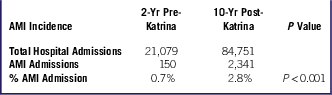
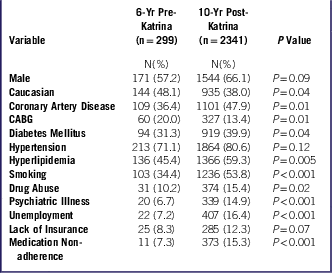
The incidence of AMI was calculated as the number of AMI admissions divided by the total number of admissions at TUHSC. This percentage increased from 0.7% (150/21,079) in the 2-year, pre-Katrina group to 2.8% (2,341/84,751) in the 10-year, post-Katrina group, as shown in Table 1 (P< 0.001). The demographic and clinical data for a total of 2,341 post-Katrina AMI patients were analyzed and compared with a 6-year, pre-Katrina cohort of 299 patients with all percentages and associated P values shown in Table 2 . The post-Katrina cohort comprised significantly fewer Caucasians than the pre-Katrina group. There were also significantly higher rates of previously diagnosed coronary artery disease, diabetes mellitus, hyperlipidemia, smoking, drug abuse, psychiatric illness, medication non-adherence, and lack of employment. Hypertension and lack of insurance were also increased, but percentages did not reach statistical significance.
Ten-Year Incidence of Acute Myocardial Infarction (AMI) Before and After Hurricane Katrina

Demographic and Clinical Factors Before and After Hurricane KatrinaFootnote a

a Abbreviation: CABG, coronary artery bypass grafting.
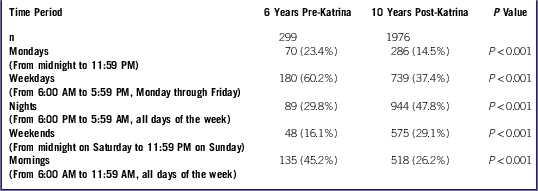
After exclusion for inadequate documentation of symptom onset, we performed an AMI chronobiology analysis of 299 pre-Katrina (6 years total) and 1,976 post-Katrina (10 years total) patients. The comparison of pre-Katrina and post-Katrina groups revealed significantly decreased AMI rates during Mondays, mornings, and weekdays and significantly increased rates of AMI during nights and weekends in the post-Katrina group. The chronobiology percentages and associated P values are shown in Table 3 .
Chronobiology Acute Myocardial Infarction (AMI) Before and After Hurricane Katrina (10 Years Post-Katrina)

DISCUSSION
After 10 years of study, our institutional findings in post-Katrina New Orleans indicate that the increased incidence of AMI and altered chronobiology, evident early and up to 6 years after the storm, have persisted longer than expected.Reference Gautam, Menachem and Srivastav 1 - Reference Peters, Moscona and Katz 3 , Reference Peters, Katz and Moscona 5 The incidence of AMI appears to be associated not only with worsening medical disease, but also with increased chronic psychosocial stressors and adverse behaviors in the 10-year, post-Katrina cohort. In the original 2-year, post-Katrina investigation, significant differences were observed only in behavioral and psychosocial risk factors, including unemployment, lack of insurance, smoking, and substance abuse, whereas coronary artery disease and traditional comorbid associations, such as diabetes and hyperlipidemia, were not different between the pre- and post-Katrina groups. However, as time has progressed, the prevalence of medical disease in the post-Katrina population has significantly increased, perhaps hinting at a compounding effect of chronic mental stress and adverse behaviors on the development of medical comorbidities and AMI.
Ours is not the only study that considers the association of psychological morbidity with cardiac disease. End-stage renal disease patients in New Orleans who developed a depression in the year after Hurricane Katrina were reported to have an increased risk of cardiovascular hospitalization and mortality.Reference Edmondson, Gamboa and Cohen 11 The concept of mental stress-induced myocardial ischemia (MSIMI) has been experimentally noted in patients with and without exercise-induced myocardial ischemia.Reference Jiang, Samad and Boyle 12 MSIMI defined on echocardiography as wall motion abnormalities and reduction in ejection fraction appears to occur at significantly higher rates than exercise-induced ischemia, suggesting the independence of psychological stress on the development of ischemia. Furthermore, escitalopram treatment has been associated with significantly reduced rates of MSIMI, indicating that treatment of mental stress might be able to reduce ischemia.Reference Jiang, Velazquez and Kuchibhatia 13
The contribution of psychosocial risk factors to the development of coronary artery disease has been well documented.Reference Jiang, Samad and Boyle 12 - Reference Jiang 19 In terms of molecular pathophysiology, psychosocial stress can influence the central nervous output of the autonomic system affecting blood flow, endothelial response, decreased fibrinolysis, increased inflammation, and enhanced platelet reactivity.Reference Soufer, Jain and Yoon 20 - Reference Koudouovoh-Tripp and Sperner-Unterweger 24 In the New Orleans population, demographic studies have reported high rates of psychological stress, posttraumatic stress disorder, suicide, and lack of medical care in New Orleans after Hurricane Katrina, which all potentially activate these pathologic mechanisms.Reference DeSalvo, Sachs and Hamm 25 - Reference Kessler, Galea, Jones and Parker 27
The other significant finding in our study involves the disruption of typical chronobiological patterns of AMI. Myocardial infarction and sudden cardiac death appear to have a typical peak incidence during the morning and on Monday compared with other days of the week.Reference Willich, Klatt and Arntz 28 The morning increase in events begins upon standing after waking with an increase in sympathetic nervous system activation.Reference Muller 29 However, the post-Katrina patients had a higher incidence of AMI on nights and weekends compared with mornings. The post-Katrina alteration in the chronobiological pattern of AMI might be explained as a disruption of circadian rhythm due to chronic psychosocial stress with resultant chronic sympathetic activation. Overall, data regarding the chronobiology of specific acute or chronic cardiac conditions are rare. Takotsubo cardiomyopathy, which is caused by an acute stressor, appears to have a morning preference for symptom onset similar to typical AMI.Reference Manfredini, Manfredini and Fabbian 30 However, obstructive sleep apnea, which is a chronic condition, seems to have a peak in sudden cardiac death between midnight and 6:00 AM, similar to our post-Katrina cohort and perhaps also mediated by chronic sympathetic stimulation.Reference Gami, Howard and Olson 31 Theorizing an explanation is difficult due to the dearth of data examining circadian patterns of disease, and additional study is needed to better understand this phenomenon.
Ultimately, the question remains as to whether chronic mental stress can act as a direct trigger for AMI or whether stress mainly influences behavioral patterns that contribute to worsening cardiovascular disease and risk factors resulting in AMI. Regardless, medical professionals should be aware of how Hurricane Katrina appears to have impacted the cardiovascular health of the patients treated at our institution. Our findings should raise awareness of the heightened cardiovascular, psychosocial, and behavioral risks not only in this population, but also in any population that might have been or might become impacted by a natural disaster. The identification of individuals and communities at higher risk for worsening cardiovascular disease post-disaster and how to limit the effect of that disaster should be emphasized in future research.
Importantly, there are many limitations of our study. Diverse competing factors can affect the health, morbidity, and mortality of a study population over the course of an extended period of time, and it is challenging to perform a statistical analysis that adequately controls all such factors. Only a univariate analysis of our data was performed. Other social determinants of health, such as community support or access to health care, may also explain our findings, although the measurement of such variables was not part of the patients’ medical records included in the study. New Orleans underwent several population shifts after Hurricane Katrina. The population decreased from nearly 460,000 at the time that the storm struck in 2005 to around 230,000 in 2006 before growing to approximately 385,000 in 2015.Reference Plyer 32 The demographics have also changed with about 97,000 fewer African Americans living in New Orleans, comprising 58 percent of the city’s total population, which is decreased from 66 percent in 2000. An overall reduction in the New Orleans population may have led to a decrease in non-AMI admissions, and the closure of other hospitals might have contributed to increased AMI referrals to TUHSC. Additionally, patient residency status, clearly noting those who were impacted by Hurricane Katrina, was inadequately documented and not included in our data analysis. We should also emphasize that the population under study at TUHSC post-Katrina represents only a single center, and generalizing the results to the entire affected population is difficult. The incorporation of multicenter data from all acute care hospitals within New Orleans would provide higher quality of information and reduce selection bias. Higher rates of cardiovascular risk factors in the post-Katrina group may also indicate that the population of patients who returned to downtown New Orleans after Hurricane Katrina is less healthy at baseline than the pre-Katrina New Orleans population. We do not have information on rates of non-cardiac comorbidities such as chronic obstructive pulmonary disease or malignancy. The higher incidence of AMI may be explained by a worsened baseline health status of the post-Katrina population rather than the hurricane itself. Discordant sample sizes with a large difference between the number of AMI admissions pre- and post-Katrina may have also impacted our results.
CONCLUSION
Hurricane Katrina appears to have affected the long-term incidence of AMI and an altered chronobiology toward nights and weekends, even 10 years after the event. Both a higher prevalence of traditional cardiovascular risk factors and chronic psychosocial stressors have likely contributed to the increased incidence of AMI. These risk factors appear to have had a more lasting impact than previously realized, and further research performed in multiple sites around New Orleans and in other disaster-affected areas could provide additional data to evaluate our findings.