Introduction
Seagrass beds are widely distributed in shallow coastal and estuarine areas from tropical to arctic regions (Short et al., Reference Short, Carruthers, Dennison and Waycott2007), typically supporting large numbers of fish species and individuals compared with adjacent unvegetated areas (Guidetti, Reference Guidetti2000; Heck et al., Reference Heck, Hays and Orth2003; Tuya et al., Reference Tuya, Boyra, Sanchez-Jerez and Haroun2005). It is generally considered that seagrass beds provide important nursery and feeding grounds for various fishes, including commercially important and endangered species (Gray et al., Reference Gray, McElligott and Chick1996; Heck et al., Reference Heck, Hays and Orth2003; Dorenbosch et al., Reference Dorenbosch, Grol, Nagelkerken and van der Velde2006; Nagelkerken, Reference Nagelkerken and Nagelkerken2009). For example, in tropical/subtropical regions, juvenile reef fishes, such as from the families Haemulidae, Lethrinidae and Lutjanidae, utilize seagrass beds before moving to nearby coral reefs where they remain as adults, due to seagrass beds functioning as effective juvenile habitats with higher food availability and/or lower predation risks (Grol et al., Reference Grol, Nagelkerken, Rypel and Layman2011; Nakamura et al., Reference Nakamura, Hirota, Shibuno and Watanabe2012; Berkström et al., Reference Berkström, Jörgensen and Hellström2013). Therefore, seagrass beds are considered essential for maintaining high levels of biodiversity in coastal ecosystems and supporting local fisheries.
However, seagrass beds have been rapidly lost and degraded around the world due to natural and/or anthropogenic causes, including climate change, overharvesting by mega herbivores, coastal urbanization and vessel grounding (Waycott et al., Reference Waycott, Duarte, Carruthers, Orth, Dennison, Olyarnik, Calladine, Fourqurean, Heck, Hughes, Kendrick, Kenworthy, Short and Williams2009; Christianen et al., Reference Christianen, Herman, Bouma, Lamers, van Katwijk, van der Heide, Mumby, Silliman, Engelhard, van de Kerk, Kiswara and van de Koppel2014). The loss of such beds results in a decrease in nursery and feeding grounds of seagrass-associated fishes, typically resulting in a significant decrease in numbers of fish species and individuals (Hughes et al., Reference Hughes, Deegan, Wyda, Weaver and Wright2002; Nakamura, Reference Nakamura2010; Inoue et al., Reference Inoue, Mizutani, Nanjo, Tsutsumi and Kohno2021). Accordingly, conservation of seagrass beds and associated fishes is a growing priority. For effective conservation and management of seagrass fishes, a greater understanding of their dependency on seagrass beds is necessary.
Analyses of feeding patterns and trophic guild structures of seagrass fish assemblages are common approaches for understanding habitat use and habitat dependence of fishes. However, most of the many studies on the feeding habits of seagrass fishes have focused on temperate habitats (Kikuchi, Reference Kikuchi1966; Adams, Reference Adams1976; Livingston, Reference Livingston1982; Bell & Harmelin-Vivien, Reference Bell and Harmelin-Vivien1983; Burchmore et al., Reference Burchmore, Pollard and Bell1984; Hanekom & Baird, Reference Hanekom and Baird1984; Robertson, Reference Robertson1984; Whitfield, Reference Whitfield1988; Edgar & Shaw, Reference Edgar and Shaw1995; Hindell et al., Reference Hindell, Jenkins and Keough2000; Horinouchi & Sano, Reference Horinouchi and Sano2000). Although the diet of a number of fish assemblages in tropical seagrass beds has been reported (e.g. Carr & Adams, Reference Carr and Adams1973; Heck & Weinstein, Reference Heck and Weinstein1989; Motta et al., Reference Motta, Clifton, Hernandez, Eggold, Giordano and Wilcox1995; Nagelkerken et al., Reference Nagelkerken, Dorenbosch, Verberk, Cocheret de la Morinière and van der Velde2000; Nagelkerken & van der Velde, Reference Nagelkerken and van der Velde2004; Vaslet et al., Reference Vaslet, France, Phillips, Feller and Baldwin2011; Kwak et al., Reference Kwak, Klumpp and Park2015; Dromard et al., Reference Dromard, Vaslet, Gautier, Bouchon-Navaro, Harmelin-Vivien and Bouchon2017), feeding habit analyses targeting entire fish assemblages in tropical and subtropical regions are relatively uncommon (Robblee & Zieman, Reference Robblee and Zieman1984; Nakamura et al., Reference Nakamura, Horinouchi, Nakai and Sano2003; Nagelkerken et al., Reference Nagelkerken, van der Velde, Verberk and Dorenbosch2006; Horinouchi et al., Reference Horinouchi, Tongnunui, Furumitsu, Nakamura, Kanou, Yamaguchi, Okamoto and Sano2012; Lee et al., Reference Lee, Huang, Chung and Lin2014).
The trophic guild structures of seagrass fish assemblages vary over broad regional scales. For example, in temperate seagrass beds, small crustacean feeders consuming harpacticoid copepods and gammaridean amphipods, and zooplankton feeders feeding on calanoid copepods, have been considered dominant in the fish assemblages (Burchmore et al., Reference Burchmore, Pollard and Bell1984; Hanekom & Baird, Reference Hanekom and Baird1984; Robertson, Reference Robertson1984; Edgar & Shaw, Reference Edgar and Shaw1995; Horinouchi & Sano, Reference Horinouchi and Sano2000), whereas in tropical/subtropical seagrass beds, large crustacean feeders preying upon crabs and shrimps were abundant in the assemblage, as well as similarly sized small crustacean feeders (Nakamura et al., Reference Nakamura, Horinouchi, Nakai and Sano2003; Horinouchi et al., Reference Horinouchi, Tongnunui, Furumitsu, Nakamura, Kanou, Yamaguchi, Okamoto and Sano2012; Kwak et al., Reference Kwak, Klumpp and Park2015). Furthermore, the major food items for each fish species occurring in seagrass beds have often varied among several locations, with variations in ontogenetic trophic shifts (Nakamura et al., Reference Nakamura, Horinouchi, Nakai and Sano2003; Horinouchi et al., Reference Horinouchi, Tongnunui, Furumitsu, Nakamura, Kanou, Yamaguchi, Okamoto and Sano2012), due to high dietary flexibility in some of the former, suggesting that fish feeding habits may change in different locations, possibly within a single region. Nevertheless, exactly how seagrass fish diets change on a small local scale remains undetermined.
Extensive seagrass beds occurring in Nagura Bay, on the west side of Ishigaki Island, Yaeyama Archipelago, Okinawa Prefecture, Japan (Yamada et al., Reference Yamada, Nakamoto, Hayakawa, Kawamura, Kon, Shimabukuro and Fukuoka2018), support rich seagrass-associated invertebrates (Nakamoto et al., Reference Nakamoto, Hayakawa, Kawamura, Kodama, Yamada, Kitagawa and Watanabe2018), therefore having potential as fish feeding grounds. However, the feeding patterns of fish assemblages are still unclear in the bay, although the trophic structure of seagrass fish assemblages has already been reported from Amitori Bay, Iriomote Island, adjacent to Ishigaki Island (Nakamura et al., Reference Nakamura, Horinouchi, Nakai and Sano2003). Accordingly, the seagrass fishes in Nagura Bay present a challenging subject for demonstrating how fish food-use patterns vary in seagrass systems on a small spatial scale (i.e. within an archipelago).
In the present study, the patterns of food resource use within the fish assemblage occupying the subtropical seagrass bed in Nagura Bay were examined, with the specific aims of describing the food habits of each fish species and their ontogenetic trophic shifts, and identifying the trophic guild structures by determining the degree of dietary overlap among species.
Materials and methods
Study area and collection of fish samples
Nagura Bay (24°39′N 124°13′E) is situated on the western side of Ishigaki Island, Yaeyama Archipelago, southern Japan, ~45 km east from Amitori Bay (Iriomote Island; Figure 1), where a previous dietary study of seagrass fish assemblages was conducted (Nakamura et al., Reference Nakamura, Horinouchi, Nakai and Sano2003). Nagura Bay supports large seagrass beds occupied primarily by Cymodocea rotundata, C. serrulate and Thalassia hemprichii, plus other sandy bottom-dwelling species (Yamada et al., Reference Yamada, Nakamoto, Hayakawa, Kawamura, Kon, Shimabukuro and Fukuoka2018). The beds form an extensive belt (100–500 m width, ~20 km length) along the shoreline of the bay (Tanaka & Kayanne, Reference Tanaka and Kayanne2007), being some 300–500 m wide at the study site in the southern part of the bay. Sampling was conducted during spring ebb tides between 1000 and 1700 h in June and September 2018 and 2019, fishes being collected from the seagrass beds at depths between 0.5–1.0 m with a small seine net (4 m wide, 1.5 m deep, 10 mm mesh size) and two gill nets (15 m wide, 0.9 m deep, 18 mm mesh; 20 m wide, 1.2 m deep, 21 mm mesh, respectively). Immediately after collection, so as to preserve gut contents, specimens were placed into a cooler with ice packs, before being frozen for transport to the laboratory for subsequent identification to species following Nakabo (Reference Nakabo2013), and measurement of standard length (SL) to the nearest 0.1 mm.
Map of Nagura Bay, Ishigaki Island (present study site) and Amitori Bay, Iriomote Island (previous study site, Nakamura et al., Reference Nakamura, Horinouchi, Nakai and Sano2003), Yaeyama Archipelago, Okinawa Prefecture, Japan.

Gut content analysis
In total, 537 individuals representing 61 fish species were collected (Table 1). Food items in the gut contents of each specimen were identified to the lowest possible taxon, the percentage volume of each item in the diet being visually estimated under a binocular microscope as follows. Initially, gut contents were squashed on a Sedgewick–Raffer cell (1 mm × 1 mm grid slide) to a uniform depth of 1 mm and the area taken up by each item measured. The measured area was then divided by the total area of the gut contents to calculate the percentage volume (%V) of that item in the diet (Nakane et al., Reference Nakane, Suda and Sano2011). Food resource use was expressed as mean percentage composition of each item by volume, which was calculated by dividing the sum total of the individual volumetric percentage for the item by the number of specimens examined (Nanjo et al., Reference Nanjo, Kohno and Sano2008). Specimens with empty guts were excluded from the analysis. Although some studies have suggested that analyses of fewer than five individuals are inadequate for realistic food item representation of a species (Nakamura et al., Reference Nakamura, Horinouchi, Nakai and Sano2003; Inoue et al., Reference Inoue, Suda and Sano2005), poorly represented species (<5 individuals) were included in the present gut content analyses, because the cumulative prey curves calculated for fish species with a large number of specimens (which represented each trophic group), showed that the dietary composition of each species was represented to some degree, even though in a small number of specimens (Supplementary Figure S1). In fact, such dietary information must also contribute to an understanding of general patterns of food-resource use by the overall seagrass fish assemblage (Horinouchi et al., Reference Horinouchi, Tongnunui, Furumitsu, Nakamura, Kanou, Yamaguchi, Okamoto and Sano2012). The diets of fish species collected in both the present study and previous dietary study in Amitori Bay, on neighbouring Iriomote Island (both islands included within the Yaeyama Archipelago) (Nakamura et al., Reference Nakamura, Horinouchi, Nakai and Sano2003), were compared. All experimental procedures followed the guidelines for animal welfare of Fisheries Research and Education Agency, Japan (00323005).
Number of specimens (N) and standard length (SL) of each species used for gut content analyses

Data analysis
Data were pooled for each year and month, because the aim of the study was to clarify overall food habits of fishes within the assemblage, rather than seasonal fluctuations. For some species, which included various size classes, ontogenetic trophic shifts were assessed between different size classes. Because the assumption of homogeneity of variances was not met, the non-parametric Mann–Whitney U test was employed to test whether or not size class differences existed in the percentage volume of each major food item.
To evaluate the overall relative importance of each food item for the entire fish assemblage, we calculated the cumulative percentage volume of each food item (%V total) by summing the total of all-species individual volumetric percentages for the item, as well as calculating the percentage of fish units consuming each item (%U). Four of the 61 species were analysed in two length classes, resulting in 65 fish units being considered.
To separate the seagrass bed fishes into groups that feed upon similar food, dietary overlaps were calculated, and a cluster analysis applied. For the calculation of dietary overlaps, food items were grouped in mutually exclusive categories (Table 2). Calculations of the dietary overlaps between all species pairs were based on mean percentage volumes of each prey category. For species in which food habits differed by size class, each size class was regarded as a separate unit in the cluster analysis. The percentage similarity index (PS) was used to determine the dietary overlap between species (Krebs, Reference Krebs1989):

where P ij and P ik are proportions by volume of the ith prey category in the diets of species j and k, the index ranging from 0 (no similarity) to 100 (complete similarity). Overlap data were subjected to an average linkage clustering method to generate a diet similarity phenogram for the assemblage. A level of 43 similarity (intermediate overlap value) was arbitrarily adopted as the basis for dividing the fishes into feeding groups. Kruskal–Wallis tests were used to examine differences in the percentage volume of each major food category among trophic groups. When significant effects were indicated, subsequent multiple comparison tests using the Holm method were applied.
Gut content components of seagrass fishes collected in Nagura Bay and descriptive codes used in Figure 2

Cumulative percentage volume (%V total) for each important food item (top three items ranked in decreasing order) and percentage of fish units consuming each item (%U).
Others – items regarded as separate units for dietary overlap calculations.
Results
Relative importance of each food item
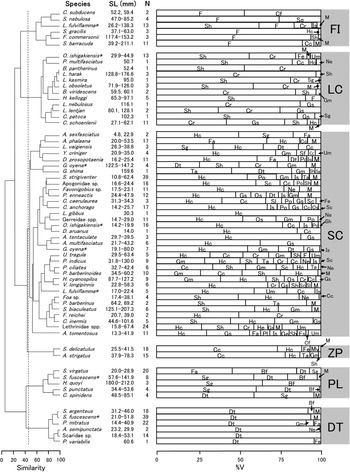
A wide variety of food items were consumed by the seagrass fishes examined (Figure 2, Table 2). According to the cumulative percentage volume values of all fish units for each food item, and the percentage of fish units consuming each item, harpacticoid copepods were the most important food item for the present seagrass fish assemblage (Table 2). Shrimps were consumed by about half of the fish units (49% of total), being the second most important food item by cumulative percentage volume and percentage of units. Detritus was the third most important food item with a high cumulative percentage volume, since some species (such as Siganus argenteus and Petroscirtes mitratus) fed almost exclusively on detritus, although the percentage of units consuming this item was only 26% of the total. Crabs and fishes were next, consumed by 25% and 12% of the total units, respectively.
Dendrogram obtained from dietary overlap data and mean percentage volume of food items (%V) of each fish species. Abbreviations of each food item given in Table 2. M, food items comprising less than 3% of gut content volume of each species. *, fish species showing ontogenetic trophic shifts; N, number of fish examined containing food; SL, standard length. At a similarity index level of 43, the fish assemblage was divided into six trophic groups. FI, fish feeders; LC, large crustacean feeders; SC, small crustacean feeders; ZP, zooplankton feeders; PL, plant feeders; DT, detritus feeders.

Feeding groups
A cluster analysis based on the dietary overlap among species (units) showed that the present seagrass fish assemblage was divided into six trophic groups at a similarity index level of 43 (Figure 2).
Fish feeders (FI in Figure 2) comprised six units, representing 9.2% of the total (65 units). Most members predated on juvenile and/or adult fishes, such as gobiids and siganids, whereas some members, such as Lutjanus fulviflamma, also fed on large crustaceans, including shrimps and crabs.
Large crustacean feeders (LC) included 12 units (18.4%). Shrimps and crabs were predominant food items for all members of this group. Some fishes, such as Choerodon schoenleinii, Chelonodon patoca, Lethrinus lentjan and Lethrinus nebulosus, also took gastropods.
Small crustacean feeders (SC) comprised 34 units (52.3%). Members fed primarily on small crustaceans, such as harpacticoid copepods, gammaridean amphipods, tanaids and isopods. Harpacticoid copepods were consumed by most of the group members (32 of 34 units).
Zooplankton feeders (ZP) included only two units (3%), Spratelloides delicatulus and Aeoliscus strigatus. These species fed mainly on calanoid copepods.
Plant feeders (PL) comprised five units (7.6%). Members of this group fed primarily on plant materials, such as seagrass fronds, filamentous algae and brown algae fronds. Most units (excluding Hyporhamphus quoyi) also consumed detritus.
Detritus feeders (DT) included six units (9.2%), which fed mainly on detritus.
The percentage volume of major food categories differed significantly among trophic groups (Table 3), each group feeding exclusively on food items which characterized that group (Figure 2).
Results of Kruskal–Wallis tests and Holm tests examining differences in the percentage volume value of each major food category among trophic groups

FI, fish feeders; LC, large crustacean feeders; SC, small crustacean feeders; ZP, zooplankton feeders; PL, plant feeders; DT, detritus feeders.
Ontogenetic trophic shift
Ontogenetic trophic shifts were recognized in four species: Lutjanus fulviflamma, Ostorhinchus ishigakiensis, Siganus fuscescens and Gerres oyena (Figure 2).
Lutjanus fulviflamma
Smaller fish (17.0–22.4 mm SL) fed mainly on harpacticoid copepods, but less so in larger size classes (26.2–138.3 mm SL) (Mann–Whitney U test, P = 0.01). In contrast, larger individuals consumed predominantly shrimps, the relative importance of shrimps increasing with growth (Mann–Whitney U test, P = 0.004).
Ostorhinchus ishigakiensis
Harpacticoid copepods dominated the diet of the smaller size class (14.2–19.9 mm SL), whereas shrimps and crabs were significant prey of the larger size class (22.9–44.9 mm SL). The importance of these items in the diet differed significantly between the size classes (Mann–Whitney U test, P < 0.001 for harpacticoid copepods, P = 0.006 for shrimps).
Siganus fuscescens
The major food item of smaller fish (21.0–51.8 mm SL) was detritus, but this was consumed less by the larger size class (57.6–141.9 mm SL) (Mann–Whitney U test, P < 0.001), for which seagrass fronds became the major food item (Mann–Whitney U test, P < 0.001).
Gerres oyena
The diet of smaller fish (19.1–80.0 mm SL) consisted mainly of small crustaceans, such as harpacticoid copepods and gammaridean amphipods. However, harpacticoid copepods decreased with increasing fish body size (Mann–Whitney U test, P < 0.001). Shrimps, crabs and detritus were significant dietary components of the larger size class (122.5–147.2 mm SL) (Mann–Whitney U test, P = 0.042).
Discussion
Sixty-one fish species occurring in the seagrass bed in Nagura Bay were classified into six trophic groups by the cluster analysis. Of these, ontogenetic trophic shifts were observed in four species (Lutjanus fulviflamma, Ostorhinchus ishigakiensis, Gerres oyena and Siganus fuscescens), with smaller individuals feeding on small crustaceans or detritus, and subsequently switching to larger prey items (e.g. crabs, shrimps and seagrass fronds) when attaining larger sizes. Such shifts in food preference in some fishes may result partly from an increase in jaw crushing strength (Wainwright, Reference Wainwright1988) or mouth gape size with body growth (Lukoschek & McCormick, Reference Lukoschek and McCormick2001).
The most important food items of the seagrass fishes in Nagura Bay comprised harpacticoid copepods, detritus, shrimps and crabs, comprising high cumulative gut volumes in all fishes and high numbers of fish units consuming them. The trophic guilds which mainly consumed the above items also included a large number of units. Previous studies in other tropical/subtropical and temperate seagrass beds have also shown that a wide variety of fish species feed on small crustaceans (Burchmore et al., Reference Burchmore, Pollard and Bell1984; Hanekom & Baird, Reference Hanekom and Baird1984; Edgar & Shaw, Reference Edgar and Shaw1995; Horinouchi & Sano, Reference Horinouchi and Sano2000; Kwak et al., Reference Kwak, Klumpp and Park2015). Hence, small crustaceans such as harpacticoid copepods and gammaridean amphipods, are important epiphytic/benthic prey for seagrass fishes. The degree of dependence on larger crustaceans (e.g. shrimps and crabs) as food resources for seagrass fishes differs among regions. For example, Horinouchi et al. (Reference Horinouchi, Tongnunui, Furumitsu, Nakamura, Kanou, Yamaguchi, Okamoto and Sano2012), who studied the feeding habits of seagrass fishes in Trang, west coast of Thailand, reported that shrimps were one of the most important food items for the overall fish assemblage, which supports the results of the present study. However, in other studies, there has not been a significant number of seagrass fish species found to feed mostly on large crustaceans, whether in subtropical (Nakamura et al., Reference Nakamura, Horinouchi, Nakai and Sano2003) or temperate regions (Adams, Reference Adams1976; Hanekom & Baird, Reference Hanekom and Baird1984; Horinouchi & Sano, Reference Horinouchi and Sano2000). Although the contribution of detritus to seagrass fish diets has been reported as relatively small in temperate seagrass beds, due to low numbers of detritus-feeding fishes (Livingston, Reference Livingston1982; Burchmore et al., Reference Burchmore, Pollard and Bell1984; Hanekom & Baird, Reference Hanekom and Baird1984; Edgar & Shaw, Reference Edgar and Shaw1995; Horinouchi & Sano, Reference Horinouchi and Sano2000), detritus was one of the most consumed food items by seagrass fishes in the present study. Similar results have been reported for other tropical/subtropical seagrass beds, including Crystal River, Florida (Carr & Adams, Reference Carr and Adams1973), Trang, west coast of Thailand (Horinouchi et al., Reference Horinouchi, Tongnunui, Furumitsu, Nakamura, Kanou, Yamaguchi, Okamoto and Sano2012), and Amitori Bay, Iriomote Island (Nakamura et al., Reference Nakamura, Horinouchi, Nakai and Sano2003). In contrast, zooplanktonic prey have been considered a less important food item for seagrass fishes in subtropical regions (Nakamura et al., Reference Nakamura, Horinouchi, Nakai and Sano2003), again coinciding with the results of the present study, whilst zooplankton have been found to be relatively more important in temperate seagrass beds (Adams, Reference Adams1976; Livingston, Reference Livingston1982; Horinouchi & Sano, Reference Horinouchi and Sano2000). Hence, greater dietary importance of detritus and lesser importance of zooplankton may be one of the characteristics of seagrass fish diets in tropical/subtropical regions. The mechanisms underlying such food preferences of tropical/subtropical seagrass fishes are unclear, requiring further study.
Twenty-two species collected in Nagura Bay, Ishigaki Island overlapped the seagrass fish assemblages in Amitori Bay, Iriomote Island, a neighbouring island within the Yaeyama Archipelago, with the trophic structure of the former being similar to that in Amitori Bay (Nakamura et al., Reference Nakamura, Horinouchi, Nakai and Sano2003). However, 12 overlapping species exhibited different diets to those determined in Amitori Bay, most in Nagura Bay feeding mainly on harpacticoid copepods, shrimps or crabs (Table 4). For example, Nakamura et al. (Reference Nakamura, Horinouchi, Nakai and Sano2003) reported that Cheilio inermis (53–148 mm SL) in Amitori Bay fed mostly on gastropods and fishes, whereas similarly sized individuals (44.6–101.6 mm SL) in Nagura Bay consumed mainly shrimps. Similarly sized Choerodon anchorago (17–24 mm SL and 14.2–25.7 mm SL, respectively) fed on gammaridean amphipods in Amitori Bay (Nakamura et al., Reference Nakamura, Horinouchi, Nakai and Sano2003), and harpacticoid copepods in Nagura Bay, supporting food habits of the species previously determined in Nagura Bay (Fukuoka & Yamada, Reference Fukuoka and Yamada2015). The most consumed food items of Leptoscarus vaigiensis (19–60 mm SL and 26.3–38.6 mm SL, respectively) were detritus in Amitori Bay (Nakamura et al., Reference Nakamura, Horinouchi, Nakai and Sano2003), and seagrass fronds and harpacticoid copepods in Nagura Bay, resulting in the species being allocated to different feeding groups; detritus feeders in Amitori Bay and small crustacean feeders in Nagura Bay. Some species exhibited different patterns in ontogenetic trophic shifts at the above two locations. Stethojulis strigiventer underwent an ontogenetic trophic shift in Amitori Bay, important prey shifting from harpacticoid copepods to gammaridean amphipods and tanaids with fish growth (small size class, 10–25 mm SL; large size class, 40–71 mm SL) (Nakamura et al., Reference Nakamura, Horinouchi, Nakai and Sano2003). However, a similar shift was not apparent during the present study, both small and large fish (10.8–62.4 mm SL) feeding mostly on harpacticoid copepods. On the contrary, Ostorhinchus ishigakiensis (14–38 mm SL) fed mostly on calanoid copepods and gammaridean amphipods in Amitori Bay (Nakamura et al., Reference Nakamura, Horinouchi, Nakai and Sano2003), whereas in the present study, the species exhibited a trophic shift; smaller individuals (14.2–19.9 mm SL) consuming mostly harpacticoid copepods, and larger individuals (29.9–44.9 mm SL) feeding on shrimps and crabs. Such differences in overlapping fish species diets suggest that harpacticoid copepods, crabs and shrimps were more readily available food resources for fishes in the present seagrass beds, compared with Amitori Bay.
Fish species showing diets different from those determined for fishes in other seagrass beds off a nearby neighbouring island (Iriomote Island) (Nakamura et al., Reference Nakamura, Horinouchi, Nakai and Sano2003) (food items comprising more than 40% of gut content volume of each species in bold)

SL, standard length; N, number of specimens.
The differences in food availability at different locations, responsible for the variations in fish feeding habits, may have been determined by differences in habitat complexity and seagrass species. For example, seagrasses with long leaves, such as Enhaulus acoroides (which is dominant in Amitori Bay), often support a large number of small epiphytic crustaceans, including gammaridean amphipods (Nakamura & Sano, Reference Nakamura and Sano2005). However, epifaunal amphipods may not always be abundant in seagrasses with short leaves (including Cymodocea rotundata in Nagura Bay), because the former often preferentially select seagrasses with high surface area (Stoner, Reference Stoner1980). Subsequently, small infaunal crustaceans, such as harpacticoid copepods, are more likely to be dominant in short-leafed seagrass beds (see Fukuoka & Yamada, Reference Fukuoka and Yamada2015). Furthermore, food sources supporting amphipods have sometimes differed from those for harpacticoids in seagrass systems (Hyndes & Lavery, Reference Hyndes and Lavery2005), indicating different trophic pathways to fish feeding on them. The impacts of seagrass bed characteristics (e.g. habitat complexity and seagrass species) and prey abundance on fish food-use patterns should be considered in future studies.
The present study revealed that feeding habits of seagrass fishes can vary on a small local scale, even between adjacent islands within the Yaeyama Archipelago. The food habits of some species were restricted, whilst the diets of other species were more varied, which may be related to habitat dependence of each species. More varied diets may increase the adaptability of some species to seagrass beds characterized by significant variations in available food resources. In fact, differences in major fish food resources imply differences in the food web structure supporting fish production. The analyses of fish food use patterns, therefore, should contribute to our understanding of the mechanisms underlying fish production and diversity supported by seagrass beds.
Supplementary material
The supplementary material for this article can be found at https://doi.org/10.1017/S0025315422000601.
Acknowledgements
We are grateful to S. Tominaga and R. Nakano for assistance with fieldwork. Constructive comments on the manuscript from G. Hardy and anonymous reviewers were much appreciated. We also thank Yaeyama Fisheries Cooperative Association for their cooperation in field surveys.
Author contribution
MS and KN contributed to conceptualization, formal analysis, investigation and writing – original draft. IT and KK contributed to investigation, writing, reviewing and editing. HY contributed to writing, reviewing and editing and funding acquisition.
Financial support
This study was granted by a Grant-in-Aid for Scientific Research (B) from the Ministry of Education, Science, Sports and Culture of Japan (No. 17H03628).
Conflict of interest
None.